Intro toIntro to
OceanographyOceanography
How does it differ from Marine Biology?
Study of the ocean, its surroundings, and life
within it.
Marine bio studies marine organisms’
anatomy, physiology, behavior; more
individualistic.
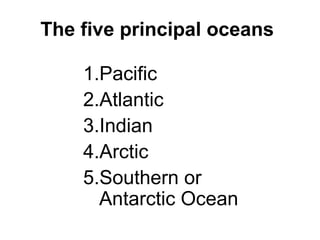
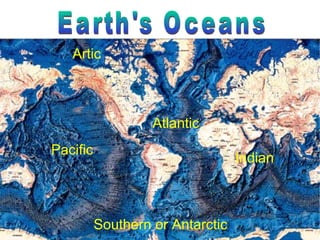
1.Pacific
2.Atlantic
3.Indian
4.Arctic
5.Southern or
Antarctic Ocean
The five principal oceans
Indian
Southern or Antarctic
Artic
Pacific
Atlantic
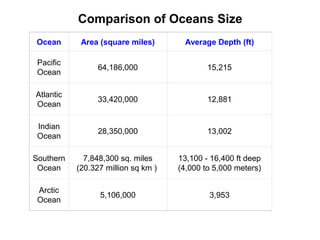
Ocean Area (square miles) Average Depth (ft) D
Pacific
Ocean
64,186,000 15,215 Marian
Atlantic
Ocean
33,420,000 12,881 Puerto R
Indian
Ocean
28,350,000 13,002 Java
Southern
Ocean
7,848,300 sq. miles
(20.327 million sq km )
13,100 - 16,400 ft deep
(4,000 to 5,000 meters)
the souther
Trench,
Arctic
Ocean
5,106,000 3,953 Euras
Comparison of Oceans Size
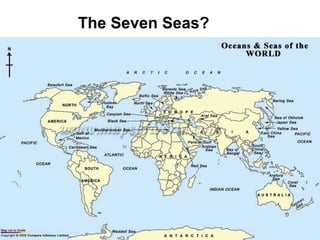
The Seven Seas?
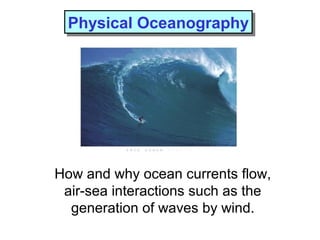
Physical OceanographyPhysical Oceanography
How and why ocean currents flow,
air-sea interactions such as the
generation of waves by wind.
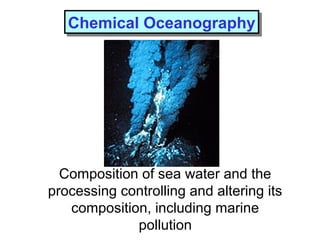
Chemical OceanographyChemical Oceanography
Composition of sea water and the
processing controlling and altering its
composition, including marine
pollution
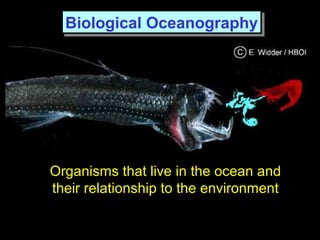
Organisms that live in the ocean and
their relationship to the environment
Biological OceanographyBiological Oceanography
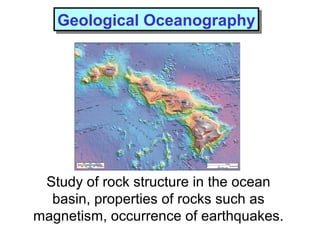
Study of rock structure in the ocean
basin, properties of rocks such as
magnetism, occurrence of earthquakes.
Geological OceanographyGeological Oceanography
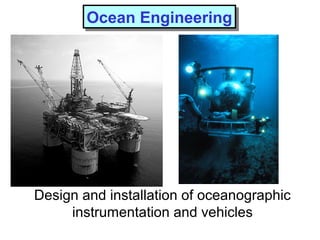
Design and installation of oceanographic
instrumentation and vehicles
Ocean EngineeringOcean Engineering
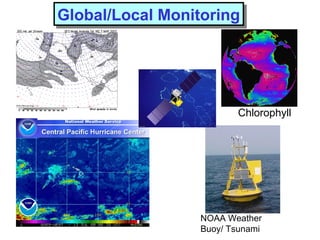
NOAA Weather
Buoy/ Tsunami
Global/Local MonitoringGlobal/Local Monitoring
Chlorophyll
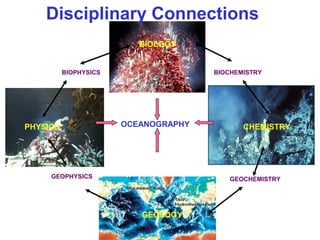
Disciplinary Connections
BIOLOGY
BIOCHEMISTRY
OCEANOGRAPHYPHYSICS
GEOLOGY
CHEMISTRY
GEOPHYSICS
BIOPHYSICS
GEOCHEMISTRY
Average depth of ocean- 4000m
Average temperature- 39o
F (3.9o
C)
Age of ocean- 4 billion years old
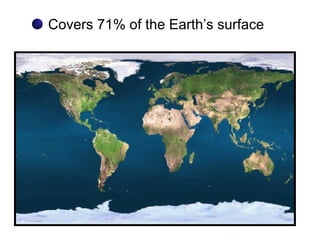
Covers 71% of the Earth’s surface
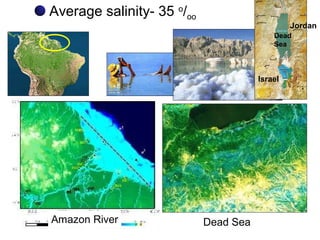
Amazon River
Average salinity- 35 o
/oo
Dead Sea
Jordan
Israel
Dead
Sea
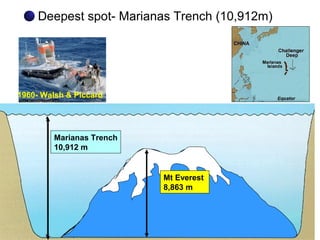
Deepest spot- Marianas Trench (10,912m)
1960- Walsh & Piccard
Marianas Trench
10,912 m
Mt Everest
8,863 m
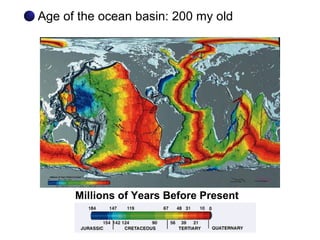
Millions of Years Before Present
Age of the ocean basin: 200 my old
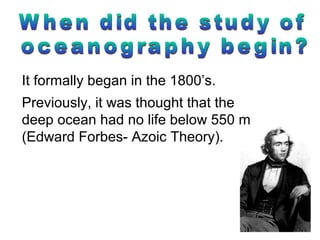
It formally began in the 1800’s.
Previously, it was thought that the
deep ocean had no life below 550 m
(Edward Forbes- Azoic Theory).
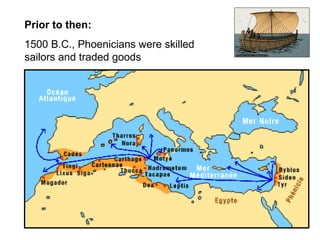
Prior to then:
1500 B.C., Phoenicians were skilled
sailors and traded goods
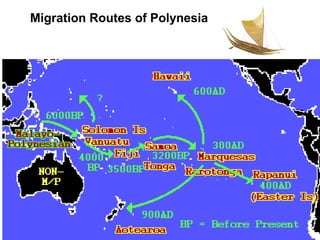
Migration Routes of Polynesia
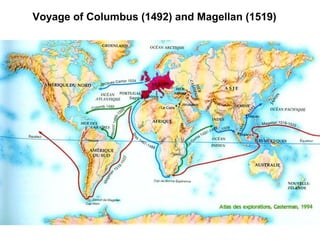
Voyage of Columbus (1492) and Magellan (1519)
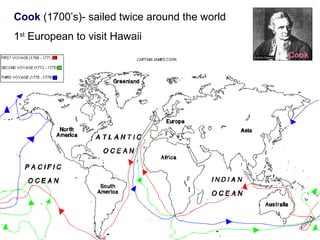
Cook (1700’s)- sailed twice around the world
1st
European to visit Hawaii
Cook
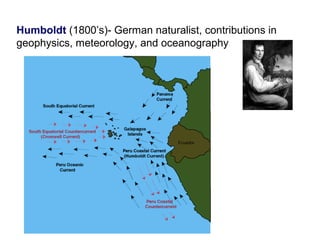
Humboldt (1800’s)- German naturalist, contributions in
geophysics, meteorology, and oceanography
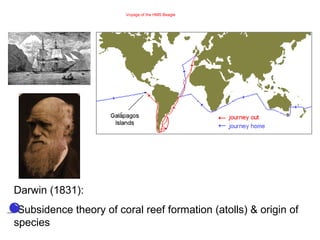
Voyage of the HMS Beagle
Darwin (1831):
•Subsidence theory of coral reef formation (atolls) & origin of
species
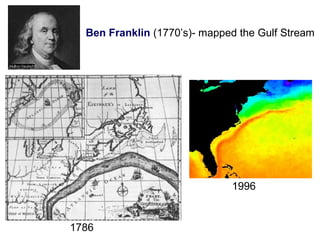
Ben Franklin (1770’s)- mapped the Gulf Stream
1996
1786
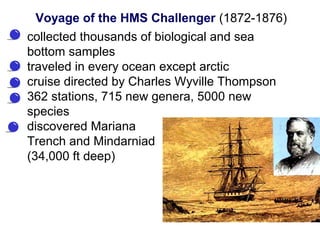
• collected thousands of biological and sea
bottom samples
• traveled in every ocean except arctic
• cruise directed by Charles Wyville Thompson
• 362 stations, 715 new genera, 5000 new
species
• discovered Mariana
Trench and Mindarniad
(34,000 ft deep)
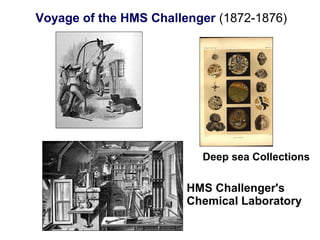
Voyage of the HMS Challenger (1872-1876)
HMS Challenger's
Chemical Laboratory
Deep sea Collections
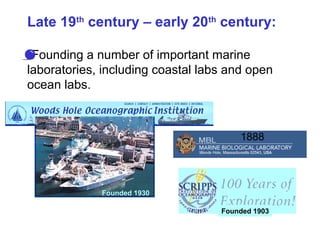
Late 19th
century – early 20th
century:
•Founding a number of important marine
laboratories, including coastal labs and open
ocean labs.
Founded 1903
Founded 1930
1888
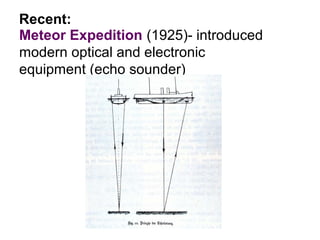
Meteor Expedition (1925)- introduced
modern optical and electronic
equipment (echo sounder)
Recent:
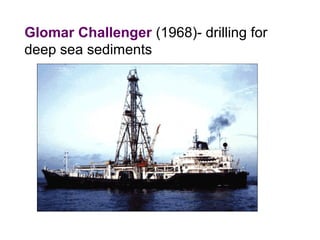
Glomar Challenger (1968)- drilling for
deep sea sediments
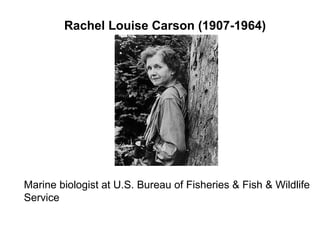
Rachel Louise Carson (1907-1964)
Marine biologist at U.S. Bureau of Fisheries & Fish & Wildlife
Service
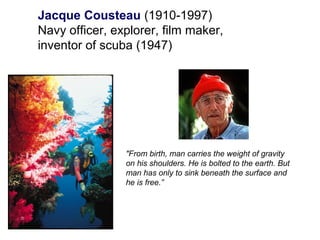
Jacque Cousteau (1910-1997)
Navy officer, explorer, film maker,
inventor of scuba (1947)
"From birth, man carries the weight of gravity
on his shoulders. He is bolted to the earth. But
man has only to sink beneath the surface and
he is free.”
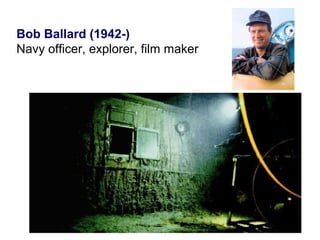
Bob Ballard (1942-)
Navy officer, explorer, film maker
Waves
Ocean waves can form from something as
simple as wind or as violent as an earthquake
They can travel through water slowly or incredibly
quickly
Anatomy of a Wave
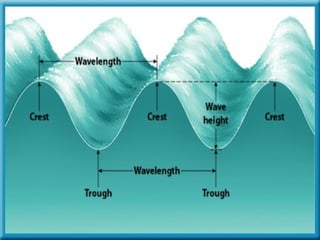
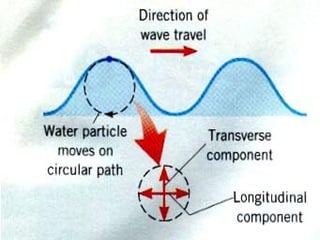
Waves are made of two main parts
Crests: highest point of the wave
Troughs: lowest point of the wave
Anatomy of a Wave
The distance between two adjacent wave
crests or wave troughs is a wavelength
The vertical distance between a crest
and trough is the wave height
Wave Speeds
Scientists need to know the wavelength and
wave period to calculate wave speed
Wave period is the time between the
passage of two crests/troughs
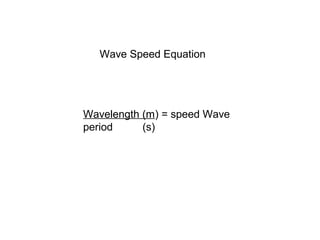
Wave Speed Equation
Wavelength (m) = speed Wave
period (s)
Types of Waves
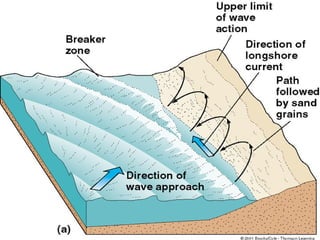
Shore currents create an undertow which
brings water back into the ocean
Longshore currents cause waves to hit
the shore at an angle
Types of Waves
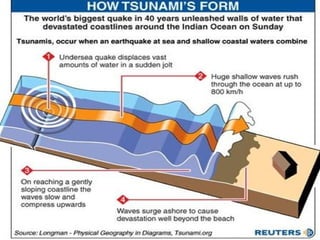
Tsunamis are large waves that are
formed from violent activity on the ocean
floor (earthquakes, landslides)
Tides
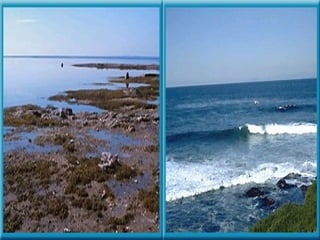
• The rise and fall in sea level is called tide.
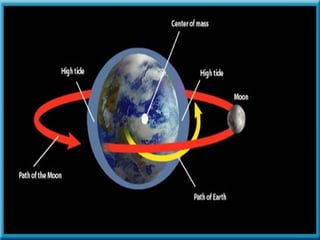
• A tide is caused by a giant wave produced by the
gravitational pull of the Sun, Earth and Moon.
• The tidal range is the difference between the level of
the ocean at high tide and low tide.
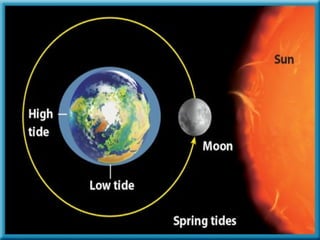
Spring Tides
When the Moon, Earth, and the Sun are
lined up together, they cause spring tides.
During spring tides, high tides are higher
and low tides are lower than normal.
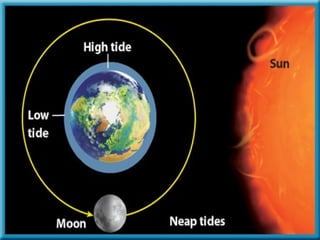
Neap Tides
Neap Tides are when the Sun, Earth, and
the Moon form a right angle,
High tides are lower and low tides are
higher than normal.
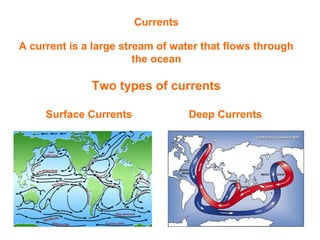
Currents
A current is a large stream of water that flows through
the ocean
Two types of currents
Surface Currents Deep Currents
Surface Currents
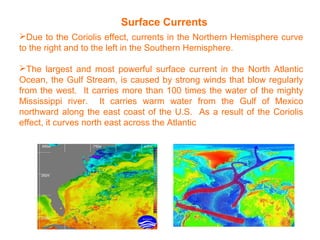
Due to the Coriolis effect, currents in the Northern Hemisphere curve
to the right and to the left in the Southern Hemisphere.
The largest and most powerful surface current in the North Atlantic
Ocean, the Gulf Stream, is caused by strong winds that blow regularly
from the west. It carries more than 100 times the water of the mighty
Mississippi river. It carries warm water from the Gulf of Mexico
northward along the east coast of the U.S. As a result of the Coriolis
effect, it curves north east across the Atlantic
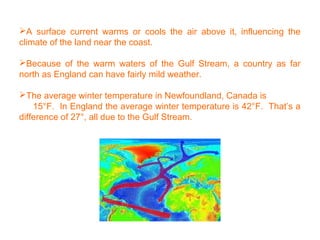
A surface current warms or cools the air above it, influencing the
climate of the land near the coast.
Because of the warm waters of the Gulf Stream, a country as far
north as England can have fairly mild weather.
The average winter temperature in Newfoundland, Canada is
15°F. In England the average winter temperature is 42°F. That’s a
difference of 27°, all due to the Gulf Stream.
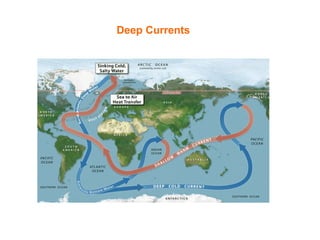
Deep Currents
 Deep currents are caused by differences in the density of ocean water.
 Ocean water density depends on its temperature and its salinity.
 Cold water is more dense than warm water.
 Saltier water is more dense than less saltier water.
 As warm surface currents near the poles the water cools and its salinity
increases due to ocean water freezing and leaving the water near the
poles more salty.
 The cold, saltier water sinks and starts moving back towards the
equator along the bottom of the ocean.
 When the water reaches the equator, it warms and rises again.
 Deep currents flow slowly. They may take as long as 1,000 years to
flow from pole to equator and back again.
Deep Currents
Questions???????

intro to oceanography cool

  • 1.
  • 2.
    How does itdiffer from Marine Biology? Study of the ocean, its surroundings, and life within it. Marine bio studies marine organisms’ anatomy, physiology, behavior; more individualistic.
  • 3.
  • 4.
  • 5.
    Ocean Area (squaremiles) Average Depth (ft) D Pacific Ocean 64,186,000 15,215 Marian Atlantic Ocean 33,420,000 12,881 Puerto R Indian Ocean 28,350,000 13,002 Java Southern Ocean 7,848,300 sq. miles (20.327 million sq km ) 13,100 - 16,400 ft deep (4,000 to 5,000 meters) the souther Trench, Arctic Ocean 5,106,000 3,953 Euras Comparison of Oceans Size
  • 6.
  • 8.
    Physical OceanographyPhysical Oceanography Howand why ocean currents flow, air-sea interactions such as the generation of waves by wind.
  • 9.
    Chemical OceanographyChemical Oceanography Compositionof sea water and the processing controlling and altering its composition, including marine pollution
  • 10.
    Organisms that livein the ocean and their relationship to the environment Biological OceanographyBiological Oceanography
  • 11.
    Study of rockstructure in the ocean basin, properties of rocks such as magnetism, occurrence of earthquakes. Geological OceanographyGeological Oceanography
  • 12.
    Design and installationof oceanographic instrumentation and vehicles Ocean EngineeringOcean Engineering
  • 13.
    NOAA Weather Buoy/ Tsunami Global/LocalMonitoringGlobal/Local Monitoring Chlorophyll
  • 14.
  • 15.
    Average depth ofocean- 4000m Average temperature- 39o F (3.9o C) Age of ocean- 4 billion years old
  • 16.
    Covers 71% ofthe Earth’s surface
  • 17.
    Amazon River Average salinity-35 o /oo Dead Sea Jordan Israel Dead Sea
  • 18.
    Deepest spot- MarianasTrench (10,912m) 1960- Walsh & Piccard Marianas Trench 10,912 m Mt Everest 8,863 m
  • 19.
    Millions of YearsBefore Present Age of the ocean basin: 200 my old
  • 20.
    It formally beganin the 1800’s. Previously, it was thought that the deep ocean had no life below 550 m (Edward Forbes- Azoic Theory).
  • 22.
    Prior to then: 1500B.C., Phoenicians were skilled sailors and traded goods
  • 23.
  • 24.
    Voyage of Columbus(1492) and Magellan (1519)
  • 25.
    Cook (1700’s)- sailedtwice around the world 1st European to visit Hawaii Cook
  • 26.
    Humboldt (1800’s)- Germannaturalist, contributions in geophysics, meteorology, and oceanography
  • 27.
    Voyage of theHMS Beagle Darwin (1831): •Subsidence theory of coral reef formation (atolls) & origin of species
  • 28.
    Ben Franklin (1770’s)-mapped the Gulf Stream 1996 1786
  • 29.
    • collected thousandsof biological and sea bottom samples • traveled in every ocean except arctic • cruise directed by Charles Wyville Thompson • 362 stations, 715 new genera, 5000 new species • discovered Mariana Trench and Mindarniad (34,000 ft deep) Voyage of the HMS Challenger (1872-1876)
  • 30.
    Voyage of theHMS Challenger (1872-1876) HMS Challenger's Chemical Laboratory Deep sea Collections
  • 31.
    Late 19th century –early 20th century: •Founding a number of important marine laboratories, including coastal labs and open ocean labs. Founded 1903 Founded 1930 1888
  • 32.
    Meteor Expedition (1925)-introduced modern optical and electronic equipment (echo sounder) Recent:
  • 33.
    Glomar Challenger (1968)-drilling for deep sea sediments
  • 34.
    Rachel Louise Carson(1907-1964) Marine biologist at U.S. Bureau of Fisheries & Fish & Wildlife Service
  • 35.
    Jacque Cousteau (1910-1997) Navyofficer, explorer, film maker, inventor of scuba (1947) "From birth, man carries the weight of gravity on his shoulders. He is bolted to the earth. But man has only to sink beneath the surface and he is free.”
  • 36.
    Bob Ballard (1942-) Navyofficer, explorer, film maker
  • 37.
    Waves Ocean waves canform from something as simple as wind or as violent as an earthquake They can travel through water slowly or incredibly quickly
  • 38.
    Anatomy of aWave Waves are made of two main parts Crests: highest point of the wave Troughs: lowest point of the wave
  • 40.
    Anatomy of aWave The distance between two adjacent wave crests or wave troughs is a wavelength The vertical distance between a crest and trough is the wave height
  • 42.
    Wave Speeds Scientists needto know the wavelength and wave period to calculate wave speed Wave period is the time between the passage of two crests/troughs
  • 43.
    Wave Speed Equation Wavelength(m) = speed Wave period (s)
  • 44.
    Types of Waves Shorecurrents create an undertow which brings water back into the ocean Longshore currents cause waves to hit the shore at an angle
  • 46.
    Types of Waves Tsunamisare large waves that are formed from violent activity on the ocean floor (earthquakes, landslides)
  • 48.
    Tides • The riseand fall in sea level is called tide. • A tide is caused by a giant wave produced by the gravitational pull of the Sun, Earth and Moon. • The tidal range is the difference between the level of the ocean at high tide and low tide.
  • 51.
    Spring Tides When theMoon, Earth, and the Sun are lined up together, they cause spring tides. During spring tides, high tides are higher and low tides are lower than normal.
  • 53.
    Neap Tides Neap Tidesare when the Sun, Earth, and the Moon form a right angle, High tides are lower and low tides are higher than normal.
  • 55.
    Currents A current isa large stream of water that flows through the ocean Two types of currents Surface Currents Deep Currents
  • 56.
    Surface Currents Due tothe Coriolis effect, currents in the Northern Hemisphere curve to the right and to the left in the Southern Hemisphere. The largest and most powerful surface current in the North Atlantic Ocean, the Gulf Stream, is caused by strong winds that blow regularly from the west. It carries more than 100 times the water of the mighty Mississippi river. It carries warm water from the Gulf of Mexico northward along the east coast of the U.S. As a result of the Coriolis effect, it curves north east across the Atlantic
  • 57.
    A surface currentwarms or cools the air above it, influencing the climate of the land near the coast. Because of the warm waters of the Gulf Stream, a country as far north as England can have fairly mild weather. The average winter temperature in Newfoundland, Canada is 15°F. In England the average winter temperature is 42°F. That’s a difference of 27°, all due to the Gulf Stream.
  • 58.
    Deep Currents  Deepcurrents are caused by differences in the density of ocean water.  Ocean water density depends on its temperature and its salinity.  Cold water is more dense than warm water.  Saltier water is more dense than less saltier water.  As warm surface currents near the poles the water cools and its salinity increases due to ocean water freezing and leaving the water near the poles more salty.  The cold, saltier water sinks and starts moving back towards the equator along the bottom of the ocean.  When the water reaches the equator, it warms and rises again.  Deep currents flow slowly. They may take as long as 1,000 years to flow from pole to equator and back again.
  • 59.
  • 60.

Editor's Notes

  • #5 The Earth's oceans are all connected to one another. Until the year 2000, there were four recognized oceans: the Pacific, Atlantic, Indian, and Arctic. In the Spring of 2000, the International Hydrographic Organization delimited a new ocean, the Southern Ocean (it surrounds Antarctica and extends to 60 degrees latitude). The oceans of Earth are unique in our Solar System. No other planet in our Solar System has liquid water (although recent finds on Mars indicate that Mars may have had some liquid water in the recent past). Life on Earth originated in the seas, and the oceans continue to be home to an incredibly diverse web of life. The oceans of Earth serve many functions, especially affecting the weather and temperature. They moderate the Earth's temperature by absorbing incoming solar radiation (stored as heat energy). The always-moving ocean currents distribute this heat energy around the globe. This heats the land and air during winter and cools it during summer. OCEANS ARE DEFINED BY POSITION OF OCEAN BASINS & POSITION OF CONTINENTS Pacific- world’s largest ; relative size- 50.1% Atlantic- ½ the size of the Pacific ; relative size- 26% Indian- slightly smaller than the Atlantic ; relative size- 20.5% Arctic- ; relative size- 3.4% Southern or Antarctic 7 SEAS: smaller and shallower and somewhat enclosed by land North Pacific, South Pacific, North Atlantic, South Atlantic, Indian, Arctic, Southern or Antarctic
  • #7 Mediterranean Dead Sea Ross Sea South China Sea Sea of Japan Caribbean Sea Sea of Japan Baltic Sea Adriatic Sea Black Sea Red Sea Aegean Sea Marmara Sea North Sea
  • #14 Satellite Oceanography: Benthic habitat types in optically shallow water(30m or less), chlorophyll concentration, coral bleaching events, water temperature, formation of eddies, El Nino, track global warming, atmospheric ocean wing and waves, sea level heights, measure ice sheet retreat and growth
  • #18 This is the lowest point on earth at 412 metres below sea level. It was the centre of one of the biggest activities of the earth. It was the rift called the Syrian African Rift. Due to the depth below sea level and the very hot temperature, about 12 million tons of water has evaporated, and so the salinity of the Dead Sea is the highest in the world (38%= 380 o/oo). This is the reason why people can float easily, even if they do not know how to swim.
  • #19 1960- Walsh & Piccard voyaged to Marianas Trench in the bathyscaphe Trieste. A bathyscaphe is a submersible tethered to the main ship by a cable. The voyage took several hours for the bathyscaphe to descend . The men heard a dull cracking sound that shook the cabin. The plexiglass port cracked. Depth 10, 912m (35, 8000 ft). They saw a few fish , shrimp and jellyfish.
  • #21 Edward Forbes was a distinguished British naturalist, born in 1815. His accomplishments included the curatorship of the museum of the Geological Society of London and the professorship of botany at Kings College. In November 1844 he resigned the curatorship of the Geological Society, and became palaeontologist to the Geological Survey of Great Britain. In 1841 he sailed with the British Survey on the Beacon, charting the waters of the Mediterranean and Aegean Sea, where he was able to dredge for samples from the deepest waters examined to date. After these explorations, Forbes developed his theory that below 300 fathoms the mysterious dark depths of the seas was a baren lifeless area and he named this the Azoic (lifeless) zone. His theory was accepted by the public and assumed the status of fact. In 1853 he fulfilled a long-cherished wish with his appointment to the professorship of natural history in the university of Edinburgh, made vacant by the death of his and Darwin's mentor Professor Jameson. But soon after taking on the professorship, he died suddenly, aged 39. Despite his many contributions to science and great status in the scientific community, he is best remembered for his misguided Azoic theory. Forbes was followed in the Edinburgh Chair by Charles Wyville-Thomson, who strongly disputed the Azoic theory and became determined to disprove it. And so the stage was set for the Challenger's historic voyage.
  • #22 Latitude measured by using a sextant by measuring position of sun and stars John Harrison of England is credited with solving the longitude problem by inventing an accurate timepiece Compass came from China 4th century BC, used in Europe 1190 AD GPS- global positioning system- uses satellite tracking Human populations through time have often flourished near the sea, partly because of the food resources that can be found there, but also because of the ease of transportation of people and cargo by boats. Observations about various organisms and environments were of course a major part of human activities since the earliest times, since the very survival of early Homo sapiens depended on this knowledge to obtain food and provide defense against dangerous plants and animals. Near the end of the bronze age, the Egyptians were not a maritime people, and the Greek and Hebrew civilizations had not yet developed to the point where they could make extensive sea voyages (and no written records are known from that time). The Phoenicians, however, were accomplished navigators and sailors, and made voyages throughout the Mediterranean for the establishment of colonies and commerce. They made voyages outside the Straits of Gibraltar, into the Atlantic, and made extensive voyages along the coast of Africa. They apparently recognized the higher tides of the Atlantic, and considered the possibility of a water mass that surrounded all lands. During the bronze age, the Minoans of Crete and later the Mycenaean Greeks must also have made voyages within the Mediterranean. The Homeric poems (written several hundred years later by Homer, as the Iliad and Odyssey), describe events around 1200 BC, and involve fairly extensive sea voyages (at least for that era).
  • #23 Phoenicians: Egypt, Syria, Lebanon and Israel- as early as 2000BC they explored the Mediterranean Sea , Red Sea, and Indian Ocean Early navigation done by keeping view of land
  • #24 Marquesas appeared to be the starting point for voyages to Easter Island, Hawaiian Islands and New Zealand. Polynesians navigated using the sun and moon, the nighttime stars, behavior of marine organisms, various ocean properties and a stick chart.Stick charts consistently depicted regular patterns of ocean waves In addition to their more advanced navigational techniques, the early navigators used some simple facts as an aid to their navigation. The first of these was the occurrence of trade wind clouds over invisible islands over the horizon. What the navigator could see was the reflection of the island in the under surface of the cloud. This green reflection was an obvious sign to the navigator that there was an island or atoll over the horizon. The second simple navigational technique adopted by our forefathers was to follow the movements of the birds. Such birds as the frigate bird and the tern roost ashore and then feed at sea. Dawn and dusk flight paths pointed the way to land. When travelling greater distances, the early navigators steered by the stars. They directed their canoes towards a particular star in the constellation Leo and when that star moved too high and too far to the left, they followed the next star that rose from the same point on the horizon. Then the next and after that the next and so on until dawn broke. The star-compass technique is still practised over much of the Pacific. What is more impressive however is the island navigator's uncanny skill to steer by wave motion - swells reflected from islands beyond the horizons. The skilled navigator comes to recognise the profile and characteristic of particular ocean swells as he would the faces of his friends, but he judges their direction more by feel than by sight. The complex patterns produced by swell reflected and refracted among the islands are recognised by navigators throughout Oceania.
  • #25 Voyage around the World. On September 20th 1519 Magellan set sail from Sanlucar de Barrameda in southern Spain. He commanded a total of 241 men and a fleet of five ships ;the Concepcion, San Antonio, Santiago, Trindad and Victoria. About a month after the voyage began the Spanish captain of the San Antonio challenged Magellan’s authority and Magellan had him arrested. The fleet sailed across the Atlantic Ocean to the coast of Brazil. The ships followed the coast to the bay where Rio de Janeiro now stands. They remained there for two weeks and then sailed South in search of a passage to the Pacific Ocean. However they could not find a passage before the end of summer in the Southern Hemisphere. In late March 1520 the fleet anchored for the winter at San Julian in what is now southern Argentina. During the winter a storm destroyed the Santiago. In addition a mutiny broke out shortly after the men set up their winter quarters. Magellan and loyal crew members put down the mutiny and executed the leader. They also marooned two other mutineers when the fleet sailed again. Magellan and his crew resumed their voyage on October the 18th 1520. Three days later they discovered the passage to the Pacific -- a passage known every since as the Strait of Magellan. As the fleet sailed through the strait, the crew of the San Antonio mutinied and returned to Spain. On November 28th, the three remaining ships sailed out of the strait and into the ocean. Magellan named the Ocean the Pacific, which means peaceful, because it appeared calm compared with the stormy Atlantic. Sailing across the Pacific. They were the first Europeans ever to sail across the Pacific and it was far larger than anyone had imagined. They sailed for ninety - eight days without seeing any land except two uninhabited islands. There food became contaminated and nineteen men died before the fleet reached Guam on March the 6th, 1521. After a while the crew seized enough food and water to continue the journey to the Philippines. On April 27th Magellan was killed when he took part in a battle between rival Filipino groups on the island of Mactan. One of the crew members who returned with Del Cano was an Italian named Antonio Pigafetta. He had written down the events of the voyage, and his journey is the source of information about the expedition. According to Pigafetta, the voyage covered 50,610 miles. Magellan who was looking for the Spice Islands failed to find a short route to them, but his voyage contributed greatly to knowledge about the earth. In addition the discovery of the Strait of Magellan lead to future European voyages to explore the vast Pacific. Magellan's Voyage The crew of Portuguese sea captain Ferdinand Magellan were the first Europeans to sail around the world, proving that the world was round. From 1519 to 1521, Magellan, with 5 ships and a Spanish crew of 241 men, searched for a western route to the Spice Islands. He was killed in a battle with Philippine natives on April 27, 1521, and only two of his ships continued to the Spice Islands. The two ships then made separate return voyages, and only one, commanded by Juan Sebastian delCa completed the trip back to Spain. Passing Through the Straits When a small boat was dispatched from the mutineer’s ships to give Magellan their demands, Magellan cleverly positioned his vessel between the small boat and the mutinous ships. The mutineer commanders could not see that Magellan arrested the party and put men loyal to him in the boat to take back his message. When they arrived at one of the mutineer ships, one of the men—acting under Magellan’s orders—immediately stabbed and killed the leader of the mutiny on that vessel. At the same time, men loyal to Magellan clambered on board the other rebellious ships. The bold move worked, as the mutineers, with their leader dead, did not resist. Consequently, in that era’s horrific mode of naval punishment, Magellan had the remaining captains of the mutiny executed in front of the assembled crew. Magellan sentenced to death the men who had gone along with the mutiny. Then, in a stroke of brilliant psychology, after letting them despair for some time, Magellan announced that they were pardoned. As a result, the grateful men forged unswerving loyalty to their commander. They would need it, for Magellan would lead them through terrible ordeals. After more than a year from the date of their departure, in October of 1520, Magellan found a strait, now bearing his name, which would allow them through the frigid waters at the tip of South America. Leaving one hapless mutineer behind in Patagonia (Southern Argentina), he continued the journey. It took 38 days to negotiate the narrow strait and during that time one of the ships deserted and turned back for Spain. Magellan was never to know what happened to it. When the deserting ship reached Spain, the officers and crew began to spread lies about Magellan. Balboa had seen the ocean earlier and named it the great Southern Sea. It was Magellan who called it the Pacific (peaceful) due to the gentle winds that he found as he entered. Today the water passage between the two great oceans (the Atlantic and Pacific) is named the Strait of Magellan in the explorer’s honor. Magellan resisted the pleas of the timorous, who wanted to turn back for Spain, and continued across the vast emptiness of the Pacific. It was to be one of the most difficult voyages in the history of navigation. After two months of sailing they were nowhere near any major land mass.  During the bleak Pacific crossing, Magellan’s men ate the last of their biscuits, now rotten or reduced to insect-infested powder. When the biscuits were gone they ate sawdust, the leather from their belts and shoes (boiled until softened) and any rats they could catch. The going price for a rat was half a crown, a small gold coin. Even when drinking the putrid water from the barrels on board, the men held their nose due to the brackish stench. Fortunately, occasionally flying fish would leap on board, and the men would pounce on this source of fresh seafood. Not surprisingly the men developed scurvy. The sailor’s gums bled and turned black; “their gums grew fat,” wrote Pigafetta. They became feverish and docile, unable to work or even move. Dozens of them died. They were given last rites and were thrown overboard. About thirty more were so ill from scurvy that they could not work and in many cases could not move. The men despaired of surviving the voyage. According to Magellan’s maps, he should have been in Asia. Little did he know he was not even half way across the vast Pacific. He threw the maps overboard in disgust. The very next day they spotted an island and landed briefly, but found little in the way of supplies.  The crew decimated; they finally reached an island with bananas, coconuts, sugar cane and yams. The waters were teeming with fish. Magellan’s crew had sailed half way across the Pacific Ocean, the largest body of water on the planet. By February 13th they had crossed the equator, and in March they landed in Guam. He called the island Ladrones (thieves) when the islanders tried to rob his boats. Today they are called the Marianas. On March 16th he landed on an island in what was to become known as the Philippines. They reached the Ladrone Islands and two weeks later the Philippines. They had sailed half way around the world. On one of the Philippine Islands, Magellan was given a basket of ginger and a bar of solid gold. He realized that the wealth of the Spice Islands must be near at hand. Magellan continued westward and reached the island of Cebu, which he claimed for Spain. The commander must have been relieved and deeply satisfied. He had sailed half way round the world and had proven that the great water ways and oceans of the world were interconnected. He had demonstrated that it was possible to arrive in the east by sailing west. And now he had opened up a fabulous trade route for Spain. But here the story turns tragic for Magellan. The people of Cebu and their ruler were peaceful and amicable at first, even when Magellan claimed the island for his king. When he tried to convert the chieftain to Christianity, the island leader seemed agreeable. Magellan did not realize that his seeming acceptance of the intentions of the Spaniard was superficial and insincere. It was customary among the island people to show politeness, grace and hospitality, but they would only bend so far. The chieftain of Cebu had designs of his own; he thought to use the Spaniard’s presence to his advantage against a traditional enemy. He told Magellan that the nearby island of Cilapulapu was resisting Spanish authority by refusing to acknowledge the dominion of the Spanish crown. Magellan accompanied a large group of soldiers to the island where they made the mistake of attacking the main village. They were immediately confronted by a much larger band of armed islanders. The two groups exchanged volleys of arrows and spears for some time, but eventually Magellan decided to break off the attack. As his men retreat to the boats, Magellan was struck in the face by a spear. He fell to the ground and before his men could attempt a rescue, a swarm of islanders fell upon him and hacked him to death. Magellan’s men were disconsolate at the loss of their leader. They sailed back to Cebu and told the rest of the crew of the disaster.  With the death of Magellan, the crew fell into squabbling and behaved like pirates among the natives. Finally a leader emerged who was able to organize them sufficiently to continue their voyage. He was Juan Sebastian del Cano. Two of the remaining vessels developed leaks and became too dangerous to face the long voyage home, so they were destroyed. Now with only 47 Europeans and some islanders gathered on the way, the newly elected captain, Juan Sebastian del Cano, embarked for Africa. Their troubles were still not over. More men died of scurvy in the Cape Verde islands controlled by Portugal; others were arrested. Only eighteen of the original crew reached Seville at the end of three epic and tortuous years. When the emaciated sailors disembarked, del Cano led them on foot to two churches where they gave thanks for their successful arrival. Stunned crowds gathered to stare at the stricken sailors who had endured indescribable privation and suffering. In recognition of his service, the king gave del Cano a small pension and a coat of arms with an image of a globe and the inscription. “You were the first to circumnavigate me.”  The cargo of 26 tons of cloves which the crew had secured was sold at a tremendous rate of profit. Yet with such staggering losses and expenses for the voyage, the entire expedition barely paid for itself. Magellan was almost forgotten and did not receive the honor due him until many years later. It is generally agreed by scholars of the voyage that had Magellan survived, many of the difficulties of the latter part of the voyage most likely would have been avoided. Sadly, his wife died when she heard the news of his death. His voyage is one of the great accomplishments in all of world history. It has been said that up until Magellan’s circumnavigation of the earth, the world was constantly expanding. Since that time it has been growing smaller. Two decades after his death, a chronicler wrote the following tribute to the great navigator: “The track the Victoria followed is the most wonderful thing and the greatest novelty that has ever been seen from the time God created the first man and ordered the world unto our own day. Neither has anything more notable ever been heard or described since the voyage of the patriarch Noah.” With the passage of time it is clear that Magellan was one of the ablest of the maritime leaders of the period. He combined leadership with diplomacy uncommon among the Spanish and Portuguese captains of conquest. Had he not tragically been killed, it is likely that many more of the original crew would have retuned home alive.
  • #26 James Cook was born on October 27, 1728, in Marton-in-Cleveland, Yorkshire, England. He was the son of a farmer of Scottish decent. As a young teenager, Cook was apprenticed to a seafaring family. In 1755, he joined Great Britain's Royal Navy and soon proved himself an expert navigator. Just after making officer rank, Lieutenant Cook was chosen by the Royal Society of London to undertake a scientific journey to Tahiti to observe and document the planet Venus as it passed between the earth and the sun. These observations would help scientists calculate the distance of the earth from the sun. On August 25, [1768], Cook departed England aboard the Endeavour with 94 crewmen and scientists. He was carrying secret orders from the Royal Navy to be opened upon completion of his scientific mission. Cook was determined to keep his crew healthy. He insisted his men eat onions and pickled cabbage every day, and made sure that the ship kept fresh fruit and vegetables on board. He ordered his men to bathe every day, to clean their clothing, and to air out their bedding. He did not know the scientific reasons behind these measures, but he knew they worked to prevent scurvy and other diseases in his crew. On April 11, 1769, the Endeavour arrived on the shores of Tahiti, seven weeks early. After viewing the passing of Venus between the earth and sun for several weeks, Cook opened a sealed envelope with the Royal Navy's orders. He was to seek out the fabled southern continent and claim it for England. Early mapmakers in the 1570s assumed there were two major continents at each of the earth's poles. Dutch explorers searched for the southern continent in the seventeenth century. Since the continents had not yet been found, the Royal Navy trusted that Cook would find the southern one if it existed. He left Tahiti on July 13 and headed southwest. When Cook reached New Zealand on October 6, the native Maori people proved to be unfriendly and his crew was forced to fire on them. The Endeavour spent a few months exploring New Zealand and proved it was not part of the great southern continent. On April 9, [1770], Cook explored and documented the location of Australia. While sailing around this great continent, the Endeavour ran aground on the Great Barrier Reef (extending 150 miles from Australia's northeast coast and the largest reef in the world) on June 11. It took a day to free the ship after the crew threw fifty tons of ship's ballast, iron cannons, firewood, and barrels overboard. Once free, the crew quickly made repairs to the badly leaking ship to keep it from sinking. After months of exploring the coastline of Australia, Cook concluded that this continent was not the great southern continent. The Endeavour made its way to Java in the East Indies in October, 1770. Once there, Cook's men became very ill with Malaria and dysentery. Despite all his efforts to keep his crew safe and healthy, they were no match for these diseases. He lost 30 men and had to sign on new crew in South Africa in order to make it back home to England. The Endeavour made it back to Dover, England, on July 13, 1771, after a three-year voyage. Cook was formally presented to his majesty, King George III following the historic journey and made a naval commander
  • #27 Alexander von Humboldt was an ecologist before the word existed. In 1799 the explorer left his native Berlin to embark on a five-year wilderness trek through Central and South America, where he gathered plant and animal specimens, recorded meteorological data, and developed ideas that would influence generations of scientists, including Charles Darwin.
  • #28 The primary mission of the Beagle was to map the coastline of southern South America and take oceanographic measurements (currents, bathymetry, etc) as well. Darwin's job as ship's naturalist was to observe everything, write it all down and collect as many specimens as possible. It was his job to record the weather, geological features, plants, animals, fossils, rocks, minerals, indigenous people and anything else that he saw. Specimens had to be packed and labeled very carefully. In preparing for the voyage, Darwin made a list of things that he would need, including 12 new shirts and other clothing; slippers; light walking shoes; a folding, portable dissecting microscope; a geological compass; a case of pistols and a rifle; a Spanish-English dictionary; a book on taxidermy; reading material (Humboldt and Milton); his favorite geology text, Lyell's Principles of Geology; a Bible; a pair of binoculars; a magnifying glass; and jars of "Spirit" (probably alcohol) for preserving specimens. (I wonder what his dad thought of that list...Thanks, Dad!) Like any expedition, there were space limitations. The Beagle was not an exceptionally large vessel by any means. Measuring only ninety feet in length, she carried a crew of 74 people, "including the Captain, three officers, the crew, a doctor, an artist, and the naturalist. Darwin shared the poop cabin (at the back of the ship) with two officers. Their space was so cramped that Darwin had to remove a drawer each night so that he would have room for his feet." David Likely tells the story of how the ship's Captain Robert Fitzroy almost refused to let Darwin sail because his nose did not appear to be that of a man with character. Darwin had to get testimonials that he was suitable for dining at the Captain's dinner table. Apparently, Darwin and the Captain, a fundamentalist Christian, didn't always see eye to eye (Darwin was once banned from the dinner table for several days), which has led some to speculate that this relationship even further hardened Darwin against religion. After more than two months delay (the ship was to leave October 24, 1831), the ship attempted a departure on December 10 but ran into bad weather. Finally, on December 27 at 2:00 pm, Darwin and the Beagle left Plymouth harbor on what was to become most revolutionary oceanographic expedition of our time. Immediately upon sailing, Darwin's enthusiasm for the voyage was severely dampened by sea-sickness. He writes: "...the misery I endured from sea sickness is far beyond what I ever guessed at. The real misery only begins when you are so exhausted that a little exertion makes a feeling faintness come on -- I found that nothing but lying in my hammock did any good. Three and a half weeks later, on January 16 1832, they reached the Cape Verde Islands off the coast of south Africa. It was here that Darwin's innate ability to observe in great detail and think "large" began to assert itself. In St. Jago, he correctly surmised the African origins of dust that created the hazy atmosphere of the islands, he wrote about "reckless destruction" of the forests and offered the following observations on octopus: I was much interested by watching the habits of an Octopus, or cuttle-fish. By means of their long arms and suckers, they could drag their bodies into very narrow crevices; and, when thus fixed, it required great force to remove them. These animals escape detection by a very extraordinary, chameleon-like power of changing their color. They appear to vary their tints according to the nature of the ground over which they pass. These changes were affected in such a manner that clouds, varying in tint were continually passing over the body. Any part, being subjected to a slight shock, became almost black. While not the first to observe cephalopod chromatophores, the detail with which he describes them belies his fascination with nature. Indeed, the enthusiasm with which he carried out his observations and collections can be found in his diary entries upon exploring South America: I have been wandering by myself in the Brazilian forest: amongst the multitude it is hard to say what set of objects is most striking; the general luxuriance of the vegetation bears the victory, the elegance of the grasses, the novelty of the parasitical plants, the beauty of the flowers, the glossy green of the foliage, all tend to this end...To a person fond of Natural History such a day brings with it pleasure more acute than he ever may again experience" [Barlow 1933: 39-40]. And the next day, "I can only add rapture s to the former raptures" [Barlow 1933: 40].[Journal of Syms Covington, Darwin's assistant] Overtaken with such "treasures", Darwin felt that he needed an assistant. He got permission to hire Syms Covington, the ship's "fiddler and boy to the poop cabin" [where the officers lived], who helped with the time-consuming task of cataloguing and shipping Darwin's specimens. Covington kept his own journal [Journal of Syms Covington] which offers interesting reading about Darwin and his relationship with others on board.
  • #30 On 21 December 1872 the 2306 ton steam assisted corvette HMS Challenger sailed from Portsmouth on a 3-year voyage of marine exploration which laid the foundations of almost every branch of oceanography as we know it today. Her naval complement was headed by Captain G S Nares, an experienced survey officer, while the Director of her scientific staff was Charles Wyville Thomson, Professor of Natural History at the University of Edinburgh. These two men were responsible for an extremely wide-ranging programme of research into the physical and biological characteristics of the deep sea, for when the Challenger sailed the scientific investigation of the open oceans had hardly begun and many basic questions were still unanswered. What was the nature of the animal life in the very greatest depths? Indeed, did animals exist at all over wide areas of the sea bed? (Only a few years previously it had been widely assumed that life was untenable in the perpetual darkness, enormous pressures and intense cold of the abyssal depths.) What was the shape of the bottom of the great ocean basins, the composition of the bottom sediments and their source? And what of the sea water itself? Would a knowledge of its temperature variation with depth as well as its specific gravity give clues to the nature and causes of the complex system of sub-surface currents of which scientists were becoming aware? To enable her to probe into these and many other problems, Challengers guns had been removed, her spars reduced, and laboratories, extra cabins and a special dredging platform installed. She was loaded with thousands of specimen jars, alcohol for preservation, microscopes and chemical apparatus, trawls and dredges, thermometers and water sampling bottles, sounding leads and devices to collect sediment from the deep sea bed and great lengths of rope with which to suspend the equipment into the ocean depths. In all she was supplied with the staggering total of 181 miles of best Italian hemp for sounding, trawling and dredging. During the 68890 mile voyage the naval staff was responsible for taking a wide variety of magnetic and meteorological observations, and for the actual working of the sampling gears at the 354 official stations where the vessel stopped to make detailed studies. The work of the scientists, or 'philosophers' as they were nicknamed aboard, began with the arrival of the samples on deck. The water samples were examined by the chemist, John Young Buchanan, while the contents of the nets and dredges were the responsibility of Wyville Thomson and his three young naturalist assistants. All of the naturalists were involved in the documentation of the thousands of samples and their preparation for dispatch back home, but they also had their own particular research interests. H N Moseley, for instance, took particular interest in the corals and sea squirts, the young German, Rudolf von Willemoes Suhm, was mainly concerned with the crustaceans, while John Murray dealt with the pelagic organisms and the ocean deposits. The final member of the civilian staff, the Swiss J. J. Wild, acted as secretary to Wyville Thomson and artist to the expedition. The voyage was an orderly and unhurried affair, with the ship proceeding mainly under sail at the somewhat matronly rate of about 100 miles a day, generally using her engine only to maintain position when she stopped to work a station every two or three days. For the period, the expedition was also a very healthy one, for only 10 fatalities occurred amongst the total complement of 243 during the whole voyage. One of these was Willemoes Suhm's tragic death from erysipelas while the ship was in the Pacific. But they lost a further 61 ratings through desertion, evidently caused in part by a desire for a cheap passage to Australia as well as by the arduous and tedious routine of the sounding and dredging operations which often took many hours. The ratings were not the only ones affected, for many of the officers became discontented with their lot long before the voyage was over, and even amongst the scientists only Wyville Thomson seems to have retained his enthusiasm to the end. Yet the expedition was not all tedium, for of the 1281 days spent away from home, 568 were spent in harbours in all quarters of the world. During these shore breaks the officers and scientists made extensive zoological, geological and ethnological collections and socialised with all manner of 'locals' ranging from the King of Portugal to recently cannibalistic Fijian natives! By the time the ship returned to Spithead in May 1876, the expedition had already provided answers to some of the significant oceanographic questions which had been posed at the outset. There was now a much clearer idea of the form of the great ocean basins down to the greatest depth sounded at 4475 fathoms, including the important discovery of a submarine ridge running the length of the Atlantic Ocean. The varying types of sea-bed samples had been classified and it had been conclusively demonstrated that the deep-sea oozes were made up of the skeletons of tiny organisms which lived in the upper layers of the sea rather than on the bottom, a subject which had caused considerable controversy during the decade before the Challenger sailed. Ample evidence had been obtained of the existence of a rich and varied fauna in the very deepest regions, although there was no evidence that the ocean depths were occupied by 'living fossils' as some biologists had expected. These results were apparent from the relatively cursory investigations which had been carried out on board, but the detailed examination of the massive collections of animals and plants, water and sea-bed samples, and of the vast quantities of numerical data had still to be accomplished. The mammoth task of organising the distribution of the material to the scientists who were to work on it and the publication of the results initially fell to Wyville Thomson. This involved him in a series of acrimonious exchanges with many individuals and institutions, including the Trustees of the British Museum who demanded that the specimens should go directly to the national collection instead of being separately distributed from an office in Edinburgh as Wyville Thomson wished. With the aid of the Royal Society Thomson eventually won this tussle, but the strain of the responsibility of establishing a style for the publication of the official reports with opposition from those who did not understand the requirements for accurate scientific investigations and illustrations, as well as the rigid accountability forced upon him, proved too much for his highly strung but unmethodical nature. He broke down first in 1879, and in 1881 when the initial five year grant from the Treasury came to an end he collapsed, resigned his professorship, and took to his bed to die in 1881. The reins were taken up by John Murray under whose forceful leadership the publication of the results was finally completed in 1895, almost a quarter of a century after the ship set sail. The fifty thick royal quarto tomes of the report, containing 29552 pages, were written by an international galaxy of scientists and many of these reports still form a starting point for specialist studies in oceanography. Similarly, many of the original samples on which the reports were based, including nearly 4000 new species of animals taken by the trawls and dredges, are still referred to by scientists from a11 over the world. The reports were the tangible evidence of the achievements of the Challenger venture, but perhaps of much greater importance in the long term was the co-operation between scientists of many countries, inspired by Wyville Thomson's leadership, which set the young science of oceanography on the path to becoming the truly international discipline that it is today. PostscriptHMS Challenger's foray into oceanography interrupted an otherwise unremarkable career. In 1862 she had taken part in operations against Mexico, including the occupation of Vera Cruz, but otherwise the only action which she saw seems to have been a punitive operation in 1866 against some Fijian natives to avenge the murder of a missionary and some of his dependents. After her three years of glory, her fate was even more ignominious. Commissioned as a Coast Guard and Dril1 ship of Naval Reserves at Harwich in July 1876, she was finally paid off at Chatham in 1878. She remained in reserve until 1883, when she was converted into a receiving hulk in the River Medway, where she stayed until she was finally broken up for her copper bottom in 1921. Despite the great excitement which surrounded her middle years, virtually nothing, apart from her figurehead, now remains. This is on display in the foyer of Southampton Oceanography Centre.
  • #31 During the 68890 mile voyage the naval staff was responsible for taking a wide variety of magnetic and meteorological observations, and for the actual working of the sampling gears at the 354 official stations where the vessel stopped to make detailed studies. The work of the scientists, or 'philosophers' as they were nicknamed aboard, began with the arrival of the samples on deck. The water samples were examined by the chemist, John Young Buchanan, while the contents of the nets and dredges were the responsibility of Wyville Thomson and his three young naturalist assistants. All of the naturalists were involved in the documentation of the thousands of samples and their preparation for dispatch back home, but they also had their own particular research interests. H N Moseley, for instance, took particular interest in the corals and sea squirts, the young German, Rudolf von Willemoes Suhm, was mainly concerned with the crustaceans, while John Murray dealt with the pelagic organisms and the ocean deposits. The final member of the civilian staff, the Swiss J. J. Wild, acted as secretary to Wyville Thomson and artist to the expedition. The voyage was an orderly and unhurried affair, with the ship proceeding mainly under sail at the somewhat matronly rate of about 100 miles a day, generally using her engine only to maintain position when she stopped to work a station every two or three days. For the period, the expedition was also a very healthy one, for only 10 fatalities occurred amongst the total complement of 243 during the whole voyage. One of these was Willemoes Suhm's tragic death from erysipelas while the ship was in the Pacific. But they lost a further 61 ratings through desertion, evidently caused in part by a desire for a cheap passage to Australia as well as by the arduous and tedious routine of the sounding and dredging operations which often took many hours. The ratings were not the only ones affected, for many of the officers became discontented with their lot long before the voyage was over, and even amongst the scientists only Wyville Thomson seems to have retained his enthusiasm to the end. Yet the expedition was not all tedium, for of the 1281 days spent away from home, 568 were spent in harbours in all quarters of the world. During these shore breaks the officers and scientists made extensive zoological, geological and ethnological collections and socialised with all manner of 'locals' ranging from the King of Portugal to recently cannibalistic Fijian natives! By the time the ship returned to Spithead in May 1876, the expedition had already provided answers to some of the significant oceanographic questions which had been posed at the outset. There was now a much clearer idea of the form of the great ocean basins down to the greatest depth sounded at 4475 fathoms, including the important discovery of a submarine ridge running the length of the Atlantic Ocean. The varying types of sea-bed samples had been classified and it had been conclusively demonstrated that the deep-sea oozes were made up of the skeletons of tiny organisms which lived in the upper layers of the sea rather than on the bottom, a subject which had caused considerable controversy during the decade before the Challenger sailed. Ample evidence had been obtained of the existence of a rich and varied fauna in the very deepest regions, although there was no evidence that the ocean depths were occupied by 'living fossils' as some biologists had expected. These results were apparent from the relatively cursory investigations which had been carried out on board, but the detailed examination of the massive collections of animals and plants, water and sea-bed samples, and of the vast quantities of numerical data had still to be accomplished. The mammoth task of organising the distribution of the material to the scientists who were to work on it and the publication of the results initially fell to Wyville Thomson. This involved him in a series of acrimonious exchanges with many individuals and institutions, including the Trustees of the British Museum who demanded that the specimens should go directly to the national collection instead of being separately distributed from an office in Edinburgh as Wyville Thomson wished. With the aid of the Royal Society Thomson eventually won this tussle, but the strain of the responsibility of establishing a style for the publication of the official reports with opposition from those who did not understand the requirements for accurate scientific investigations and illustrations, as well as the rigid accountability forced upon him, proved too much for his highly strung but unmethodical nature. He broke down first in 1879, and in 1881 when the initial five year grant from the Treasury came to an end he collapsed, resigned his professorship, and took to his bed to die in 1881. The reins were taken up by John Murray under whose forceful leadership the publication of the results was finally completed in 1895, almost a quarter of a century after the ship set sail. The fifty thick royal quarto tomes of the report, containing 29552 pages, were written by an international galaxy of scientists and many of these reports still form a starting point for specialist studies in oceanography. Similarly, many of the original samples on which the reports were based, including nearly 4000 new species of animals taken by the trawls and dredges, are still referred to by scientists from a11 over the world. The reports were the tangible evidence of the achievements of the Challenger venture, but perhaps of much greater importance in the long term was the co-operation between scientists of many countries, inspired by Wyville Thomson's leadership, which set the young science of oceanography on the path to becoming the truly international discipline that it is today. PostscriptHMS Challenger's foray into oceanography interrupted an otherwise unremarkable career. In 1862 she had taken part in operations against Mexico, including the occupation of Vera Cruz, but otherwise the only action which she saw seems to have been a punitive operation in 1866 against some Fijian natives to avenge the murder of a missionary and some of his dependents. After her three years of glory, her fate was even more ignominious. Commissioned as a Coast Guard and Dril1 ship of Naval Reserves at Harwich in July 1876, she was finally paid off at Chatham in 1878. She remained in reserve until 1883, when she was converted into a receiving hulk in the River Medway, where she stayed until she was finally broken up for her copper bottom in 1921. Despite the great excitement which surrounded her middle years, virtually nothing, apart from her figurehead, now remains. This is on display in the foyer of Southampton Oceanography Centre.
  • #33 Meteor Expedition- 1925 2 major achievements: 1. mapped the depth and contours of the seafloor, using a new technique known as ____________ . 2. By measuring temperature and salinity, scientists were able to map the vertical distribution of water masses, finding that the water column consisted of several physically and chemically distinct layered water masses. 1925-1927 - The German Meteor expedition systematically surveys the South Atlantic with echo-sounding equipment and other oceanographic instruments, proving beyond a doubt the continuity of the Mid-Atlantic Ridge.
  • #34 But the purpose of the Glomar Challenger was scientific exploration. One of the most important discoveries was made during Leg 3. The crew drilled 17 holes at 10 different sites along a oceanic ridge between South America and Africa. The core samples retrieved provided definitive proof for continential drift and seafloor renewal at rift zones. This confirmation of Alfred Wegener's theory of continental drift strengthened the proposal of a single, ancient land mass, which is called Pangaea. The samples gave further evidence to support the plate tectonics theory of W. Jason Morgan and Xavier Le Pichon. The theory of these two geologists attempts to explain the formation of mountain ranges, earthquakes, and deep sea trenches. Another discovery was how youthful the ocean floor is in comparison to Earth's geologic history. After analysis of samples, scientists concluded that the ocean floor is probably no older than 200 million years. This is in comparison with the 4.5 billion years of our Earth. As the seafloor spreads from the rifts, it descends again beneath tectonic plates or is pushed upwards to form mountain ranges.
  • #35 CARSON, Rachel LouiseWriter, scientist, and ecologist. Carson grew up in Springdale, Pennsylvania. Carson graduated from Pennsylvania College for Women in 1929, and later studied at the Woods Hole Marine Biological Laboratory. She received her MA in zoology from Johns Hopkins University in 1932. She wrote her most famous book, Silent Spring, in 1962. U.S. President Kennedy was impressed with her ideas and called for a testing of the chemicals mentioned in her book. DESCRIPTION OF ACCOMPLISHMENTS: After completing her education, Carson joined the U. S. Bureau of Fisheries as the writer of a radio show entitled "Romance Under the Waters," in which she was able to explore life under the seas and bring it to listeners. In 1936, after being the first woman to take and pass the civil service test, the Bureau of Fisheries hired her as a full-time junior biologist, and over the next 15 years, she rose in the ranks until she was the chief editor of all publications for the U.S. Fish and Wildlife Service. During the 1940s, Carson began to write books on her observations of life under the sea, a world as yet unknown to the majority of people. She resigned from her government position in 1952 in order to devote all her time to writing. The idea for her most famous book, Silent Spring, emerged, and she began writing it in 1957. It was published in 1962, and influenced President Kennedy, who had read it, to call for testing of the chemicals mentioned in the book. Carson has been called the mother of the modern environmental movement. (1907–64), American marine biologist, author of widely read books on ecological themes. Born in Springdale, Pa., and educated at the former Pennsylvania College for Women and Johns Hopkins University, she taught zoology at the University of Maryland from 1931 to 1936. She was aquatic biologist at the U.S. Bureau of Fisheries and its successor, the Fish and Wildlife Service, from 1936 to 1952. Her books on the sea, Under the Sea Wind (1941), The Sea Around Us (1951), for which she was awarded the 1952 National Book Award in nonfiction, and The Edge of the Sea (1955), are praised for beauty of language as well as scientific accuracy. In Silent Spring (1962), she questioned the use of chemical pesticides and was responsible for arousing worldwide concern for the preservation of the environment.
  • #37 Dr. Ballard is President of the Institute For Exploration, founder and Chairman of the JASON Foundation for Education, and Chairman of Odyssey Corporation. He is also Scientist Emeritus in Applied Ocean Physics and Engineering at the Woods Hole Oceanographic Institution. He has won numerous awards for his continuing work. As part of his studies, Dr. Ballard has led or participated in over 100 deep-sea expeditions including the use of the deep-diving submersible ALVIN, ARCHIMEDE, TRIESTE II, TURTLE, BEN FRANKLIN, CYANA, and NR-1. These missions include the first manned exploration of the Mid-Ocean Ridge; the discovery of warm water springs in the Galápagos Rift; the first discovery of polymetallic sulfides; the discovery of high temperature "black smokers;" the discoveries of the R.M.S. TITANIC, the battleship BISMARCK, 11 warships from the lost fleet of Guadalcanal and the WWII aircraft carrier YORKTOWN; and exploration of the LUSITANIA and hospital ship BRITANNIC. Dr. Ballard has published over 50 scientific articles in refereed journals including Science, Nature, Earth and Planetary Science Letters, the Journal of Geophysical Research, and many others. He received the Newcomb Cleveland Award from the American Association for the Advancement of Science for an article he co-authored in Science detailing their discovery of high temperature vent fields in the East Pacific Rise. Dr. Ballard has also written many articles for the general public, including ten in National Geographic Magazine. For this work he received the Westinghouse Award from the American Association for the Advancement of Science. The books he has written on discovering the R.M.S. TITANIC and the German battleship BISMARCK are best sellers. His first novel, "Bright Shark" and "Explorer," a children's pop-up book, were released in 1992. "The Lost Ships of Guadalcanal," was published in October of 1993. His autobiography, "Explorations" and "Exploring the LUSITANIA," both were published in 1995. His latest book, "Return to Midway" was published in 1999. Dr. Ballard has participated in the production of numerous television programs for various networks. From 1989 to 1991, he served as host of the weekly National Geographic Explorer program shown on Turner Broadcasting System. Dr. Ballard was also technical advisor on "SeaQuest DSV" during its premiere season in 1993/1994. He graduated from the University of California as a distinguished military graduate with a Commission in Army Intelligence. Later he transferred to the U.S. Navy, and during the Vietnam War he served on active duty as an Ensign, Lt. J.G. and finally as a Lieutenant. Dr. Ballard has rejoined the U.S. Naval Reserve as a Commander. Dr. Ballard attained his B.S. in Geology and Chemistry from the University of California. He got his Ph.D. in Marine Geology and Geophysics from the University of Rhode Island, and attended the graduate schools at USC and the University of Hawaii.