Prentice Hall
EARTH SCIENCE


  Tarbuck    Lutgens
Chapter   Ocean Water and
          Ocean Life
13
    S6E3.c Describe the composition, location, and
    subsurface topography of the world’s oceans.
15.1 The Composition of Seawater

   Salinity
     Salinity is the total amount of solid material
      dissolved in water.
     Because the proportion of dissolved
      substances in seawater is such a small
      number, oceanographers typically express
      salinity in parts per thousands.
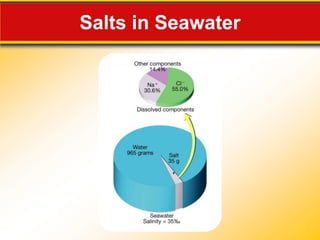
     Most of the salt in seawater is sodium
      chloride, common table salt.
15.1 The Composition of Seawater

   Salinity
     Sources of Sea Salt
      • Chemical weathering of rocks on the continents
        is one source of elements found in seawater.
      • The second major source of elements found in
        seawater is from Earth’s interior.
Salts in Seawater
15.1 The Composition of Seawater

   Salinity
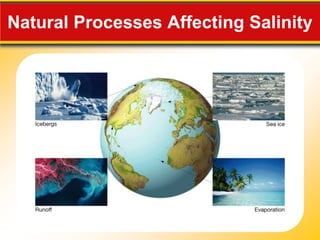
     Processes Affecting Salinity
      • Processes that decrease salinity:
        - Precipitation
        - Sea ice melting
        - Icebergs melting
        - Runoff from land
      • Processes that increase salinity:
        - Evaporation
        - Formation of sea ice
Natural Processes Affecting Salinity
15.1 The Composition of Seawater

   Ocean Temperature Variation
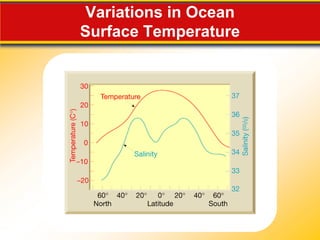
     The ocean’s surface water temperature
      varies with the amount of solar radiation
      received, which is primarily a function of
      latitude.
     Temperature Variation with Depth
       • The thermocline is the layer of ocean water
         between about 300 meters and 1000 meters where
         there is a rapid change of temperature with depth.
       • The thermocline is a very important structure
         because it creates a barrier to marine life.
Variations in Ocean
Surface Temperature
Variations in Ocean
Water Temperature
15.1 The Composition of Seawater

   Ocean Density Variation
     Density is defined as mass per unit volume.
      It can be thought of as a measure of how
      heavy something is for its size.
     Factors Affecting Seawater Density
      • Seawater density is influenced by two main
        factors: salinity and temperature.
15.1 The Composition of Seawater

   Ocean Density Variation
     Density Variation with Depth
      • The pycnocline is the layer of ocean water
        between about 300 meters and 1000 meters
        where there is a rapid change of density with
        depth.
Variations in Ocean
   Water Density
15.1 The Composition of Seawater

   Ocean Layering
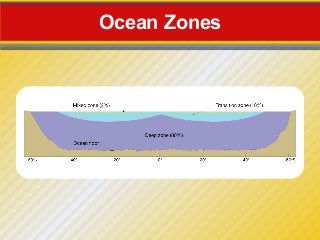
     Oceanographers generally recognize a
      three-layered structure in most parts of the
      open ocean: a shallow surface mixed zone,
      a transition zone, and a deep zone.
     Surface Zone
       • Shallow (300 to 450 meters)
       • Zone of mixing
       • Sun-warmed zone
15.1 The Composition of Seawater

   Ocean Layering
     Transition Zone
      • Between surface layer and deep zone
      • Thermocline and pycnocline
     Deep Zone
      • Sunlight never reaches this zone.
      • Temperatures are just a few degrees above
        freezing.
      • Constant high-density water
Ocean Zones
15.2 The Diversity of Ocean Life

   Classification of Marine Organisms
     Marine organisms can be classified
      according to where they live and how they
      move.
     Plankton
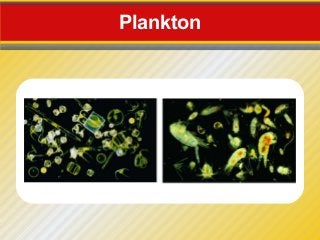
      • Plankton include all organisms—algae, animals,
        and bacteria—that drift with ocean currents.
      • Phytoplankton are algal plankton, which are the
        most important community of primary producers
        in the ocean.
      • Zooplankton are animal plankton.
Plankton
15.2 The Diversity of Ocean Life

   Classification of Marine Organisms
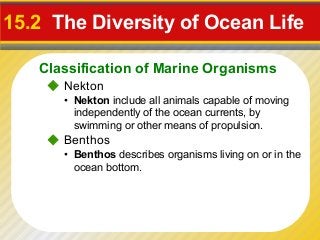
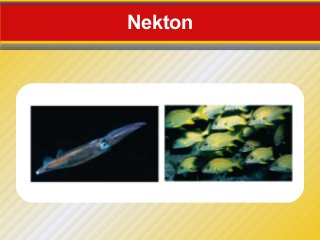
     Nekton
      • Nekton include all animals capable of moving
        independently of the ocean currents, by
        swimming or other means of propulsion.
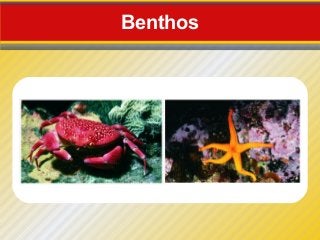
     Benthos
      • Benthos describes organisms living on or in the
        ocean bottom.
Nekton
Benthos
15.2 The Diversity of Ocean Life

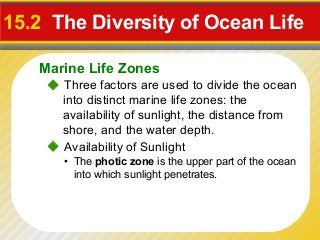
   Marine Life Zones
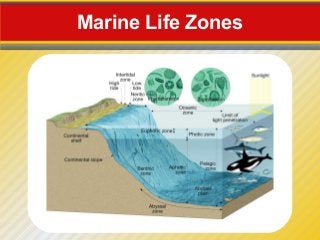
     Three factors are used to divide the ocean
      into distinct marine life zones: the
      availability of sunlight, the distance from
      shore, and the water depth.
     Availability of Sunlight
      • The photic zone is the upper part of the ocean
        into which sunlight penetrates.
15.2 The Diversity of Ocean Life

   Marine Life Zones
     Distance from Shore
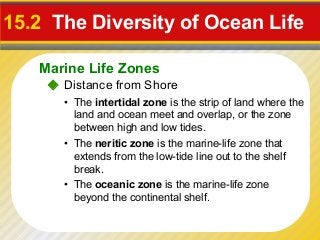
      • The intertidal zone is the strip of land where the
        land and ocean meet and overlap, or the zone
        between high and low tides.
      • The neritic zone is the marine-life zone that
        extends from the low-tide line out to the shelf
        break.
      • The oceanic zone is the marine-life zone
        beyond the continental shelf.
Marine Life Zones
15.2 The Diversity of Ocean Life

   Marine Life Zones
     Water Depth
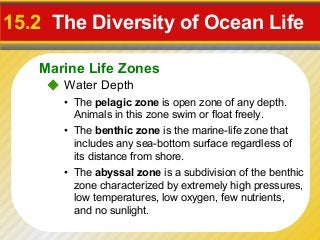
      • The pelagic zone is open zone of any depth.
        Animals in this zone swim or float freely.
      • The benthic zone is the marine-life zone that
        includes any sea-bottom surface regardless of
        its distance from shore.
      • The abyssal zone is a subdivision of the benthic
        zone characterized by extremely high pressures,
        low temperatures, low oxygen, few nutrients,
        and no sunlight.
15.2 The Diversity of Ocean Life

   Marine Life Zones
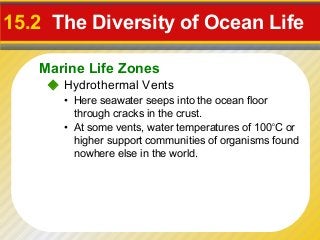
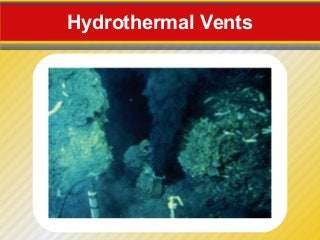
     Hydrothermal Vents
      • Here seawater seeps into the ocean floor
        through cracks in the crust.
      • At some vents, water temperatures of 100oC or
        higher support communities of organisms found
        nowhere else in the world.
Hydrothermal Vents
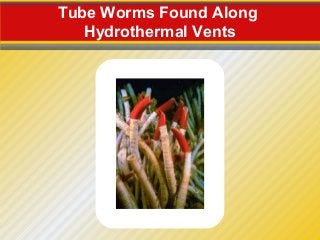
Tube Worms Found Along
   Hydrothermal Vents
15.3 Oceanic Productivity
   Primary Productivity
     Primary productivity is the production of
      organic compounds from inorganic
      substances through photosynthesis or
      chemosynthesis.
     Photosynthesis is the use of light energy
      to convert water and carbon dioxide into
      energy-rich glucose molecules.
     Chemosynthesis is the process by which
      certain microorganisms create organic
      molecules from inorganic nutrients using
      chemical energy.
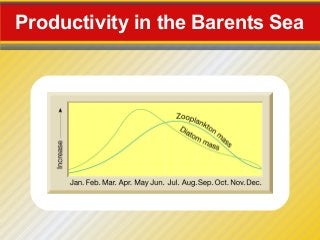
Productivity in the Barents Sea
15.3 Oceanic Productivity

   Primary Productivity
     Productivity in Polar Oceans
      • The low availability of solar energy limits
        photosynthetic productivity in polar areas.
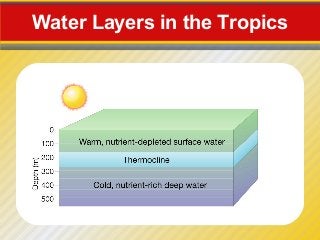
     Productivity in Tropical Oceans
      • Productivity in tropical regions is limited by the
        lack of nutrients.
Water Layers in the Tropics
15.3 Oceanic Productivity

   Primary Productivity
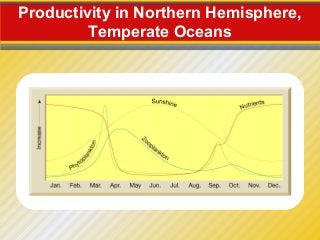
     Productivity in Temperate Oceans
      • In temperate regions, which are found at mid-
        latitudes, a combination of these two limiting
        factors, sunlight and nutrient supply, controls
        productivity.
      • Winter
        - Low productivity
        - Days are short and sun angle is low.
Productivity in Northern Hemisphere,
         Temperate Oceans
15.3 Oceanic Productivity

   Primary Productivity
     Productivity in Temperate Oceans
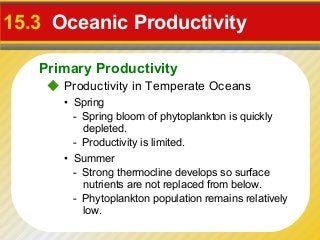
      • Spring
        - Spring bloom of phytoplankton is quickly
          depleted.
        - Productivity is limited.
      • Summer
        - Strong thermocline develops so surface
          nutrients are not replaced from below.
        - Phytoplankton population remains relatively
          low.
15.3 Oceanic Productivity

   Oceanic Feeding Relationships
     Trophic Levels
      • A trophic level is a nourishment level in a food
        chain. Plant and algae producers constitute the
        lowest level, followed by herbivores and a series
        of carnivores at progressively higher levels.
     Transfer Efficiency
      • The transfer of energy between trophic levels is
        very inefficient.
15.3 Oceanic Productivity

   Oceanic Feeding Relationships
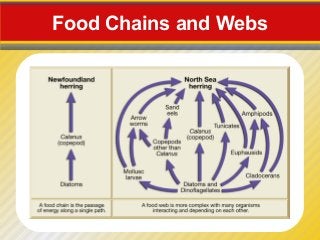
     Food Chains and Food Webs
      • A food chain is a sequence of organisms
        through which energy is transferred, starting with
        the primary producer.
      • A food web is a group of interrelated food
        chains.
      • Animals that feed through a food web rather than
        a food chain are more likely to survive because
        they have alternative foods to eat should one of
        their food sources diminish or disappear.
Food Chains and Webs

Oceans2012[1]

  • 1.
    Prentice Hall EARTH SCIENCE Tarbuck  Lutgens
  • 2.
    Chapter Ocean Water and Ocean Life 13 S6E3.c Describe the composition, location, and subsurface topography of the world’s oceans.
  • 3.
    15.1 The Compositionof Seawater Salinity  Salinity is the total amount of solid material dissolved in water.  Because the proportion of dissolved substances in seawater is such a small number, oceanographers typically express salinity in parts per thousands.  Most of the salt in seawater is sodium chloride, common table salt.
  • 4.
    15.1 The Compositionof Seawater Salinity  Sources of Sea Salt • Chemical weathering of rocks on the continents is one source of elements found in seawater. • The second major source of elements found in seawater is from Earth’s interior.
  • 5.
  • 7.
    15.1 The Compositionof Seawater Salinity  Processes Affecting Salinity • Processes that decrease salinity: - Precipitation - Sea ice melting - Icebergs melting - Runoff from land • Processes that increase salinity: - Evaporation - Formation of sea ice
  • 8.
  • 9.
    15.1 The Compositionof Seawater Ocean Temperature Variation  The ocean’s surface water temperature varies with the amount of solar radiation received, which is primarily a function of latitude.  Temperature Variation with Depth • The thermocline is the layer of ocean water between about 300 meters and 1000 meters where there is a rapid change of temperature with depth. • The thermocline is a very important structure because it creates a barrier to marine life.
  • 10.
  • 11.
  • 12.
    15.1 The Compositionof Seawater Ocean Density Variation  Density is defined as mass per unit volume. It can be thought of as a measure of how heavy something is for its size.  Factors Affecting Seawater Density • Seawater density is influenced by two main factors: salinity and temperature.
  • 13.
    15.1 The Compositionof Seawater Ocean Density Variation  Density Variation with Depth • The pycnocline is the layer of ocean water between about 300 meters and 1000 meters where there is a rapid change of density with depth.
  • 14.
    Variations in Ocean Water Density
  • 15.
    15.1 The Compositionof Seawater Ocean Layering  Oceanographers generally recognize a three-layered structure in most parts of the open ocean: a shallow surface mixed zone, a transition zone, and a deep zone.  Surface Zone • Shallow (300 to 450 meters) • Zone of mixing • Sun-warmed zone
  • 16.
    15.1 The Compositionof Seawater Ocean Layering  Transition Zone • Between surface layer and deep zone • Thermocline and pycnocline  Deep Zone • Sunlight never reaches this zone. • Temperatures are just a few degrees above freezing. • Constant high-density water
  • 17.
  • 18.
    15.2 The Diversityof Ocean Life Classification of Marine Organisms  Marine organisms can be classified according to where they live and how they move.  Plankton • Plankton include all organisms—algae, animals, and bacteria—that drift with ocean currents. • Phytoplankton are algal plankton, which are the most important community of primary producers in the ocean. • Zooplankton are animal plankton.
  • 19.
  • 20.
    15.2 The Diversityof Ocean Life Classification of Marine Organisms  Nekton • Nekton include all animals capable of moving independently of the ocean currents, by swimming or other means of propulsion.  Benthos • Benthos describes organisms living on or in the ocean bottom.
  • 21.
  • 22.
  • 23.
    15.2 The Diversityof Ocean Life Marine Life Zones  Three factors are used to divide the ocean into distinct marine life zones: the availability of sunlight, the distance from shore, and the water depth.  Availability of Sunlight • The photic zone is the upper part of the ocean into which sunlight penetrates.
  • 24.
    15.2 The Diversityof Ocean Life Marine Life Zones  Distance from Shore • The intertidal zone is the strip of land where the land and ocean meet and overlap, or the zone between high and low tides. • The neritic zone is the marine-life zone that extends from the low-tide line out to the shelf break. • The oceanic zone is the marine-life zone beyond the continental shelf.
  • 25.
  • 26.
    15.2 The Diversityof Ocean Life Marine Life Zones  Water Depth • The pelagic zone is open zone of any depth. Animals in this zone swim or float freely. • The benthic zone is the marine-life zone that includes any sea-bottom surface regardless of its distance from shore. • The abyssal zone is a subdivision of the benthic zone characterized by extremely high pressures, low temperatures, low oxygen, few nutrients, and no sunlight.
  • 27.
    15.2 The Diversityof Ocean Life Marine Life Zones  Hydrothermal Vents • Here seawater seeps into the ocean floor through cracks in the crust. • At some vents, water temperatures of 100oC or higher support communities of organisms found nowhere else in the world.
  • 28.
  • 29.
    Tube Worms FoundAlong Hydrothermal Vents
  • 30.
    15.3 Oceanic Productivity Primary Productivity  Primary productivity is the production of organic compounds from inorganic substances through photosynthesis or chemosynthesis.  Photosynthesis is the use of light energy to convert water and carbon dioxide into energy-rich glucose molecules.  Chemosynthesis is the process by which certain microorganisms create organic molecules from inorganic nutrients using chemical energy.
  • 31.
  • 32.
    15.3 Oceanic Productivity Primary Productivity  Productivity in Polar Oceans • The low availability of solar energy limits photosynthetic productivity in polar areas.  Productivity in Tropical Oceans • Productivity in tropical regions is limited by the lack of nutrients.
  • 33.
    Water Layers inthe Tropics
  • 34.
    15.3 Oceanic Productivity Primary Productivity  Productivity in Temperate Oceans • In temperate regions, which are found at mid- latitudes, a combination of these two limiting factors, sunlight and nutrient supply, controls productivity. • Winter - Low productivity - Days are short and sun angle is low.
  • 35.
    Productivity in NorthernHemisphere, Temperate Oceans
  • 36.
    15.3 Oceanic Productivity Primary Productivity  Productivity in Temperate Oceans • Spring - Spring bloom of phytoplankton is quickly depleted. - Productivity is limited. • Summer - Strong thermocline develops so surface nutrients are not replaced from below. - Phytoplankton population remains relatively low.
  • 37.
    15.3 Oceanic Productivity Oceanic Feeding Relationships  Trophic Levels • A trophic level is a nourishment level in a food chain. Plant and algae producers constitute the lowest level, followed by herbivores and a series of carnivores at progressively higher levels.  Transfer Efficiency • The transfer of energy between trophic levels is very inefficient.
  • 38.
    15.3 Oceanic Productivity Oceanic Feeding Relationships  Food Chains and Food Webs • A food chain is a sequence of organisms through which energy is transferred, starting with the primary producer. • A food web is a group of interrelated food chains. • Animals that feed through a food web rather than a food chain are more likely to survive because they have alternative foods to eat should one of their food sources diminish or disappear.
  • 39.

Editor's Notes

  • #3 Who is Stan Hatfield and Ken Pinzke
  • #6 Makes no sense without caption in book
  • #9 Makes no sense without caption in book
  • #11 Makes no sense without caption in book
  • #12 Makes no sense without caption in book
  • #15 Makes no sense without caption in book
  • #18 Makes no sense without caption in book
  • #20 Makes no sense without caption in book
  • #22 Makes no sense without caption in book
  • #23 Makes no sense without caption in book
  • #26 Makes no sense without caption in book
  • #29 Makes no sense without caption in book
  • #30 Makes no sense without caption in book
  • #32 Makes no sense without caption in book
  • #34 Makes no sense without caption in book
  • #36 Makes no sense without caption in book
  • #40 Makes no sense without caption in book