Projections and Coordinate
Systems
Overview
Projections
Examples of different projections
Coordinate systems
Datums
2
Projections
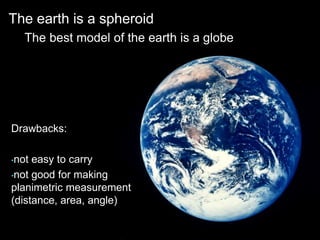
The earth is a spheroid
The best model of the earth is a globe
Drawbacks:
•not easy to carry
•not good for making
planimetric measurement
(distance, area, angle)
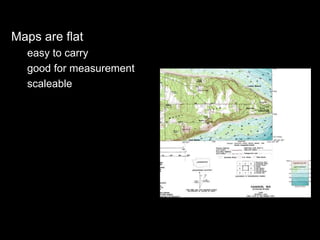
Maps are flat
easy to carry
good for measurement
scaleable
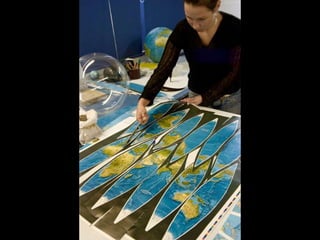
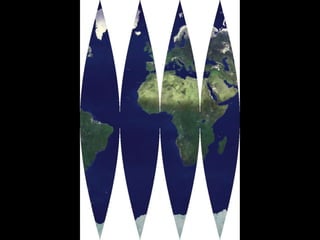
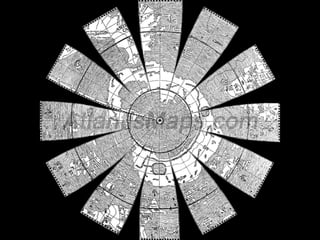
A map projection is a method for mapping
spatial patterns on a curved surface (the
Earth’s surface) to a flat surface.
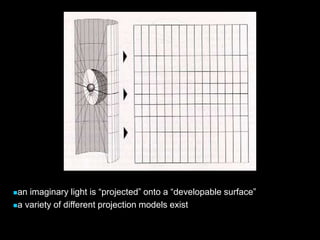
an imaginary light is “projected” onto a “developable surface”
a variety of different projection models exist
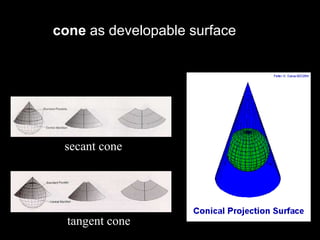
secant cone
tangent cone
cone as developable surface
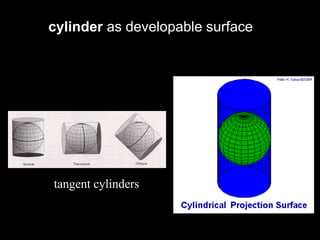
tangent cylinders
cylinder as developable surface
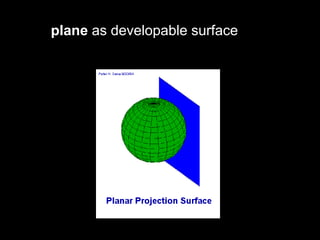
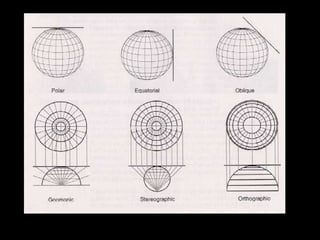
plane as developable surface
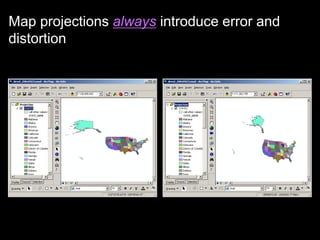
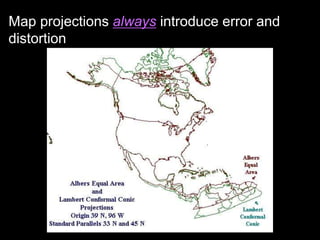
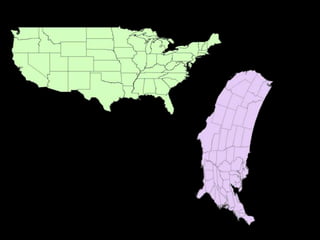
Map projections always introduce error and
distortion
Map projections always introduce error and
distortion
Map projections always introduce error and
distortion
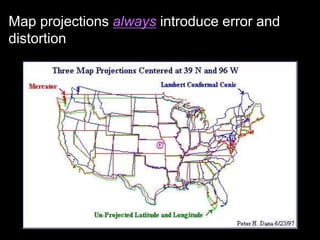
Map projections always introduce error and
distortion
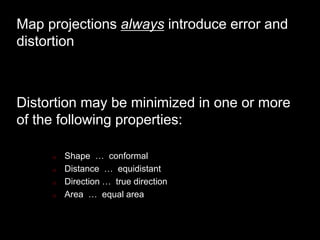
Distortion may be minimized in one or more
of the following properties:
o Shape … conformal
o Distance … equidistant
o Direction … true direction
o Area … equal area
y)
(x,
y)
(x, f
f

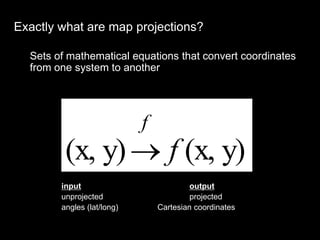
input output
unprojected projected
angles (lat/long) Cartesian coordinates
Exactly what are map projections?
Sets of mathematical equations that convert coordinates
from one system to another
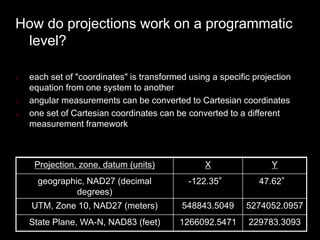
How do projections work on a programmatic
level?
o each set of "coordinates" is transformed using a specific projection
equation from one system to another
o angular measurements can be converted to Cartesian coordinates
o one set of Cartesian coordinates can be converted to a different
measurement framework
Projection, zone, datum (units) X Y
geographic, NAD27 (decimal
degrees)
-122.35° 47.62°
UTM, Zone 10, NAD27 (meters) 548843.5049 5274052.0957
State Plane, WA-N, NAD83 (feet) 1266092.5471 229783.3093
How does ArcGIS handle map projections in
data frames?
o Project data frames to see or measure features under
different projection parameters
o Applying a projection on a data frame projects data “on
the fly.”
o ArcGIS’s data frame projection equations can handle any
input projection.
o However, sometimes on-the-fly projected data do not
properly overlap.
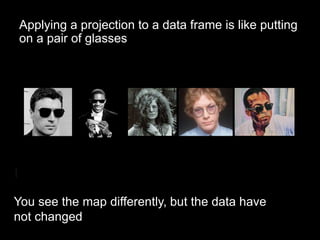
Applying a projection to a data frame is like putting
on a pair of glasses
You see the map differently, but the data have
not changed
How does ArcGIS handle map projections
for data?
 Projecting data creates a new data set on the file
system
 Data can be projected so that incompatibly projected
data sets can be made to match.
 ArcGIS’s projection engine can go in and out of a large
number of different projections, coordinate systems, and
datums.
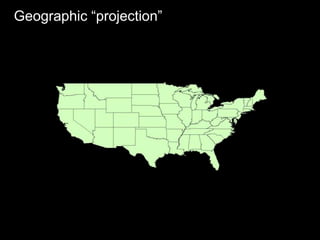
Geographic “projection”
Examples of different projections
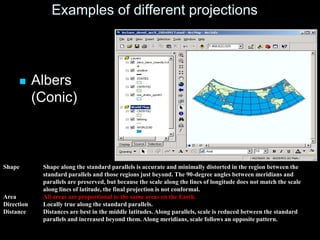
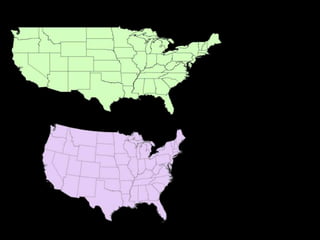
 Albers
(Conic)
Shape Shape along the standard parallels is accurate and minimally distorted in the region between the
standard parallels and those regions just beyond. The 90-degree angles between meridians and
parallels are preserved, but because the scale along the lines of longitude does not match the scale
along lines of latitude, the final projection is not conformal.
Area All areas are proportional to the same areas on the Earth.
Direction Locally true along the standard parallels.
Distance Distances are best in the middle latitudes. Along parallels, scale is reduced between the standard
parallels and increased beyond them. Along meridians, scale follows an opposite pattern.
Examples of different projections
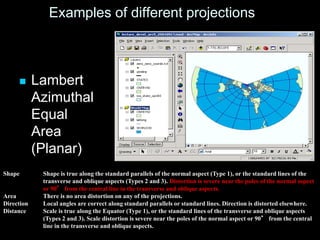
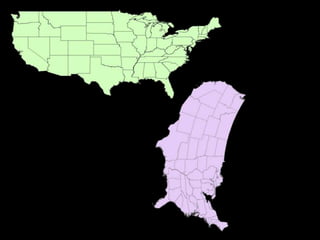
 Lambert
Azimuthal
Equal
Area
(Planar)
Shape Shape is true along the standard parallels of the normal aspect (Type 1), or the standard lines of the
transverse and oblique aspects (Types 2 and 3). Distortion is severe near the poles of the normal aspect
or 90° from the central line in the transverse and oblique aspects.
Area There is no area distortion on any of the projections.
Direction Local angles are correct along standard parallels or standard lines. Direction is distorted elsewhere.
Distance Scale is true along the Equator (Type 1), or the standard lines of the transverse and oblique aspects
(Types 2 and 3). Scale distortion is severe near the poles of the normal aspect or 90° from the central
line in the transverse and oblique aspects.
Examples of different projections
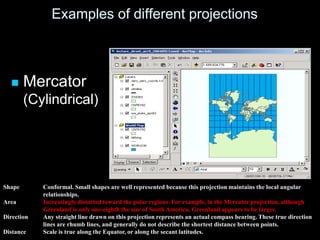
 Mercator
(Cylindrical)
Shape Conformal. Small shapes are well represented because this projection maintains the local angular
relationships.
Area Increasingly distorted toward the polar regions. For example, in the Mercator projection, although
Greenland is only one-eighth the size of South America, Greenland appears to be larger.
Direction Any straight line drawn on this projection represents an actual compass bearing. These true direction
lines are rhumb lines, and generally do not describe the shortest distance between points.
Distance Scale is true along the Equator, or along the secant latitudes.
Examples of different projections
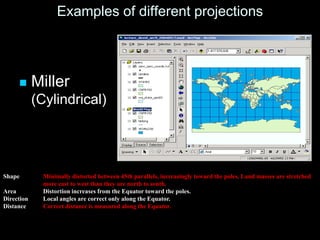
 Miller
(Cylindrical)
Shape Minimally distorted between 45th parallels, increasingly toward the poles. Land masses are stretched
more east to west than they are north to south.
Area Distortion increases from the Equator toward the poles.
Direction Local angles are correct only along the Equator.
Distance Correct distance is measured along the Equator.
Examples of different projections
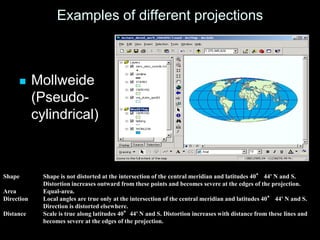
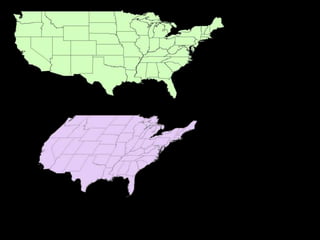
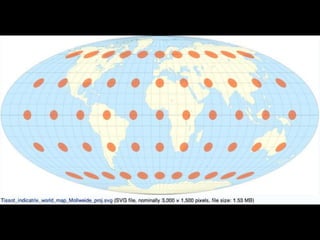
 Mollweide
(Pseudo-
cylindrical)
Shape Shape is not distorted at the intersection of the central meridian and latitudes 40° 44' N and S.
Distortion increases outward from these points and becomes severe at the edges of the projection.
Area Equal-area.
Direction Local angles are true only at the intersection of the central meridian and latitudes 40° 44' N and S.
Direction is distorted elsewhere.
Distance Scale is true along latitudes 40°44' N and S. Distortion increases with distance from these lines and
becomes severe at the edges of the projection.
Examples of different projections
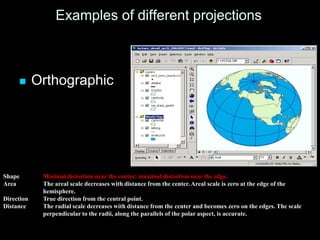
 Orthographic
Shape Minimal distortion near the center; maximal distortion near the edge.
Area The areal scale decreases with distance from the center. Areal scale is zero at the edge of the
hemisphere.
Direction True direction from the central point.
Distance The radial scale decreases with distance from the center and becomes zero on the edges. The scale
perpendicular to the radii, along the parallels of the polar aspect, is accurate.
Examples of different
projections
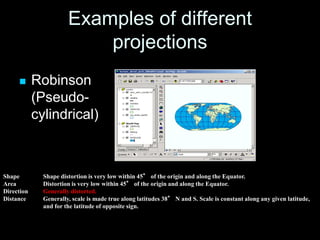
 Robinson
(Pseudo-
cylindrical)
Shape Shape distortion is very low within 45° of the origin and along the Equator.
Area Distortion is very low within 45° of the origin and along the Equator.
Direction Generally distorted.
Distance Generally, scale is made true along latitudes 38° N and S. Scale is constant along any given latitude,
and for the latitude of opposite sign.
Coordinate Systems
Coordinates
Features on spherical surfaces are not
easy to measure
Features on planes are easy to measure
and calculate
 distance
 angle
 area
Coordinate systems provide a
measurement framework
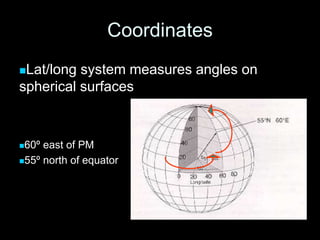
Coordinates
Lat/long system measures angles on
spherical surfaces
60º east of PM
55º north of equator
Lat/long values are NOT Cartesian (X,
Y) coordinates
constant angular deviations do not have
constant distance deviations
1° of longitude at the equator  1° of
longitude near the poles
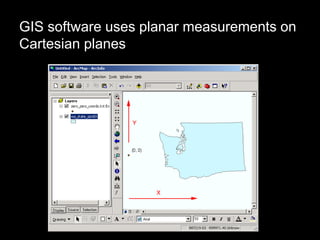
GIS software uses planar measurements on
Cartesian planes
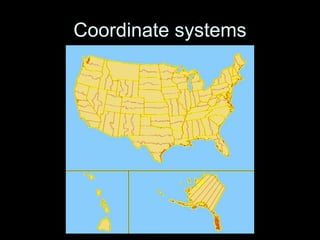
Coordinate systems
Coordinate systems
Examples of different coordinate/projection
systems
 State Plane
 Universal Transverse Mercator (UTM)
Coordinate systems
State Plane
 Codified in 1930s
 Use of numeric zones for shorthand
 SPCS (State Plane Coordinate System)
 FIPS (Federal Information Processing System)
 Uses one or more of 3 different projections:
 Lambert Conformal Conic (east-west orientation )
 Transverse Mercator (north-south orientation)
 Oblique Mercator (nw-se or ne-sw orientation)
Coordinate systems
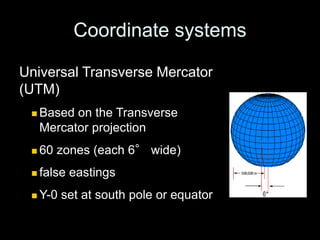
Universal Transverse Mercator
(UTM)
 Based on the Transverse
Mercator projection
 60 zones (each 6° wide)
 false eastings
 Y-0 set at south pole or equator
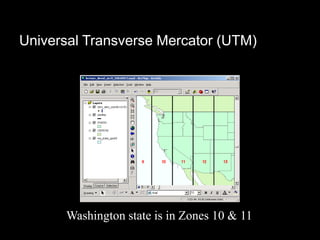
Washington state is in Zones 10 & 11
Universal Transverse Mercator (UTM)
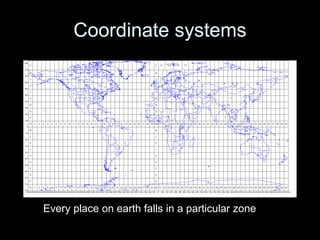
Coordinate systems
Every place on earth falls in a particular zone
Datums
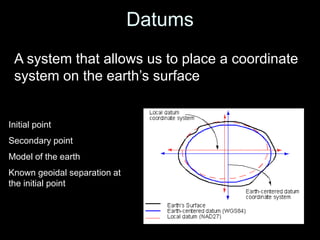
Datums
A system that allows us to place a coordinate
system on the earth’s surface
Initial point
Secondary point
Model of the earth
Known geoidal separation at
the initial point
Datums
Commonly used datums in North America
 North American Datum of 1927 (NAD27)
 NAD83
 World Geodetic System of 1984 (WGS84)
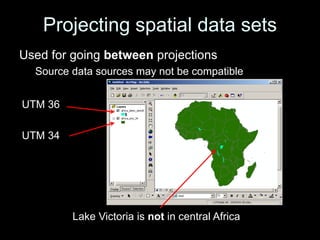
Projecting spatial data sets
UTM 36
UTM 34
Lake Victoria is not in central Africa
Used for going between projections
Source data sources may not be compatible
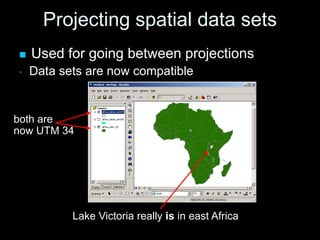
Projecting spatial data sets
 Used for going between projections
• Data sets are now compatible
Lake Victoria really is in east Africa
both are
now UTM 34

projections.ppt

  • 1.
    Projections and Coordinate Systems Overview Projections Examplesof different projections Coordinate systems Datums
  • 2.
  • 3.
    The earth isa spheroid The best model of the earth is a globe Drawbacks: •not easy to carry •not good for making planimetric measurement (distance, area, angle)
  • 4.
    Maps are flat easyto carry good for measurement scaleable
  • 8.
    A map projectionis a method for mapping spatial patterns on a curved surface (the Earth’s surface) to a flat surface.
  • 9.
    an imaginary lightis “projected” onto a “developable surface” a variety of different projection models exist
  • 10.
    secant cone tangent cone coneas developable surface
  • 11.
    tangent cylinders cylinder asdevelopable surface
  • 12.
  • 14.
    Map projections alwaysintroduce error and distortion
  • 15.
    Map projections alwaysintroduce error and distortion
  • 16.
    Map projections alwaysintroduce error and distortion
  • 17.
    Map projections alwaysintroduce error and distortion Distortion may be minimized in one or more of the following properties: o Shape … conformal o Distance … equidistant o Direction … true direction o Area … equal area
  • 18.
    y) (x, y) (x, f f  input output unprojectedprojected angles (lat/long) Cartesian coordinates Exactly what are map projections? Sets of mathematical equations that convert coordinates from one system to another
  • 19.
    How do projectionswork on a programmatic level? o each set of "coordinates" is transformed using a specific projection equation from one system to another o angular measurements can be converted to Cartesian coordinates o one set of Cartesian coordinates can be converted to a different measurement framework Projection, zone, datum (units) X Y geographic, NAD27 (decimal degrees) -122.35° 47.62° UTM, Zone 10, NAD27 (meters) 548843.5049 5274052.0957 State Plane, WA-N, NAD83 (feet) 1266092.5471 229783.3093
  • 20.
    How does ArcGIShandle map projections in data frames? o Project data frames to see or measure features under different projection parameters o Applying a projection on a data frame projects data “on the fly.” o ArcGIS’s data frame projection equations can handle any input projection. o However, sometimes on-the-fly projected data do not properly overlap.
  • 21.
    Applying a projectionto a data frame is like putting on a pair of glasses You see the map differently, but the data have not changed
  • 22.
    How does ArcGIShandle map projections for data?  Projecting data creates a new data set on the file system  Data can be projected so that incompatibly projected data sets can be made to match.  ArcGIS’s projection engine can go in and out of a large number of different projections, coordinate systems, and datums.
  • 23.
  • 24.
    Examples of differentprojections  Albers (Conic) Shape Shape along the standard parallels is accurate and minimally distorted in the region between the standard parallels and those regions just beyond. The 90-degree angles between meridians and parallels are preserved, but because the scale along the lines of longitude does not match the scale along lines of latitude, the final projection is not conformal. Area All areas are proportional to the same areas on the Earth. Direction Locally true along the standard parallels. Distance Distances are best in the middle latitudes. Along parallels, scale is reduced between the standard parallels and increased beyond them. Along meridians, scale follows an opposite pattern.
  • 26.
    Examples of differentprojections  Lambert Azimuthal Equal Area (Planar) Shape Shape is true along the standard parallels of the normal aspect (Type 1), or the standard lines of the transverse and oblique aspects (Types 2 and 3). Distortion is severe near the poles of the normal aspect or 90° from the central line in the transverse and oblique aspects. Area There is no area distortion on any of the projections. Direction Local angles are correct along standard parallels or standard lines. Direction is distorted elsewhere. Distance Scale is true along the Equator (Type 1), or the standard lines of the transverse and oblique aspects (Types 2 and 3). Scale distortion is severe near the poles of the normal aspect or 90° from the central line in the transverse and oblique aspects.
  • 28.
    Examples of differentprojections  Mercator (Cylindrical) Shape Conformal. Small shapes are well represented because this projection maintains the local angular relationships. Area Increasingly distorted toward the polar regions. For example, in the Mercator projection, although Greenland is only one-eighth the size of South America, Greenland appears to be larger. Direction Any straight line drawn on this projection represents an actual compass bearing. These true direction lines are rhumb lines, and generally do not describe the shortest distance between points. Distance Scale is true along the Equator, or along the secant latitudes.
  • 30.
    Examples of differentprojections  Miller (Cylindrical) Shape Minimally distorted between 45th parallels, increasingly toward the poles. Land masses are stretched more east to west than they are north to south. Area Distortion increases from the Equator toward the poles. Direction Local angles are correct only along the Equator. Distance Correct distance is measured along the Equator.
  • 32.
    Examples of differentprojections  Mollweide (Pseudo- cylindrical) Shape Shape is not distorted at the intersection of the central meridian and latitudes 40° 44' N and S. Distortion increases outward from these points and becomes severe at the edges of the projection. Area Equal-area. Direction Local angles are true only at the intersection of the central meridian and latitudes 40° 44' N and S. Direction is distorted elsewhere. Distance Scale is true along latitudes 40°44' N and S. Distortion increases with distance from these lines and becomes severe at the edges of the projection.
  • 35.
    Examples of differentprojections  Orthographic Shape Minimal distortion near the center; maximal distortion near the edge. Area The areal scale decreases with distance from the center. Areal scale is zero at the edge of the hemisphere. Direction True direction from the central point. Distance The radial scale decreases with distance from the center and becomes zero on the edges. The scale perpendicular to the radii, along the parallels of the polar aspect, is accurate.
  • 37.
    Examples of different projections Robinson (Pseudo- cylindrical) Shape Shape distortion is very low within 45° of the origin and along the Equator. Area Distortion is very low within 45° of the origin and along the Equator. Direction Generally distorted. Distance Generally, scale is made true along latitudes 38° N and S. Scale is constant along any given latitude, and for the latitude of opposite sign.
  • 38.
  • 39.
    Coordinates Features on sphericalsurfaces are not easy to measure Features on planes are easy to measure and calculate  distance  angle  area Coordinate systems provide a measurement framework
  • 40.
    Coordinates Lat/long system measuresangles on spherical surfaces 60º east of PM 55º north of equator
  • 41.
    Lat/long values areNOT Cartesian (X, Y) coordinates constant angular deviations do not have constant distance deviations 1° of longitude at the equator  1° of longitude near the poles
  • 42.
    GIS software usesplanar measurements on Cartesian planes
  • 43.
  • 44.
    Coordinate systems Examples ofdifferent coordinate/projection systems  State Plane  Universal Transverse Mercator (UTM)
  • 45.
    Coordinate systems State Plane Codified in 1930s  Use of numeric zones for shorthand  SPCS (State Plane Coordinate System)  FIPS (Federal Information Processing System)  Uses one or more of 3 different projections:  Lambert Conformal Conic (east-west orientation )  Transverse Mercator (north-south orientation)  Oblique Mercator (nw-se or ne-sw orientation)
  • 46.
    Coordinate systems Universal TransverseMercator (UTM)  Based on the Transverse Mercator projection  60 zones (each 6° wide)  false eastings  Y-0 set at south pole or equator
  • 47.
    Washington state isin Zones 10 & 11 Universal Transverse Mercator (UTM)
  • 48.
    Coordinate systems Every placeon earth falls in a particular zone
  • 49.
  • 50.
    Datums A system thatallows us to place a coordinate system on the earth’s surface Initial point Secondary point Model of the earth Known geoidal separation at the initial point
  • 51.
    Datums Commonly used datumsin North America  North American Datum of 1927 (NAD27)  NAD83  World Geodetic System of 1984 (WGS84)
  • 52.
    Projecting spatial datasets UTM 36 UTM 34 Lake Victoria is not in central Africa Used for going between projections Source data sources may not be compatible
  • 53.
    Projecting spatial datasets  Used for going between projections • Data sets are now compatible Lake Victoria really is in east Africa both are now UTM 34