General Guidelines forTrainings
Interact
Engage
Participate
Mobile Phones - Silent Please
3.
Introduction …
Name
Nationality
Educational Qualifications
Current Position & Company Name
Yrs of Experience in Supply Chain Management
Expectations from this Course
Where do you stay & Family details (Optional)
4.
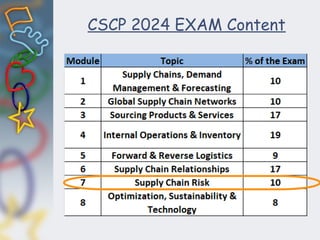
CSCP 2024 ProgramContent
The CSCP 2024 Program consists of Eight Modules
with an exam that reflects critical changes in the
marketplace and in the evolving roles and
responsibilities of supply chain managers.
Module 1 – Supply Chains, Demand Management & Forecasting
Module 2 – Global Supply Chain Networks
Module 3 – Sourcing Products & Services
Module 4 – Internal Operations & Inventory
Module 5 – Forward & Reverse Logistics
Module 6 – Supply Chain Relationships
Module 7 – Supply Chain Risk
Module 8 – Optimization, Sustainability & Technology
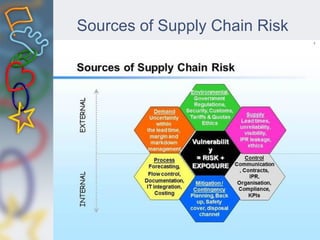
Supply Chain RiskManagement
Supply Chain Risk Management (SCRM) is the
process of taking strategic steps to identify, assess
and mitigate the risk in your end-to-end supply
chain.
A comprehensive approach to SCRM involves
the management of all types of risk, for all tiers
of supply and for all risk objects (suppliers,
locations, ports and more).
14.
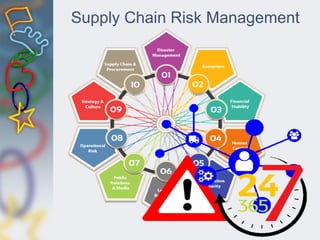
Supply Chain RiskManagement
Supply Chain Risk Management (SCRM) is the
process of taking strategic steps to identify,
assess and mitigate the risk in your end-to-
end supply chain.
A comprehensive approach to SCRM involves
the management of all types of risk, for all tiers
of supply and for all risk objects (suppliers,
locations, ports and more).
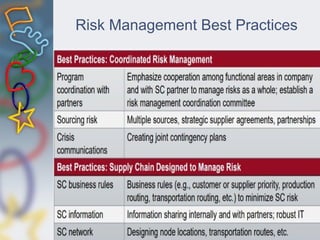
Supply Chain RiskManagement is more than a
helpful addition to your operations - it is essential
to your success in events like natural disasters,
unpaid bills, transport disruptions, etc.
The purpose of risk management is to prevent
issues and provide loss mitigation if risk events do
occur.
Importance of Risk Management
in SCM
17.
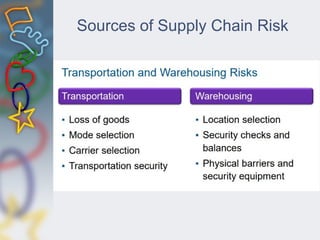
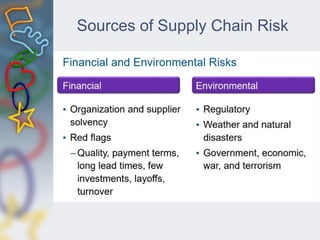
Top 10 Risksin SCM
Global trade wars and Brexit
Raw material shortages
Safety recalls
Climate change risk
Tougher environmental regulations
Economic uncertainty
Cargo theft
Container ship fires
Boarder Battles
Drone Risk in Aviation
18.
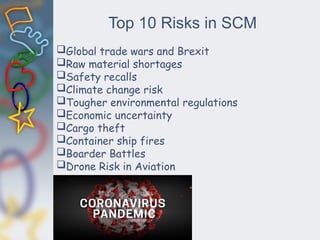
Top 10 Risksin SCM
Global trade wars and Brexit
Raw material shortages
Safety recalls
Climate change risk
Tougher environmental regulations
Economic uncertainty
Cargo theft
Container ship fires
Boarder Battles
Drone Risk in Aviation
19.
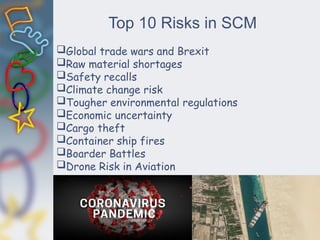
Top 10 Risksin SCM
Global trade wars and Brexit
Raw material shortages
Safety recalls
Climate change risk
Tougher environmental regulations
Economic uncertainty
Cargo theft
Container ship fires
Boarder Battles
Drone Risk in Aviation
Risk Management Strategy
ARisk Management Strategy provides a
structured and coherent approach to identifying,
assessing and mitigating the risk.
It builds in a process for regularly updating and
reviewing the assessment based on new
developments or actions taken.
30.
Risk Management Strategy
ARisk Management Strategy provides a
structured and coherent approach to identifying,
assessing and mitigating the risk.
It builds in a process for regularly updating and
reviewing the assessment based on new
developments or actions taken.
Quiz Time –Q1
A company's supply chain depends heavily on sourcing
from international suppliers. Conditions increasingly
threaten supply continuity. Which of the following
actions is most appropriate?
A. Source from domestic suppliers.
B. Conduct a risk assessment.
C. Carry additional safety stock.
D. Spread logistics across multiple carriers.
33.
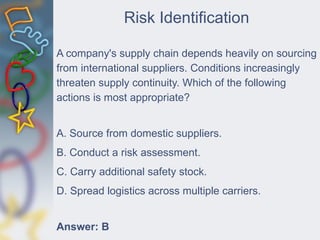
Risk Identification
A company'ssupply chain depends heavily on sourcing
from international suppliers. Conditions increasingly
threaten supply continuity. Which of the following
actions is most appropriate?
A. Source from domestic suppliers.
B. Conduct a risk assessment.
C. Carry additional safety stock.
D. Spread logistics across multiple carriers.
Answer: B
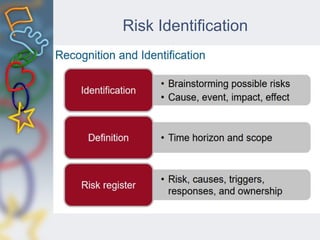
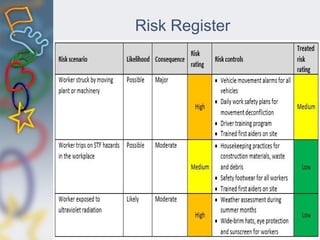
Risk Register
A RiskRegister is a document used as a risk
management tool and to fulfill regulatory
compliance acting as a repository for all risks
identified and includes additional information about
each risk, e.g. nature of the risk, reference and
owner, mitigation measures.
It can be displayed as a scatter plot or as a table.
Cause, Event, Impact& Effect
Risk Event – This is what could go wrong.
This is where the uncertainty lies - the existence
of the Cause does not mean the event will happen.
40.
Cause, Event, Impact& Effect
Risk Event – This is what could go wrong.
This is where the uncertainty lies - the existence
of the Cause does not mean the event will happen.
But if it does, there will most likely be an impact.
Consequence – This is the potential outcome of
the event.
42.
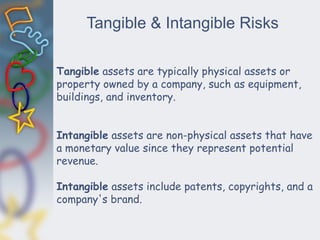
Tangible & IntangibleRisks
Tangible assets are typically physical assets or
property owned by a company, such as equipment,
buildings, and inventory.
Intangible assets are non-physical assets that have
a monetary value since they represent potential
revenue.
Intangible assets include patents, copyrights, and a
company's brand.
43.
Quiz Time –Q2
Which of the following actions is most likely to increase
total supply chain risk?
A. Standardizing components used in a product family
B. Expanding operations to multiple locations
C. Consolidating manufacturing locations
D. Reducing the supplier base for commodity-type
components
44.
Quiz Time –Q2
Which of the following actions is most likely to increase
total supply chain risk?
A. Standardizing components used in a product family
B. Expanding operations to multiple locations
C. Consolidating manufacturing locations
D. Reducing the supplier base for commodity-type
components
Answer: C
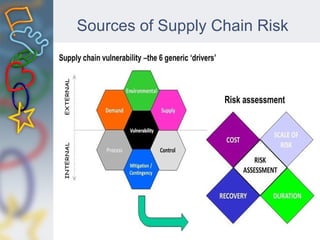
Risk Assessment
Risk Assessmentis a term used to describe the
overall process or method where you:
Identify hazards and risk factors that have the
potential to cause harm (hazard identification).
Analyze and evaluate the risk associated with
that hazard
- risk analysis and risk evaluation.
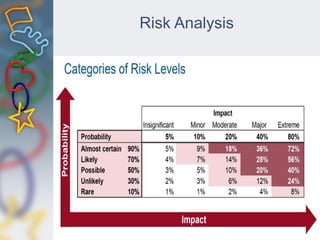
Qualitative Risk Analysis
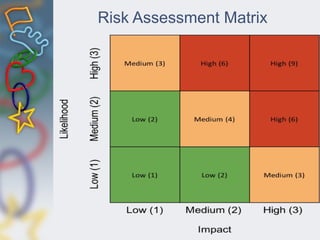
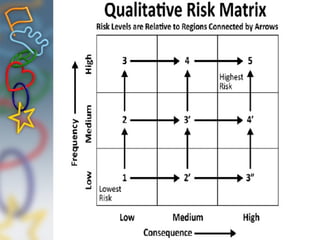
Aqualitative risk analysis is an analysis of various
qualities that make up each risk. The primary
factors are Probability & Impact.
In Qualitative analysis, risk can be rated that can
be used to rank the risk in order of importance.
51.
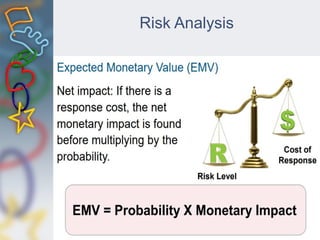
Quantitative Risk Analysis
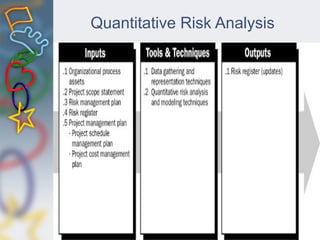
Quantitativerisk analysis is to identify the “effect
of identified risks on overall project objectives.”
It quantifies the risk exposure and determines the
size of cost and schedule contingencies.
Qualitative vs QuantitativeRisk
Analysis
Qualitative risk analysis tends to be more
subjective.
It focuses on identifying risks to measure both the
likelihood of a specific risk event occurring during
the project life cycle and the impact it will have on
project.
Quantitative risk analysis, on the other hand, is
objective.
It uses verifiable data to analyze the effects of
risk in terms of cost overruns, scope creep,
resource consumption, and schedule delays.
54.
Qualitative or QuantitativeRisk
Analysis – All in One
For Better Results …
Qualitative and Quantitative risk analysis should be
conducted in tandem, giving you the best possible
insight into the risks and their potential impact on
the successful execution of your project.
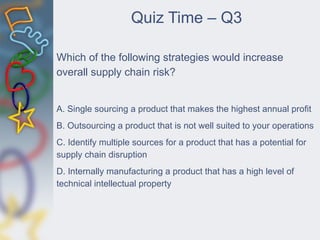
Quiz Time –Q3
Which of the following strategies would increase
overall supply chain risk?
A. Single sourcing a product that makes the highest annual profit
B. Outsourcing a product that is not well suited to your operations
C. Identify multiple sources for a product that has a potential for
supply chain disruption
D. Internally manufacturing a product that has a high level of
technical intellectual property
58.
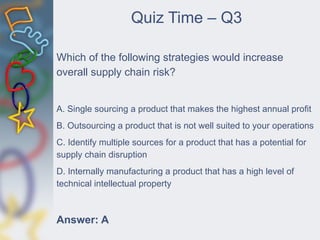
Quiz Time –Q3
Which of the following strategies would increase
overall supply chain risk?
A. Single sourcing a product that makes the highest annual profit
B. Outsourcing a product that is not well suited to your operations
C. Identify multiple sources for a product that has a potential for
supply chain disruption
D. Internally manufacturing a product that has a high level of
technical intellectual property
Answer: A
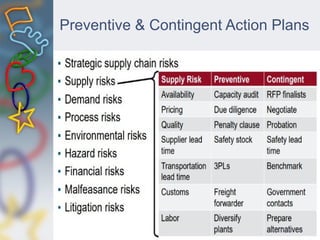
Risk Response ActionTypes
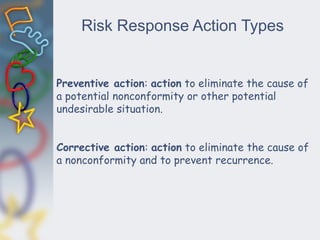
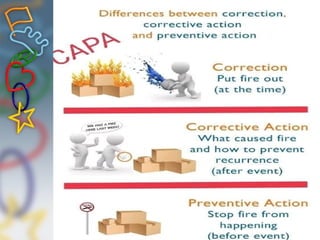
Preventive action: action to eliminate the cause of
a potential nonconformity or other potential
undesirable situation.
Corrective action: action to eliminate the cause of
a nonconformity and to prevent recurrence.
65.
Risk Response ActionTypes
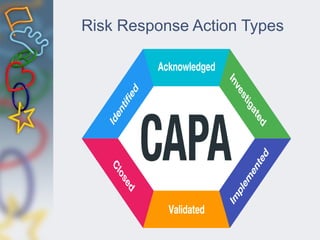
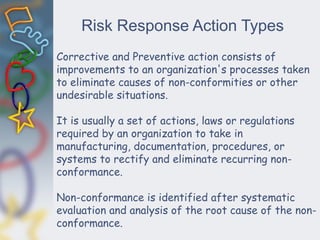
Corrective and Preventive action consists of
improvements to an organization's processes taken
to eliminate causes of non-conformities or other
undesirable situations.
It is usually a set of actions, laws or regulations
required by an organization to take in
manufacturing, documentation, procedures, or
systems to rectify and eliminate recurring non-
conformance.
Non-conformance is identified after systematic
evaluation and analysis of the root cause of the non-
conformance.
67.
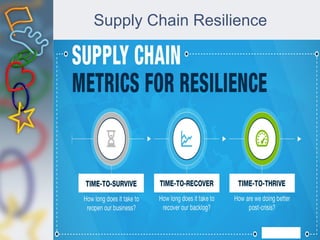
Supply Chain Resilience
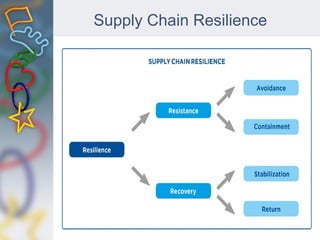
Aresilient supply chain is defined by its capacity
for resistance and recovery.
That means having the capability to resist or even
avoid the impact of a supply chain disruption – and
the ability to quickly recover from a disruption.
Business Continuity Management
System(BCMS)
Business Continuity Management System (BCMS)
is a holistic management process that identifies
potential threats to an organization and the impacts
to business operations those threats, if realized,
might cause, and which provides a framework for
building organizational resilience with the capability
for an effective response
71.
Business Continuity Management
SystemStandard – ISO22301
The current version of the ISO 22301
standard is 22301:2012.
The ISO 22301 BCMS standard is designed to
ensure that a robust business continuity
management system has been established, and that
internal staff members are fully aware of their role
within the system should an incident occur.
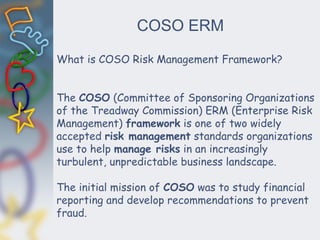
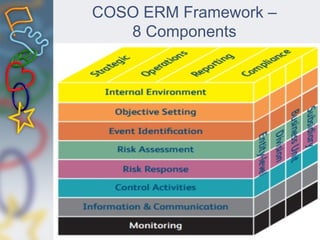
COSO ERM
What isCOSO Risk Management Framework?
The COSO (Committee of Sponsoring Organizations
of the Treadway Commission) ERM (Enterprise Risk
Management) framework is one of two widely
accepted risk management standards organizations
use to help manage risks in an increasingly
turbulent, unpredictable business landscape.
The initial mission of COSO was to study financial
reporting and develop recommendations to prevent
fraud.
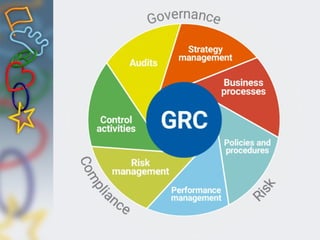
Governance, Risk &Compliance
Governance, Risk and Compliance (GRC) refers to a
strategy for managing an organization's overall
governance, enterprise risk management and
compliance with regulations.
Think of GRC as a structured approach to aligning
IT with business objectives, while effectively
managing risk and meeting compliance requirements.
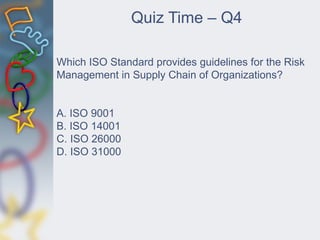
Which ISO Standardprovides guidelines for the Risk
Management in Supply Chain of Organizations?
A. ISO 9001
B. ISO 14001
C. ISO 26000
D. ISO 31000
Quiz Time – Q4
80.
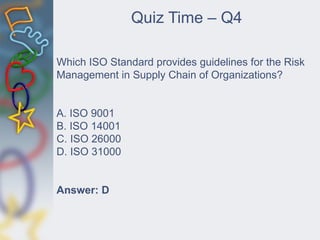
Which ISO Standardprovides guidelines for the Risk
Management in Supply Chain of Organizations?
A. ISO 9001
B. ISO 14001
C. ISO 26000
D. ISO 31000
Answer: D
Quiz Time – Q4
81.
ISO Risk Standards
Thecurrent version of the ISO 31000
standard is 31000:2018.
ISO 31000 is a family of standards relating to risk
management codified by the International
Organization for Standardization.
ISO 31000:2018 provides principles and generic
guidelines on managing risks faced by organizations.
82.
ISO 31010 Standard
IEC31010:2019 is a dual logo IEC/ISO, single
prefix IEC (International Electro-Technical
Commission), supporting standard for ISO
31000 and provides guidance on selection and
application of systematic techniques for risk
assessment.
This standard is not intended for certification,
regulatory or contractual use.
83.
ISO Guide 73:2009
ISOGuide 73:2009 provides the definitions of
generic terms related to risk management.
It aims to encourage a mutual and consistent
understanding of, and a coherent approach to, the
description of activities relating to the management
of risk, and the use of uniform risk management
terminology in processes and frameworks dealing
with the management of risk.
For principles and guidelines on risk management,
reference is made to ISO 31000:2018.
84.
Benefits of 31000,31010 & Guide73
Risk management establishes and sustains value
Risk management is an integral part of all
organizational processes
Risk management is part of decision making
Risk management explicitly addresses uncertainty
Risk management is systematic, structured &
timely
Risk management is based on the best available
information
Risk management is tailored
RM takes human and cultural factors into account
Risk management is transparent and inclusive
Risk management is dynamic, iterative, and
responsive to change
Risk management facilitates continual
improvement of the organization
#1 The aim of this course is just to give an overview of these areas so that trainees have an awareness of the basic requirements for food safety management. i.e. it is not training in how to do a HACCP study, or how to do a DICE risk assessment.
#2 General guidelines for online training.
Please participate and interact – this training is all about you!
As a courtesy to your fellow procurement and contracting specialists, your phone will be muted by the Moderator.
All participants will be muted – if you want to ‘talk’ with the Moderator by using the ‘raise your hand’ function or chat, depending on instructions provided by Instructor/Moderator.
Participation is welcome. Please submit questions as you go using the Chat function. The Moderator is here to field your questions and answer them real time, at the end of module, or in a follow up group email.