WHY RK METHOD ?
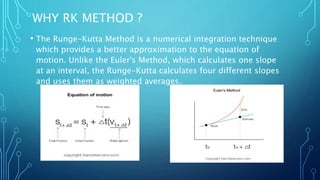
• The Runge-Kutta Method is a numerical integration technique
which provides a better approximation to the equation of
motion. Unlike the Euler's Method, which calculates one slope
at an interval, the Runge-Kutta calculates four different slopes
and uses them as weighted averages.
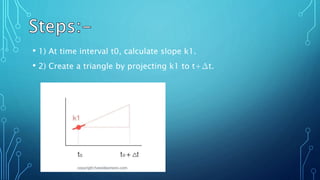
• 1) At time interval t0, calculate slope k1.
• 2) Create a triangle by projecting k1 to t+∆t.
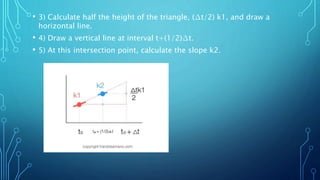
• 3) Calculate half the height of the triangle, (∆t/2) k1, and draw a
horizontal line.
• 4) Draw a vertical line at interval t+(1/2)∆t.
• 5) At this intersection point, calculate the slope k2.
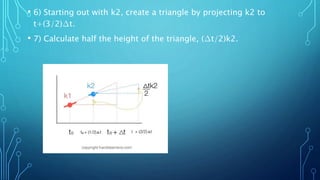
• 6) Starting out with k2, create a triangle by projecting k2 to
t+(3/2)∆t.
• 7) Calculate half the height of the triangle, (∆t/2)k2.
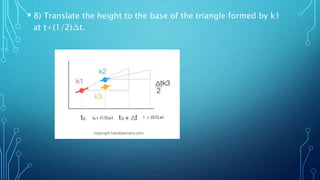
• 8) Translate the height to the base of the triangle formed by k1
at t+(1/2)∆t.
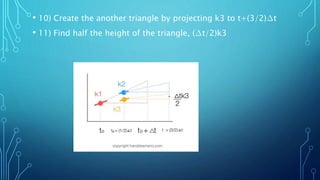
• 10) Create the another triangle by projecting k3 to t+(3/2)∆t
• 11) Find half the height of the triangle, (∆t/2)k3
• 13) Find the slope k4.
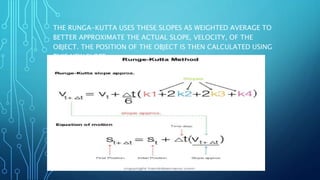
THE RUNGA-KUTTA USES THESE SLOPES AS WEIGHTED AVERAGE TO
BETTER APPROXIMATE THE ACTUAL SLOPE, VELOCITY, OF THE
OBJECT. THE POSITION OF THE OBJECT IS THEN CALCULATED USING
THIS NEW SLOPE.
• I hope this visual depiction of the Runge-Kutta method helps.

R kmethod

  • 2.
    WHY RK METHOD? • The Runge-Kutta Method is a numerical integration technique which provides a better approximation to the equation of motion. Unlike the Euler's Method, which calculates one slope at an interval, the Runge-Kutta calculates four different slopes and uses them as weighted averages.
  • 3.
    • 1) Attime interval t0, calculate slope k1. • 2) Create a triangle by projecting k1 to t+∆t.
  • 4.
    • 3) Calculatehalf the height of the triangle, (∆t/2) k1, and draw a horizontal line. • 4) Draw a vertical line at interval t+(1/2)∆t. • 5) At this intersection point, calculate the slope k2.
  • 5.
    • 6) Startingout with k2, create a triangle by projecting k2 to t+(3/2)∆t. • 7) Calculate half the height of the triangle, (∆t/2)k2.
  • 6.
    • 8) Translatethe height to the base of the triangle formed by k1 at t+(1/2)∆t.
  • 7.
    • 10) Createthe another triangle by projecting k3 to t+(3/2)∆t • 11) Find half the height of the triangle, (∆t/2)k3
  • 8.
    • 13) Findthe slope k4.
  • 9.
    THE RUNGA-KUTTA USESTHESE SLOPES AS WEIGHTED AVERAGE TO BETTER APPROXIMATE THE ACTUAL SLOPE, VELOCITY, OF THE OBJECT. THE POSITION OF THE OBJECT IS THEN CALCULATED USING THIS NEW SLOPE.
  • 10.
    • I hopethis visual depiction of the Runge-Kutta method helps.