1
1
Electrostatic fields
• Why study electrostatics?
• Many applications in biology and medicine:
-Diagnosis as incorporated in electrocardiograms,
electroencephalograms and other recordings of
organs with electrical activity)
-Therapy as incorporated in diathermy, electro-
poration, ……
2
• Electrostatics is the branch of science that deals
with the phenomena arising from what seem to be
stationary electric charges.
• Two fundamental laws govern electrostatic fields:
• 1. Coulomb’s law (Self Study)
• 2. Gauss’s law (Check experiment on the net)
• Both laws are based on experimental studies.
2
3
4
3
5
6
Coulomb’s Law
• The force F between two point charges Q1 and Q2 is:
1. Along the line joining them
2. Directly proportional to the product of Q1 and Q2
3. Inversely proportional to the square of the distance R
between them
4
7
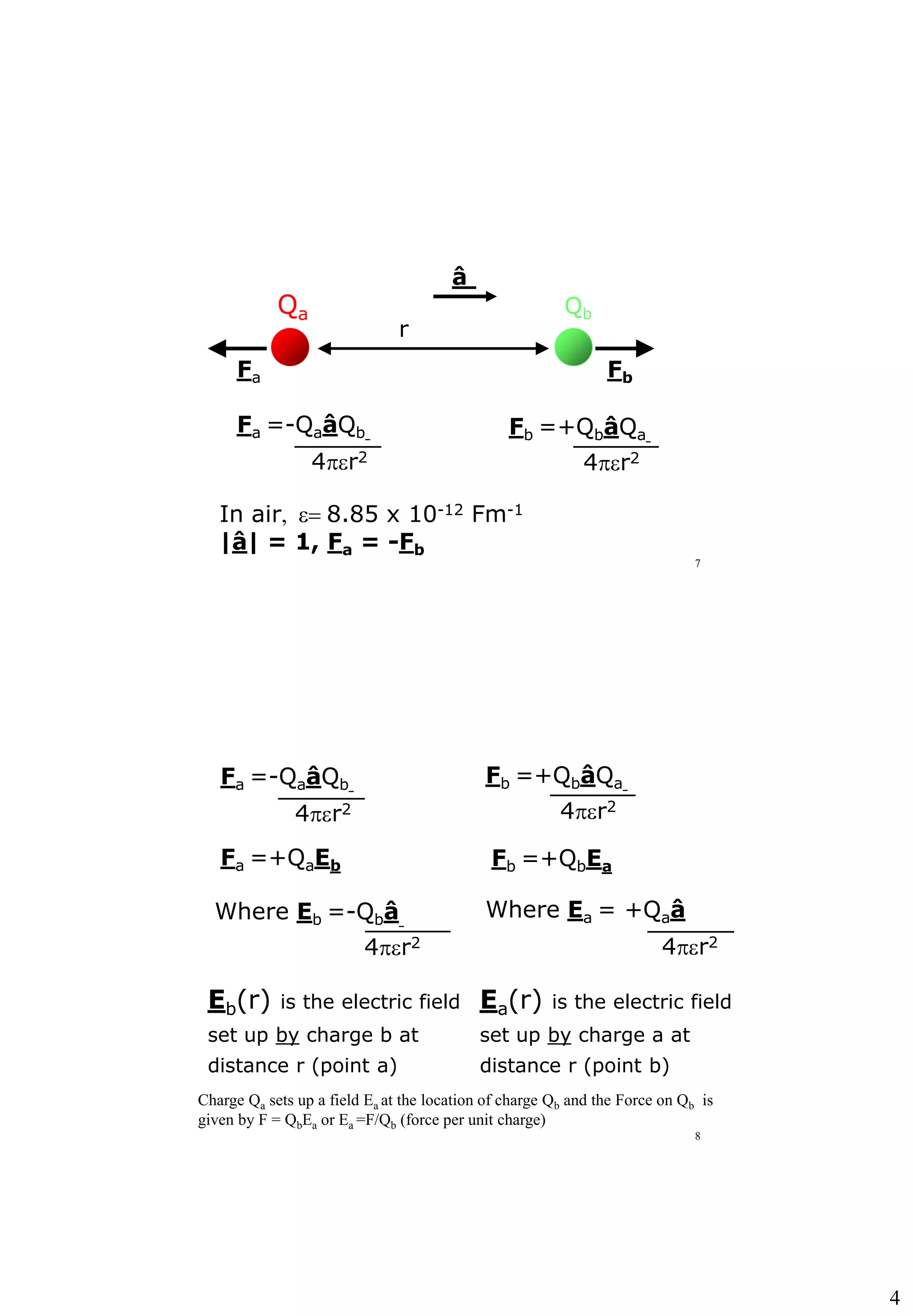
r
FbFa
Fa =-QaâQb
4per2
Fb =+QbâQa
4per2
â
In air, e= 8.85 x 10⁻¹² Fm-1
|â| = 1, Fa = -Fb
Qa Qb
8
Fa =-QaâQb
4per2
Fb =+QbâQa
4per2
Fa =+QaEb Fb =+QbEa
Where Ea = +Qaâ
4per2
Where Eb =-Qbâ
4per2
Eb(r) is the electric field
set up by charge b at
distance r (point a)
Ea(r) is the electric field
set up by charge a at
distance r (point b)
Charge Qa sets up a field Ea at the location of charge Qb and the Force on Qb is
given by F = QbEa or Ea =F/Qb (force per unit charge)
5
9
10
Several Charges?
• If there are N charges
Qa,Qb,….located
at points with position
vectors r1,r2,…
the resultant force F on
a charge Q located at point r
is the vector sum of the forces exerted on Q by each of the charges
Q1,Q2,…..
+Qa
+Qc
+Qd
-Qe
-Qb
Ea
Eb
Ec
Ed
Ee
6
11
Many charges …
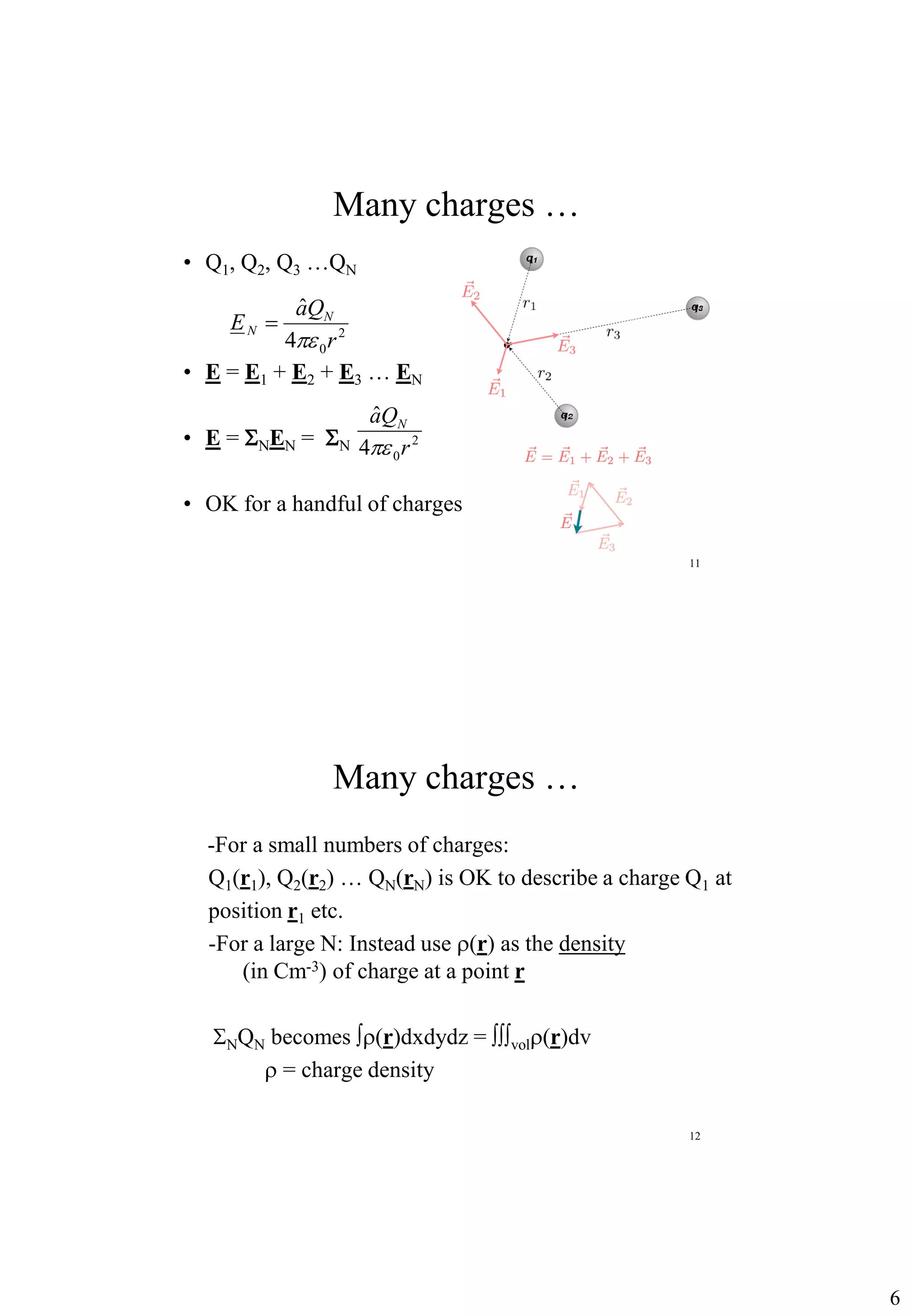
• Q1, Q2, Q3 …QN
• E = E1 + E2 + E3 … EN
• E = SNEN = SN
• OK for a handful of charges
2
04
ˆ
r
Qa
E N
N
pe
=
2
04
ˆ
r
Qa N
pe
12
Many charges …
-For a small numbers of charges:
Q1(r1), Q2(r2) … QN(rN) is OK to describe a charge Q1 at
position r1 etc.
-For a large N: Instead use r(r) as the density
(in Cm-3) of charge at a point r
SNQN becomes ∫r(r)dxdydz = ∫∫∫volr(r)dv
r = charge density
7
13
14
8
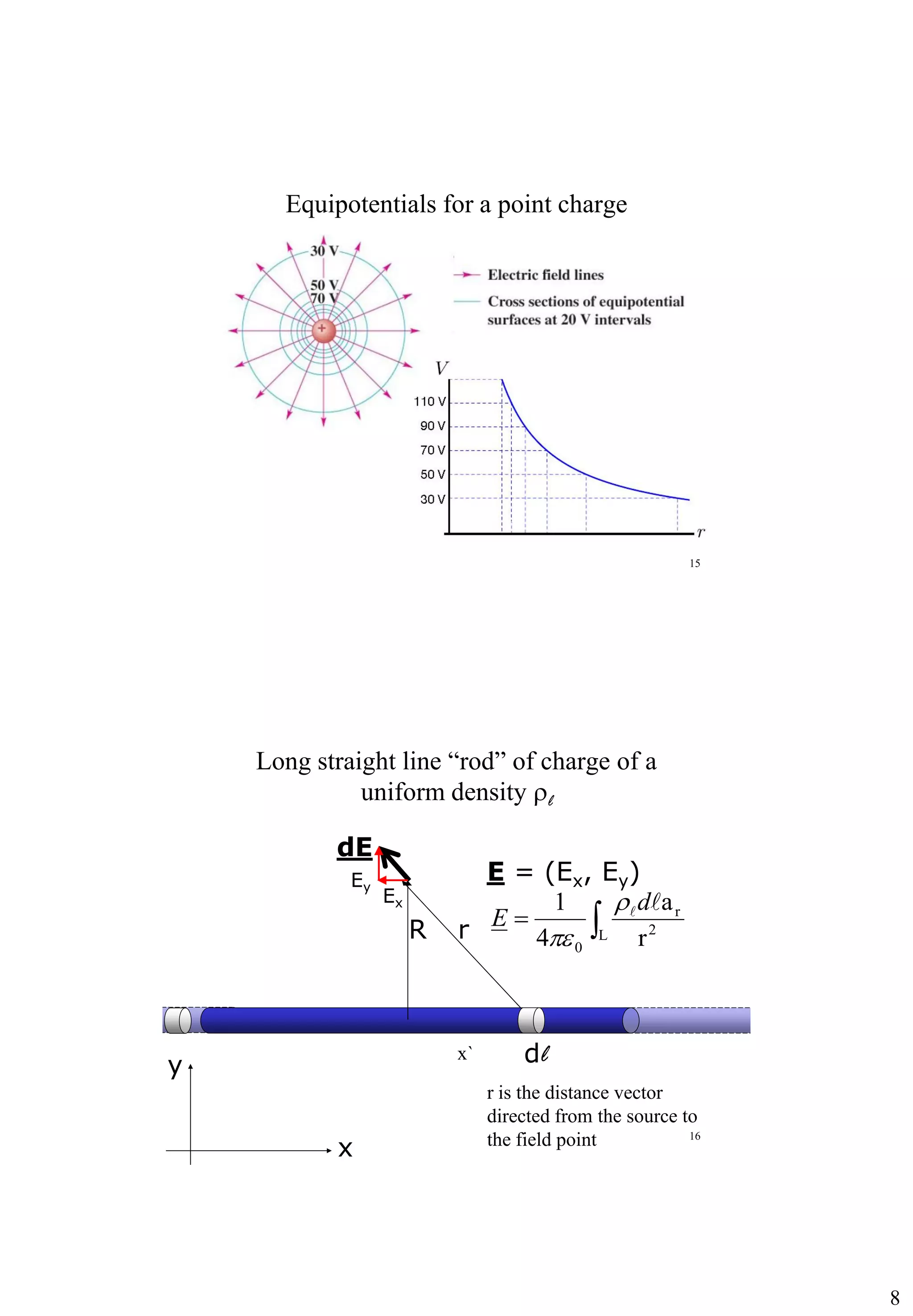
Equipotentials for a point charge
15
16
Long straight line “rod” of charge of a
uniform density rl
r is the distance vector
directed from the source to
the field point
dE
R r
dl
x
y
E = (Ex, Ey)Ey
Ex
=
L 2
r
0 r
a
4
1 d
E
r
pe
x`
9
17
• r = aRR - axx`
• For every rl dx at +x there is a charge element rl dx at
–x, which will produce a dE with components dER and
-dEx Hence the axcomponents will cancel in the integration
process.
2322
0 )(4 xR
Rdx
dER

=
pe
r
2322
x
0 )(
a
4
E
xR
xRdx
d


= Ra
pe
r
2322
0 )(4 xR
dxx
dEx


=
pe
r




== 2322
0
RR
)(4
aaE
xR
dxR
ER
pe
r
R0
R
2
aE
pe
r
=
Spherical cells in an electric field (depolarization at
the cathode and hyperpolarization at the anode)
Vm = 3/2 ER cos
10
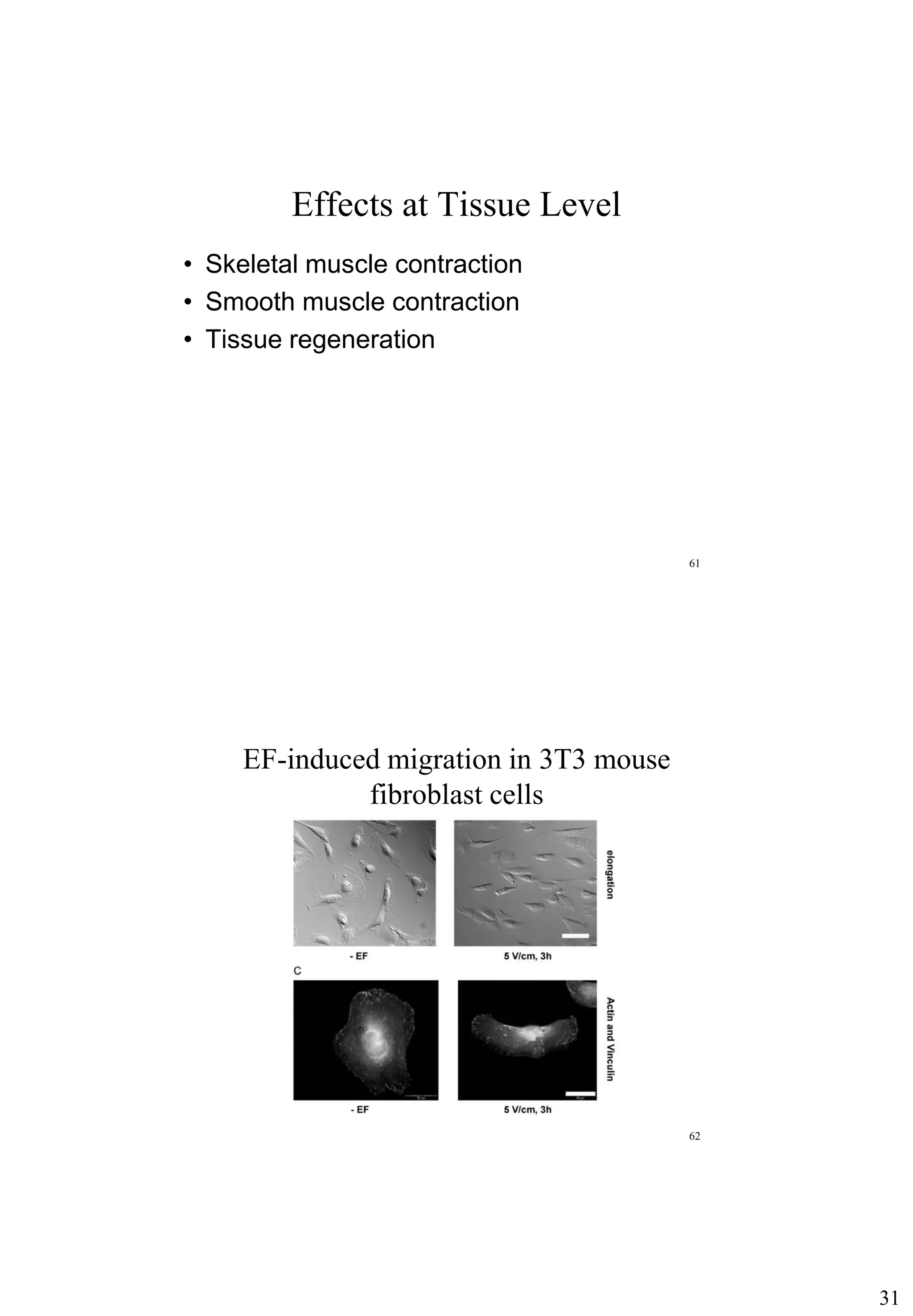
Fibroblasts in a DC electric field (elongation
perpendicular to the electric field vector
19
20
Electric Flux Density :
• Flux : number of field lines that cross a normal area
(measured in Coulombs per square meter)
D = e0E
 = D.ds
• One line of electric flux emanates from +1 C and
terminates on – 1 C.
• ε0 = 8.85 x 10⁻¹² in a vacuum
11
21
Gauss’s Law: Integral form
 = Qenc
22
Gauss’s Law - Integral form
dvdsD
dvQ
dsDd
Q
v
v
v
venc
enc


 
=
=
==
=
r
r


.
.
12
23
Gauss’s Law - Differential form
 =s v vdvsdD r

vD r=

  =s v dvDsdD

=  v vv dvdvD r

Divergence Theorem
Remember: The divergence theorem
states that the total outward flux of a
vector field through the closed surface S
is the same as the volume integral of the
divergence of A.
This equation says that the electric flux density D diverges
from free charge rv
24
Gauss’s Law : Cartoon Version
• The number of electric field lines leaving a closed surface is
equal to the charge enclosed by that surface
S(E-field-lines) a Charge Enclosed
N Coulombs  aN lines
The surface is chosen such that D is normal or tangential to the Gaussian
surface. When D is normal to the surface, D • dS = D dS. When D is tangential
to the surface, D • dS = 0.
13
25
Flux of rain (rainfall) through an area ds
ds
Rainfall
Rainfall
This area gets
wetter!
Flux rain = D.ds
|D||ds|  cos()
Dds cos()
Flux rain = 0 for 90° … cos() = 0
Flux rain = -Dds for 180° … cos() = -1
Generally, Flux rain = Dds cos()
-1 < cos() < +1
26
rl Coulombs/m
L
Gauss’s law - Example
Long straight “rod” of charge
Construct a “Gaussian Surface” that reflects the symmetry
of the charge - cylindrical in this case, then evaluate D.ds
ds
ds
E, D
ds
E, D
r
14
27
ds
E, D
r
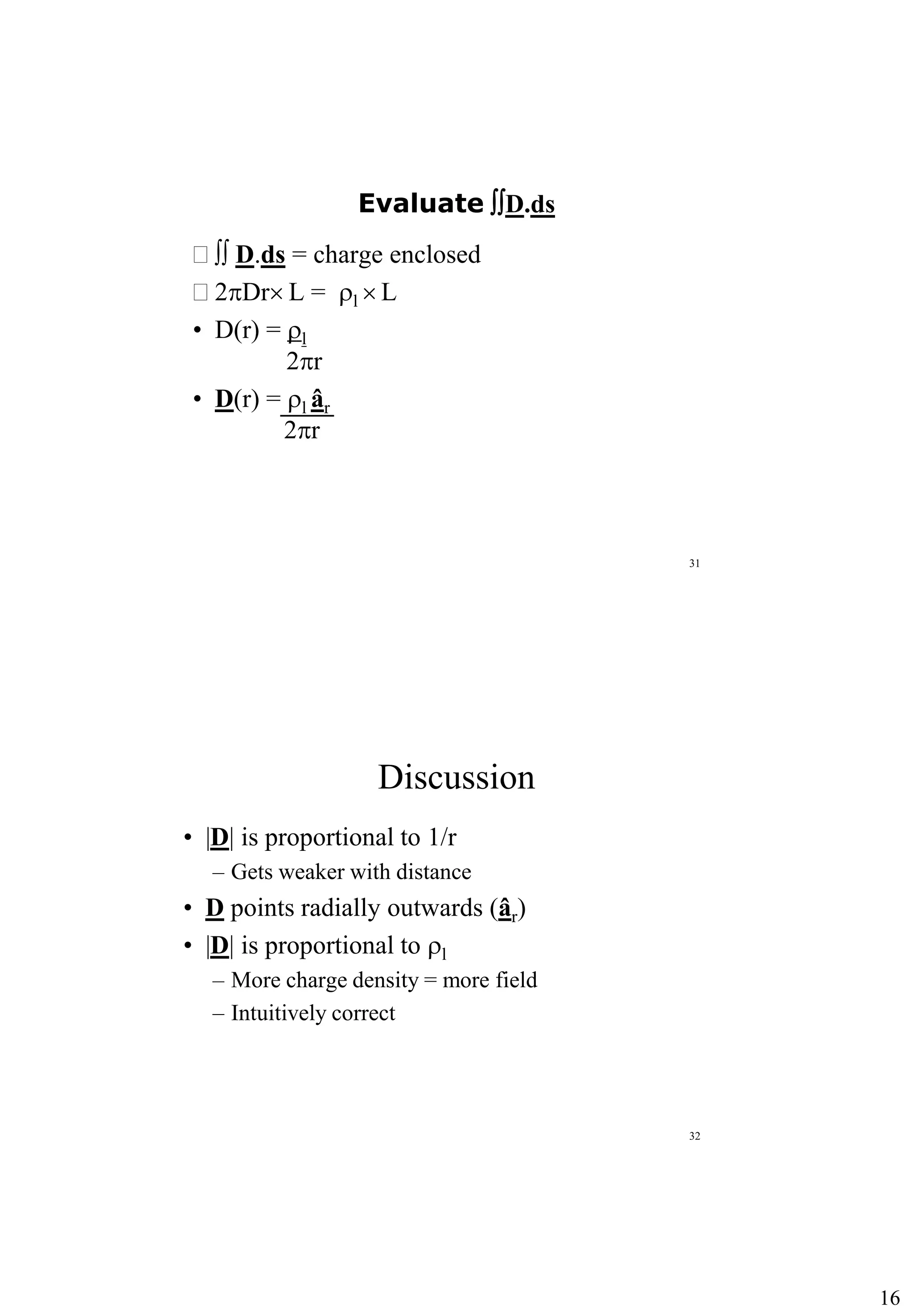
Evaluate D.ds
 D.ds =  D.ds curved surface
+ D.ds flat end faces
• End faces, D & ds are perpendicular
– D.ds on end faces = 0
–  D.ds flat end faces = 0
• Flat end faces do not contribute!
28
Evaluate D.ds
 D.ds =  D.ds curved surface only
rl Coulombs/m
L
ds
ds
E, D D & ds parallel,
D.ds = |D|´|ds| = Dds
15
29
Evaluate D.ds
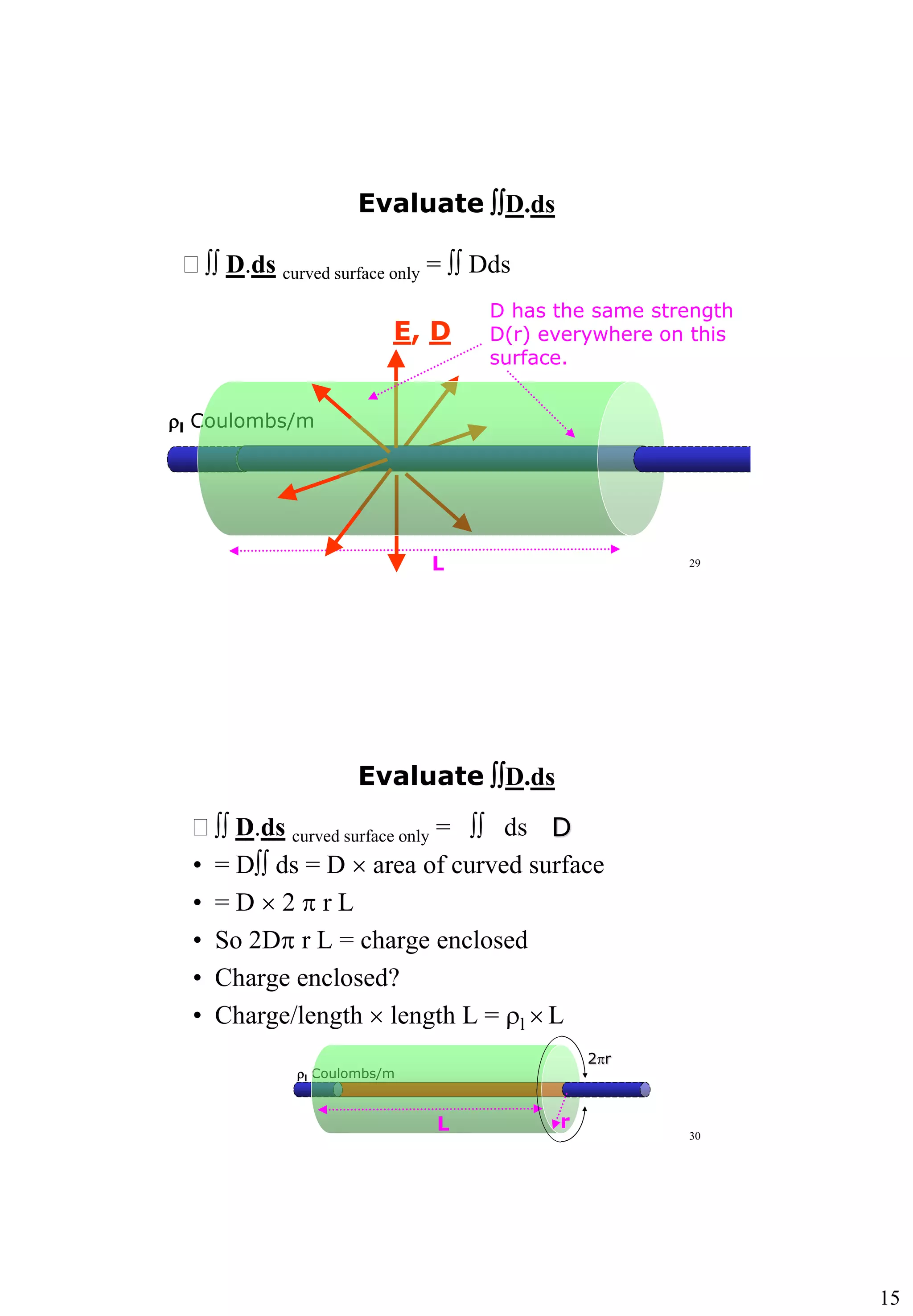
  D.ds curved surface only =  Dds
rl Coulombs/m
L
E, D
D has the same strength
D(r) everywhere on this
surface.
30
Evaluate D.ds
  D.ds curved surface only =  ds
• = D ds = D  area of curved surface
• = D  2 p r L
• So 2Dp r L = charge enclosed
• Charge enclosed?
• Charge/length  length L = rl  L
rl Coulombs/m
rL
2pr
D
16
31
Evaluate D.ds
  D.ds = charge enclosed
 2pDr L = rl  L
• D(r) = rl
2pr
• D(r) = rl âr
2pr
32
Discussion
• |D| is proportional to 1/r
– Gets weaker with distance
• D points radially outwards (âr)
• |D| is proportional to rl
– More charge density = more field
– Intuitively correct
17
33
dvdsD
v
v = r.
dvD.ds
v
v = ρ
34
18
35
36
Assume rs=
19
37
38
20
39
HW:
• Solve the previous example using Gauss’s law in
the differential form
40
Postulates of Electrostatics in Free Space
Differential Form Integral Form
- Static electric field is not solenoidal unless ρ = 0
- Static E-Fields are conservative or irrotational. If a vector field is
curl-free, then it can be expressed as the gradient of a scalar field:
-The total outward flux of the electric field intensity over any closed
surface in free space equals to the total charge enclosed in the
surface divided e0by (Gauss's Law)
-The scalar line integral of the static electric field intensity around any
closed path vanishes (KVL)
0
0
=
=
E
E
e
r


=
=
c
s
dlE
Q
dsE
0
0e
VE =
21
41
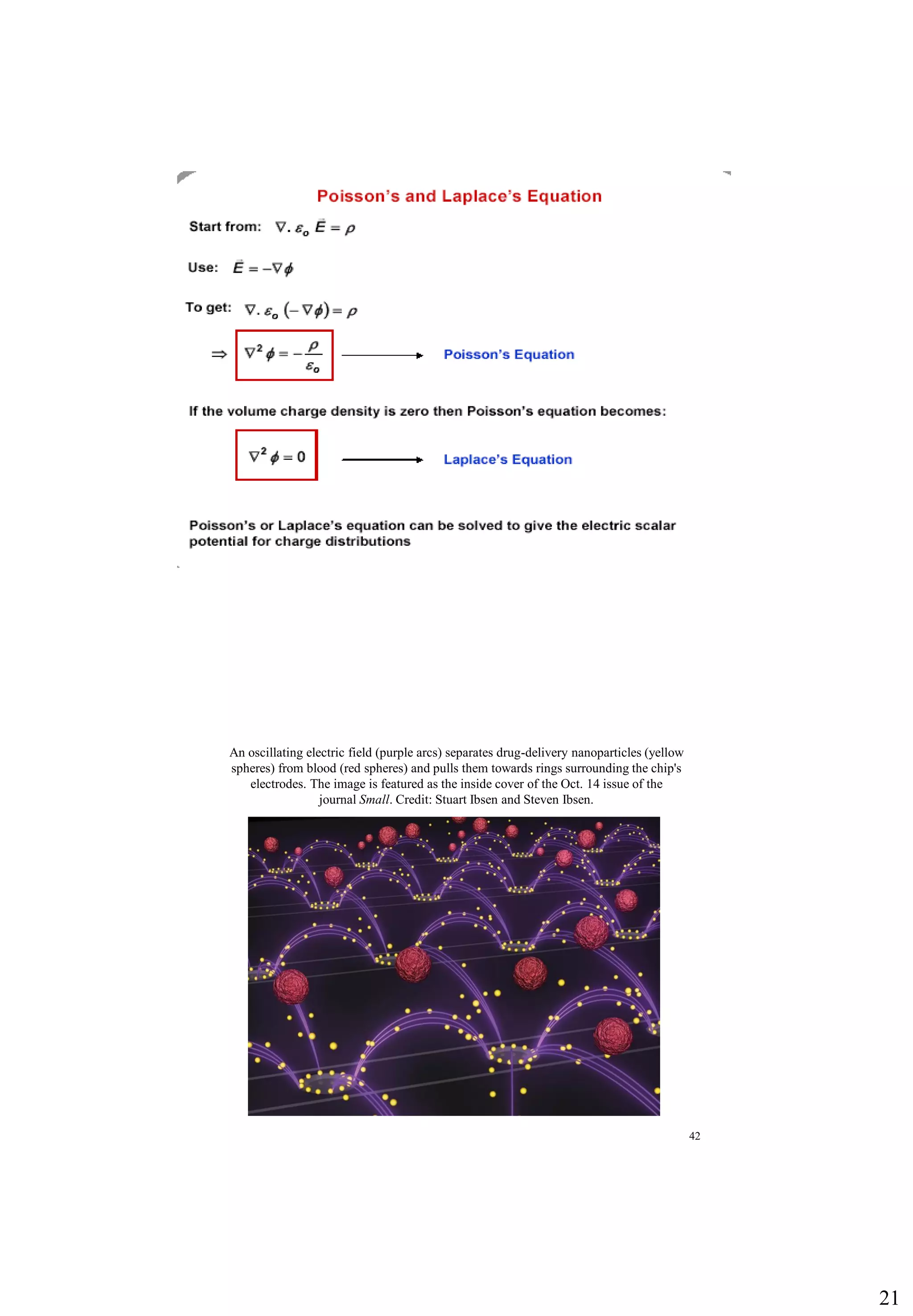
An oscillating electric field (purple arcs) separates drug-delivery nanoparticles (yellow
spheres) from blood (red spheres) and pulls them towards rings surrounding the chip's
electrodes. The image is featured as the inside cover of the Oct. 14 issue of the
journal Small. Credit: Stuart Ibsen and Steven Ibsen.
42
22
43
Parallel plate capacitor
44
VE =
23
45
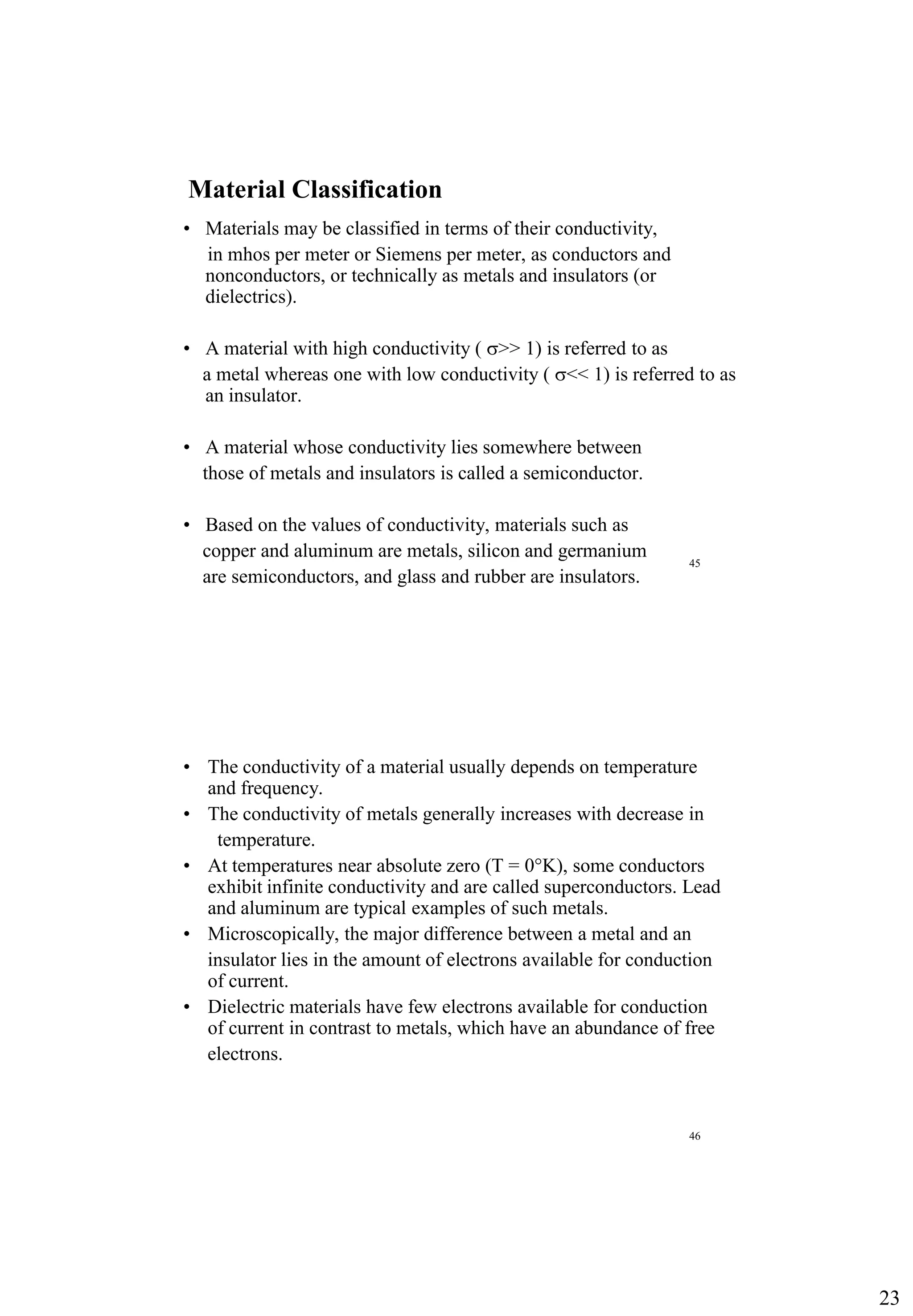
Material Classification
• Materials may be classified in terms of their conductivity,
in mhos per meter or Siemens per meter, as conductors and
nonconductors, or technically as metals and insulators (or
dielectrics).
• A material with high conductivity ( >> 1) is referred to as
a metal whereas one with low conductivity ( << 1) is referred to as
an insulator.
• A material whose conductivity lies somewhere between
those of metals and insulators is called a semiconductor.
• Based on the values of conductivity, materials such as
copper and aluminum are metals, silicon and germanium
are semiconductors, and glass and rubber are insulators.
46
• The conductivity of a material usually depends on temperature
and frequency.
• The conductivity of metals generally increases with decrease in
temperature.
• At temperatures near absolute zero (T = 0°K), some conductors
exhibit infinite conductivity and are called superconductors. Lead
and aluminum are typical examples of such metals.
• Microscopically, the major difference between a metal and an
insulator lies in the amount of electrons available for conduction
of current.
• Dielectric materials have few electrons available for conduction
of current in contrast to metals, which have an abundance of free
electrons.
24
47
Electrical Conductivity
48
Conductors and Dielectrics
25
49
Conductors in Electric Fields
50
Dielectrics in Electric Fields: Polarization
26
51
Polarization vector
52
Conductors and Dielectrics
27
53
Conduction & Displacement Currents
• Electric current is generally caused by the motion of electric charges.
• The current (in amperes) through a given area is the electric charge
passing through the area per unit time.
• Current I = dQ / dt
• If current I flows through a surface S, the current density
Jn= I / S or I = Jn S
assuming that the current density is perpendicular to the surface. If the
current density is not normal to the surface, I = J • S
• Thus, the total current flowing through a surface S is
I = ∫ J . dS
54
28
55
56
Electrical properties of body tissues
• The human body is made of a large number of materials (tissues),
each of them having specific properties.
• Since biological tissues mainly consist of water, they behave
neither as a conductor nor a dielectric, but as a lossy dielectric.
•  represents the ability of the material’s charge to be transported
throughout its volume by an applied E-field.
• e represents the ability of the material’s molecular dipoles to
rotate or its charge to be stored by an applied external applied E-
field.
• The permittivity and conductivity of biological tissues are
functions of frequency.
29
57
Examples: (Bone Cancellous)
58
Cerebellum
30
59
Grey Matter
Effects of E-Fields at Cellular
Level
• Excitation of nerve cells
• Changes in cell membrane permeability
• Protein synthesis
• Stimulation of fibroblasts and osteoblasts
• Modification of microcirculation
60
31
Effects at Tissue Level
• Skeletal muscle contraction
• Smooth muscle contraction
• Tissue regeneration
61
EF-induced migration in 3T3 mouse
fibroblast cells
62
32
Fura 2-loaded cells showing the elevation of [Ca2+]
i
initiated at rear-end (anode side) and propagating through
entire cell body as a wave (small arrows).(E= 14 V/cm)
63
Promotion of fracture healing
• Electrical current triggers bone growth
• Piezoelectric effect within the collagen matrix
• Alternating current
– Applied transcutaneously
– Similar to diathermy units (no heat production)
• Direct current
– Implanted electrodes
64
33
HW
• Present a list of FDA approved therapeutic
devices that use DC electric fields.
65

Fields Lec 3

  • 1.
    1 1 Electrostatic fields • Whystudy electrostatics? • Many applications in biology and medicine: -Diagnosis as incorporated in electrocardiograms, electroencephalograms and other recordings of organs with electrical activity) -Therapy as incorporated in diathermy, electro- poration, …… 2 • Electrostatics is the branch of science that deals with the phenomena arising from what seem to be stationary electric charges. • Two fundamental laws govern electrostatic fields: • 1. Coulomb’s law (Self Study) • 2. Gauss’s law (Check experiment on the net) • Both laws are based on experimental studies.
  • 2.
  • 3.
    3 5 6 Coulomb’s Law • Theforce F between two point charges Q1 and Q2 is: 1. Along the line joining them 2. Directly proportional to the product of Q1 and Q2 3. Inversely proportional to the square of the distance R between them
  • 4.
    4 7 r FbFa Fa =-QaâQb 4per2 Fb =+QbâQa 4per2 â Inair, e= 8.85 x 10⁻¹² Fm-1 |â| = 1, Fa = -Fb Qa Qb 8 Fa =-QaâQb 4per2 Fb =+QbâQa 4per2 Fa =+QaEb Fb =+QbEa Where Ea = +Qaâ 4per2 Where Eb =-Qbâ 4per2 Eb(r) is the electric field set up by charge b at distance r (point a) Ea(r) is the electric field set up by charge a at distance r (point b) Charge Qa sets up a field Ea at the location of charge Qb and the Force on Qb is given by F = QbEa or Ea =F/Qb (force per unit charge)
  • 5.
    5 9 10 Several Charges? • Ifthere are N charges Qa,Qb,….located at points with position vectors r1,r2,… the resultant force F on a charge Q located at point r is the vector sum of the forces exerted on Q by each of the charges Q1,Q2,….. +Qa +Qc +Qd -Qe -Qb Ea Eb Ec Ed Ee
  • 6.
    6 11 Many charges … •Q1, Q2, Q3 …QN • E = E1 + E2 + E3 … EN • E = SNEN = SN • OK for a handful of charges 2 04 ˆ r Qa E N N pe = 2 04 ˆ r Qa N pe 12 Many charges … -For a small numbers of charges: Q1(r1), Q2(r2) … QN(rN) is OK to describe a charge Q1 at position r1 etc. -For a large N: Instead use r(r) as the density (in Cm-3) of charge at a point r SNQN becomes ∫r(r)dxdydz = ∫∫∫volr(r)dv r = charge density
  • 7.
  • 8.
    8 Equipotentials for apoint charge 15 16 Long straight line “rod” of charge of a uniform density rl r is the distance vector directed from the source to the field point dE R r dl x y E = (Ex, Ey)Ey Ex = L 2 r 0 r a 4 1 d E r pe x`
  • 9.
    9 17 • r =aRR - axx` • For every rl dx at +x there is a charge element rl dx at –x, which will produce a dE with components dER and -dEx Hence the axcomponents will cancel in the integration process. 2322 0 )(4 xR Rdx dER  = pe r 2322 x 0 )( a 4 E xR xRdx d   = Ra pe r 2322 0 )(4 xR dxx dEx   = pe r     == 2322 0 RR )(4 aaE xR dxR ER pe r R0 R 2 aE pe r = Spherical cells in an electric field (depolarization at the cathode and hyperpolarization at the anode) Vm = 3/2 ER cos
  • 10.
    10 Fibroblasts in aDC electric field (elongation perpendicular to the electric field vector 19 20 Electric Flux Density : • Flux : number of field lines that cross a normal area (measured in Coulombs per square meter) D = e0E  = D.ds • One line of electric flux emanates from +1 C and terminates on – 1 C. • ε0 = 8.85 x 10⁻¹² in a vacuum
  • 11.
    11 21 Gauss’s Law: Integralform  = Qenc 22 Gauss’s Law - Integral form dvdsD dvQ dsDd Q v v v venc enc     = = == = r r   . .
  • 12.
    12 23 Gauss’s Law -Differential form  =s v vdvsdD r  vD r=    =s v dvDsdD  =  v vv dvdvD r  Divergence Theorem Remember: The divergence theorem states that the total outward flux of a vector field through the closed surface S is the same as the volume integral of the divergence of A. This equation says that the electric flux density D diverges from free charge rv 24 Gauss’s Law : Cartoon Version • The number of electric field lines leaving a closed surface is equal to the charge enclosed by that surface S(E-field-lines) a Charge Enclosed N Coulombs  aN lines The surface is chosen such that D is normal or tangential to the Gaussian surface. When D is normal to the surface, D • dS = D dS. When D is tangential to the surface, D • dS = 0.
  • 13.
    13 25 Flux of rain(rainfall) through an area ds ds Rainfall Rainfall This area gets wetter! Flux rain = D.ds |D||ds|  cos() Dds cos() Flux rain = 0 for 90° … cos() = 0 Flux rain = -Dds for 180° … cos() = -1 Generally, Flux rain = Dds cos() -1 < cos() < +1 26 rl Coulombs/m L Gauss’s law - Example Long straight “rod” of charge Construct a “Gaussian Surface” that reflects the symmetry of the charge - cylindrical in this case, then evaluate D.ds ds ds E, D ds E, D r
  • 14.
    14 27 ds E, D r Evaluate D.ds D.ds =  D.ds curved surface + D.ds flat end faces • End faces, D & ds are perpendicular – D.ds on end faces = 0 –  D.ds flat end faces = 0 • Flat end faces do not contribute! 28 Evaluate D.ds  D.ds =  D.ds curved surface only rl Coulombs/m L ds ds E, D D & ds parallel, D.ds = |D|´|ds| = Dds
  • 15.
    15 29 Evaluate D.ds  D.ds curved surface only =  Dds rl Coulombs/m L E, D D has the same strength D(r) everywhere on this surface. 30 Evaluate D.ds   D.ds curved surface only =  ds • = D ds = D  area of curved surface • = D  2 p r L • So 2Dp r L = charge enclosed • Charge enclosed? • Charge/length  length L = rl  L rl Coulombs/m rL 2pr D
  • 16.
    16 31 Evaluate D.ds  D.ds = charge enclosed  2pDr L = rl  L • D(r) = rl 2pr • D(r) = rl âr 2pr 32 Discussion • |D| is proportional to 1/r – Gets weaker with distance • D points radially outwards (âr) • |D| is proportional to rl – More charge density = more field – Intuitively correct
  • 17.
  • 18.
  • 19.
  • 20.
    20 39 HW: • Solve theprevious example using Gauss’s law in the differential form 40 Postulates of Electrostatics in Free Space Differential Form Integral Form - Static electric field is not solenoidal unless ρ = 0 - Static E-Fields are conservative or irrotational. If a vector field is curl-free, then it can be expressed as the gradient of a scalar field: -The total outward flux of the electric field intensity over any closed surface in free space equals to the total charge enclosed in the surface divided e0by (Gauss's Law) -The scalar line integral of the static electric field intensity around any closed path vanishes (KVL) 0 0 = = E E e r   = = c s dlE Q dsE 0 0e VE =
  • 21.
    21 41 An oscillating electricfield (purple arcs) separates drug-delivery nanoparticles (yellow spheres) from blood (red spheres) and pulls them towards rings surrounding the chip's electrodes. The image is featured as the inside cover of the Oct. 14 issue of the journal Small. Credit: Stuart Ibsen and Steven Ibsen. 42
  • 22.
  • 23.
    23 45 Material Classification • Materialsmay be classified in terms of their conductivity, in mhos per meter or Siemens per meter, as conductors and nonconductors, or technically as metals and insulators (or dielectrics). • A material with high conductivity ( >> 1) is referred to as a metal whereas one with low conductivity ( << 1) is referred to as an insulator. • A material whose conductivity lies somewhere between those of metals and insulators is called a semiconductor. • Based on the values of conductivity, materials such as copper and aluminum are metals, silicon and germanium are semiconductors, and glass and rubber are insulators. 46 • The conductivity of a material usually depends on temperature and frequency. • The conductivity of metals generally increases with decrease in temperature. • At temperatures near absolute zero (T = 0°K), some conductors exhibit infinite conductivity and are called superconductors. Lead and aluminum are typical examples of such metals. • Microscopically, the major difference between a metal and an insulator lies in the amount of electrons available for conduction of current. • Dielectric materials have few electrons available for conduction of current in contrast to metals, which have an abundance of free electrons.
  • 24.
  • 25.
    25 49 Conductors in ElectricFields 50 Dielectrics in Electric Fields: Polarization
  • 26.
  • 27.
    27 53 Conduction & DisplacementCurrents • Electric current is generally caused by the motion of electric charges. • The current (in amperes) through a given area is the electric charge passing through the area per unit time. • Current I = dQ / dt • If current I flows through a surface S, the current density Jn= I / S or I = Jn S assuming that the current density is perpendicular to the surface. If the current density is not normal to the surface, I = J • S • Thus, the total current flowing through a surface S is I = ∫ J . dS 54
  • 28.
    28 55 56 Electrical properties ofbody tissues • The human body is made of a large number of materials (tissues), each of them having specific properties. • Since biological tissues mainly consist of water, they behave neither as a conductor nor a dielectric, but as a lossy dielectric. •  represents the ability of the material’s charge to be transported throughout its volume by an applied E-field. • e represents the ability of the material’s molecular dipoles to rotate or its charge to be stored by an applied external applied E- field. • The permittivity and conductivity of biological tissues are functions of frequency.
  • 29.
  • 30.
    30 59 Grey Matter Effects ofE-Fields at Cellular Level • Excitation of nerve cells • Changes in cell membrane permeability • Protein synthesis • Stimulation of fibroblasts and osteoblasts • Modification of microcirculation 60
  • 31.
    31 Effects at TissueLevel • Skeletal muscle contraction • Smooth muscle contraction • Tissue regeneration 61 EF-induced migration in 3T3 mouse fibroblast cells 62
  • 32.
    32 Fura 2-loaded cellsshowing the elevation of [Ca2+] i initiated at rear-end (anode side) and propagating through entire cell body as a wave (small arrows).(E= 14 V/cm) 63 Promotion of fracture healing • Electrical current triggers bone growth • Piezoelectric effect within the collagen matrix • Alternating current – Applied transcutaneously – Similar to diathermy units (no heat production) • Direct current – Implanted electrodes 64
  • 33.
    33 HW • Present alist of FDA approved therapeutic devices that use DC electric fields. 65