

Empowering People Enhancing Education
darla/smbs/vit 2
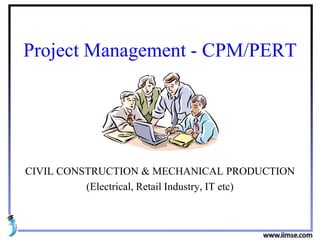
Project Management - CPM/PERT
CIVIL CONSTRUCTION & MECHANICAL PRODUCTION
(Electrical, Retail Industry, IT etc)
4
Characteristic of a project
A project is a temporary endeavour involving a connected sequence
of activities and a range of resources, which is designed to achieve a
specific and unique outcome and which operates within time, cost
and quality constraints and which is often used to introduce change.
A unique, one-time operational activity or effort
Requires the completion of a large number of interrelated activities
Established to achieve specific objective
Resources, such as people, machinery and material are limited
Typically has its own management structure
Need leadership
Project
5
Examples
– Constructing houses, factories, shopping malls, athletic
stadiums etc
– Developing military weapons systems, aircrafts, new
ships
– Launching satellite systems
– Constructing oil pipelines
– Constructing electrical lines
– Developing and implementing new technology systems
– Metro rail projects
– Power Projects
– Lunching new products into market etc.
6
What is Project Management
• Project management is the application of processes,
methods, knowledge, skills and experience to achieve
the project objectives.
OR
• Project management is the discipline of initiating,
planning, executing, controlling, and closing
the work of a team to achieve specific goals and meet
specific success criteria.
 Its origins lie in World War II, when the military
authorities used the techniques of operational research
to plan the optimum use of resources.
 One of these techniques was the use of networks to
represent a system of related activities/tasks.
Why do we use Project Management?
• Investment in effective project management will
have a number of benefits to both the host
organization and the people involved in delivering
the project.
It will:
• Provide a greater likelihood of achieving the
desired result.
• Ensure efficient and best valued use of resources.
• Satisfy the differing needs of the project’s
stakeholders.
7
Basic Steps Involved in Every Project
• Initiation
• Planning/Designing
• Execution
• Controlling/Monitoring
• Closing/Finishing
8
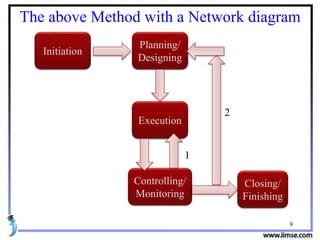
The above Method with a Network diagram
9
Initiation
Planning/
Designing
Execution
Controlling/
Monitoring
Closing/
Finishing
1
2
10
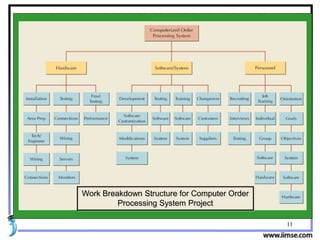
Work Breakdown Structure(WBS)
• A method of breaking down a project into individual
elements (components, subcomponents, activities and
tasks) in a hierarchical structure which can be scheduled.
• It defines activities/tasks that can be completed
independently of other tasks, facilitating resource
allocation, assignment of responsibilities and
measurement and control of the project
• It is a foundation for project planning
11
Work Breakdown Structure for Computer Order
Processing System Project
12
Project Planning
Resource Availability and Limits
Due date, late penalties, early completion incentives,
Budget etc.
Activity Information
• Identify all required activities/tasks
• Estimate the resources required (based on time) to
complete each activity
• Predecessor/Successor to each activity is required
to create relationships among all the activities.
13
Project Scheduling and Control Techniques
 Critical Path Method (CPM)
 Program Evaluation and Review Technique (PERT)
Bothe the methods will use Gantt Chart to represent a
project as Network Diagram
14
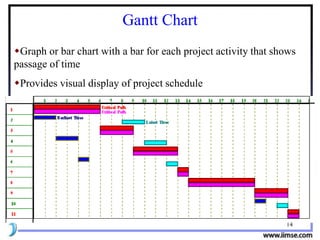
Graph or bar chart with a bar for each project activity that shows
passage of time
Provides visual display of project schedule
Gantt Chart
15
History of CPM/PERT
• Critical Path Method (CPM)
– E I Du Pont de Nemours & Co. (1957) for construction of new
chemical plant and maintenance shut-down
– Deterministic task times
– Activity-on-node network construction
– Repetitive nature of jobs
• Project Evaluation and Review Technique (PERT)
– U S Navy (1958) for the POLARIS missile program
– Multiple task time estimates (probabilistic nature)
– Activity-on-arrow network construction
– Non-repetitive jobs (R & D work)
16
Project Network
• Network analysis is the general name given to certain specific
techniques which can be used for the planning, management and
control of projects
• Use of nodes and arrows
Arrows  An arrow leads from tail to head directionally
– Indicate ACTIVITY, a time consuming effort that is required to perform a
part of the work.
Nodes  A node is represented by a circle
- Indicate EVENT, a point in time where one or more activities start and/or
finish.
• Activity
– A task or a certain amount of work required in the project
– Requires time to complete
– Represented by an arrow
• Dummy Activity
– Indicates only precedence relationships
– Does not require any time of effort
17
• Event
– Signals the beginning or ending of an activity
– Designates a point in time
– Represented by a circle (node)
• Network
– Shows the sequential relationships among activities using nodes
and arrows
Activity-on-node (AON)
nodes represent activities, and arrows show precedence
relationships
Activity-on-arrow (AOA)
arrows represent activities and nodes are events for points in
time
Project Network
darla/smbs/vit 18
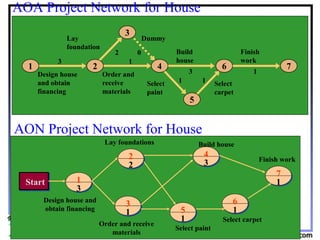
AOA Project Network for House
3
2 0
1
3
1 1
1
1 2 4 6 7
3
5
Lay
foundation
Design house
and obtain
financing
Order and
receive
materials
Dummy
Finish
work
Select
carpet
Select
paint
Build
house
AON Project Network for House
1
3
2
2
4
3
3
1 5
1
6
1
7
1Start
Design house and
obtain financing
Order and receive
materials
Select paint
Select carpet
Lay foundations Build house
Finish work
19
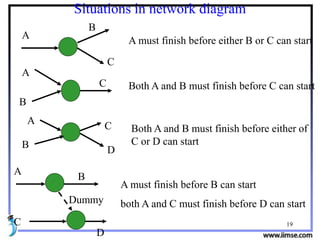
Situations in network diagram
A
B
C
A must finish before either B or C can start
A
B
C Both A and B must finish before C can start
D
C
B
A
Both A and B must finish before either of
C or D can start
A
C
B
D
Dummy
A must finish before B can start
both A and C must finish before D can start
20
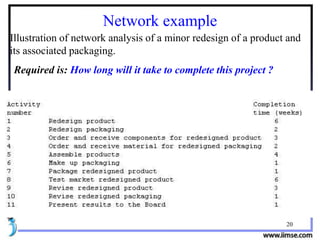
Network example
Illustration of network analysis of a minor redesign of a product and
its associated packaging.
Required is: How long will it take to complete this project ?
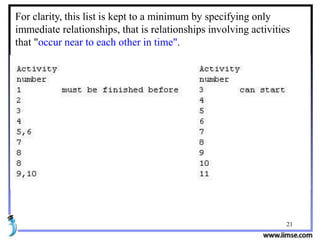
21
For clarity, this list is kept to a minimum by specifying only
immediate relationships, that is relationships involving activities
that "occur near to each other in time".
darla/smbs/vit 22
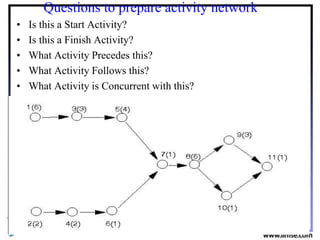
Questions to prepare activity network
• Is this a Start Activity?
• Is this a Finish Activity?
• What Activity Precedes this?
• What Activity Follows this?
• What Activity is Concurrent with this?
23
CPM calculation
• Path
– A connected sequence of activities leading from
the starting activity to the ending activity.
• Critical Path
– The longest path (time); determines the project
duration
• Critical Activities
– All of the activities that make up the critical path
24
Forward Pass
• Earliest Start Time (ES)
– earliest time an activity can start
– ES = maximum EF of immediate predecessors
• Earliest finish time (EF)
– earliest time an activity can finish
– earliest start time plus activity time
EF= ES + t
Latest Start Time (LS)
Latest time an activity can start without delaying critical path time
LS= LF - t
Latest finish time (LF)
latest time an activity can be completed without delaying critical
path time
LS = minimum LS of immediate predecessors
Backward Pass
Methods to Estimate Dates
25
CPM analysis
• Draw the CPM network
• Analyze the paths through the network
• Determine the float for each activity
– Compute the activity’s float
float = LS - ES = LF - EF
– Float is the maximum amount of time that an activity can be delay
in its completion before it becomes a critical activity, i.e., delays
completion of the project
• Find the critical path is that the sequence of activities and events where
there is no “slack” i.e.. Zero slack
– Longest path through a network
• To find the project duration. It is the minimum project completion time
26
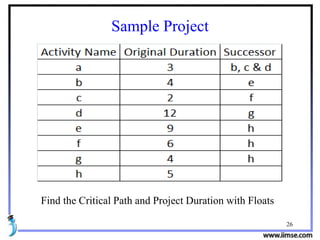
Sample Project
Find the Critical Path and Project Duration with Floats
27
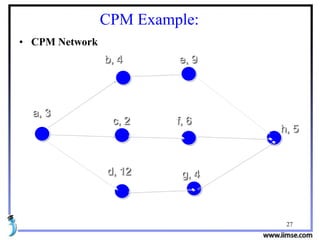
CPM Example:
• CPM Network
a, 3
e, 9b, 4
c, 2
g, 4d, 12
f, 6
h, 5
28
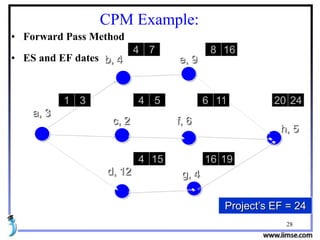
CPM Example:
• Forward Pass Method
a, 3
e, 9b, 4
c, 2
g, 4d, 12
f, 6
h, 5
1 3
4 7 8 16
4 5 6 11 20 24
4 15 16 19
Project’s EF = 24
• ES and EF dates
29
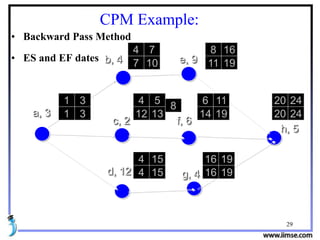
CPM Example:
a, 3
e, 9b, 4
c, 2
g, 4d, 12
f, 6
h, 5
1 3
1 3
4 7
7 10
8 16
11 19
4 5
12 13
8
6 11
14 19
20 24
20 24
4 15
4 15
16 19
16 19
• Backward Pass Method
• ES and EF dates
30
CPM Example:
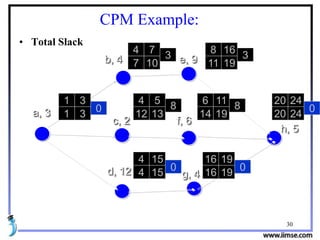
• Total Slack
a, 3
e, 9b, 4
c, 2
g, 4d, 12
f, 6
h, 5
1 3
1 3
0
4 7
7 10
3
8 16
11 19
3
4 5
12 13
8
6 11
14 19
8
20 24
20 24
4 15
4 15
16 19
16 19
0
00
31
CPM Example:
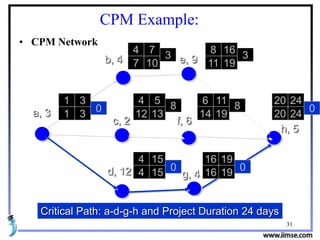
• CPM Network
a, 3
e, 9b, 4
c, 2
g, 4d, 12
f, 6
h, 5
1 3
1 3
0
4 7
7 10
3
8 16
11 19
3
4 5
12 13
8
6 11
14 19
8
20 24
20 24
4 15
4 15
16 19
16 19
0
00
Critical Path: a-d-g-h and Project Duration 24 days
32
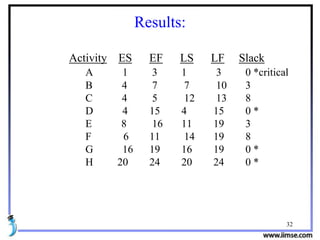
Activity ES EF LS LF Slack
A 1 3 1 3 0 *critical
B 4 7 7 10 3
C 4 5 12 13 8
D 4 15 4 15 0 *
E 8 16 11 19 3
F 6 11 14 19 8
G 16 19 16 19 0 *
H 20 24 20 24 0 *
Results:
33
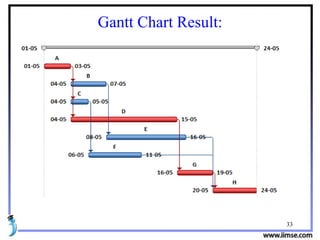
Gantt Chart Result:
PROJECT COST
35
Cost consideration in project
• Project managers may have the option or requirement to crash the
project, or accelerate the completion of the project.
• This is accomplished by reducing the length of the critical path(s).
• The length of the critical path is reduced by reducing the duration
of the activities on the critical path.
• If each activity requires the expenditure of an amount of money to
reduce its duration by one unit of time, then the project manager
selects the least cost critical activity, reduces it by one time unit,
and traces that change through the remainder of the network.
• As a result of a reduction in an activity’s time, a new critical path
may be created.
• When there is more than one critical path, each of the critical
paths must be reduced.
• If the length of the project needs to be reduced further, the
process is repeated.
36
Project Crashing
• Crashing
– Reducing project time by expending additional resources
• Crash time
– An amount of time an activity is reduced
• Crash cost
– Cost of reducing activity time
• Goal
– Reduce project duration at minimum cost
37
Benefits of CPM/PERT
• Useful at many stages of project management
• Mathematically simple
• Give critical path and slack time
• Provide project documentation
• Useful in monitoring costs
•How long will the entire project take to be completed? What are the
risks involved?
•Which are the critical activities or tasks in the project which could
delay the entire project if they were not completed on time?
•Is the project on schedule, behind schedule or ahead of schedule?
•If the project has to be finished earlier than planned, what is the best
way to do this at the least cost?
CPM/PERT can answer the following important
questions:
38
Earned Value (Analysis) Management
• Earned Value analysis is a method of performance measurement.
• Earned Value is a program management technique that uses “work in
progress” to indicate what will happen to work in the future.
• Earned Value is an enhancement over traditional accounting progress
measures. Traditional methods focus on planned accomplishment
(expenditure) and actual costs.
• But Earned Value goes one step further and examines actual
accomplishment. This gives managers greater insight into potential risk
areas.
39
Description of Earned Value Management terms
Three quantities form the basis for cost performance measurement using
Earned Value Management.
• They are Budgeted Cost of Work Scheduled (BCWS) or Planned Value (PV)
• Budgeted Cost of Work Performed (BCWP) or Earned Value (EV) and
• Actual Cost of Work Performed (ACWP) or Actual Cost (AC).
The above quantities are defined below.
• Budgeted Cost of Work Scheduled (BCWS) or Planned Value (PV) – The
sum of budgets for all work packages scheduled to be accomplished within a
given time period.
• Budgeted Cost of Work Performed (BCWP) or Earned Value (EV) – The sum
of budgets for completed work packages and completed portions of open work
packages.
• Actual Cost of Work Performed (ACWP) or Actual Cost (AC) – The actual
cost incurred in accomplishing the work performed within a given time period.
40
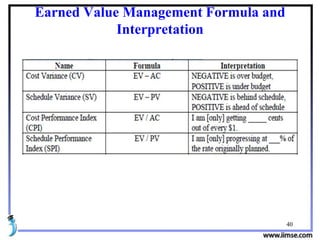
Earned Value Management Formula and
Interpretation
41
Limitations to CPM/PERT
• Clearly defined, independent and stable activities
• Specified precedence relationships
• Over emphasis on critical paths
• Activity time estimates are subjective and depend on judgment
• Concerned people with work experience required
42
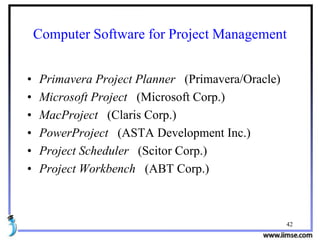
Computer Software for Project Management
• Primavera Project Planner (Primavera/Oracle)
• Microsoft Project (Microsoft Corp.)
• MacProject (Claris Corp.)
• PowerProject (ASTA Development Inc.)
• Project Scheduler (Scitor Corp.)
• Project Workbench (ABT Corp.)
43

PMP Project Management Basics Tutorial For Beginners

  • 1.
  • 2.
  • 3.
    Project Management -CPM/PERT CIVIL CONSTRUCTION & MECHANICAL PRODUCTION (Electrical, Retail Industry, IT etc)
  • 4.
    4 Characteristic of aproject A project is a temporary endeavour involving a connected sequence of activities and a range of resources, which is designed to achieve a specific and unique outcome and which operates within time, cost and quality constraints and which is often used to introduce change. A unique, one-time operational activity or effort Requires the completion of a large number of interrelated activities Established to achieve specific objective Resources, such as people, machinery and material are limited Typically has its own management structure Need leadership Project
  • 5.
    5 Examples – Constructing houses,factories, shopping malls, athletic stadiums etc – Developing military weapons systems, aircrafts, new ships – Launching satellite systems – Constructing oil pipelines – Constructing electrical lines – Developing and implementing new technology systems – Metro rail projects – Power Projects – Lunching new products into market etc.
  • 6.
    6 What is ProjectManagement • Project management is the application of processes, methods, knowledge, skills and experience to achieve the project objectives. OR • Project management is the discipline of initiating, planning, executing, controlling, and closing the work of a team to achieve specific goals and meet specific success criteria.  Its origins lie in World War II, when the military authorities used the techniques of operational research to plan the optimum use of resources.  One of these techniques was the use of networks to represent a system of related activities/tasks.
  • 7.
    Why do weuse Project Management? • Investment in effective project management will have a number of benefits to both the host organization and the people involved in delivering the project. It will: • Provide a greater likelihood of achieving the desired result. • Ensure efficient and best valued use of resources. • Satisfy the differing needs of the project’s stakeholders. 7
  • 8.
    Basic Steps Involvedin Every Project • Initiation • Planning/Designing • Execution • Controlling/Monitoring • Closing/Finishing 8
  • 9.
    The above Methodwith a Network diagram 9 Initiation Planning/ Designing Execution Controlling/ Monitoring Closing/ Finishing 1 2
  • 10.
    10 Work Breakdown Structure(WBS) •A method of breaking down a project into individual elements (components, subcomponents, activities and tasks) in a hierarchical structure which can be scheduled. • It defines activities/tasks that can be completed independently of other tasks, facilitating resource allocation, assignment of responsibilities and measurement and control of the project • It is a foundation for project planning
  • 11.
    11 Work Breakdown Structurefor Computer Order Processing System Project
  • 12.
    12 Project Planning Resource Availabilityand Limits Due date, late penalties, early completion incentives, Budget etc. Activity Information • Identify all required activities/tasks • Estimate the resources required (based on time) to complete each activity • Predecessor/Successor to each activity is required to create relationships among all the activities.
  • 13.
    13 Project Scheduling andControl Techniques  Critical Path Method (CPM)  Program Evaluation and Review Technique (PERT) Bothe the methods will use Gantt Chart to represent a project as Network Diagram
  • 14.
    14 Graph or barchart with a bar for each project activity that shows passage of time Provides visual display of project schedule Gantt Chart
  • 15.
    15 History of CPM/PERT •Critical Path Method (CPM) – E I Du Pont de Nemours & Co. (1957) for construction of new chemical plant and maintenance shut-down – Deterministic task times – Activity-on-node network construction – Repetitive nature of jobs • Project Evaluation and Review Technique (PERT) – U S Navy (1958) for the POLARIS missile program – Multiple task time estimates (probabilistic nature) – Activity-on-arrow network construction – Non-repetitive jobs (R & D work)
  • 16.
    16 Project Network • Networkanalysis is the general name given to certain specific techniques which can be used for the planning, management and control of projects • Use of nodes and arrows Arrows  An arrow leads from tail to head directionally – Indicate ACTIVITY, a time consuming effort that is required to perform a part of the work. Nodes  A node is represented by a circle - Indicate EVENT, a point in time where one or more activities start and/or finish. • Activity – A task or a certain amount of work required in the project – Requires time to complete – Represented by an arrow • Dummy Activity – Indicates only precedence relationships – Does not require any time of effort
  • 17.
    17 • Event – Signalsthe beginning or ending of an activity – Designates a point in time – Represented by a circle (node) • Network – Shows the sequential relationships among activities using nodes and arrows Activity-on-node (AON) nodes represent activities, and arrows show precedence relationships Activity-on-arrow (AOA) arrows represent activities and nodes are events for points in time Project Network
  • 18.
    darla/smbs/vit 18 AOA ProjectNetwork for House 3 2 0 1 3 1 1 1 1 2 4 6 7 3 5 Lay foundation Design house and obtain financing Order and receive materials Dummy Finish work Select carpet Select paint Build house AON Project Network for House 1 3 2 2 4 3 3 1 5 1 6 1 7 1Start Design house and obtain financing Order and receive materials Select paint Select carpet Lay foundations Build house Finish work
  • 19.
    19 Situations in networkdiagram A B C A must finish before either B or C can start A B C Both A and B must finish before C can start D C B A Both A and B must finish before either of C or D can start A C B D Dummy A must finish before B can start both A and C must finish before D can start
  • 20.
    20 Network example Illustration ofnetwork analysis of a minor redesign of a product and its associated packaging. Required is: How long will it take to complete this project ?
  • 21.
    21 For clarity, thislist is kept to a minimum by specifying only immediate relationships, that is relationships involving activities that "occur near to each other in time".
  • 22.
    darla/smbs/vit 22 Questions toprepare activity network • Is this a Start Activity? • Is this a Finish Activity? • What Activity Precedes this? • What Activity Follows this? • What Activity is Concurrent with this?
  • 23.
    23 CPM calculation • Path –A connected sequence of activities leading from the starting activity to the ending activity. • Critical Path – The longest path (time); determines the project duration • Critical Activities – All of the activities that make up the critical path
  • 24.
    24 Forward Pass • EarliestStart Time (ES) – earliest time an activity can start – ES = maximum EF of immediate predecessors • Earliest finish time (EF) – earliest time an activity can finish – earliest start time plus activity time EF= ES + t Latest Start Time (LS) Latest time an activity can start without delaying critical path time LS= LF - t Latest finish time (LF) latest time an activity can be completed without delaying critical path time LS = minimum LS of immediate predecessors Backward Pass Methods to Estimate Dates
  • 25.
    25 CPM analysis • Drawthe CPM network • Analyze the paths through the network • Determine the float for each activity – Compute the activity’s float float = LS - ES = LF - EF – Float is the maximum amount of time that an activity can be delay in its completion before it becomes a critical activity, i.e., delays completion of the project • Find the critical path is that the sequence of activities and events where there is no “slack” i.e.. Zero slack – Longest path through a network • To find the project duration. It is the minimum project completion time
  • 26.
    26 Sample Project Find theCritical Path and Project Duration with Floats
  • 27.
    27 CPM Example: • CPMNetwork a, 3 e, 9b, 4 c, 2 g, 4d, 12 f, 6 h, 5
  • 28.
    28 CPM Example: • ForwardPass Method a, 3 e, 9b, 4 c, 2 g, 4d, 12 f, 6 h, 5 1 3 4 7 8 16 4 5 6 11 20 24 4 15 16 19 Project’s EF = 24 • ES and EF dates
  • 29.
    29 CPM Example: a, 3 e,9b, 4 c, 2 g, 4d, 12 f, 6 h, 5 1 3 1 3 4 7 7 10 8 16 11 19 4 5 12 13 8 6 11 14 19 20 24 20 24 4 15 4 15 16 19 16 19 • Backward Pass Method • ES and EF dates
  • 30.
    30 CPM Example: • TotalSlack a, 3 e, 9b, 4 c, 2 g, 4d, 12 f, 6 h, 5 1 3 1 3 0 4 7 7 10 3 8 16 11 19 3 4 5 12 13 8 6 11 14 19 8 20 24 20 24 4 15 4 15 16 19 16 19 0 00
  • 31.
    31 CPM Example: • CPMNetwork a, 3 e, 9b, 4 c, 2 g, 4d, 12 f, 6 h, 5 1 3 1 3 0 4 7 7 10 3 8 16 11 19 3 4 5 12 13 8 6 11 14 19 8 20 24 20 24 4 15 4 15 16 19 16 19 0 00 Critical Path: a-d-g-h and Project Duration 24 days
  • 32.
    32 Activity ES EFLS LF Slack A 1 3 1 3 0 *critical B 4 7 7 10 3 C 4 5 12 13 8 D 4 15 4 15 0 * E 8 16 11 19 3 F 6 11 14 19 8 G 16 19 16 19 0 * H 20 24 20 24 0 * Results:
  • 33.
  • 34.
  • 35.
    35 Cost consideration inproject • Project managers may have the option or requirement to crash the project, or accelerate the completion of the project. • This is accomplished by reducing the length of the critical path(s). • The length of the critical path is reduced by reducing the duration of the activities on the critical path. • If each activity requires the expenditure of an amount of money to reduce its duration by one unit of time, then the project manager selects the least cost critical activity, reduces it by one time unit, and traces that change through the remainder of the network. • As a result of a reduction in an activity’s time, a new critical path may be created. • When there is more than one critical path, each of the critical paths must be reduced. • If the length of the project needs to be reduced further, the process is repeated.
  • 36.
    36 Project Crashing • Crashing –Reducing project time by expending additional resources • Crash time – An amount of time an activity is reduced • Crash cost – Cost of reducing activity time • Goal – Reduce project duration at minimum cost
  • 37.
    37 Benefits of CPM/PERT •Useful at many stages of project management • Mathematically simple • Give critical path and slack time • Provide project documentation • Useful in monitoring costs •How long will the entire project take to be completed? What are the risks involved? •Which are the critical activities or tasks in the project which could delay the entire project if they were not completed on time? •Is the project on schedule, behind schedule or ahead of schedule? •If the project has to be finished earlier than planned, what is the best way to do this at the least cost? CPM/PERT can answer the following important questions:
  • 38.
    38 Earned Value (Analysis)Management • Earned Value analysis is a method of performance measurement. • Earned Value is a program management technique that uses “work in progress” to indicate what will happen to work in the future. • Earned Value is an enhancement over traditional accounting progress measures. Traditional methods focus on planned accomplishment (expenditure) and actual costs. • But Earned Value goes one step further and examines actual accomplishment. This gives managers greater insight into potential risk areas.
  • 39.
    39 Description of EarnedValue Management terms Three quantities form the basis for cost performance measurement using Earned Value Management. • They are Budgeted Cost of Work Scheduled (BCWS) or Planned Value (PV) • Budgeted Cost of Work Performed (BCWP) or Earned Value (EV) and • Actual Cost of Work Performed (ACWP) or Actual Cost (AC). The above quantities are defined below. • Budgeted Cost of Work Scheduled (BCWS) or Planned Value (PV) – The sum of budgets for all work packages scheduled to be accomplished within a given time period. • Budgeted Cost of Work Performed (BCWP) or Earned Value (EV) – The sum of budgets for completed work packages and completed portions of open work packages. • Actual Cost of Work Performed (ACWP) or Actual Cost (AC) – The actual cost incurred in accomplishing the work performed within a given time period.
  • 40.
    40 Earned Value ManagementFormula and Interpretation
  • 41.
    41 Limitations to CPM/PERT •Clearly defined, independent and stable activities • Specified precedence relationships • Over emphasis on critical paths • Activity time estimates are subjective and depend on judgment • Concerned people with work experience required
  • 42.
    42 Computer Software forProject Management • Primavera Project Planner (Primavera/Oracle) • Microsoft Project (Microsoft Corp.) • MacProject (Claris Corp.) • PowerProject (ASTA Development Inc.) • Project Scheduler (Scitor Corp.) • Project Workbench (ABT Corp.)
  • 43.