Mammals

   BEENISH SARFRAZ,GROUP 8
                         1
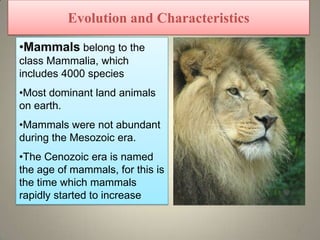
Evolution and Characteristics

             belong to the
class Mammalia, which
includes 4000 species
•Most dominant land animals
on earth.
•Mammals were not abundant
during the Mesozoic era.
•The Cenozoic era is named
the age of mammals, for this is
the time which mammals
rapidly started to increase


                                          2
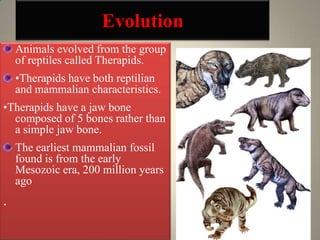
Evolution
    Animals evolved from the group
    of reptiles called Therapids.
    •Therapids have both reptilian
    and mammalian characteristics.
•Therapids have a jaw bone
  composed of 5 bones rather than
  a simple jaw bone.
    The earliest mammalian fossil
    found is from the early
    Mesozoic era, 200 million years
    ago
.
                                      3
Characteristics
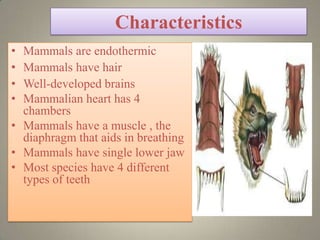
• Mammals are endothermic
• Mammals have hair
• Well-developed brains
• Mammalian heart has 4
  chambers
• Mammals have a muscle , the
  diaphragm that aids in breathing
• Mammals have single lower jaw
• Most species have 4 different
  types of teeth


                                      4
Characteristics
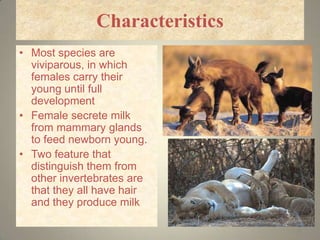
• Most species are
  viviparous, in which
  females carry their
  young until full
  development
• Female secrete milk
  from mammary glands
  to feed newborn young.
• Two feature that
  distinguish them from
  other invertebrates are
  that they all have hair
  and they produce milk

                                 5
Mammal Orders
  There are 19 orders of
   mammals in the class
Mammalia in which 17 nourish
unborn young in the placenta,
  egg laying mammals and
         marsupials

                                6
Monotremata
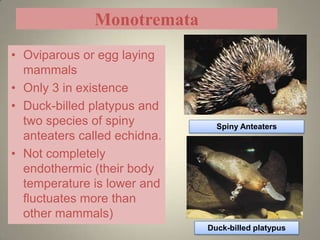
• Oviparous or egg laying
  mammals
• Only 3 in existence
• Duck-billed platypus and
  two species of spiny          Spiny Anteaters
  anteaters called echidna.
• Not completely
  endothermic (their body
  temperature is lower and
  fluctuates more than
  other mammals)
                              Duck-billed platypus   7
Marsupials
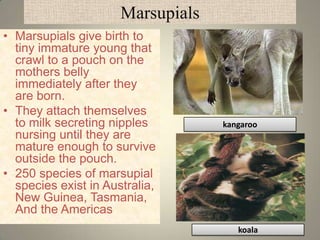
• Marsupials give birth to
  tiny immature young that
  crawl to a pouch on the
  mothers belly
  immediately after they
  are born.
• They attach themselves
  to milk secreting nipples        kangaroo
  nursing until they are
  mature enough to survive
  outside the pouch.
• 250 species of marsupial
  species exist in Australia,
  New Guinea, Tasmania,
  And the Americas
                                      koala
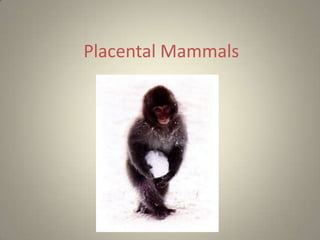
Placental Mammals


                    9
Characteristics of Placentals
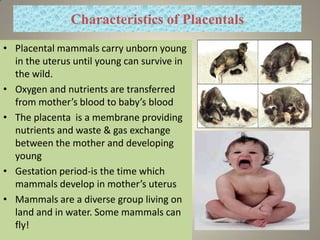
• Placental mammals carry unborn young
  in the uterus until young can survive in
  the wild.
• Oxygen and nutrients are transferred
  from mother’s blood to baby’s blood
• The placenta is a membrane providing
  nutrients and waste & gas exchange
  between the mother and developing
  young
• Gestation period-is the time which
  mammals develop in mother’s uterus
• Mammals are a diverse group living on
  land and in water. Some mammals can
  fly!                                         10
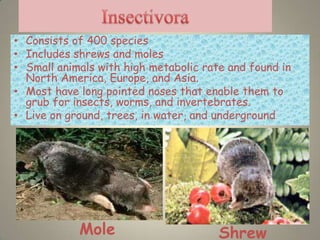
• Consists of 400 species
• Includes shrews and moles
• Small animals with high metabolic rate and found in
  North America, Europe, and Asia.
• Most have long pointed noses that enable them to
  grub for insects, worms, and invertebrates.
• Live on ground, trees, in water, and underground


            Mole                       Shrew            11
Rodentia


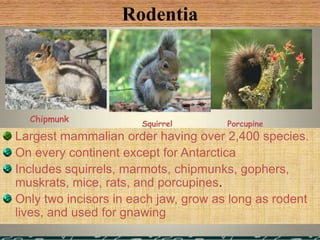
  Chipmunk
                      Squirrel        Porcupine
Largest mammalian order having over 2,400 species.
On every continent except for Antarctica
Includes squirrels, marmots, chipmunks, gophers,
muskrats, mice, rats, and porcupines.
Only two incisors in each jaw, grow as long as rodent
lives, and used for gnawing
                                                  12
Lagomorpha
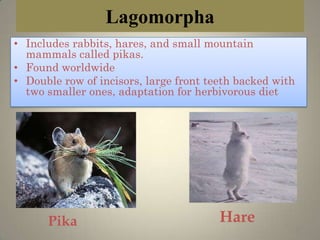
• Includes rabbits, hares, and small mountain
  mammals called pikas.
• Found worldwide
• Double row of incisors, large front teeth backed with
  two smaller ones, adaptation for herbivorous diet


      Pika                              Hare
                                                      13
Edentata
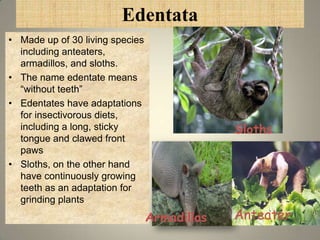
• Made up of 30 living species
  including anteaters,
  armadillos, and sloths.
• The name edentate means
  “without teeth”
• Edentates have adaptations
  for insectivorous diets,
  including a long, sticky                    Sloths
  tongue and clawed front
  paws
• Sloths, on the other hand
  have continuously growing
  teeth as an adaptation for
  grinding plants
                                 Armadillos   Anteater
                                                         14
Chiroptera
• Made up of over 900 species of
  bats.Live throughout the world except
  in polar environments
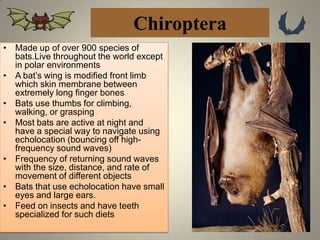
• A bat’s wing is modified front limb
  which skin membrane between
  extremely long finger bones
• Bats use thumbs for climbing,
  walking, or grasping
• Most bats are active at night and
  have a special way to navigate using
  echolocation (bouncing off high-
  frequency sound waves)
• Frequency of returning sound waves
  with the size, distance, and rate of
  movement of different objects
• Bats that use echolocation have small
  eyes and large ears.
• Feed on insects and have teeth
  specialized for such diets
                                            15
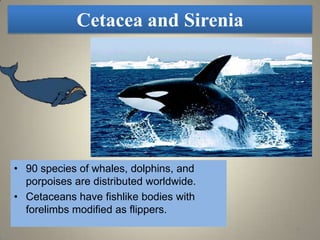
Cetacea and Sirenia


• 90 species of whales, dolphins, and
  porpoises are distributed worldwide.
• Cetaceans have fishlike bodies with
  forelimbs modified as flippers.
                                         16
dolphin                  Blue wale


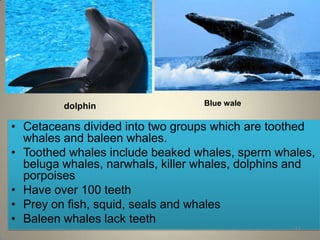
• Cetaceans divided into two groups which are toothed
  whales and baleen whales.
• Toothed whales include beaked whales, sperm whales,
  beluga whales, narwhals, killer whales, dolphins and
  porpoises
• Have over 100 teeth
• Prey on fish, squid, seals and whales
• Baleen whales lack teeth
                                                  17
Sirenia
                                       Dugongs
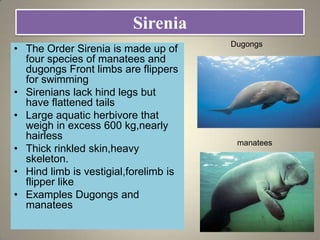
• The Order Sirenia is made up of
  four species of manatees and
  dugongs Front limbs are flippers
  for swimming
• Sirenians lack hind legs but
  have flattened tails
• Large aquatic herbivore that
  weigh in excess 600 kg,nearly
  hairless
                                        manatees
• Thick rinkled skin,heavy
  skeleton.
• Hind limb is vestigial,forelimb is
  flipper like
             .


• Examples Dugongs and
  manatees

                                                   18
Carnivora
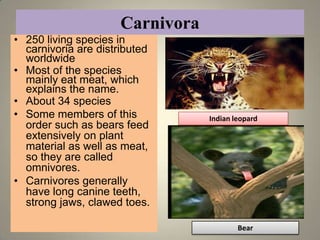
• 250 living species in
  carnivoria are distributed
  worldwide
• Most of the species
  mainly eat meat, which
  explains the name.
• About 34 species
• Some members of this           Indian leopard
  order such as bears feed
  extensively on plant
  material as well as meat,
  so they are called
  omnivores.
• Carnivores generally
  have long canine teeth,
  strong jaws, clawed toes.

                                         Bear     19
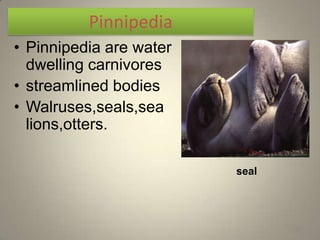
Pinnipedia
• Pinnipedia are water
  dwelling carnivores
• streamlined bodies
• Walruses,seals,sea
  lions,otters.

                         seal


                                20
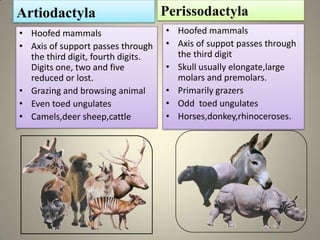
Artiodactyla                        Perissodactyla
• Hoofed mammals                    • Hoofed mammals
• Axis of support passes through    • Axis of suppot passes through
  the third digit, fourth digits.     the third digit
  Digits one, two and five          • Skull usually elongate,large
  reduced or lost.                    molars and premolars.
• Grazing and browsing animal       • Primarily grazers
• Even toed ungulates               • Odd toed ungulates
• Camels,deer sheep,cattle          • Horses,donkey,rhinoceroses.


                                                                  21
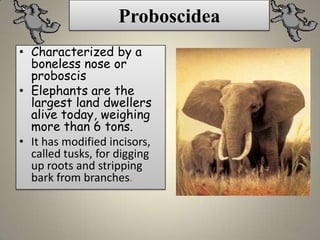
Proboscidea
• Characterized by a
  boneless nose or
  proboscis
• Elephants are the
  largest land dwellers
  alive today, weighing
  more than 6 tons.
• It has modified incisors,
  called tusks, for digging
  up roots and stripping
  bark from branches.


                                  22
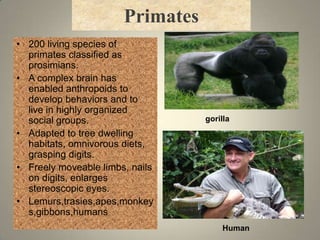
Primates
• 200 living species of
  primates classified as
  prosimians.
• A complex brain has
  enabled anthropoids to
  develop behaviors and to
  live in highly organized
  social groups.                  gorilla
• Adapted to tree dwelling
  habitats, omnivorous diets,
  grasping digits.
• Freely moveable limbs, nails
  on digits, enlarges
  stereoscopic eyes.
• Lemurs,trasies,apes,monkey
  s,gibbons,humans
                                      Human

Mammals

  • 1.
    Mammals BEENISH SARFRAZ,GROUP 8 1
  • 2.
    Evolution and Characteristics belong to the class Mammalia, which includes 4000 species •Most dominant land animals on earth. •Mammals were not abundant during the Mesozoic era. •The Cenozoic era is named the age of mammals, for this is the time which mammals rapidly started to increase 2
  • 3.
    Evolution Animals evolved from the group of reptiles called Therapids. •Therapids have both reptilian and mammalian characteristics. •Therapids have a jaw bone composed of 5 bones rather than a simple jaw bone. The earliest mammalian fossil found is from the early Mesozoic era, 200 million years ago . 3
  • 4.
    Characteristics • Mammals areendothermic • Mammals have hair • Well-developed brains • Mammalian heart has 4 chambers • Mammals have a muscle , the diaphragm that aids in breathing • Mammals have single lower jaw • Most species have 4 different types of teeth 4
  • 5.
    Characteristics • Most speciesare viviparous, in which females carry their young until full development • Female secrete milk from mammary glands to feed newborn young. • Two feature that distinguish them from other invertebrates are that they all have hair and they produce milk 5
  • 6.
    Mammal Orders There are 19 orders of mammals in the class Mammalia in which 17 nourish unborn young in the placenta, egg laying mammals and marsupials 6
  • 7.
    Monotremata • Oviparous oregg laying mammals • Only 3 in existence • Duck-billed platypus and two species of spiny Spiny Anteaters anteaters called echidna. • Not completely endothermic (their body temperature is lower and fluctuates more than other mammals) Duck-billed platypus 7
  • 8.
    Marsupials • Marsupials givebirth to tiny immature young that crawl to a pouch on the mothers belly immediately after they are born. • They attach themselves to milk secreting nipples kangaroo nursing until they are mature enough to survive outside the pouch. • 250 species of marsupial species exist in Australia, New Guinea, Tasmania, And the Americas koala
  • 9.
  • 10.
    Characteristics of Placentals •Placental mammals carry unborn young in the uterus until young can survive in the wild. • Oxygen and nutrients are transferred from mother’s blood to baby’s blood • The placenta is a membrane providing nutrients and waste & gas exchange between the mother and developing young • Gestation period-is the time which mammals develop in mother’s uterus • Mammals are a diverse group living on land and in water. Some mammals can fly! 10
  • 11.
    • Consists of400 species • Includes shrews and moles • Small animals with high metabolic rate and found in North America, Europe, and Asia. • Most have long pointed noses that enable them to grub for insects, worms, and invertebrates. • Live on ground, trees, in water, and underground Mole Shrew 11
  • 12.
    Rodentia Chipmunk Squirrel Porcupine Largest mammalian order having over 2,400 species. On every continent except for Antarctica Includes squirrels, marmots, chipmunks, gophers, muskrats, mice, rats, and porcupines. Only two incisors in each jaw, grow as long as rodent lives, and used for gnawing 12
  • 13.
    Lagomorpha • Includes rabbits,hares, and small mountain mammals called pikas. • Found worldwide • Double row of incisors, large front teeth backed with two smaller ones, adaptation for herbivorous diet Pika Hare 13
  • 14.
    Edentata • Made upof 30 living species including anteaters, armadillos, and sloths. • The name edentate means “without teeth” • Edentates have adaptations for insectivorous diets, including a long, sticky Sloths tongue and clawed front paws • Sloths, on the other hand have continuously growing teeth as an adaptation for grinding plants Armadillos Anteater 14
  • 15.
    Chiroptera • Made upof over 900 species of bats.Live throughout the world except in polar environments • A bat’s wing is modified front limb which skin membrane between extremely long finger bones • Bats use thumbs for climbing, walking, or grasping • Most bats are active at night and have a special way to navigate using echolocation (bouncing off high- frequency sound waves) • Frequency of returning sound waves with the size, distance, and rate of movement of different objects • Bats that use echolocation have small eyes and large ears. • Feed on insects and have teeth specialized for such diets 15
  • 16.
    Cetacea and Sirenia •90 species of whales, dolphins, and porpoises are distributed worldwide. • Cetaceans have fishlike bodies with forelimbs modified as flippers. 16
  • 17.
    dolphin Blue wale • Cetaceans divided into two groups which are toothed whales and baleen whales. • Toothed whales include beaked whales, sperm whales, beluga whales, narwhals, killer whales, dolphins and porpoises • Have over 100 teeth • Prey on fish, squid, seals and whales • Baleen whales lack teeth 17
  • 18.
    Sirenia Dugongs • The Order Sirenia is made up of four species of manatees and dugongs Front limbs are flippers for swimming • Sirenians lack hind legs but have flattened tails • Large aquatic herbivore that weigh in excess 600 kg,nearly hairless manatees • Thick rinkled skin,heavy skeleton. • Hind limb is vestigial,forelimb is flipper like . • Examples Dugongs and manatees 18
  • 19.
    Carnivora • 250 livingspecies in carnivoria are distributed worldwide • Most of the species mainly eat meat, which explains the name. • About 34 species • Some members of this Indian leopard order such as bears feed extensively on plant material as well as meat, so they are called omnivores. • Carnivores generally have long canine teeth, strong jaws, clawed toes. Bear 19
  • 20.
    Pinnipedia • Pinnipedia arewater dwelling carnivores • streamlined bodies • Walruses,seals,sea lions,otters. seal 20
  • 21.
    Artiodactyla Perissodactyla • Hoofed mammals • Hoofed mammals • Axis of support passes through • Axis of suppot passes through the third digit, fourth digits. the third digit Digits one, two and five • Skull usually elongate,large reduced or lost. molars and premolars. • Grazing and browsing animal • Primarily grazers • Even toed ungulates • Odd toed ungulates • Camels,deer sheep,cattle • Horses,donkey,rhinoceroses. 21
  • 22.
    Proboscidea • Characterized bya boneless nose or proboscis • Elephants are the largest land dwellers alive today, weighing more than 6 tons. • It has modified incisors, called tusks, for digging up roots and stripping bark from branches. 22
  • 23.
    Primates • 200 livingspecies of primates classified as prosimians. • A complex brain has enabled anthropoids to develop behaviors and to live in highly organized social groups. gorilla • Adapted to tree dwelling habitats, omnivorous diets, grasping digits. • Freely moveable limbs, nails on digits, enlarges stereoscopic eyes. • Lemurs,trasies,apes,monkey s,gibbons,humans Human