Birds
Class Aves – Birds
 Birds (class Aves) are archosaurs but
almost every feature of their reptilian
anatomy has undergone modification in
their adaptation to flight.
Class Aves – Birds
 Birds are found in most every habitat
from forests to deserts, even in caves.
 Some birds dive in the ocean to 45 m to
catch prey.
 Birds have visited both the North & South
poles.
 The bee hummingbird of Cuba weighs 1.8 g
and is one of the smallest vertebrate
endotherms.
Derived Characters of Birds
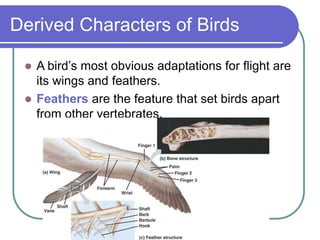
 A bird’s most obvious adaptations for flight are
its wings and feathers.
 Feathers are the feature that set birds apart
from other vertebrates.
Derived Characters of Birds
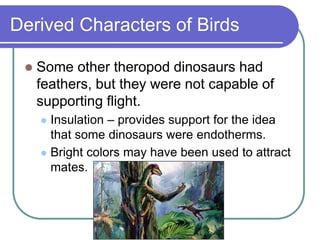
 Some other theropod dinosaurs had
feathers, but they were not capable of
supporting flight.
 Insulation – provides support for the idea
that some dinosaurs were endotherms.
 Bright colors may have been used to attract
mates.
Characteristics of Birds
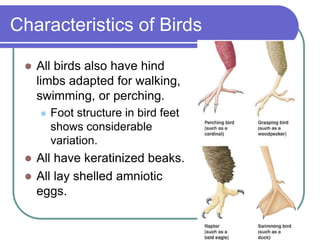
 All birds also have hind
limbs adapted for walking,
swimming, or perching.
 Foot structure in bird feet
shows considerable
variation.
 All have keratinized beaks.
 All lay shelled amniotic
eggs.
The Origin of Birds
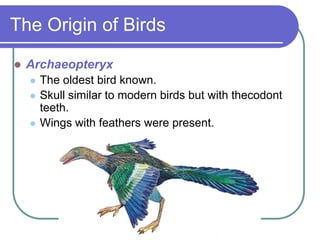
 Archaeopteryx
 The oldest bird known.
 Skull similar to modern birds but with thecodont
teeth.
 Wings with feathers were present.
The Origin of Birds
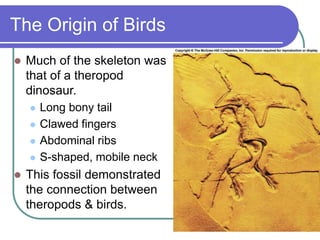
 Much of the skeleton was
that of a theropod
dinosaur.
 Long bony tail
 Clawed fingers
 Abdominal ribs
 S-shaped, mobile neck
 This fossil demonstrated
the connection between
theropods & birds.
Living Birds
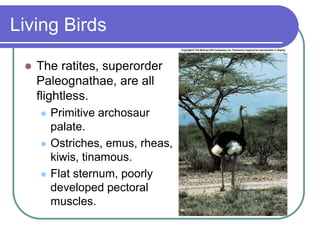
 The ratites, superorder
Paleognathae, are all
flightless.
 Primitive archosaur
palate.
 Ostriches, emus, rheas,
kiwis, tinamous.
 Flat sternum, poorly
developed pectoral
muscles.
Living Birds
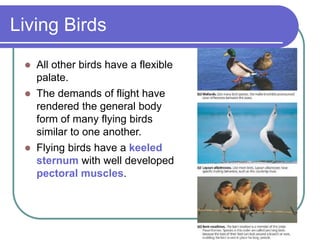
 All other birds have a flexible
palate.
 The demands of flight have
rendered the general body
form of many flying birds
similar to one another.
 Flying birds have a keeled
sternum with well developed
pectoral muscles.
Living Birds
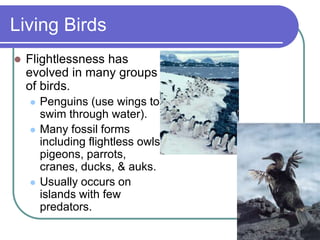
 Flightlessness has
evolved in many groups
of birds.
 Penguins (use wings to
swim through water).
 Many fossil forms
including flightless owls,
pigeons, parrots,
cranes, ducks, & auks.
 Usually occurs on
islands with few
predators.
Form & Function – Feathers
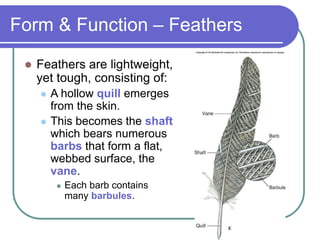
 Feathers are lightweight,
yet tough, consisting of:
 A hollow quill emerges
from the skin.
 This becomes the shaft
which bears numerous
barbs that form a flat,
webbed surface, the
vane.
 Each barb contains
many barbules.
Form & Function – Feathers
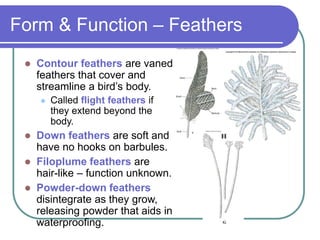
 Contour feathers are vaned
feathers that cover and
streamline a bird’s body.
 Called flight feathers if
they extend beyond the
body.
 Down feathers are soft and
have no hooks on barbules.
 Filoplume feathers are
hair-like – function unknown.
 Powder-down feathers
disintegrate as they grow,
releasing powder that aids in
waterproofing.
Form & Function – Feathers
 Feathers are homologous to reptiles’
scales.
 It develops from an epidermal elevation
overlying a nourishing dermal core.
 In reptiles, this elevation flattens into a
scale.
 In birds, it rolls into a cylinder and sinks into
the follicle from which it will grow.
Form & Function – Feathers
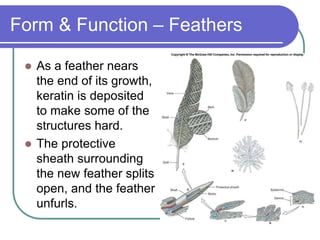
 As a feather nears
the end of its growth,
keratin is deposited
to make some of the
structures hard.
 The protective
sheath surrounding
the new feather splits
open, and the feather
unfurls.
Form & Function – Feathers
 When fully grown, feathers are dead –
like mammalian hair.
 Birds molt to replace worn out feathers.
 Usually feathers are discarded gradually to
avoid bare spots.
 Flight feathers & tail feathers are lost in
pairs to maintain balance.
 Many water birds lose all their primary
feathers at once and are grounded during
the molt.
Form & Function – Feathers
 Colors in birds may be pigmentary or
structural.
 Red, orange, & yellow are colored by
pigments called lipochromes.
 Black, brown, & gray are produced by the
pigment melanin.
 Blue is created structurally by the scattering
of shorter wavelengths of light by particles
within the feather.
Form & Function – Skeleton
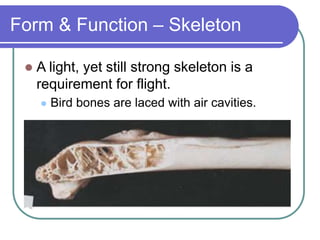
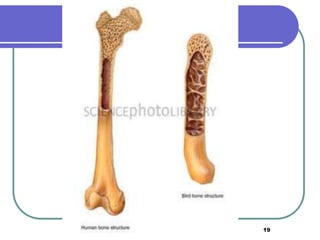
 A light, yet still strong skeleton is a
requirement for flight.
 Bird bones are laced with air cavities.
19
Form & Function – Skeleton
 Birds are archosaurs, and had
ancestors with diapsid skulls.
 Bird skulls are highly specialized – mostly
fused into one piece.
 Leg bones in birds are heavier – this
helps lower the center of gravity giving
aerodynamic stability.
Form & Function – Skeleton
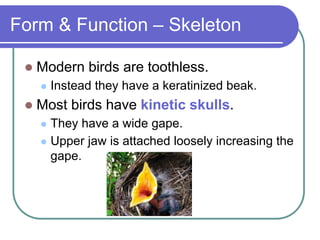
 Modern birds are toothless.
 Instead they have a keratinized beak.
 Most birds have kinetic skulls.
 They have a wide gape.
 Upper jaw is attached loosely increasing the
gape.
Form & Function – Skeleton
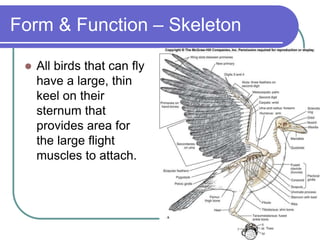
 All birds that can fly
have a large, thin
keel on their
sternum that
provides area for
the large flight
muscles to attach.
Food & Feeding
 Early birds were carnivorous, feeding
mostly on insects.
 Many birds are still insectivores.
 Other foods include nectar, seeds, berries,
worms, crustaceans, molluscs, fish, frogs,
small birds & mammals.
Food & Feeding
 Some birds are generalists, feeding on
a wide range of food items.
 Perhaps more competition for food, but less
danger of something happening to the food
source.
 Others are specialists, only feeding on
one type of food.
 Less competition, more danger of losing the
food source.
Food & Feeding
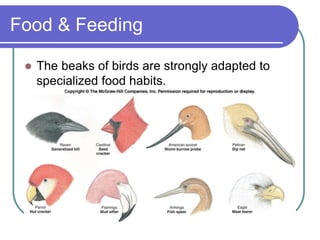
 The beaks of birds are strongly adapted to
specialized food habits.
Digestion
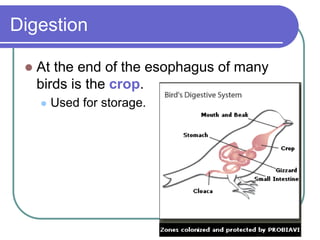
 At the end of the esophagus of many
birds is the crop.
 Used for storage.
Digestion
 The stomach has two compartments:
 The first secretes gastric juices.
 The second, the gizzard, is lined with
keratinized plates that serve as millstones
for grinding food.
 Birds swallow small stones to help this process.
Digestion
 Owls can’t digest the bones & fur or
feathers of their prey.
 These materials are bundled together and
ejected through the mouth.
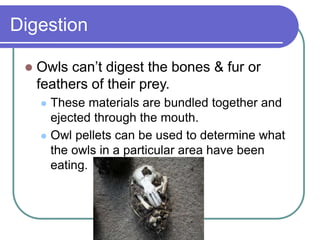
 Owl pellets can be used to determine what
the owls in a particular area have been
eating.
Circulatory System
 Birds have a four-chambered heart.
 Separate systemic and respiratory
circulations.
 Fast heartbeat – faster in smaller birds.
 Red blood cells are nucleated and
biconvex.
 Mammals are enucleated and biconcave.
Respiratory System
 The highly adapted respiratory system of
birds is adapted for the high metabolic
demands of flight.
 The finest branches of the bronchi are
developed as tubelike parabronchi through
which air can flow continuously – instead of
ending in saclike alveoli as in mammals.
Respiratory System
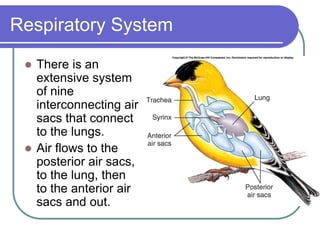
 There is an
extensive system
of nine
interconnecting air
sacs that connect
to the lungs.
 Air flows to the
posterior air sacs,
to the lung, then
to the anterior air
sacs and out.
Respiratory System
 The result is that there is an almost
continuous stream of oxygenated air
passing through the highly vascularized
parabronchi.
Excretory System
 Urine is formed in large, paired
metanephric kidneys.
 There is no urinary bladder.
 Nitrogenous wastes are secreted as uric
acid rather than urea.
 Bird kidneys can only concentrate solutes to
4-8 times that of blood concentration.
Excretory System
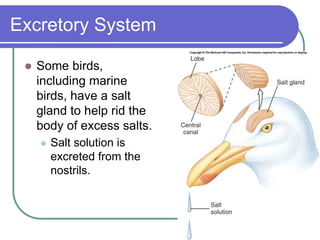
 Some birds,
including marine
birds, have a salt
gland to help rid the
body of excess salts.
 Salt solution is
excreted from the
nostrils.
Nervous System
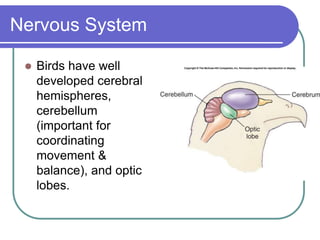
 Birds have well
developed cerebral
hemispheres,
cerebellum
(important for
coordinating
movement &
balance), and optic
lobes.
Senses
 Birds usually have poor sense of smell &
taste.
 Some, carnivores, waterfowl, flightless birds
have well developed sense of smell & taste.
 Birds have the keenest eyesight in the
animal kingdom and also very good
hearing.
 A hawk can clearly see a crouching rabbit a
mile away!
Flight
 To fly, birds must generate lift forces
greater than their own mass and they
must provide propulsion to move
forward.
 Bird wings are designed to provide lift.
Flight - Wings are Specialized for
Particular Kinds of Flight
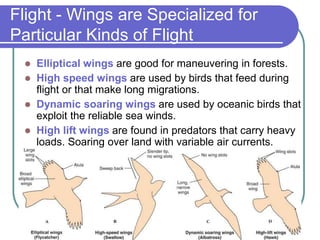
 Elliptical wings are good for maneuvering in forests.
 High speed wings are used by birds that feed during
flight or that make long migrations.
 Dynamic soaring wings are used by oceanic birds that
exploit the reliable sea winds.
 High lift wings are found in predators that carry heavy
loads. Soaring over land with variable air currents.
Migration
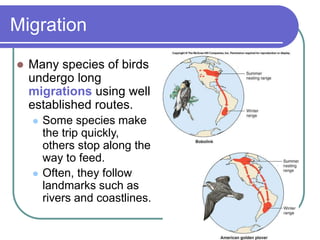
 Many species of birds
undergo long
migrations using well
established routes.
 Some species make
the trip quickly,
others stop along the
way to feed.
 Often, they follow
landmarks such as
rivers and coastlines.
Migration
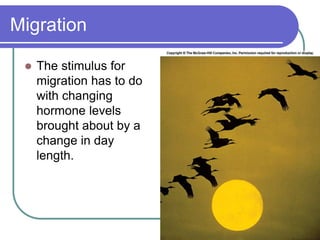
 The stimulus for
migration has to do
with changing
hormone levels
brought about by a
change in day
length.
Migration
 Birds navigate using a number of cues:
 Visual cues – landmarks.
 Accurate sense of time.
 Some may use the Earth’s magnetic field.
 Celestial cues – sun by day, stars at night.
Social Behavior – Mating Systems
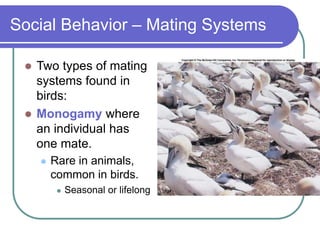
 Two types of mating
systems found in
birds:
 Monogamy where
an individual has
one mate.
 Rare in animals,
common in birds.
 Seasonal or lifelong
Social Behavior – Mating Systems
 Birds have a high incidence of
monogamy because both parents are
equally able to perform most aspects of
parental care.
 Often success of the hatchlings requires
care from two parents.
Social Behavior – Mating Systems
 Polygamy where an individual has more
than one mate during a breeding
season.
 Polygyny – one male, many females
 Polyandry – one female, many males
Social Behavior – Mating Systems
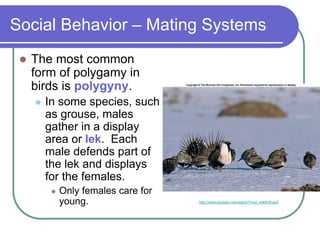
 The most common
form of polygamy in
birds is polygyny.
 In some species, such
as grouse, males
gather in a display
area or lek. Each
male defends part of
the lek and displays
for the females.
 Only females care for
young. http://www.youtube.com/watch?v=s2_wdMmEupQ
Social Behavior – Mating Systems
 An example of polyandry occurs in
spotted sandpipers.
 Females defend territories and mate with
several males.
 Each male incubates a nest of eggs in the
female’s territory and does most of the
parental care.
 This system may have evolved in
response to high predation rates.
Nesting
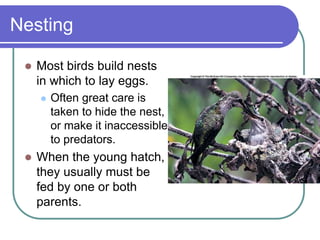
 Most birds build nests
in which to lay eggs.
 Often great care is
taken to hide the nest,
or make it inaccessible
to predators.
 When the young hatch,
they usually must be
fed by one or both
parents.
Nesting
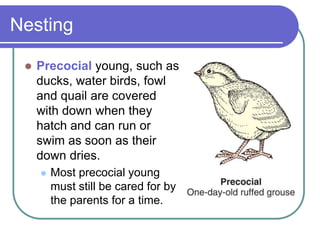
 Precocial young, such as
ducks, water birds, fowl
and quail are covered
with down when they
hatch and can run or
swim as soon as their
down dries.
 Most precocial young
must still be cared for by
the parents for a time.
Nesting
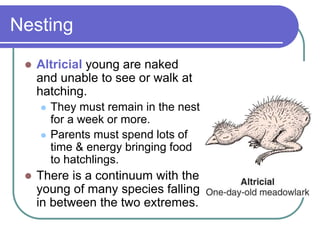
 Altricial young are naked
and unable to see or walk at
hatching.
 They must remain in the nest
for a week or more.
 Parents must spend lots of
time & energy bringing food
to hatchlings.
 There is a continuum with the
young of many species falling
in between the two extremes.

Birds

  • 1.
  • 2.
    Class Aves –Birds  Birds (class Aves) are archosaurs but almost every feature of their reptilian anatomy has undergone modification in their adaptation to flight.
  • 3.
    Class Aves –Birds  Birds are found in most every habitat from forests to deserts, even in caves.  Some birds dive in the ocean to 45 m to catch prey.  Birds have visited both the North & South poles.  The bee hummingbird of Cuba weighs 1.8 g and is one of the smallest vertebrate endotherms.
  • 4.
    Derived Characters ofBirds  A bird’s most obvious adaptations for flight are its wings and feathers.  Feathers are the feature that set birds apart from other vertebrates.
  • 5.
    Derived Characters ofBirds  Some other theropod dinosaurs had feathers, but they were not capable of supporting flight.  Insulation – provides support for the idea that some dinosaurs were endotherms.  Bright colors may have been used to attract mates.
  • 6.
    Characteristics of Birds All birds also have hind limbs adapted for walking, swimming, or perching.  Foot structure in bird feet shows considerable variation.  All have keratinized beaks.  All lay shelled amniotic eggs.
  • 7.
    The Origin ofBirds  Archaeopteryx  The oldest bird known.  Skull similar to modern birds but with thecodont teeth.  Wings with feathers were present.
  • 8.
    The Origin ofBirds  Much of the skeleton was that of a theropod dinosaur.  Long bony tail  Clawed fingers  Abdominal ribs  S-shaped, mobile neck  This fossil demonstrated the connection between theropods & birds.
  • 9.
    Living Birds  Theratites, superorder Paleognathae, are all flightless.  Primitive archosaur palate.  Ostriches, emus, rheas, kiwis, tinamous.  Flat sternum, poorly developed pectoral muscles.
  • 10.
    Living Birds  Allother birds have a flexible palate.  The demands of flight have rendered the general body form of many flying birds similar to one another.  Flying birds have a keeled sternum with well developed pectoral muscles.
  • 11.
    Living Birds  Flightlessnesshas evolved in many groups of birds.  Penguins (use wings to swim through water).  Many fossil forms including flightless owls, pigeons, parrots, cranes, ducks, & auks.  Usually occurs on islands with few predators.
  • 12.
    Form & Function– Feathers  Feathers are lightweight, yet tough, consisting of:  A hollow quill emerges from the skin.  This becomes the shaft which bears numerous barbs that form a flat, webbed surface, the vane.  Each barb contains many barbules.
  • 13.
    Form & Function– Feathers  Contour feathers are vaned feathers that cover and streamline a bird’s body.  Called flight feathers if they extend beyond the body.  Down feathers are soft and have no hooks on barbules.  Filoplume feathers are hair-like – function unknown.  Powder-down feathers disintegrate as they grow, releasing powder that aids in waterproofing.
  • 14.
    Form & Function– Feathers  Feathers are homologous to reptiles’ scales.  It develops from an epidermal elevation overlying a nourishing dermal core.  In reptiles, this elevation flattens into a scale.  In birds, it rolls into a cylinder and sinks into the follicle from which it will grow.
  • 15.
    Form & Function– Feathers  As a feather nears the end of its growth, keratin is deposited to make some of the structures hard.  The protective sheath surrounding the new feather splits open, and the feather unfurls.
  • 16.
    Form & Function– Feathers  When fully grown, feathers are dead – like mammalian hair.  Birds molt to replace worn out feathers.  Usually feathers are discarded gradually to avoid bare spots.  Flight feathers & tail feathers are lost in pairs to maintain balance.  Many water birds lose all their primary feathers at once and are grounded during the molt.
  • 17.
    Form & Function– Feathers  Colors in birds may be pigmentary or structural.  Red, orange, & yellow are colored by pigments called lipochromes.  Black, brown, & gray are produced by the pigment melanin.  Blue is created structurally by the scattering of shorter wavelengths of light by particles within the feather.
  • 18.
    Form & Function– Skeleton  A light, yet still strong skeleton is a requirement for flight.  Bird bones are laced with air cavities.
  • 19.
  • 20.
    Form & Function– Skeleton  Birds are archosaurs, and had ancestors with diapsid skulls.  Bird skulls are highly specialized – mostly fused into one piece.  Leg bones in birds are heavier – this helps lower the center of gravity giving aerodynamic stability.
  • 21.
    Form & Function– Skeleton  Modern birds are toothless.  Instead they have a keratinized beak.  Most birds have kinetic skulls.  They have a wide gape.  Upper jaw is attached loosely increasing the gape.
  • 22.
    Form & Function– Skeleton  All birds that can fly have a large, thin keel on their sternum that provides area for the large flight muscles to attach.
  • 23.
    Food & Feeding Early birds were carnivorous, feeding mostly on insects.  Many birds are still insectivores.  Other foods include nectar, seeds, berries, worms, crustaceans, molluscs, fish, frogs, small birds & mammals.
  • 24.
    Food & Feeding Some birds are generalists, feeding on a wide range of food items.  Perhaps more competition for food, but less danger of something happening to the food source.  Others are specialists, only feeding on one type of food.  Less competition, more danger of losing the food source.
  • 25.
    Food & Feeding The beaks of birds are strongly adapted to specialized food habits.
  • 26.
    Digestion  At theend of the esophagus of many birds is the crop.  Used for storage.
  • 27.
    Digestion  The stomachhas two compartments:  The first secretes gastric juices.  The second, the gizzard, is lined with keratinized plates that serve as millstones for grinding food.  Birds swallow small stones to help this process.
  • 28.
    Digestion  Owls can’tdigest the bones & fur or feathers of their prey.  These materials are bundled together and ejected through the mouth.  Owl pellets can be used to determine what the owls in a particular area have been eating.
  • 29.
    Circulatory System  Birdshave a four-chambered heart.  Separate systemic and respiratory circulations.  Fast heartbeat – faster in smaller birds.  Red blood cells are nucleated and biconvex.  Mammals are enucleated and biconcave.
  • 30.
    Respiratory System  Thehighly adapted respiratory system of birds is adapted for the high metabolic demands of flight.  The finest branches of the bronchi are developed as tubelike parabronchi through which air can flow continuously – instead of ending in saclike alveoli as in mammals.
  • 31.
    Respiratory System  Thereis an extensive system of nine interconnecting air sacs that connect to the lungs.  Air flows to the posterior air sacs, to the lung, then to the anterior air sacs and out.
  • 32.
    Respiratory System  Theresult is that there is an almost continuous stream of oxygenated air passing through the highly vascularized parabronchi.
  • 33.
    Excretory System  Urineis formed in large, paired metanephric kidneys.  There is no urinary bladder.  Nitrogenous wastes are secreted as uric acid rather than urea.  Bird kidneys can only concentrate solutes to 4-8 times that of blood concentration.
  • 34.
    Excretory System  Somebirds, including marine birds, have a salt gland to help rid the body of excess salts.  Salt solution is excreted from the nostrils.
  • 35.
    Nervous System  Birdshave well developed cerebral hemispheres, cerebellum (important for coordinating movement & balance), and optic lobes.
  • 36.
    Senses  Birds usuallyhave poor sense of smell & taste.  Some, carnivores, waterfowl, flightless birds have well developed sense of smell & taste.  Birds have the keenest eyesight in the animal kingdom and also very good hearing.  A hawk can clearly see a crouching rabbit a mile away!
  • 37.
    Flight  To fly,birds must generate lift forces greater than their own mass and they must provide propulsion to move forward.  Bird wings are designed to provide lift.
  • 38.
    Flight - Wingsare Specialized for Particular Kinds of Flight  Elliptical wings are good for maneuvering in forests.  High speed wings are used by birds that feed during flight or that make long migrations.  Dynamic soaring wings are used by oceanic birds that exploit the reliable sea winds.  High lift wings are found in predators that carry heavy loads. Soaring over land with variable air currents.
  • 39.
    Migration  Many speciesof birds undergo long migrations using well established routes.  Some species make the trip quickly, others stop along the way to feed.  Often, they follow landmarks such as rivers and coastlines.
  • 40.
    Migration  The stimulusfor migration has to do with changing hormone levels brought about by a change in day length.
  • 41.
    Migration  Birds navigateusing a number of cues:  Visual cues – landmarks.  Accurate sense of time.  Some may use the Earth’s magnetic field.  Celestial cues – sun by day, stars at night.
  • 42.
    Social Behavior –Mating Systems  Two types of mating systems found in birds:  Monogamy where an individual has one mate.  Rare in animals, common in birds.  Seasonal or lifelong
  • 43.
    Social Behavior –Mating Systems  Birds have a high incidence of monogamy because both parents are equally able to perform most aspects of parental care.  Often success of the hatchlings requires care from two parents.
  • 44.
    Social Behavior –Mating Systems  Polygamy where an individual has more than one mate during a breeding season.  Polygyny – one male, many females  Polyandry – one female, many males
  • 45.
    Social Behavior –Mating Systems  The most common form of polygamy in birds is polygyny.  In some species, such as grouse, males gather in a display area or lek. Each male defends part of the lek and displays for the females.  Only females care for young. http://www.youtube.com/watch?v=s2_wdMmEupQ
  • 46.
    Social Behavior –Mating Systems  An example of polyandry occurs in spotted sandpipers.  Females defend territories and mate with several males.  Each male incubates a nest of eggs in the female’s territory and does most of the parental care.  This system may have evolved in response to high predation rates.
  • 47.
    Nesting  Most birdsbuild nests in which to lay eggs.  Often great care is taken to hide the nest, or make it inaccessible to predators.  When the young hatch, they usually must be fed by one or both parents.
  • 48.
    Nesting  Precocial young,such as ducks, water birds, fowl and quail are covered with down when they hatch and can run or swim as soon as their down dries.  Most precocial young must still be cared for by the parents for a time.
  • 49.
    Nesting  Altricial youngare naked and unable to see or walk at hatching.  They must remain in the nest for a week or more.  Parents must spend lots of time & energy bringing food to hatchlings.  There is a continuum with the young of many species falling in between the two extremes.