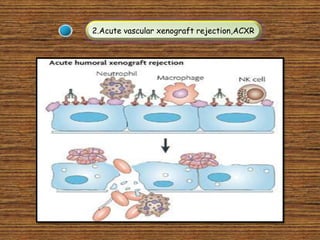
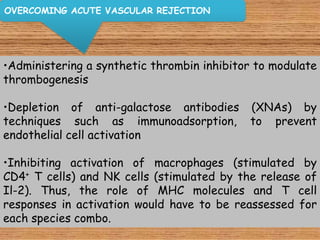
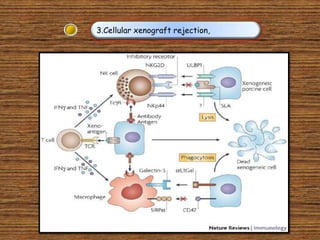
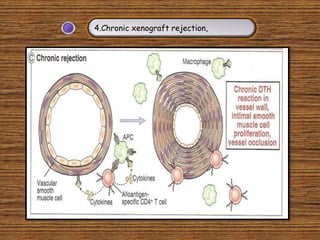
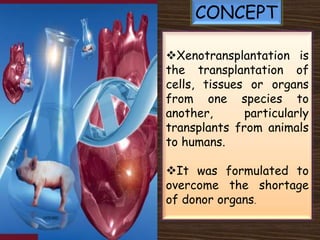
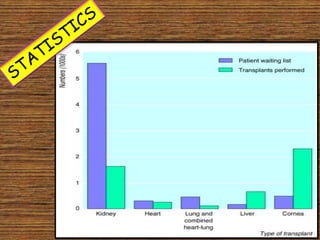
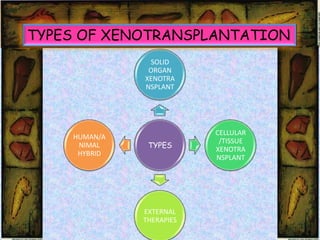
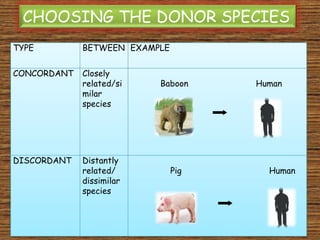
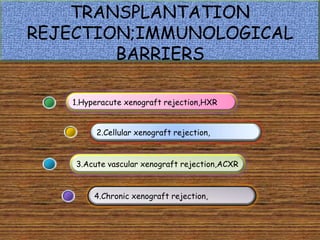
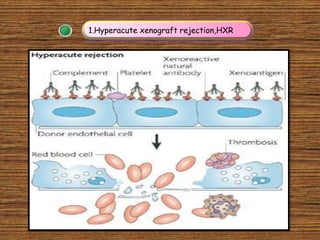
Xenotransplantation involves transplanting cells, tissues or organs from animals to humans to address the shortage of human donor organs. The first type attempted was concordant xenotransplantation using organs from primates similar to humans. However, discordant xenotransplantation using organs from pigs is more promising due to similarities in organ size and physiology. Major barriers to xenotransplantation success are hyperacute rejection within minutes due to pre-existing antibodies, acute vascular rejection within days or weeks, and cellular rejection as T-cells recognize the foreign antigens. Strategies to overcome these barriers include genetically modifying pigs to eliminate antigen triggers, depleting antibodies in recipients, and inducing donor-specific tolerance through bone marrow chimerism. Another



![OVERCOMING HYPERACUTE REJECTION
•alter the organ source through using genetically engineered
pigs (e.g., pigs that will lack the α-Gal epitope and/or will have
an artificially added gene[s] for human complement-regulatory
proteins (such as decay-accelerating factor)
• alter the recipient by depleting naturally occurring
antibodies directed against α-Gal (NXAs) prior to xenograft
receipt. Either approach to overcoming HAR may also
facilitate the potential for the human recipient to be infected
by endogenous retroviruses from the pig xenotransplantation
product.](https://image.slidesharecdn.com/xenotransplantation-130202201601-phpapp02/85/Xenotransplantation-9-320.jpg)