DIGITAL ALBUM MAKING
ANU VARGHESE
NATURAL SCIENCE
MOUNT TABOR TRAINING COLLEGE,
PATHANAPURAM.
MAMMALIA
Mammals are warm blooded animals who give birth to their
younger ones.
They are the most dominant forms of animals found in almost all
types of habitats.
They have mammary glands that help them produce milk to feed
their younger ones.
Body is covered with hairs.
Forelimbs are adapted mainly for locomotion
Circulatory system is four chambered heart
Excretory system with metanephron kidney and ureters that
usually open into the bladder.
Respiratory system consist of a pair of lungs with alveoli
Internal fertilization and young one is nourished by milk from
mammary glands.
CLASSIFICATION OF
MAMMALIA
SUBCLASS PROTOTHERIA
Subclass Prototheria are called unfinished mammals.
It show the characteristics of both mammals and reptiles
Referred as living fossil
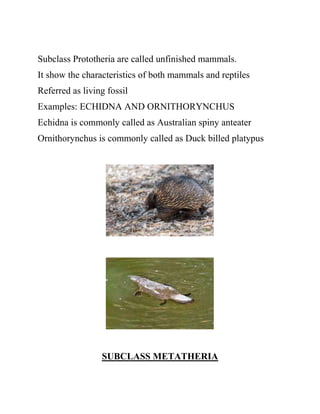
Examples: ECHIDNA AND ORNITHORYNCHUS
Echidna is commonly called as Australian spiny anteater
Ornithorynchus is commonly called as Duck billed platypus
SUBCLASS METATHERIA
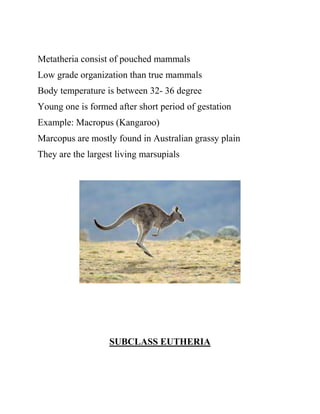
Metatheria consist of pouched mammals
Low grade organization than true mammals
Body temperature is between 32- 36 degree
Young one is formed after short period of gestation
Example: Macropus (Kangaroo)
Marcopus are mostly found in Australian grassy plain
They are the largest living marsupials
SUBCLASS EUTHERIA
Eutheria are called placental mammals
They are the higher group of mammals
Eutheria was named in 1872 by Theodore Gill in 1880
Subclass eutheria is divided into 16 orders. They are:
Order Insectivora
Order Chiroptera
Order Primates
Order Carnivora
Order Xenarthra
Order Pholidota
Order Proboscidea
Order Perissodactyla
Order Artiodactyla
Order Hydracoidea
Order Sirenea
Order Rodentia
Order Tubulidentata
Order Cetaceae
Order Lagomorpha
ORDER: INSECTIVORA
Insectivores are insect eating mammals
They are small, sharp- snouted animals
All are nocturnal
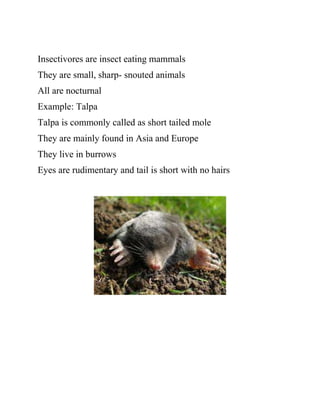
Example: Talpa
Talpa is commonly called as short tailed mole
They are mainly found in Asia and Europe
They live in burrows
Eyes are rudimentary and tail is short with no hairs
ORDER: DERMOPTERA
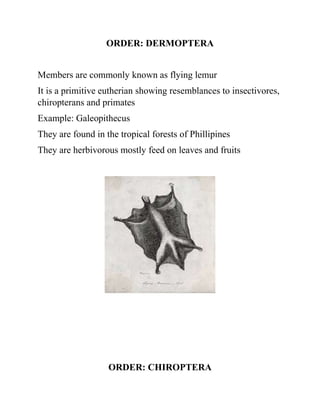
Members are commonly known as flying lemur
It is a primitive eutherian showing resemblances to insectivores,
chiropterans and primates
Example: Galeopithecus
They are found in the tropical forests of Phillipines
They are herbivorous mostly feed on leaves and fruits
ORDER: CHIROPTERA
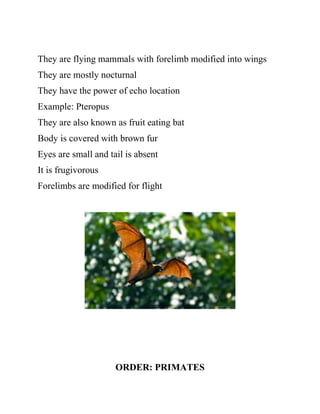
They are flying mammals with forelimb modified into wings
They are mostly nocturnal
They have the power of echo location
Example: Pteropus
They are also known as fruit eating bat
Body is covered with brown fur
Eyes are small and tail is absent
It is frugivorous
Forelimbs are modified for flight
ORDER: PRIMATES
Body is covered with hairs except on face, palm and sol
Well developed brain with large cerebral hemispheres
They are omnivorous and are mostly arboreal
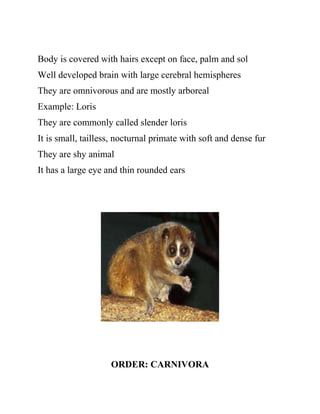
Example: Loris
They are commonly called slender loris
It is small, tailless, nocturnal primate with soft and dense fur
They are shy animal
It has a large eye and thin rounded ears
ORDER: CARNIVORA
The carnivores are mostly animals of medium sized which feed
on other animals, bird, insects, fish but some of them also eat
berries, juicy roots and other vegetables.
They have their main area of distribution in the Tropics
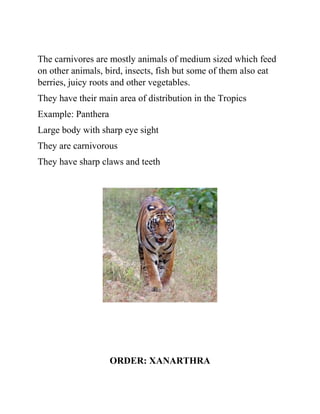
Example: Panthera
Large body with sharp eye sight
They are carnivorous
They have sharp claws and teeth
ORDER: XANARTHRA
They are ant eaters and sloth
They have false teeth
They have long protrusible tongue
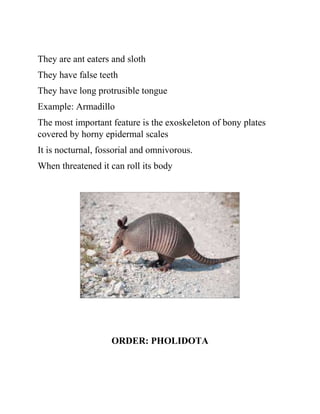
Example: Armadillo
The most important feature is the exoskeleton of bony plates
covered by horny epidermal scales
It is nocturnal, fossorial and omnivorous.
When threatened it can roll its body
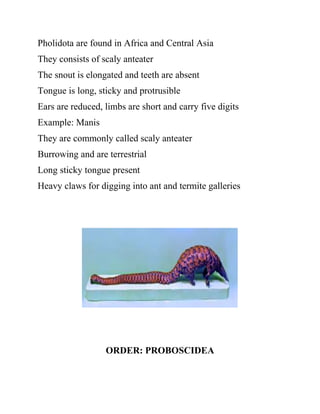
ORDER: PHOLIDOTA
Pholidota are found in Africa and Central Asia
They consists of scaly anteater
The snout is elongated and teeth are absent
Tongue is long, sticky and protrusible
Ears are reduced, limbs are short and carry five digits
Example: Manis
They are commonly called scaly anteater
Burrowing and are terrestrial
Long sticky tongue present
Heavy claws for digging into ant and termite galleries
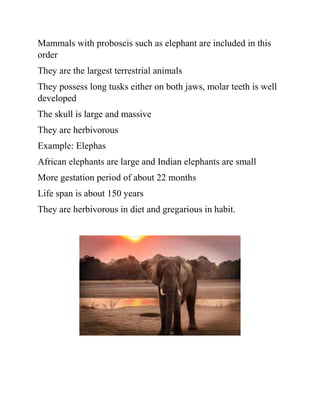
ORDER: PROBOSCIDEA
Mammals with proboscis such as elephant are included in this
order
They are the largest terrestrial animals
They possess long tusks either on both jaws, molar teeth is well
developed
The skull is large and massive
They are herbivorous
Example: Elephas
African elephants are large and Indian elephants are small
More gestation period of about 22 months
Life span is about 150 years
They are herbivorous in diet and gregarious in habit.
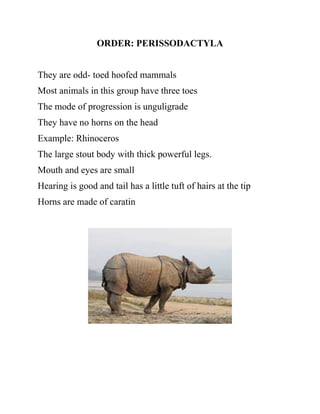
ORDER: PERISSODACTYLA
They are odd- toed hoofed mammals
Most animals in this group have three toes
The mode of progression is unguligrade
They have no horns on the head
Example: Rhinoceros
The large stout body with thick powerful legs.
Mouth and eyes are small
Hearing is good and tail has a little tuft of hairs at the tip
Horns are made of caratin
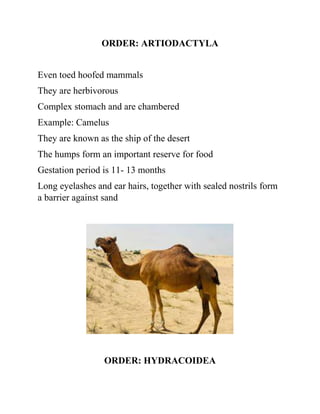
ORDER: ARTIODACTYLA
Even toed hoofed mammals
They are herbivorous
Complex stomach and are chambered
Example: Camelus
They are known as the ship of the desert
The humps form an important reserve for food
Gestation period is 11- 13 months
Long eyelashes and ear hairs, together with sealed nostrils form
a barrier against sand
ORDER: HYDRACOIDEA
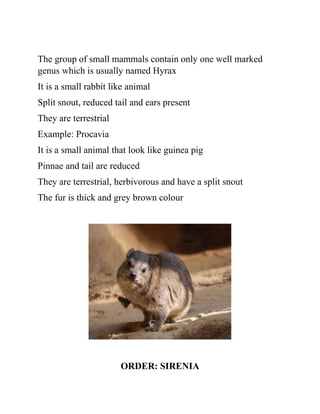
The group of small mammals contain only one well marked
genus which is usually named Hyrax
It is a small rabbit like animal
Split snout, reduced tail and ears present
They are terrestrial
Example: Procavia
It is a small animal that look like guinea pig
Pinnae and tail are reduced
They are terrestrial, herbivorous and have a split snout
The fur is thick and grey brown colour
ORDER: SIRENIA
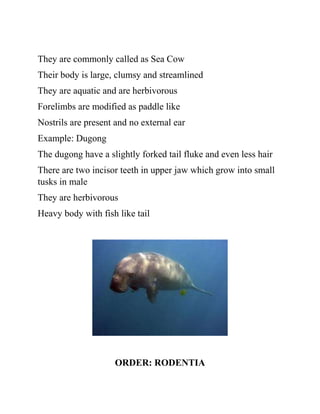
They are commonly called as Sea Cow
Their body is large, clumsy and streamlined
They are aquatic and are herbivorous
Forelimbs are modified as paddle like
Nostrils are present and no external ear
Example: Dugong
The dugong have a slightly forked tail fluke and even less hair
There are two incisor teeth in upper jaw which grow into small
tusks in male
They are herbivorous
Heavy body with fish like tail
ORDER: RODENTIA
Rodents are gnawing mammals which include squirrels, rats,
mice, guinea pigs, porcupines and beavers
Canines are absent, molar and premolars are present
The space between incisors and premolar is called diastema
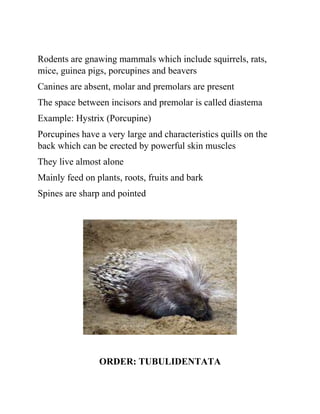
Example: Hystrix (Porcupine)
Porcupines have a very large and characteristics quills on the
back which can be erected by powerful skin muscles
They live almost alone
Mainly feed on plants, roots, fruits and bark
Spines are sharp and pointed
ORDER: TUBULIDENTATA
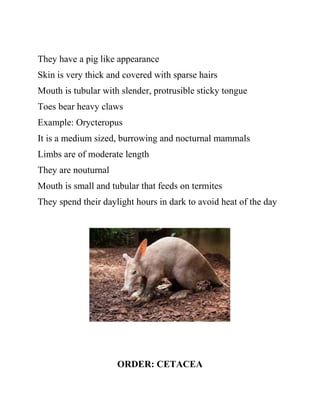
They have a pig like appearance
Skin is very thick and covered with sparse hairs
Mouth is tubular with slender, protrusible sticky tongue
Toes bear heavy claws
Example: Orycteropus
It is a medium sized, burrowing and nocturnal mammals
Limbs are of moderate length
They are nouturnal
Mouth is small and tubular that feeds on termites
They spend their daylight hours in dark to avoid heat of the day
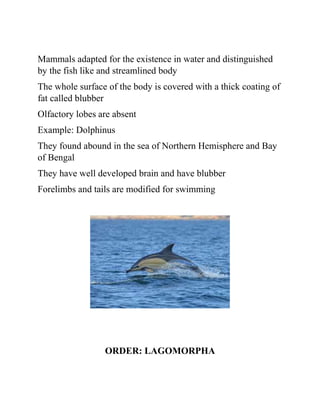
ORDER: CETACEA
Mammals adapted for the existence in water and distinguished
by the fish like and streamlined body
The whole surface of the body is covered with a thick coating of
fat called blubber
Olfactory lobes are absent
Example: Dolphinus
They found abound in the sea of Northern Hemisphere and Bay
of Bengal
They have well developed brain and have blubber
Forelimbs and tails are modified for swimming
ORDER: LAGOMORPHA
It is similar to rodents
Tail is short and bushy
Body is covered with hairs
They are gregarious and live in colonies
They are herbivorous
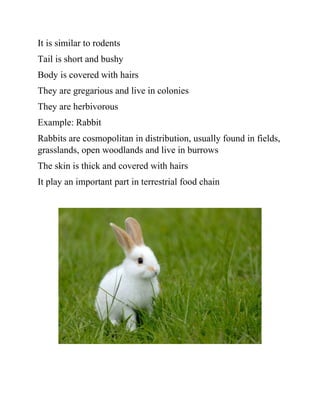
Example: Rabbit
Rabbits are cosmopolitan in distribution, usually found in fields,
grasslands, open woodlands and live in burrows
The skin is thick and covered with hairs
It play an important part in terrestrial food chain
THANK YOU

DIGITAL ALBUM MAKING - MAMMALS NS WORK PRESENTATION

  • 1.
    DIGITAL ALBUM MAKING ANUVARGHESE NATURAL SCIENCE MOUNT TABOR TRAINING COLLEGE, PATHANAPURAM.
  • 2.
    MAMMALIA Mammals are warmblooded animals who give birth to their younger ones. They are the most dominant forms of animals found in almost all types of habitats. They have mammary glands that help them produce milk to feed their younger ones. Body is covered with hairs. Forelimbs are adapted mainly for locomotion Circulatory system is four chambered heart Excretory system with metanephron kidney and ureters that usually open into the bladder. Respiratory system consist of a pair of lungs with alveoli Internal fertilization and young one is nourished by milk from mammary glands.
  • 3.
  • 4.
    Subclass Prototheria arecalled unfinished mammals. It show the characteristics of both mammals and reptiles Referred as living fossil Examples: ECHIDNA AND ORNITHORYNCHUS Echidna is commonly called as Australian spiny anteater Ornithorynchus is commonly called as Duck billed platypus SUBCLASS METATHERIA
  • 5.
    Metatheria consist ofpouched mammals Low grade organization than true mammals Body temperature is between 32- 36 degree Young one is formed after short period of gestation Example: Macropus (Kangaroo) Marcopus are mostly found in Australian grassy plain They are the largest living marsupials SUBCLASS EUTHERIA
  • 6.
    Eutheria are calledplacental mammals They are the higher group of mammals Eutheria was named in 1872 by Theodore Gill in 1880 Subclass eutheria is divided into 16 orders. They are: Order Insectivora Order Chiroptera Order Primates Order Carnivora Order Xenarthra Order Pholidota Order Proboscidea Order Perissodactyla Order Artiodactyla Order Hydracoidea Order Sirenea Order Rodentia Order Tubulidentata Order Cetaceae Order Lagomorpha ORDER: INSECTIVORA
  • 7.
    Insectivores are insecteating mammals They are small, sharp- snouted animals All are nocturnal Example: Talpa Talpa is commonly called as short tailed mole They are mainly found in Asia and Europe They live in burrows Eyes are rudimentary and tail is short with no hairs
  • 8.
    ORDER: DERMOPTERA Members arecommonly known as flying lemur It is a primitive eutherian showing resemblances to insectivores, chiropterans and primates Example: Galeopithecus They are found in the tropical forests of Phillipines They are herbivorous mostly feed on leaves and fruits ORDER: CHIROPTERA
  • 9.
    They are flyingmammals with forelimb modified into wings They are mostly nocturnal They have the power of echo location Example: Pteropus They are also known as fruit eating bat Body is covered with brown fur Eyes are small and tail is absent It is frugivorous Forelimbs are modified for flight ORDER: PRIMATES
  • 10.
    Body is coveredwith hairs except on face, palm and sol Well developed brain with large cerebral hemispheres They are omnivorous and are mostly arboreal Example: Loris They are commonly called slender loris It is small, tailless, nocturnal primate with soft and dense fur They are shy animal It has a large eye and thin rounded ears ORDER: CARNIVORA
  • 11.
    The carnivores aremostly animals of medium sized which feed on other animals, bird, insects, fish but some of them also eat berries, juicy roots and other vegetables. They have their main area of distribution in the Tropics Example: Panthera Large body with sharp eye sight They are carnivorous They have sharp claws and teeth ORDER: XANARTHRA
  • 12.
    They are anteaters and sloth They have false teeth They have long protrusible tongue Example: Armadillo The most important feature is the exoskeleton of bony plates covered by horny epidermal scales It is nocturnal, fossorial and omnivorous. When threatened it can roll its body ORDER: PHOLIDOTA
  • 13.
    Pholidota are foundin Africa and Central Asia They consists of scaly anteater The snout is elongated and teeth are absent Tongue is long, sticky and protrusible Ears are reduced, limbs are short and carry five digits Example: Manis They are commonly called scaly anteater Burrowing and are terrestrial Long sticky tongue present Heavy claws for digging into ant and termite galleries ORDER: PROBOSCIDEA
  • 14.
    Mammals with proboscissuch as elephant are included in this order They are the largest terrestrial animals They possess long tusks either on both jaws, molar teeth is well developed The skull is large and massive They are herbivorous Example: Elephas African elephants are large and Indian elephants are small More gestation period of about 22 months Life span is about 150 years They are herbivorous in diet and gregarious in habit.
  • 15.
    ORDER: PERISSODACTYLA They areodd- toed hoofed mammals Most animals in this group have three toes The mode of progression is unguligrade They have no horns on the head Example: Rhinoceros The large stout body with thick powerful legs. Mouth and eyes are small Hearing is good and tail has a little tuft of hairs at the tip Horns are made of caratin
  • 16.
    ORDER: ARTIODACTYLA Even toedhoofed mammals They are herbivorous Complex stomach and are chambered Example: Camelus They are known as the ship of the desert The humps form an important reserve for food Gestation period is 11- 13 months Long eyelashes and ear hairs, together with sealed nostrils form a barrier against sand ORDER: HYDRACOIDEA
  • 17.
    The group ofsmall mammals contain only one well marked genus which is usually named Hyrax It is a small rabbit like animal Split snout, reduced tail and ears present They are terrestrial Example: Procavia It is a small animal that look like guinea pig Pinnae and tail are reduced They are terrestrial, herbivorous and have a split snout The fur is thick and grey brown colour ORDER: SIRENIA
  • 18.
    They are commonlycalled as Sea Cow Their body is large, clumsy and streamlined They are aquatic and are herbivorous Forelimbs are modified as paddle like Nostrils are present and no external ear Example: Dugong The dugong have a slightly forked tail fluke and even less hair There are two incisor teeth in upper jaw which grow into small tusks in male They are herbivorous Heavy body with fish like tail ORDER: RODENTIA
  • 19.
    Rodents are gnawingmammals which include squirrels, rats, mice, guinea pigs, porcupines and beavers Canines are absent, molar and premolars are present The space between incisors and premolar is called diastema Example: Hystrix (Porcupine) Porcupines have a very large and characteristics quills on the back which can be erected by powerful skin muscles They live almost alone Mainly feed on plants, roots, fruits and bark Spines are sharp and pointed ORDER: TUBULIDENTATA
  • 20.
    They have apig like appearance Skin is very thick and covered with sparse hairs Mouth is tubular with slender, protrusible sticky tongue Toes bear heavy claws Example: Orycteropus It is a medium sized, burrowing and nocturnal mammals Limbs are of moderate length They are nouturnal Mouth is small and tubular that feeds on termites They spend their daylight hours in dark to avoid heat of the day ORDER: CETACEA
  • 21.
    Mammals adapted forthe existence in water and distinguished by the fish like and streamlined body The whole surface of the body is covered with a thick coating of fat called blubber Olfactory lobes are absent Example: Dolphinus They found abound in the sea of Northern Hemisphere and Bay of Bengal They have well developed brain and have blubber Forelimbs and tails are modified for swimming ORDER: LAGOMORPHA
  • 22.
    It is similarto rodents Tail is short and bushy Body is covered with hairs They are gregarious and live in colonies They are herbivorous Example: Rabbit Rabbits are cosmopolitan in distribution, usually found in fields, grasslands, open woodlands and live in burrows The skin is thick and covered with hairs It play an important part in terrestrial food chain
  • 23.