1
Mammals
Evolution
2
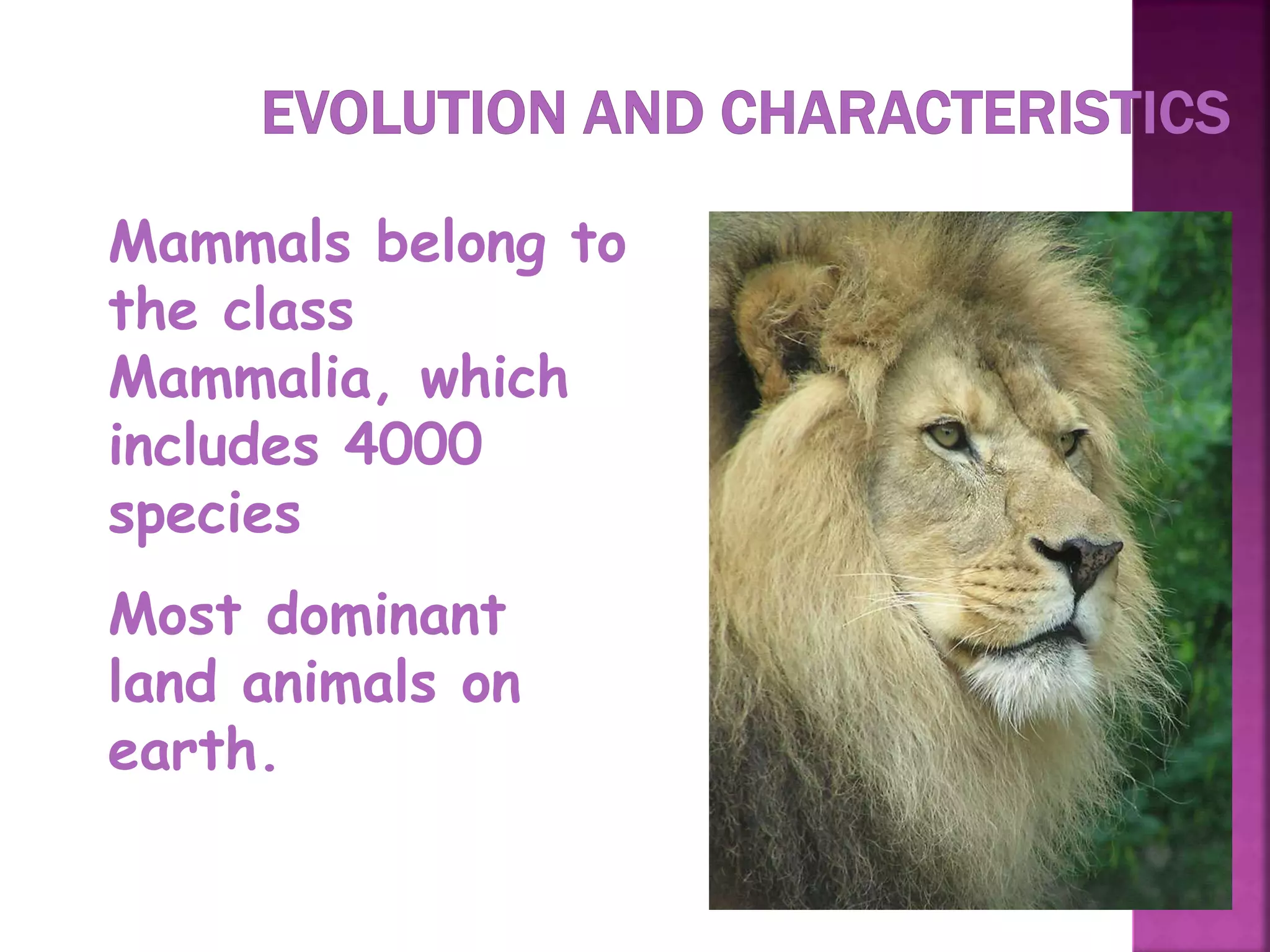
Mammals belong to
the class
Mammalia, which
includes 4000
species
Most dominant
land animals on
earth.
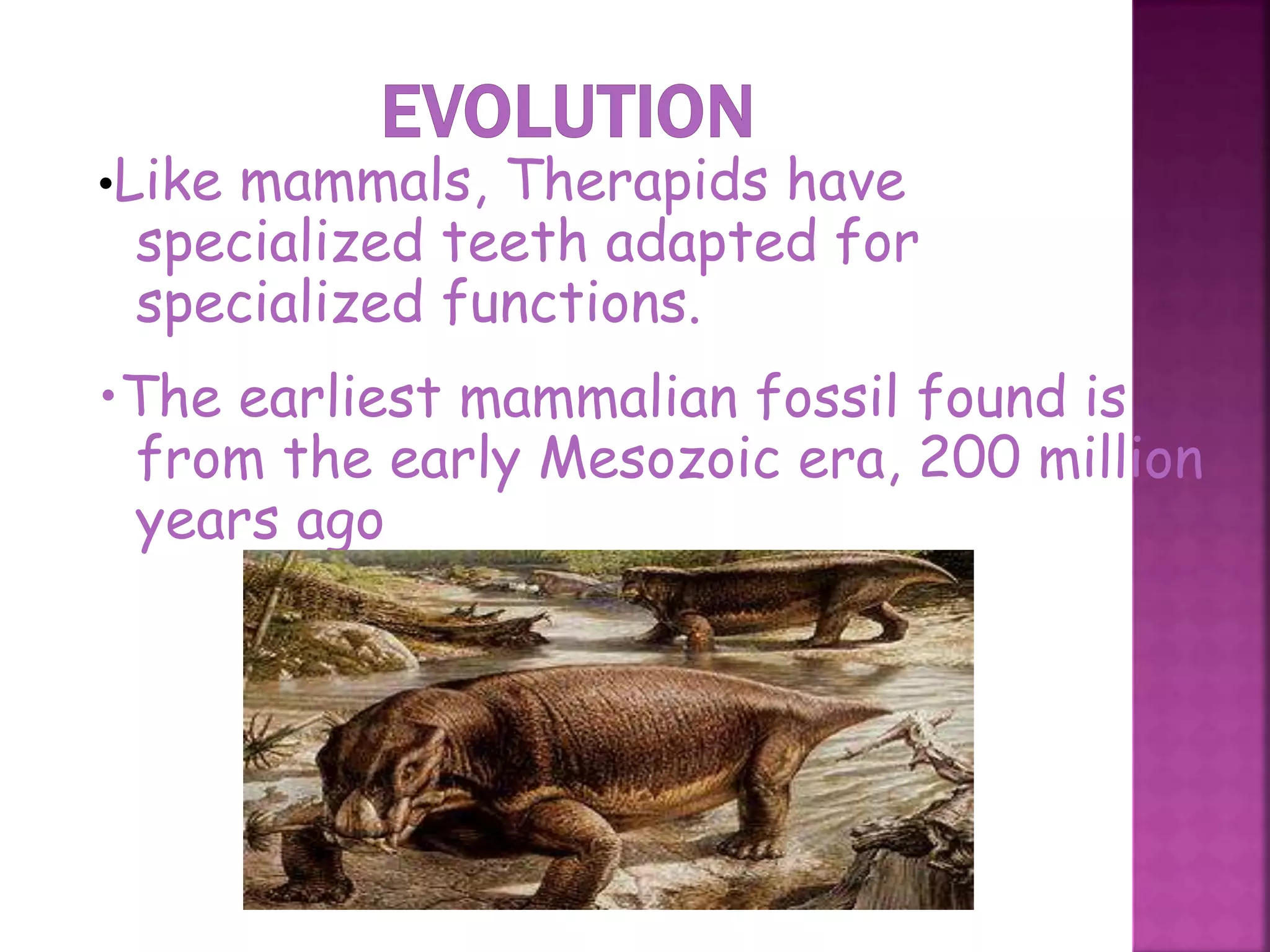
•Like mammals, Therapids have
specialized teeth adapted for
specialized functions.
•The earliest mammalian fossil found is
from the early Mesozoic era, 200 million
years ago
3
The remaining group, the ā€œTherianā€ mammals, which
originated during the Jurassic survive today
3 major groups of living mammals (the Therians):
1) Monotremes – egg-laying mammals
2) Marsupials – pouched mammals
3) Placentals – mammals with placenta
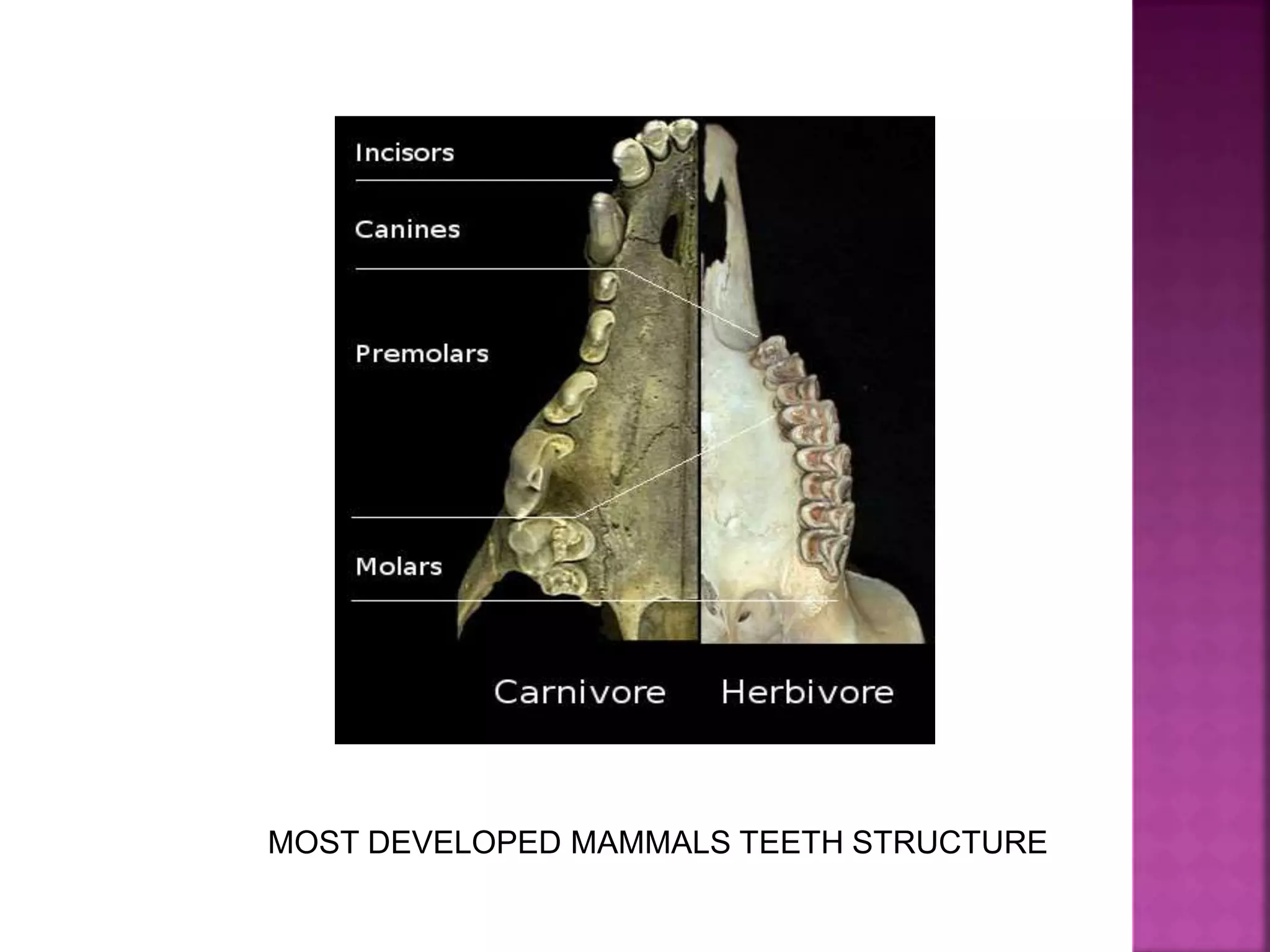
DIFFERENTIATED DENTITION
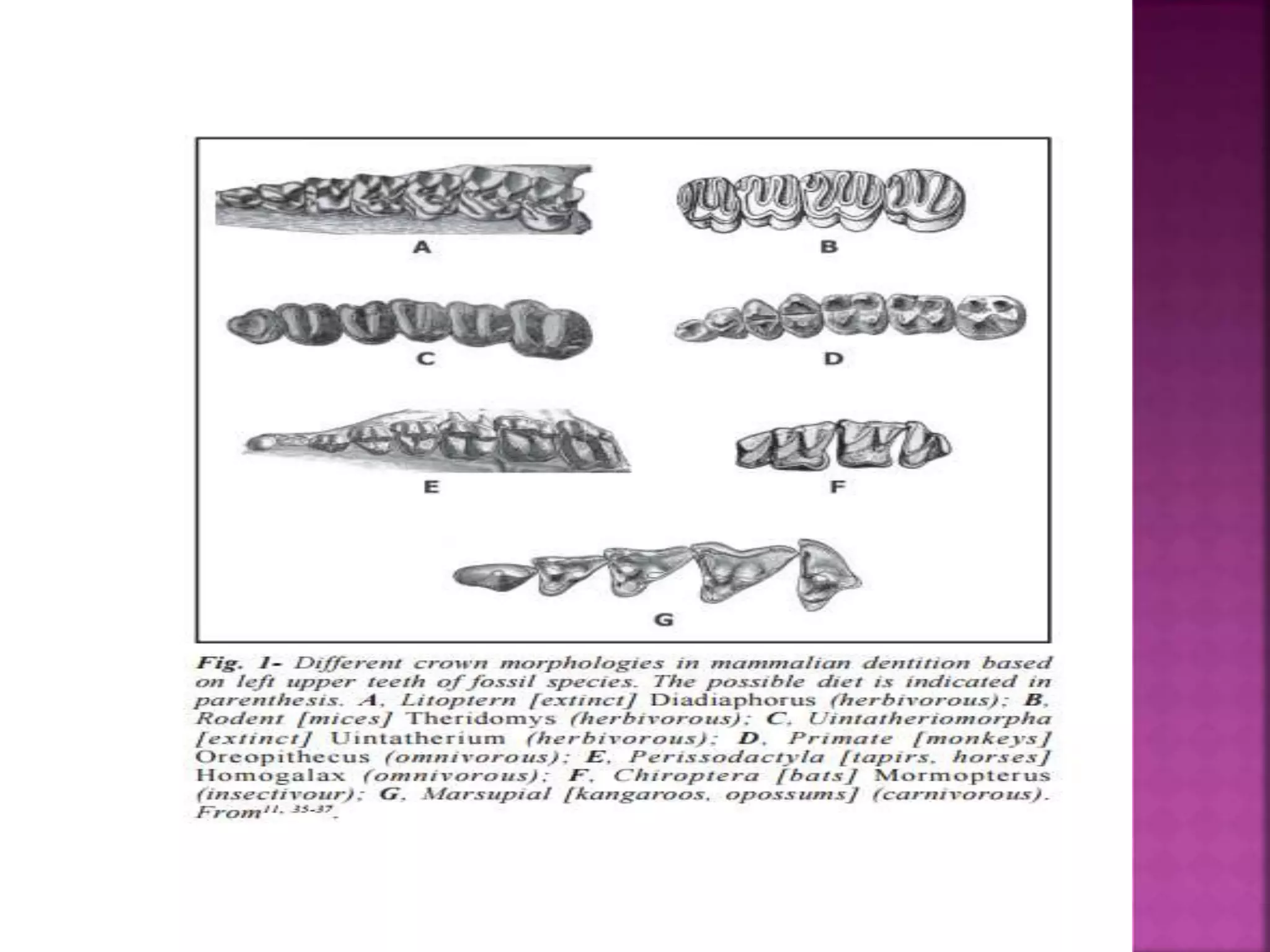
-Mammals needed their teeth to do several different jobs and so mammal
teeth evolved into different forms. Mammal teeth can grind, stab, scissor, dig,
chisel, sieve and lift (elephants tusks).
-The number, size, organization and shape of the teeth are different in every
species of mammal and can be used in taxonomy, especially of fossils. In
fact without teeth the fossil record would be much harder to understand.
-Mammals have only two sets of teeth, the first set they get soon after birth,
often called the 'milk teeth' and a larger set they acquire as an adult.
- In all other toothed vertebrates teeth just keep coming, no matter how
many you lose there is always another one ready to take its place. In other
words fish amphibians, reptiles and birds either have no teeth or numerous
sets.
Slender limbs, more movement in pectoral and
pelvic girdles;
Cynodonts showed general reduction in body
size. Early cynodonts were size of large dogs,
by
mid-Triassic the carnivorous cynodonts were
size of rabbits.
– Earliest mammals were small, about 100 mm
long, shrew-size.
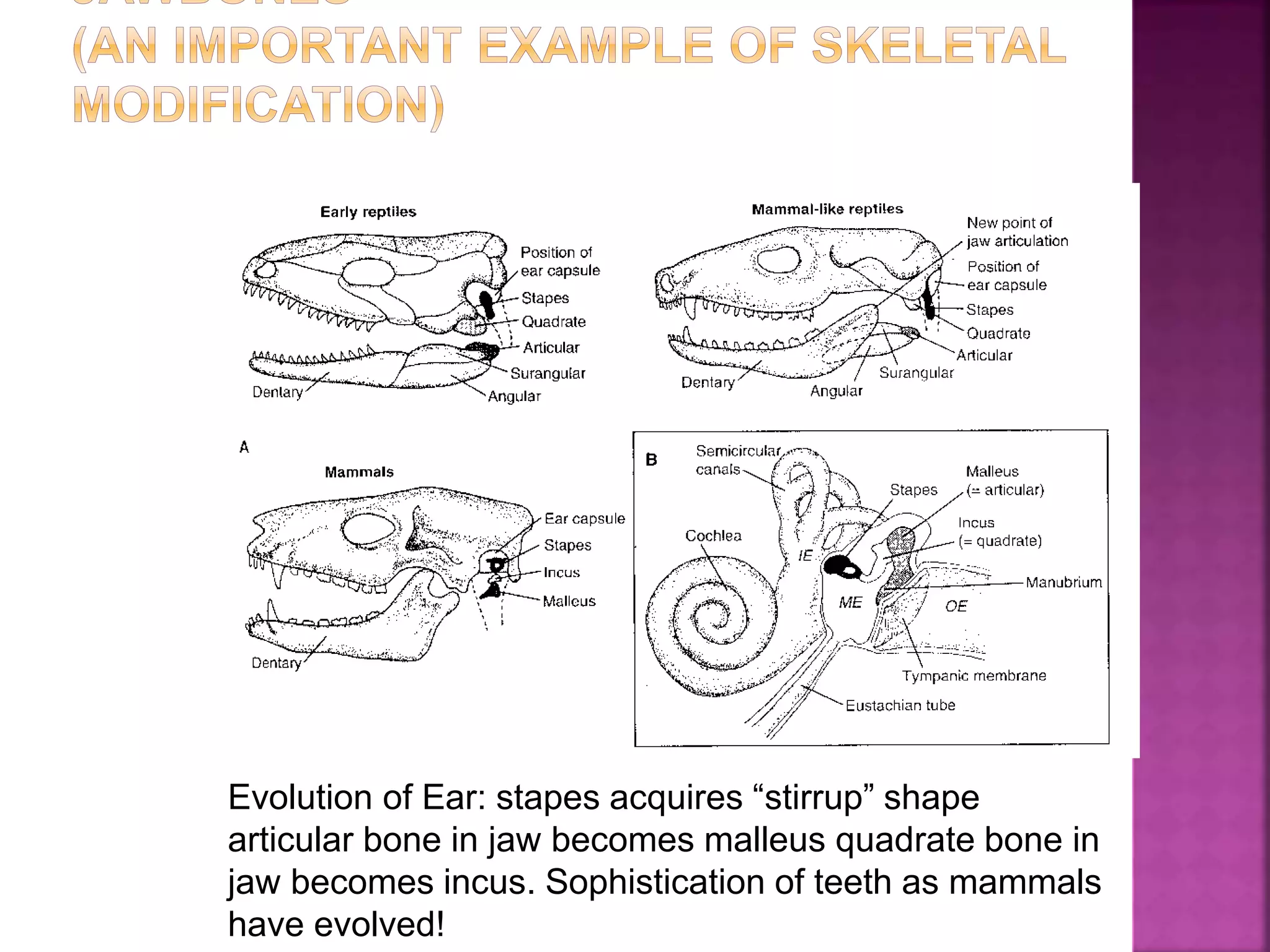
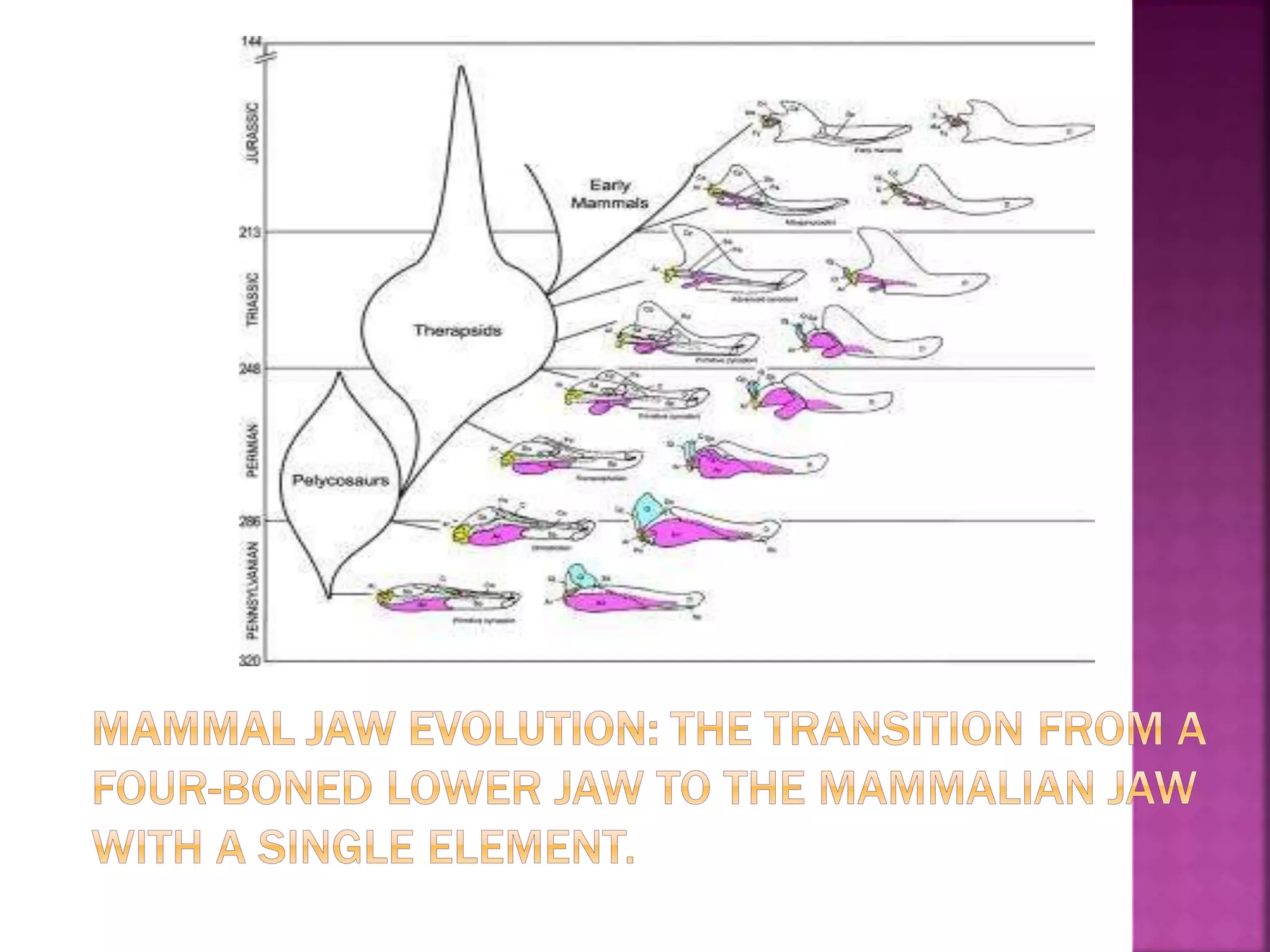
•Most reptiles have several bones in the lower jaw,
and Dimetrodon shares this characteristic.
• But mammals have only a single lower jawbone, the dentary.
• Throughout synapsid evolution, the gradual reduction of the non-dentary
elements of the jaw as they are crowded towards the back and eventually
lost.
•The dentary bone, in contrast, gets larger and takes over the entire jaw.
•In the final stage of evolution, the dentary bone expands until it makes
direct contact with the skull and develops a new articulation with it.
Evolution of Ear: stapes acquires ā€œstirrupā€ shape
articular bone in jaw becomes malleus quadrate bone in
jaw becomes incus. Sophistication of teeth as mammals
have evolved!
MOST DEVELOPED MAMMALS TEETH STRUCTURE
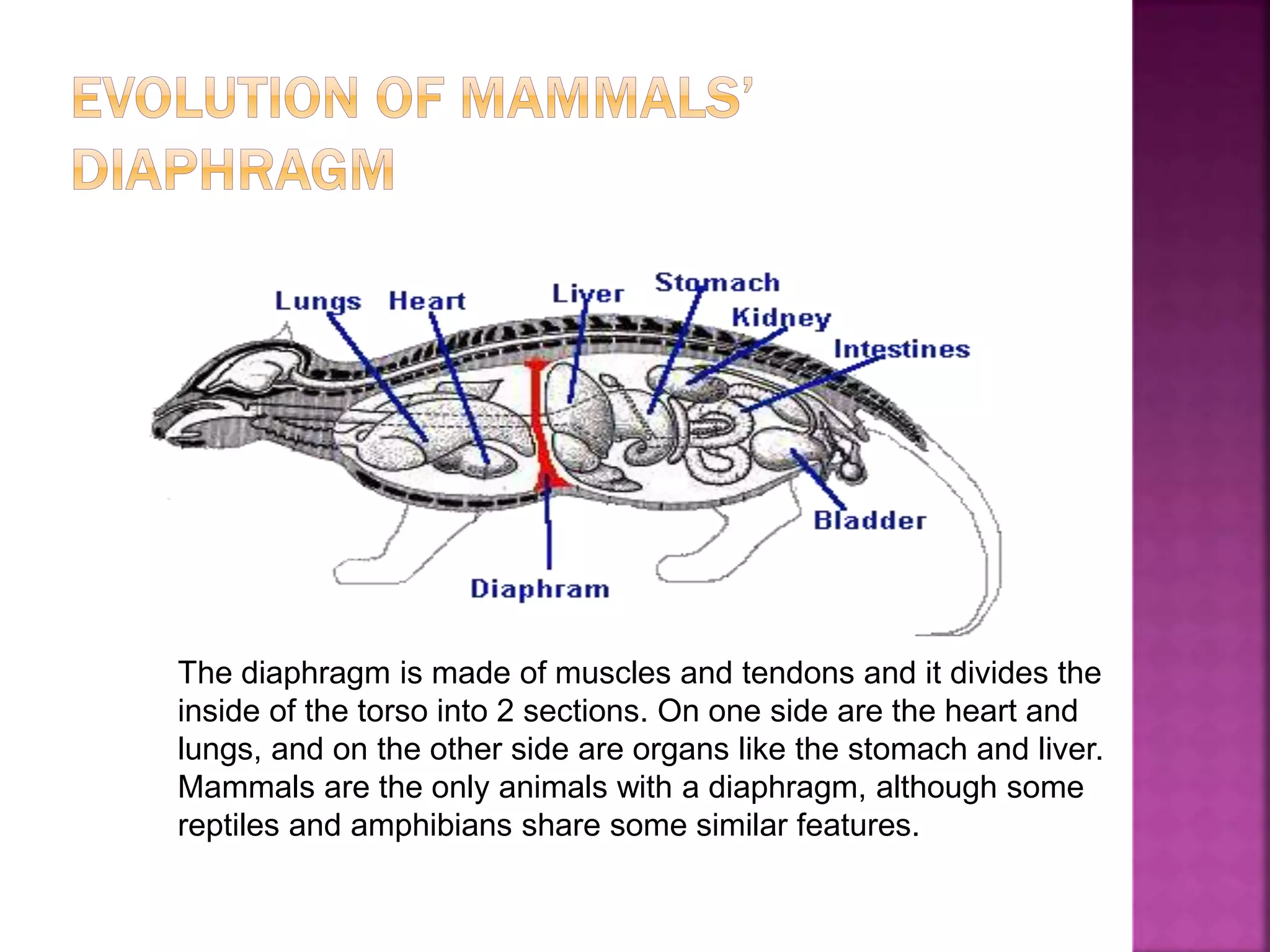
The diaphragm is made of muscles and tendons and it divides the
inside of the torso into 2 sections. On one side are the heart and
lungs, and on the other side are organs like the stomach and liver.
Mammals are the only animals with a diaphragm, although some
reptiles and amphibians share some similar features.
The muscle fibers of the diaphragm originate from the lumbar
vertebrae, ribs and sternum and insert into the central tendon. This
uniformity among mammals and the absence of this muscle from
non-mammalian tetrapods have been an obstacle to comparative
anatomy in unraveling the evolutionary origin of the diaphragm.
embryonic positions of forelimb muscle progenitors, which correspond to
the position of the brachial plexus, likely played an important role in the
evolution of the diaphragm.
evolution of diaphragm can be conluded as, first, forelimb muscle cells
were incorporated into tissues to form a primitive diaphragm in the stem
synapsid grade, and second, the diaphragm in cynodonts became
entrapped in the region controlled by pulmonary development.
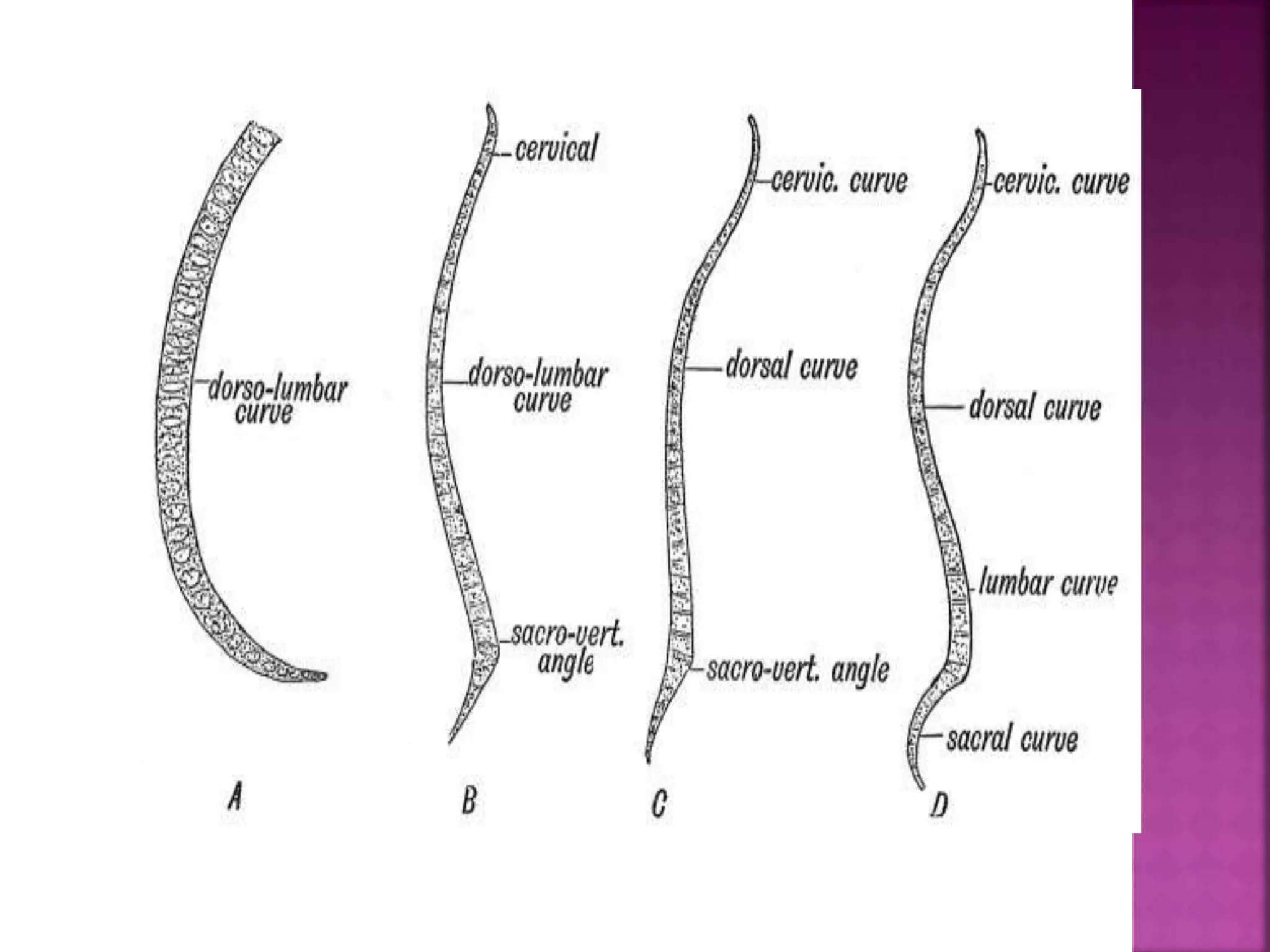
ļ‚ž In human anatomy, the five vertebrae in the
lumbar region of the back are the largest and
strongest in the movable part of the spinal
column, and can be distinguished by the
absence of a foramen in the transverse
process, and by the absence of facets on the
sides of the body. In most mammals, the
lumbar region of the spine curves outward.
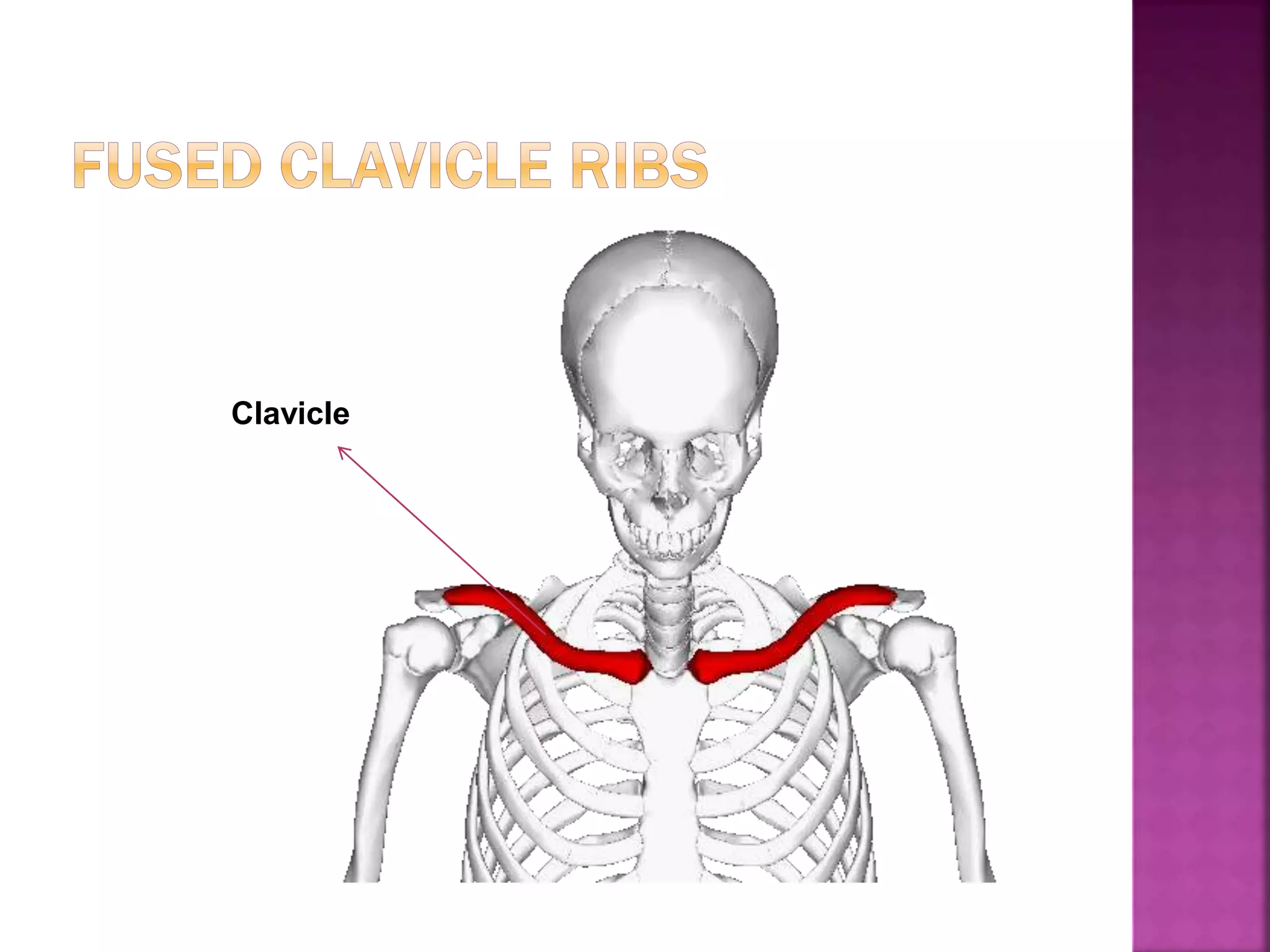
Clavicle
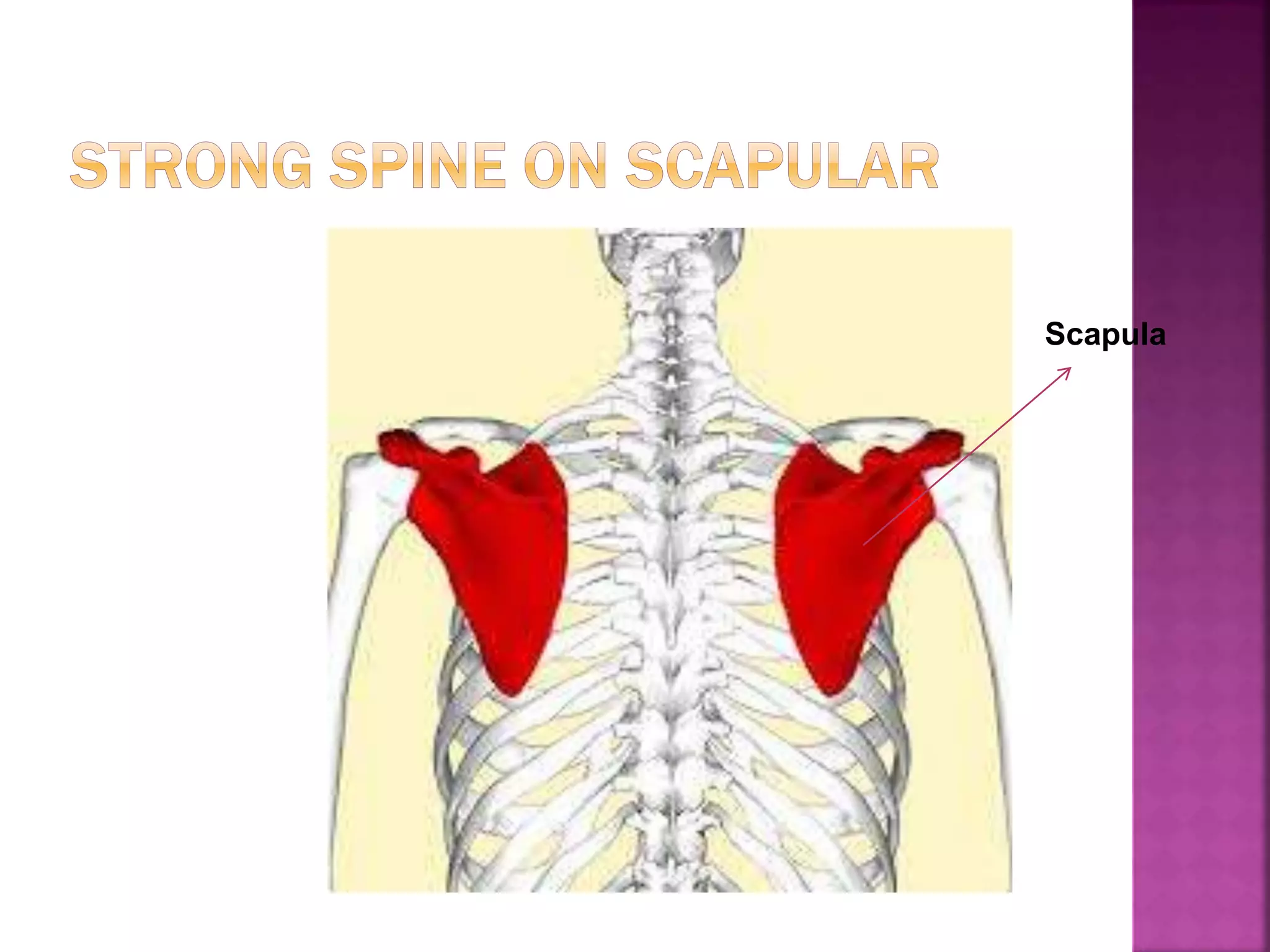
ļ‚ž The pectoral girdle consists of two pairs of
bones, the large flat Scapula (shoulder bone)
and the much smaller and more slender
Clavicle (collar bone).
ļ‚ž The clavicle runs from the far end of the
scapular to the sternum in most mammals
ļ‚ž In some mammals such as the Anisodactyla,
Perissodactyla, Mysticeti and Odontoceti
(Horses, Pigs, Deer, Buffaloes, etc. and
Whales) the clavicle is absent.
Scapula
ļ‚ž In anatomy, the scapula or shoulder blade,
is the bone that connects the humerus (upper
arm bone) with the clavicle (collar bone). Like
their connected bones the scapulae are
paired, with the scapula on the left side of the
body being roughly a mirror image of the right
scapula.
ļ‚ž The scapula forms the back of
the shoulder girdle. In humans, it is a flat
bone, roughly ttriangular in shape, placed on
a posterolateral aspect of the thoracic cage.
ļ‚ž The pentadactyl limb is common to humans, other
mammals (although whales and dolphins have lost
their hind limbs).
Darwin noted how widespread it was when he wrote
On the Origin of Species:
ļ‚ž 'What could be more curious than that the hand of
man formed for grasping, that of a mole, for digging,
the leg of a horse, the paddle of a porpoise and the
wing of a bat, should all be constructed on the same
pattern and should include similar bones and in the
same relative positions?'
ļ‚ž There are a few mammals that appear to have
different numbers of digits from us. One of these is
the panda, which looks like it has 6 digits.
ļ‚ž However, close examination has shown that the
extra thumb is actually an outgrowth of one of the
wrist bones and not an extra digit at all. The same is
true of moles.
ļ‚ž The pentadactyl limb is common to most tetrapods
(4-limbed creatures).
ļ‚ž Among extinct tetrapods, many dinosaurs had only 3
toes, and some marine reptiles had more than 5
digits in their paddles. But no animals living today
have more than 5 digits that all developed in the
same way.
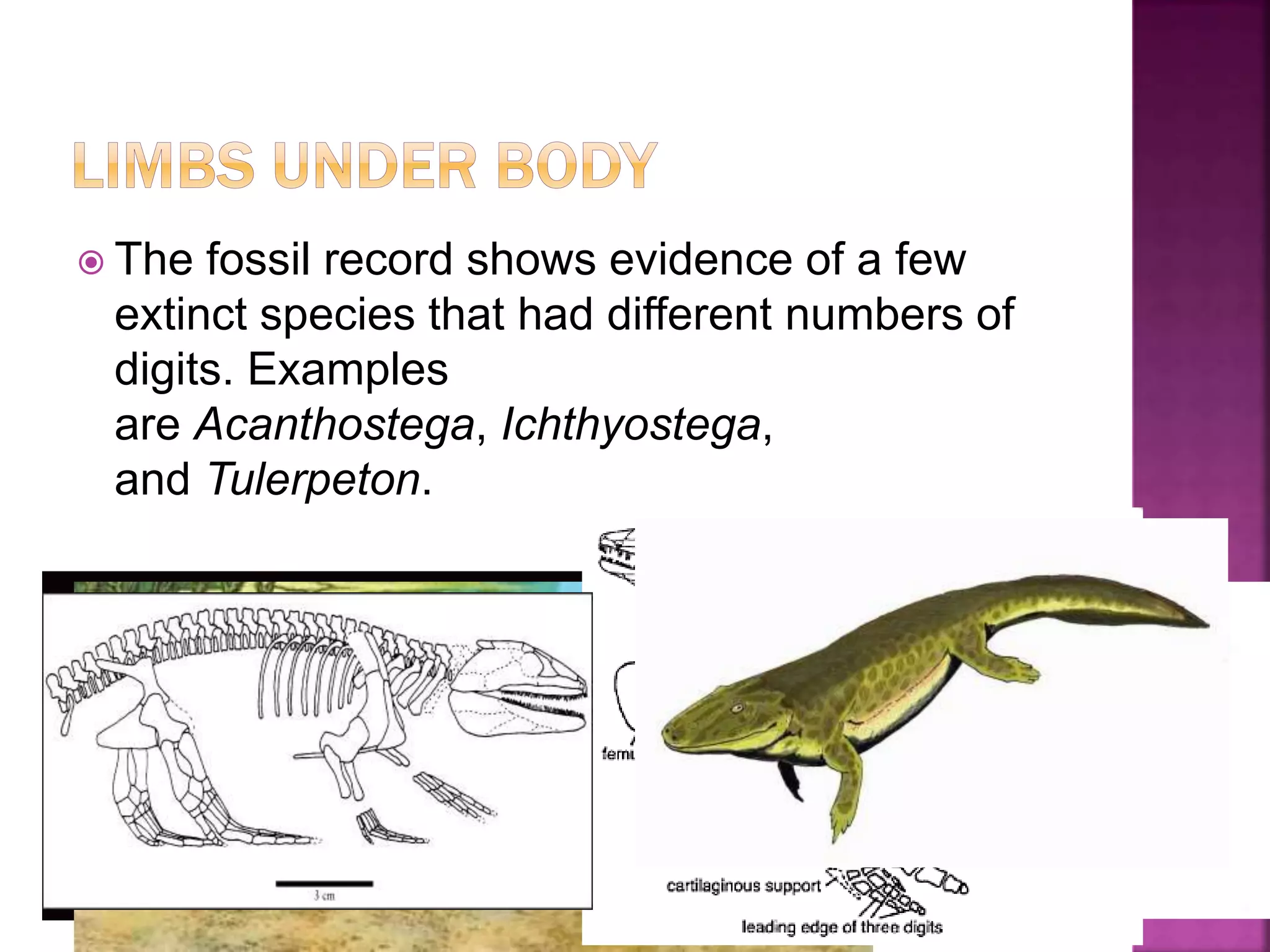
ļ‚ž The fossil record shows evidence of a few
extinct species that had different numbers of
digits. Examples
are Acanthostega, Ichthyostega,
and Tulerpeton.
ļ‚ž These are all animals that lived during the late
Devonian period, between 380 and 360
million years ago, when tetrapods first began
to move onto land. Some had as many as 8
digits, before the common pattern of 5 digits
became established that we have inherited.
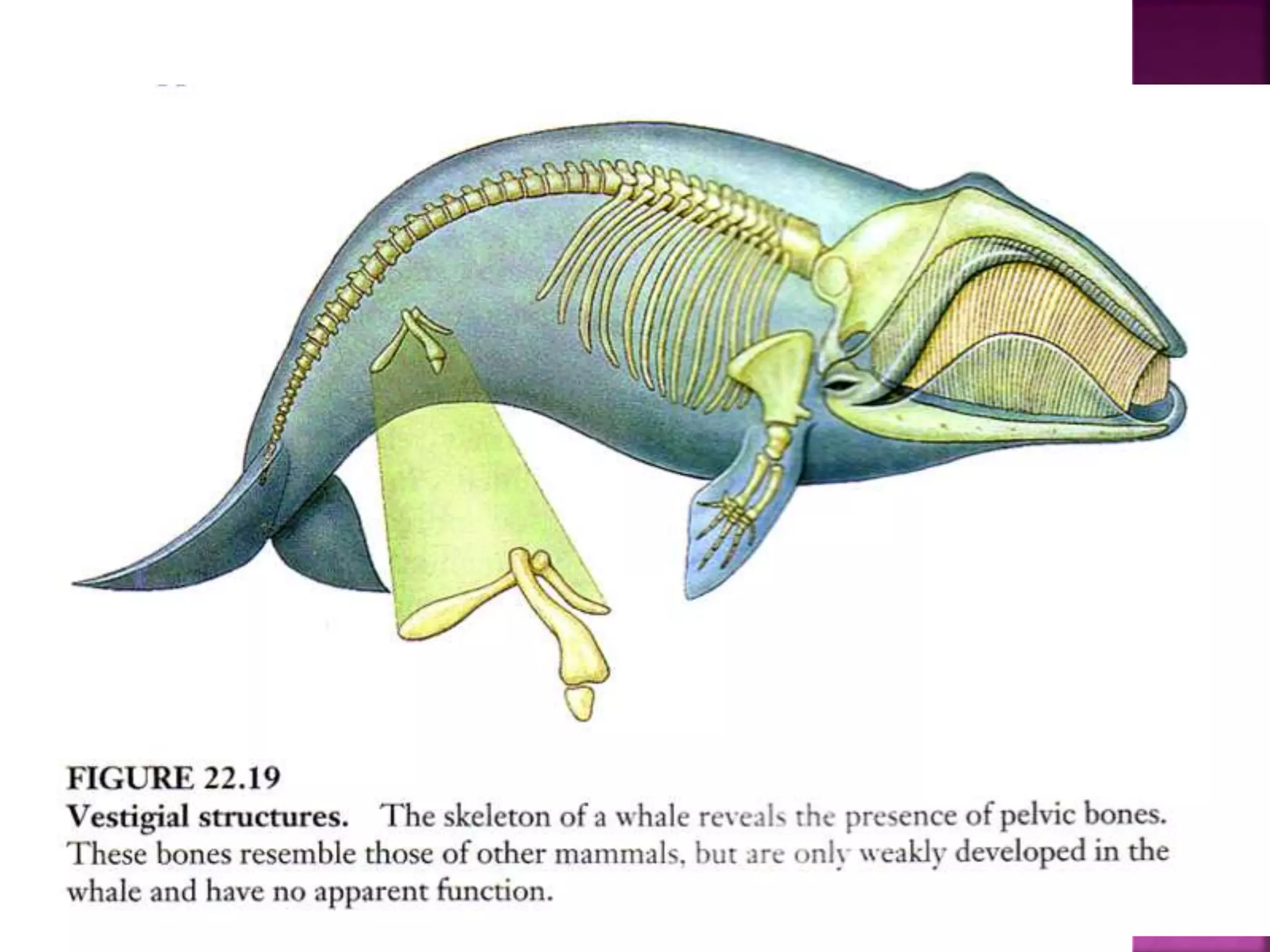
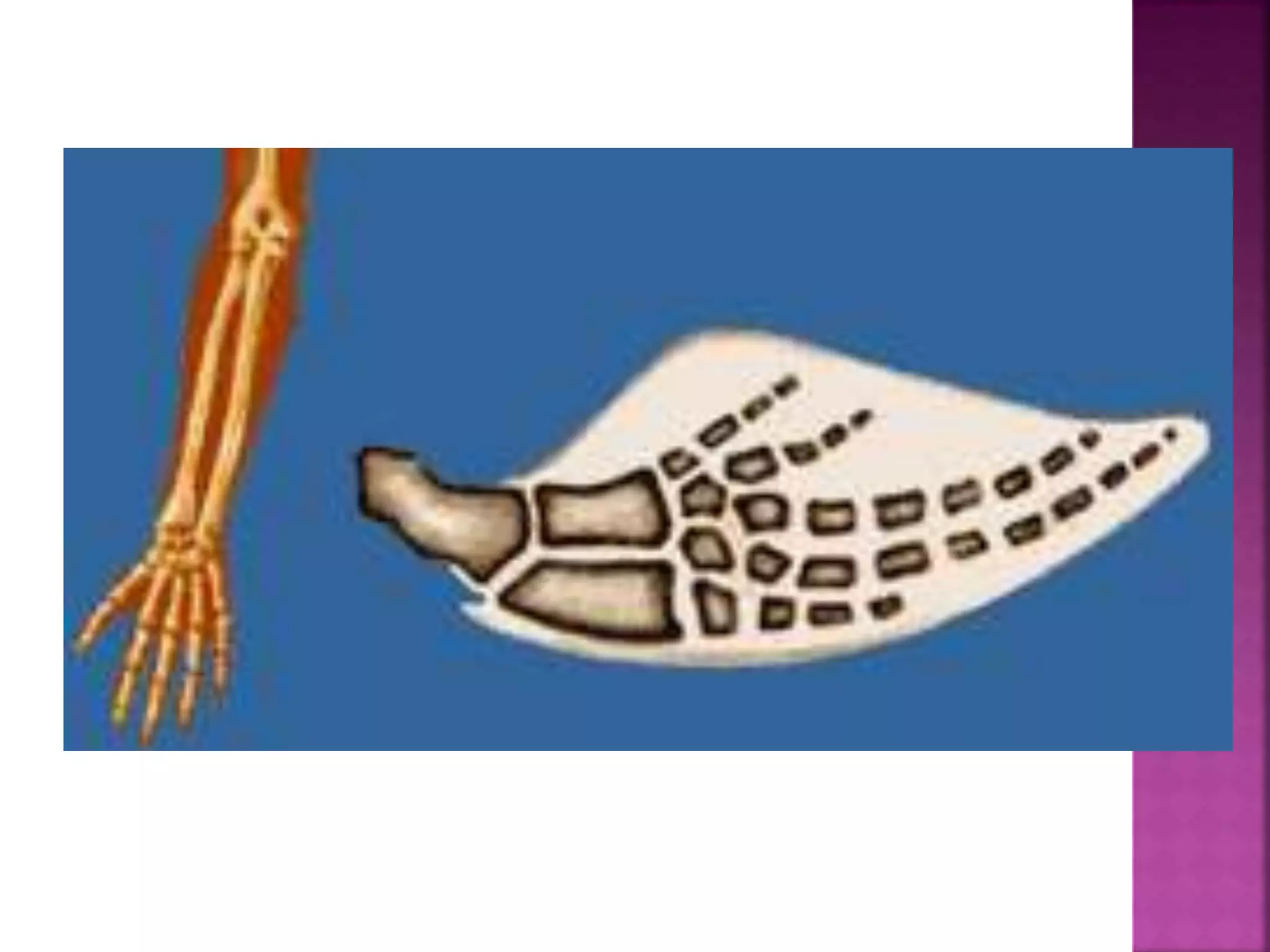
Whale:
ļ‚ž The similarities between the skeletons of land
mammals and whales are quite clear. The
hind limbs have all but disappeared.
ļ‚ž The front limbs in all whales, the pectoral fins
or flippers, basically contain all the bones that
can be found in the front limbs of land
mammals.
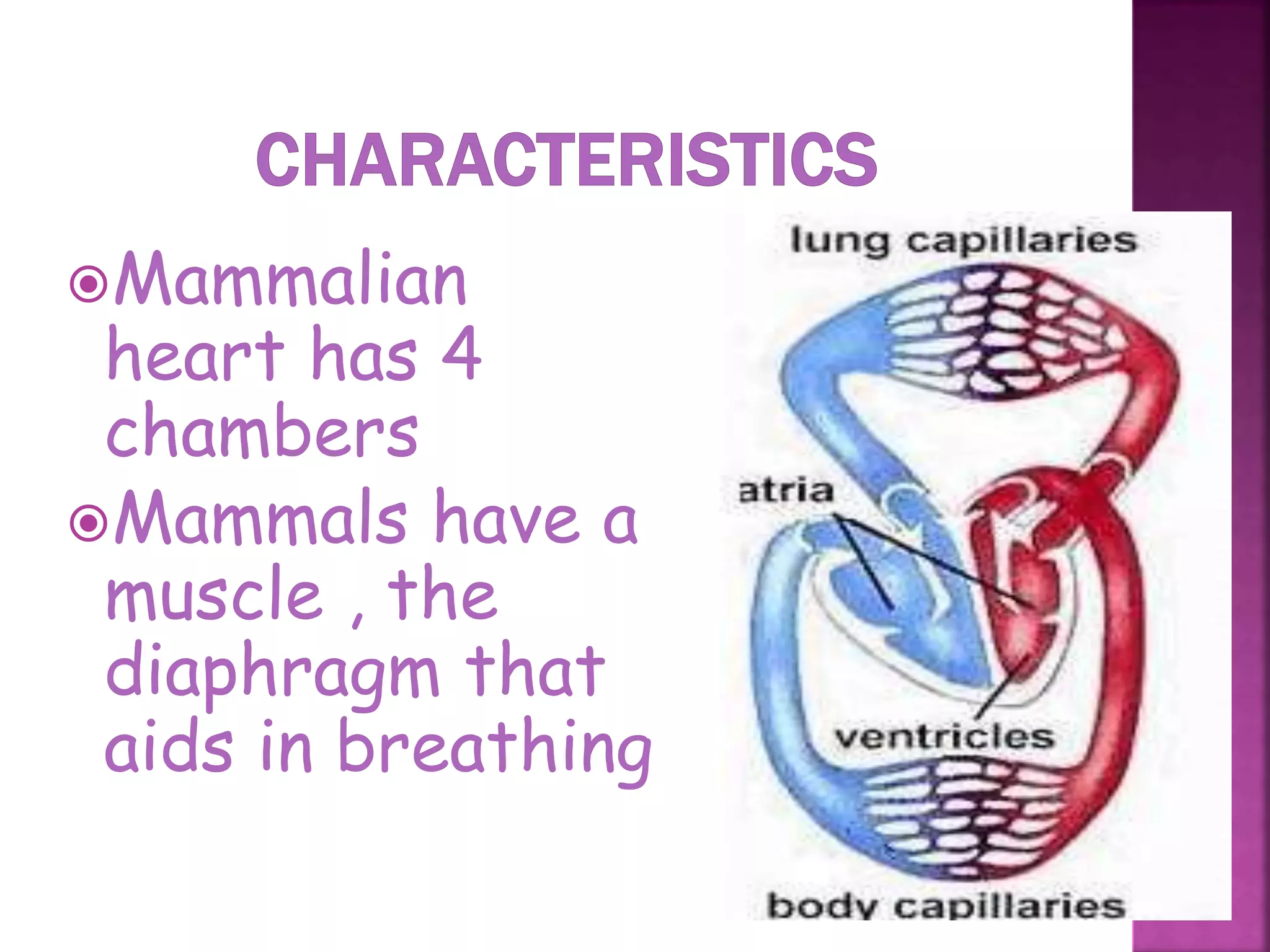
ļ‚žMammalian
heart has 4
chambers
ļ‚žMammals have a
muscle , the
diaphragm that
aids in breathing
27
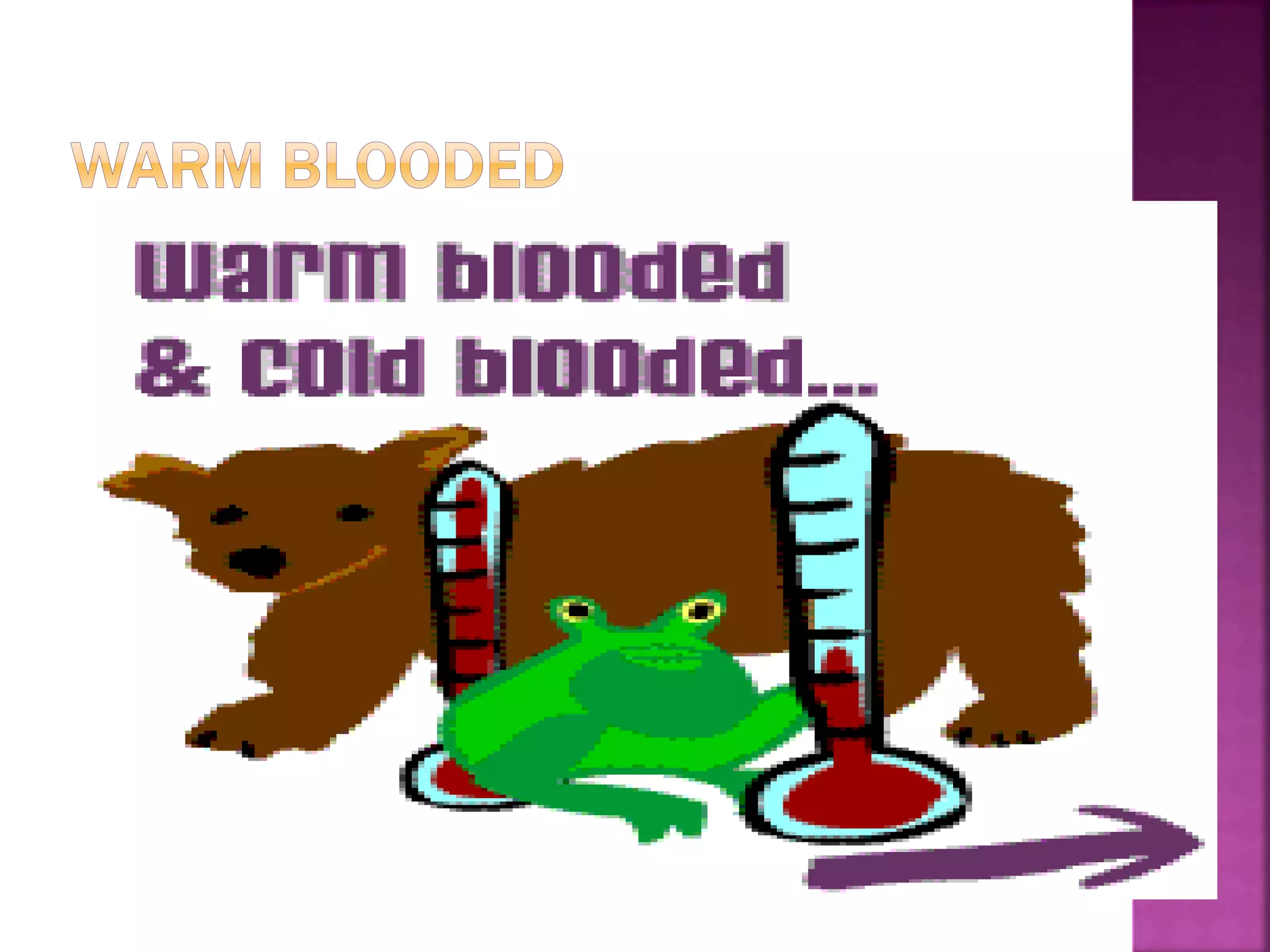
ļ‚ž It explains that warm-bloodedness most likely did not
evolve for purposes of thermoregulation, but instead
evolved slowly as a side-effect of increased
metabolism, and longer and longer aerobic (oxygen-
consuming) activity.
ļ‚ž In other words, it did not evolve suddenly in one
animal, but was a long-developing trend across
many species in the diapsid and therapsid
dinosaurs.
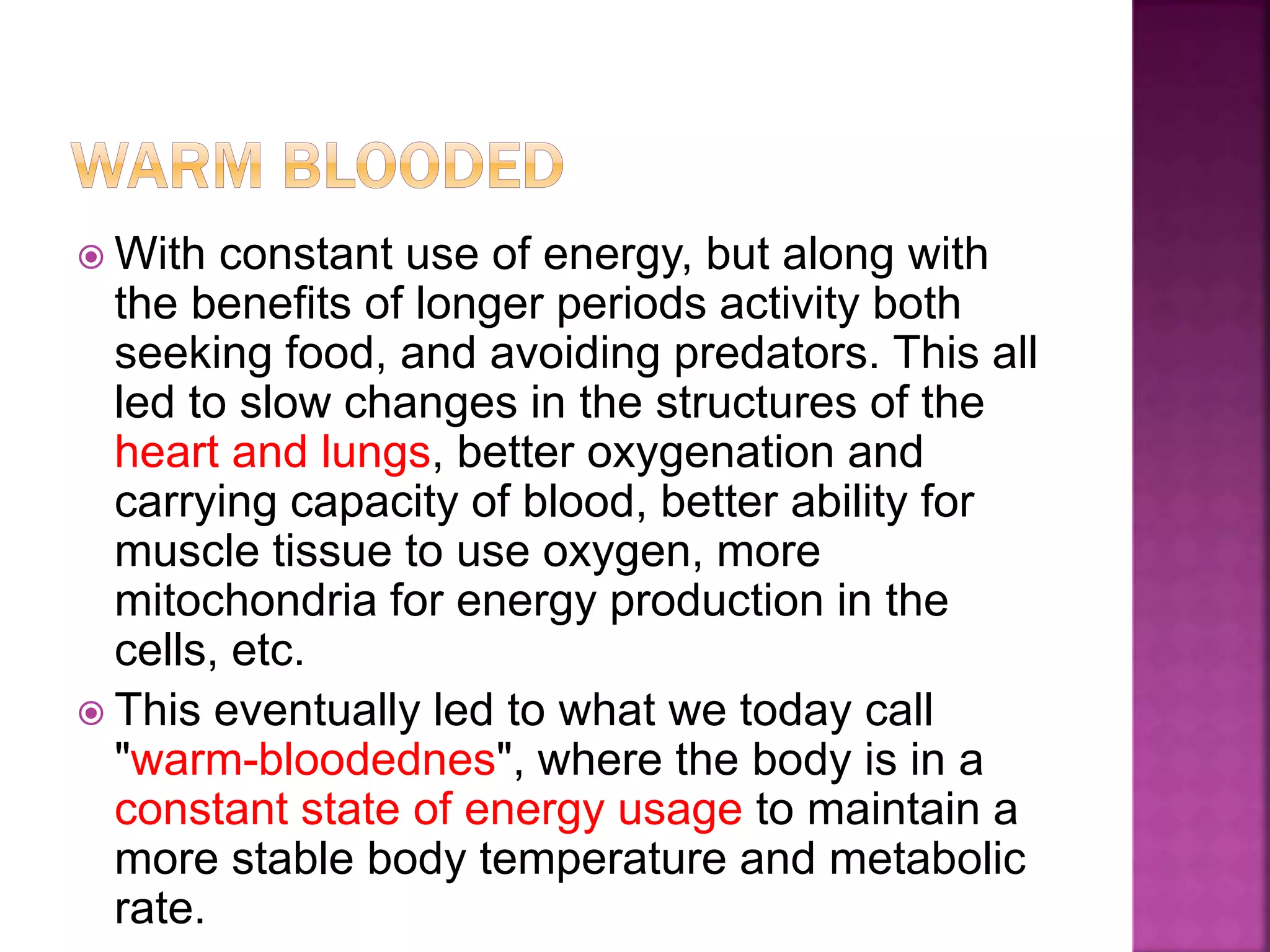
ļ‚ž With constant use of energy, but along with
the benefits of longer periods activity both
seeking food, and avoiding predators. This all
led to slow changes in the structures of the
heart and lungs, better oxygenation and
carrying capacity of blood, better ability for
muscle tissue to use oxygen, more
mitochondria for energy production in the
cells, etc.
ļ‚ž This eventually led to what we today call
"warm-bloodednes", where the body is in a
constant state of energy usage to maintain a
more stable body temperature and metabolic
rate.
ļ‚ž Mammals were the first animals to evolve
body hair and it is still one of their common
features today.
ļ‚ž Even mammals like whales and dolphins are
born with hair above their mouths, even
though the adults are hair-less.
ļ‚ž Hair is widely believed by Darwinists to have evolved
from scales (Denton, 1986, p. 106).
ļ‚ž An alternative view is that hair evolved first as tiny
projecting rods in the hinges between scales and
served as tactile devices.
ļ‚ž The "protohairs" could help monitor surface sensory
data when an animal was hiding from an enemy or
retreating from the weather.
ļ‚ž This sensory protohair might then have evolved
secondarily into an insulative pelage as mammals
become endothermic. Although insulative in modern
mammals, hair still retains a sensory function.
Whale:
ļ‚ž Land mammals have some form of hairy fur, which
serves among others as insulation. Whales don't
have fur. In water, fur needs a lot of maintenance in
order to maintain its insulating properties. Losing the
fur gave whales a perfectly streamlined body. In
whales, the remnants of the fur can still be seen.
Young dolphins have small whiskers and in older
animals, the hair follicles can still be seen on the
snout. Some dolphin species (e.g. river dolphins)
have whiskers throughout their life.
34
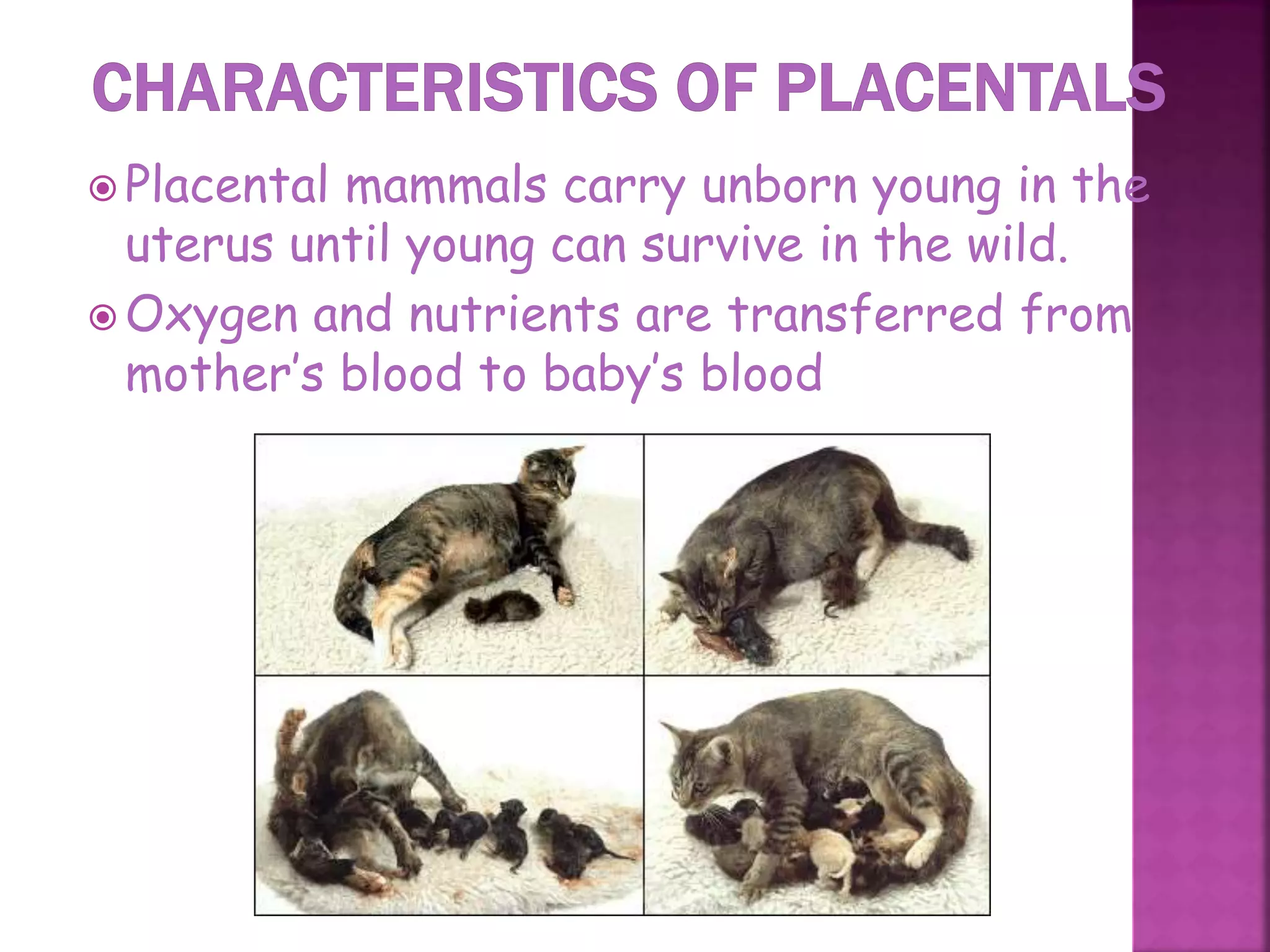
ļ‚ž Placental mammals carry unborn young in the
uterus until young can survive in the wild.
ļ‚ž Oxygen and nutrients are transferred from
mother’s blood to baby’s blood
35
ļ‚žThe placenta is a
membrane providing
nutrients and waste &
gas exchange between
the mother and
developing young
ļ‚žGestation period-is the
time which mammals
develop in mother’s
uterus
36
37
Walrus
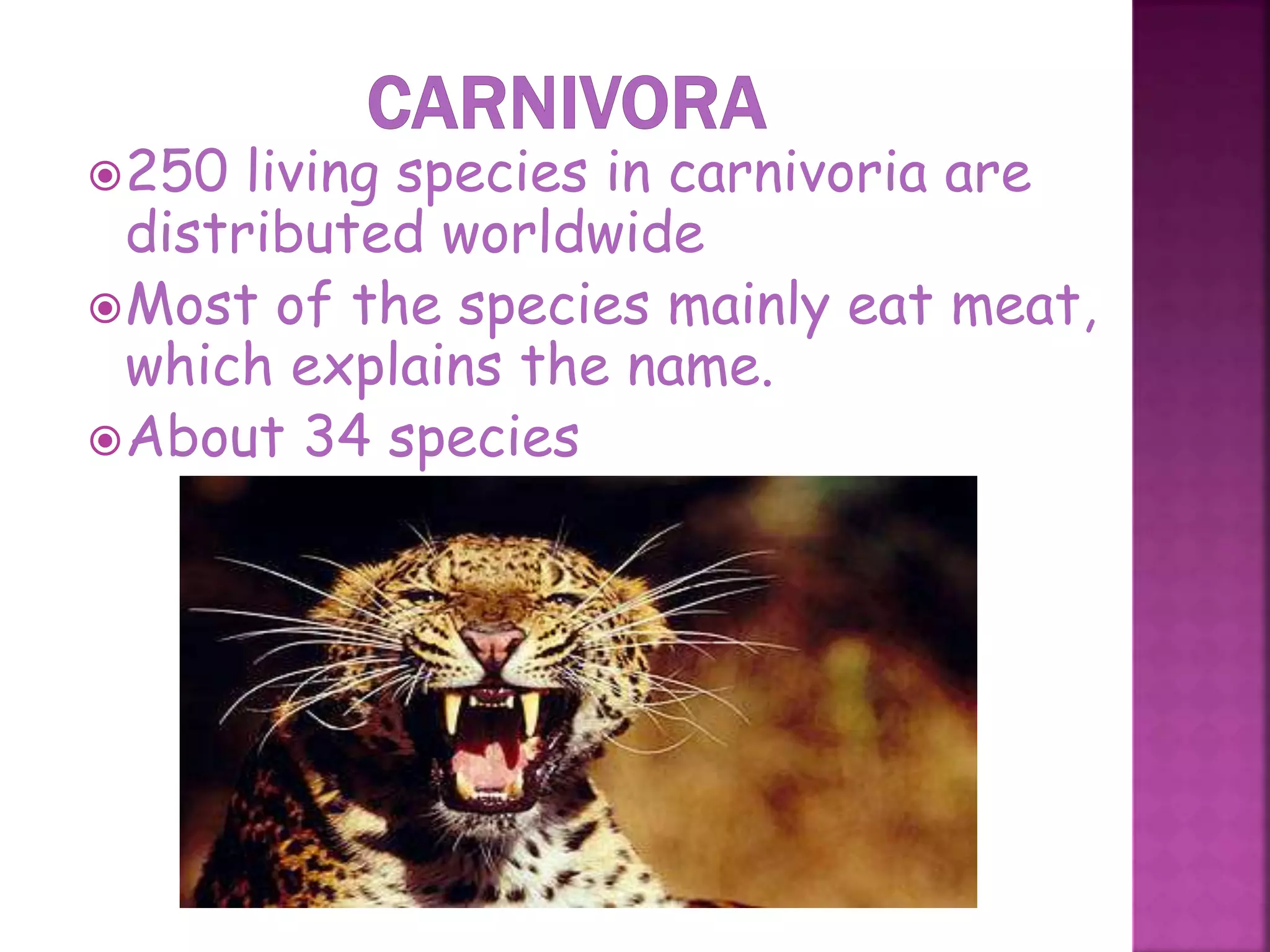
ļ‚ž250 living species in carnivoria are
distributed worldwide
ļ‚žMost of the species mainly eat meat,
which explains the name.
ļ‚žAbout 34 species
38
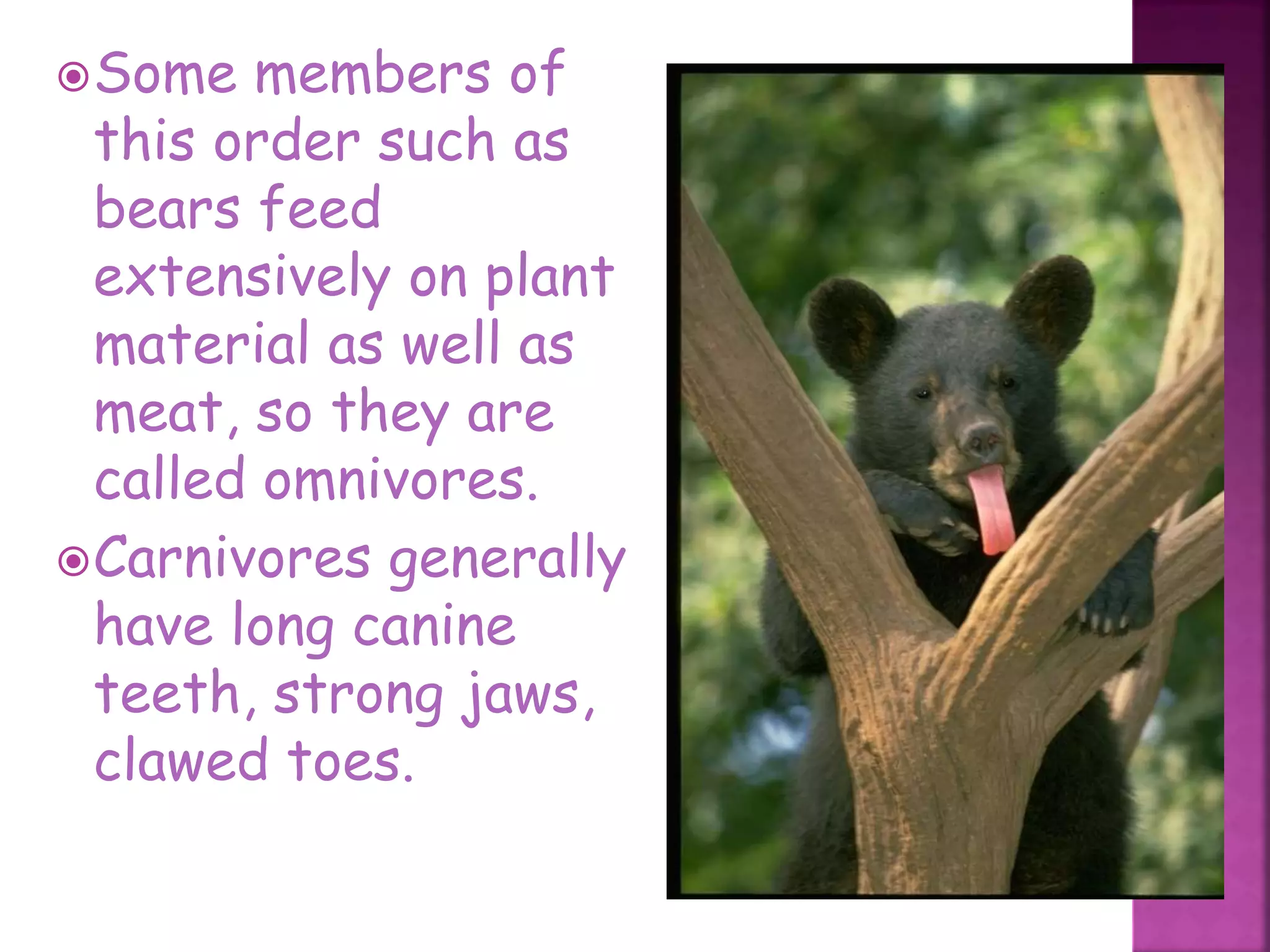
ļ‚žSome members of
this order such as
bears feed
extensively on plant
material as well as
meat, so they are
called omnivores.
ļ‚žCarnivores generally
have long canine
teeth, strong jaws,
clawed toes.
39
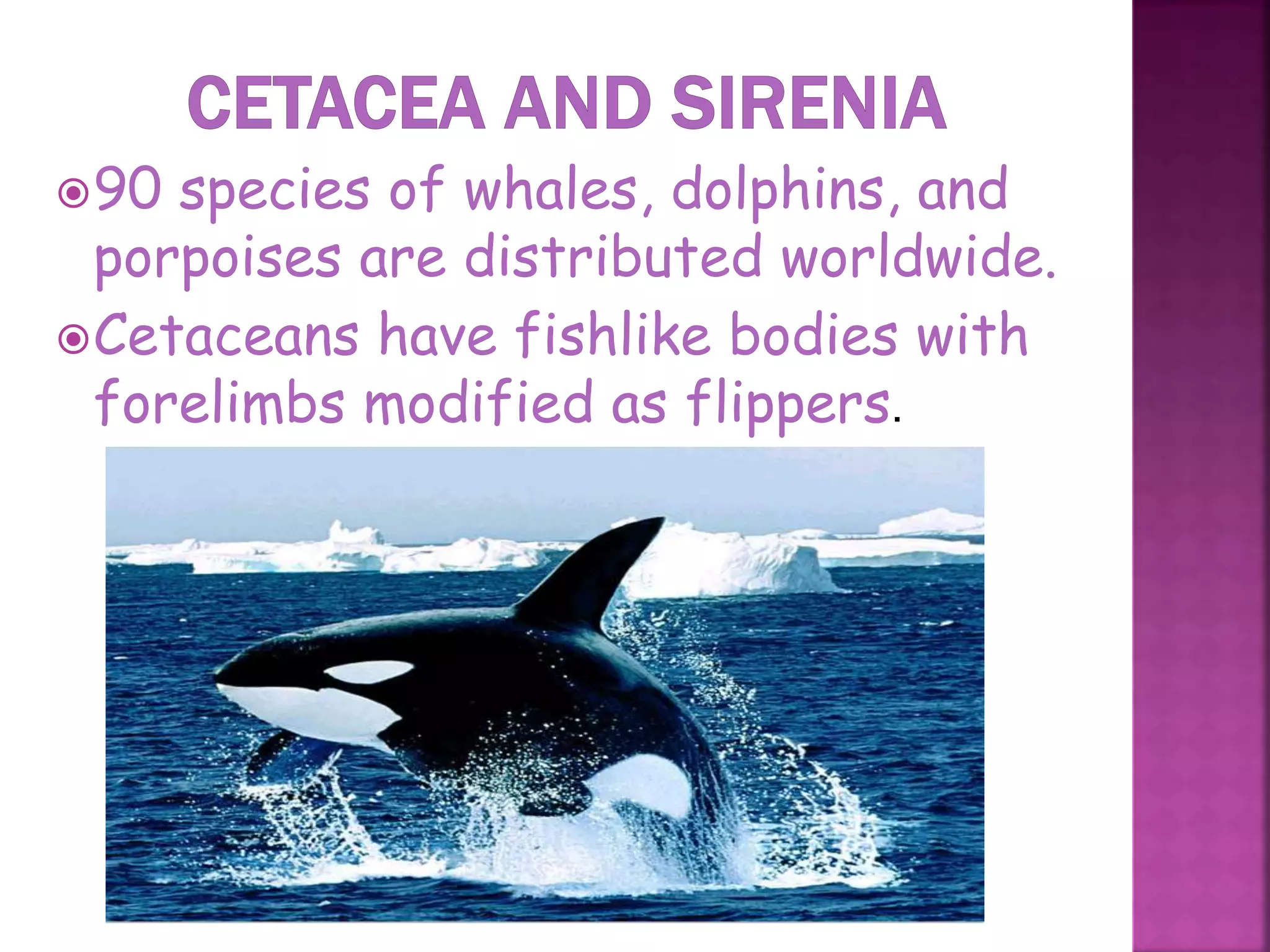
ļ‚ž90 species of whales, dolphins, and
porpoises are distributed worldwide.
ļ‚žCetaceans have fishlike bodies with
forelimbs modified as flippers.
40
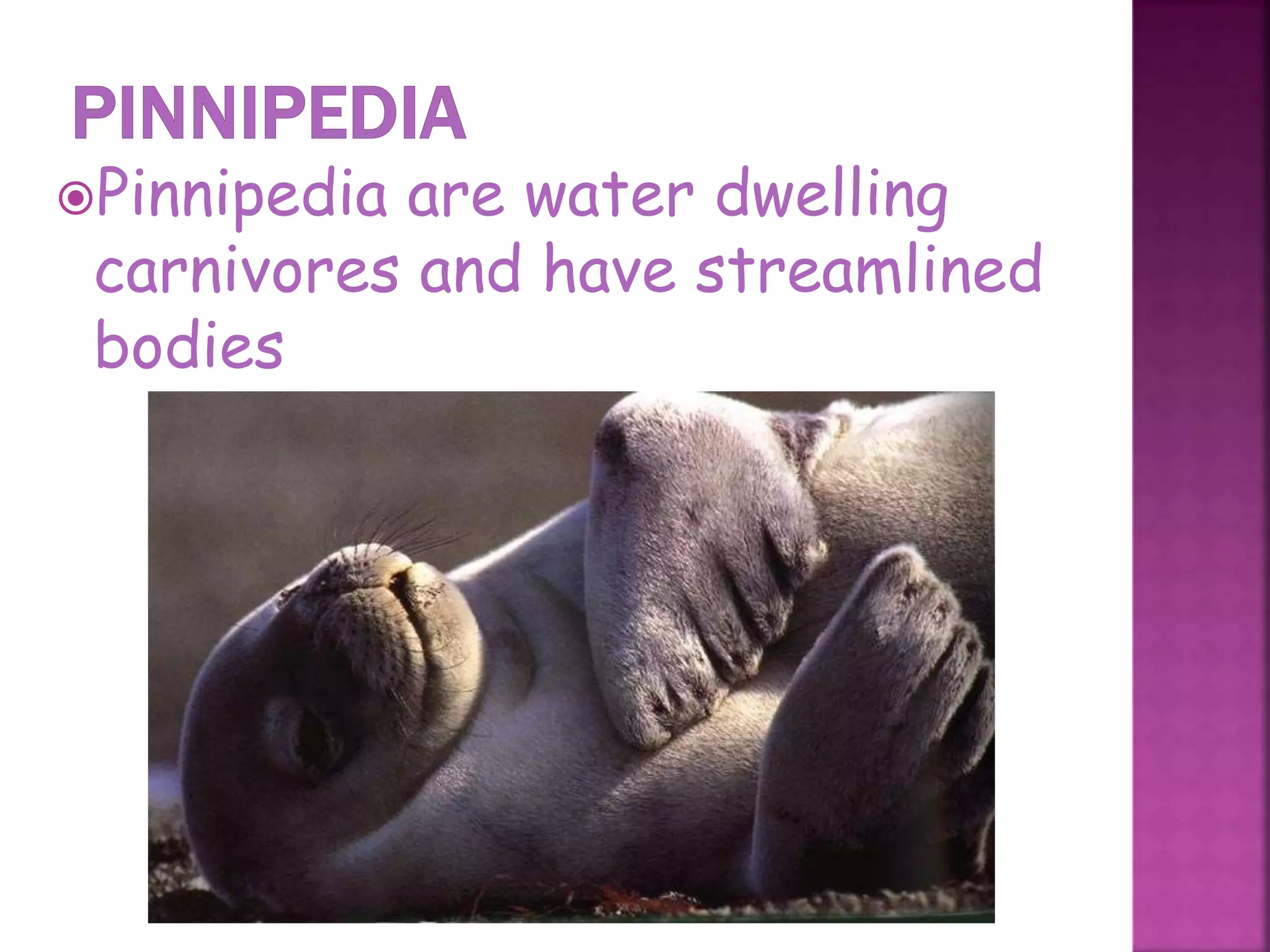
ļ‚žPinnipedia are water dwelling
carnivores and have streamlined
bodies
41
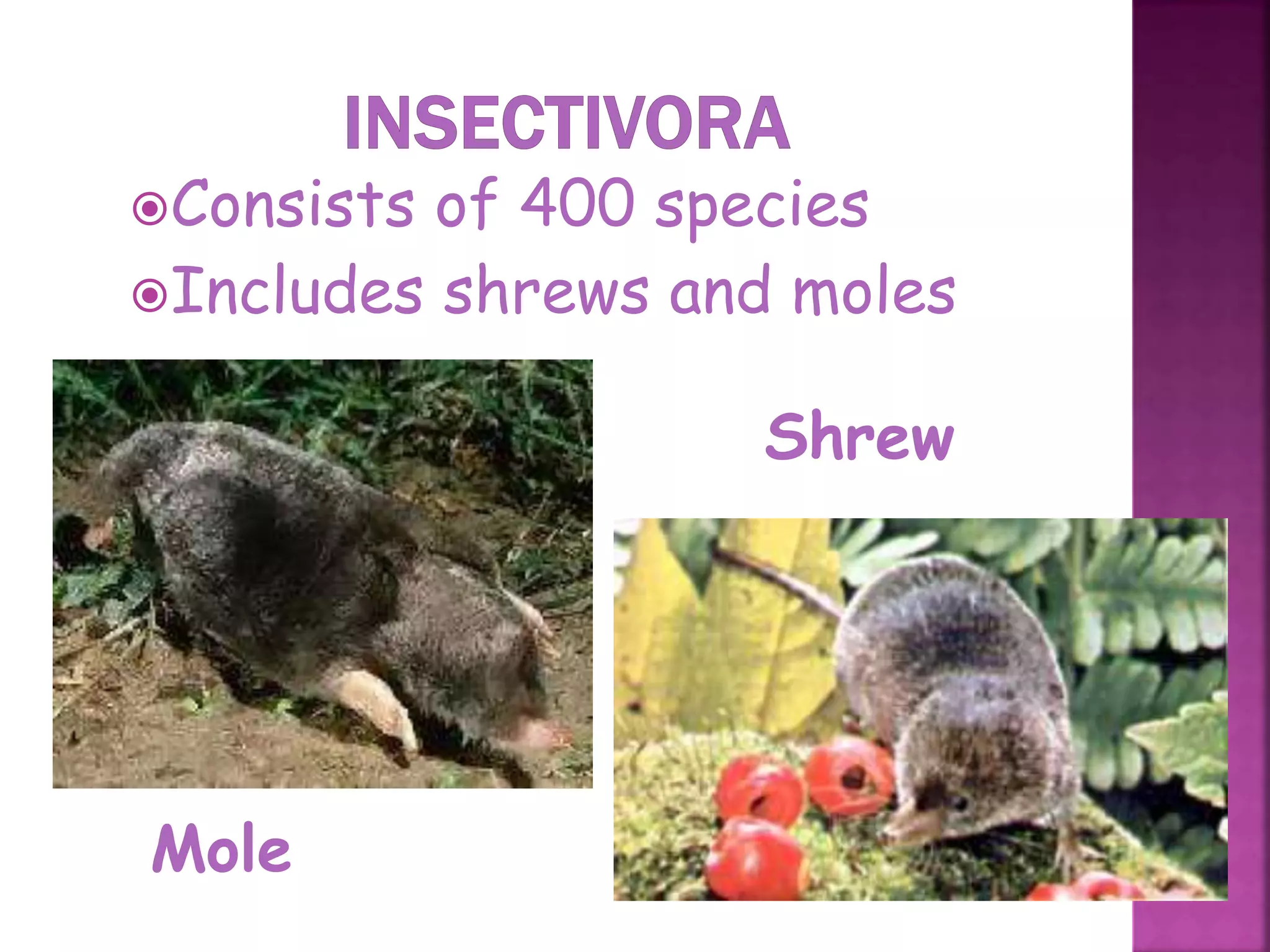
ļ‚žConsists of 400 species
ļ‚žIncludes shrews and moles
42
Mole
Shrew
ļ‚žUngulates-hoofed mammals, classified
into two orders: Artiodactyla and
Perissodactyla
ļ‚žThese two classes are herbivores.
ļ‚žThey have a storage chamber in their
stomach called the rumen, undergoes
double digestion.
43
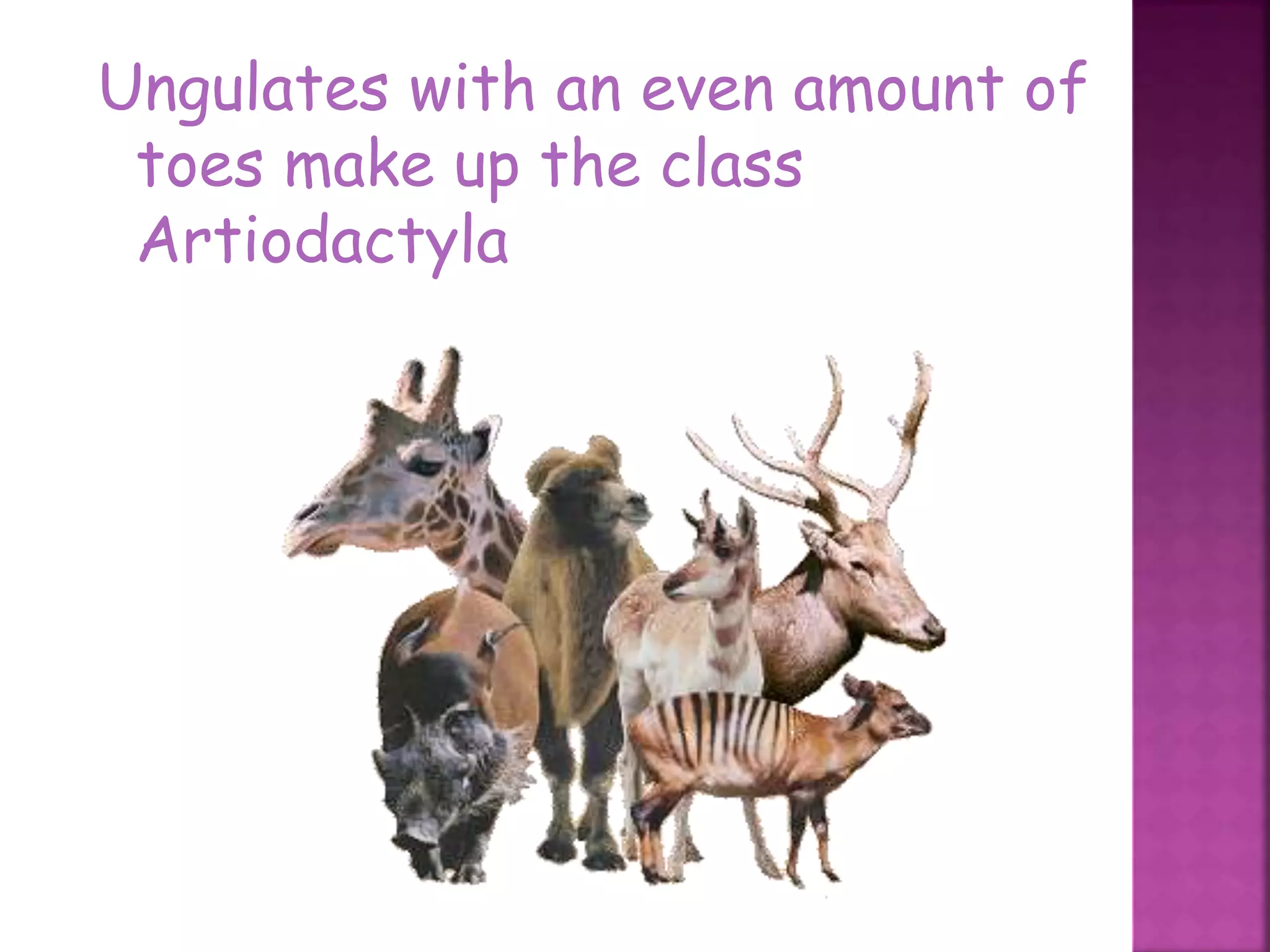
Ungulates with an even amount of
toes make up the class
Artiodactyla
44
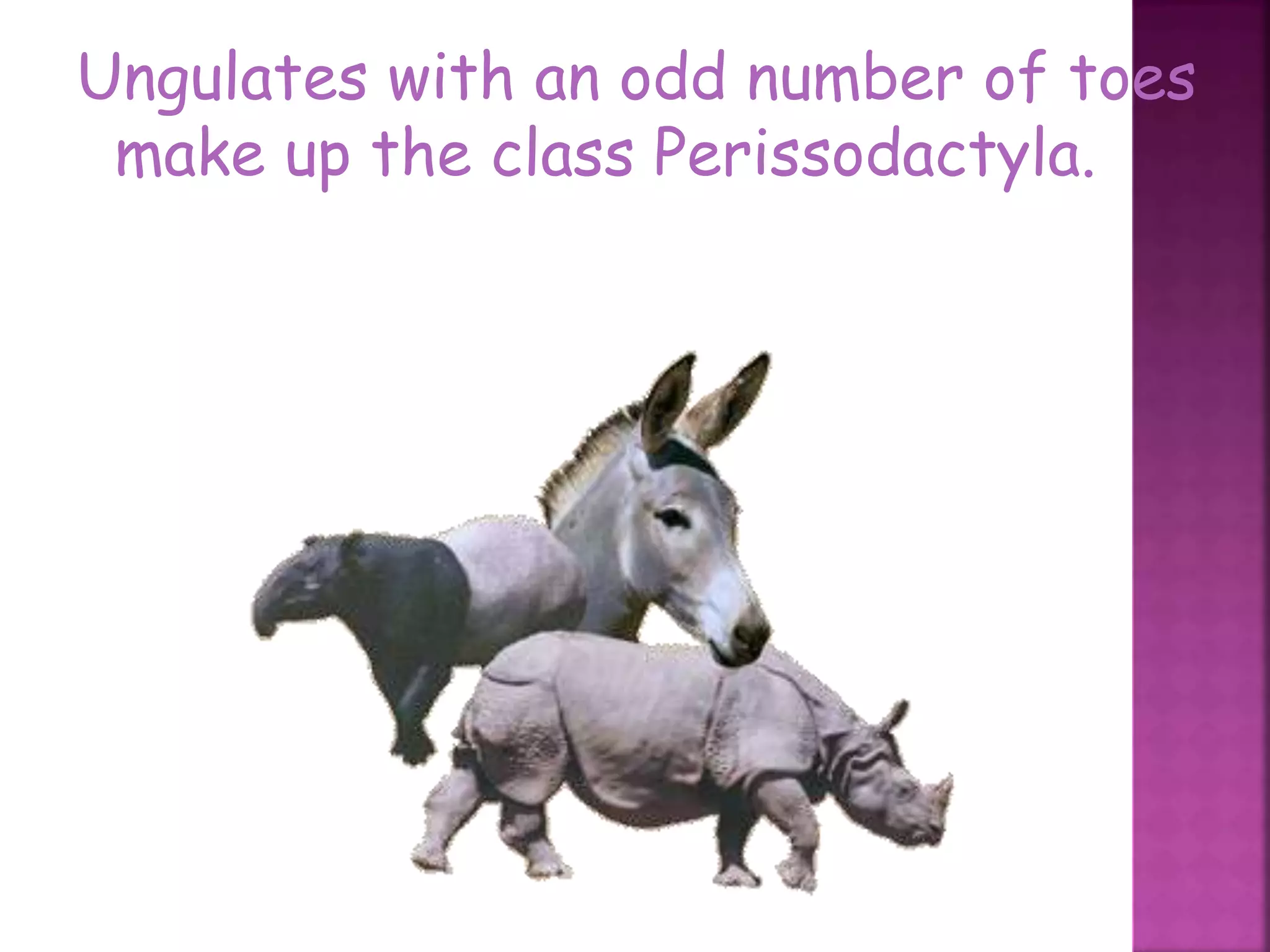
Ungulates with an odd number of toes
make up the class Perissodactyla.
45
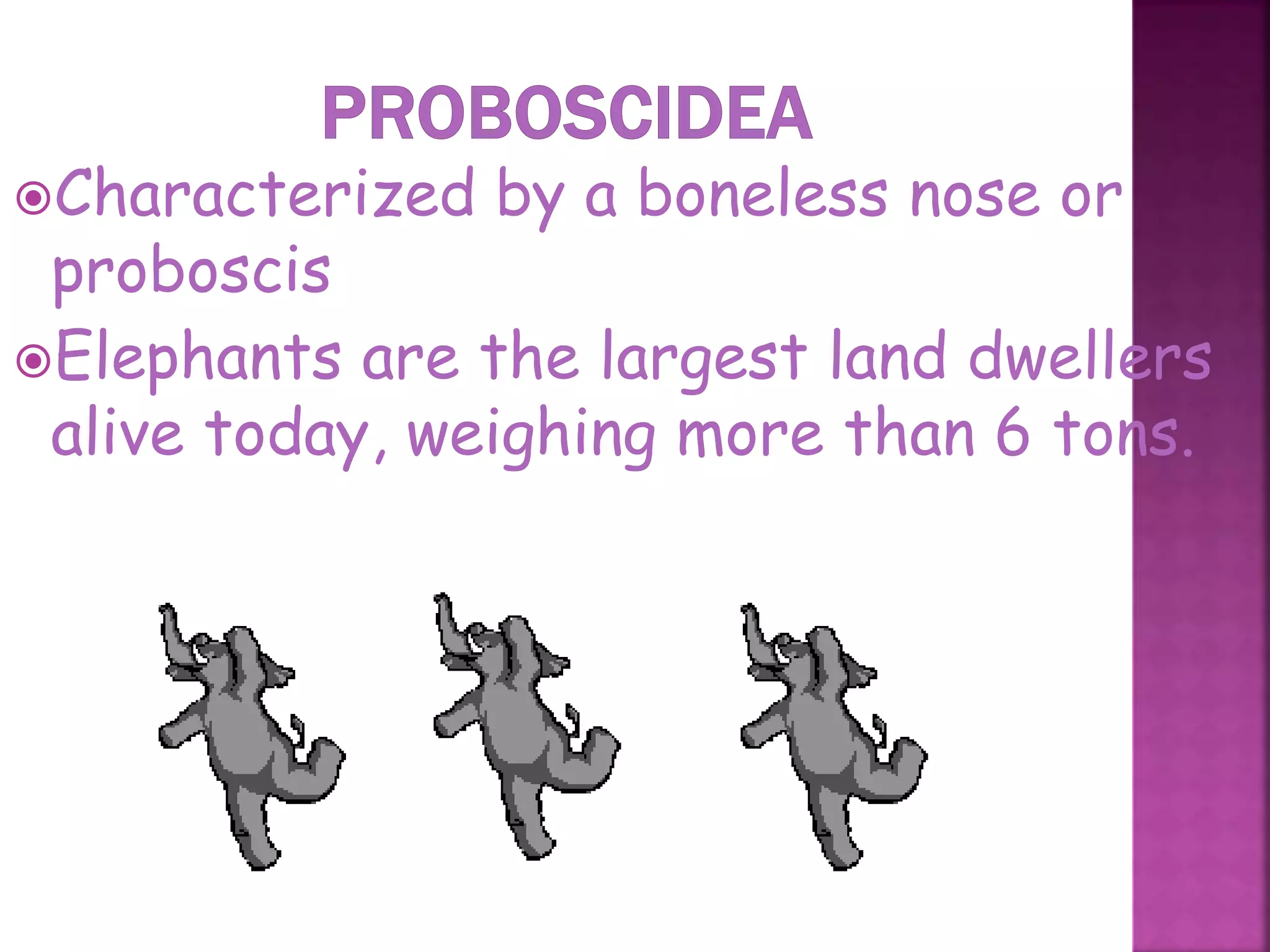
ļ‚žCharacterized by a boneless nose or
proboscis
ļ‚žElephants are the largest land dwellers
alive today, weighing more than 6 tons.
46
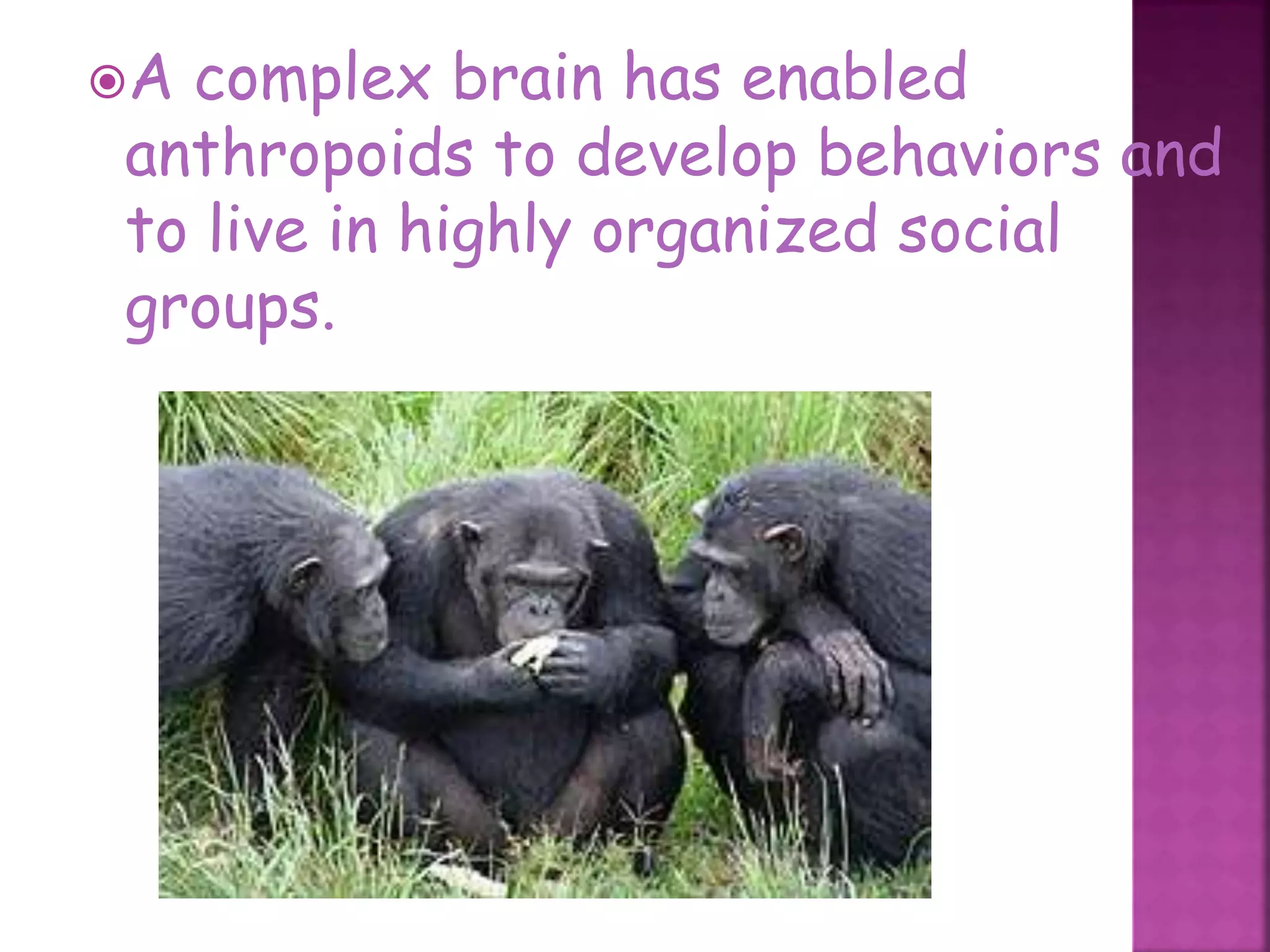
ļ‚žA complex brain has enabled
anthropoids to develop behaviors and
to live in highly organized social
groups.
47
1. Evolution of mammals limbs.
https://answers.yahoo.com/question/index?qid=2011
0624172700AAHnvHe. Retrieved on 19 March
2015.
2. Evolution of mammals.
http://www.creationresearch.org/crsq/articles/40/40_
4/Bergman.htm. Retrieved on 19 March 2015.
3. Evolution of mammals hair.
http://www.nhm.ac.uk/nature-online/evolution/what-
is-the-evidence/morphology/body-hair/index.html.
Retrieved on 19 March 2015.
4. Evolution.
http://www.sarkanniemi.fi/akatemiat/eng_evo.html.
Retrieved on 19 March 2015.

evolution of mammals by davendran

  • 1.
  • 2.
    2 Mammals belong to theclass Mammalia, which includes 4000 species Most dominant land animals on earth.
  • 3.
    •Like mammals, Therapidshave specialized teeth adapted for specialized functions. •The earliest mammalian fossil found is from the early Mesozoic era, 200 million years ago 3
  • 4.
    The remaining group,the ā€œTherianā€ mammals, which originated during the Jurassic survive today 3 major groups of living mammals (the Therians): 1) Monotremes – egg-laying mammals 2) Marsupials – pouched mammals 3) Placentals – mammals with placenta
  • 5.
    DIFFERENTIATED DENTITION -Mammals neededtheir teeth to do several different jobs and so mammal teeth evolved into different forms. Mammal teeth can grind, stab, scissor, dig, chisel, sieve and lift (elephants tusks). -The number, size, organization and shape of the teeth are different in every species of mammal and can be used in taxonomy, especially of fossils. In fact without teeth the fossil record would be much harder to understand. -Mammals have only two sets of teeth, the first set they get soon after birth, often called the 'milk teeth' and a larger set they acquire as an adult. - In all other toothed vertebrates teeth just keep coming, no matter how many you lose there is always another one ready to take its place. In other words fish amphibians, reptiles and birds either have no teeth or numerous sets.
  • 7.
    Slender limbs, moremovement in pectoral and pelvic girdles; Cynodonts showed general reduction in body size. Early cynodonts were size of large dogs, by mid-Triassic the carnivorous cynodonts were size of rabbits. – Earliest mammals were small, about 100 mm long, shrew-size.
  • 8.
    •Most reptiles haveseveral bones in the lower jaw, and Dimetrodon shares this characteristic. • But mammals have only a single lower jawbone, the dentary. • Throughout synapsid evolution, the gradual reduction of the non-dentary elements of the jaw as they are crowded towards the back and eventually lost. •The dentary bone, in contrast, gets larger and takes over the entire jaw. •In the final stage of evolution, the dentary bone expands until it makes direct contact with the skull and develops a new articulation with it.
  • 9.
    Evolution of Ear:stapes acquires ā€œstirrupā€ shape articular bone in jaw becomes malleus quadrate bone in jaw becomes incus. Sophistication of teeth as mammals have evolved!
  • 11.
    MOST DEVELOPED MAMMALSTEETH STRUCTURE
  • 12.
    The diaphragm ismade of muscles and tendons and it divides the inside of the torso into 2 sections. On one side are the heart and lungs, and on the other side are organs like the stomach and liver. Mammals are the only animals with a diaphragm, although some reptiles and amphibians share some similar features.
  • 13.
    The muscle fibersof the diaphragm originate from the lumbar vertebrae, ribs and sternum and insert into the central tendon. This uniformity among mammals and the absence of this muscle from non-mammalian tetrapods have been an obstacle to comparative anatomy in unraveling the evolutionary origin of the diaphragm. embryonic positions of forelimb muscle progenitors, which correspond to the position of the brachial plexus, likely played an important role in the evolution of the diaphragm. evolution of diaphragm can be conluded as, first, forelimb muscle cells were incorporated into tissues to form a primitive diaphragm in the stem synapsid grade, and second, the diaphragm in cynodonts became entrapped in the region controlled by pulmonary development.
  • 14.
    ļ‚ž In humananatomy, the five vertebrae in the lumbar region of the back are the largest and strongest in the movable part of the spinal column, and can be distinguished by the absence of a foramen in the transverse process, and by the absence of facets on the sides of the body. In most mammals, the lumbar region of the spine curves outward.
  • 16.
  • 17.
    ļ‚ž The pectoralgirdle consists of two pairs of bones, the large flat Scapula (shoulder bone) and the much smaller and more slender Clavicle (collar bone). ļ‚ž The clavicle runs from the far end of the scapular to the sternum in most mammals ļ‚ž In some mammals such as the Anisodactyla, Perissodactyla, Mysticeti and Odontoceti (Horses, Pigs, Deer, Buffaloes, etc. and Whales) the clavicle is absent.
  • 18.
  • 19.
    ļ‚ž In anatomy,the scapula or shoulder blade, is the bone that connects the humerus (upper arm bone) with the clavicle (collar bone). Like their connected bones the scapulae are paired, with the scapula on the left side of the body being roughly a mirror image of the right scapula. ļ‚ž The scapula forms the back of the shoulder girdle. In humans, it is a flat bone, roughly ttriangular in shape, placed on a posterolateral aspect of the thoracic cage.
  • 20.
    ļ‚ž The pentadactyllimb is common to humans, other mammals (although whales and dolphins have lost their hind limbs). Darwin noted how widespread it was when he wrote On the Origin of Species: ļ‚ž 'What could be more curious than that the hand of man formed for grasping, that of a mole, for digging, the leg of a horse, the paddle of a porpoise and the wing of a bat, should all be constructed on the same pattern and should include similar bones and in the same relative positions?'
  • 21.
    ļ‚ž There area few mammals that appear to have different numbers of digits from us. One of these is the panda, which looks like it has 6 digits. ļ‚ž However, close examination has shown that the extra thumb is actually an outgrowth of one of the wrist bones and not an extra digit at all. The same is true of moles. ļ‚ž The pentadactyl limb is common to most tetrapods (4-limbed creatures). ļ‚ž Among extinct tetrapods, many dinosaurs had only 3 toes, and some marine reptiles had more than 5 digits in their paddles. But no animals living today have more than 5 digits that all developed in the same way.
  • 22.
    ļ‚ž The fossilrecord shows evidence of a few extinct species that had different numbers of digits. Examples are Acanthostega, Ichthyostega, and Tulerpeton.
  • 23.
    ļ‚ž These areall animals that lived during the late Devonian period, between 380 and 360 million years ago, when tetrapods first began to move onto land. Some had as many as 8 digits, before the common pattern of 5 digits became established that we have inherited.
  • 24.
    Whale: ļ‚ž The similaritiesbetween the skeletons of land mammals and whales are quite clear. The hind limbs have all but disappeared. ļ‚ž The front limbs in all whales, the pectoral fins or flippers, basically contain all the bones that can be found in the front limbs of land mammals.
  • 27.
    ļ‚žMammalian heart has 4 chambers ļ‚žMammalshave a muscle , the diaphragm that aids in breathing 27
  • 29.
    ļ‚ž It explainsthat warm-bloodedness most likely did not evolve for purposes of thermoregulation, but instead evolved slowly as a side-effect of increased metabolism, and longer and longer aerobic (oxygen- consuming) activity. ļ‚ž In other words, it did not evolve suddenly in one animal, but was a long-developing trend across many species in the diapsid and therapsid dinosaurs.
  • 30.
    ļ‚ž With constantuse of energy, but along with the benefits of longer periods activity both seeking food, and avoiding predators. This all led to slow changes in the structures of the heart and lungs, better oxygenation and carrying capacity of blood, better ability for muscle tissue to use oxygen, more mitochondria for energy production in the cells, etc. ļ‚ž This eventually led to what we today call "warm-bloodednes", where the body is in a constant state of energy usage to maintain a more stable body temperature and metabolic rate.
  • 31.
    ļ‚ž Mammals werethe first animals to evolve body hair and it is still one of their common features today. ļ‚ž Even mammals like whales and dolphins are born with hair above their mouths, even though the adults are hair-less.
  • 32.
    ļ‚ž Hair iswidely believed by Darwinists to have evolved from scales (Denton, 1986, p. 106). ļ‚ž An alternative view is that hair evolved first as tiny projecting rods in the hinges between scales and served as tactile devices. ļ‚ž The "protohairs" could help monitor surface sensory data when an animal was hiding from an enemy or retreating from the weather. ļ‚ž This sensory protohair might then have evolved secondarily into an insulative pelage as mammals become endothermic. Although insulative in modern mammals, hair still retains a sensory function.
  • 33.
    Whale: ļ‚ž Land mammalshave some form of hairy fur, which serves among others as insulation. Whales don't have fur. In water, fur needs a lot of maintenance in order to maintain its insulating properties. Losing the fur gave whales a perfectly streamlined body. In whales, the remnants of the fur can still be seen. Young dolphins have small whiskers and in older animals, the hair follicles can still be seen on the snout. Some dolphin species (e.g. river dolphins) have whiskers throughout their life.
  • 34.
  • 35.
    ļ‚ž Placental mammalscarry unborn young in the uterus until young can survive in the wild. ļ‚ž Oxygen and nutrients are transferred from mother’s blood to baby’s blood 35
  • 36.
    ļ‚žThe placenta isa membrane providing nutrients and waste & gas exchange between the mother and developing young ļ‚žGestation period-is the time which mammals develop in mother’s uterus 36
  • 37.
  • 38.
    ļ‚ž250 living speciesin carnivoria are distributed worldwide ļ‚žMost of the species mainly eat meat, which explains the name. ļ‚žAbout 34 species 38
  • 39.
    ļ‚žSome members of thisorder such as bears feed extensively on plant material as well as meat, so they are called omnivores. ļ‚žCarnivores generally have long canine teeth, strong jaws, clawed toes. 39
  • 40.
    ļ‚ž90 species ofwhales, dolphins, and porpoises are distributed worldwide. ļ‚žCetaceans have fishlike bodies with forelimbs modified as flippers. 40
  • 41.
    ļ‚žPinnipedia are waterdwelling carnivores and have streamlined bodies 41
  • 42.
    ļ‚žConsists of 400species ļ‚žIncludes shrews and moles 42 Mole Shrew
  • 43.
    ļ‚žUngulates-hoofed mammals, classified intotwo orders: Artiodactyla and Perissodactyla ļ‚žThese two classes are herbivores. ļ‚žThey have a storage chamber in their stomach called the rumen, undergoes double digestion. 43
  • 44.
    Ungulates with aneven amount of toes make up the class Artiodactyla 44
  • 45.
    Ungulates with anodd number of toes make up the class Perissodactyla. 45
  • 46.
    ļ‚žCharacterized by aboneless nose or proboscis ļ‚žElephants are the largest land dwellers alive today, weighing more than 6 tons. 46
  • 47.
    ļ‚žA complex brainhas enabled anthropoids to develop behaviors and to live in highly organized social groups. 47
  • 48.
    1. Evolution ofmammals limbs. https://answers.yahoo.com/question/index?qid=2011 0624172700AAHnvHe. Retrieved on 19 March 2015. 2. Evolution of mammals. http://www.creationresearch.org/crsq/articles/40/40_ 4/Bergman.htm. Retrieved on 19 March 2015. 3. Evolution of mammals hair. http://www.nhm.ac.uk/nature-online/evolution/what- is-the-evidence/morphology/body-hair/index.html. Retrieved on 19 March 2015. 4. Evolution. http://www.sarkanniemi.fi/akatemiat/eng_evo.html. Retrieved on 19 March 2015.