


Mammalian Cell
Cycle
Abiola Nelson 1014800
Ramzee Small 1012412
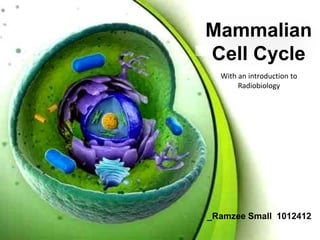
Mammalian
Cell Cycle
_Ramzee Small 1012412
With an introduction to
Radiobiology
Outline
Definition of Mammalian Cell Cycle
Cellular Review
Explanation of Mammalian Cell Cycle
Discussion of the Stages in the Mammalian Cell
Cycle
Introduction to Radiobiology
Mammalian Cell Cycle
What is the Mammalian cell cycle?
Mammalian ------- Cell--------Cycle
A series of events that take place in a cell leading to
its division and duplication (replication) that
produces two daughter cells.
Cellular Review
Definition
Cells are the smallest living subunits of a multicellular
organism
Refer to as “Building Block of Life”
They are composed of protoplasm which contains
75% water, electrolytes, proteins, lipids and
carbohydrates
Composition of Cell
The cell has three (3) major parts
Cell Membrane
 Semi-permeable structure
Barrier between cell and its environment
Nucleus
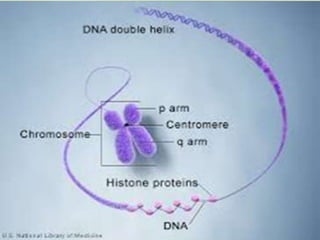
Houses DNA which contains chromosomes
Control Cell activities
Composition of Cell
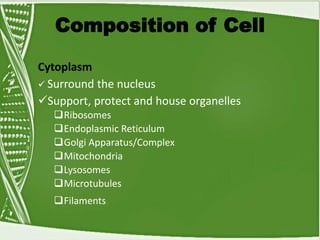
Cytoplasm
 Surround the nucleus
Support, protect and house organelles
Ribosomes
Endoplasmic Reticulum
Golgi Apparatus/Complex
Mitochondria
Lysosomes
Microtubules
Filaments
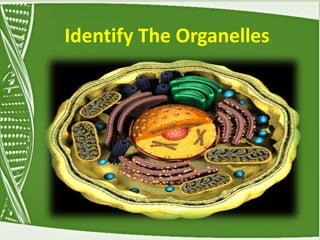
Identify The Organelles
Was that even necessary??
Real….ly???
Fun Facts About cell
Your body contains around 32.7 trillion cells
The ovum is the largest cell in the body, and can be
seen without a microscope
Nerve cell in our arms and legs are at least 2 feet (60
cm) long.
Liver cells and osteoclasts often have more than one
nucleus while a mature red blood cell has NONE
Cells come only from the replication of existing cells.
Mammalian Cell
Cycle
Definition
The series of events that take place in a cell leading
to its division and duplication (replication) that
produces two daughter cells.
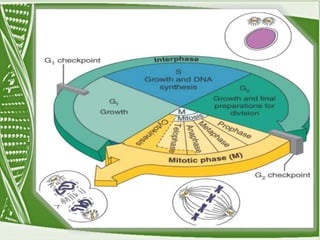
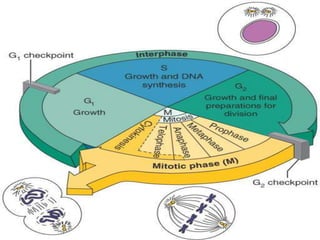
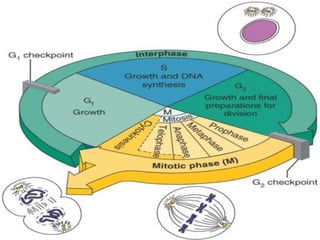
The mammalian cell cycle has two major portions;
Interphase
Mitotic Phase
Interphase
Cell carries on its regular activities
It also gets ready to divide if stimulated to complete
the cell cycle
Interphase encompass three phases;
 G1 Phase
 S Phase
 G2 Phase
Interphase
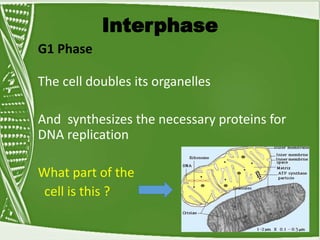
G1 Phase
The cell doubles its organelles
And synthesizes the necessary proteins for
DNA replication
What part of the
cell is this ?
Interphase
S Phase
So-called because DNA is Synthesized in this
phase
Each chromosome is composed of one DNA
double helix, which is equal to a chromatid.
S phase result in each chromosome having
two identical DNA double helix molecules.
Interphase
S Phase (Overview of DNA Synthesis)
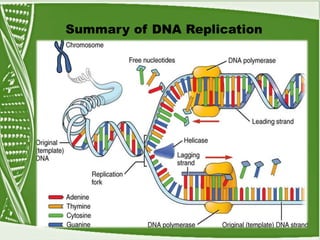
The DNA double helix splits down the middle and
becomes two single strands (serving as templates)
DNA polymerase adds an A base wherever there is a
T, a C where there is a G, and so on until all of the
bases once again have partners.
Each DNA molecule formed consists of one old
strand and one newly assembled strand and
constitutes a chromatid of a chromosome.
Summary of DNA Replication
Interphase
G2 Phase
The cell synthesizes proteins that will assist
cell division
At the end of G2 phase a major check-point
exist that controls the entry of the cell into
M-phase
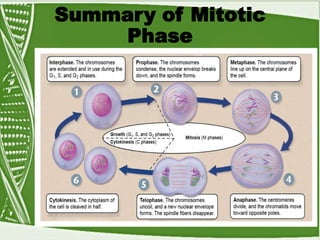
Mitotic Phase
Also called the Cell division phase
Mitotic phase includes;
Mitosis (division of the nucleus)
Cytokinesis (division of the cytoplasm)
Mitotic Phase
Mitosis
Divided into distinct steps that were originally
identified and characterized through light microscopic
observations of dividing cell.
These are termed;
Prophase
Metaphase
Anaphase
Telophase
Mitotic Phase
Mitosis
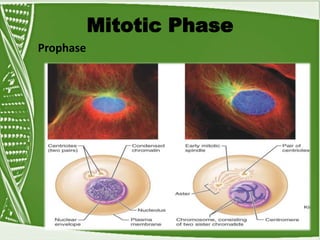
Prophase
The duplicated chromosomes condense while the
nuclear membrane breaks away
The centrioles move toward opposite poles of the cell
and organize the spindle fibers, which extend across
the equator of the cell
Mitotic Phase
Prophase
Mitotic Phase
Mitosis
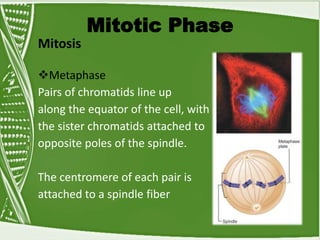
Metaphase
Pairs of chromatids line up
along the equator of the cell, with
the sister chromatids attached to
opposite poles of the spindle.
The centromere of each pair is
attached to a spindle fiber
Mitotic Phase
Mitosis
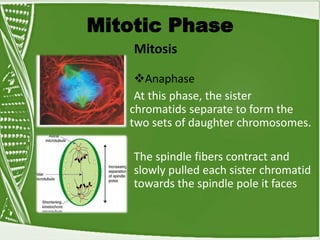
Anaphase
At this phase, the sister
chromatids separate to form the
two sets of daughter chromosomes.
The spindle fibers contract and
slowly pulled each sister chromatid
towards the spindle pole it faces
Mitotic Phase
Mitosis
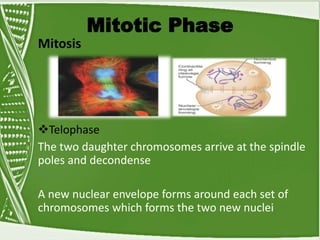
Telophase
The two daughter chromosomes arrive at the spindle
poles and decondense
A new nuclear envelope forms around each set of
chromosomes which forms the two new nuclei
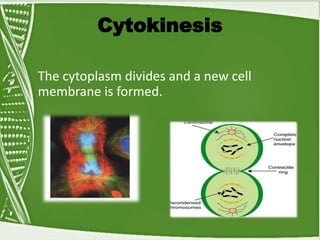
Cytokinesis
The cytoplasm divides and a new cell
membrane is formed.
Summary of Mitotic
Phase
Mammalian Cell Cycle
Most of the cells in our body are NOT replicating
at any given point of time
Instead, most cells in our body remain in the
G1/G2 phase for their entire lifetime
Specialized cell (muscle and nerve cells) rarely, if
ever, go through the cell cycle
Stem cells, are always immature and go through
the cell cycle repeatedly
List two of these cells
Mammalian Cell Cycle
The cell cycle is controlled by internal and
external signals
Name 3 Stimulus that can trigger this cycle
This process must be highly regulated so as to
ensure that the resulting cells are viable
Mammalian Cell Cycle
Control of progression through the cell cycle is
exerted at checkpoints.
The two most critical checkpoint are those that
occur near the end of G1 prior to S-phase and
those near the end of G2 prior to mitosis.
Any cell that did not successfully complete
mitosis undergo apoptosis at the restriction
checkpoint.
Radiobiology
Definition
A branch of science concerned with the
action of ionizing radiation on biological
tissues and living organisms.
Ionizing radiation is any type of particle or
electromagnetic radiation that carries enough
energy to ionize or remove electrons from an
atom.
History
Research on the biological effects of ionizing
radiation started almost immediately after the
discovery by Wilhelm Roentgen in 1895.
By 1910 several hundred cases of severe x-ray burns
(radiodermatitis), many leading to death, had been
reported.
Charles T. Dally, Thomas case
Radio sensitivity
The probability of a cell, tissue, or organ suffering an
effect per unit dose of radiation.
Radio sensitivity is highest in cells which are highly
mitotic or undifferentiated.
Name some cells that are radiosensitive?
Name some cells that are not radiosensitive?
Cell Irradiation
When exposed to ionizing radiation, large molecules
such as nucleic acid and proteins in the cells will be
ionized or excited
This may cause changes in the molecular structures
which then affect the function and metabolism of
the cells
Cell Irradiation
The damage to the cell may occur in one of
two ways;
Direct
Indirect
Cell Irradiation
Direct action in cell damage by radiation
In direct action the radiation interacts directly with
the critical target in the cell
Which may be ionize or excited, leading to the chain
of events that produce the biological damage
Cell Irradiation
Indirect action in cell damage by radiation
Radiation indirectly interact with other molecules
and atoms (mainly water) within the cell to produce
free radicals
Free radicals are highly reactive molecules that break
chemical bonds and produce chemical changes that
lead to biological damage
Cell Irradiation
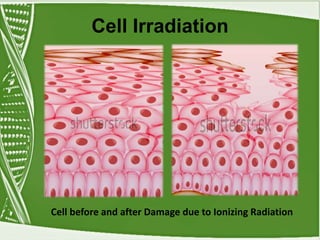
Cell before and after Damage due to Ionizing Radiation
Radiobiology Significance
Ionizing radiation is potentially lethal in living
organism, but can have health benefits in
radiation therapy, medical diagnosis etc.
Understanding the effects of radiation on cells
provide useful information for the
development of radiation protection
measures
References
• Valerie C. Scanlon, Tina Sanders, Essentials of Anatomy and
Physiology, Fifth Edition, Copyright © 2007 by F. A. Davis, pg. 46-66
• https://en.wikipedia.org/wiki/History_of_radiation_therapy
• Sylvia S. Mader, Understanding human anatomy and physiology, Fifth
Edition, © The McGraw−Hill Companies, 2004, pg. 46
• Frederic H. Martini, Ph.D., Judi L. Nath, Ph.D., Edwin F. Bartholomew,
M.S, Fundamental of Anatomy and physiology, Ninth Edition, pg. 63
• Philip W. Ballinger, Eugene D. Frank, Merrill’s Atlas of Radiographic
Positions & Radiologic Procedures, Volume One, Tenth Edition,
Copyright © 2003. Mosby. Inc., pg. 51
• https://en.wikipedia.org/wiki/DNA_damage_(naturally_occurring)
• Michael W King, The medical biochemistry page.org
Mammalian cycle

Mammalian cycle

  • 1.
    Mammalian Cell Cycle Abiola Nelson1014800 Ramzee Small 1012412 Mammalian Cell Cycle _Ramzee Small 1012412 With an introduction to Radiobiology
  • 2.
    Outline Definition of MammalianCell Cycle Cellular Review Explanation of Mammalian Cell Cycle Discussion of the Stages in the Mammalian Cell Cycle Introduction to Radiobiology
  • 3.
    Mammalian Cell Cycle Whatis the Mammalian cell cycle? Mammalian ------- Cell--------Cycle A series of events that take place in a cell leading to its division and duplication (replication) that produces two daughter cells.
  • 4.
  • 5.
    Definition Cells are thesmallest living subunits of a multicellular organism Refer to as “Building Block of Life” They are composed of protoplasm which contains 75% water, electrolytes, proteins, lipids and carbohydrates
  • 6.
    Composition of Cell Thecell has three (3) major parts Cell Membrane  Semi-permeable structure Barrier between cell and its environment Nucleus Houses DNA which contains chromosomes Control Cell activities
  • 7.
    Composition of Cell Cytoplasm Surround the nucleus Support, protect and house organelles Ribosomes Endoplasmic Reticulum Golgi Apparatus/Complex Mitochondria Lysosomes Microtubules Filaments
  • 8.
  • 9.
    Was that evennecessary?? Real….ly???
  • 10.
    Fun Facts Aboutcell Your body contains around 32.7 trillion cells The ovum is the largest cell in the body, and can be seen without a microscope Nerve cell in our arms and legs are at least 2 feet (60 cm) long. Liver cells and osteoclasts often have more than one nucleus while a mature red blood cell has NONE Cells come only from the replication of existing cells.
  • 11.
  • 12.
    Definition The series ofevents that take place in a cell leading to its division and duplication (replication) that produces two daughter cells. The mammalian cell cycle has two major portions; Interphase Mitotic Phase
  • 14.
    Interphase Cell carries onits regular activities It also gets ready to divide if stimulated to complete the cell cycle Interphase encompass three phases;  G1 Phase  S Phase  G2 Phase
  • 15.
    Interphase G1 Phase The celldoubles its organelles And synthesizes the necessary proteins for DNA replication What part of the cell is this ?
  • 16.
    Interphase S Phase So-called becauseDNA is Synthesized in this phase Each chromosome is composed of one DNA double helix, which is equal to a chromatid. S phase result in each chromosome having two identical DNA double helix molecules.
  • 17.
    Interphase S Phase (Overviewof DNA Synthesis) The DNA double helix splits down the middle and becomes two single strands (serving as templates) DNA polymerase adds an A base wherever there is a T, a C where there is a G, and so on until all of the bases once again have partners. Each DNA molecule formed consists of one old strand and one newly assembled strand and constitutes a chromatid of a chromosome.
  • 18.
    Summary of DNAReplication
  • 19.
    Interphase G2 Phase The cellsynthesizes proteins that will assist cell division At the end of G2 phase a major check-point exist that controls the entry of the cell into M-phase
  • 20.
    Mitotic Phase Also calledthe Cell division phase Mitotic phase includes; Mitosis (division of the nucleus) Cytokinesis (division of the cytoplasm)
  • 21.
    Mitotic Phase Mitosis Divided intodistinct steps that were originally identified and characterized through light microscopic observations of dividing cell. These are termed; Prophase Metaphase Anaphase Telophase
  • 22.
    Mitotic Phase Mitosis Prophase The duplicatedchromosomes condense while the nuclear membrane breaks away The centrioles move toward opposite poles of the cell and organize the spindle fibers, which extend across the equator of the cell
  • 23.
  • 24.
    Mitotic Phase Mitosis Metaphase Pairs ofchromatids line up along the equator of the cell, with the sister chromatids attached to opposite poles of the spindle. The centromere of each pair is attached to a spindle fiber
  • 25.
    Mitotic Phase Mitosis Anaphase At thisphase, the sister chromatids separate to form the two sets of daughter chromosomes. The spindle fibers contract and slowly pulled each sister chromatid towards the spindle pole it faces
  • 26.
    Mitotic Phase Mitosis Telophase The twodaughter chromosomes arrive at the spindle poles and decondense A new nuclear envelope forms around each set of chromosomes which forms the two new nuclei
  • 27.
    Cytokinesis The cytoplasm dividesand a new cell membrane is formed.
  • 28.
  • 29.
    Mammalian Cell Cycle Mostof the cells in our body are NOT replicating at any given point of time Instead, most cells in our body remain in the G1/G2 phase for their entire lifetime Specialized cell (muscle and nerve cells) rarely, if ever, go through the cell cycle Stem cells, are always immature and go through the cell cycle repeatedly List two of these cells
  • 30.
    Mammalian Cell Cycle Thecell cycle is controlled by internal and external signals Name 3 Stimulus that can trigger this cycle This process must be highly regulated so as to ensure that the resulting cells are viable
  • 31.
    Mammalian Cell Cycle Controlof progression through the cell cycle is exerted at checkpoints. The two most critical checkpoint are those that occur near the end of G1 prior to S-phase and those near the end of G2 prior to mitosis. Any cell that did not successfully complete mitosis undergo apoptosis at the restriction checkpoint.
  • 32.
  • 33.
    Definition A branch ofscience concerned with the action of ionizing radiation on biological tissues and living organisms. Ionizing radiation is any type of particle or electromagnetic radiation that carries enough energy to ionize or remove electrons from an atom.
  • 34.
    History Research on thebiological effects of ionizing radiation started almost immediately after the discovery by Wilhelm Roentgen in 1895. By 1910 several hundred cases of severe x-ray burns (radiodermatitis), many leading to death, had been reported. Charles T. Dally, Thomas case
  • 35.
    Radio sensitivity The probabilityof a cell, tissue, or organ suffering an effect per unit dose of radiation. Radio sensitivity is highest in cells which are highly mitotic or undifferentiated. Name some cells that are radiosensitive? Name some cells that are not radiosensitive?
  • 36.
    Cell Irradiation When exposedto ionizing radiation, large molecules such as nucleic acid and proteins in the cells will be ionized or excited This may cause changes in the molecular structures which then affect the function and metabolism of the cells
  • 37.
    Cell Irradiation The damageto the cell may occur in one of two ways; Direct Indirect
  • 38.
    Cell Irradiation Direct actionin cell damage by radiation In direct action the radiation interacts directly with the critical target in the cell Which may be ionize or excited, leading to the chain of events that produce the biological damage
  • 39.
    Cell Irradiation Indirect actionin cell damage by radiation Radiation indirectly interact with other molecules and atoms (mainly water) within the cell to produce free radicals Free radicals are highly reactive molecules that break chemical bonds and produce chemical changes that lead to biological damage
  • 40.
    Cell Irradiation Cell beforeand after Damage due to Ionizing Radiation
  • 41.
    Radiobiology Significance Ionizing radiationis potentially lethal in living organism, but can have health benefits in radiation therapy, medical diagnosis etc. Understanding the effects of radiation on cells provide useful information for the development of radiation protection measures
  • 42.
    References • Valerie C.Scanlon, Tina Sanders, Essentials of Anatomy and Physiology, Fifth Edition, Copyright © 2007 by F. A. Davis, pg. 46-66 • https://en.wikipedia.org/wiki/History_of_radiation_therapy • Sylvia S. Mader, Understanding human anatomy and physiology, Fifth Edition, © The McGraw−Hill Companies, 2004, pg. 46 • Frederic H. Martini, Ph.D., Judi L. Nath, Ph.D., Edwin F. Bartholomew, M.S, Fundamental of Anatomy and physiology, Ninth Edition, pg. 63 • Philip W. Ballinger, Eugene D. Frank, Merrill’s Atlas of Radiographic Positions & Radiologic Procedures, Volume One, Tenth Edition, Copyright © 2003. Mosby. Inc., pg. 51 • https://en.wikipedia.org/wiki/DNA_damage_(naturally_occurring) • Michael W King, The medical biochemistry page.org