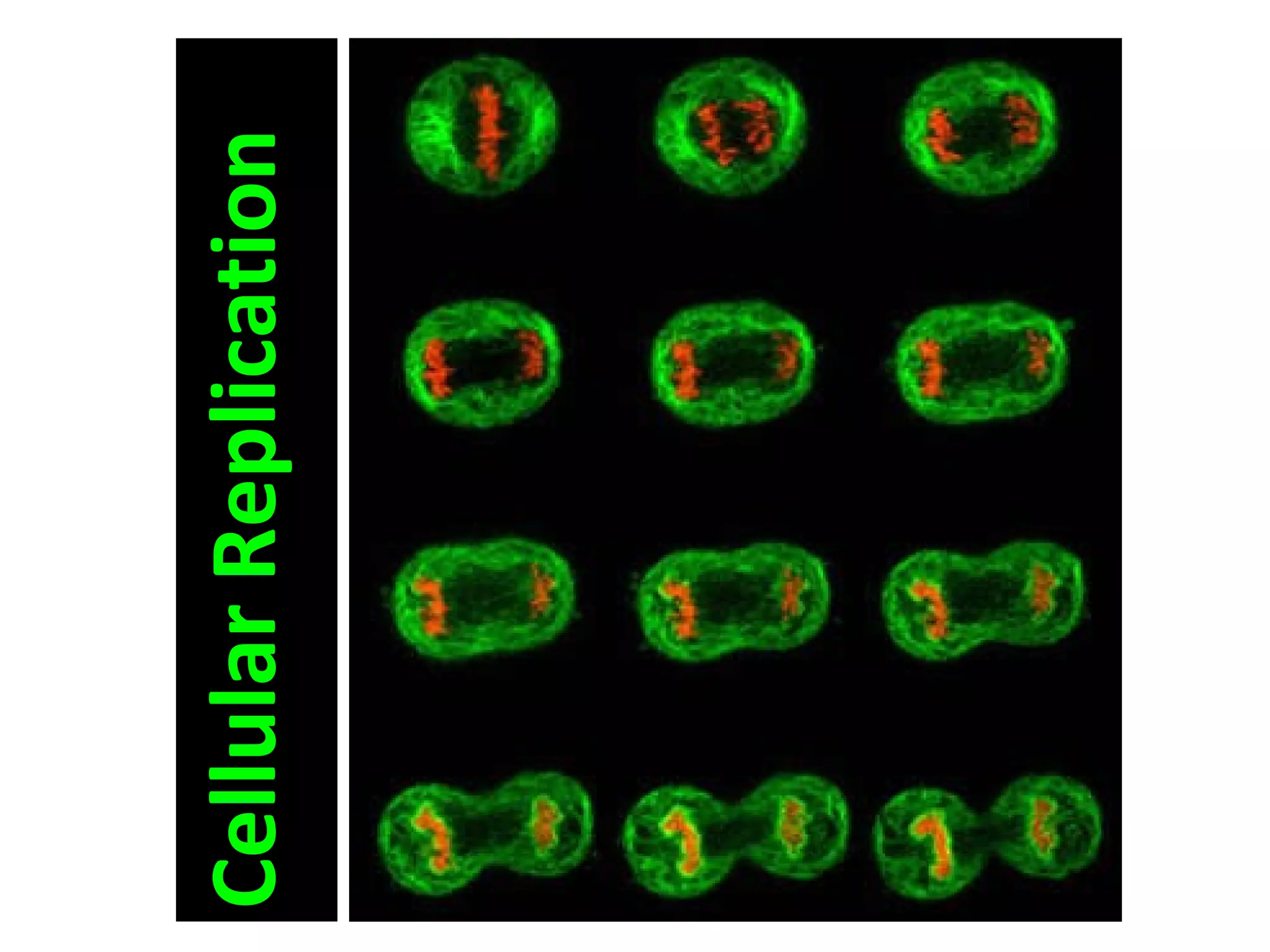
Cellular Replication
What is the meaning of life? The purpose of life is to pass genetic information onto the next generation How is this done? 42
Cells The Cell Theory of Life states that: Cells are the smallest functional unit of life All living things consist of one or more cells New cells are produced from existing cells
Cells The Cell Theory of Life states that: Cells are the smallest functional unit of life All living things consist of one or more cells New cells are produced from existing cells HOW? One  (parent)  cell divides into two  (daughter)  cells  =  CELL DIVISION � however, one cell becomes two cells    =  CELL MULTIPLICATION Therefore, cells multiply by dividing� Let�s just call it  cellular replication
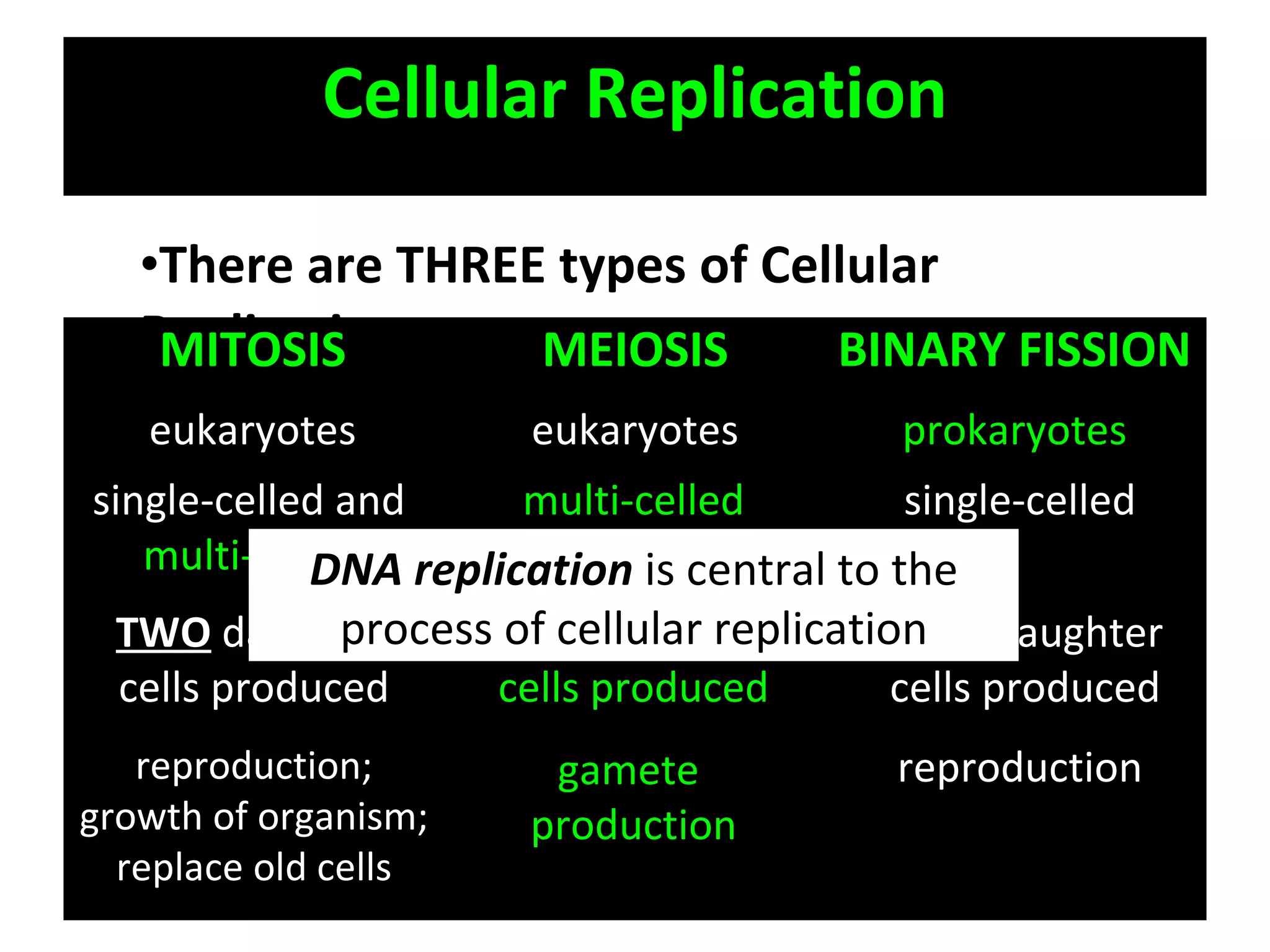
Cellular Replication There are THREE types of Cellular Replication MITOSIS MEIOSIS BINARY FISSION eukaryotes eukaryotes prokaryotes single-celled and  multi-celled multi-celled single-celled TWO   daughter cells produced FOUR   daughter cells produced TWO   daughter cells produced reproduction; growth of organism; replace old cells gamete  production reproduction DNA replication  is central to the process of cellular replication
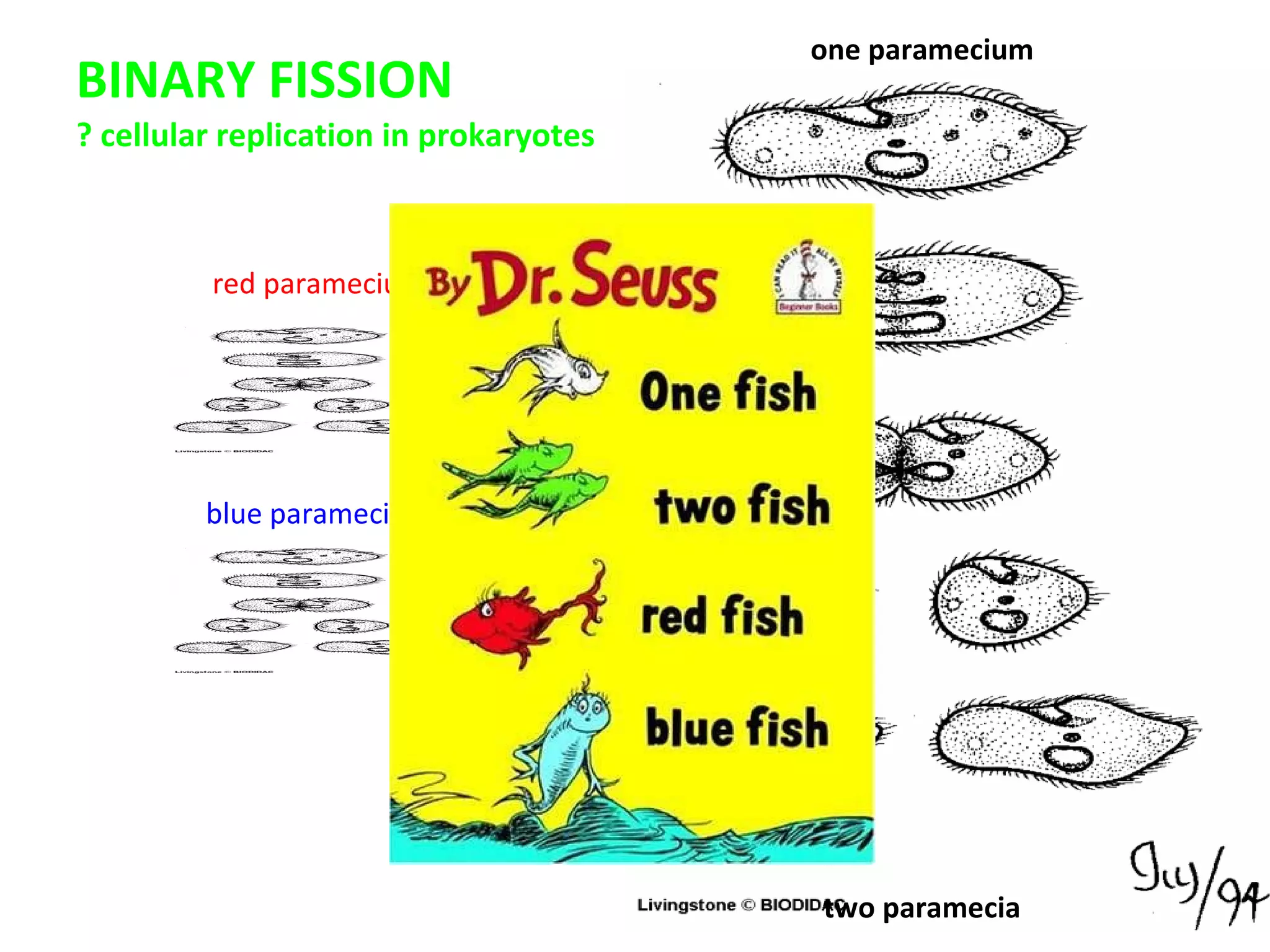
BINARY FISSION ? cellular replication in prokaryotes one paramecium two paramecia red paramecium blue   paramecium
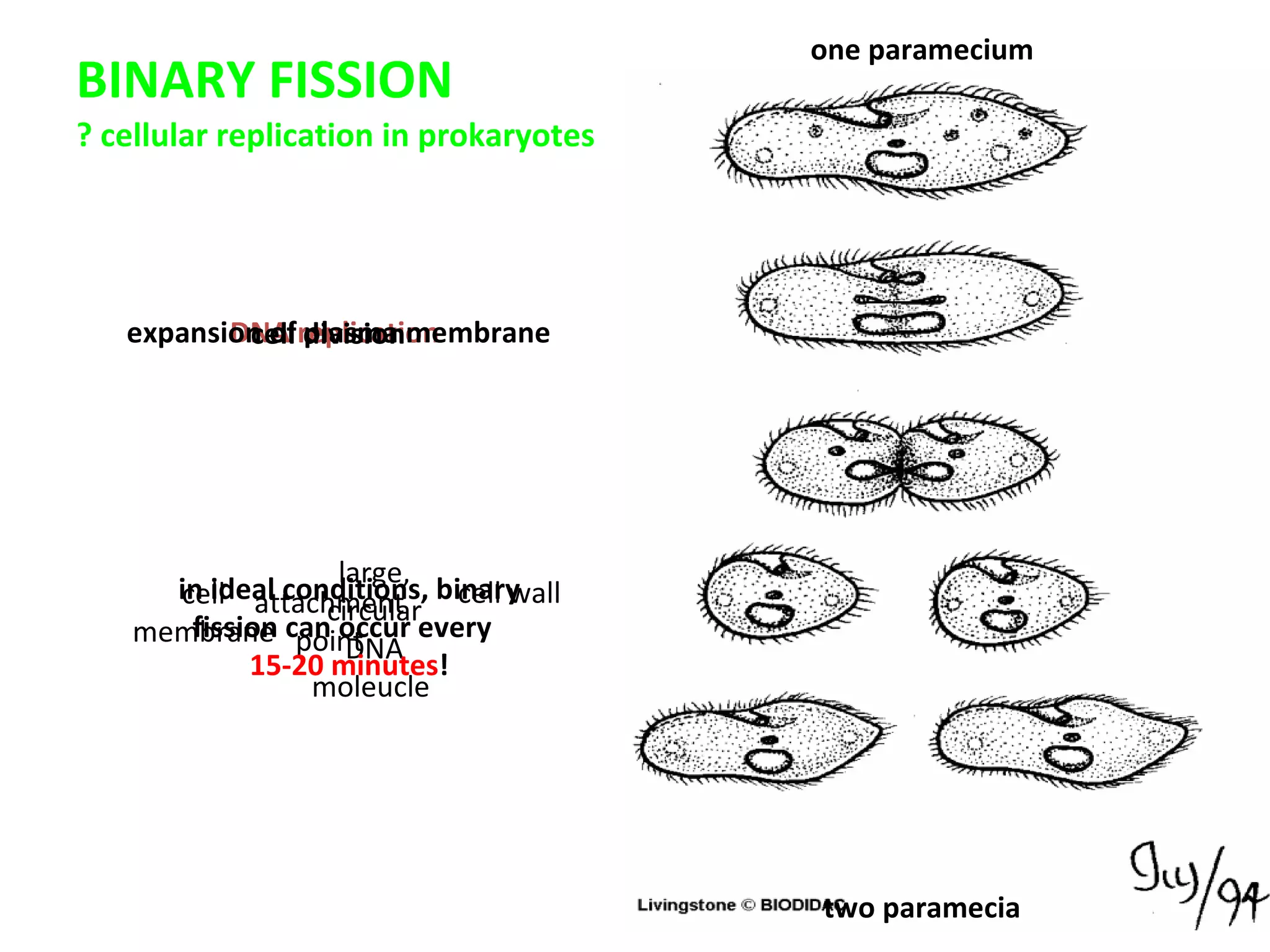
BINARY FISSION ? cellular replication in prokaryotes one paramecium two paramecia cell wall cell membrane large, circular DNA moleucle  DNA replication attachment point expansion of plasma membrane cell division in ideal conditions, binary fission can occur every  15-20 minutes !
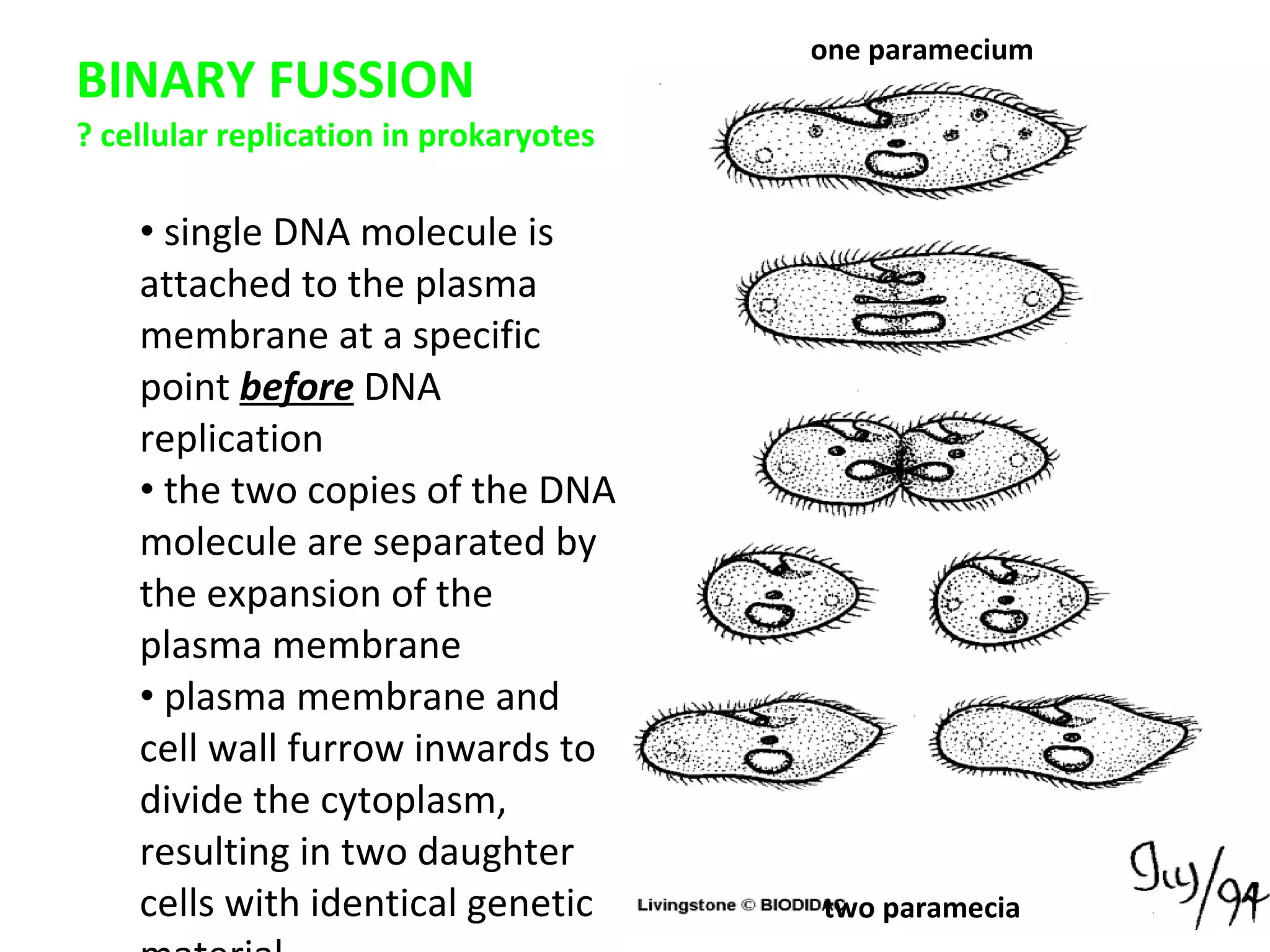
BINARY FUSSION ? cellular replication in prokaryotes single DNA molecule is attached to the plasma membrane at a specific point  before  DNA replication the two copies of the DNA molecule are separated by the expansion of the plasma membrane plasma membrane and cell wall furrow inwards to divide the cytoplasm, resulting in two daughter cells with identical genetic material one paramecium two paramecia
Cell Division in Eukaryotes A combination of two processes: DIVISION OF NUCLEUS  (incl. DNA replication) DIVISION OF CYTOPLASM  (incl. organelle replication) To accomplish this task, the cell passes through a series of discrete stages, or phases, known as the  cell cycle DIVISION OF NUCLEUS =  MITOSIS  DIVISION OF CYTOPLASM =  CYTOKINESIS
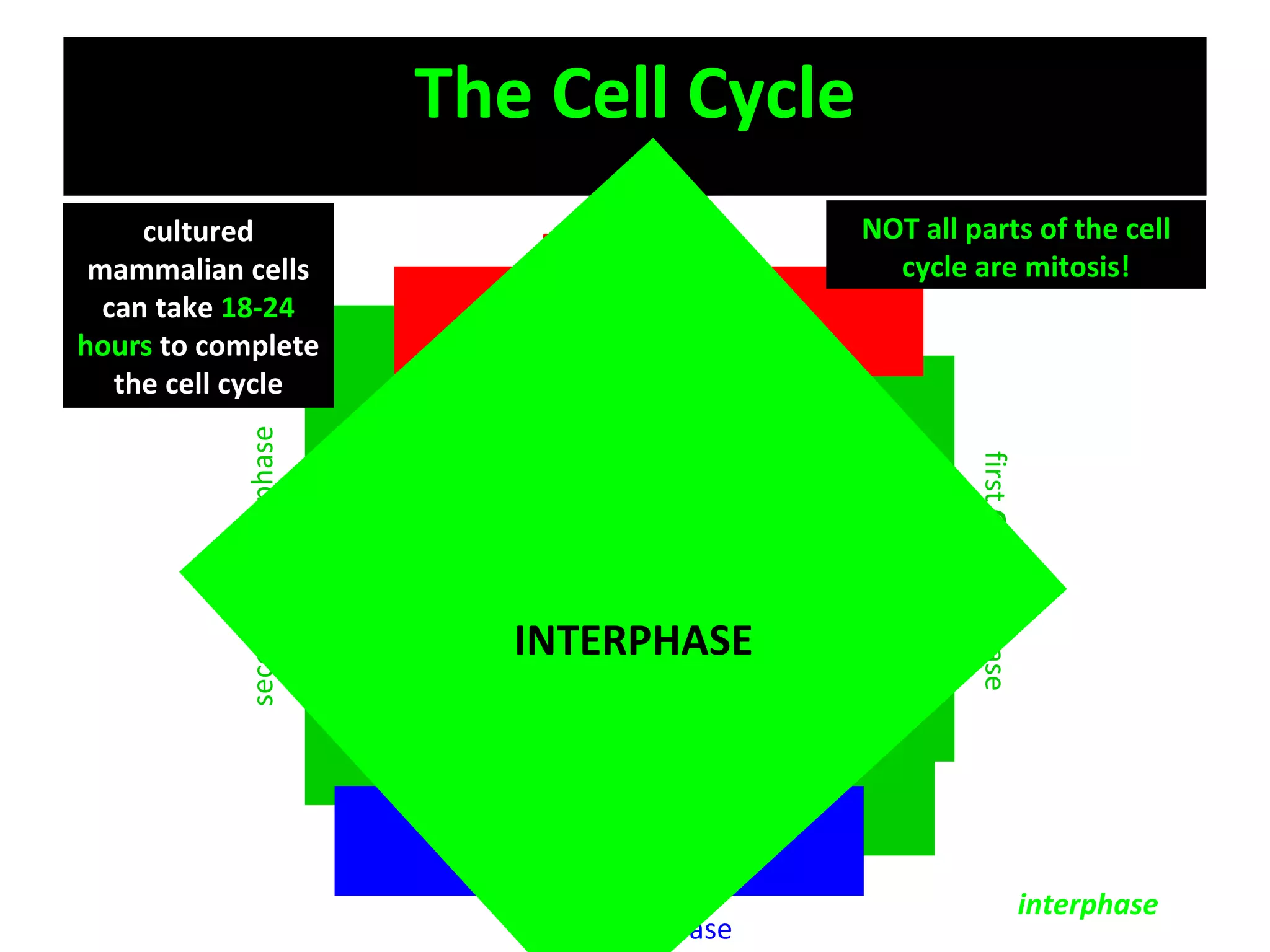
The Cell Cycle M S G1 G2 Growth & normal metabolic roles Growth & preparation for mitosis DNA replication first  G rowth phase second  G rowth phase S ynthesis phase M itotic phase prophase metaphase anaphase telophase NOT all parts of the cell cycle are mitosis! The non-mitosis parts of the cell cycle are known as  interphase cultured mammalian cells can take  18-24 hours  to complete the cell cycle INTERPHASE
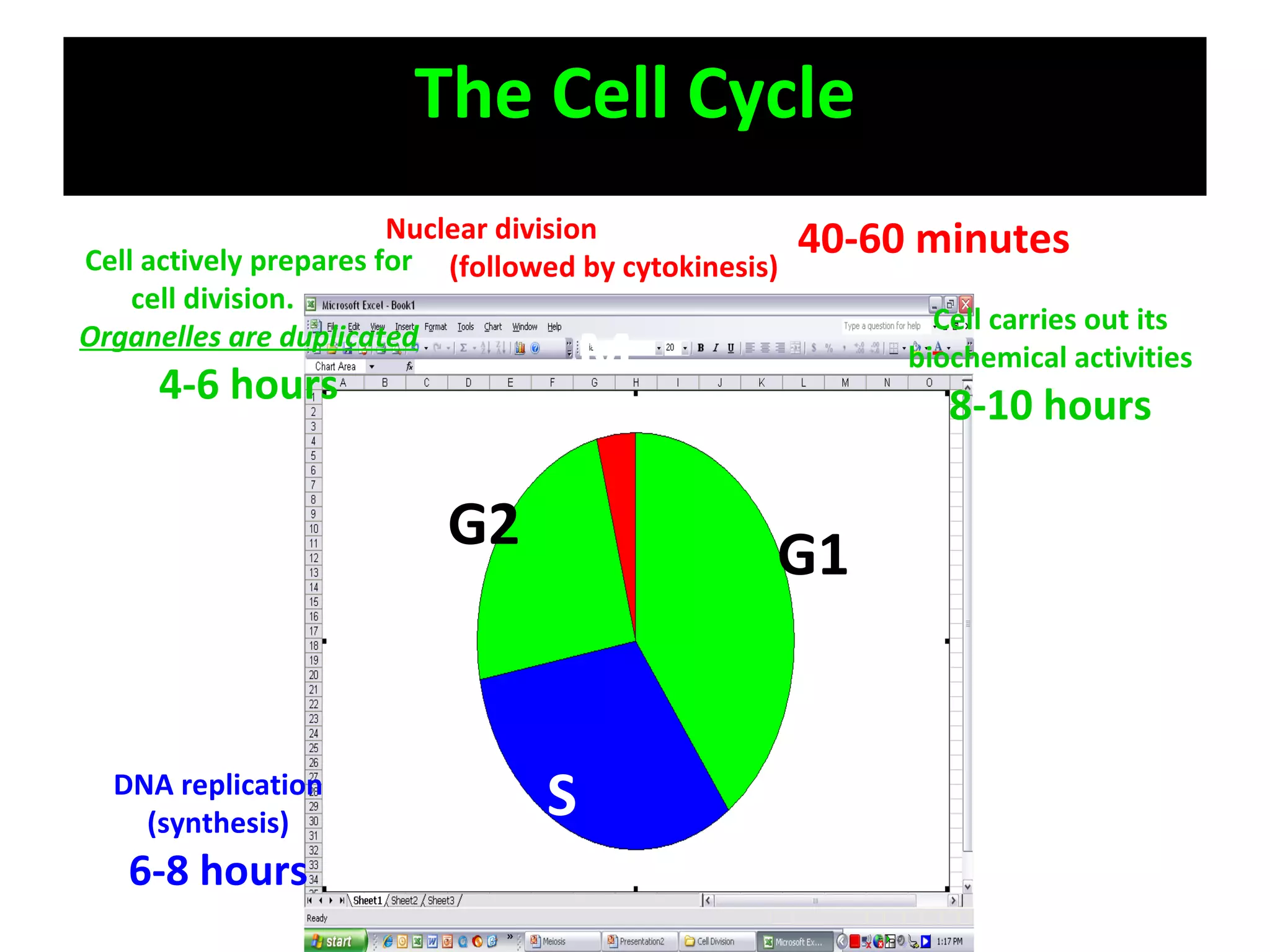
The Cell Cycle G1 G2 S M Cell carries out its biochemical activities 8-10 hours DNA replication (synthesis) 6-8 hours Cell actively prepares for cell division.  Organelles are duplicated 4-6 hours Nuclear division  (followed by cytokinesis) 40-60 minutes
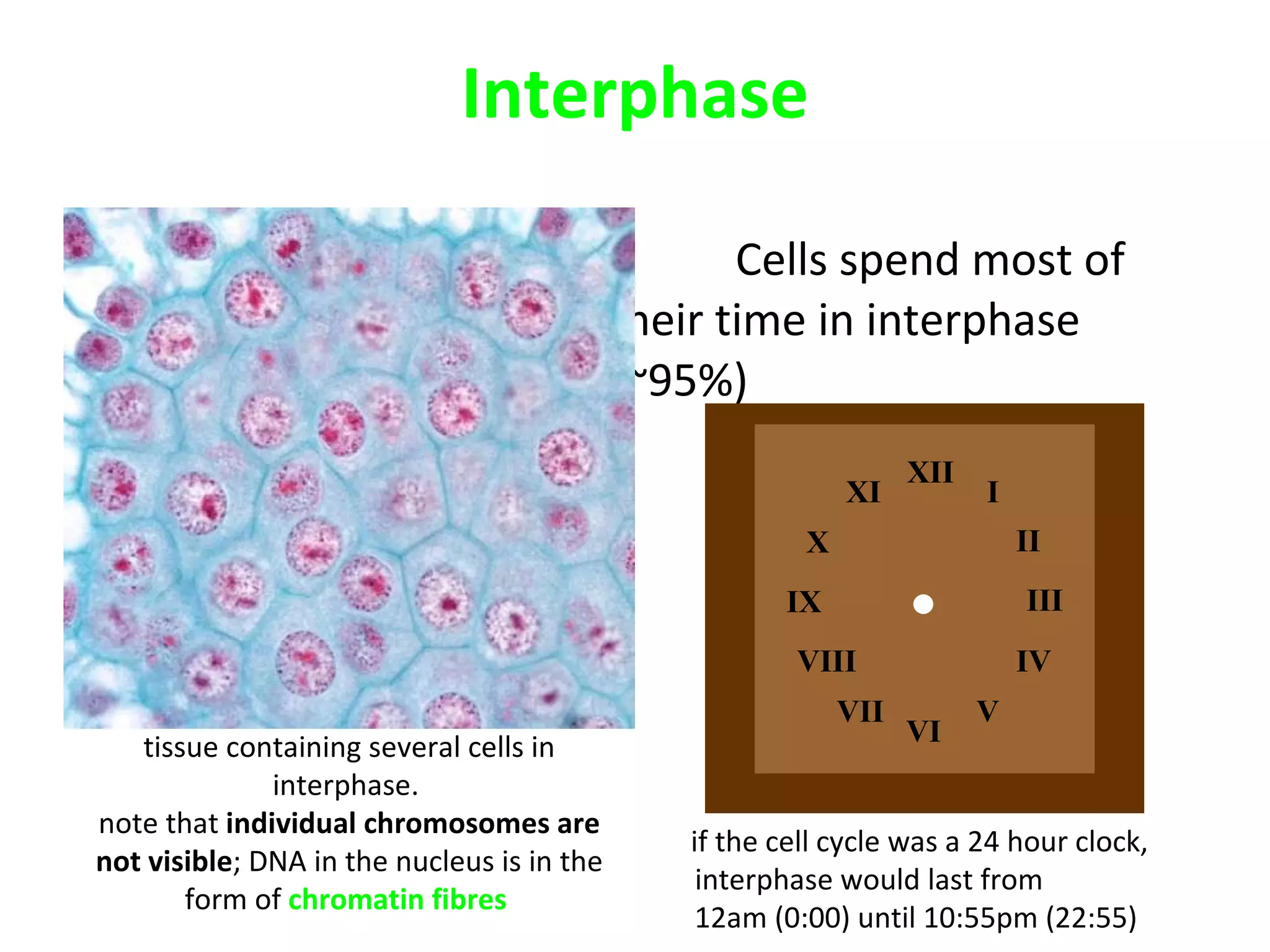
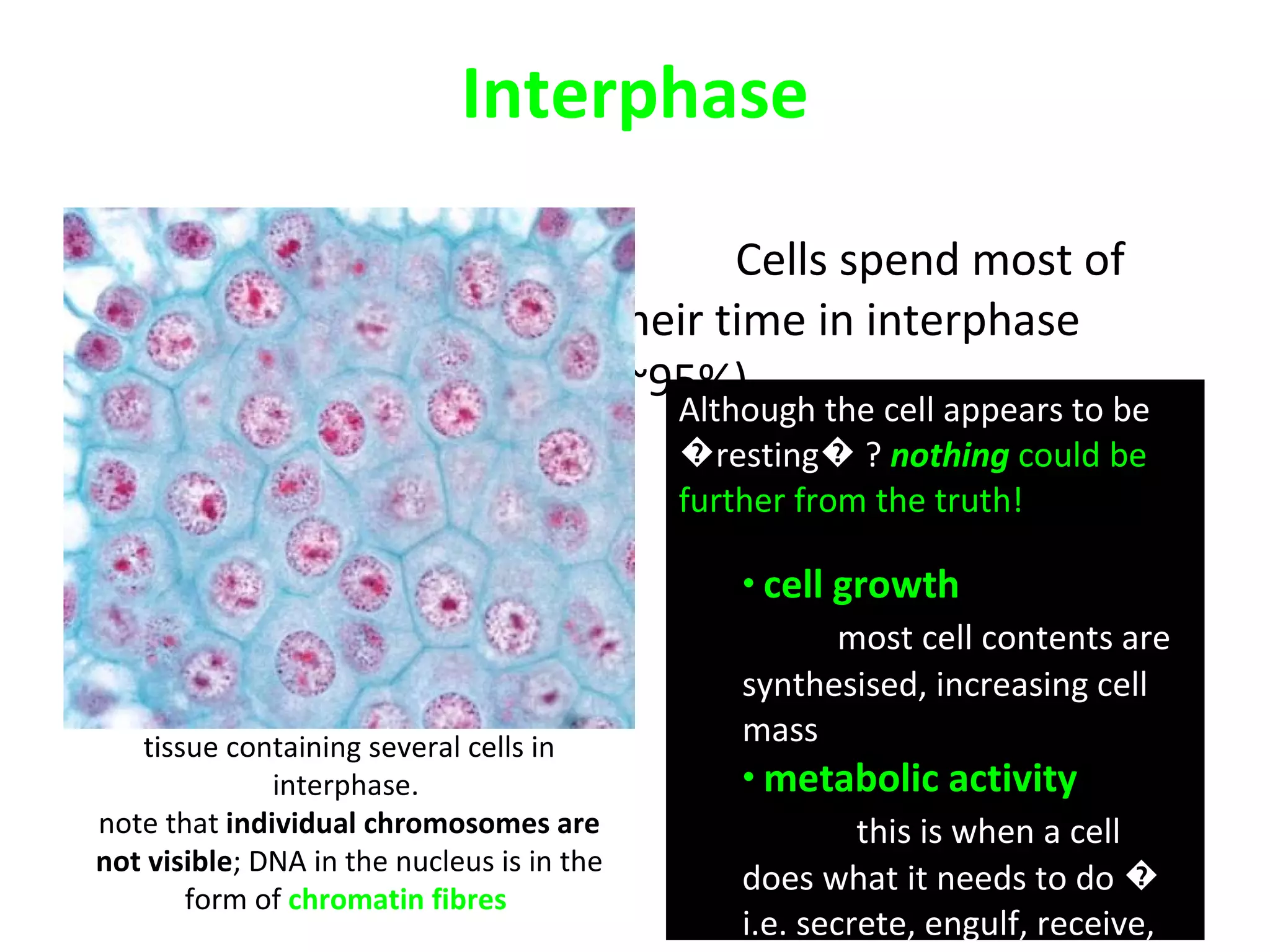
Interphase Cells spend most of their time in interphase (~95%) Although the cell appears to be �resting�  nothing   could be further from the truth! cell growth   (most cell contents are synthesised, increasing cell mass) metabolic activity  (this is when a cell does what it needs to do � i.e. secrete, engulf, receive, respond etc)  DNA replication tissue containing several cells in interphase.  note that  individual chromosomes are not visible ; DNA in the nucleus is in the form of  chromatin fibres  III XII I II IV V VI VII VIII IX X XI if the cell cycle was a 24 hour clock, interphase would last from  12am (0:00) until 10:55pm (22:55)
Interphase Cells spend most of their time in interphase (~95%) tissue containing several cells in interphase.  note that  individual chromosomes are not visible ; DNA in the nucleus is in the form of  chromatin fibres  Although the cell appears to be �resting� ?  nothing   could be further from the truth! cell growth   most cell contents are synthesised, increasing cell mass metabolic activity  this is when a cell does what it needs to do � i.e. secrete, engulf, receive, respond etc  DNA replication during S phase
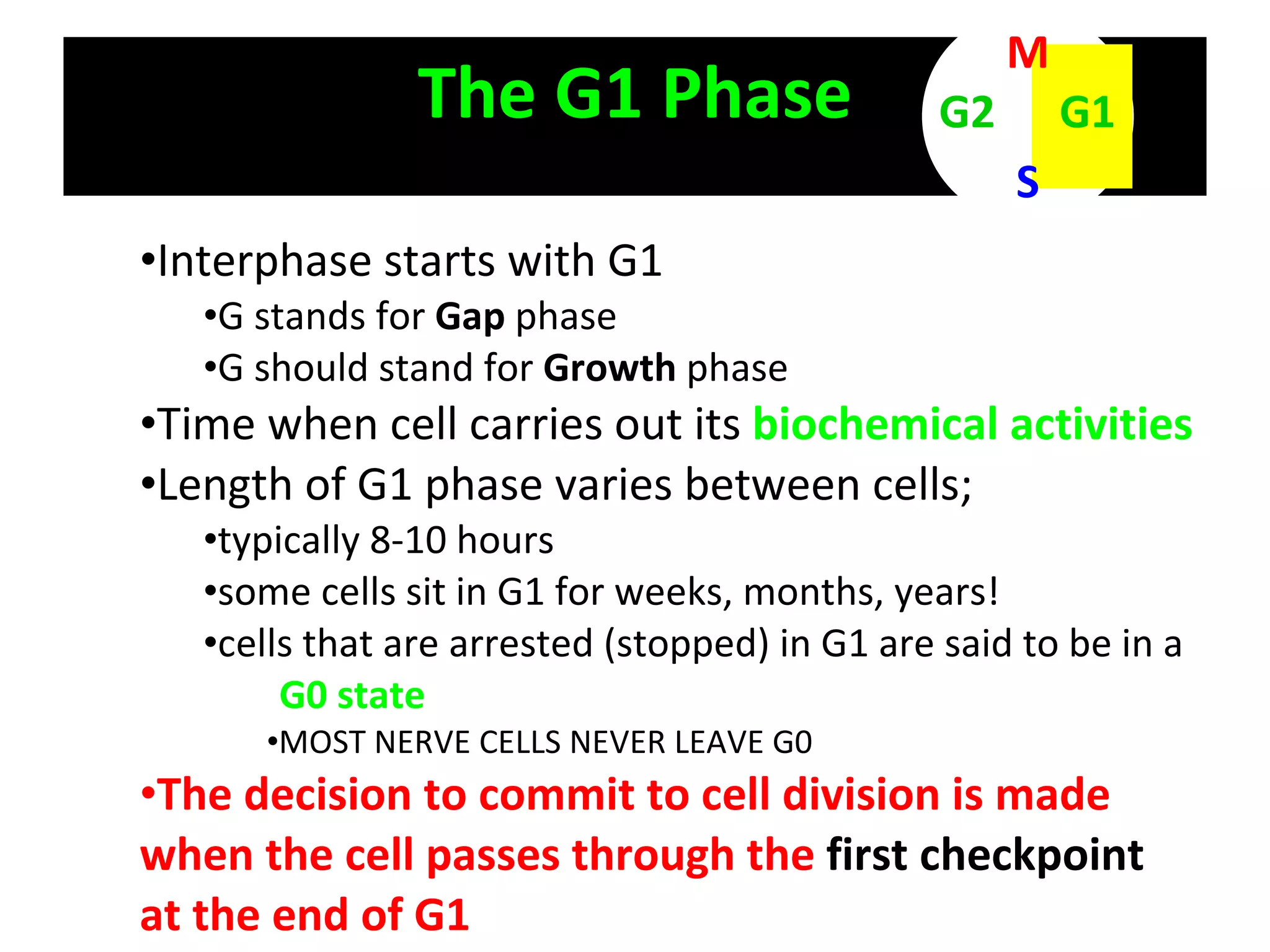
The G1 Phase Interphase starts with G1 G stands for  Gap  phase G should stand for  Growth  phase Time when cell carries out its  biochemical activities Length of G1 phase varies between cells;  typically 8-10 hours some cells sit in G1 for weeks, months, years! cells that are arrested (stopped) in G1 are said to be in a  G0 state   MOST NERVE CELLS NEVER LEAVE G0 The decision to commit to cell division is made when the cell passes through the  first checkpoint  at the end of G1 M S G1 G2
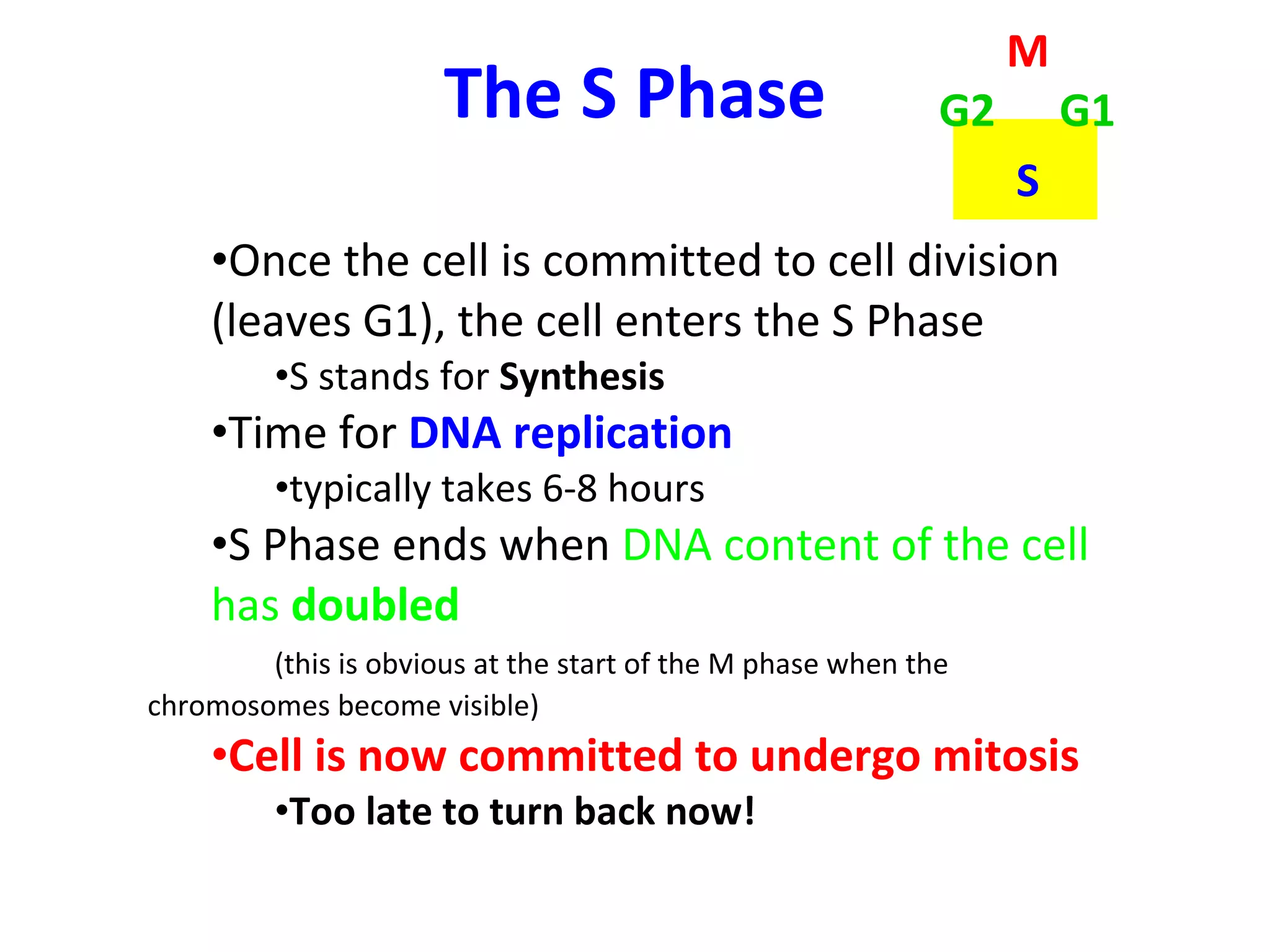
The S Phase Once the cell is committed to cell division (leaves G1), the cell enters the S Phase S   stands for  Synthesis Time for  DNA replication typically takes 6-8 hours S Phase ends when  DNA content of the cell has  doubled (this is obvious at the start of the M phase when the chromosomes become visible) Cell is now committed to undergo mitosis Too late to turn back now! M S G1 G2
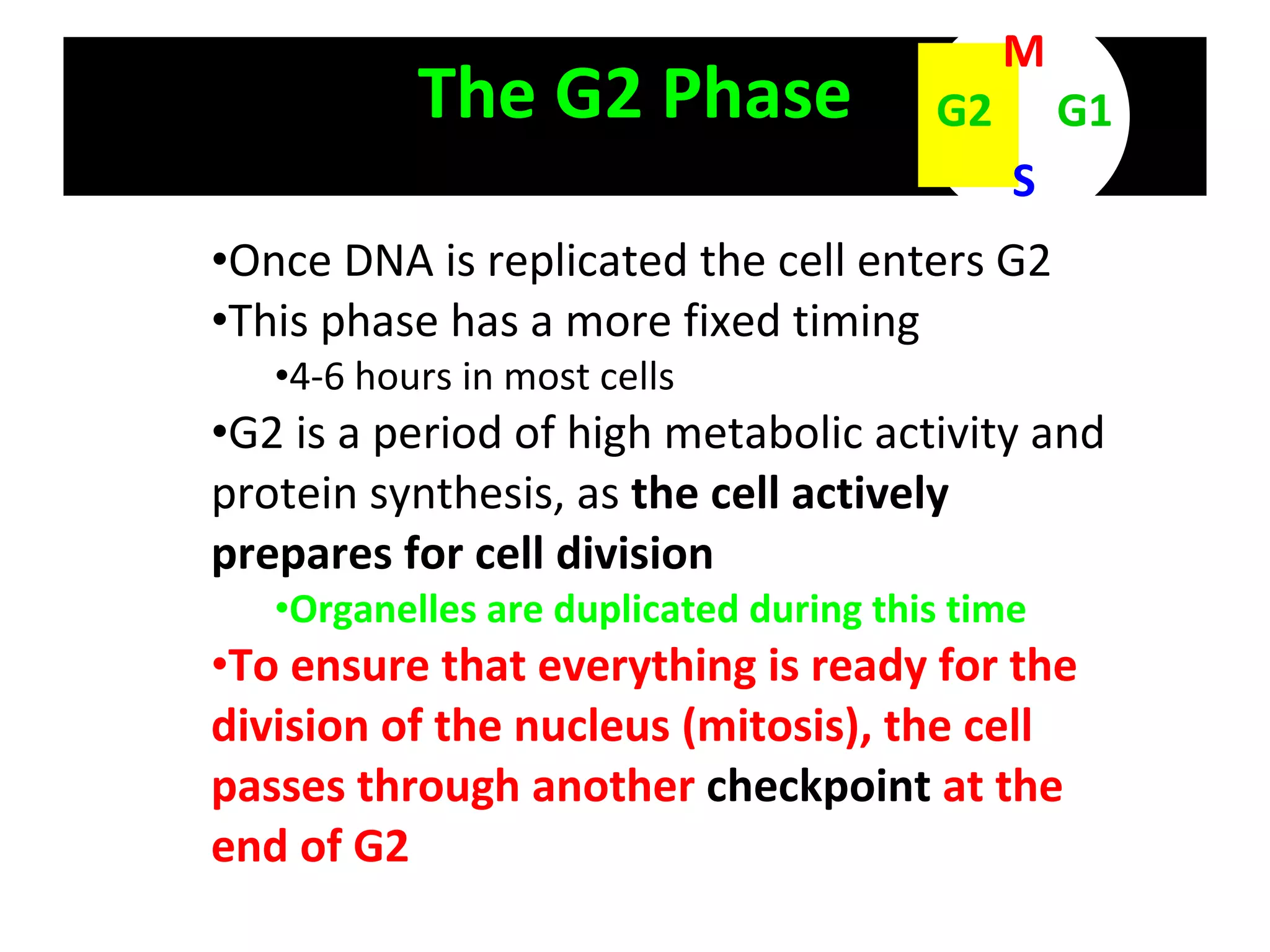
The G2 Phase Once DNA is replicated the cell enters G2 This phase has a more fixed timing 4-6 hours in most cells G2 is a period of high metabolic activity and protein synthesis, as  the cell actively prepares for cell division Organelles are duplicated during this time To ensure that everything is ready for the division of the nucleus (mitosis), the cell passes through another  checkpoint  at the end of G2 M S G1 G2
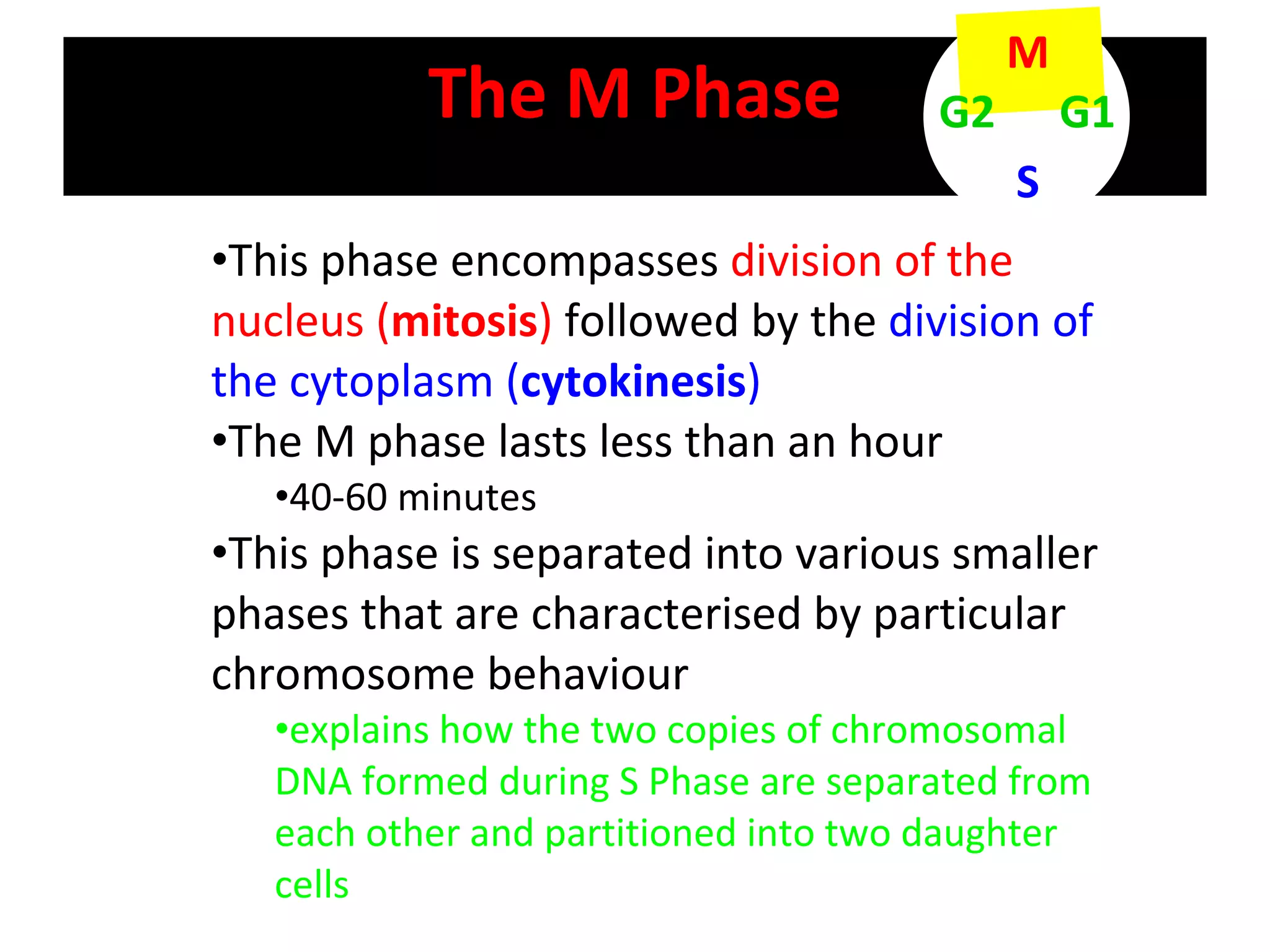
The M Phase This phase encompasses  division of the nucleus ( mitosis )  followed by the  division of the cytoplasm ( cytokinesis ) The M phase lasts less than an hour  40-60 minutes This phase is separated into various smaller phases that are characterised by particular chromosome behaviour explains how the two copies of chromosomal DNA formed during S Phase are separated from each other and partitioned into two daughter cells M S G1 G2
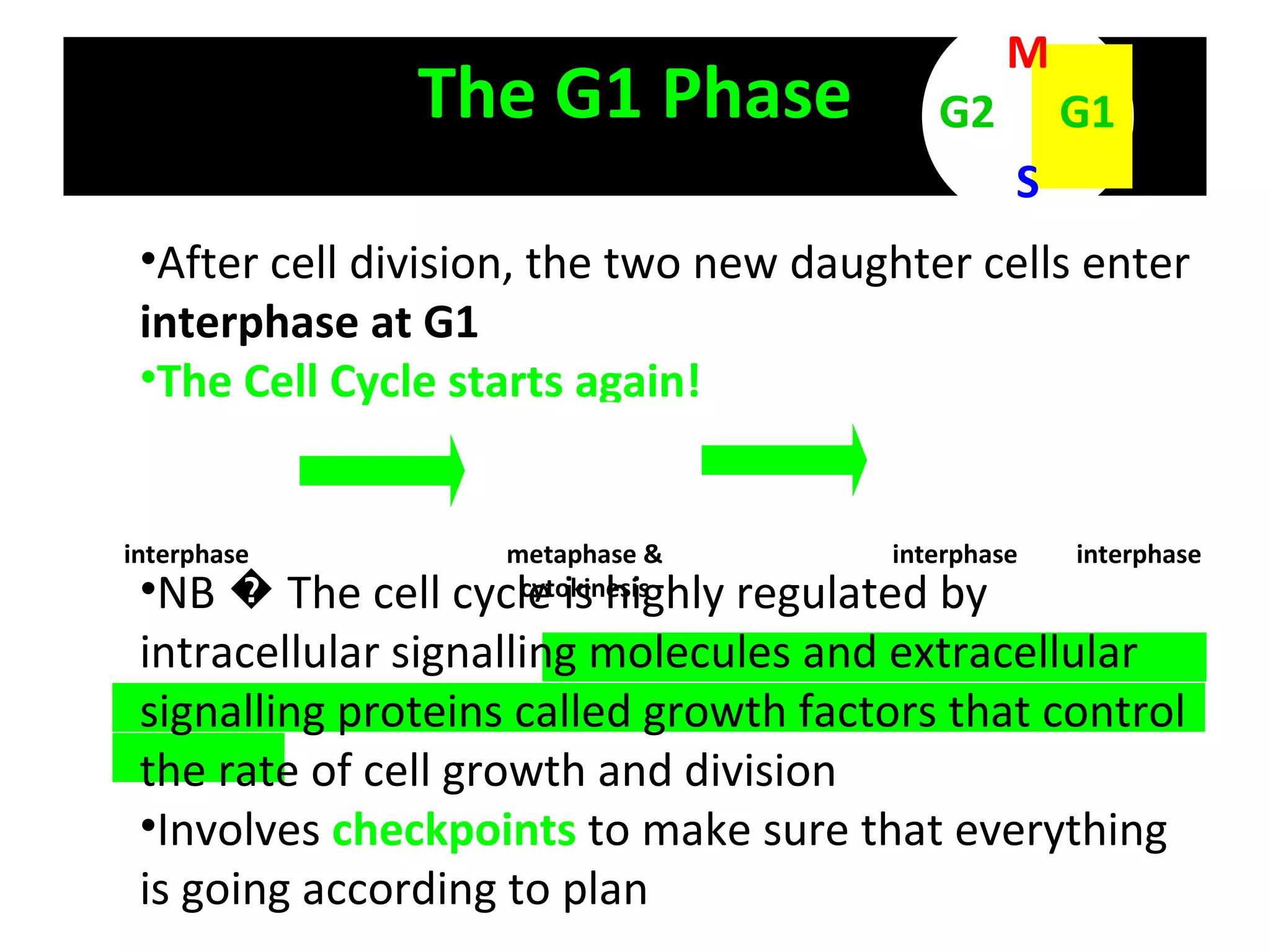
The G1 Phase M S G1 G2 After cell division, the two new daughter cells enter  interphase at G1 The Cell Cycle starts again! NB � The cell cycle is highly regulated by intracellular signalling molecules and extracellular signalling proteins called growth factors that control the rate of cell growth and division Involves  checkpoints  to make sure that everything is going according to plan interphase metaphase & cytokinesis interphase interphase
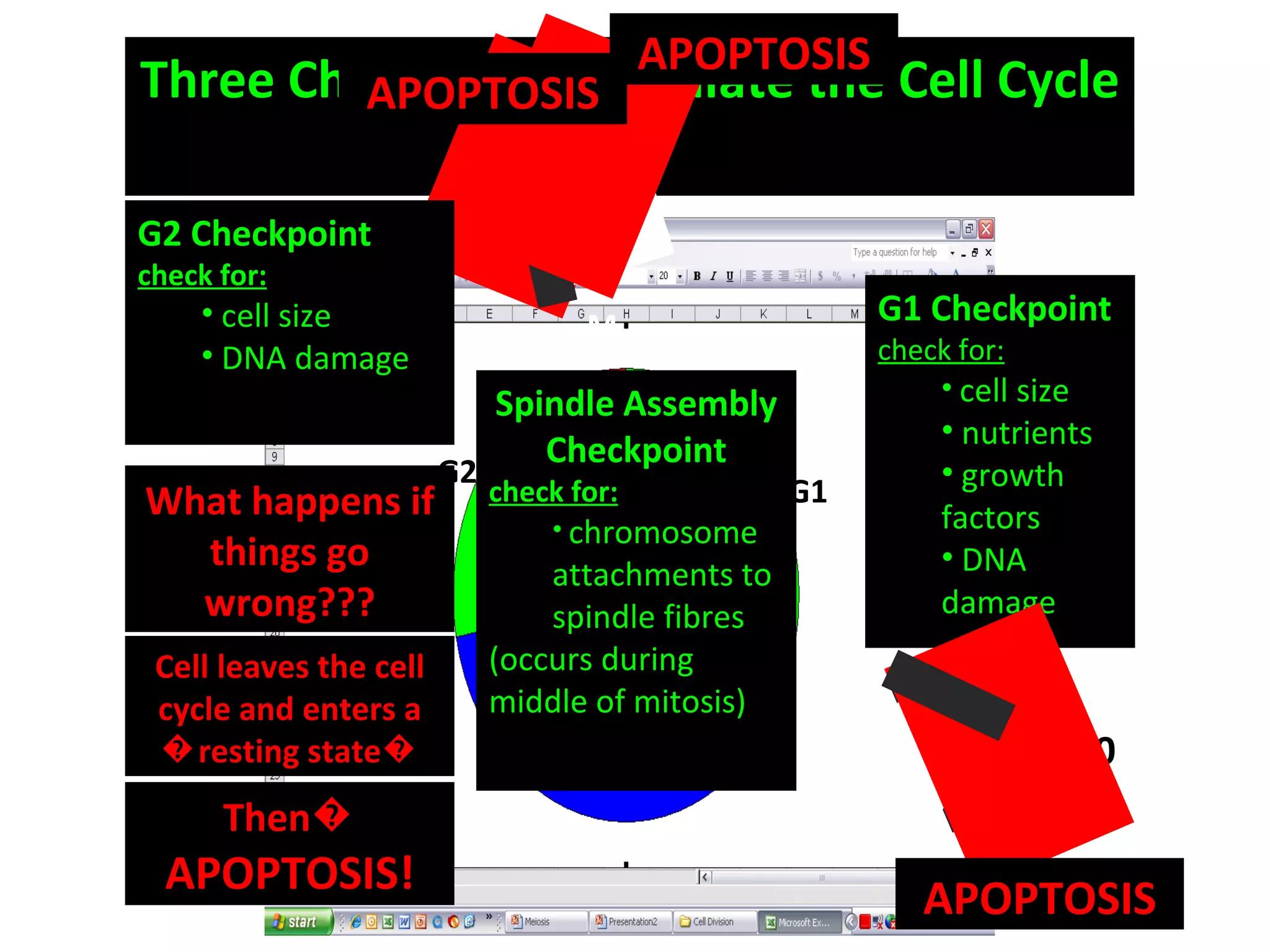
Three Checkpoints Regulate the Cell Cycle G1 G2 S M G1 Checkpoint check for: cell size nutrients growth factors DNA damage G2 Checkpoint check for: cell size DNA damage Spindle Assembly Checkpoint check for: chromosome attachments to spindle fibres (occurs during middle of mitosis)  What happens if things go wrong??? Cell leaves the cell cycle and enters a �resting state� G0 Then�  APOPTOSIS! APOPTOSIS APOPTOSIS APOPTOSIS

document.php?document_name=asdf

  • 1.
  • 2.
    What is themeaning of life? The purpose of life is to pass genetic information onto the next generation How is this done? 42
  • 3.
    Cells The CellTheory of Life states that: Cells are the smallest functional unit of life All living things consist of one or more cells New cells are produced from existing cells
  • 4.
    Cells The CellTheory of Life states that: Cells are the smallest functional unit of life All living things consist of one or more cells New cells are produced from existing cells HOW? One (parent) cell divides into two (daughter) cells = CELL DIVISION � however, one cell becomes two cells = CELL MULTIPLICATION Therefore, cells multiply by dividing� Let�s just call it cellular replication
  • 5.
    Cellular Replication Thereare THREE types of Cellular Replication MITOSIS MEIOSIS BINARY FISSION eukaryotes eukaryotes prokaryotes single-celled and multi-celled multi-celled single-celled TWO daughter cells produced FOUR daughter cells produced TWO daughter cells produced reproduction; growth of organism; replace old cells gamete production reproduction DNA replication is central to the process of cellular replication
  • 6.
    BINARY FISSION ?cellular replication in prokaryotes one paramecium two paramecia red paramecium blue paramecium
  • 7.
    BINARY FISSION ?cellular replication in prokaryotes one paramecium two paramecia cell wall cell membrane large, circular DNA moleucle DNA replication attachment point expansion of plasma membrane cell division in ideal conditions, binary fission can occur every 15-20 minutes !
  • 8.
    BINARY FUSSION ?cellular replication in prokaryotes single DNA molecule is attached to the plasma membrane at a specific point before DNA replication the two copies of the DNA molecule are separated by the expansion of the plasma membrane plasma membrane and cell wall furrow inwards to divide the cytoplasm, resulting in two daughter cells with identical genetic material one paramecium two paramecia
  • 9.
    Cell Division inEukaryotes A combination of two processes: DIVISION OF NUCLEUS (incl. DNA replication) DIVISION OF CYTOPLASM (incl. organelle replication) To accomplish this task, the cell passes through a series of discrete stages, or phases, known as the cell cycle DIVISION OF NUCLEUS = MITOSIS DIVISION OF CYTOPLASM = CYTOKINESIS
  • 10.
    The Cell CycleM S G1 G2 Growth & normal metabolic roles Growth & preparation for mitosis DNA replication first G rowth phase second G rowth phase S ynthesis phase M itotic phase prophase metaphase anaphase telophase NOT all parts of the cell cycle are mitosis! The non-mitosis parts of the cell cycle are known as interphase cultured mammalian cells can take 18-24 hours to complete the cell cycle INTERPHASE
  • 11.
    The Cell CycleG1 G2 S M Cell carries out its biochemical activities 8-10 hours DNA replication (synthesis) 6-8 hours Cell actively prepares for cell division. Organelles are duplicated 4-6 hours Nuclear division (followed by cytokinesis) 40-60 minutes
  • 12.
    Interphase Cells spendmost of their time in interphase (~95%) Although the cell appears to be �resting� nothing could be further from the truth! cell growth (most cell contents are synthesised, increasing cell mass) metabolic activity (this is when a cell does what it needs to do � i.e. secrete, engulf, receive, respond etc) DNA replication tissue containing several cells in interphase. note that individual chromosomes are not visible ; DNA in the nucleus is in the form of chromatin fibres III XII I II IV V VI VII VIII IX X XI if the cell cycle was a 24 hour clock, interphase would last from 12am (0:00) until 10:55pm (22:55)
  • 13.
    Interphase Cells spendmost of their time in interphase (~95%) tissue containing several cells in interphase. note that individual chromosomes are not visible ; DNA in the nucleus is in the form of chromatin fibres Although the cell appears to be �resting� ? nothing could be further from the truth! cell growth most cell contents are synthesised, increasing cell mass metabolic activity this is when a cell does what it needs to do � i.e. secrete, engulf, receive, respond etc DNA replication during S phase
  • 14.
    The G1 PhaseInterphase starts with G1 G stands for Gap phase G should stand for Growth phase Time when cell carries out its biochemical activities Length of G1 phase varies between cells; typically 8-10 hours some cells sit in G1 for weeks, months, years! cells that are arrested (stopped) in G1 are said to be in a G0 state MOST NERVE CELLS NEVER LEAVE G0 The decision to commit to cell division is made when the cell passes through the first checkpoint at the end of G1 M S G1 G2
  • 15.
    The S PhaseOnce the cell is committed to cell division (leaves G1), the cell enters the S Phase S stands for Synthesis Time for DNA replication typically takes 6-8 hours S Phase ends when DNA content of the cell has doubled (this is obvious at the start of the M phase when the chromosomes become visible) Cell is now committed to undergo mitosis Too late to turn back now! M S G1 G2
  • 16.
    The G2 PhaseOnce DNA is replicated the cell enters G2 This phase has a more fixed timing 4-6 hours in most cells G2 is a period of high metabolic activity and protein synthesis, as the cell actively prepares for cell division Organelles are duplicated during this time To ensure that everything is ready for the division of the nucleus (mitosis), the cell passes through another checkpoint at the end of G2 M S G1 G2
  • 17.
    The M PhaseThis phase encompasses division of the nucleus ( mitosis ) followed by the division of the cytoplasm ( cytokinesis ) The M phase lasts less than an hour 40-60 minutes This phase is separated into various smaller phases that are characterised by particular chromosome behaviour explains how the two copies of chromosomal DNA formed during S Phase are separated from each other and partitioned into two daughter cells M S G1 G2
  • 18.
    The G1 PhaseM S G1 G2 After cell division, the two new daughter cells enter interphase at G1 The Cell Cycle starts again! NB � The cell cycle is highly regulated by intracellular signalling molecules and extracellular signalling proteins called growth factors that control the rate of cell growth and division Involves checkpoints to make sure that everything is going according to plan interphase metaphase & cytokinesis interphase interphase
  • 19.
    Three Checkpoints Regulatethe Cell Cycle G1 G2 S M G1 Checkpoint check for: cell size nutrients growth factors DNA damage G2 Checkpoint check for: cell size DNA damage Spindle Assembly Checkpoint check for: chromosome attachments to spindle fibres (occurs during middle of mitosis) What happens if things go wrong??? Cell leaves the cell cycle and enters a �resting state� G0 Then� APOPTOSIS! APOPTOSIS APOPTOSIS APOPTOSIS