CELL REPLICATION(in prokaryotes & eukaryotes)
Binary fission in bacteriaMuch faster than mitosis in eukaryotic cellsTakes approx. 20 mins as opposed to several hoursIf resources were available once cell could become 16,000,000 in 8 hours!
Binary Fission in bacteria
Binary Fission in bacteriaBidirectional replication of circular DNA
Binary Fission in bacteriaDNA moves to poles
Binary Fission in bacteriaCell elongatesCleavage furrow forms
Binary Fission in bacteriaCell divides
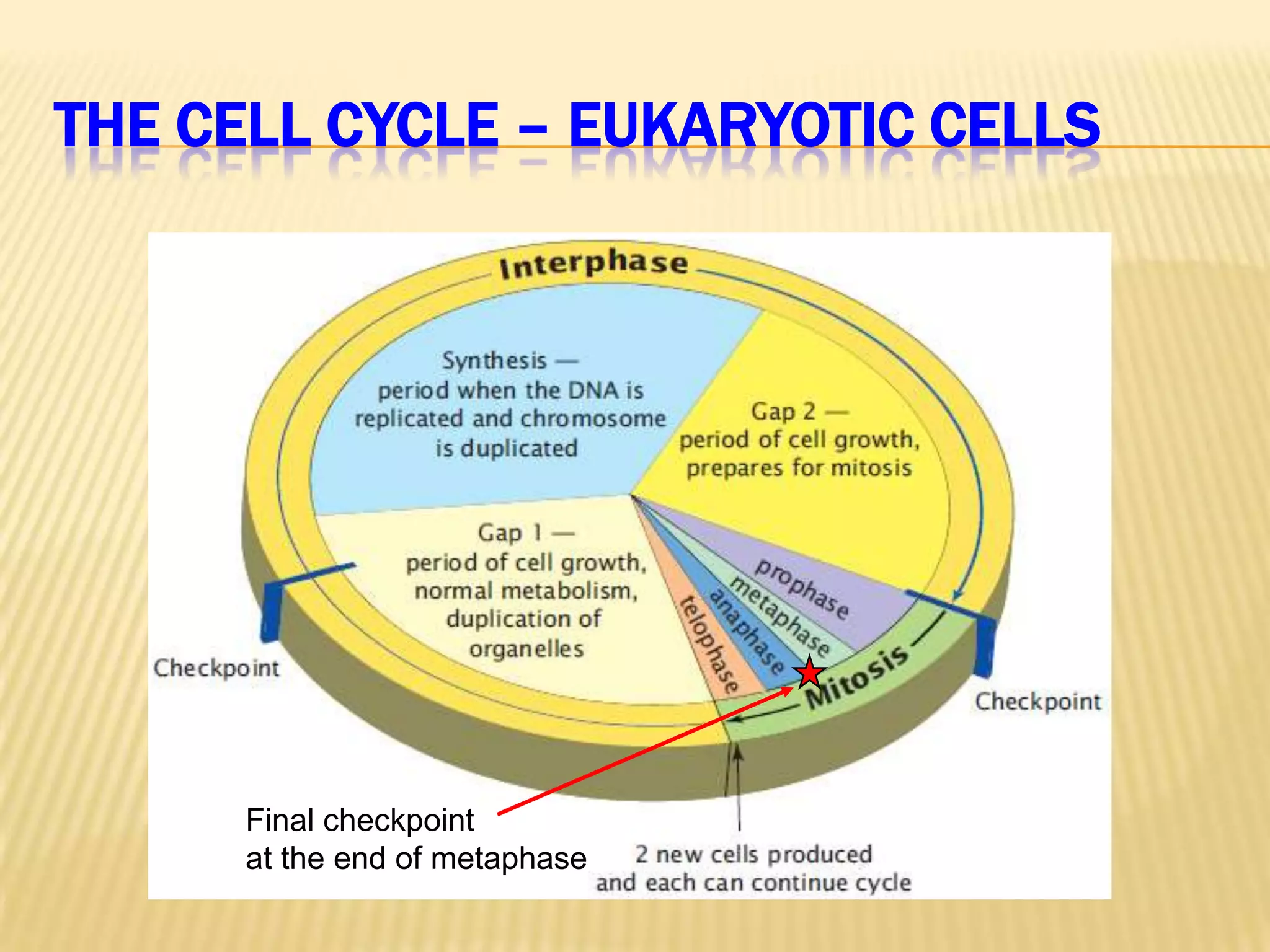
The Cell Cycle – Eukaryotic cellsFinal checkpoint at the end of metaphase
AnimationsAnimation 1Animation 2
The Cell Cycle – G1The first phase is a growth phase (G1)The new cell starts growing and replicating its organellesAt the end of G1, the checkpoint is to gauge if it is a good time for cell to keep growing or dividing or if a delay is necessary.If the cell is under any sort of stress, it will pause at this stage.
The Cell Cycle - SDuring the synthesis (S) phase, DNA replication occurs
It is at this point that the diploid cell (2n) doubles to 4n, so that when it divides there will be two complete copies of the DNA
DNA replication is semi-conservative – every new molecule consists of one original strand and one new strand.
DNA replication involves numerous enzymes
Helicase and gyrase unwind and unzip to strands of DNA
DNA polymerase continuously adds nucleotides to the leading strand in a 5’ to 3’ direction
RNA primase makes an RNA primer on the lagging strand
DNA ligse sticks together prefabricated ‘Okazaki’ fragments made by DNA polymerase to replace the RNAThe Cell Cycle – G2During the next growth phase (G2), the cell continues to grow in preparation for divisionThe checkpoint during this phase is extremely important.If any errors have occurred during transcription, the cell must undergo apoptosis (programmed cell death)
The Cell Cycle - MDuring Mitosis (M), the single parent cell gives rise to two identical daughter cells.Another checkpoint occurs at the end of metaphase to ensure that chromosomes are aligned and that spindle fibres are attached corectly.A negative result at the checkpoint here will result in apoptosis.
The Cell Cycle - CCytokynesis (C) is actually the last part of MitosisAt this point the cell, which momentarily has twin nuclei, will divide in to two new cells (2n) and the process will begin again.
What happens if the checkpoints don’t work?If cell cycle checkpoints are operated by enzyme proteins.These enzymes can be prevented from carrying out normal function by inhibitors. These enzymes could also be stimulated to maintain an active state permanently.Either way can lead to uncontrolled and unmonitored cell division, this is commonly known as ….
CANCERCells multiply uncontrollably and regardless of accumulating errors will never apoptose.Does not form useful cells as cells spend far more time in division rather than growth (a reversal of the normal situation).
MITOSIS
InterphaseThe cell prepares for division2N - 4NAnimal & Plant Cells Nucleus clearly definedChromosomes not yet visibleDNA replicatedOrganelles replicatedCell increases in size
InterphasePlant CellAnimal CellPhotographs from: http://www.bioweb.uncc.edu/biol1110/Stages.htm
ProphaseThe cell prepares for nuclear division4NAnimal & Plant CellsDNA packaged in to chromosomesNuclear envelope disappearsCentrioles move to opposite sides of the cell
ProphasePlant CellAnimal CellPhotographs from: http://www.bioweb.uncc.edu/biol1110/Stages.htm
MetaphaseThe cell prepares chromosomes for division4NAnimal & Plant CellsChromosomes line up at the center of the cellSpindle fibres attach to centromeres on the chromosomesCentrioles reach the opposite poles of the cell
MetaphasePlant CellAnimal CellPhotographs from: http://www.bioweb.uncc.edu/biol1110/Stages.htm
AnaphaseThe chromosomes divide4NAnimal & Plant CellsSpindle fibers contract and pull chromosomes apart½ of each chromosome (called a chromatid) moves to each hemisphereUnattached spindle fibres push against each other or the sides of the cell, and it begins to elongate
AnaphasePlant CellAnimal CellPhotographs from: http://www.bioweb.uncc.edu/biol1110/Stages.htm
TelophaseThe cytoplasm divides4N - 2NPlant CellDNA spreads out2 nuclei formCell plate forms new cell wall between the nuclei to form the 2 new daughter cellsAnimal CellDNA spreads out2 nuclei formContractile ring causes a cleavage furrow to form the 2 new daughter cells
TelophasePlant CellAnimal CellPhotographs from: http://www.bioweb.uncc.edu/biol1110/Stages.htm
MitosisAnimationsMitosis.exeMitosis Animation
Animal Mitosis -- Review
Plant Mitosis -- Review
Summary of MitosisProphase: Chromosomes condenseNuclear envelope disappearscentrosomes move to opposite sides of the cellSpindle forms and attaches to centromeres on the chromosomesMetaphaseChromosomes lined up on equator of spindlecentrosomes at opposite ends of cellAnaphaseCentromeres divide: each 2-chromatid chromosome becomes two 1-chromatid chromosomesChromosomes pulled to opposite poles by the spindleTelophaseChromosomes de-condenseNuclear envelope reappearsCytokinesis: the cytoplasm is divided into 2 cells
MEIOSIS
Recombination through meiosisDNA replicatesCrossing overRandom assortmentFirst divisionSecond random assortmentSecond division
Mitosis vs. meiosis
Getting the names rightCentromereSpindle fibres / microtubulesKinetochoreSister chromatids
Recombination = variation2 pairs of chromosomes = 4 possibilities

01 Cell Reproduction

  • 1.
  • 2.
    Binary fission inbacteriaMuch faster than mitosis in eukaryotic cellsTakes approx. 20 mins as opposed to several hoursIf resources were available once cell could become 16,000,000 in 8 hours!
  • 3.
  • 4.
    Binary Fission inbacteriaBidirectional replication of circular DNA
  • 5.
    Binary Fission inbacteriaDNA moves to poles
  • 6.
    Binary Fission inbacteriaCell elongatesCleavage furrow forms
  • 7.
    Binary Fission inbacteriaCell divides
  • 8.
    The Cell Cycle– Eukaryotic cellsFinal checkpoint at the end of metaphase
  • 9.
  • 10.
    The Cell Cycle– G1The first phase is a growth phase (G1)The new cell starts growing and replicating its organellesAt the end of G1, the checkpoint is to gauge if it is a good time for cell to keep growing or dividing or if a delay is necessary.If the cell is under any sort of stress, it will pause at this stage.
  • 11.
    The Cell Cycle- SDuring the synthesis (S) phase, DNA replication occurs
  • 12.
    It is atthis point that the diploid cell (2n) doubles to 4n, so that when it divides there will be two complete copies of the DNA
  • 13.
    DNA replication issemi-conservative – every new molecule consists of one original strand and one new strand.
  • 14.
    DNA replication involvesnumerous enzymes
  • 15.
    Helicase and gyraseunwind and unzip to strands of DNA
  • 16.
    DNA polymerase continuouslyadds nucleotides to the leading strand in a 5’ to 3’ direction
  • 17.
    RNA primase makesan RNA primer on the lagging strand
  • 18.
    DNA ligse stickstogether prefabricated ‘Okazaki’ fragments made by DNA polymerase to replace the RNAThe Cell Cycle – G2During the next growth phase (G2), the cell continues to grow in preparation for divisionThe checkpoint during this phase is extremely important.If any errors have occurred during transcription, the cell must undergo apoptosis (programmed cell death)
  • 19.
    The Cell Cycle- MDuring Mitosis (M), the single parent cell gives rise to two identical daughter cells.Another checkpoint occurs at the end of metaphase to ensure that chromosomes are aligned and that spindle fibres are attached corectly.A negative result at the checkpoint here will result in apoptosis.
  • 20.
    The Cell Cycle- CCytokynesis (C) is actually the last part of MitosisAt this point the cell, which momentarily has twin nuclei, will divide in to two new cells (2n) and the process will begin again.
  • 21.
    What happens ifthe checkpoints don’t work?If cell cycle checkpoints are operated by enzyme proteins.These enzymes can be prevented from carrying out normal function by inhibitors. These enzymes could also be stimulated to maintain an active state permanently.Either way can lead to uncontrolled and unmonitored cell division, this is commonly known as ….
  • 22.
    CANCERCells multiply uncontrollablyand regardless of accumulating errors will never apoptose.Does not form useful cells as cells spend far more time in division rather than growth (a reversal of the normal situation).
  • 23.
  • 24.
    InterphaseThe cell preparesfor division2N - 4NAnimal & Plant Cells Nucleus clearly definedChromosomes not yet visibleDNA replicatedOrganelles replicatedCell increases in size
  • 25.
    InterphasePlant CellAnimal CellPhotographsfrom: http://www.bioweb.uncc.edu/biol1110/Stages.htm
  • 26.
    ProphaseThe cell preparesfor nuclear division4NAnimal & Plant CellsDNA packaged in to chromosomesNuclear envelope disappearsCentrioles move to opposite sides of the cell
  • 27.
    ProphasePlant CellAnimal CellPhotographsfrom: http://www.bioweb.uncc.edu/biol1110/Stages.htm
  • 28.
    MetaphaseThe cell prepareschromosomes for division4NAnimal & Plant CellsChromosomes line up at the center of the cellSpindle fibres attach to centromeres on the chromosomesCentrioles reach the opposite poles of the cell
  • 29.
    MetaphasePlant CellAnimal CellPhotographsfrom: http://www.bioweb.uncc.edu/biol1110/Stages.htm
  • 30.
    AnaphaseThe chromosomes divide4NAnimal& Plant CellsSpindle fibers contract and pull chromosomes apart½ of each chromosome (called a chromatid) moves to each hemisphereUnattached spindle fibres push against each other or the sides of the cell, and it begins to elongate
  • 31.
    AnaphasePlant CellAnimal CellPhotographsfrom: http://www.bioweb.uncc.edu/biol1110/Stages.htm
  • 32.
    TelophaseThe cytoplasm divides4N- 2NPlant CellDNA spreads out2 nuclei formCell plate forms new cell wall between the nuclei to form the 2 new daughter cellsAnimal CellDNA spreads out2 nuclei formContractile ring causes a cleavage furrow to form the 2 new daughter cells
  • 33.
    TelophasePlant CellAnimal CellPhotographsfrom: http://www.bioweb.uncc.edu/biol1110/Stages.htm
  • 34.
  • 35.
  • 36.
  • 37.
    Summary of MitosisProphase:Chromosomes condenseNuclear envelope disappearscentrosomes move to opposite sides of the cellSpindle forms and attaches to centromeres on the chromosomesMetaphaseChromosomes lined up on equator of spindlecentrosomes at opposite ends of cellAnaphaseCentromeres divide: each 2-chromatid chromosome becomes two 1-chromatid chromosomesChromosomes pulled to opposite poles by the spindleTelophaseChromosomes de-condenseNuclear envelope reappearsCytokinesis: the cytoplasm is divided into 2 cells
  • 38.
  • 39.
    Recombination through meiosisDNAreplicatesCrossing overRandom assortmentFirst divisionSecond random assortmentSecond division
  • 40.
  • 41.
    Getting the namesrightCentromereSpindle fibres / microtubulesKinetochoreSister chromatids
  • 42.
    Recombination = variation2pairs of chromosomes = 4 possibilities
  • 43.
    4 pairs ofchromosomes = 8 possibilities
  • 44.
    What are thechances of identical offspring?
  • 45.
    2n = 46 (not incl. twins) 1 / 16,777,216DNA ReplicationDNA is uncoiled and unzipped by helicase & gyraseThe original strands are called the template strandsThe new strands are called the complementary strandsThe 3’ to 5’ template strand is the leading strandThe 5’ to 3’ template strand is the lagging strandThe complementary strand can only be written 5’ to 3’DNAi ANIMATIONS x 2
  • 46.
    The leading strandAnRNA primer is put down by RNA polymeraseComplementary DNA is put down base-pair by base-pair by DNA polymeraseDIRECTION OF REPLICATION3’ 5’RpDp5’3’
  • 47.
    The lagging strandRNApolymerase puts down primers along the template strand of DNADNA polymerase III builds short ‘Okazaki’ fragments from each primerDNA polymerase I removes the RNA and replaces it with DNADNA ligase sticks the fragments together
  • 48.
    The lagging strandRNAPolymeraseDNA Polymerase IIIDNA Polymerase IDNA LigaseDIRECTION OF REPLICATION5’ 3’3’5’
  • 49.
    Additional info oncell reproductionOur cells can be categorised in to two typesSomatic cells (diploid)Germline cells (diploid but give rise to haploid gametes – sperm & eggs)
  • 50.
    Biozone Fun!DNA replicationpp.203-25Cell cycle, mitosis, apoptosispp. 209-212Meiosispp. 287-290