CELL CYCLE AND ITS ROLE IN
REPAIR
By Dr Gulshan Munir
CELL CYCLE
The cell cycle, or cell-division cycle, is the
sequential series of events that take place in a
cell that causes it to divide into two daughter
cells. These events include the growth of the
cell, duplication of its DNA (DNA replication) and
some of its organelles, and subsequently the
partitioning of its cytoplasm, chromosomes and
other components into two daughter cells in a
process called cell division.
In eukaryotic cells including animal, plant, fungal, and protist
cells, the cell cycle is divided into two main stages: interphase,
and the M phase that includes mitosis and cytokinesis. During
interphase, the cell grows, accumulating nutrients needed for
mitosis, and replicates its DNA and some of its organelles.
During the M phase, the replicated chromosomes, organelles,
and cytoplasm separate into two new daughter cells. To ensure
the proper replication of cellular components and division,
there are control mechanisms known as cell cycle checkpoints
after each of the key steps of the cycle that determine if the
cell can progress to the next phase.
• In cells without nuclei the prokaryotes,
bacteria and archaea, the cell cycle is divided
into the B, C, and D periods. The B period
extends from the end of cell division to the
beginning of DNA replication. DNA replication
occurs during the C period. The D period
refers to the stage between the end of DNA
replication and the splitting of the bacterial
cell into two daughter cells.
PHASES
• The eukaryotic cell cycle consists of four distinct phases: G1
phase, S phase (synthesis), G2 phase (collectively known as
interphase) and M phase (mitosis and cytokinesis). M phase
is itself composed of two tightly coupled processes: mitosis,
in which the cell's nucleus divides, and cytokinesis, in which
the cell's cytoplasm and cell membrane divides forming two
daughter cells. Activation of each phase is dependent on the
proper progression and completion of the previous one.
Cells that have temporarily or reversibly stopped dividing are
said to have entered a state of quiescence known as G0
phase or resting phase.
G0 Or Resting phase
• G0 is a resting phase where the cell has left the cycle and
has stopped dividing. The cell cycle starts with this phase.
• Non-proliferative (non-dividing) cells in multicellular
eukaryotes generally enter the quiescent G0 state and may
remain quiescent for long periods of time, possibly
indefinitely (as is often the case for neurons). This is very
common for cells that are fully differentiated.
• Some cells enter the G0 phase semi-permanently e.g.,
some liver, kidney, and stomach cells.
• Many cells do not enter G0 and continue to divide
throughout an organism's life, e.g., epithelial cells.
INTERPHASE
• Interphase represents the phase between two successive M
phases. Interphase is a series of changes that takes place in
a newly formed cell and its nucleus before it becomes
capable of division again. It is also called preparatory phase
or intermitosis. Typically interphase lasts for at least 91% of
the total time required for the cell cycle.
• Interphase proceeds in three stages, G1, S, and G2, followed
by the cycle of mitosis and cytokinesis. The cell's nuclear
DNA contents are duplicated during S phase.
G1 PHASE
• The first phase within interphase, from the end of the previous M phase until
the beginning of DNA synthesis, is called G1 (G indicating gap). It is also called
the growth phase. During this phase, the biosynthetic activities of the cell, which
are considerably slowed down during M phase, resume at a high rate. The
duration of G1 is highly variable, even among different cells of the same species.
In this phase, the cell increases its supply of proteins, increases the number of
organelles (such as mitochondria, ribosomes), and grows in size. In G1 phase, a
cell has three options.
 To continue cell cycle and enter S phase
 Stop cell cycle and enter G0 phase for undergoing differentiation.
 Become arrested in G1 phase hence it may enter G0 phase or re-enter cell cycle.
• The deciding point is called check point (Restriction point). This check point is
called the restriction point or START and is regulated by G1/S cyclins, which
cause transition from G1 to S phase. Passage through the G1 check point
commits the cell to division.
S PHASE
DNA replication
• The ensuing S phase starts when DNA synthesis
commences; when it is complete, all of the
chromosomes have been replicated,Thus, during
this phase, the amount of DNA in the cell has
doubled, Rates of RNA transcription and protein
synthesis are very low during this phase. An
exception to this is histone production, most of
which occurs during the S phase.
G2 PHASE
Growth Phase
• G2 phase occurs after DNA replication and is a period of protein
synthesis and rapid cell growth to prepare the cell for mitosis.
During this phase microtubules begin to reorganize to form a
spindle (preprophase). Before proceeding to mitotic phase, cells
must be checked at the G2 checkpoint for any DNA damage
within the chromosomes.
• The G2 checkpoint is mainly regulated by the tumor protein
p53. If the DNA is damaged, p53 will either repair the DNA or
trigger the apoptosis of the cell. If p53 is dysfunctional or
mutated, cells with damaged DNA may continue through the
cell cycle, leading to the development of cancer.
METAPHASE
• The relatively brief M phase consists of nuclear division (karyokinesis) and division of
cytoplasm (cytokinesis). M phase is complex and highly regulated. The sequence of
events is divided into phases, corresponding to the completion of one set of
activities and the start of the next. These phases are sequentially known as:
 Prophase
 Prometaphase
 Metaphase
 Anaphase
 Telophase
• Mitosis is the process by which a eukaryotic cell separates the chromosomes in its
cell nucleus into two identical sets in two nuclei. During the process of mitosis the
pairs of chromosomes condense and attach to microtubules that pull the sister
chromatids to opposite sides of the cell
CYTOKINESIS
• Mitosis is immediately followed by cytokinesis, which divides the
nuclei, cytoplasm, organelles and cell membrane into two cells
containing roughly equal shares of these cellular components. Mitosis
and cytokinesis together define the division of the parent cell into
two daughter cells, genetically identical to each other and to their
parent cell. This accounts for approximately 10% of the cell cycle.
• Because cytokinesis usually occurs in conjunction with mitosis,
"mitosis" is often used interchangeably with "M phase". However,
there are many cells where mitosis and cytokinesis occur separately,
forming single cells with multiple nuclei in a process called
endoreplication. Errors in mitosis can result in cell death through
apoptosis or cause mutations that may lead to cancer.
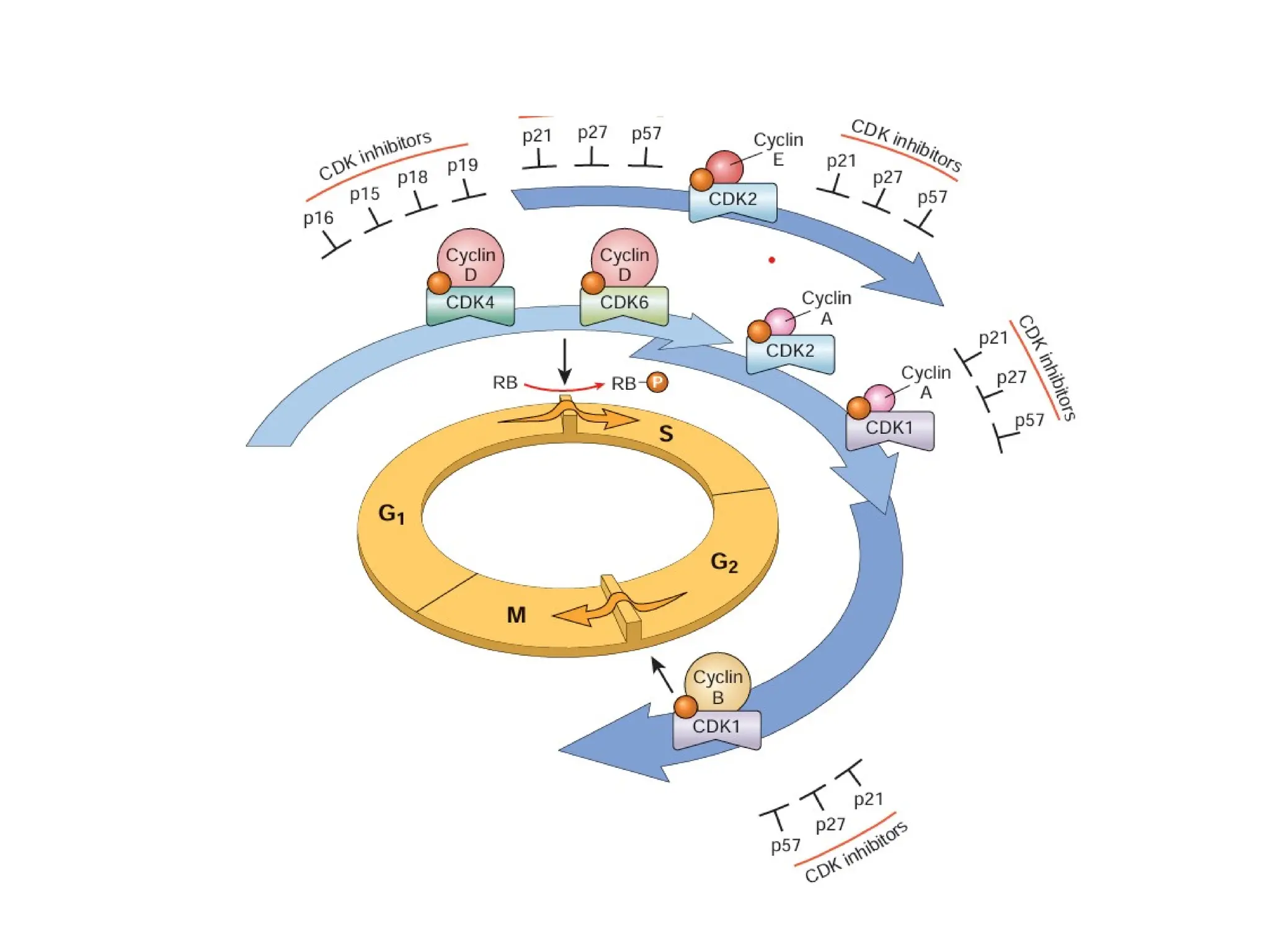
ROLE OF CYCLINS AND CDKs
• Two key classes of regulatory molecules, cyclins and cyclin-dependent
kinases (CDKs), determine a cell's progress through the cell cycle
• Cyclins form the regulatory subunits and CDKs the catalytic subunits
of an activated heterodimer; cyclins have no catalytic activity and
CDKs are inactive in the absence of a partner cyclin.
• When activated by a bound cyclin, CDKs perform a common
biochemical reaction called phosphorylation that activates or
inactivates target proteins to orchestrate coordinated entry into the
next phase of the cell cycle.
• CDKs are constitutively expressed in cells whereas cyclins are
synthesised at specific stages of the cell cycle, in response to various
molecular signals.
General mechanism for cyclin-CDK
interaction
• Upon receiving a pro-mitotic extracellular signal, G1 cyclin-CDK complexes become
active to prepare the cell for S phase, promoting the expression of transcription factors
that in turn promote the expression of S cyclins and of enzymes required for DNA
replication. The G1 cyclin-CDK complexes also promote the degradation of molecules
that function as S phase inhibitors by targeting them for ubiquitination. Once a protein
has been ubiquitinated, it is targeted for proteolytic degradation by the proteasome.
• Active S cyclin-CDK complexes phosphorylate proteins that make up the pre-replication
complexes assembled during G1 phase on DNA replication origins. The phosphorylation
serves two purposes: to activate each already-assembled pre-replication complex, and
to prevent new complexes from forming. This ensures that every portion of the cell's
genome will be replicated once and only once.
• Mitotic cyclin-CDK complexes, which are synthesized during S and G2 phases, promote
the initiation of mitosis by stimulating downstream proteins involved in chromosome
condensation and mitotic spindle assembly.
Cell Cycle Check points
• Cell cycle checkpoints are used by the cell to
monitor and regulate the progress of the cell cycle.
Checkpoints prevent cell cycle progression at
specific points, allowing verification of necessary
phase processes and repair of DNA damage. The cell
cannot proceed to the next phase until checkpoint
requirements have been met. Checkpoints typically
consist of a network of regulatory proteins that
monitor and dictate the progression of the cell
through the different stages of the cell cycle.
• There are several checkpoints to ensure that damaged or incomplete DNA is not passed on to
daughter cells. Three main checkpoints exist: the G1/S checkpoint, the G2/M checkpoint and
the metaphase (mitotic) checkpoint. Another checkpoint is the Go checkpoint, in which the
cells are checked for maturity. If the cells fail to pass this checkpoint by not being ready yet,
they will be discarded from dividing.
• G1/S transition is a rate-limiting step in the cell cycle and is also known as restriction
point.This is where the cell checks whether it has enough raw materials to fully replicate its
DNA (nucleotide bases, DNA synthase, chromatin, etc.). An unhealthy or malnourished cell
will get stuck at this checkpoint.
• The G2/M checkpoint is where the cell ensures that it has enough cytoplasm and
phospholipids for two daughter cells. But sometimes more importantly, it checks to see if it is
the right time to replicate. There are some situations where many cells need to all replicate
simultaneously (for example, a growing embryo should have a symmetric cell distribution
until it reaches the mid-blastula transition). This is done by controlling the G2/M checkpoint.
• The metaphase checkpoint is a fairly minor checkpoint, in that once a cell is in
metaphase, it has committed to undergoing mitosis. However that's not to say it
isn't important. In this checkpoint, the cell checks to ensure that the spindle has
formed and that all of the chromosomes are aligned at the spindle equator
before anaphase begins.
• While these are the three "main" checkpoints, not all cells have to pass through
each of these checkpoints in this order to replicate. Many types of cancer are
caused by mutations that allow the cells to speed through the various
checkpoints or even skip them altogether. Because these cells have lost their
checkpoints, any DNA mutations that may have occurred are disregarded and
passed on to the daughter cells.
• p53 plays an important role in triggering the control mechanisms at both G1/S
and G2/M checkpoints. In addition to p53, checkpoint regulators are being
heavily researched for their roles in cancer growth and proliferation.
THANK YOU

CELL CYCLE AND ITS ROLE IN REPAIrrR.pptx

  • 1.
    CELL CYCLE ANDITS ROLE IN REPAIR By Dr Gulshan Munir
  • 2.
    CELL CYCLE The cellcycle, or cell-division cycle, is the sequential series of events that take place in a cell that causes it to divide into two daughter cells. These events include the growth of the cell, duplication of its DNA (DNA replication) and some of its organelles, and subsequently the partitioning of its cytoplasm, chromosomes and other components into two daughter cells in a process called cell division.
  • 3.
    In eukaryotic cellsincluding animal, plant, fungal, and protist cells, the cell cycle is divided into two main stages: interphase, and the M phase that includes mitosis and cytokinesis. During interphase, the cell grows, accumulating nutrients needed for mitosis, and replicates its DNA and some of its organelles. During the M phase, the replicated chromosomes, organelles, and cytoplasm separate into two new daughter cells. To ensure the proper replication of cellular components and division, there are control mechanisms known as cell cycle checkpoints after each of the key steps of the cycle that determine if the cell can progress to the next phase.
  • 5.
    • In cellswithout nuclei the prokaryotes, bacteria and archaea, the cell cycle is divided into the B, C, and D periods. The B period extends from the end of cell division to the beginning of DNA replication. DNA replication occurs during the C period. The D period refers to the stage between the end of DNA replication and the splitting of the bacterial cell into two daughter cells.
  • 6.
  • 7.
    • The eukaryoticcell cycle consists of four distinct phases: G1 phase, S phase (synthesis), G2 phase (collectively known as interphase) and M phase (mitosis and cytokinesis). M phase is itself composed of two tightly coupled processes: mitosis, in which the cell's nucleus divides, and cytokinesis, in which the cell's cytoplasm and cell membrane divides forming two daughter cells. Activation of each phase is dependent on the proper progression and completion of the previous one. Cells that have temporarily or reversibly stopped dividing are said to have entered a state of quiescence known as G0 phase or resting phase.
  • 8.
    G0 Or Restingphase • G0 is a resting phase where the cell has left the cycle and has stopped dividing. The cell cycle starts with this phase. • Non-proliferative (non-dividing) cells in multicellular eukaryotes generally enter the quiescent G0 state and may remain quiescent for long periods of time, possibly indefinitely (as is often the case for neurons). This is very common for cells that are fully differentiated. • Some cells enter the G0 phase semi-permanently e.g., some liver, kidney, and stomach cells. • Many cells do not enter G0 and continue to divide throughout an organism's life, e.g., epithelial cells.
  • 9.
    INTERPHASE • Interphase representsthe phase between two successive M phases. Interphase is a series of changes that takes place in a newly formed cell and its nucleus before it becomes capable of division again. It is also called preparatory phase or intermitosis. Typically interphase lasts for at least 91% of the total time required for the cell cycle. • Interphase proceeds in three stages, G1, S, and G2, followed by the cycle of mitosis and cytokinesis. The cell's nuclear DNA contents are duplicated during S phase.
  • 10.
    G1 PHASE • Thefirst phase within interphase, from the end of the previous M phase until the beginning of DNA synthesis, is called G1 (G indicating gap). It is also called the growth phase. During this phase, the biosynthetic activities of the cell, which are considerably slowed down during M phase, resume at a high rate. The duration of G1 is highly variable, even among different cells of the same species. In this phase, the cell increases its supply of proteins, increases the number of organelles (such as mitochondria, ribosomes), and grows in size. In G1 phase, a cell has three options.  To continue cell cycle and enter S phase  Stop cell cycle and enter G0 phase for undergoing differentiation.  Become arrested in G1 phase hence it may enter G0 phase or re-enter cell cycle. • The deciding point is called check point (Restriction point). This check point is called the restriction point or START and is regulated by G1/S cyclins, which cause transition from G1 to S phase. Passage through the G1 check point commits the cell to division.
  • 11.
    S PHASE DNA replication •The ensuing S phase starts when DNA synthesis commences; when it is complete, all of the chromosomes have been replicated,Thus, during this phase, the amount of DNA in the cell has doubled, Rates of RNA transcription and protein synthesis are very low during this phase. An exception to this is histone production, most of which occurs during the S phase.
  • 12.
    G2 PHASE Growth Phase •G2 phase occurs after DNA replication and is a period of protein synthesis and rapid cell growth to prepare the cell for mitosis. During this phase microtubules begin to reorganize to form a spindle (preprophase). Before proceeding to mitotic phase, cells must be checked at the G2 checkpoint for any DNA damage within the chromosomes. • The G2 checkpoint is mainly regulated by the tumor protein p53. If the DNA is damaged, p53 will either repair the DNA or trigger the apoptosis of the cell. If p53 is dysfunctional or mutated, cells with damaged DNA may continue through the cell cycle, leading to the development of cancer.
  • 13.
    METAPHASE • The relativelybrief M phase consists of nuclear division (karyokinesis) and division of cytoplasm (cytokinesis). M phase is complex and highly regulated. The sequence of events is divided into phases, corresponding to the completion of one set of activities and the start of the next. These phases are sequentially known as:  Prophase  Prometaphase  Metaphase  Anaphase  Telophase • Mitosis is the process by which a eukaryotic cell separates the chromosomes in its cell nucleus into two identical sets in two nuclei. During the process of mitosis the pairs of chromosomes condense and attach to microtubules that pull the sister chromatids to opposite sides of the cell
  • 15.
    CYTOKINESIS • Mitosis isimmediately followed by cytokinesis, which divides the nuclei, cytoplasm, organelles and cell membrane into two cells containing roughly equal shares of these cellular components. Mitosis and cytokinesis together define the division of the parent cell into two daughter cells, genetically identical to each other and to their parent cell. This accounts for approximately 10% of the cell cycle. • Because cytokinesis usually occurs in conjunction with mitosis, "mitosis" is often used interchangeably with "M phase". However, there are many cells where mitosis and cytokinesis occur separately, forming single cells with multiple nuclei in a process called endoreplication. Errors in mitosis can result in cell death through apoptosis or cause mutations that may lead to cancer.
  • 16.
  • 17.
    • Two keyclasses of regulatory molecules, cyclins and cyclin-dependent kinases (CDKs), determine a cell's progress through the cell cycle • Cyclins form the regulatory subunits and CDKs the catalytic subunits of an activated heterodimer; cyclins have no catalytic activity and CDKs are inactive in the absence of a partner cyclin. • When activated by a bound cyclin, CDKs perform a common biochemical reaction called phosphorylation that activates or inactivates target proteins to orchestrate coordinated entry into the next phase of the cell cycle. • CDKs are constitutively expressed in cells whereas cyclins are synthesised at specific stages of the cell cycle, in response to various molecular signals.
  • 18.
    General mechanism forcyclin-CDK interaction • Upon receiving a pro-mitotic extracellular signal, G1 cyclin-CDK complexes become active to prepare the cell for S phase, promoting the expression of transcription factors that in turn promote the expression of S cyclins and of enzymes required for DNA replication. The G1 cyclin-CDK complexes also promote the degradation of molecules that function as S phase inhibitors by targeting them for ubiquitination. Once a protein has been ubiquitinated, it is targeted for proteolytic degradation by the proteasome. • Active S cyclin-CDK complexes phosphorylate proteins that make up the pre-replication complexes assembled during G1 phase on DNA replication origins. The phosphorylation serves two purposes: to activate each already-assembled pre-replication complex, and to prevent new complexes from forming. This ensures that every portion of the cell's genome will be replicated once and only once. • Mitotic cyclin-CDK complexes, which are synthesized during S and G2 phases, promote the initiation of mitosis by stimulating downstream proteins involved in chromosome condensation and mitotic spindle assembly.
  • 20.
  • 21.
    • Cell cyclecheckpoints are used by the cell to monitor and regulate the progress of the cell cycle. Checkpoints prevent cell cycle progression at specific points, allowing verification of necessary phase processes and repair of DNA damage. The cell cannot proceed to the next phase until checkpoint requirements have been met. Checkpoints typically consist of a network of regulatory proteins that monitor and dictate the progression of the cell through the different stages of the cell cycle.
  • 22.
    • There areseveral checkpoints to ensure that damaged or incomplete DNA is not passed on to daughter cells. Three main checkpoints exist: the G1/S checkpoint, the G2/M checkpoint and the metaphase (mitotic) checkpoint. Another checkpoint is the Go checkpoint, in which the cells are checked for maturity. If the cells fail to pass this checkpoint by not being ready yet, they will be discarded from dividing. • G1/S transition is a rate-limiting step in the cell cycle and is also known as restriction point.This is where the cell checks whether it has enough raw materials to fully replicate its DNA (nucleotide bases, DNA synthase, chromatin, etc.). An unhealthy or malnourished cell will get stuck at this checkpoint. • The G2/M checkpoint is where the cell ensures that it has enough cytoplasm and phospholipids for two daughter cells. But sometimes more importantly, it checks to see if it is the right time to replicate. There are some situations where many cells need to all replicate simultaneously (for example, a growing embryo should have a symmetric cell distribution until it reaches the mid-blastula transition). This is done by controlling the G2/M checkpoint.
  • 23.
    • The metaphasecheckpoint is a fairly minor checkpoint, in that once a cell is in metaphase, it has committed to undergoing mitosis. However that's not to say it isn't important. In this checkpoint, the cell checks to ensure that the spindle has formed and that all of the chromosomes are aligned at the spindle equator before anaphase begins. • While these are the three "main" checkpoints, not all cells have to pass through each of these checkpoints in this order to replicate. Many types of cancer are caused by mutations that allow the cells to speed through the various checkpoints or even skip them altogether. Because these cells have lost their checkpoints, any DNA mutations that may have occurred are disregarded and passed on to the daughter cells. • p53 plays an important role in triggering the control mechanisms at both G1/S and G2/M checkpoints. In addition to p53, checkpoint regulators are being heavily researched for their roles in cancer growth and proliferation.
  • 24.