Outline
 Introduction of the Spleen
 Anatomy
 Functions
 Ultrasonography of the Spleen
Procedure for splenic ultrasound
Sonographic appearance of the normal spleen
Pathologies of the Spleen
Splenic rupture
Splenic Hemangioma
References
Introduction
Anatomy
The spleen is a purplish, soft, vascular organ of the
lymphatic system.
The spleen varies amongst individual, but it’s commonly
oval/fist-shaped and is about 1 inch thick, 3 inches wide, 4-5
inches long, and weighs 7 ounces.
A layer of tissue entirely covers the spleen in a capsule-like
fashion.
Introduction
Situated in the left hypochondriac region of the abdominal body
cavity, between the stomach, and the
diaphragm.
The spleen is protected by the ribs
(9th-12th)
Anteriorly - the stomach, and tail
of pancreas.
Posteriorly - the left part of the
diaphragm, which separates it
from the lung and ribs.
Inferiorly - the left colic flexure.
Medially - the left kidney.
Introduction
Function
The spleen have multiple supportive roles in the body;
The spleen is the storage place for red blood cells.
Removes old and damaged red blood cells and recycle
minerals.
Produce lymphocytes that aid our body immune system.
Act as reservoir of blood in times of shock.
Facts…. not Fiction!!!
The spleen is the largest organ in the lymphatic system.
A person can survive well without their spleen.
The spleen is protected by the ribs... So you cannot feel it... if you
can.. you are probably sick... GET HELP!!.
No one likes a spleenful person!!
Spleen Ultrasonography
Some common indication for splenic ultrasound includes;
 Splenomegaly
 Blunt abdominal trauma
 Left abdominal mass
 Left upper abdominal pain
 Jaundice combined with anaemia
 Ascites or localized intra-abdominal fluid
 Suspected subphrenic abscess
 Suspected malignancy
 Liver disease
Spleen Ultrasonography
Procedure
a) Preparation
Patient should take nothing by mouth for 8 hours preceding the
examination.
If fluid is essential to prevent dehydration, only water should be
given.
Infants should be given nothing by mouth
for 3 hours preceding the examination
Spleen Ultrasonography
b) Position
The patient should be supine initially and later on the right side.
Apply coupling agent liberally over the left lower chest, the
upper abdomen and left flank
The patient should take a deep breath and hold it in when a
specific area is being scanned.
Spleen Ultrasonography
When the spleen is normal in size, it can be difficult to image
completely.
The splenic hilus is the reference point to ensure correct
identification of the spleen.
It is also important to identify the left diaphragm and the upper
edge of the spleen.
Spleen Ultrasonography
Sonographic appearance of a normal spleen
The spleen should show a uniform homogenous echo pattern. It is slightly
less echogenic than the liver.
Markedly hyperechoic compared to kidney tissue
Its outer convexity is smooth, whereas the inner margin may be indented or
nodulous
Spleen Pathology
Common pathologies of the spleen;
 Splenomegaly
Infection- multiple echogenic foci (granulomata).
 Hemangioma.
 Cysts.
 Lymphoma.
 Varices - portal hypertension.
 Haematomas-intraparenchymal,
 Abscess.
 Splenic infarction.
Spleen Pathology
Splenic Rupture
A ruptured spleen occurs when the capsule-like covering of the spleen
breaks open, pouring blood into your abdominal area.
The spleen most frequently rupture when the abdomen suffers a
severe direct blow or blunt trauma.
Motor vehicle accidents
Injury during contact sports
Bicycle accidents,
Domestic violence
Iatrogenesis 101..
Spleen Pathology
Symptoms of a Ruptured Spleen
Pain may be felt in these locations:
 Left side of the abdomen under the rib cage
 Left shoulder
Internal bleeding caused by the ruptured spleen can cause blood pressure to
drop. This can cause:
 Blurred vision
 Light-headedness
 Signs of shock
Spleen Pathology
Sonographic appearance of a rupture spleen
The primary goal is to detect the presence of blood in the left
hypochondria region.
Some signs of splenic rupture on an ultrasound image are as follows:
 Acute blood is hypoechoic and can be almost anechoic.
 Due to coagulation in the formation of a hemorrhage,
echogenicity increases as the thrombus condenses.
Spleen Pathology
Sonographic appearance continue…
Sonographic patterns included a heterogeneous appearance,
hyperechoic and hypoechoic perisplenic crescents,
hypoechoic or hyperechoic areas within the spleen.
Spleen Pathology
Splenic Hemangioma
A hemangioma is a slow-growing neoplasm consisting of an
overgrowth of new blood vessels.
The most common type of benign mass that might develop on the
spleen but it is a rare disorder.
The hemangioma looks like a solid cluster with open spaces located
within the mass.
The benign growth will have rounded and defined edges
Spleen Pathology
Symptom of Splenic Hemangioma;
The vast majority are asymptomatic and are accidentally discovered.
Occasionally they may be associated with;
 Splenomegaly,
 Abdominal pain,
 Dyspnea,
 Nausea.
Splenic rupture cause
by Hemangioma
Spleen Pathology
Sonographic appearance of splenic hemangiomas
Hemangiomas can have a variety of sonographic appearances
depending on their exact histological composition (i.e. hypo, iso or
hyper echoic).
The dominant pattern however is considered to be a homogeneous
echotexture that is predominantly hyperechoic and well-defined.
Rarely, contain cystic areas.
References
Willcox M T, Speer W R, Schlinkert T R, Sarg G M. Hemangioma of the Spleen:
Presentation, Diagnosis, and Management. Journal of Gastrointestinal Surgery,
2000 DEC;4(6):611–613.
https://www.livescience.com/44725-spleen.html
https://www.webmd.com/digestive-disorders/picture-of-the-spleen
Ultrasonography of splenic abnormalities - Ming-Jen Chen, Ming-Jer Huang, Wen-
Hsiung Chang, Tsang-En Wang, Horng-Yuan Wang, Cheng-Hsin Chu, Shee-Chan Lin,
and Shou-Chuan Shih
https://www.healthline.com/human-body-maps/spleen
http://www.organsofthebody.com/spleen/
Ros PR, Moser RP, Dachman AH et al. 1987 Haemangioma of the spleen:
radiologic–pathologic correlation in ten cases. American Journal of Roentgenology
162: 73–77.
http://www.sciencedirect.com/science/article/pii/S0020138300001479
http://www.kosmos-design.co.uk/efsumb-ecb/ecbse-ch08-spleen.pdf

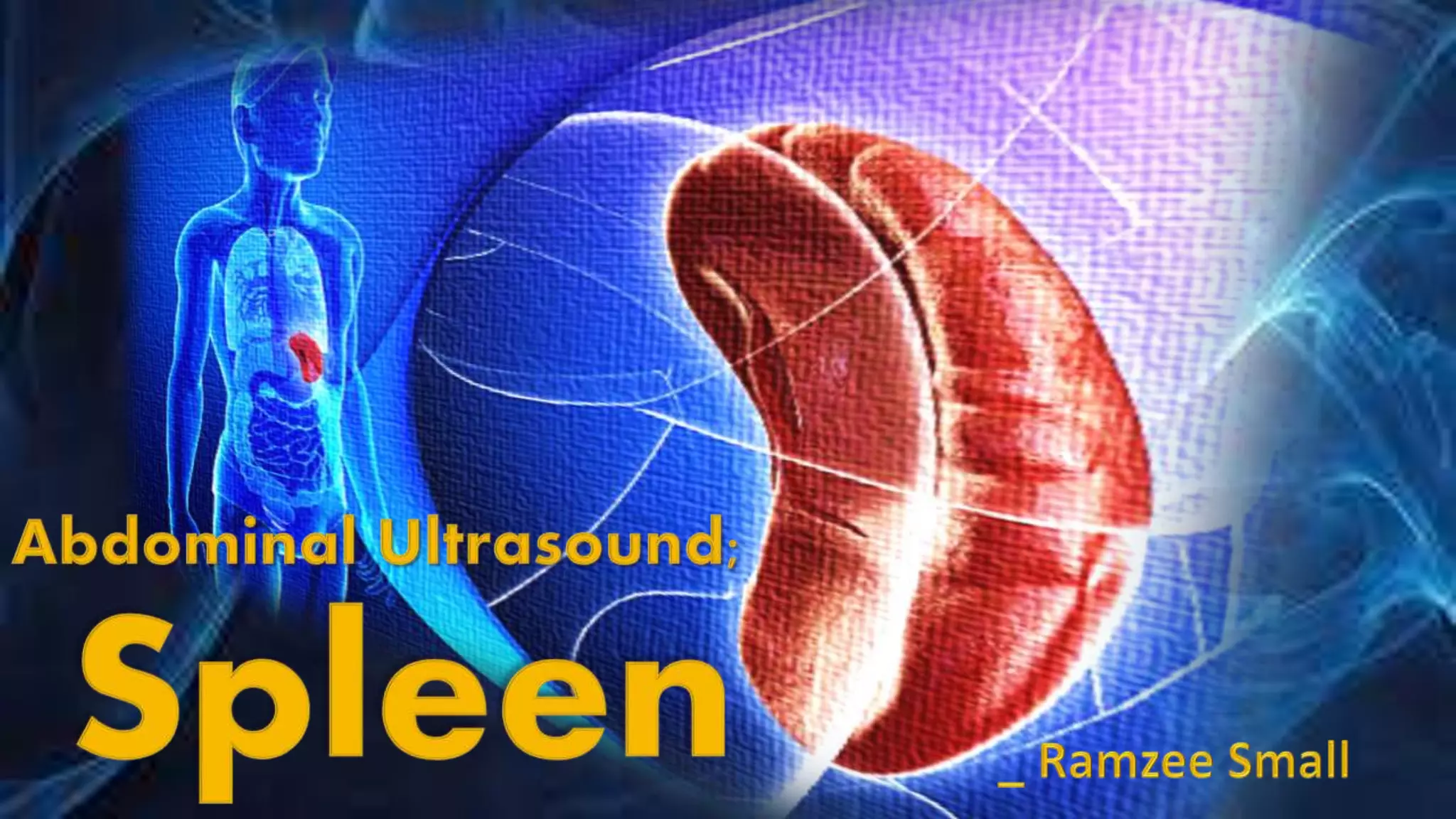
Spleen ultrasound

  • 2.
    Outline  Introduction ofthe Spleen  Anatomy  Functions  Ultrasonography of the Spleen Procedure for splenic ultrasound Sonographic appearance of the normal spleen Pathologies of the Spleen Splenic rupture Splenic Hemangioma References
  • 4.
    Introduction Anatomy The spleen isa purplish, soft, vascular organ of the lymphatic system. The spleen varies amongst individual, but it’s commonly oval/fist-shaped and is about 1 inch thick, 3 inches wide, 4-5 inches long, and weighs 7 ounces. A layer of tissue entirely covers the spleen in a capsule-like fashion.
  • 5.
    Introduction Situated in theleft hypochondriac region of the abdominal body cavity, between the stomach, and the diaphragm. The spleen is protected by the ribs (9th-12th)
  • 6.
    Anteriorly - thestomach, and tail of pancreas. Posteriorly - the left part of the diaphragm, which separates it from the lung and ribs. Inferiorly - the left colic flexure. Medially - the left kidney.
  • 7.
    Introduction Function The spleen havemultiple supportive roles in the body; The spleen is the storage place for red blood cells. Removes old and damaged red blood cells and recycle minerals. Produce lymphocytes that aid our body immune system. Act as reservoir of blood in times of shock.
  • 8.
    Facts…. not Fiction!!! Thespleen is the largest organ in the lymphatic system. A person can survive well without their spleen. The spleen is protected by the ribs... So you cannot feel it... if you can.. you are probably sick... GET HELP!!. No one likes a spleenful person!!
  • 10.
    Spleen Ultrasonography Some commonindication for splenic ultrasound includes;  Splenomegaly  Blunt abdominal trauma  Left abdominal mass  Left upper abdominal pain  Jaundice combined with anaemia  Ascites or localized intra-abdominal fluid  Suspected subphrenic abscess  Suspected malignancy  Liver disease
  • 11.
    Spleen Ultrasonography Procedure a) Preparation Patientshould take nothing by mouth for 8 hours preceding the examination. If fluid is essential to prevent dehydration, only water should be given. Infants should be given nothing by mouth for 3 hours preceding the examination
  • 12.
    Spleen Ultrasonography b) Position Thepatient should be supine initially and later on the right side. Apply coupling agent liberally over the left lower chest, the upper abdomen and left flank The patient should take a deep breath and hold it in when a specific area is being scanned.
  • 13.
    Spleen Ultrasonography When thespleen is normal in size, it can be difficult to image completely. The splenic hilus is the reference point to ensure correct identification of the spleen. It is also important to identify the left diaphragm and the upper edge of the spleen.
  • 14.
    Spleen Ultrasonography Sonographic appearanceof a normal spleen The spleen should show a uniform homogenous echo pattern. It is slightly less echogenic than the liver. Markedly hyperechoic compared to kidney tissue Its outer convexity is smooth, whereas the inner margin may be indented or nodulous
  • 18.
    Spleen Pathology Common pathologiesof the spleen;  Splenomegaly Infection- multiple echogenic foci (granulomata).  Hemangioma.  Cysts.  Lymphoma.  Varices - portal hypertension.  Haematomas-intraparenchymal,  Abscess.  Splenic infarction.
  • 20.
    Spleen Pathology Splenic Rupture Aruptured spleen occurs when the capsule-like covering of the spleen breaks open, pouring blood into your abdominal area. The spleen most frequently rupture when the abdomen suffers a severe direct blow or blunt trauma. Motor vehicle accidents Injury during contact sports Bicycle accidents, Domestic violence
  • 21.
  • 22.
    Spleen Pathology Symptoms ofa Ruptured Spleen Pain may be felt in these locations:  Left side of the abdomen under the rib cage  Left shoulder Internal bleeding caused by the ruptured spleen can cause blood pressure to drop. This can cause:  Blurred vision  Light-headedness  Signs of shock
  • 24.
    Spleen Pathology Sonographic appearanceof a rupture spleen The primary goal is to detect the presence of blood in the left hypochondria region. Some signs of splenic rupture on an ultrasound image are as follows:  Acute blood is hypoechoic and can be almost anechoic.  Due to coagulation in the formation of a hemorrhage, echogenicity increases as the thrombus condenses.
  • 25.
    Spleen Pathology Sonographic appearancecontinue… Sonographic patterns included a heterogeneous appearance, hyperechoic and hypoechoic perisplenic crescents, hypoechoic or hyperechoic areas within the spleen.
  • 27.
    Spleen Pathology Splenic Hemangioma Ahemangioma is a slow-growing neoplasm consisting of an overgrowth of new blood vessels. The most common type of benign mass that might develop on the spleen but it is a rare disorder. The hemangioma looks like a solid cluster with open spaces located within the mass. The benign growth will have rounded and defined edges
  • 28.
    Spleen Pathology Symptom ofSplenic Hemangioma; The vast majority are asymptomatic and are accidentally discovered. Occasionally they may be associated with;  Splenomegaly,  Abdominal pain,  Dyspnea,  Nausea. Splenic rupture cause by Hemangioma
  • 29.
    Spleen Pathology Sonographic appearanceof splenic hemangiomas Hemangiomas can have a variety of sonographic appearances depending on their exact histological composition (i.e. hypo, iso or hyper echoic). The dominant pattern however is considered to be a homogeneous echotexture that is predominantly hyperechoic and well-defined. Rarely, contain cystic areas.
  • 32.
    References Willcox M T,Speer W R, Schlinkert T R, Sarg G M. Hemangioma of the Spleen: Presentation, Diagnosis, and Management. Journal of Gastrointestinal Surgery, 2000 DEC;4(6):611–613. https://www.livescience.com/44725-spleen.html https://www.webmd.com/digestive-disorders/picture-of-the-spleen Ultrasonography of splenic abnormalities - Ming-Jen Chen, Ming-Jer Huang, Wen- Hsiung Chang, Tsang-En Wang, Horng-Yuan Wang, Cheng-Hsin Chu, Shee-Chan Lin, and Shou-Chuan Shih https://www.healthline.com/human-body-maps/spleen http://www.organsofthebody.com/spleen/ Ros PR, Moser RP, Dachman AH et al. 1987 Haemangioma of the spleen: radiologic–pathologic correlation in ten cases. American Journal of Roentgenology 162: 73–77. http://www.sciencedirect.com/science/article/pii/S0020138300001479 http://www.kosmos-design.co.uk/efsumb-ecb/ecbse-ch08-spleen.pdf