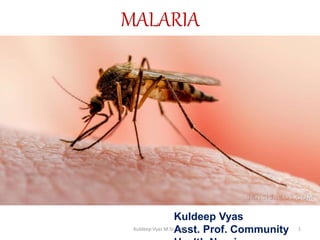
MALARIA
Kuldeep Vyas
Asst. Prof. Community 1Kuldeep Vyas M.Sc. CHN
2Kuldeep Vyas M.Sc. CHN
Malaria remains the
world's most devastating
human parasitic infection.
Malaria affects over 40%
of the world's population.
WHO, estimates that
there are 350 - 500
million cases of malaria
worldwide.In India 2
million cases and 1000
deaths annually
3Kuldeep Vyas M.Sc. CHN
The malaria life cycle is a complex system with both sexual and asexual aspects . cycle
of all species that infect humans is basically the same. There is an exogenous sexual
phase in the mosquito called sporogony during which the parasite multiplies.
There is also an endogenous asexual phase that takes place in the vertebrate or
human host that is called schizogeny
4Kuldeep Vyas M.Sc. CHN
A COMPLEX LIFECYCLE
5Kuldeep Vyas M.Sc. CHN
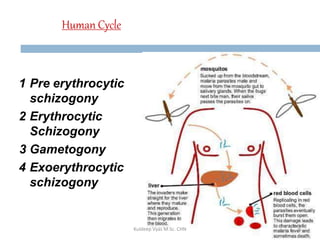
Human Cycle
1 Pre erythrocytic
schizogony
2 Erythrocytic
Schizogony
3 Gametogony
4 Exoerythrocytic
schizogony
6Kuldeep Vyas M.Sc. CHN
Events in Humans start with Bite of Mosquito
 Man – Intermediate
host.
 Mosquito – Definitive
host
– Sporozoites are
infective forms
 Present in the salivary
gland of female
anopheles mosquito
 After bite of infected
mosquito sporozoites are
introduced into blood
circulation.
7Kuldeep Vyas M.Sc. CHN
Pre erythrocyticcycle
 Sprozoites undergo
developmental phase in
the liver cell
 Multiple nuclear divisions
develop to Schozonts
 A Schizont contains
20,000 – 50,000
merozoites.
8Kuldeep Vyas M.Sc. CHN
Period of Pre erythrocytic cycle
 1 P.vivax 8 days
 2 P.falciparum – 6 days
 3 P.malariae - 13 – 16 days,
 4 P.ovale 9 days
On maturation Liver cells ruputure
Liberate Merozoites into blood stream
9Kuldeep Vyas M.Sc. CHN
Erythrocyte cycle
 Merozoites released invade red cells
 P.vivax infects young erythrocytes
 P.malariae Infects old erythrocytes
 P.falciparum infects RBC of all ages
 The Merozoites are pear shaped 1-5 microns
in length
 The receptors for Merozoites are on red cells
in the glycoprotein
10Kuldeep Vyas M.Sc. CHN
Erythrocytic Schizogony
 Liberated Merozoites
penetrate RBC
 Three stages occur
1 Trophozoites
2 Schizont
3 Merozoite
11Kuldeep Vyas M.Sc. CHN
Exo-erythrocytic (tissue) phase
 P. malariae or P. falciparum sporozoites
do not form hypnotizes, develop directly
into pre-erythrocytic schizonts in the liver
 Schizonts rupture, releasing merozoites
which invade red blood cells (RBC) in liver
12Kuldeep Vyas M.Sc. CHN
Gametogony
 Merozoites differentiate into Male and female
gametocytes
 They develop in the red cells
 Found in the peripheral blood smears
 Microgametocyte of all species are similar in
size
 Macro gametocytes are larger in size.
13Kuldeep Vyas M.Sc. CHN
Mosquitocycle Sexual cycle
 Sexual cycle will be initiated in the Humans by
the formation of Gametocytes
 Develop further in the female Anopheles
Mosquito
 Fertilization occurs when a Microgametocyte
penetrate into Macrogametocyte
 ZYGOTE is formed matures into OOKINETE
 OOKINETE to OOCYST
 OOCYST matures with large number of
Sporozoites ( A few hundred tothousands)
14Kuldeep Vyas M.Sc. CHN
Mosquito cycle
A definitive Host –Mosquito
15Kuldeep Vyas M.Sc. CHN
16Kuldeep Vyas M.Sc. CHN
Malaria thedisease
 9-14 day
incubation period
17Kuldeep Vyas M.Sc. CHN
Earlysymptoms
 The common first symptoms –
fever, headache, chills and
vomiting – usually appear 10 to 15
days after a person is infected. If
not treated promptly with effective
medicines, malaria can cause
severe illness and is often fatal.
18Kuldeep Vyas M.Sc. CHN
How Malaria present Clinically
 Stage 1(cold stage)
 Chills for 15 mt to 1 hour
 Caused due to rupture from the host red cells
escape into Blood
 Preset with nausea, vomitting,headache
 Stage 2(hotstage)
 Fever may reach upto 400c may last for
several hours starts invading newer red cells.
19Kuldeep Vyas M.Sc. CHN
ClinicalMalaria
 Stage 3(sweating stage)
Patent starts sweating, concludes the episode
Cycles are frequently Asynchronous
Paroxysms occur every 48 – 72 hours
In P.malariae pyrexia may last for 8 hours or
more and temperature my exceed 410c
20Kuldeep Vyas M.Sc. CHN
Malaria stages of the disease
21Kuldeep Vyas M.Sc. CHN
More commonly,the patient presents witha combination of the following
symptoms
 Fever
 Chills
 Sweats
 Headaches
 Nausea and vomiting
 Body aches
 General malaise.
22Kuldeep Vyas M.Sc. CHN
Periodicity can be clue in Diagnosis and species relation
 Malaria tertiana:
48h between fevers
(P. vivax and ovale)
 Malaria quartana:
72h between fevers
(P. malariae)
 Malaria tropica:
irregular high fever
(P. falciparum)
23Kuldeep Vyas M.Sc. CHN
SEVERE COMPLICATED MALARIA
Confusion, or drowsiness with extreme weakness (prostration).
In addition, the following may develop:
 Alteration in the level of consciousness (ranging from drowsiness to deep
coma)
 Cerebral malaria (unrousable coma not attributable to any other cause in a
patient with falciparum malaria)
 Respiratory distress (metabolic acidosis bicarb less than 15 meq/l)
 Multiple generalized convulsions (2 or more episodes within a 24 hour period)
 Shock (circulatory collapse, septicaemia)
 Pulmonary oedema
 Abnormal bleeding (Disseminated Intravascular coagulopathy)
 Jaundice
 Haemoglobinuria (black water fever)
 Acute renal failure - presenting as oliguria or anuria
 Severe anaemia (Haemoglobin < 5g/dl or Haematocrit < 15%)
 High fever
 Hypoglycaemia (blood glucose level < 2.2.mmol/l)
defined as the detection of P.falciparum in the peripheralblood
24Kuldeep Vyas M.Sc. CHN
Malaria the disease
25Kuldeep Vyas M.Sc. CHN
Why Falciparum Infectionsare Dangerous
 Can produce fatal complications,
1.Cerebral malaria
2.Malarial hyperpyrexia
3.Gastrointestinal disorders.
4.Algid malaria(SHOCK)
5 Black water fever can lead to death
26Kuldeep Vyas M.Sc. CHN
Pernicious Malaria
 Is a life threatening complication in acute
falciparum malaria
 It is due to heavy parasitization
 Manifest with
1Cerebral malaria – it presents with
hyperpyrexia, coma and paralysis. Brain is
congested
2Algid malaria – presents with clammy skin
leading to peripheral circulatory failure.
27Kuldeep Vyas M.Sc. CHN
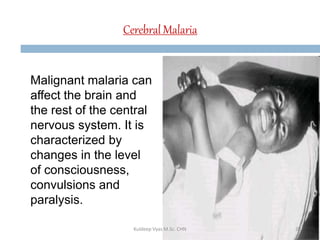
Cerebral Malaria
Malignant malaria can
affect the brain and
the rest of the central
nervous system. It is
characterized by
changes in the level
of consciousness,
convulsions and
paralysis.
28Kuldeep Vyas M.Sc. CHN
Cerebral Malaria
 Present with
Hyperpyrexia
 Can lead to Coma
 Paralysis and other
complications.
 Brain appears
congested
29Kuldeep Vyas M.Sc. CHN
Pathogenesis of Cerebral malaria
 High cytokine levels could be toxic on their own
 High levels of cytokine also enhance the second process
thought to be responsible for cerebral malaria: sequestration
of infected RBCs
30Kuldeep Vyas M.Sc. CHN
Sequestration & cytoadherence
 Rosetting (adhesion of
infected RBCs to other
RBCs) and clumping
(adhesion between
infected cells) was first
observed in in vitro culture
31Kuldeep Vyas M.Sc. CHN
Black WaterFever
 In malignant malaria a large
number of the red blood
corpuscles are destroyed.
Haemoglobin from the blood
corpuscles is excreted in the
urine, which therefore is dark
and almost the colour of cola
32Kuldeep Vyas M.Sc. CHN
How long Malaria infection can lost in Man
 Without treatment P.falciparum will terminate in
less than 1 year.
 But in P.vivax and P.ovale persist as
hypnozoites after the parasites have disppeared
from blood.
 Can prodce periodic relapses upto 5 years
 In P.malariae may last for 40 years
( Called as recrudescence X relapse )
Parasites survive in erythrocytes Liver ?
33Kuldeep Vyas M.Sc. CHN
LABORATORY DIAGNOSIS
OF
MALARIA
34Kuldeep Vyas M.Sc. CHN
DiagnosticTools
for Human Infections with Malaria
 Blood film examination(Microscopy)
 QBC system
 Rapid Diagnostic Tests" (RDTs)
 PCR
35Kuldeep Vyas M.Sc. CHN
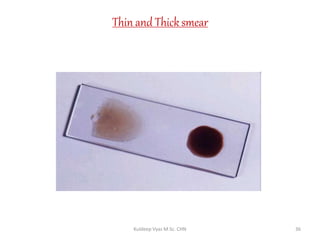
Thin and Thick smear
36Kuldeep Vyas M.Sc. CHN
Microscopy
 Malaria parasites can be identified by
examining under the microscope a drop of the
patient's blood, spread out as a "blood smear"
on a microscope slide. Prior to examination, the
specimen is stained (most often with the
Giemsa stain) to give to the parasites a
distinctive appearance. This technique remains
the gold standard for laboratory confirmation
of malaria.
37Kuldeep Vyas M.Sc. CHN
38Kuldeep Vyas M.Sc. CHN
QBC system has evolved as rapid and precise method in Diagnosis
 The QBC Malaria method is the simplest and
most sensitive method for diagnosing the
following diseases.
 Malaria
 Babesiosis
 Trypanosomiasis (Chagas disease, Sleeping
Sickness)
 Filariasis (Elephantiasis, Loa-Loa)
 Relapsing Fever (Borreliosis)
39Kuldeep Vyas M.Sc. CHN
Appearance of Malarial parasite in QBC system
40Kuldeep Vyas M.Sc. CHN
Antigen Detection Methods are Rapid and Precise
Antigen Detection
 Various test kits are available to detect antigens
derived from malaria parasites and provide results in
2-15 minutes. These "Rapid Diagnostic Tests"
(RDTs). Rapid diagnostic tests (RDTs) are
immunochromatographic tests based on detection of
specific parasite antigens. Tests which detect
histidine-rich protein 2 (HRP2) are specific for
P.falciparum while those that detect parasite
lactate dehydrogenase (pLDH)-OptiMAL
 or aldolase have the ability to differentiate between
P.falciparum and non-P.falciparum malaria
41Kuldeep Vyas M.Sc. CHN
Newer Diagnostic methods
Molecular Diagnosis
 Parasite nucleic acids are detected using
polymerase chain reaction (PCR). This technique
is more accurate than microscopy. However, it is
expensive, and requires a specialized laboratory
(even though technical advances will likely result in
field-operated PCR machines).
42Kuldeep Vyas M.Sc. CHN
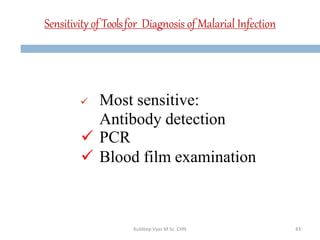
Sensitivity of Toolsfor Diagnosis of Malarial Infection
 Most sensitive:
Antibody detection
 PCR
 Blood film examination
43Kuldeep Vyas M.Sc. CHN
Malaria Relapses
 In P.vivax and P.ovale infections, patients
having recovered from the first episode of illness
may suffer several additional attacks
("relapses") after months or even years without
symptoms. Relapses occur because P.vivax
and P.ovale have dormant liver stage parasites
("hypnozoites") that may reactivate.
44Kuldeep Vyas M.Sc. CHN
45Kuldeep Vyas M.Sc. CHN
46Kuldeep Vyas M.Sc. CHN
47Kuldeep Vyas M.Sc. CHN
48Kuldeep Vyas M.Sc. CHN
49Kuldeep Vyas M.Sc. CHN
50Kuldeep Vyas M.Sc. CHN
Class
Definition
Examples
Class Definition Examples Class Definition Examples
Blood
schizonticidal
drugs
Act on (erythrocytic) stage of
the parasite thereby
terminating clinical illness
Quinine, artemisinins,
amodiaquine, chloroquine,
lumefantrine, tetracyclinea ,
atovaquone, sulphadoxine,
clindamycina , proguanila
Tissue
schizonticidal
drugs
Act on primary tissue forms of
plasmodia which initiate the
erythrocytic stage. They block
further
development of the
infection
Primaquine, pyrimethamine,
proguanil, tetracycline
Gametocytocid
al drugs
Destroy sexual forms of the
parasite thereby preventing
transmission of infection to
mosquitoes
Primaquine, artemisinins,
quinineb
THE PHARMACOLOGY OFANTIMALARIALS
a Slow acting, cannot be used alone to avert clinical symptoms
b Weakly gametocytocidal 51Kuldeep Vyas M.Sc. CHN
THE PHARMACOLOGY OF ANTIMALARIALS(cont.)
Class Definition
Examples
Class Definition
Examples
Class Definition
Examples
Hypnozoitocidal
drugs
These act on persistent
liver stages of P.ovale
and P.vivax which cause
recurrent illness
Primaquine,
tafenoquine
Sporozontocidal
drugs
These act by affecting
further development of
gametocytes into
oocytes
within the mosquito thus
abating transmission
Primaquine, proguanil,
chlorguanil
52Kuldeep Vyas M.Sc. CHN
53Kuldeep Vyas M.Sc. CHN
54Kuldeep Vyas M.Sc. CHN
1. Treatment of severe falciparum malaria
Preferred regime Alternative regime
IV Artesunate (60mg): 2.4mg/kg on
admission, followed by 2.4mg/kg at 12h &
24h, then once daily for 7 days.
Once the patient can tolerate oral therapy,
treatment should be switched to a complete
dosage of Riamet (artemether/lumefantrine)
for 3 day.
IV Quinine loading 7mg salt /kg over 1hr
followed by infusion quinine 10mg salt/kg over
4 hrs, then 10mg salt/kg Q8H or IV Quinine
20mg/kg over 4 hrs, then 10mg/kg Q8H.
Plus
Adult & child >8yrs old: Doxycycline
(3.5mg/kg once daily)
or
Pregnant women & child < 8yrs old:
Clindamycin (10mg/kg twice daily). Both drug
can be given for 7 days.
Reconstitute with 5% Sodium Bicarbonate &
shake 2-3min until clear solution obtained.
Then add 5ml of D5% or 0.9%NaCl to create
total volume of 6ml.
Slow IV injection with rate of 3-4ml/min or
IM injection to the anterior thigh.
The solution should be prepared freshly for
each administration & should not be stored.
Dilute injection quinine in 250ml od D5%
and infused over 4hrs.
Infusion rate should not exceed 5 mg salt/kg
per hour.
55Kuldeep Vyas M.Sc. CHN
2. Treatment of uncomplicated p.falciparum
Preferred regime Alternative regime
Artemether plus lumefantrine(Riamet)
(1 tab: 20mg artemether/120mg lumefantrine)
Quinine sulphate (300mg/tab)
Weight
Group
Day 1 Day 2 Day3 Day 1-7: Quinine 10mg salt/kg PO
Q8H
Plus
*Doxycycline (3.5mg/kg once a
day)
OR
*Clindamycin (10mg/kg twice a
day)
*Any of these combinations should
be given for 7 days.
Doxycycline: Children>8yr
Clindamycin: Children<8yr
5-14kg 1 tab stat
then 8hr
later
1 tab
Q12H
1 tab
Q12H
15-24kg 2 tab stat
then 8hr
later
2 tab
Q12H
2 tab
Q12H
25-34kg 3 tab stat
then 8hr
later
3 tab
Q12H
3 tab
Q12H
>34kg 4 tab stat
then 8hr
later
4 tab
Q12H
4 tab
Q12H
Take immediately after a meal or drink
containing at least 1.2g fat to enhance
56Kuldeep Vyas M.Sc. CHN
Dosage and administration Plasmodium falciparum for young infant
Age Group
Weight
group
Artesunate or *Quinine
0 - 4
months
<5 kg
** IM first dose
Artesunate 1.2
mg/kg or IM
Arthemeter 1.6
mg/kg)
***Oral
Artesunate
2mg/kg/day
day 2 to day 7
Oral
Quinine 10
mg/kgTDS
for 4 days
then 15-20
mg/kg TDS
for 4 days
Source: Malaria in Children, Department of tropical Pediatrics, Faculty of Tropical Medicine,
Mahidol University.
** Preferably Artesunate/Artemether IM on day 1 if available
*** When Artesunate/Artemether IM is unavailable, give oral Artesunate from day 1 to day 7
* Treat the young infant with Quinine when oral Artesunate is not available
Children under 5 kg or below 4 months should not be given Riamet
instead treat with the following regimen (see table).
57Kuldeep Vyas M.Sc. CHN
3. Treatment of malaria caused by p.knowlesi & mixed infection (p. falciparum + p. vivax)
Treat as p. falciparum
58Kuldeep Vyas M.Sc. CHN
4. Treatment of of malaria caused by p.vivax, p. ovale or p.
malariae.
CHLOROQUINE
(150 mg base/tab) 25 mg
base/kg divided over 3 days
PRIMAQUINE
(7.5 mg base/tab)
Day 1 Day 2 Day 3 Start concurrently with
CHLOROQUINE 0.5 mg base/kg Q24H
for 2 weeks
Take with food
Check G6PD status before start
primaquine
In mild-to-moderate G6PD deficiency,
primaquine 0.75 mg base/kg body weight
given once a week for 8 weeks.
In severe G6PD deficiency, primaquine
iscontraindicated and should not be
used.
10mg
base/kg
stat,
then
5mg
base/kg
5mg
base/kg
Q24H
5mg
base/kg
Q24H
1 tab of chloroquine phosphate 250mg equivalent to 150mg base. Calculation of
dose for chloroquine is based on BASE, not SALT form. 1 tab of primaquine
phosphate contains 7.5mg base. 59Kuldeep Vyas M.Sc. CHN
Treatment in specific population & situations
Specific
populations
Preferred regime Alternative regime
Pregnancy Quinine plus clindamycin to be given for
7 day
Artesunate plus Clindamycin
for 7 days is indicated if first
line treatment fails
Lactating
women
Should receive standard antimalarial treatment (including ACTs) except for
dapsone, primaquine and tetracyclines, which should be withheld during
lactation
Hepatic
impairment
Chloroquine: 30-50% is modified by liver, appropriate dosage adjustment
is needed, monitor closely.
Quinine : Mild to moderate hepatic impairment-no dosage adjustment,
monitor closely.
Artemisinins : No dosage adjustment
Renal
Impairment
Chloroquine : ClCr<10ml/min-50% of normal dose.
Hemodialysis, peritoneal dialysis: 50% of normal dose.
Continuous Renal Replacement Therapy(CRRT) :100% of normal dose.
Quinine : .ClCr 10-50ml/min : Administer Q8-12H, CLCr<10ml/min :
administer Q24H,Severe chronic renal failure not on dialysis : initial dose:
600mg followed by 300mg Q12H, Hemo- or peritoneal dialysis: administer
Q24H ,Continuous arteriovenous or hemodialysis: Administer Q8-12H.
Artemisinin : no dosage adjustment.
60Kuldeep Vyas M.Sc. CHN
Treatment of complications of malaria
 Severe & complicated falciparum or
knowlesi malaria is a medical emergency
that requires intervention and intensive care
as rapidly as possible.
 Fluid, electolyte glucose & acid-base balance
must be monitored.Intake & output should be
carefully recorded.
61Kuldeep Vyas M.Sc. CHN
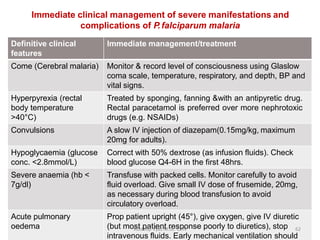
Immediate clinical management of severe manifestations and
complications of P.falciparum malaria
Definitive clinical
features
Immediate management/treatment
Come (Cerebral malaria) Monitor & record level of consciousness using Glaslow
coma scale, temperature, respiratory, and depth, BP and
vital signs.
Hyperpyrexia (rectal
body temperature
>40°C)
Treated by sponging, fanning &with an antipyretic drug.
Rectal paracetamol is preferred over more nephrotoxic
drugs (e.g. NSAIDs)
Convulsions A slow IV injection of diazepam(0.15mg/kg, maximum
20mg for adults).
Hypoglycaemia (glucose
conc. <2.8mmol/L)
Correct with 50% dextrose (as infusion fluids). Check
blood glucose Q4-6H in the first 48hrs.
Severe anaemia (hb <
7g/dl)
Transfuse with packed cells. Monitor carefully to avoid
fluid overload. Give small IV dose of frusemide, 20mg,
as necessary during blood transfusion to avoid
circulatory overload.
Acute pulmonary
oedema
Prop patient upright (45°), give oxygen, give IV diuretic
(but most patient response poorly to diuretics), stop
intravenous fluids. Early mechanical ventilation should
62Kuldeep Vyas M.Sc. CHN
Immediate clinical management of severe manifestations and
complications of P.falciparum malaria (cont.)
Definitive clinical
features
Immediate management/treatment
Acute renal failure (urine
output <400ml in 24hrs
in adults or 0.5ml/kg/hr,
failing to improve after
rehydration & a serum
creatinine of
>265μmol/L)
Exclude pre-renal causes by assessing hydration status.
Rule out urinary tract obstruction by abdominal
examination or ultrasound.
Give intravenous normal saline
If in established renal failure add haemofiltration or
haemodialysis, or if unavailable, peritoneal dialysis.
Disseminated
intravascular
Coagulopathy (DIVC)
Transfuse with packed cell, clotting factors or platelet.
Usual regime: Cryoprecipitate 10units,platelets 4-8units,
fresh frozen plasma(10-15ml/kg).
For prolonged PT, give vitamin K, 10mg by slow IV
injection.
metabolic acidosis Infuse sodium bicarbonate 8.4% 1mg/kg over 30min
and repeat if needed.
if severe, add haemodialysis.
Shock (hypotension with
systolic blood pressure
Suspect septicaemia, take blood for cultures; give
parenteral broad-spectrum antimicrobials, correct
63Kuldeep Vyas M.Sc. CHN
Monitoring & follow-up
 Blood smear should be repeated daily
(twice daily in severe infection). Within 48-
72 hr after start of treatment, patients
usually become afebrile and improve
clinically except in complicated cases.
 All patients should be investigated with
repeated blood film of malarial parasite
one month upon recovery of malarial
infection, to ensure no recrudescence.
64Kuldeep Vyas M.Sc. CHN
Prevention
Avoid mosquito bites:
Wearing long sleeves,
trousers.
Insecticide Treated Bednets
Repellent creams or sprays.
65Kuldeep Vyas M.Sc. CHN
66Kuldeep Vyas M.Sc. CHN

Malaria

  • 1.
    MALARIA Kuldeep Vyas Asst. Prof.Community 1Kuldeep Vyas M.Sc. CHN
  • 2.
  • 3.
    Malaria remains the world'smost devastating human parasitic infection. Malaria affects over 40% of the world's population. WHO, estimates that there are 350 - 500 million cases of malaria worldwide.In India 2 million cases and 1000 deaths annually 3Kuldeep Vyas M.Sc. CHN
  • 4.
    The malaria lifecycle is a complex system with both sexual and asexual aspects . cycle of all species that infect humans is basically the same. There is an exogenous sexual phase in the mosquito called sporogony during which the parasite multiplies. There is also an endogenous asexual phase that takes place in the vertebrate or human host that is called schizogeny 4Kuldeep Vyas M.Sc. CHN
  • 5.
  • 6.
    Human Cycle 1 Preerythrocytic schizogony 2 Erythrocytic Schizogony 3 Gametogony 4 Exoerythrocytic schizogony 6Kuldeep Vyas M.Sc. CHN
  • 7.
    Events in Humansstart with Bite of Mosquito  Man – Intermediate host.  Mosquito – Definitive host – Sporozoites are infective forms  Present in the salivary gland of female anopheles mosquito  After bite of infected mosquito sporozoites are introduced into blood circulation. 7Kuldeep Vyas M.Sc. CHN
  • 8.
    Pre erythrocyticcycle  Sprozoitesundergo developmental phase in the liver cell  Multiple nuclear divisions develop to Schozonts  A Schizont contains 20,000 – 50,000 merozoites. 8Kuldeep Vyas M.Sc. CHN
  • 9.
    Period of Preerythrocytic cycle  1 P.vivax 8 days  2 P.falciparum – 6 days  3 P.malariae - 13 – 16 days,  4 P.ovale 9 days On maturation Liver cells ruputure Liberate Merozoites into blood stream 9Kuldeep Vyas M.Sc. CHN
  • 10.
    Erythrocyte cycle  Merozoitesreleased invade red cells  P.vivax infects young erythrocytes  P.malariae Infects old erythrocytes  P.falciparum infects RBC of all ages  The Merozoites are pear shaped 1-5 microns in length  The receptors for Merozoites are on red cells in the glycoprotein 10Kuldeep Vyas M.Sc. CHN
  • 11.
    Erythrocytic Schizogony  LiberatedMerozoites penetrate RBC  Three stages occur 1 Trophozoites 2 Schizont 3 Merozoite 11Kuldeep Vyas M.Sc. CHN
  • 12.
    Exo-erythrocytic (tissue) phase P. malariae or P. falciparum sporozoites do not form hypnotizes, develop directly into pre-erythrocytic schizonts in the liver  Schizonts rupture, releasing merozoites which invade red blood cells (RBC) in liver 12Kuldeep Vyas M.Sc. CHN
  • 13.
    Gametogony  Merozoites differentiateinto Male and female gametocytes  They develop in the red cells  Found in the peripheral blood smears  Microgametocyte of all species are similar in size  Macro gametocytes are larger in size. 13Kuldeep Vyas M.Sc. CHN
  • 14.
    Mosquitocycle Sexual cycle Sexual cycle will be initiated in the Humans by the formation of Gametocytes  Develop further in the female Anopheles Mosquito  Fertilization occurs when a Microgametocyte penetrate into Macrogametocyte  ZYGOTE is formed matures into OOKINETE  OOKINETE to OOCYST  OOCYST matures with large number of Sporozoites ( A few hundred tothousands) 14Kuldeep Vyas M.Sc. CHN
  • 15.
    Mosquito cycle A definitiveHost –Mosquito 15Kuldeep Vyas M.Sc. CHN
  • 16.
  • 17.
    Malaria thedisease  9-14day incubation period 17Kuldeep Vyas M.Sc. CHN
  • 18.
    Earlysymptoms  The commonfirst symptoms – fever, headache, chills and vomiting – usually appear 10 to 15 days after a person is infected. If not treated promptly with effective medicines, malaria can cause severe illness and is often fatal. 18Kuldeep Vyas M.Sc. CHN
  • 19.
    How Malaria presentClinically  Stage 1(cold stage)  Chills for 15 mt to 1 hour  Caused due to rupture from the host red cells escape into Blood  Preset with nausea, vomitting,headache  Stage 2(hotstage)  Fever may reach upto 400c may last for several hours starts invading newer red cells. 19Kuldeep Vyas M.Sc. CHN
  • 20.
    ClinicalMalaria  Stage 3(sweatingstage) Patent starts sweating, concludes the episode Cycles are frequently Asynchronous Paroxysms occur every 48 – 72 hours In P.malariae pyrexia may last for 8 hours or more and temperature my exceed 410c 20Kuldeep Vyas M.Sc. CHN
  • 21.
    Malaria stages ofthe disease 21Kuldeep Vyas M.Sc. CHN
  • 22.
    More commonly,the patientpresents witha combination of the following symptoms  Fever  Chills  Sweats  Headaches  Nausea and vomiting  Body aches  General malaise. 22Kuldeep Vyas M.Sc. CHN
  • 23.
    Periodicity can beclue in Diagnosis and species relation  Malaria tertiana: 48h between fevers (P. vivax and ovale)  Malaria quartana: 72h between fevers (P. malariae)  Malaria tropica: irregular high fever (P. falciparum) 23Kuldeep Vyas M.Sc. CHN
  • 24.
    SEVERE COMPLICATED MALARIA Confusion,or drowsiness with extreme weakness (prostration). In addition, the following may develop:  Alteration in the level of consciousness (ranging from drowsiness to deep coma)  Cerebral malaria (unrousable coma not attributable to any other cause in a patient with falciparum malaria)  Respiratory distress (metabolic acidosis bicarb less than 15 meq/l)  Multiple generalized convulsions (2 or more episodes within a 24 hour period)  Shock (circulatory collapse, septicaemia)  Pulmonary oedema  Abnormal bleeding (Disseminated Intravascular coagulopathy)  Jaundice  Haemoglobinuria (black water fever)  Acute renal failure - presenting as oliguria or anuria  Severe anaemia (Haemoglobin < 5g/dl or Haematocrit < 15%)  High fever  Hypoglycaemia (blood glucose level < 2.2.mmol/l) defined as the detection of P.falciparum in the peripheralblood 24Kuldeep Vyas M.Sc. CHN
  • 25.
  • 26.
    Why Falciparum InfectionsareDangerous  Can produce fatal complications, 1.Cerebral malaria 2.Malarial hyperpyrexia 3.Gastrointestinal disorders. 4.Algid malaria(SHOCK) 5 Black water fever can lead to death 26Kuldeep Vyas M.Sc. CHN
  • 27.
    Pernicious Malaria  Isa life threatening complication in acute falciparum malaria  It is due to heavy parasitization  Manifest with 1Cerebral malaria – it presents with hyperpyrexia, coma and paralysis. Brain is congested 2Algid malaria – presents with clammy skin leading to peripheral circulatory failure. 27Kuldeep Vyas M.Sc. CHN
  • 28.
    Cerebral Malaria Malignant malariacan affect the brain and the rest of the central nervous system. It is characterized by changes in the level of consciousness, convulsions and paralysis. 28Kuldeep Vyas M.Sc. CHN
  • 29.
    Cerebral Malaria  Presentwith Hyperpyrexia  Can lead to Coma  Paralysis and other complications.  Brain appears congested 29Kuldeep Vyas M.Sc. CHN
  • 30.
    Pathogenesis of Cerebralmalaria  High cytokine levels could be toxic on their own  High levels of cytokine also enhance the second process thought to be responsible for cerebral malaria: sequestration of infected RBCs 30Kuldeep Vyas M.Sc. CHN
  • 31.
    Sequestration & cytoadherence Rosetting (adhesion of infected RBCs to other RBCs) and clumping (adhesion between infected cells) was first observed in in vitro culture 31Kuldeep Vyas M.Sc. CHN
  • 32.
    Black WaterFever  Inmalignant malaria a large number of the red blood corpuscles are destroyed. Haemoglobin from the blood corpuscles is excreted in the urine, which therefore is dark and almost the colour of cola 32Kuldeep Vyas M.Sc. CHN
  • 33.
    How long Malariainfection can lost in Man  Without treatment P.falciparum will terminate in less than 1 year.  But in P.vivax and P.ovale persist as hypnozoites after the parasites have disppeared from blood.  Can prodce periodic relapses upto 5 years  In P.malariae may last for 40 years ( Called as recrudescence X relapse ) Parasites survive in erythrocytes Liver ? 33Kuldeep Vyas M.Sc. CHN
  • 34.
  • 35.
    DiagnosticTools for Human Infectionswith Malaria  Blood film examination(Microscopy)  QBC system  Rapid Diagnostic Tests" (RDTs)  PCR 35Kuldeep Vyas M.Sc. CHN
  • 36.
    Thin and Thicksmear 36Kuldeep Vyas M.Sc. CHN
  • 37.
    Microscopy  Malaria parasitescan be identified by examining under the microscope a drop of the patient's blood, spread out as a "blood smear" on a microscope slide. Prior to examination, the specimen is stained (most often with the Giemsa stain) to give to the parasites a distinctive appearance. This technique remains the gold standard for laboratory confirmation of malaria. 37Kuldeep Vyas M.Sc. CHN
  • 38.
  • 39.
    QBC system hasevolved as rapid and precise method in Diagnosis  The QBC Malaria method is the simplest and most sensitive method for diagnosing the following diseases.  Malaria  Babesiosis  Trypanosomiasis (Chagas disease, Sleeping Sickness)  Filariasis (Elephantiasis, Loa-Loa)  Relapsing Fever (Borreliosis) 39Kuldeep Vyas M.Sc. CHN
  • 40.
    Appearance of Malarialparasite in QBC system 40Kuldeep Vyas M.Sc. CHN
  • 41.
    Antigen Detection Methodsare Rapid and Precise Antigen Detection  Various test kits are available to detect antigens derived from malaria parasites and provide results in 2-15 minutes. These "Rapid Diagnostic Tests" (RDTs). Rapid diagnostic tests (RDTs) are immunochromatographic tests based on detection of specific parasite antigens. Tests which detect histidine-rich protein 2 (HRP2) are specific for P.falciparum while those that detect parasite lactate dehydrogenase (pLDH)-OptiMAL  or aldolase have the ability to differentiate between P.falciparum and non-P.falciparum malaria 41Kuldeep Vyas M.Sc. CHN
  • 42.
    Newer Diagnostic methods MolecularDiagnosis  Parasite nucleic acids are detected using polymerase chain reaction (PCR). This technique is more accurate than microscopy. However, it is expensive, and requires a specialized laboratory (even though technical advances will likely result in field-operated PCR machines). 42Kuldeep Vyas M.Sc. CHN
  • 43.
    Sensitivity of ToolsforDiagnosis of Malarial Infection  Most sensitive: Antibody detection  PCR  Blood film examination 43Kuldeep Vyas M.Sc. CHN
  • 44.
    Malaria Relapses  InP.vivax and P.ovale infections, patients having recovered from the first episode of illness may suffer several additional attacks ("relapses") after months or even years without symptoms. Relapses occur because P.vivax and P.ovale have dormant liver stage parasites ("hypnozoites") that may reactivate. 44Kuldeep Vyas M.Sc. CHN
  • 45.
  • 46.
  • 47.
  • 48.
  • 49.
  • 50.
  • 51.
    Class Definition Examples Class Definition ExamplesClass Definition Examples Blood schizonticidal drugs Act on (erythrocytic) stage of the parasite thereby terminating clinical illness Quinine, artemisinins, amodiaquine, chloroquine, lumefantrine, tetracyclinea , atovaquone, sulphadoxine, clindamycina , proguanila Tissue schizonticidal drugs Act on primary tissue forms of plasmodia which initiate the erythrocytic stage. They block further development of the infection Primaquine, pyrimethamine, proguanil, tetracycline Gametocytocid al drugs Destroy sexual forms of the parasite thereby preventing transmission of infection to mosquitoes Primaquine, artemisinins, quinineb THE PHARMACOLOGY OFANTIMALARIALS a Slow acting, cannot be used alone to avert clinical symptoms b Weakly gametocytocidal 51Kuldeep Vyas M.Sc. CHN
  • 52.
    THE PHARMACOLOGY OFANTIMALARIALS(cont.) Class Definition Examples Class Definition Examples Class Definition Examples Hypnozoitocidal drugs These act on persistent liver stages of P.ovale and P.vivax which cause recurrent illness Primaquine, tafenoquine Sporozontocidal drugs These act by affecting further development of gametocytes into oocytes within the mosquito thus abating transmission Primaquine, proguanil, chlorguanil 52Kuldeep Vyas M.Sc. CHN
  • 53.
  • 54.
  • 55.
    1. Treatment ofsevere falciparum malaria Preferred regime Alternative regime IV Artesunate (60mg): 2.4mg/kg on admission, followed by 2.4mg/kg at 12h & 24h, then once daily for 7 days. Once the patient can tolerate oral therapy, treatment should be switched to a complete dosage of Riamet (artemether/lumefantrine) for 3 day. IV Quinine loading 7mg salt /kg over 1hr followed by infusion quinine 10mg salt/kg over 4 hrs, then 10mg salt/kg Q8H or IV Quinine 20mg/kg over 4 hrs, then 10mg/kg Q8H. Plus Adult & child >8yrs old: Doxycycline (3.5mg/kg once daily) or Pregnant women & child < 8yrs old: Clindamycin (10mg/kg twice daily). Both drug can be given for 7 days. Reconstitute with 5% Sodium Bicarbonate & shake 2-3min until clear solution obtained. Then add 5ml of D5% or 0.9%NaCl to create total volume of 6ml. Slow IV injection with rate of 3-4ml/min or IM injection to the anterior thigh. The solution should be prepared freshly for each administration & should not be stored. Dilute injection quinine in 250ml od D5% and infused over 4hrs. Infusion rate should not exceed 5 mg salt/kg per hour. 55Kuldeep Vyas M.Sc. CHN
  • 56.
    2. Treatment ofuncomplicated p.falciparum Preferred regime Alternative regime Artemether plus lumefantrine(Riamet) (1 tab: 20mg artemether/120mg lumefantrine) Quinine sulphate (300mg/tab) Weight Group Day 1 Day 2 Day3 Day 1-7: Quinine 10mg salt/kg PO Q8H Plus *Doxycycline (3.5mg/kg once a day) OR *Clindamycin (10mg/kg twice a day) *Any of these combinations should be given for 7 days. Doxycycline: Children>8yr Clindamycin: Children<8yr 5-14kg 1 tab stat then 8hr later 1 tab Q12H 1 tab Q12H 15-24kg 2 tab stat then 8hr later 2 tab Q12H 2 tab Q12H 25-34kg 3 tab stat then 8hr later 3 tab Q12H 3 tab Q12H >34kg 4 tab stat then 8hr later 4 tab Q12H 4 tab Q12H Take immediately after a meal or drink containing at least 1.2g fat to enhance 56Kuldeep Vyas M.Sc. CHN
  • 57.
    Dosage and administrationPlasmodium falciparum for young infant Age Group Weight group Artesunate or *Quinine 0 - 4 months <5 kg ** IM first dose Artesunate 1.2 mg/kg or IM Arthemeter 1.6 mg/kg) ***Oral Artesunate 2mg/kg/day day 2 to day 7 Oral Quinine 10 mg/kgTDS for 4 days then 15-20 mg/kg TDS for 4 days Source: Malaria in Children, Department of tropical Pediatrics, Faculty of Tropical Medicine, Mahidol University. ** Preferably Artesunate/Artemether IM on day 1 if available *** When Artesunate/Artemether IM is unavailable, give oral Artesunate from day 1 to day 7 * Treat the young infant with Quinine when oral Artesunate is not available Children under 5 kg or below 4 months should not be given Riamet instead treat with the following regimen (see table). 57Kuldeep Vyas M.Sc. CHN
  • 58.
    3. Treatment ofmalaria caused by p.knowlesi & mixed infection (p. falciparum + p. vivax) Treat as p. falciparum 58Kuldeep Vyas M.Sc. CHN
  • 59.
    4. Treatment ofof malaria caused by p.vivax, p. ovale or p. malariae. CHLOROQUINE (150 mg base/tab) 25 mg base/kg divided over 3 days PRIMAQUINE (7.5 mg base/tab) Day 1 Day 2 Day 3 Start concurrently with CHLOROQUINE 0.5 mg base/kg Q24H for 2 weeks Take with food Check G6PD status before start primaquine In mild-to-moderate G6PD deficiency, primaquine 0.75 mg base/kg body weight given once a week for 8 weeks. In severe G6PD deficiency, primaquine iscontraindicated and should not be used. 10mg base/kg stat, then 5mg base/kg 5mg base/kg Q24H 5mg base/kg Q24H 1 tab of chloroquine phosphate 250mg equivalent to 150mg base. Calculation of dose for chloroquine is based on BASE, not SALT form. 1 tab of primaquine phosphate contains 7.5mg base. 59Kuldeep Vyas M.Sc. CHN
  • 60.
    Treatment in specificpopulation & situations Specific populations Preferred regime Alternative regime Pregnancy Quinine plus clindamycin to be given for 7 day Artesunate plus Clindamycin for 7 days is indicated if first line treatment fails Lactating women Should receive standard antimalarial treatment (including ACTs) except for dapsone, primaquine and tetracyclines, which should be withheld during lactation Hepatic impairment Chloroquine: 30-50% is modified by liver, appropriate dosage adjustment is needed, monitor closely. Quinine : Mild to moderate hepatic impairment-no dosage adjustment, monitor closely. Artemisinins : No dosage adjustment Renal Impairment Chloroquine : ClCr<10ml/min-50% of normal dose. Hemodialysis, peritoneal dialysis: 50% of normal dose. Continuous Renal Replacement Therapy(CRRT) :100% of normal dose. Quinine : .ClCr 10-50ml/min : Administer Q8-12H, CLCr<10ml/min : administer Q24H,Severe chronic renal failure not on dialysis : initial dose: 600mg followed by 300mg Q12H, Hemo- or peritoneal dialysis: administer Q24H ,Continuous arteriovenous or hemodialysis: Administer Q8-12H. Artemisinin : no dosage adjustment. 60Kuldeep Vyas M.Sc. CHN
  • 61.
    Treatment of complicationsof malaria  Severe & complicated falciparum or knowlesi malaria is a medical emergency that requires intervention and intensive care as rapidly as possible.  Fluid, electolyte glucose & acid-base balance must be monitored.Intake & output should be carefully recorded. 61Kuldeep Vyas M.Sc. CHN
  • 62.
    Immediate clinical managementof severe manifestations and complications of P.falciparum malaria Definitive clinical features Immediate management/treatment Come (Cerebral malaria) Monitor & record level of consciousness using Glaslow coma scale, temperature, respiratory, and depth, BP and vital signs. Hyperpyrexia (rectal body temperature >40°C) Treated by sponging, fanning &with an antipyretic drug. Rectal paracetamol is preferred over more nephrotoxic drugs (e.g. NSAIDs) Convulsions A slow IV injection of diazepam(0.15mg/kg, maximum 20mg for adults). Hypoglycaemia (glucose conc. <2.8mmol/L) Correct with 50% dextrose (as infusion fluids). Check blood glucose Q4-6H in the first 48hrs. Severe anaemia (hb < 7g/dl) Transfuse with packed cells. Monitor carefully to avoid fluid overload. Give small IV dose of frusemide, 20mg, as necessary during blood transfusion to avoid circulatory overload. Acute pulmonary oedema Prop patient upright (45°), give oxygen, give IV diuretic (but most patient response poorly to diuretics), stop intravenous fluids. Early mechanical ventilation should 62Kuldeep Vyas M.Sc. CHN
  • 63.
    Immediate clinical managementof severe manifestations and complications of P.falciparum malaria (cont.) Definitive clinical features Immediate management/treatment Acute renal failure (urine output <400ml in 24hrs in adults or 0.5ml/kg/hr, failing to improve after rehydration & a serum creatinine of >265μmol/L) Exclude pre-renal causes by assessing hydration status. Rule out urinary tract obstruction by abdominal examination or ultrasound. Give intravenous normal saline If in established renal failure add haemofiltration or haemodialysis, or if unavailable, peritoneal dialysis. Disseminated intravascular Coagulopathy (DIVC) Transfuse with packed cell, clotting factors or platelet. Usual regime: Cryoprecipitate 10units,platelets 4-8units, fresh frozen plasma(10-15ml/kg). For prolonged PT, give vitamin K, 10mg by slow IV injection. metabolic acidosis Infuse sodium bicarbonate 8.4% 1mg/kg over 30min and repeat if needed. if severe, add haemodialysis. Shock (hypotension with systolic blood pressure Suspect septicaemia, take blood for cultures; give parenteral broad-spectrum antimicrobials, correct 63Kuldeep Vyas M.Sc. CHN
  • 64.
    Monitoring & follow-up Blood smear should be repeated daily (twice daily in severe infection). Within 48- 72 hr after start of treatment, patients usually become afebrile and improve clinically except in complicated cases.  All patients should be investigated with repeated blood film of malarial parasite one month upon recovery of malarial infection, to ensure no recrudescence. 64Kuldeep Vyas M.Sc. CHN
  • 65.
    Prevention Avoid mosquito bites: Wearinglong sleeves, trousers. Insecticide Treated Bednets Repellent creams or sprays. 65Kuldeep Vyas M.Sc. CHN
  • 66.