MALARIAMALARIA
Dr. Ansuman DashDr. Ansuman Dash
GUIDE – Dr.(BRIG) P . PRUSTYGUIDE – Dr.(BRIG) P . PRUSTY
INTRODUCTION
• From the Italian “malaria” - Bad Air
– Also known as ague, marsh disease
– Descriptions of malaria go as far back as 3550 B.C.
• Malaria is a protozoan disease transmitted by bite of infected
Anopheles mosquito caused by parasites of genus Plasmodium.
• Transmitted in 106 countries and 3 billion people causes
approximately 2000 deaths each day.
• Eliminated from USA, Canada, Europe & Russia.
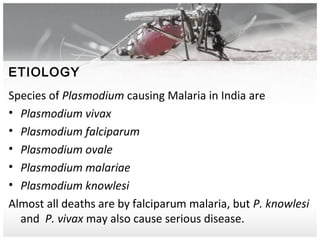
ETIOLOGY
Species of Plasmodium causing Malaria in India are
• Plasmodium vivax
• Plasmodium falciparum
• Plasmodium ovale
• Plasmodium malariae
• Plasmodium knowlesi
Almost all deaths are by falciparum malaria, but P. knowlesi
and P. vivax may also cause serious disease.
CHARACTERISTICS OF DIFFERENT
PLASMODIUM SPECIES
• P.falciperum has reticulocyte-binding protein
homologue 5 (PfRh5) which attaches to erythrocyte
receptor Basigin (CD 147) and helps in erythrocyte
invasion.
• For P.vivax erythrocyte receptor is Duffy blood group
antigen Fya or Fyb.
• So individuals having Duffy negative blood group are
resistant to Vivax malaria
ERYTHROCYTE CHANGES IN MALARIA
• Growing parasite progressively consumes and degrades
intracellular proteins, majorly Hemoglobin.
• Degradation of Hemoglobin produces toxic Heme which
is detoxified by lipid mediated crystallization to inert
Hemozoin.
• Parasite alters the RBC membrane. So RBC becomes
more irregular, more antigenic and less deformable.
• In P.falciparum, membrane protuberances or “Knobs”
appear in RBC which extrude a high molecular weight
erythrocyte membrane adhesive protein (PfEMP1).
• PfEMP1 mediates attachment of RBC to various
receptors like Intercellular adhesion molecule 1, CD 36 in
vascular and capillary endothelium- A process known as
Cytoadherence.
• Rosetting – Infected RBCs bind to uninfected RBCS.
• Agglutination – Infected RBCS bind to other infected
RBCs.
• Cytoadherence, Rosetting and Agglutination are central
to pathogenesis of falciparum malaria. This blocks
microcirculatory flow and impairs metabolism.
HOST RESPONSE
• Splenic filtrative mechanism accelerates removal of both
infected and uninfected RBCSs.
• RBCs escaping splenic removal are destroyed when the
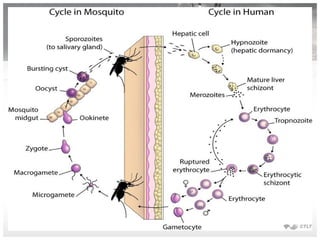
shizont ruptures.
• Materials released induce activation of macrophages and
release of proinflammatory cytokines occurs which cause
fever and other pathologic effects.
CLINIACAL FEATURES
• Fever – Classical fever spikes at regular intervals with chills and
rigors are unusual and may suggest P. vivax or P. ovale infection.
Fever usually irregular at first.
• Lack of sense of well being
• Headache and muscle aches
• Fatigue
• Nausea
• Vomitting
• Generalized seizures may occur.
• SIGNS – mild Pallor, mild jaundice and a palpable spleen maybe
seen.
MANIFESTATIONS OF SEVERE FALCIPARUM
MALARIA
• Unarousable Coma / Cerebral Malaria
• Acidosis
• Severe Normocytic Normochromic anemia
• Renal failure
• Pulmonary edema / ARDS
• Hypoglycemia
• Hypotension / Shock
• Bleeding / DIC
• Convulsions
• Others like Jaundice, Hemoglobinuria, Extreme weakness,
Hyperparasitemia
CEREBRAL MALARIA
• Failure to localize or respond appropriately to noxious stimuli or
coma persisting for > 30 min after generalized convulsion.
• Manifests as diffuse symmetric encephalopathy. Focal signs are
unusual
• Muscle tone may be increased or decreased.
• Tendon reflexes variable and plantar maybe flexor or extensor.
• Eye – Retinal hemorrhages, Retinal opacifications, Papilledema,
cotton wool spots.
• Covulsions usually generalized and often repeated.
• 10 percent of children surviving cerebral malaria have neurologic
sequele whereas adults rarely have neurologic sequele.
HYPOGLYCEMIA
• Plasma glucose level of < 40 mg/dl is associated with poor
prognosis particularly in children and pregnant women.
• Usually results from failure of hepatic gluconeogenesis and
increase in consumption of glucose by both host and parasite.
• Quinine – used in both uncomplicated and complicated Falciparum
malaria enhances insulin release and aggravates hypoglycemia.
• Diagnosis of hypoglycemia may be difficult because usual signs of
hypoglycemia like sweating, tachycardia may be absent in severe
illness.
ACIDOSIS
• Plasma pH of < 7.25 or plasma bicarbonate < 15 mmol/L; Lactate
level of > 5 mmol/L.
• Important cause of death. Results from accumulation of organic
acids produced by anaerobic glycolysis in tissues due to impaired
microcirculatory flow.
• Coexisting renal failure aggravates acidosis.
• Manifests as laboured deep breathing or acidotic breathing – a
sign of poor prognosis.
• Is followed by circulatory failure refractory to inotopic drug
treatment.
RENAL FAILURE
• Serum Creatinine level of > 3mg/dL; urine output (24hr) < 400 ml
in adults or < 12 ml/ Kg in children, not improving with
rehydration.
• Maybe due to impaired micro-circulatory flow and metabolism.
• Manifests as Acute tubular necrosis
• Occurs simultaneously with other vital organ dysfunction.
• Early dialysis or hemofiltration increase the chances of patient
survival.
NONCARDIOGENIC PULMONARY EDEMA
• Often aggravated by overhydration.
• Pathogenesis is unclear.
• Mortality rate is > 80%
• May develop even after several days of antimalarial therapy.
HEMATOLOGIC ABNORMALITIES
• Severe normocytic normochromic anemia due to accelerated RBC
destruction by spleen and parasite.
• Splenic clearance is increased as RBCs show reduced
deformability.
• In areas of unstable transmission, anemia can progress rapidly and
transfusion may be required.
• Slight coagulation abnormalities are common in falciparum malaria
and mild thrombocytopenia may be seen.
• DIC with significant bleeding occurs in < 10% of patients.
LIVER DYSFUNCTION
• Mild hemolytic jaundice is common in malaria but severe jaundice
may occur in P.falciparum infections.
• Jaundice is more common in adults than in children and results
from hemolysis, hepatocyte injury and cholestasis.
• Liver dysfunction leads to hypoglycemia, lactic acidosis and
impaired drug metabolism.
OTHER COMPLICATIONS
• HIV/AIDS predispose to more severe malaria.
• Septicemia may complicate severe malaria.
• Aspiration pneumonia may occur after generalized convulsions.
• Chest infection and catheter induced UTI may occur in unconscious
patients.
• Malaria in Pregnancy – In early pregnancy causes abortion. In
areas of high transmission associated with low birth weight and
increased infant mortality rate. In areas of unstable transmission
pregnant women are susceptible to more severe infections with
high parasitemia, anemia, hypoglycemia and pulmonary edema.
Fetal distress, stillbirth, premature labor and low birthweight occur
LAB DIAGNOSIS OF MALARIA
Common methods of diagnosis of malaria are –
• Light Microscopy
• Antigen detection – Rapid Diagnostic Tests
• Serology
• QBC
• Microtube concentration methods with acridine orange staining.
LIGHT MICROSCOPY
• Gold standard
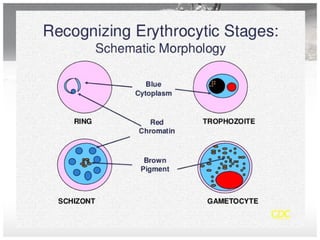
• Based on demonstration of asexual forms of parasite in stained
peripheral blood smears
• Giemsa at pH 7.2 is preferred stain. Field’s , Wright’s , or
Leishman’s stain can also be used.
• At least 100 to 200 fields should be examined.
• After a negative smear, repeat blood smear should be made if
there is high degree clinical suspicion.
RAPID DIAGNOSTIC TEST
TREATMENT OF MALARIA
• When a patient from a malarious area presents with fever, thick
and thin blood smears or RDT should be prepared to confirm the
diagnosis and identify the species.
• All fever cases diagnosed as malaria by either RDT or microscopy
should be promptly given effective treatment. The medicine
chosen will depend upon whether the patient has vivax malaria or
falciparum malaria or mixed infection as diagnosed by the blood
test.
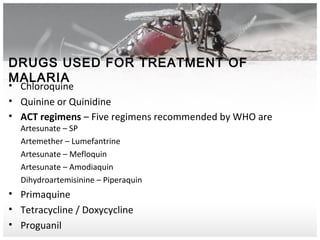
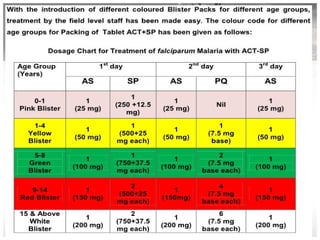
DRUGS USED FOR TREATMENT OF
MALARIA
• Chloroquine
• Quinine or Quinidine
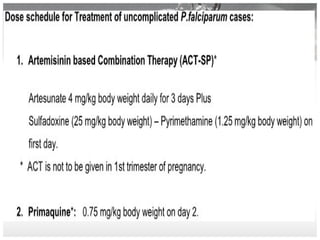
• ACT regimens – Five regimens recommended by WHO are
Artesunate – SP
Artemether – Lumefantrine
Artesunate – Mefloquin
Artesunate – Amodiaquin
Dihydroartemisinine – Piperaquin
• Primaquine
• Tetracycline / Doxycycline
• Proguanil
• Choloroquine – Acts on trophozoite blood stages; Kills
gemetocytes of P.vivax, P.ovale and P.malariae; no action on liver
stages. Minor adverse effects are nausea, pruritus, postural
hypotension, rash. Major toxicites include cardiac arrythmia,
hypotensive shock, retinopathy.
• Quinine, Quinidine – Antimalarial action is as Chloroquine.
Common minor adverse effect is “Cinchonism” , QT prolongation,
diarrhoea. Common major toxicity is hypoglycemia, hypotension,
blindness, deafness, HUS , thrombocytopenia.
• ARTEMISININ and derivatives – Rapid action, broader stage
specificity, no action on liver stages. Common adverse effect is
reduction in reticulocyte count but anemia does not occur.
Neutropenia may occur at high doses. Anaphylaxis is major
adverse effect.
• Primaquine – Used for Radical cure i.e. eradicates hepatic forms of
P.vivax and P.ovale, kills all stages of gemetocyte development of
P.falciparum. Common adverse effects are nausea, vomiting ,
diarrhoea, abdominal pain. Major adverse effect is massive
hemolysis in severe G6PD deficiency.
MANAGEMENT OF COMPLICATIONS
• ACUTE RENAL FAILURE – Fluid administration to be restricted.
Hemofiltration and hemodialysis are effective.
• ACUTE PULMONARY EDEMA – Patient should be positioned with
the head end of the bed elevated. Oxygen and diuretics to be
given.
• HYPOGLYCEMIA – Initial slow injection of 50% dextrose and then
an infusion of 10% dextrose to be given. Blood glucose should be
monitored regularly.
• CONVULSIONS – IV or rectal benzodiazepine
• IV antimicrobial agents and oxygen to be given in suspected
aspiration pneumonia.
PREVENTION OF MALARIA
• Avoidance of exposure to mosquitoes during their peek feeding
times.
• Wearing long sleeve clothes.
• Insecticide Treated Bed nets with residual pyrethroids.
• Mosquito repellant creams containing 10 – 35% DEET.
• RTS,S/AS01 (RTS,S) is a malaria vaccine that has been developed through a
partnership between GlaxoSmithKline Biologicals (GSK) and the PATH Malaria
Vaccine Initiative (MVI), with support from the Bill & Melinda Gates Foundation
and from a network of African research centres that performed the studies.
RTS,S is the first malaria vaccine to have completed pivotal Phase 3 testing and
obtained a positive scientific opinion by a stringent medicines regulatory
authority.
CHEMOPROPHYLAXIS OF MALARIA
Malaria

Malaria

  • 1.
    MALARIAMALARIA Dr. Ansuman DashDr.Ansuman Dash GUIDE – Dr.(BRIG) P . PRUSTYGUIDE – Dr.(BRIG) P . PRUSTY
  • 2.
    INTRODUCTION • From theItalian “malaria” - Bad Air – Also known as ague, marsh disease – Descriptions of malaria go as far back as 3550 B.C. • Malaria is a protozoan disease transmitted by bite of infected Anopheles mosquito caused by parasites of genus Plasmodium. • Transmitted in 106 countries and 3 billion people causes approximately 2000 deaths each day. • Eliminated from USA, Canada, Europe & Russia.
  • 5.
    ETIOLOGY Species of Plasmodiumcausing Malaria in India are • Plasmodium vivax • Plasmodium falciparum • Plasmodium ovale • Plasmodium malariae • Plasmodium knowlesi Almost all deaths are by falciparum malaria, but P. knowlesi and P. vivax may also cause serious disease.
  • 7.
  • 8.
    • P.falciperum hasreticulocyte-binding protein homologue 5 (PfRh5) which attaches to erythrocyte receptor Basigin (CD 147) and helps in erythrocyte invasion. • For P.vivax erythrocyte receptor is Duffy blood group antigen Fya or Fyb. • So individuals having Duffy negative blood group are resistant to Vivax malaria
  • 9.
    ERYTHROCYTE CHANGES INMALARIA • Growing parasite progressively consumes and degrades intracellular proteins, majorly Hemoglobin. • Degradation of Hemoglobin produces toxic Heme which is detoxified by lipid mediated crystallization to inert Hemozoin. • Parasite alters the RBC membrane. So RBC becomes more irregular, more antigenic and less deformable. • In P.falciparum, membrane protuberances or “Knobs” appear in RBC which extrude a high molecular weight erythrocyte membrane adhesive protein (PfEMP1).
  • 10.
    • PfEMP1 mediatesattachment of RBC to various receptors like Intercellular adhesion molecule 1, CD 36 in vascular and capillary endothelium- A process known as Cytoadherence. • Rosetting – Infected RBCs bind to uninfected RBCS. • Agglutination – Infected RBCS bind to other infected RBCs. • Cytoadherence, Rosetting and Agglutination are central to pathogenesis of falciparum malaria. This blocks microcirculatory flow and impairs metabolism.
  • 11.
    HOST RESPONSE • Splenicfiltrative mechanism accelerates removal of both infected and uninfected RBCSs. • RBCs escaping splenic removal are destroyed when the shizont ruptures. • Materials released induce activation of macrophages and release of proinflammatory cytokines occurs which cause fever and other pathologic effects.
  • 12.
    CLINIACAL FEATURES • Fever– Classical fever spikes at regular intervals with chills and rigors are unusual and may suggest P. vivax or P. ovale infection. Fever usually irregular at first. • Lack of sense of well being • Headache and muscle aches • Fatigue • Nausea • Vomitting • Generalized seizures may occur. • SIGNS – mild Pallor, mild jaundice and a palpable spleen maybe seen.
  • 13.
    MANIFESTATIONS OF SEVEREFALCIPARUM MALARIA • Unarousable Coma / Cerebral Malaria • Acidosis • Severe Normocytic Normochromic anemia • Renal failure • Pulmonary edema / ARDS • Hypoglycemia • Hypotension / Shock • Bleeding / DIC • Convulsions • Others like Jaundice, Hemoglobinuria, Extreme weakness, Hyperparasitemia
  • 14.
    CEREBRAL MALARIA • Failureto localize or respond appropriately to noxious stimuli or coma persisting for > 30 min after generalized convulsion. • Manifests as diffuse symmetric encephalopathy. Focal signs are unusual • Muscle tone may be increased or decreased. • Tendon reflexes variable and plantar maybe flexor or extensor. • Eye – Retinal hemorrhages, Retinal opacifications, Papilledema, cotton wool spots. • Covulsions usually generalized and often repeated. • 10 percent of children surviving cerebral malaria have neurologic sequele whereas adults rarely have neurologic sequele.
  • 15.
    HYPOGLYCEMIA • Plasma glucoselevel of < 40 mg/dl is associated with poor prognosis particularly in children and pregnant women. • Usually results from failure of hepatic gluconeogenesis and increase in consumption of glucose by both host and parasite. • Quinine – used in both uncomplicated and complicated Falciparum malaria enhances insulin release and aggravates hypoglycemia. • Diagnosis of hypoglycemia may be difficult because usual signs of hypoglycemia like sweating, tachycardia may be absent in severe illness.
  • 16.
    ACIDOSIS • Plasma pHof < 7.25 or plasma bicarbonate < 15 mmol/L; Lactate level of > 5 mmol/L. • Important cause of death. Results from accumulation of organic acids produced by anaerobic glycolysis in tissues due to impaired microcirculatory flow. • Coexisting renal failure aggravates acidosis. • Manifests as laboured deep breathing or acidotic breathing – a sign of poor prognosis. • Is followed by circulatory failure refractory to inotopic drug treatment.
  • 17.
    RENAL FAILURE • SerumCreatinine level of > 3mg/dL; urine output (24hr) < 400 ml in adults or < 12 ml/ Kg in children, not improving with rehydration. • Maybe due to impaired micro-circulatory flow and metabolism. • Manifests as Acute tubular necrosis • Occurs simultaneously with other vital organ dysfunction. • Early dialysis or hemofiltration increase the chances of patient survival.
  • 18.
    NONCARDIOGENIC PULMONARY EDEMA •Often aggravated by overhydration. • Pathogenesis is unclear. • Mortality rate is > 80% • May develop even after several days of antimalarial therapy.
  • 19.
    HEMATOLOGIC ABNORMALITIES • Severenormocytic normochromic anemia due to accelerated RBC destruction by spleen and parasite. • Splenic clearance is increased as RBCs show reduced deformability. • In areas of unstable transmission, anemia can progress rapidly and transfusion may be required. • Slight coagulation abnormalities are common in falciparum malaria and mild thrombocytopenia may be seen. • DIC with significant bleeding occurs in < 10% of patients.
  • 20.
    LIVER DYSFUNCTION • Mildhemolytic jaundice is common in malaria but severe jaundice may occur in P.falciparum infections. • Jaundice is more common in adults than in children and results from hemolysis, hepatocyte injury and cholestasis. • Liver dysfunction leads to hypoglycemia, lactic acidosis and impaired drug metabolism.
  • 21.
    OTHER COMPLICATIONS • HIV/AIDSpredispose to more severe malaria. • Septicemia may complicate severe malaria. • Aspiration pneumonia may occur after generalized convulsions. • Chest infection and catheter induced UTI may occur in unconscious patients. • Malaria in Pregnancy – In early pregnancy causes abortion. In areas of high transmission associated with low birth weight and increased infant mortality rate. In areas of unstable transmission pregnant women are susceptible to more severe infections with high parasitemia, anemia, hypoglycemia and pulmonary edema. Fetal distress, stillbirth, premature labor and low birthweight occur
  • 22.
    LAB DIAGNOSIS OFMALARIA Common methods of diagnosis of malaria are – • Light Microscopy • Antigen detection – Rapid Diagnostic Tests • Serology • QBC • Microtube concentration methods with acridine orange staining.
  • 23.
    LIGHT MICROSCOPY • Goldstandard • Based on demonstration of asexual forms of parasite in stained peripheral blood smears • Giemsa at pH 7.2 is preferred stain. Field’s , Wright’s , or Leishman’s stain can also be used. • At least 100 to 200 fields should be examined. • After a negative smear, repeat blood smear should be made if there is high degree clinical suspicion.
  • 30.
  • 31.
    TREATMENT OF MALARIA •When a patient from a malarious area presents with fever, thick and thin blood smears or RDT should be prepared to confirm the diagnosis and identify the species. • All fever cases diagnosed as malaria by either RDT or microscopy should be promptly given effective treatment. The medicine chosen will depend upon whether the patient has vivax malaria or falciparum malaria or mixed infection as diagnosed by the blood test.
  • 32.
    DRUGS USED FORTREATMENT OF MALARIA • Chloroquine • Quinine or Quinidine • ACT regimens – Five regimens recommended by WHO are Artesunate – SP Artemether – Lumefantrine Artesunate – Mefloquin Artesunate – Amodiaquin Dihydroartemisinine – Piperaquin • Primaquine • Tetracycline / Doxycycline • Proguanil
  • 33.
    • Choloroquine –Acts on trophozoite blood stages; Kills gemetocytes of P.vivax, P.ovale and P.malariae; no action on liver stages. Minor adverse effects are nausea, pruritus, postural hypotension, rash. Major toxicites include cardiac arrythmia, hypotensive shock, retinopathy. • Quinine, Quinidine – Antimalarial action is as Chloroquine. Common minor adverse effect is “Cinchonism” , QT prolongation, diarrhoea. Common major toxicity is hypoglycemia, hypotension, blindness, deafness, HUS , thrombocytopenia.
  • 34.
    • ARTEMISININ andderivatives – Rapid action, broader stage specificity, no action on liver stages. Common adverse effect is reduction in reticulocyte count but anemia does not occur. Neutropenia may occur at high doses. Anaphylaxis is major adverse effect. • Primaquine – Used for Radical cure i.e. eradicates hepatic forms of P.vivax and P.ovale, kills all stages of gemetocyte development of P.falciparum. Common adverse effects are nausea, vomiting , diarrhoea, abdominal pain. Major adverse effect is massive hemolysis in severe G6PD deficiency.
  • 42.
    MANAGEMENT OF COMPLICATIONS •ACUTE RENAL FAILURE – Fluid administration to be restricted. Hemofiltration and hemodialysis are effective. • ACUTE PULMONARY EDEMA – Patient should be positioned with the head end of the bed elevated. Oxygen and diuretics to be given. • HYPOGLYCEMIA – Initial slow injection of 50% dextrose and then an infusion of 10% dextrose to be given. Blood glucose should be monitored regularly. • CONVULSIONS – IV or rectal benzodiazepine • IV antimicrobial agents and oxygen to be given in suspected aspiration pneumonia.
  • 43.
    PREVENTION OF MALARIA •Avoidance of exposure to mosquitoes during their peek feeding times. • Wearing long sleeve clothes. • Insecticide Treated Bed nets with residual pyrethroids. • Mosquito repellant creams containing 10 – 35% DEET. • RTS,S/AS01 (RTS,S) is a malaria vaccine that has been developed through a partnership between GlaxoSmithKline Biologicals (GSK) and the PATH Malaria Vaccine Initiative (MVI), with support from the Bill & Melinda Gates Foundation and from a network of African research centres that performed the studies. RTS,S is the first malaria vaccine to have completed pivotal Phase 3 testing and obtained a positive scientific opinion by a stringent medicines regulatory authority.
  • 44.