

Fluorosis
Kuldeep Vyas
HOD Community
Healt
h
Kuldeep Vyas M.Sc. CHN
1
Magnitude of Fluorosis
• Worldwide in distribution
• Endemic in 22 countries
• Asia
– India and China are worst affected
• Mexico in North and Argentina in Latin America
• East and North Africa are also endemic
Kuldeep Vyas M.Sc. CHN
2
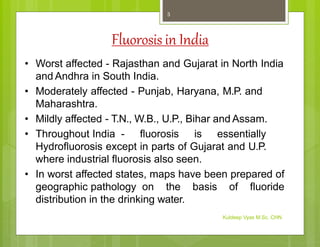
Fluorosis in India
• Worst affected - Rajasthan and Gujarat in North India
and Andhra in South India.
• Moderately affected - Punjab, Haryana, M.P. and
Maharashtra.
• Mildly affected - T.N., W.B., U.P., Bihar and Assam.
• Throughout India - fluorosis is essentially
Hydrofluorosis except in parts of Gujarat and U.P.
where industrial fluorosis also seen.
• In worst affected states, maps have been prepared of
geographic pathology on the basis of fluoride
distribution in the drinking water.
Kuldeep Vyas M.Sc. CHN
3
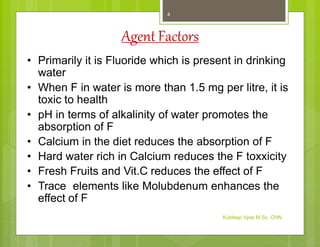
Agent Factors
• Primarily it is Fluoride which is present in drinking
water
• When F in water is more than 1.5 mg per litre, it is
toxic to health
• pH in terms of alkalinity of water promotes the
absorption of F
• Calcium in the diet reduces the absorption of F
• Hard water rich in Calcium reduces the F toxxicity
• Fresh Fruits and Vit.C reduces the effect of F
• Trace elements like Molubdenum enhances the
effect of F
Kuldeep Vyas M.Sc. CHN
4
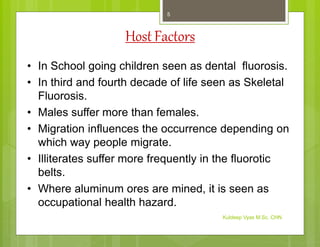
HostFactors
• In School going children seen as dental fluorosis.
• In third and fourth decade of life seen as Skeletal
Fluorosis.
• Males suffer more than females.
• Migration influences the occurrence depending on
which way people migrate.
• Illiterates suffer more frequently in the fluorotic
belts.
• Where aluminum ores are mined, it is seen as
occupational health hazard.
Kuldeep Vyas M.Sc. CHN
5
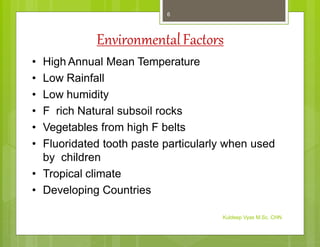
EnvironmentalFactors
• High Annual Mean Temperature
• Low Rainfall
• Low humidity
• F rich Natural subsoil rocks
• Vegetables from high F belts
• Fluoridated tooth paste particularly when used
by children
• Tropical climate
• Developing Countries
Kuldeep Vyas M.Sc. CHN
6
Magnitude of Problem
Kuldeep Vyas M.Sc. CHN
7
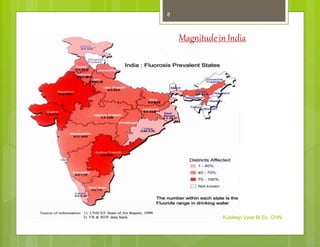
Magnitude in India
Kuldeep Vyas M.Sc. CHN
8
Magnitude in India
Alarming in at least 17 states of India:
(I)50-100% districts are affected - Andhra Pradesh,
T
amil Nadu, Uttar Pradesh, Gujarat, Rajasthan
(II)30-50% districts are affected - Bihar, Haryana,
Karnataka, Maharashtra, Madhya Pradesh, Punjab,
Orissa, West Bengal
(III)< 30 % districts are affected - J & K, Delhi, Kerala
• 66.6 million people including 6 million under
14 children are at risk of acquiring fluorosis
• 2 % children in India are affected by dental
Fluorosis Kuldeep Vyas M.Sc. CHN
9
In Rajasthan
• Fluorides in drinking water from indigenous
rocks and ground water around the mica mines
(Rajasthan has rich sources of mica).
• All the 32 districts have been declared as
fluorosis prone areas. The worst
:Nagaur, Jaipur, Sikar, Jodhpur, Barmer, Ajmer,
Sirohi, Jhunjhunu, Churu, Bikaner, Ganganagar
etc.
Kuldeep Vyas M.Sc. CHN
10
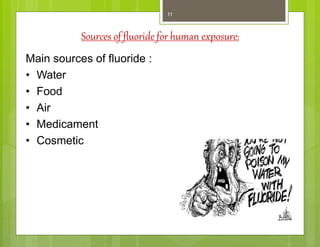
Sources of fluoride for human exposure:
Kuldeep Vyas M.Sc. CHN
Main sources of fluoride :
• Water
• Food
• Air
• Medicament
• Cosmetic
11
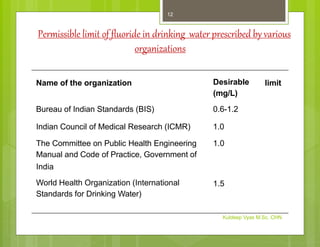
Permissible limit of fluoride in drinking water prescribed by various
organizations
Name of the organization limit
Desirable
(mg/L)
Bureau of Indian Standards (BIS) 0.6-1.2
Indian Council of Medical Research (ICMR) 1.0
The Committee on Public Health Engineering 1.0
Manual and Code of Practice, Government of
India
World Health Organization (International
Standards for Drinking Water)
1.5
Kuldeep Vyas M.Sc. CHN
12
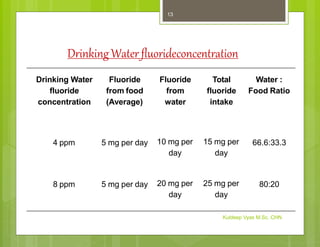
Drinking Water fluorideconcentration
Drinking Water
fluoride
concentration
Fluoride
from food
(Average)
Fluoride
from
water
Total
fluoride
intake
Water :
Food Ratio
4 ppm 5 mg per day 10 mg per
day
15 mg per
day
66.6:33.3
8 ppm 5 mg per day 20 mg per
day
25 mg per
day
80:20
Kuldeep Vyas M.Sc. CHN
13
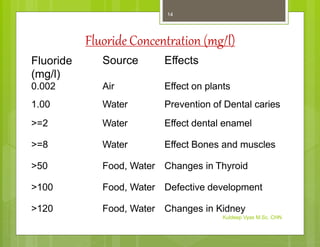
Fluoride Concentration (mg/l)
Fluoride Source Effects
(mg/l)
0.002 Air Effect on plants
1.00 Water Prevention of Dental caries
>=2 Water Effect dental enamel
>=8 Water Effect Bones and muscles
>50 Food, Water Changes in Thyroid
>100 Food, Water Defective development
>120 Food, Water Changes in Kidney
Kuldeep Vyas M.Sc. CHN
14
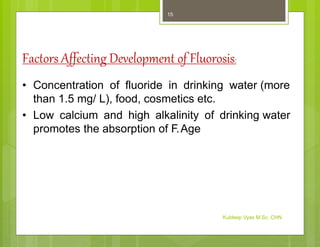
Factors Affecting Development of Fluorosis:
• Concentration of fluoride in drinking water (more
than 1.5 mg/ L), food, cosmetics etc.
• Low calcium and high alkalinity of drinking water
promotes the absorption of F.Age
Kuldeep Vyas M.Sc. CHN
15
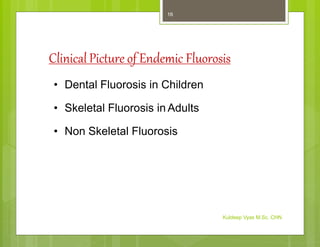
Clinical Picture of Endemic Fluorosis
• Dental Fluorosis in Children
• Skeletal Fluorosis in Adults
• Non Skeletal Fluorosis
Kuldeep Vyas M.Sc. CHN
16
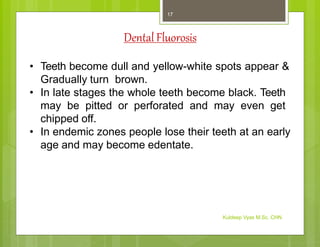
Dental Fluorosis
• Teeth become dull and yellow-white spots appear &
Gradually turn brown.
• In late stages the whole teeth become black. Teeth
may be pitted or perforated and may even get
chipped off.
• In endemic zones people lose their teeth at an early
age and may become edentate.
Kuldeep Vyas M.Sc. CHN
17
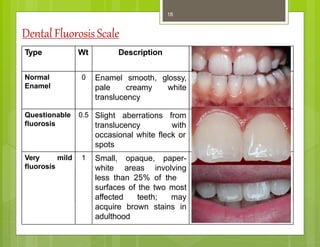
Dental FluorosisScale
Kuldeep Vyas M.Sc. CHN
Type Wt Description
Normal
Enamel
0 Enamel smooth, glossy,
pale creamy white
translucency
Questionable 0.5
fluorosis
Slight aberrations from
translucency with
occasional white fleck or
spots
Very
fluorosis
mild 1 Small, opaque, paper-
white areas involving
less than 25% of the
surfaces of the two most
affected teeth; may
acquire brown stains in
adulthood
18
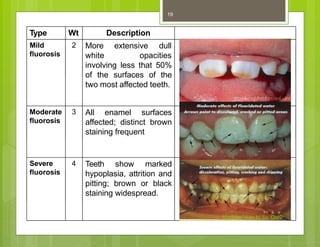
Type Wt Description
2
Mild
fluorosis
More extensive dull
white opacities
involving less that 50%
of the surfaces of the
two most affected teeth.
Moderate 3
fluorosis
All enamel surfaces
affected; distinct brown
staining frequent
4
Severe
fluorosis
Teeth show marked
hypoplasia, attrition and
pitting; brown or black
staining widespread.
Kuldeep Vyas M.Sc. CHN
19
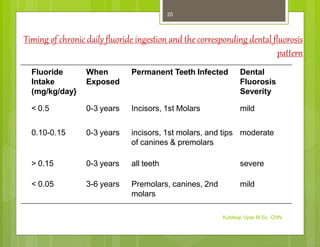
Timing of chronic daily fluoride ingestion and the corresponding dental fluorosis
pattern
Fluoride
Intake
(mg/kg/day}
When Permanent Teeth Infected
Exposed
Dental
Fluorosis
Severity
< 0.5 0-3 years Incisors, 1st Molars mild
0.10-0.15 0-3 years moderate
incisors, 1st molars, and tips
of canines & premolars
> 0.15 0-3 years all teeth severe
< 0.05 3-6 years Premolars, canines, 2nd
molars
mild
Kuldeep Vyas M.Sc. CHN
20
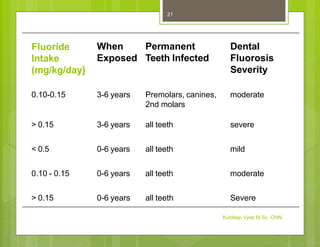
Fluoride
Intake
(mg/kg/day}
When
Exposed
Permanent
Teeth Infected
Dental
Fluorosis
Severity
0.10-0.15 3-6 years Premolars, canines,
2nd molars
moderate
> 0.15 3-6 years all teeth severe
< 0.5 0-6 years all teeth mild
0.10 - 0.15 0-6 years all teeth moderate
> 0.15 0-6 years all teeth Severe
Kuldeep Vyas M.Sc. CHN
21
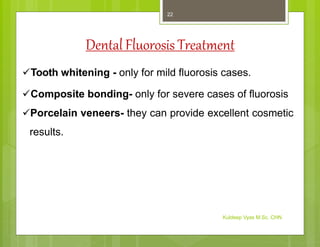
Dental Fluorosis Treatment
Tooth whitening - only for mild fluorosis cases.
Composite bonding- only for severe cases of fluorosis
Porcelain veneers- they can provide excellent cosmetic
results.
Kuldeep Vyas M.Sc. CHN
22
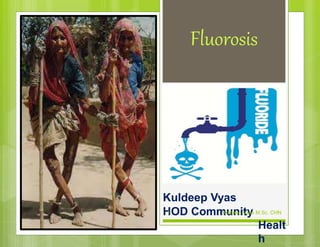
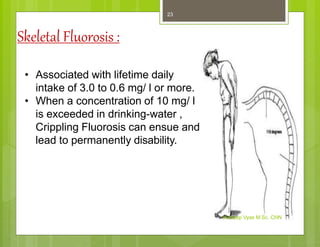
Skeletal Fluorosis :
• Associated with lifetime daily
intake of 3.0 to 0.6 mg/ l or more.
• When a concentration of 10 mg/ l
is exceeded in drinking-water ,
Crippling Fluorosis can ensue and
lead to permanently disability.
Kuldeep Vyas M.Sc. CHN
23
Stages: Skeletal Fluorosis
Preclinical Stage: the patient feels no symptoms but
changes have taken place in the body
• Biochemical abnormalities occur in the blood and in bone
composition
• Histological changes can be observed in the bone in biopsies
Early clinical stage:
• Pains in the bones and joints
• Sensations of burning, pricking, and tingling in the limbs
• Muscle weakness
• Chronic fatigue;
• Gastrointestinal disorders and reduced appetite.
• Changes in the pelvis and spinal column can be detected on x-
rays.
Kuldeep Vyas M.Sc. CHN
24
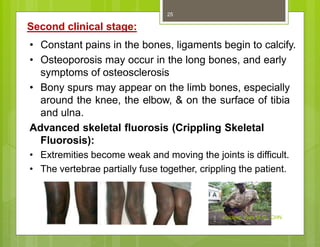
Second clinical stage:
• Constant pains in the bones, ligaments begin to calcify.
• Osteoporosis may occur in the long bones, and early
symptoms of osteosclerosis
• Bony spurs may appear on the limb bones, especially
around the knee, the elbow, & on the surface of tibia
and ulna.
Advanced skeletal fluorosis (Crippling Skeletal
Fluorosis):
• Extremities become weak and moving the joints is difficult.
• The vertebrae partially fuse together, crippling the patient.
Kuldeep Vyas M.Sc. CHN
25
Tests for Skeletal Fluorosis
• Coin Test: The subject is asked to lift a coin from the floor
without bending the knee. A fluorotic subject would not be
able to lift the coin without flexing the large joints of lower
extremity.
• Chin Test: The subject is asked to touch the anterior
wall of the chest with the chin. If there is pain or stiffness
in the neck, it indicates the presence of Fluorosis.
• Stretch Test: The individual is made to stretch the arm
sideways, fold at elbow and touch the back of the head.
When there is pain and stiffness, it would not be possible
to reach to the occiput indicating presence of Fluorosis.
Kuldeep Vyas M.Sc. CHN
26
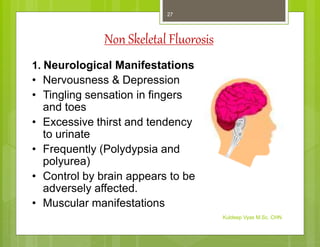
Non Skeletal Fluorosis
1. Neurological Manifestations
• Nervousness & Depression
• Tingling sensation in fingers
and toes
• Excessive thirst and tendency
to urinate
• Frequently (Polydypsia and
polyurea)
• Control by brain appears to be
adversely affected.
• Muscular manifestations
Kuldeep Vyas M.Sc. CHN
27
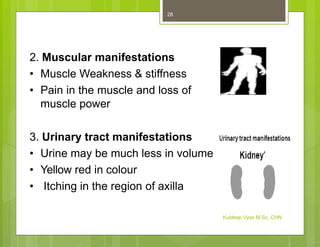
2. Muscular manifestations
• Muscle Weakness & stiffness
• Pain in the muscle and loss of
muscle power
3. Urinary tract manifestations
• Urine may be much less in volume
• Yellow red in colour
• Itching in the region of axilla
Kuldeep Vyas M.Sc. CHN
28
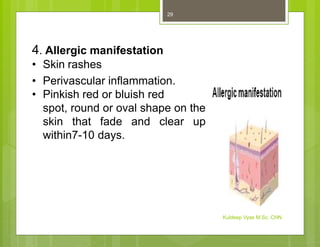
4. Allergic manifestation
• Skin rashes
• Perivascular inflammation.
• Pinkish red or bluish red
spot, round or oval shape on the
skin that fade and clear up
within7-10 days.
Kuldeep Vyas M.Sc. CHN
29
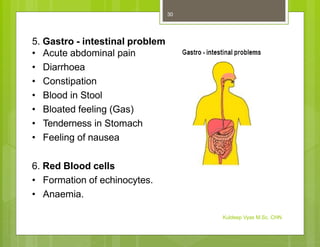
5. Gastro - intestinal problem
• Acute abdominal pain
• Diarrhoea
• Constipation
• Blood in Stool
• Bloated feeling (Gas)
• Tenderness in Stomach
• Feeling of nausea
6. Red Blood cells
• Formation of echinocytes.
• Anaemia.
Kuldeep Vyas M.Sc. CHN
30
De-fluoridation:
-At Household Level
-At Commercial Level
Kuldeep Vyas M.Sc. CHN
31
• De-fluoridation is the process of removal of
excess fluoride from water.
• WHO has identified and evaluated the most
promising de-fluoridation methods :
Bone charcoal
Contact precipitation based on the addition of
calcium and phosphate compounds
Nalgonda Technique
Activated alumina
Kuldeep Vyas M.Sc. CHN
32
At Household Level
Kuldeep Vyas M.Sc. CHN
33
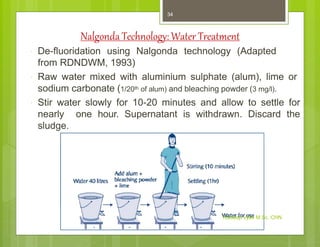
Nalgonda Technology:Water Treatment
 De-fluoridation using Nalgonda technology (Adapted
from RDNDWM, 1993)
 Raw water mixed with aluminium sulphate (alum), lime or
sodium carbonate (1/20th of alum) and bleaching powder (3 mg/l).
 Stir water slowly for 10-20 minutes and allow to settle for
nearly one hour. Supernatant is withdrawn. Discard the
sludge.
Kuldeep Vyas M.Sc. CHN
34
These Do NOT Remove Fluoride
• Boiling Water :This will concentrate the fluoride
rather than reduce it.
• Freezing Water: Freezing water does not affect
the concentration of fluoride.
Kuldeep Vyas M.Sc. CHN
35
Drugs
Kuldeep Vyas M.Sc. CHN
36
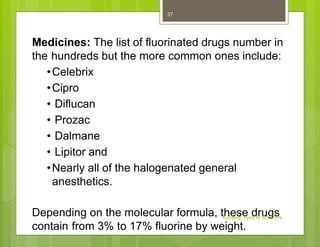
Medicines: The list of fluorinated drugs number in
the hundreds but the more common ones include:
•Celebrix
•Cipro
• Diflucan
• Prozac
• Dalmane
• Lipitor and
•Nearly all of the halogenated general
anesthetics.
Depending on the molecular formula, these drugs
contain from 3% to 17% fluorine by weight.
Kuldeep Vyas M.Sc. CHN
37
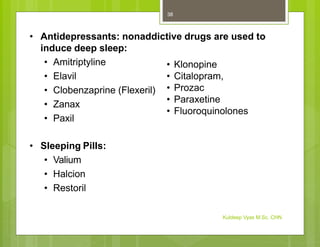
• Antidepressants: nonaddictive drugs are used to
induce deep sleep:
• Amitriptyline
• Elavil
• Clobenzaprine (Flexeril)
• Zanax
• Paxil
• Klonopine
• Citalopram,
• Prozac
• Paraxetine
• Fluoroquinolones
• Sleeping Pills:
• Valium
• Halcion
• Restoril
Kuldeep Vyas M.Sc. CHN
38
• Corticosteroids: Prescribed for severe pain
• Prednisone
• Cortisone
• Acetaminophen (nonsteroidal anti-inflammatory plus
antipyretic [lowers fever])
• Tylenol
• Liquiprin
• Datril
• NSAIDs (Nonsteroidal anti-inflammatory)
• Motrin
• Advil
• Aspirin
• Indocin
• Ibuprofen
• Excedrin
• Midol
• Nuprin
Kuldeep Vyas M.Sc. CHN
39
FoodSupplements
Kuldeep Vyas M.Sc. CHN
40
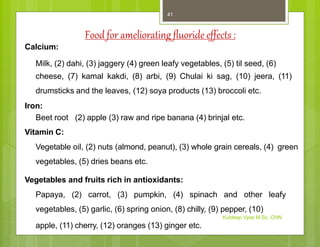
Food for ameliorating fluoride effects :
Calcium:
Milk, (2) dahi, (3) jaggery (4) green leafy vegetables, (5) til seed, (6)
cheese, (7) kamal kakdi, (8) arbi, (9) Chulai ki sag, (10) jeera, (11)
drumsticks and the leaves, (12) soya products (13) broccoli etc.
Iron:
Beet root (2) apple (3) raw and ripe banana (4) brinjal etc.
Vitamin C:
Vegetable oil, (2) nuts (almond, peanut), (3) whole grain cereals, (4) green
vegetables, (5) dries beans etc.
Vegetables and fruits rich in antioxidants:
Papaya, (2) carrot, (3) pumpkin, (4) spinach and other leafy
vegetables, (5) garlic, (6) spring onion, (8) chilly, (9) pepper, (10)
apple, (11) cherry, (12) oranges (13) ginger etc.
Kuldeep Vyas M.Sc. CHN
41
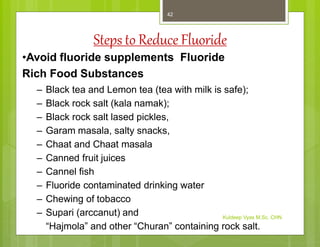
Steps to Reduce Fluoride
•Avoid fluoride supplements Fluoride
Rich Food Substances
– Black tea and Lemon tea (tea with milk is safe);
– Black rock salt (kala namak);
– Black rock salt lased pickles,
– Garam masala, salty snacks,
– Chaat and Chaat masala
– Canned fruit juices
– Cannel fish
– Fluoride contaminated drinking water
– Chewing of tobacco
– Supari (arccanut) and
“Hajmola” and other “Churan” containing rock salt.
Kuldeep Vyas M.Sc. CHN
42
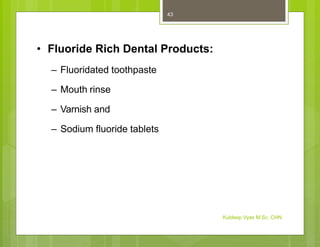
• Fluoride Rich Dental Products:
– Fluoridated toothpaste
– Mouth rinse
– Varnish and
– Sodium fluoride tablets
Kuldeep Vyas M.Sc. CHN
43
At Commercial Level
Kuldeep Vyas M.Sc. CHN
44
CommercialMethods:
• IISc method
– The magnesium oxide method, commonly called the
IISc method
– Most effective method & costs 15–30 paisa/l to
defluoridize.
– Magnesium oxide is easily available and the
technique is economically feasible.
• Solar distillation
– Because of its simplicity and very little maintenance, it
can be adopted for rural communities of India
Kuldeep Vyas M.Sc. CHN
45
Other ways to remove Fluoride
• Reverse Osmosis Filtration
• Activated Alumina De-fluoridation Filter: Used
in locales where fluorosis is prevalent, expensive and
require frequent replacement
• Using harvested rainwater for drinking
Kuldeep Vyas M.Sc. CHN
46
Project Bhagidari
• A community –based Self Sustained Safe Drinking
Water Program(De-Fluoridation Plant).
• A community –owned water purification model that
facilitates Public Private participation to deliver
safe water at Price affordable to the community
Kuldeep Vyas M.Sc. CHN
47
Need :
• No access to safe drinking water.
• Water contamination with high fluoride and
pathogens.
• Resulting bone deformities
Objective:
To improve the health of the people of nearest
residing community through a Sustainable model
approach, based on Public Private Partnership
(PPP)
Kuldeep Vyas M.Sc. CHN
48
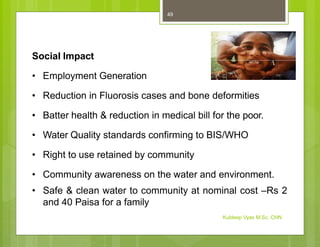
Social Impact
• Employment Generation
• Reduction in Fluorosis cases and bone deformities
• Batter health & reduction in medical bill for the poor.
• Water Quality standards confirming to BIS/WHO
• Right to use retained by community
• Community awareness on the water and environment.
• Safe & clean water to community at nominal cost –Rs 2
and 40 Paisa for a family
Kuldeep Vyas M.Sc. CHN
49
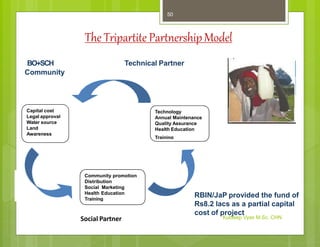
The Tripartite PartnershipModel
BO+SCH Technical Partner
Community
Capital cost
Legal approval
Water source
Land
Awareness
Technology
Annual Maintenance
Quality Assurance
Health Education
Training
Community promotion
Distribution
Social Marketing
Health Education
Training
Social Partner
RBIN/JaP provided the fund of
Rs8.2 lacs as a partial capital
cost of project
Kuldeep Vyas M.Sc. CHN
50
Thank You…
Kuldeep Vyas M.Sc. CHN
51

Fluorosis

  • 1.
  • 2.
    Magnitude of Fluorosis •Worldwide in distribution • Endemic in 22 countries • Asia – India and China are worst affected • Mexico in North and Argentina in Latin America • East and North Africa are also endemic Kuldeep Vyas M.Sc. CHN 2
  • 3.
    Fluorosis in India •Worst affected - Rajasthan and Gujarat in North India and Andhra in South India. • Moderately affected - Punjab, Haryana, M.P. and Maharashtra. • Mildly affected - T.N., W.B., U.P., Bihar and Assam. • Throughout India - fluorosis is essentially Hydrofluorosis except in parts of Gujarat and U.P. where industrial fluorosis also seen. • In worst affected states, maps have been prepared of geographic pathology on the basis of fluoride distribution in the drinking water. Kuldeep Vyas M.Sc. CHN 3
  • 4.
    Agent Factors • Primarilyit is Fluoride which is present in drinking water • When F in water is more than 1.5 mg per litre, it is toxic to health • pH in terms of alkalinity of water promotes the absorption of F • Calcium in the diet reduces the absorption of F • Hard water rich in Calcium reduces the F toxxicity • Fresh Fruits and Vit.C reduces the effect of F • Trace elements like Molubdenum enhances the effect of F Kuldeep Vyas M.Sc. CHN 4
  • 5.
    HostFactors • In Schoolgoing children seen as dental fluorosis. • In third and fourth decade of life seen as Skeletal Fluorosis. • Males suffer more than females. • Migration influences the occurrence depending on which way people migrate. • Illiterates suffer more frequently in the fluorotic belts. • Where aluminum ores are mined, it is seen as occupational health hazard. Kuldeep Vyas M.Sc. CHN 5
  • 6.
    EnvironmentalFactors • High AnnualMean Temperature • Low Rainfall • Low humidity • F rich Natural subsoil rocks • Vegetables from high F belts • Fluoridated tooth paste particularly when used by children • Tropical climate • Developing Countries Kuldeep Vyas M.Sc. CHN 6
  • 7.
  • 8.
  • 9.
    Magnitude in India Alarmingin at least 17 states of India: (I)50-100% districts are affected - Andhra Pradesh, T amil Nadu, Uttar Pradesh, Gujarat, Rajasthan (II)30-50% districts are affected - Bihar, Haryana, Karnataka, Maharashtra, Madhya Pradesh, Punjab, Orissa, West Bengal (III)< 30 % districts are affected - J & K, Delhi, Kerala • 66.6 million people including 6 million under 14 children are at risk of acquiring fluorosis • 2 % children in India are affected by dental Fluorosis Kuldeep Vyas M.Sc. CHN 9
  • 10.
    In Rajasthan • Fluoridesin drinking water from indigenous rocks and ground water around the mica mines (Rajasthan has rich sources of mica). • All the 32 districts have been declared as fluorosis prone areas. The worst :Nagaur, Jaipur, Sikar, Jodhpur, Barmer, Ajmer, Sirohi, Jhunjhunu, Churu, Bikaner, Ganganagar etc. Kuldeep Vyas M.Sc. CHN 10
  • 11.
    Sources of fluoridefor human exposure: Kuldeep Vyas M.Sc. CHN Main sources of fluoride : • Water • Food • Air • Medicament • Cosmetic 11
  • 12.
    Permissible limit offluoride in drinking water prescribed by various organizations Name of the organization limit Desirable (mg/L) Bureau of Indian Standards (BIS) 0.6-1.2 Indian Council of Medical Research (ICMR) 1.0 The Committee on Public Health Engineering 1.0 Manual and Code of Practice, Government of India World Health Organization (International Standards for Drinking Water) 1.5 Kuldeep Vyas M.Sc. CHN 12
  • 13.
    Drinking Water fluorideconcentration DrinkingWater fluoride concentration Fluoride from food (Average) Fluoride from water Total fluoride intake Water : Food Ratio 4 ppm 5 mg per day 10 mg per day 15 mg per day 66.6:33.3 8 ppm 5 mg per day 20 mg per day 25 mg per day 80:20 Kuldeep Vyas M.Sc. CHN 13
  • 14.
    Fluoride Concentration (mg/l) FluorideSource Effects (mg/l) 0.002 Air Effect on plants 1.00 Water Prevention of Dental caries >=2 Water Effect dental enamel >=8 Water Effect Bones and muscles >50 Food, Water Changes in Thyroid >100 Food, Water Defective development >120 Food, Water Changes in Kidney Kuldeep Vyas M.Sc. CHN 14
  • 15.
    Factors Affecting Developmentof Fluorosis: • Concentration of fluoride in drinking water (more than 1.5 mg/ L), food, cosmetics etc. • Low calcium and high alkalinity of drinking water promotes the absorption of F.Age Kuldeep Vyas M.Sc. CHN 15
  • 16.
    Clinical Picture ofEndemic Fluorosis • Dental Fluorosis in Children • Skeletal Fluorosis in Adults • Non Skeletal Fluorosis Kuldeep Vyas M.Sc. CHN 16
  • 17.
    Dental Fluorosis • Teethbecome dull and yellow-white spots appear & Gradually turn brown. • In late stages the whole teeth become black. Teeth may be pitted or perforated and may even get chipped off. • In endemic zones people lose their teeth at an early age and may become edentate. Kuldeep Vyas M.Sc. CHN 17
  • 18.
    Dental FluorosisScale Kuldeep VyasM.Sc. CHN Type Wt Description Normal Enamel 0 Enamel smooth, glossy, pale creamy white translucency Questionable 0.5 fluorosis Slight aberrations from translucency with occasional white fleck or spots Very fluorosis mild 1 Small, opaque, paper- white areas involving less than 25% of the surfaces of the two most affected teeth; may acquire brown stains in adulthood 18
  • 19.
    Type Wt Description 2 Mild fluorosis Moreextensive dull white opacities involving less that 50% of the surfaces of the two most affected teeth. Moderate 3 fluorosis All enamel surfaces affected; distinct brown staining frequent 4 Severe fluorosis Teeth show marked hypoplasia, attrition and pitting; brown or black staining widespread. Kuldeep Vyas M.Sc. CHN 19
  • 20.
    Timing of chronicdaily fluoride ingestion and the corresponding dental fluorosis pattern Fluoride Intake (mg/kg/day} When Permanent Teeth Infected Exposed Dental Fluorosis Severity < 0.5 0-3 years Incisors, 1st Molars mild 0.10-0.15 0-3 years moderate incisors, 1st molars, and tips of canines & premolars > 0.15 0-3 years all teeth severe < 0.05 3-6 years Premolars, canines, 2nd molars mild Kuldeep Vyas M.Sc. CHN 20
  • 21.
    Fluoride Intake (mg/kg/day} When Exposed Permanent Teeth Infected Dental Fluorosis Severity 0.10-0.15 3-6years Premolars, canines, 2nd molars moderate > 0.15 3-6 years all teeth severe < 0.5 0-6 years all teeth mild 0.10 - 0.15 0-6 years all teeth moderate > 0.15 0-6 years all teeth Severe Kuldeep Vyas M.Sc. CHN 21
  • 22.
    Dental Fluorosis Treatment Toothwhitening - only for mild fluorosis cases. Composite bonding- only for severe cases of fluorosis Porcelain veneers- they can provide excellent cosmetic results. Kuldeep Vyas M.Sc. CHN 22
  • 23.
    Skeletal Fluorosis : •Associated with lifetime daily intake of 3.0 to 0.6 mg/ l or more. • When a concentration of 10 mg/ l is exceeded in drinking-water , Crippling Fluorosis can ensue and lead to permanently disability. Kuldeep Vyas M.Sc. CHN 23
  • 24.
    Stages: Skeletal Fluorosis PreclinicalStage: the patient feels no symptoms but changes have taken place in the body • Biochemical abnormalities occur in the blood and in bone composition • Histological changes can be observed in the bone in biopsies Early clinical stage: • Pains in the bones and joints • Sensations of burning, pricking, and tingling in the limbs • Muscle weakness • Chronic fatigue; • Gastrointestinal disorders and reduced appetite. • Changes in the pelvis and spinal column can be detected on x- rays. Kuldeep Vyas M.Sc. CHN 24
  • 25.
    Second clinical stage: •Constant pains in the bones, ligaments begin to calcify. • Osteoporosis may occur in the long bones, and early symptoms of osteosclerosis • Bony spurs may appear on the limb bones, especially around the knee, the elbow, & on the surface of tibia and ulna. Advanced skeletal fluorosis (Crippling Skeletal Fluorosis): • Extremities become weak and moving the joints is difficult. • The vertebrae partially fuse together, crippling the patient. Kuldeep Vyas M.Sc. CHN 25
  • 26.
    Tests for SkeletalFluorosis • Coin Test: The subject is asked to lift a coin from the floor without bending the knee. A fluorotic subject would not be able to lift the coin without flexing the large joints of lower extremity. • Chin Test: The subject is asked to touch the anterior wall of the chest with the chin. If there is pain or stiffness in the neck, it indicates the presence of Fluorosis. • Stretch Test: The individual is made to stretch the arm sideways, fold at elbow and touch the back of the head. When there is pain and stiffness, it would not be possible to reach to the occiput indicating presence of Fluorosis. Kuldeep Vyas M.Sc. CHN 26
  • 27.
    Non Skeletal Fluorosis 1.Neurological Manifestations • Nervousness & Depression • Tingling sensation in fingers and toes • Excessive thirst and tendency to urinate • Frequently (Polydypsia and polyurea) • Control by brain appears to be adversely affected. • Muscular manifestations Kuldeep Vyas M.Sc. CHN 27
  • 28.
    2. Muscular manifestations •Muscle Weakness & stiffness • Pain in the muscle and loss of muscle power 3. Urinary tract manifestations • Urine may be much less in volume • Yellow red in colour • Itching in the region of axilla Kuldeep Vyas M.Sc. CHN 28
  • 29.
    4. Allergic manifestation •Skin rashes • Perivascular inflammation. • Pinkish red or bluish red spot, round or oval shape on the skin that fade and clear up within7-10 days. Kuldeep Vyas M.Sc. CHN 29
  • 30.
    5. Gastro -intestinal problem • Acute abdominal pain • Diarrhoea • Constipation • Blood in Stool • Bloated feeling (Gas) • Tenderness in Stomach • Feeling of nausea 6. Red Blood cells • Formation of echinocytes. • Anaemia. Kuldeep Vyas M.Sc. CHN 30
  • 31.
    De-fluoridation: -At Household Level -AtCommercial Level Kuldeep Vyas M.Sc. CHN 31
  • 32.
    • De-fluoridation isthe process of removal of excess fluoride from water. • WHO has identified and evaluated the most promising de-fluoridation methods : Bone charcoal Contact precipitation based on the addition of calcium and phosphate compounds Nalgonda Technique Activated alumina Kuldeep Vyas M.Sc. CHN 32
  • 33.
    At Household Level KuldeepVyas M.Sc. CHN 33
  • 34.
    Nalgonda Technology:Water Treatment De-fluoridation using Nalgonda technology (Adapted from RDNDWM, 1993)  Raw water mixed with aluminium sulphate (alum), lime or sodium carbonate (1/20th of alum) and bleaching powder (3 mg/l).  Stir water slowly for 10-20 minutes and allow to settle for nearly one hour. Supernatant is withdrawn. Discard the sludge. Kuldeep Vyas M.Sc. CHN 34
  • 35.
    These Do NOTRemove Fluoride • Boiling Water :This will concentrate the fluoride rather than reduce it. • Freezing Water: Freezing water does not affect the concentration of fluoride. Kuldeep Vyas M.Sc. CHN 35
  • 36.
  • 37.
    Medicines: The listof fluorinated drugs number in the hundreds but the more common ones include: •Celebrix •Cipro • Diflucan • Prozac • Dalmane • Lipitor and •Nearly all of the halogenated general anesthetics. Depending on the molecular formula, these drugs contain from 3% to 17% fluorine by weight. Kuldeep Vyas M.Sc. CHN 37
  • 38.
    • Antidepressants: nonaddictivedrugs are used to induce deep sleep: • Amitriptyline • Elavil • Clobenzaprine (Flexeril) • Zanax • Paxil • Klonopine • Citalopram, • Prozac • Paraxetine • Fluoroquinolones • Sleeping Pills: • Valium • Halcion • Restoril Kuldeep Vyas M.Sc. CHN 38
  • 39.
    • Corticosteroids: Prescribedfor severe pain • Prednisone • Cortisone • Acetaminophen (nonsteroidal anti-inflammatory plus antipyretic [lowers fever]) • Tylenol • Liquiprin • Datril • NSAIDs (Nonsteroidal anti-inflammatory) • Motrin • Advil • Aspirin • Indocin • Ibuprofen • Excedrin • Midol • Nuprin Kuldeep Vyas M.Sc. CHN 39
  • 40.
  • 41.
    Food for amelioratingfluoride effects : Calcium: Milk, (2) dahi, (3) jaggery (4) green leafy vegetables, (5) til seed, (6) cheese, (7) kamal kakdi, (8) arbi, (9) Chulai ki sag, (10) jeera, (11) drumsticks and the leaves, (12) soya products (13) broccoli etc. Iron: Beet root (2) apple (3) raw and ripe banana (4) brinjal etc. Vitamin C: Vegetable oil, (2) nuts (almond, peanut), (3) whole grain cereals, (4) green vegetables, (5) dries beans etc. Vegetables and fruits rich in antioxidants: Papaya, (2) carrot, (3) pumpkin, (4) spinach and other leafy vegetables, (5) garlic, (6) spring onion, (8) chilly, (9) pepper, (10) apple, (11) cherry, (12) oranges (13) ginger etc. Kuldeep Vyas M.Sc. CHN 41
  • 42.
    Steps to ReduceFluoride •Avoid fluoride supplements Fluoride Rich Food Substances – Black tea and Lemon tea (tea with milk is safe); – Black rock salt (kala namak); – Black rock salt lased pickles, – Garam masala, salty snacks, – Chaat and Chaat masala – Canned fruit juices – Cannel fish – Fluoride contaminated drinking water – Chewing of tobacco – Supari (arccanut) and “Hajmola” and other “Churan” containing rock salt. Kuldeep Vyas M.Sc. CHN 42
  • 43.
    • Fluoride RichDental Products: – Fluoridated toothpaste – Mouth rinse – Varnish and – Sodium fluoride tablets Kuldeep Vyas M.Sc. CHN 43
  • 44.
    At Commercial Level KuldeepVyas M.Sc. CHN 44
  • 45.
    CommercialMethods: • IISc method –The magnesium oxide method, commonly called the IISc method – Most effective method & costs 15–30 paisa/l to defluoridize. – Magnesium oxide is easily available and the technique is economically feasible. • Solar distillation – Because of its simplicity and very little maintenance, it can be adopted for rural communities of India Kuldeep Vyas M.Sc. CHN 45
  • 46.
    Other ways toremove Fluoride • Reverse Osmosis Filtration • Activated Alumina De-fluoridation Filter: Used in locales where fluorosis is prevalent, expensive and require frequent replacement • Using harvested rainwater for drinking Kuldeep Vyas M.Sc. CHN 46
  • 47.
    Project Bhagidari • Acommunity –based Self Sustained Safe Drinking Water Program(De-Fluoridation Plant). • A community –owned water purification model that facilitates Public Private participation to deliver safe water at Price affordable to the community Kuldeep Vyas M.Sc. CHN 47
  • 48.
    Need : • Noaccess to safe drinking water. • Water contamination with high fluoride and pathogens. • Resulting bone deformities Objective: To improve the health of the people of nearest residing community through a Sustainable model approach, based on Public Private Partnership (PPP) Kuldeep Vyas M.Sc. CHN 48
  • 49.
    Social Impact • EmploymentGeneration • Reduction in Fluorosis cases and bone deformities • Batter health & reduction in medical bill for the poor. • Water Quality standards confirming to BIS/WHO • Right to use retained by community • Community awareness on the water and environment. • Safe & clean water to community at nominal cost –Rs 2 and 40 Paisa for a family Kuldeep Vyas M.Sc. CHN 49
  • 50.
    The Tripartite PartnershipModel BO+SCHTechnical Partner Community Capital cost Legal approval Water source Land Awareness Technology Annual Maintenance Quality Assurance Health Education Training Community promotion Distribution Social Marketing Health Education Training Social Partner RBIN/JaP provided the fund of Rs8.2 lacs as a partial capital cost of project Kuldeep Vyas M.Sc. CHN 50
  • 51.