CEREBRAL MALARIA
mechanisms of brain injury
(pathogenesis), treatment and neuro-
cognitive outcome.
introductory
Malaria is a mosquito-borne infectious
disease of humans and other animals
caused by parasitic protozoans of the
genus Plasmodium. Commonly, the
disease is transmitted by a bite from an
infected female Anopheles mosquito,
which introduces the organisms from its
saliva into a person's circulatory system.
In the blood, the parasites travel to the
liver to mature and reproduce.
Five species of Plasmodium can infect and be
transmitted by humans.
I. Plasmodium malariae
II. Plasmodium ovale
III. Plasmodium vivax
IV. Plasmodium falciparum
V. Plasmodium knowlesi
General pathophysiology
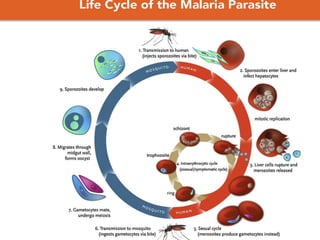
Malaria infection develops via two phases:
1. exoerythrocytic phase: involving the
liver and
2. erythrocytic phase: involving red blood
cells, or erythrocytes.
When an infected mosquito pierces a
person's skin to take a blood meal,
sporozoites in the mosquito's saliva enter
the bloodstream and migrate to the liver
where they infect hepatocytes, multiplying
asexually and asymptomatically for a
period of 8–30 days.
After a potential dormant period in
the liver, these organisms
differentiate to yield thousands of
merozoites, which, following rupture
of their host cells, escape into the
blood and infect red blood cells to
begin the erythrocytic stage of the
life cycle. The parasite escapes from
the liver undetected by wrapping
itself in the cell membrane of the
infected host liver cell.
Within the red blood cells, the parasites
multiply further, again asexually,
periodically breaking out of their host
cells to invade fresh red blood cells.
Several such amplification cycles occur.
Thus, classical descriptions of waves of
fever arise from simultaneous waves of
merozoites escaping and infecting red
blood cells.
Pathogenesis of cerebral
malaria
It is likely that the pathologies
underlying CM in humans are
highly variable and reflect a
range of attributes, including
parasite virulence, host
susceptibility and comorbidities
ranging from malnutrition to
coinfection.
Most observations of the
pathophysiology of disease come
from postmortem observations of
Plasmodium falciparum (Pf)
infections, which are thought to
account for the vast majority of CM
cases, and show a common feature
of vascular sequestration of infected
erythrocytes (IE) in the brain.
The standard clinical definition of CM
centers on:
1. a state of unarousable coma
partnered with
2. the presence of malaria infected
red blood cells(parasitized red
blood cells (pRBCs)) in the
peripheral circulation and
3. a lack of other potential causes of
coma such as other infections or
Parasite sequestration in the
brain
 Vascular sequestration of infected
erythrocytes (IE) in the brain is a
common feature of Cerebral Malaria.
 The resulting pathophysiological
changes in tissue around the
sequestered parasites, which may
explain why an intravascular parasite
may cause neural dysfunction and
why some patients may have a poor
outcome.
 Sequestration results from adherence of
pRBCs to the endothelial lining
(cytoadherence) using parasite derived
proteins exposed on erythrocyte surface.
 A group of parasite antigens including
Plasmodium falciparum erythrocyte
membrane protein-1 (PfEMP-1) mediate
binding to host receptors of which,
intercellular adhesion molecule-1 (ICAM-
1) is the most important and whose
expression is upregulated in areas adjacent
 Sequestration impairs perfusion and
may aggravate coma through hypoxia.
 Furthermore, the ability of pRBCs to
deform and pass through the
microvasculature is decreased.
 Therefore, hypoxia and inadequate
tissue perfusion may be major
pathophysiological events.
Cytokines, chemokines and
excitotoxicity
 Cytokines and chemokines play a
complex role in pathogenesis and
have both protective and harmful
effects. Parasite antigens released at
schizogony trigger the release of both
pro- and anti-inflammatory cytokines.
Although the balance between these
mediators is critical for parasite
control, their role in pathogenesis of
the neuronal damage is unclear.
Tumour necrosis factor (TNF), the most
extensively studied cytokine in cerebral
malaria, upregulates ICAM-1 expression
on the cerebral vascular endothelium
increasing the cytoadhesion of pRBCs.
Near areas of sequestration, there is
increased local synthesis.
The timing of this is important since early
in disease, TNF may be protective but
prolonged high levels contribute to
complications.
Endothelial injury, apoptosis, blood-brain
barrier (BBB) dysfunction and
intracranial hypertension
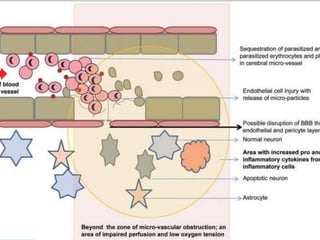
Cytoadherence of pRBCs to the
endothelium initiates a cascade of
events beginning with the
transcription of genes involved in
inflammation, cell-to-cell signalling
and signal transduction, which
result in endothelial activation,
release of endothelial micro-
particles (EMPs) and apoptosis of
host cells.
There is widespread
endothelial activation in
vessels containing pRBCs
and compared to other
complications of falciparum
malaria, significant increases
in circulating EMPs are seen
in patients in coma
Interactions between pRBCs
and platelets (which produce
platelet microparticles) cause
further injury to endothelial
cells through a direct
cytotoxic effect.
treatment
Cerebral malaria is a
syndrome of severe
malaria and therefore its
treatment falls under the
regime of treatment for
severe malaria.
objectives of treatment
The primary objective of antimalarial
treatment in severe malaria is to prevent
death.
In treating cerebral malaria, prevention
of neurological deficit is an important
objective. In the treatment of severe
malaria in pregnancy, saving the life of the
mother is the primary objective. In all cases
of severe malaria, prevention of
recrudescence and avoidance of minor
adverse effects are secondary.
Clinical features
 impaired consciousness or unrousable
coma
 prostration, i.e. generalized weakness
so that the patient is unable walk
 or sit up without assistance
 failure to feed
 multiple convulsions – more than two
episodes in 24 h
Clinical features
 – deep breathing, respiratory distress
(acidotic breathing)
 – circulatory collapse or shock, systolic
blood pressure < 70 mm Hg in adults
 and < 50 mm Hg in children
 – clinical jaundice plus evidence of other
vital organ dysfunction
 – haemoglobinuria
 – abnormal spontaneous bleeding
 – pulmonary oedema (radiological)
Laboratory findings
 hypoglycaemia (blood glucose < 2.2 mmol/l or <
40 mg/dl)
 – metabolic acidosis (plasma bicarbonate < 15
mmol/l)
 – severe normocytic anaemia (Hb < 5 g/dl,
packed cell volume < 15%)
 – haemoglobinuria
 – hyperparasitaemia (> 2%/100 000/μl in low
intensity transmission areas or > 5%
 or 250 000/μl in areas of high stable malaria
transmission intensity)
 – hyperlactataemia (lactate > 5 mmol/l)
 – renal impairment (serum creatinine > 265
μmol/l).
differential diagnosis
Coma and fever may result from
meningo-encephalitis or malaria.
Cerebral malaria is not associated with
signs of meningeal irritation (neck
stiffness, photophobia or Kernig sign),
but the patient may be opistotonic. As
untreated bacterial meningitis is almost
invariably fatal, a diagnostic lumbar
puncture should be performed to
exclude this condition.
Specific antimalarial treatment
It is essential that effective, parenteral
(or rectal) antimalarial treatment in full
doses is given promptly in severe
malaria. Two classes of medicines are
available for the parenteral treatment of
severe malaria:
 the cinchona alkaloids (quinine and
quinidine) and the
 artemisinin derivatives (artesunate,
artemether and artemotil).
Parenteral Chloroquine is no
longer recommended for the
treatment of severe malaria,
because of widespread
resistance. Intramuscular
sulfadoxine-pyrimethamine
is also not recommended.
Artemisinin derivatives
Various artemisinin derivatives have
been used in the treatment of severe
malaria, including
1. artemether
2. artemisinin
3. artemotil
4. artesunate
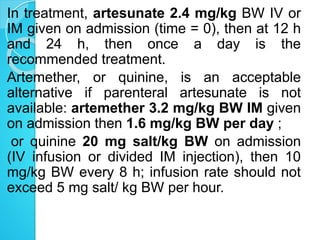
In treatment, artesunate 2.4 mg/kg BW IV or
IM given on admission (time = 0), then at 12 h
and 24 h, then once a day is the
recommended treatment.
Artemether, or quinine, is an acceptable
alternative if parenteral artesunate is not
available: artemether 3.2 mg/kg BW IM given
on admission then 1.6 mg/kg BW per day ;
or quinine 20 mg salt/kg BW on admission
(IV infusion or divided IM injection), then 10
mg/kg BW every 8 h; infusion rate should not
exceed 5 mg salt/ kg BW per hour.
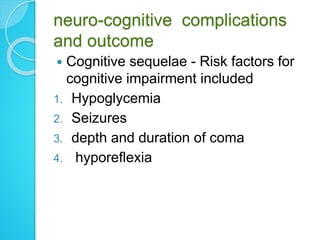
neuro-cognitive complications
and outcome
 Cognitive sequelae - Risk factors for
cognitive impairment included
1. Hypoglycemia
2. Seizures
3. depth and duration of coma
4. hyporeflexia
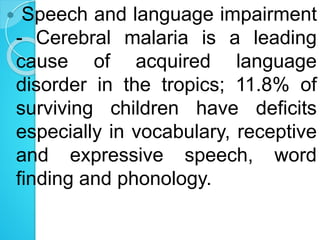
 Speech and language impairment
- Cerebral malaria is a leading
cause of acquired language
disorder in the tropics; 11.8% of
surviving children have deficits
especially in vocabulary, receptive
and expressive speech, word
finding and phonology.
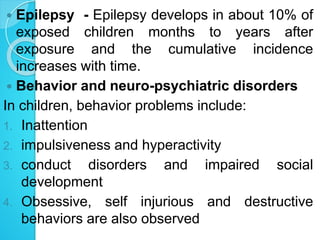
 Epilepsy - Epilepsy develops in about 10% of
exposed children months to years after
exposure and the cumulative incidence
increases with time.
 Behavior and neuro-psychiatric disorders
In children, behavior problems include:
1. Inattention
2. impulsiveness and hyperactivity
3. conduct disorders and impaired social
development
4. Obsessive, self injurious and destructive
behaviors are also observed

Cerebral malaria

  • 1.
    CEREBRAL MALARIA mechanisms ofbrain injury (pathogenesis), treatment and neuro- cognitive outcome.
  • 2.
    introductory Malaria is amosquito-borne infectious disease of humans and other animals caused by parasitic protozoans of the genus Plasmodium. Commonly, the disease is transmitted by a bite from an infected female Anopheles mosquito, which introduces the organisms from its saliva into a person's circulatory system. In the blood, the parasites travel to the liver to mature and reproduce.
  • 3.
    Five species ofPlasmodium can infect and be transmitted by humans. I. Plasmodium malariae II. Plasmodium ovale III. Plasmodium vivax IV. Plasmodium falciparum V. Plasmodium knowlesi
  • 4.
    General pathophysiology Malaria infectiondevelops via two phases: 1. exoerythrocytic phase: involving the liver and 2. erythrocytic phase: involving red blood cells, or erythrocytes. When an infected mosquito pierces a person's skin to take a blood meal, sporozoites in the mosquito's saliva enter the bloodstream and migrate to the liver where they infect hepatocytes, multiplying asexually and asymptomatically for a period of 8–30 days.
  • 5.
    After a potentialdormant period in the liver, these organisms differentiate to yield thousands of merozoites, which, following rupture of their host cells, escape into the blood and infect red blood cells to begin the erythrocytic stage of the life cycle. The parasite escapes from the liver undetected by wrapping itself in the cell membrane of the infected host liver cell.
  • 6.
    Within the redblood cells, the parasites multiply further, again asexually, periodically breaking out of their host cells to invade fresh red blood cells. Several such amplification cycles occur. Thus, classical descriptions of waves of fever arise from simultaneous waves of merozoites escaping and infecting red blood cells.
  • 8.
    Pathogenesis of cerebral malaria Itis likely that the pathologies underlying CM in humans are highly variable and reflect a range of attributes, including parasite virulence, host susceptibility and comorbidities ranging from malnutrition to coinfection.
  • 9.
    Most observations ofthe pathophysiology of disease come from postmortem observations of Plasmodium falciparum (Pf) infections, which are thought to account for the vast majority of CM cases, and show a common feature of vascular sequestration of infected erythrocytes (IE) in the brain.
  • 10.
    The standard clinicaldefinition of CM centers on: 1. a state of unarousable coma partnered with 2. the presence of malaria infected red blood cells(parasitized red blood cells (pRBCs)) in the peripheral circulation and 3. a lack of other potential causes of coma such as other infections or
  • 11.
    Parasite sequestration inthe brain  Vascular sequestration of infected erythrocytes (IE) in the brain is a common feature of Cerebral Malaria.  The resulting pathophysiological changes in tissue around the sequestered parasites, which may explain why an intravascular parasite may cause neural dysfunction and why some patients may have a poor outcome.
  • 12.
     Sequestration resultsfrom adherence of pRBCs to the endothelial lining (cytoadherence) using parasite derived proteins exposed on erythrocyte surface.  A group of parasite antigens including Plasmodium falciparum erythrocyte membrane protein-1 (PfEMP-1) mediate binding to host receptors of which, intercellular adhesion molecule-1 (ICAM- 1) is the most important and whose expression is upregulated in areas adjacent
  • 13.
     Sequestration impairsperfusion and may aggravate coma through hypoxia.  Furthermore, the ability of pRBCs to deform and pass through the microvasculature is decreased.  Therefore, hypoxia and inadequate tissue perfusion may be major pathophysiological events.
  • 14.
    Cytokines, chemokines and excitotoxicity Cytokines and chemokines play a complex role in pathogenesis and have both protective and harmful effects. Parasite antigens released at schizogony trigger the release of both pro- and anti-inflammatory cytokines. Although the balance between these mediators is critical for parasite control, their role in pathogenesis of the neuronal damage is unclear.
  • 15.
    Tumour necrosis factor(TNF), the most extensively studied cytokine in cerebral malaria, upregulates ICAM-1 expression on the cerebral vascular endothelium increasing the cytoadhesion of pRBCs. Near areas of sequestration, there is increased local synthesis. The timing of this is important since early in disease, TNF may be protective but prolonged high levels contribute to complications.
  • 16.
    Endothelial injury, apoptosis,blood-brain barrier (BBB) dysfunction and intracranial hypertension Cytoadherence of pRBCs to the endothelium initiates a cascade of events beginning with the transcription of genes involved in inflammation, cell-to-cell signalling and signal transduction, which result in endothelial activation, release of endothelial micro- particles (EMPs) and apoptosis of host cells.
  • 17.
    There is widespread endothelialactivation in vessels containing pRBCs and compared to other complications of falciparum malaria, significant increases in circulating EMPs are seen in patients in coma
  • 18.
    Interactions between pRBCs andplatelets (which produce platelet microparticles) cause further injury to endothelial cells through a direct cytotoxic effect.
  • 20.
    treatment Cerebral malaria isa syndrome of severe malaria and therefore its treatment falls under the regime of treatment for severe malaria.
  • 21.
    objectives of treatment Theprimary objective of antimalarial treatment in severe malaria is to prevent death. In treating cerebral malaria, prevention of neurological deficit is an important objective. In the treatment of severe malaria in pregnancy, saving the life of the mother is the primary objective. In all cases of severe malaria, prevention of recrudescence and avoidance of minor adverse effects are secondary.
  • 22.
    Clinical features  impairedconsciousness or unrousable coma  prostration, i.e. generalized weakness so that the patient is unable walk  or sit up without assistance  failure to feed  multiple convulsions – more than two episodes in 24 h
  • 23.
    Clinical features  –deep breathing, respiratory distress (acidotic breathing)  – circulatory collapse or shock, systolic blood pressure < 70 mm Hg in adults  and < 50 mm Hg in children  – clinical jaundice plus evidence of other vital organ dysfunction  – haemoglobinuria  – abnormal spontaneous bleeding  – pulmonary oedema (radiological)
  • 24.
    Laboratory findings  hypoglycaemia(blood glucose < 2.2 mmol/l or < 40 mg/dl)  – metabolic acidosis (plasma bicarbonate < 15 mmol/l)  – severe normocytic anaemia (Hb < 5 g/dl, packed cell volume < 15%)  – haemoglobinuria  – hyperparasitaemia (> 2%/100 000/μl in low intensity transmission areas or > 5%  or 250 000/μl in areas of high stable malaria transmission intensity)  – hyperlactataemia (lactate > 5 mmol/l)  – renal impairment (serum creatinine > 265 μmol/l).
  • 25.
    differential diagnosis Coma andfever may result from meningo-encephalitis or malaria. Cerebral malaria is not associated with signs of meningeal irritation (neck stiffness, photophobia or Kernig sign), but the patient may be opistotonic. As untreated bacterial meningitis is almost invariably fatal, a diagnostic lumbar puncture should be performed to exclude this condition.
  • 26.
    Specific antimalarial treatment Itis essential that effective, parenteral (or rectal) antimalarial treatment in full doses is given promptly in severe malaria. Two classes of medicines are available for the parenteral treatment of severe malaria:  the cinchona alkaloids (quinine and quinidine) and the  artemisinin derivatives (artesunate, artemether and artemotil).
  • 27.
    Parenteral Chloroquine isno longer recommended for the treatment of severe malaria, because of widespread resistance. Intramuscular sulfadoxine-pyrimethamine is also not recommended.
  • 28.
    Artemisinin derivatives Various artemisininderivatives have been used in the treatment of severe malaria, including 1. artemether 2. artemisinin 3. artemotil 4. artesunate
  • 29.
    In treatment, artesunate2.4 mg/kg BW IV or IM given on admission (time = 0), then at 12 h and 24 h, then once a day is the recommended treatment. Artemether, or quinine, is an acceptable alternative if parenteral artesunate is not available: artemether 3.2 mg/kg BW IM given on admission then 1.6 mg/kg BW per day ; or quinine 20 mg salt/kg BW on admission (IV infusion or divided IM injection), then 10 mg/kg BW every 8 h; infusion rate should not exceed 5 mg salt/ kg BW per hour.
  • 30.
    neuro-cognitive complications and outcome Cognitive sequelae - Risk factors for cognitive impairment included 1. Hypoglycemia 2. Seizures 3. depth and duration of coma 4. hyporeflexia
  • 31.
     Speech andlanguage impairment - Cerebral malaria is a leading cause of acquired language disorder in the tropics; 11.8% of surviving children have deficits especially in vocabulary, receptive and expressive speech, word finding and phonology.
  • 32.
     Epilepsy -Epilepsy develops in about 10% of exposed children months to years after exposure and the cumulative incidence increases with time.  Behavior and neuro-psychiatric disorders In children, behavior problems include: 1. Inattention 2. impulsiveness and hyperactivity 3. conduct disorders and impaired social development 4. Obsessive, self injurious and destructive behaviors are also observed