
RESTRAINTS
Kuldeep Vyas
Associate Professor
Dept. Community Health Nursing
K
uldeepV
y
as
A
ssociat
eProf
essor
D
ept
.– Com
m
u
n
it
yH
ealt
hN
ursin
g
2
RESTRAINTS
“A restraint is any manual method, physical or mechanical device, material or equipment that
immobilizes or reduces the ability of a patient to move his/her arms, legs, body or head freely” (e.g. -
Safe keeper bed, Posey bed, safety mitt, soft limb restraint), or a restraint is a drug or medication
when it is used as a restriction to manage the patient's behavior or restrict the patient's freedom of
movement and is not standard treatment or dosage for the patient's condition A restraint does not
include devices, such as orthopedically prescribed devices, surgical dressings or bandages, protective
helmets, or other methods that involve the physical holding of a patient for the purpose of conducting
routine physical examinations or tests, or to protect the patient from falling out of bed, or to permit
the patient to participate in activities without the risk of physical harm., side rails, airways, trapeze
etc.
Purpose of restraints: -
1. For behavioral control
2. To prevent fall and avoid injury
3. To reduce the risk of injury to others.
4. To immobilize the part
5. To Prevent interruption of therapy
Indication: -
1. Behavior that is putting themselves at risk of harm
2. Behavior that is putting others at risk of harm
K
uldeepV
y
as
A
ssociat
eProf
essor
D
ept
.– Com
m
u
n
it
yH
ealt
hN
ursin
g
3
3. Treatment by a legal order, for example, under the Mental Health Act 2007
4. Requiring urgent life-saving treatment
5. Needing to be maintained in secure settings
 Types of restraints: -
Restraints may be classified in to four types. They are:
1. Environmental restraint,
2. Physical restraint,
3. Mechanical restraint,
4. Chemical restraint.
1. Environmental restraint: - Environmental restraint limits the area where patient can move freely.
2. Physical restraint: - Physical restraint involves having one or more persons restrain patient through body contact alone.
3. Chemical restraint: - Chemical restraint may be any medicine that helps patient to calm down and relax.
4. Mechanical restraint: - Mechanical restraint involves the use of devices placed on the wrists, ankles, or chest.
K
uldeepV
y
as
A
ssociat
eProf
essor
D
ept
.– Com
m
u
n
it
yH
ealt
hN
ursin
g
4
TYPES AND PURPOSES OF MECHANICAL RESTRAINTS AND METHODS OF APPLICATIONS
S. No. Type and Purposes Methods of Application
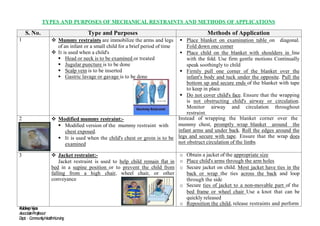
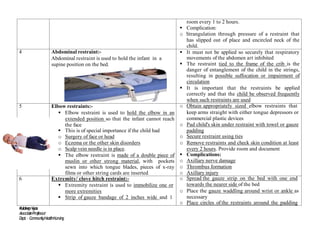
1  Mummy restraints are immobilize the arms and legs
of an infant or a small child for a brief period of time
 It is used when a child's
 Head or neck is to be examined or treated
 Jugular puncture is to be done
 Scalp vein is to be inserted
 Gastric lavage or gavage is to be done
 Place blanket on examination table on diagonal.
Fold down one comer
 Place child on the blanket with shoulders in line
with the fold. Use firm gentle motions Continually
speak soothingly to child
 Firmly pull one corner of the blanket over the
infant's body and tuck under the opposite. Pull the
bottom up and secure ends of the blanket with tape
to keep in place
 Do not cover child's face. Ensure that the wrapping
is not obstructing child's airway or circulation.
Monitor airway and circulation throughout
restraint.
2  Modified mummy restraint:-
 Modified version of the mummy restraint with
chest exposed.
 It is used when the child's chest or groin is to be
examined
Instead of wrapping the blanket corner over the
mummy chest, promptly wrap blanket around the
infant arms and under back. Roll the edges around the
legs and secure with tape. Ensure that the wrap does
not obstruct circulation of the limbs
3  Jacket restraint:-
Jacket restraint is used to help child remain flat in
bed in a supine position or to prevent the child from
falling from a high chair, wheel chair, or other
conveyance
o Obtain a jacket of the appropriate size
o Place child's arms through the arm holes
o Secure jacket on child. Most jacket have ties in the
back or wrap the ties across the back and loop
through the side
o Secure ties of jacket to a non-movable part of the
bed frame or wheel chair Use a knot that can be
quickly released
o Reposition the child, release restraints and perform
K
uldeepV
y
as
A
ssociat
eProf
essor
D
ept
.– Com
m
u
n
it
yH
ealt
hN
ursin
g
5
room every 1 to 2 hours.
 Complication:
o Strangulation through pressure of a restraint that
has slipped out of place and encircled neck of the
child.
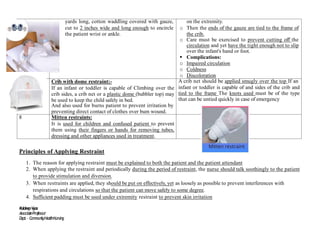
4 Abdominal restraint:-
Abdominal restraint is used to hold the infant in a
supine position on the bed.
 It must not be applied so securely that respiratory
movements of the abdomen art inhibited
 The restraint tied to the frame of the crib is the
danger of entanglement of the child in the strings,
resulting in possible suffocation or impairment of
circulation
 It is important that the restraints be applied
correctly and that the child be observed frequently
when such restraints are used
5 Elbow restraints:-
 Elbow restraint is used to hold the elbow in an
extended position so that the infant cannot reach
the face
 This is of special importance if the child had
o Surgery of face or head
o Eczema or the other skin disorders
o Scalp vein needle is in place.
 The elbow restraint is made of a double piece of
muslin or other strong material, with pockets
sewn into which tongue blades, pieces of x-ray
films or other string cards are inserted
o Obtain appropriately sized elbow restraints that
keep arms straight with either tongue depressors or
commercial plastic devices
o Pad child's skin under restraint with towel or gauze
padding
o Secure restraint using ties
o Remove restraints and check skin condition at least
every 2 hours. Provide room and document
 Complications:
o Axillary nerve damage
o Thrombus formation
o Axillary injury
6 Extremity/ clove hitch restraint:-
 Extremity restraint is used to immobilize one or
more extremities
 Strip of gauze bandage of 2 inches wide and 1
o Spread the gauze strip on the bed with one end
towards the nearer side of the bed
o Place the gauze waddling around wrist or ankle as
necessary
o Place circles of the restraints around the padding
yards long, cotton waddling covered with gauze,
cut to 2 inches wide and long enough to encircle
the patient wrist or ankle.
on the extremity.
o Then the ends of the gauze are tied to the frame of
the crib.
o Care must be exercised to prevent cutting off the
circulation and yet have the tight enough not to slip
over the infant's hand or foot.
 Complications:
o Impaired circulation
o Coldness
o Discoloration
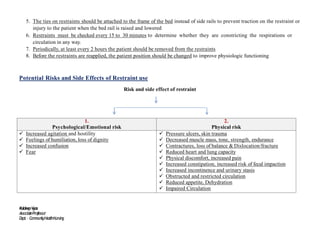
7 Crib with dome restraint:-
If an infant or toddler is capable of Climbing over the
crib sides, a crib net or a plastic dome (bubbler top) may
be used to keep the child safely in bed.
And also used for burns patient to prevent irritation by
preventing direct contact of clothes over bum wound.
A crib net should be applied smugly over the top If an
infant or toddler is capable of and sides of the crib and
tied to the frame The knots used must be of the type
that can be untied quickly in case of emergency
8 Mitten restraints:
It is used for children and confused patient to prevent
them using their fingers or hands for removing tubes,
dressing and other appliances used in treatment.
Principles of Applying Restraint
1. The reason for applying restraint must be explained to both the patient and the patient attendant
2. When applying the restraint and periodically during the period of restraint, the nurse should talk soothingly to the patient
to provide stimulation and diversion.
3. When restraints are applied, they should be put on effectively, yet as loosely as possible to prevent interferences with
respirations and circulations so that the patient can move safely to some degree.
4. Sufficient padding must be used under extremity restraint to prevent skin irritation
K
uldeepV
y
as
A
ssociat
eProf
essor
D
ept
.– Com
m
u
n
it
yH
ealt
hN
ursin
g
6
5. The ties on restraints should be attached to the frame of the bed instead of side rails to prevent traction on the restraint or
injury to the patient when the bed rail is raised and lowered
6. Restraints must be checked every 15 to 30 minutes to determine whether they are constricting the respirations or
circulation in any way.
7. Periodically, at least every 2 hours the patient should be removed from the restraints
8. Before the restraints are reapplied, the patient position should be changed to improve physiologic functioning
Potential Risks and Side Effects of Restraint use
Risk and side effect of restraint
1.
Psychological/Emotional risk
2.
Physical risk
 Increased agitation and hostility
 Feelings of humiliation, loss of dignity
 Increased confusion
 Fear
 Pressure ulcers, skin trauma
 Decreased muscle mass, tone, strength, endurance
 Contractures, loss of balance & Dislocation/fracture
 Reduced heart and lung capacity
 Physical discomfort, increased pain
 Increased constipation, increased risk of fecal impaction
 Increased incontinence and urinary stasis
 Obstructed and restricted circulation
 Reduced appetite, Dehydration
 Impaired Circulation
K
uldeepV
y
as
A
ssociat
eProf
essor
D
ept
.– Com
m
u
n
it
yH
ealt
hN
ursin
g
7
K
uldeepV
y
as
A
ssociat
eProf
essor
D
ept
.– Com
m
u
n
it
yH
ealt
hN
ursin
g
8
Legal implications and consent
1. Doctors order physician order in must to implement restraint
2. Informed consent it is must to get consent from the patient or guardian
Restraint order
Situational restraints Medical restraints Behavioral restraints
Initiation of Restraints (ALWAYS after
alternatives tried)
Obtain written or verbal order within 12
hours of initiation, physician exam within
24 hours Every 24 hours
May apply in emergency, but get doctor
order with in 1 hour. Physician must do
face-to-face assessment within 1 hour of
restraint initiation.
Renewing Order Every 24 hours In accordance with following limits up to
a total of 24 hours
4 hrs for adults 18 and up
o 2 hrs for children 9-17 years of age
o 1 hr for children nine and under
Thank You…

RESTRAINTS.pptx

  • 1.
  • 2.
    K uldeepV y as A ssociat eProf essor D ept .– Com m u n it yH ealt hN ursin g 2 RESTRAINTS “A restraintis any manual method, physical or mechanical device, material or equipment that immobilizes or reduces the ability of a patient to move his/her arms, legs, body or head freely” (e.g. - Safe keeper bed, Posey bed, safety mitt, soft limb restraint), or a restraint is a drug or medication when it is used as a restriction to manage the patient's behavior or restrict the patient's freedom of movement and is not standard treatment or dosage for the patient's condition A restraint does not include devices, such as orthopedically prescribed devices, surgical dressings or bandages, protective helmets, or other methods that involve the physical holding of a patient for the purpose of conducting routine physical examinations or tests, or to protect the patient from falling out of bed, or to permit the patient to participate in activities without the risk of physical harm., side rails, airways, trapeze etc. Purpose of restraints: - 1. For behavioral control 2. To prevent fall and avoid injury 3. To reduce the risk of injury to others. 4. To immobilize the part 5. To Prevent interruption of therapy Indication: - 1. Behavior that is putting themselves at risk of harm 2. Behavior that is putting others at risk of harm
  • 3.
    K uldeepV y as A ssociat eProf essor D ept .– Com m u n it yH ealt hN ursin g 3 3. Treatmentby a legal order, for example, under the Mental Health Act 2007 4. Requiring urgent life-saving treatment 5. Needing to be maintained in secure settings  Types of restraints: - Restraints may be classified in to four types. They are: 1. Environmental restraint, 2. Physical restraint, 3. Mechanical restraint, 4. Chemical restraint. 1. Environmental restraint: - Environmental restraint limits the area where patient can move freely. 2. Physical restraint: - Physical restraint involves having one or more persons restrain patient through body contact alone. 3. Chemical restraint: - Chemical restraint may be any medicine that helps patient to calm down and relax. 4. Mechanical restraint: - Mechanical restraint involves the use of devices placed on the wrists, ankles, or chest.
  • 4.
    K uldeepV y as A ssociat eProf essor D ept .– Com m u n it yH ealt hN ursin g 4 TYPES ANDPURPOSES OF MECHANICAL RESTRAINTS AND METHODS OF APPLICATIONS S. No. Type and Purposes Methods of Application 1  Mummy restraints are immobilize the arms and legs of an infant or a small child for a brief period of time  It is used when a child's  Head or neck is to be examined or treated  Jugular puncture is to be done  Scalp vein is to be inserted  Gastric lavage or gavage is to be done  Place blanket on examination table on diagonal. Fold down one comer  Place child on the blanket with shoulders in line with the fold. Use firm gentle motions Continually speak soothingly to child  Firmly pull one corner of the blanket over the infant's body and tuck under the opposite. Pull the bottom up and secure ends of the blanket with tape to keep in place  Do not cover child's face. Ensure that the wrapping is not obstructing child's airway or circulation. Monitor airway and circulation throughout restraint. 2  Modified mummy restraint:-  Modified version of the mummy restraint with chest exposed.  It is used when the child's chest or groin is to be examined Instead of wrapping the blanket corner over the mummy chest, promptly wrap blanket around the infant arms and under back. Roll the edges around the legs and secure with tape. Ensure that the wrap does not obstruct circulation of the limbs 3  Jacket restraint:- Jacket restraint is used to help child remain flat in bed in a supine position or to prevent the child from falling from a high chair, wheel chair, or other conveyance o Obtain a jacket of the appropriate size o Place child's arms through the arm holes o Secure jacket on child. Most jacket have ties in the back or wrap the ties across the back and loop through the side o Secure ties of jacket to a non-movable part of the bed frame or wheel chair Use a knot that can be quickly released o Reposition the child, release restraints and perform
  • 5.
    K uldeepV y as A ssociat eProf essor D ept .– Com m u n it yH ealt hN ursin g 5 room every1 to 2 hours.  Complication: o Strangulation through pressure of a restraint that has slipped out of place and encircled neck of the child. 4 Abdominal restraint:- Abdominal restraint is used to hold the infant in a supine position on the bed.  It must not be applied so securely that respiratory movements of the abdomen art inhibited  The restraint tied to the frame of the crib is the danger of entanglement of the child in the strings, resulting in possible suffocation or impairment of circulation  It is important that the restraints be applied correctly and that the child be observed frequently when such restraints are used 5 Elbow restraints:-  Elbow restraint is used to hold the elbow in an extended position so that the infant cannot reach the face  This is of special importance if the child had o Surgery of face or head o Eczema or the other skin disorders o Scalp vein needle is in place.  The elbow restraint is made of a double piece of muslin or other strong material, with pockets sewn into which tongue blades, pieces of x-ray films or other string cards are inserted o Obtain appropriately sized elbow restraints that keep arms straight with either tongue depressors or commercial plastic devices o Pad child's skin under restraint with towel or gauze padding o Secure restraint using ties o Remove restraints and check skin condition at least every 2 hours. Provide room and document  Complications: o Axillary nerve damage o Thrombus formation o Axillary injury 6 Extremity/ clove hitch restraint:-  Extremity restraint is used to immobilize one or more extremities  Strip of gauze bandage of 2 inches wide and 1 o Spread the gauze strip on the bed with one end towards the nearer side of the bed o Place the gauze waddling around wrist or ankle as necessary o Place circles of the restraints around the padding
  • 6.
    yards long, cottonwaddling covered with gauze, cut to 2 inches wide and long enough to encircle the patient wrist or ankle. on the extremity. o Then the ends of the gauze are tied to the frame of the crib. o Care must be exercised to prevent cutting off the circulation and yet have the tight enough not to slip over the infant's hand or foot.  Complications: o Impaired circulation o Coldness o Discoloration 7 Crib with dome restraint:- If an infant or toddler is capable of Climbing over the crib sides, a crib net or a plastic dome (bubbler top) may be used to keep the child safely in bed. And also used for burns patient to prevent irritation by preventing direct contact of clothes over bum wound. A crib net should be applied smugly over the top If an infant or toddler is capable of and sides of the crib and tied to the frame The knots used must be of the type that can be untied quickly in case of emergency 8 Mitten restraints: It is used for children and confused patient to prevent them using their fingers or hands for removing tubes, dressing and other appliances used in treatment. Principles of Applying Restraint 1. The reason for applying restraint must be explained to both the patient and the patient attendant 2. When applying the restraint and periodically during the period of restraint, the nurse should talk soothingly to the patient to provide stimulation and diversion. 3. When restraints are applied, they should be put on effectively, yet as loosely as possible to prevent interferences with respirations and circulations so that the patient can move safely to some degree. 4. Sufficient padding must be used under extremity restraint to prevent skin irritation K uldeepV y as A ssociat eProf essor D ept .– Com m u n it yH ealt hN ursin g 6
  • 7.
    5. The tieson restraints should be attached to the frame of the bed instead of side rails to prevent traction on the restraint or injury to the patient when the bed rail is raised and lowered 6. Restraints must be checked every 15 to 30 minutes to determine whether they are constricting the respirations or circulation in any way. 7. Periodically, at least every 2 hours the patient should be removed from the restraints 8. Before the restraints are reapplied, the patient position should be changed to improve physiologic functioning Potential Risks and Side Effects of Restraint use Risk and side effect of restraint 1. Psychological/Emotional risk 2. Physical risk  Increased agitation and hostility  Feelings of humiliation, loss of dignity  Increased confusion  Fear  Pressure ulcers, skin trauma  Decreased muscle mass, tone, strength, endurance  Contractures, loss of balance & Dislocation/fracture  Reduced heart and lung capacity  Physical discomfort, increased pain  Increased constipation, increased risk of fecal impaction  Increased incontinence and urinary stasis  Obstructed and restricted circulation  Reduced appetite, Dehydration  Impaired Circulation K uldeepV y as A ssociat eProf essor D ept .– Com m u n it yH ealt hN ursin g 7
  • 8.
    K uldeepV y as A ssociat eProf essor D ept .– Com m u n it yH ealt hN ursin g 8 Legal implicationsand consent 1. Doctors order physician order in must to implement restraint 2. Informed consent it is must to get consent from the patient or guardian Restraint order Situational restraints Medical restraints Behavioral restraints Initiation of Restraints (ALWAYS after alternatives tried) Obtain written or verbal order within 12 hours of initiation, physician exam within 24 hours Every 24 hours May apply in emergency, but get doctor order with in 1 hour. Physician must do face-to-face assessment within 1 hour of restraint initiation. Renewing Order Every 24 hours In accordance with following limits up to a total of 24 hours 4 hrs for adults 18 and up o 2 hrs for children 9-17 years of age o 1 hr for children nine and under
  • 9.