PLASMODIUM
Submitted by
Chandrakant
Submitted to
Department of microbiology
SYNOPSIS
•Introduction
•Disease
•Life cycle
•Clinical manifestation
•Reference
INTRODUCTION
• Plasmodium is a genus of parasite protozoans. They are
unicellular eukaryotes. They are Cresent (banana) shaped.
• Plasmodium genome contain 14 chromosomes. They donot
show uniform gram stain.
• It is oldest known parasite in world. They cause disease malaria.
• Malaria comes from Latin word mal- bad and aria- air.
• Their hosts are vertebrates (human, monkey ) and mosquito.
• To cause malaria in human they use mosquitos as vector.
They come under:
Phylum- Apicomplexa
Class- Aconoidasida
Order- Haemospororida
Family - Plasmodiidae
Genus - Plasmodium
In 1880 Charles Louis Alphonse Laveran first described presence of
plasmodium parasite in blood of malaria patients.
Habitat: 1. plasmodium is found in parenchymal cells of liver and
RBCs of human, perform asexual cycle.
2. Live inside female Anopheles minimus Flavirustris, perform sexual
cycle
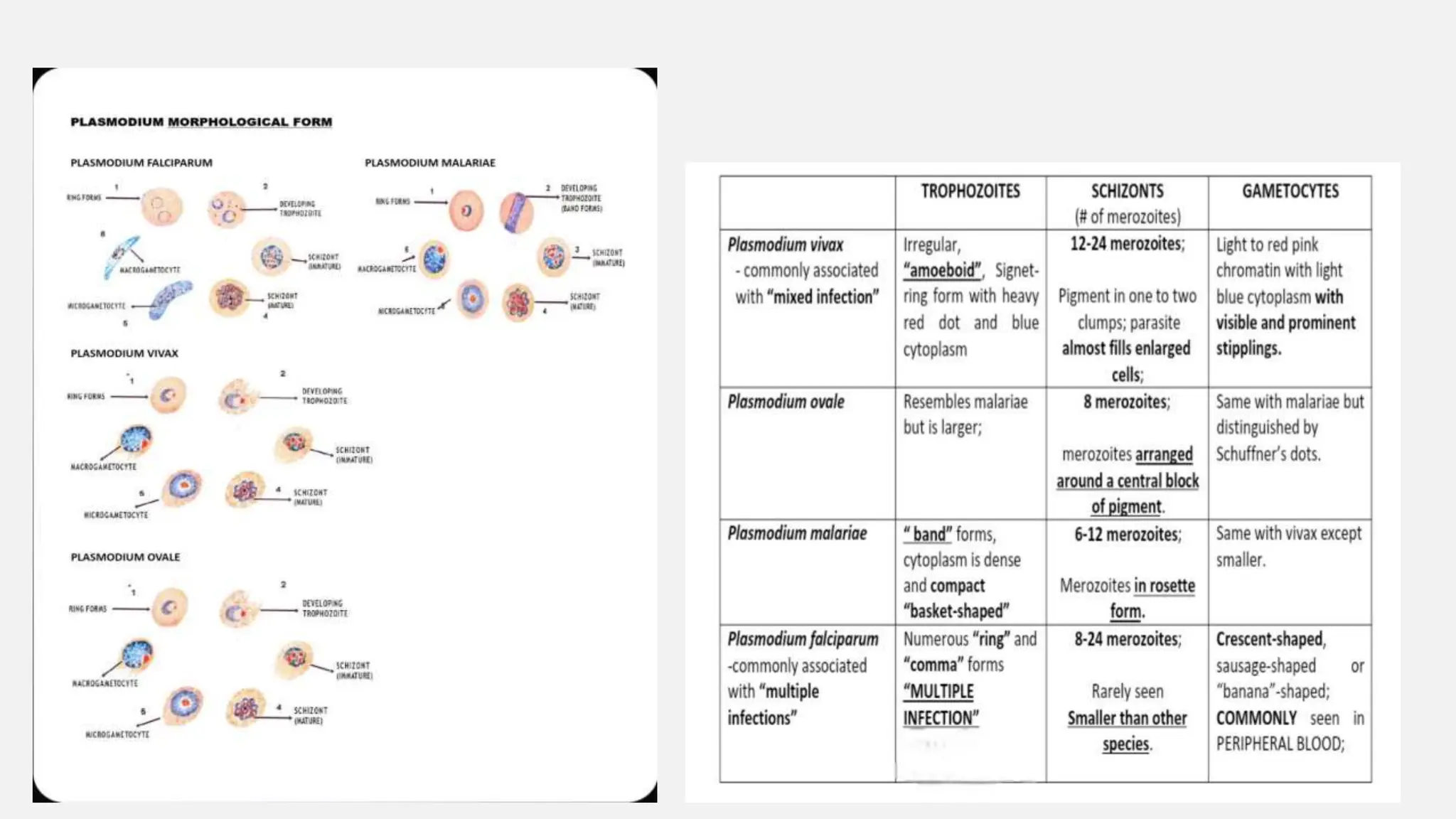
MORPHOLOGY
Plasmodium life has various stages:
• Ring form Trophozoite: it is the earliest form of plasmodium
found in RBCs of human. It has chromatin, Cytoplasm, nucleus.
• Schizonts: second stage in this nucleus divide into 8 – 24 nuclei.
Each nucleus is enclosed by cytoplasm forming merozoites.
• Gametocytes: this stage is sexual form with elongated
nucleus.these are infectious to mosquitoes.
SPECIES
Some disease causing in human species of plasmodium are:
1. Plasmodium falciparum : cause malignant Tertian Malaria
2. Plasmodium vivax: Benign Tertian Malaria
3. Plasmodium malariae: Quartan Tertian Malaria
4. Plasmodium ovale: Benign Tertian Malaria
P.Falciparum also cause black water fever it’s
Symptoms are : intravascular hemolysis,
Kidney failure, Hemoglobinuria( hemoglobin
In urine).
LIFE CYCLE OF PLASMODIUM
The life cycle is passed into two hosts a vertebrate ( human ) and
mosquito.
• Asexual phase in human [schizogony]: this take place in two
stages:
Exo Erythrocytic Schizogony : the infectious sporozoites are
injected from salivary gland of female Anopheles mosquitoes
during biting, into the blood stream of human.
Within 30 minutes this motile sporozoite enter liver parenchymal
cells and there it undergoes nuclear division and cytoplasmic
division and give rise to merozoites.
The parasitized liver cells ruptures and release merozoites out to
initiate Erythrocytic cycle.
Erythrocytic Schizogony: the released merozoties enters RBCs at this
symptoms such as fever, swelling, chills, can be seen.
Then in RBCs the merozoites develop into trophozoites and then
develop into schizonts then the cells are ruptured and re invasion to
news cells occurs.
Gametogony: some merozoites released from RBC donot undergoes
schizogony nor infect more RBCs but they develop into male and
female gametocytes which are infectious to mosquitoes.
• Sexual phase in mosquitoes [sporogony]: male and female
gametocytes are sucked in by mosquitoes during blood meal (biting)
which undergoes maturation and differentiation into microgametes
(male) and macrogametes(female).
Microgamete fertilize macrogamete producing zygote. The zygote
becomes motile and penetrates the mosquito’s gut as ookinette which
develop into oocyst.
• The oocyst undergoes division (Sporogony) and give rise to many
sporozoites which is infectious to human. When mosquito bite human
sporozoites enter human liver cells.
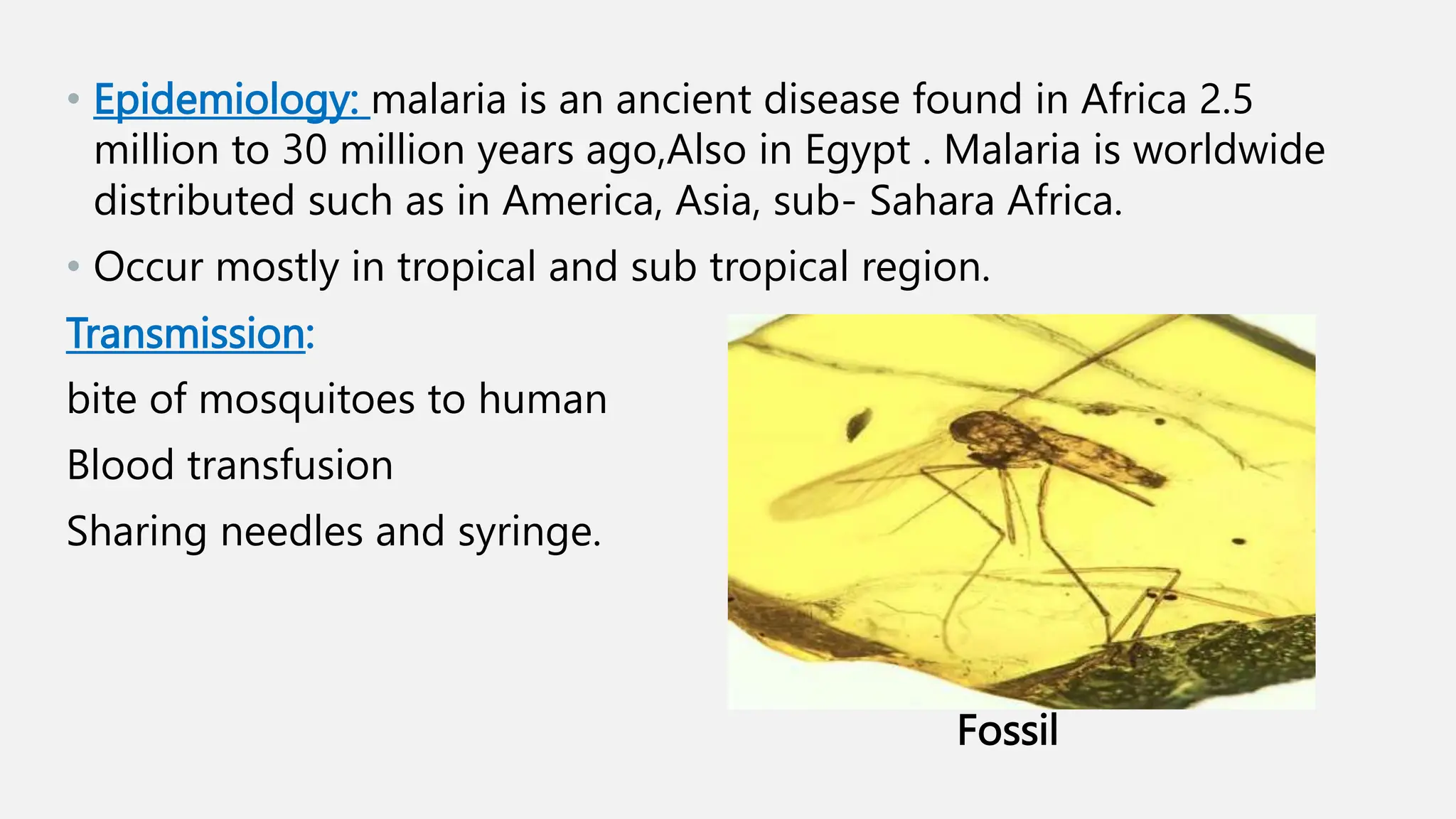
• Epidemiology: malaria is an ancient disease found in Africa 2.5
million to 30 million years ago,Also in Egypt . Malaria is worldwide
distributed such as in America, Asia, sub- Sahara Africa.
• Occur mostly in tropical and sub tropical region.
Transmission:
bite of mosquitoes to human
Blood transfusion
Sharing needles and syringe.
Fossil
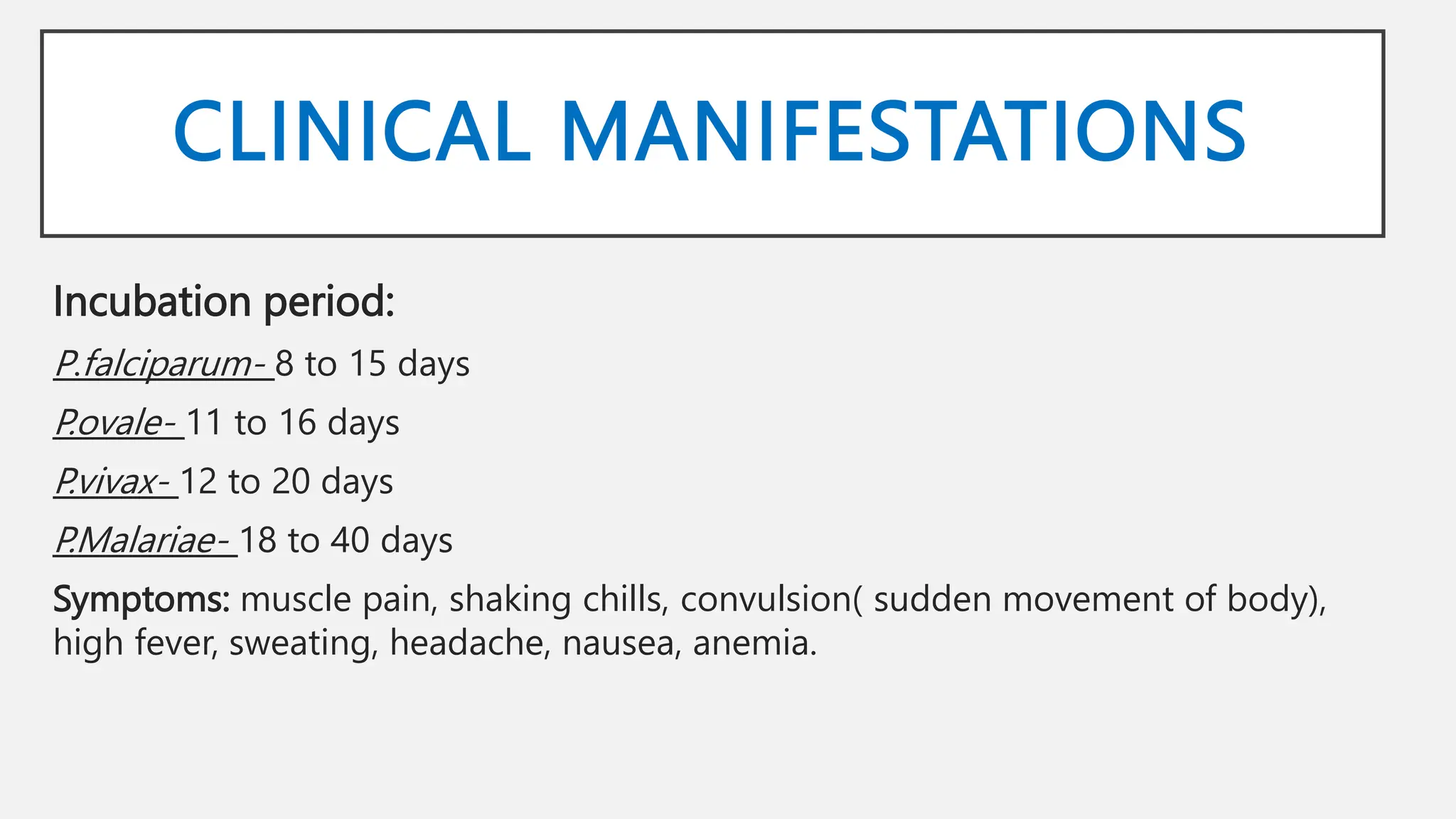
CLINICAL MANIFESTATIONS
Incubation period:
P.falciparum- 8 to 15 days
P.ovale- 11 to 16 days
P.vivax- 12 to 20 days
P.Malariae- 18 to 40 days
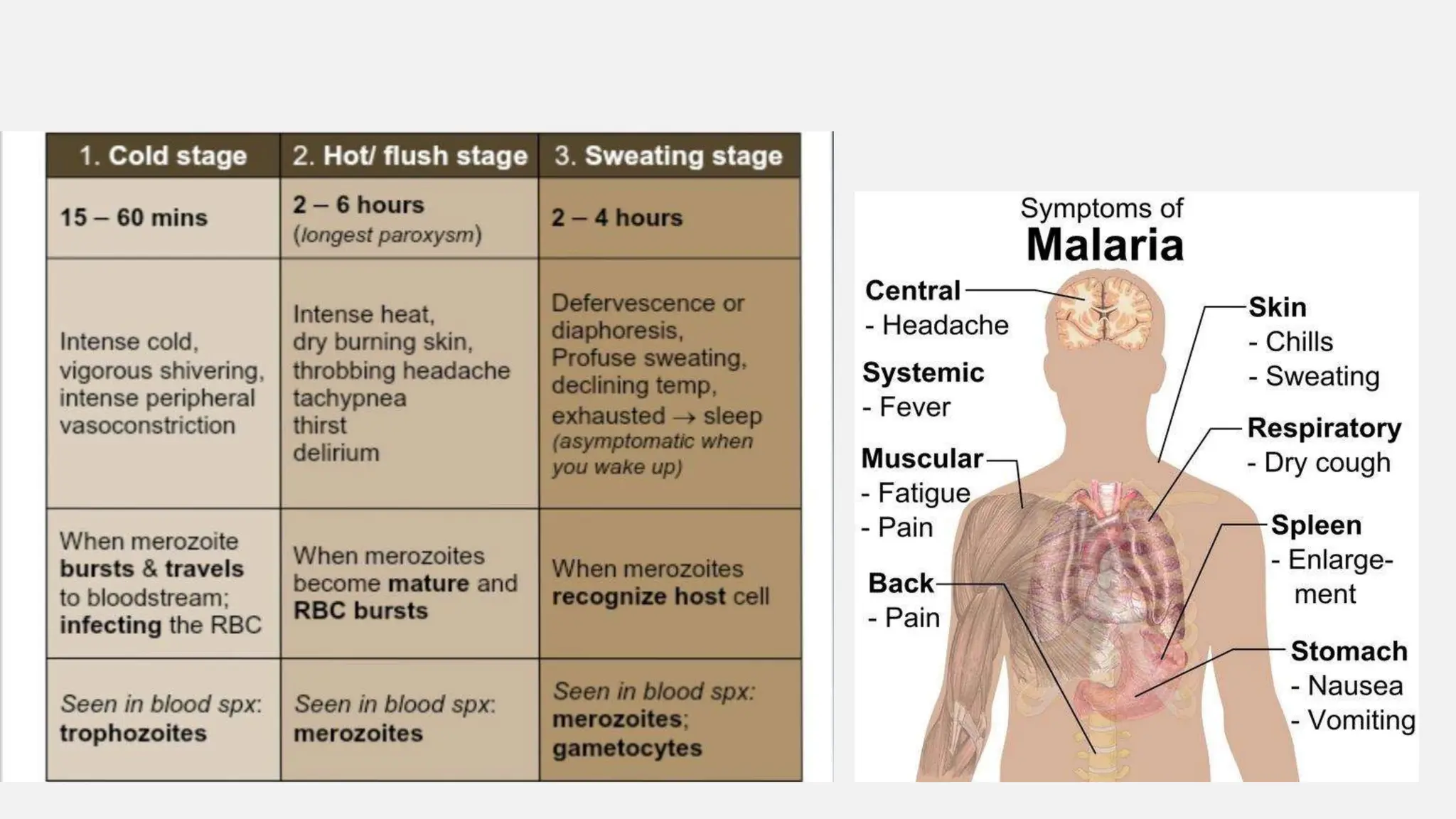
Symptoms: muscle pain, shaking chills, convulsion( sudden movement of body),
high fever, sweating, headache, nausea, anemia.
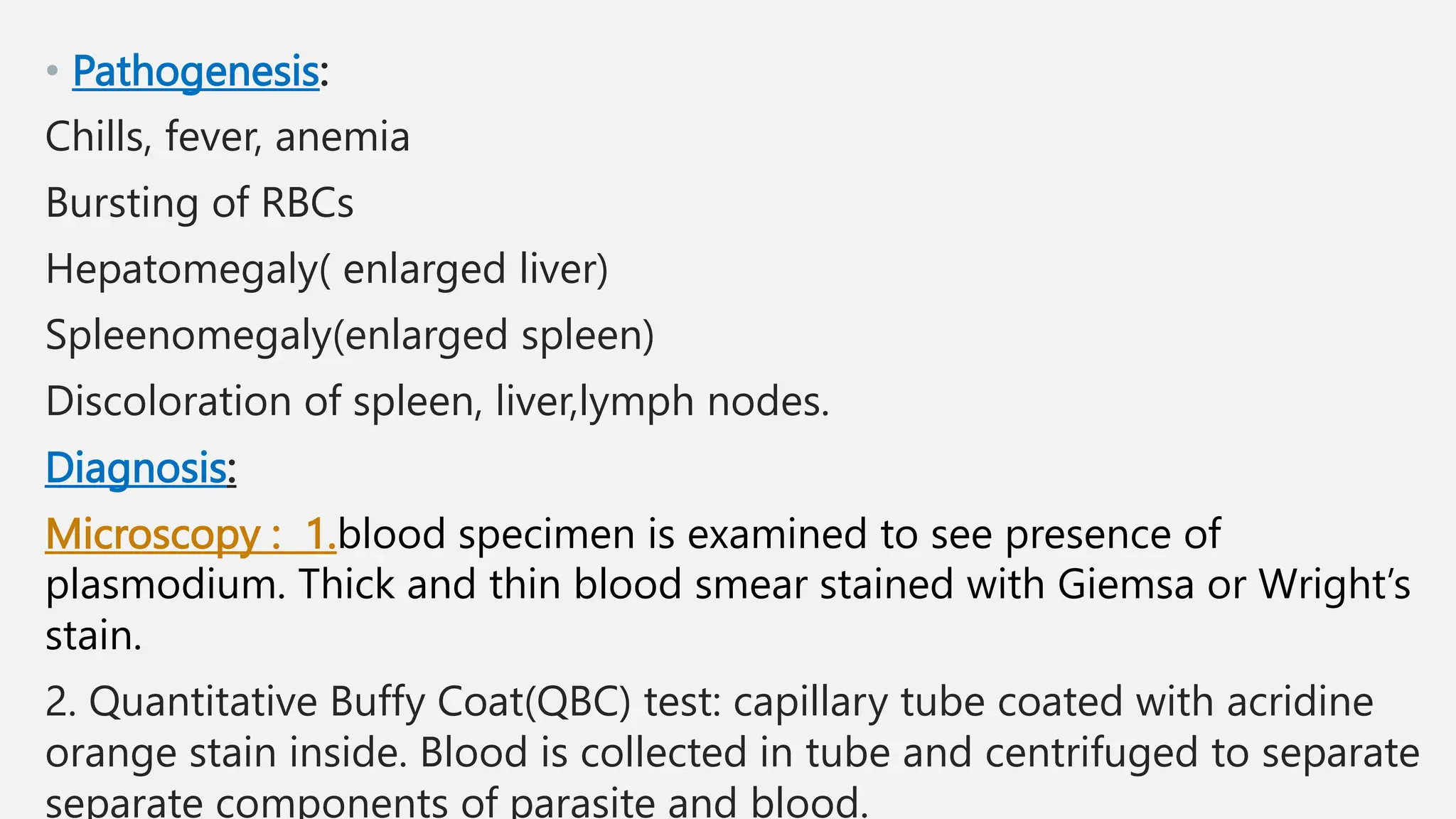
• Pathogenesis:
Chills, fever, anemia
Bursting of RBCs
Hepatomegaly( enlarged liver)
Spleenomegaly(enlarged spleen)
Discoloration of spleen, liver,lymph nodes.
Diagnosis:
Microscopy : 1.blood specimen is examined to see presence of
plasmodium. Thick and thin blood smear stained with Giemsa or Wright’s
stain.
2. Quantitative Buffy Coat(QBC) test: capillary tube coated with acridine
orange stain inside. Blood is collected in tube and centrifuged to separate
separate components of parasite and blood.
• Antigen detection : rapid diagnostic tests:
1.Histidine Rich protein II – only for p.falciparum.
2. pGLUDH (plasmodium Glutamate Dehydrogenase )
3. PLDH( plasmodium lactate Dehydrogenase enzyme)
4. PALDO (fructose bisphosphate aldolase).
These enzymes can be Detected in serum, plasma.of malaria
patients.
• Molecular diagnosis:
PCR – polymerase chain Reaction for species identification
• Serology:
IFA- Immunofluorescence Test
To detect antibodies produced against malarial antigen.
• Treatments: antimalarial drugs
1.Artemisinin drug [Artemether and Artesunate combination]
2. Atovaquone
3.Doxycycline
4.Mefloquine
5.Quinine- for pregnant women
6. Primaquine
Vaccine- RTS, S/AS01 for p.falciparum in children
PREVENTION AND CONTROL
• Screening of house, use of mosquito nets, protective
clothing
• Use of DEET (diethyltoluamide) a mosquito repellent.
• Early diagnosis and treatment
• Chemical insecticides and larvicides for vector control.
REFERENCE
• https://step1.medbullets.com/microbiology/121557/plasmodium
• https://biologynotesonline.com/plasmodium-definition-life-cycle/#Plasmodium_Morphology
• https://en.m.wikipedia.org/wiki/Malaria_antigen_detection_tests
• https://www.cdc.gov/malaria/diagnosis_treatment/diagnosis.html#:~:text=Malaria%20parasites%20c
an%20be%20identified,the%20parasites%20a%20distinctive%20appearance.

PLASMODIUM. PPTX

  • 1.
  • 2.
  • 3.
    INTRODUCTION • Plasmodium isa genus of parasite protozoans. They are unicellular eukaryotes. They are Cresent (banana) shaped. • Plasmodium genome contain 14 chromosomes. They donot show uniform gram stain. • It is oldest known parasite in world. They cause disease malaria. • Malaria comes from Latin word mal- bad and aria- air. • Their hosts are vertebrates (human, monkey ) and mosquito. • To cause malaria in human they use mosquitos as vector.
  • 4.
    They come under: Phylum-Apicomplexa Class- Aconoidasida Order- Haemospororida Family - Plasmodiidae Genus - Plasmodium In 1880 Charles Louis Alphonse Laveran first described presence of plasmodium parasite in blood of malaria patients. Habitat: 1. plasmodium is found in parenchymal cells of liver and RBCs of human, perform asexual cycle. 2. Live inside female Anopheles minimus Flavirustris, perform sexual cycle
  • 5.
    MORPHOLOGY Plasmodium life hasvarious stages: • Ring form Trophozoite: it is the earliest form of plasmodium found in RBCs of human. It has chromatin, Cytoplasm, nucleus. • Schizonts: second stage in this nucleus divide into 8 – 24 nuclei. Each nucleus is enclosed by cytoplasm forming merozoites. • Gametocytes: this stage is sexual form with elongated nucleus.these are infectious to mosquitoes.
  • 7.
    SPECIES Some disease causingin human species of plasmodium are: 1. Plasmodium falciparum : cause malignant Tertian Malaria 2. Plasmodium vivax: Benign Tertian Malaria 3. Plasmodium malariae: Quartan Tertian Malaria 4. Plasmodium ovale: Benign Tertian Malaria P.Falciparum also cause black water fever it’s Symptoms are : intravascular hemolysis, Kidney failure, Hemoglobinuria( hemoglobin In urine).
  • 8.
    LIFE CYCLE OFPLASMODIUM The life cycle is passed into two hosts a vertebrate ( human ) and mosquito. • Asexual phase in human [schizogony]: this take place in two stages: Exo Erythrocytic Schizogony : the infectious sporozoites are injected from salivary gland of female Anopheles mosquitoes during biting, into the blood stream of human. Within 30 minutes this motile sporozoite enter liver parenchymal cells and there it undergoes nuclear division and cytoplasmic division and give rise to merozoites. The parasitized liver cells ruptures and release merozoites out to initiate Erythrocytic cycle.
  • 9.
    Erythrocytic Schizogony: thereleased merozoties enters RBCs at this symptoms such as fever, swelling, chills, can be seen. Then in RBCs the merozoites develop into trophozoites and then develop into schizonts then the cells are ruptured and re invasion to news cells occurs. Gametogony: some merozoites released from RBC donot undergoes schizogony nor infect more RBCs but they develop into male and female gametocytes which are infectious to mosquitoes. • Sexual phase in mosquitoes [sporogony]: male and female gametocytes are sucked in by mosquitoes during blood meal (biting) which undergoes maturation and differentiation into microgametes (male) and macrogametes(female). Microgamete fertilize macrogamete producing zygote. The zygote becomes motile and penetrates the mosquito’s gut as ookinette which develop into oocyst.
  • 10.
    • The oocystundergoes division (Sporogony) and give rise to many sporozoites which is infectious to human. When mosquito bite human sporozoites enter human liver cells.
  • 11.
    • Epidemiology: malariais an ancient disease found in Africa 2.5 million to 30 million years ago,Also in Egypt . Malaria is worldwide distributed such as in America, Asia, sub- Sahara Africa. • Occur mostly in tropical and sub tropical region. Transmission: bite of mosquitoes to human Blood transfusion Sharing needles and syringe. Fossil
  • 12.
    CLINICAL MANIFESTATIONS Incubation period: P.falciparum-8 to 15 days P.ovale- 11 to 16 days P.vivax- 12 to 20 days P.Malariae- 18 to 40 days Symptoms: muscle pain, shaking chills, convulsion( sudden movement of body), high fever, sweating, headache, nausea, anemia.
  • 15.
    • Pathogenesis: Chills, fever,anemia Bursting of RBCs Hepatomegaly( enlarged liver) Spleenomegaly(enlarged spleen) Discoloration of spleen, liver,lymph nodes. Diagnosis: Microscopy : 1.blood specimen is examined to see presence of plasmodium. Thick and thin blood smear stained with Giemsa or Wright’s stain. 2. Quantitative Buffy Coat(QBC) test: capillary tube coated with acridine orange stain inside. Blood is collected in tube and centrifuged to separate separate components of parasite and blood.
  • 16.
    • Antigen detection: rapid diagnostic tests: 1.Histidine Rich protein II – only for p.falciparum. 2. pGLUDH (plasmodium Glutamate Dehydrogenase ) 3. PLDH( plasmodium lactate Dehydrogenase enzyme) 4. PALDO (fructose bisphosphate aldolase). These enzymes can be Detected in serum, plasma.of malaria patients. • Molecular diagnosis: PCR – polymerase chain Reaction for species identification • Serology: IFA- Immunofluorescence Test
  • 17.
    To detect antibodiesproduced against malarial antigen. • Treatments: antimalarial drugs 1.Artemisinin drug [Artemether and Artesunate combination] 2. Atovaquone 3.Doxycycline 4.Mefloquine 5.Quinine- for pregnant women 6. Primaquine Vaccine- RTS, S/AS01 for p.falciparum in children
  • 18.
    PREVENTION AND CONTROL •Screening of house, use of mosquito nets, protective clothing • Use of DEET (diethyltoluamide) a mosquito repellent. • Early diagnosis and treatment • Chemical insecticides and larvicides for vector control.
  • 19.
    REFERENCE • https://step1.medbullets.com/microbiology/121557/plasmodium • https://biologynotesonline.com/plasmodium-definition-life-cycle/#Plasmodium_Morphology •https://en.m.wikipedia.org/wiki/Malaria_antigen_detection_tests • https://www.cdc.gov/malaria/diagnosis_treatment/diagnosis.html#:~:text=Malaria%20parasites%20c an%20be%20identified,the%20parasites%20a%20distinctive%20appearance.