MALARIA
DR.HAMISI MKINDI,MD.
TO DOWNLOAD CONTACT: hermyc@live.com
OUTLINE
Introduction
Classification
Life cycle
Malaria Syndromes
Epidemiology
Pathogenesis
Cerebral and Placental Malaria
Diagnosis and Management
Refferences
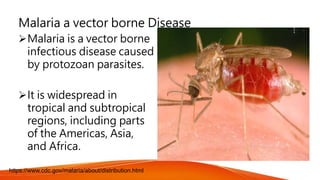
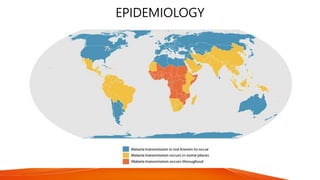
Malaria a vector borne Disease
Malaria is a vector borne
infectious disease caused
by protozoan parasites.
It is widespread in
tropical and subtropical
regions, including parts
of the Americas, Asia,
and Africa.
https://www.cdc.gov/malaria/about/distribution.html
Classification of malaria parasites
 Kingdom:- Chromalveolata
 Superphylum:- Alveolata
 Phylum:-Apicomplexa
 Class:- Aconoidasida
 Order:- Haemosporidia
 Family:-Plasmodiidae
 Genus:- Plasmodium
 Species: falciparum, ovale, malariae, P.
falciparum, P. vivax, P. ovale, P. malariae
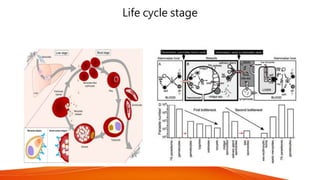
Life cycle stage
EPIDEMIOLOGY
EPIDEMIOLOGY
 Malaria is an extremely important cause of mortality in
different parts of world.
 Plasmodium falciparum is widespread, contributing to
an estimated 1 million pediatric deaths worldwide
annually.
 WHO estimated 241 million cases and 627 000 deaths
globally in 2020.
 It is responsible for millions of morbidity and thousands
of deaths annually in developing countries.
EPIDEMIOLOGY
 The WHO African Region carries a disproportionately high
share of the global malaria burden.
 In 2020,the region was home to 95% of malaria cases and 96%
of malaria deaths.
 Children under 5 accounted for an estimated 80% of all
malaria deaths in the Region.
 In Tanzania, malaria is the most important cause of morbidity
and mortality, however of recent there is significant reduction
in incidence.
EPIDEMIOLOGY
 The variable epidemiology makes it important to classify areas and
countries with malaria as.
 High risk,
 Low risk,
No risk
 In high risk areas where malaria is a major problem, all children with
febrile diseases can be assumed to have malaria.
 In low risk areas, only children with no other diagnoses should be
considered to have malaria.
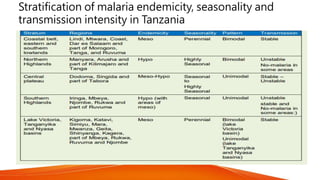
Stratification of malaria endemicity, seasonality and
transmission intensity in Tanzania
PATHOGENESIS
 Female Anopholes mosquito, infect human during blood
meal.injected sporozoites enters blood circulation to the
hepatocytes.
 In the liver develop parasitophorous vacuole and differentiate
in first round of asexual replication and merozoites multiply(
exoerythrocyte phase) and released to the blood circulation.

PATHOGENESIS
Infected RBC produce protein pfEMP1(Plasmodium
falciparum erythrocyte Membrane Protein 1
P. falciparum differs from other human malarial species
in that infected red blood cells (iRBC) do not remain in
the circulation for the entire life cycle.
Irbc bind to endothelia cell CD36,Infected RBC Trigger
microglia to produce IL-1,IL-6,,TNF,ROS and RNS,
Inflammatory cytokines→→pathological features of
cerebral malaria.
PATHOGENESIS...
 After24–32 hours, when young parasites mature from the
ring to the trophozoite stage, IRBC adhere to endothelial
cells in the microcirculation of various organs.
 Clinically Malaria is Categorized into
Uncomplicated
Complicated(Severe)
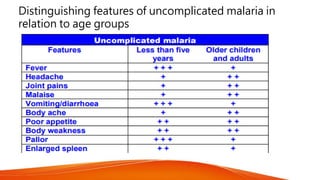
Distinguishing features of uncomplicated malaria in
relation to age groups
UNCOMPLICATED MALARIA
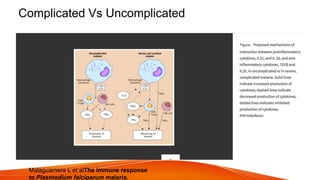
CD8 T Cells play a major role in triggering mechanism
of Adaptive immunity, depending on IL12 and NK
Cells.
In uncomplicated malaria there is significant increase
in IL18 Concentration, which diminish in recovery
phase.
Complicated Vs Uncomplicated
Malaguarnera L et alThe immune response
to Plasmodium falciparum malaria.
SEVERE MALARIA
CASE
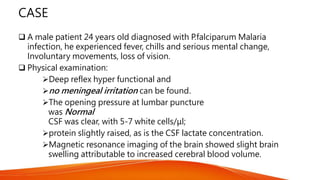
 A male patient 24 years old diagnosed with P.falciparum Malaria
infection, he experienced fever, chills and serious mental change,
Involuntary movements, loss of vision.
 Physical examination:
Deep reflex hyper functional and
no meningeal irritation can be found.
The opening pressure at lumbar puncture
was Normal
CSF was clear, with 5-7 white cells/μl;
protein slightly raised, as is the CSF lactate concentration.
Magnetic resonance imaging of the brain showed slight brain
swelling attributable to increased cerebral blood volume.
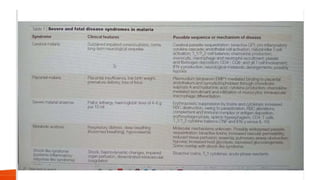
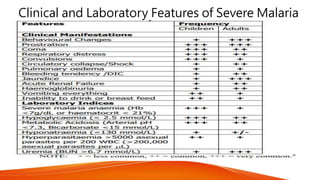
Clinical and Laboratory Features of Severe Malaria
Complicated Malaria
Malaguarnera L et alThe immune response
to Plasmodium falciparum malaria.
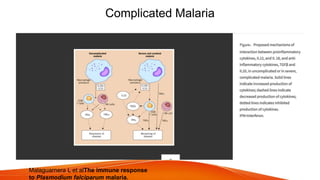
Complicated Malaria
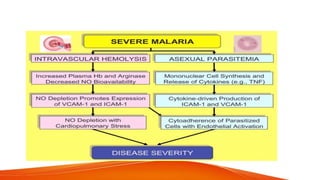
 Marked increase and persistent production of TNFα, paralled
by ↓in production of IL10 and TGFβ.
 TGFβ is an important cytokine for maintaining the balance
between protection and progression toward P falciparum
malaria.
 Persistent and late anti inflammatory cytokine response
including TNFα and TGFβ contribute to severe and
complicated Plasmodium Falciparum.
Cerebral and Malaria Pathogenesis
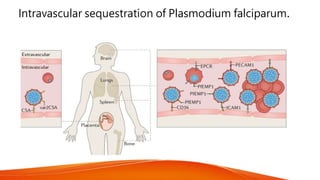
 Binding of PfEMP1 to EPCR28 and ICAM1 is crucial for
brain sequestration (and causal for cerebral malaria),
 While the precise mechanisms of CM pathogenesis
remain unclear, a hallmark of CM is the sequestration of
iRBCs in capillaries and postcapillary venules.
Intravascular sequestration of Plasmodium falciparum.
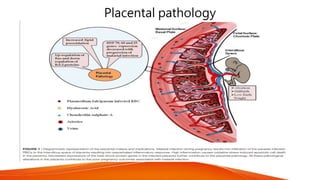
Placental pathology in malaria
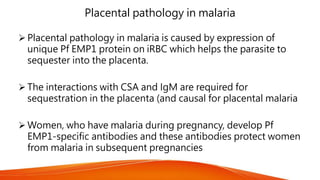
 Placental pathology in malaria is caused by expression of
unique Pf EMP1 protein on iRBC which helps the parasite to
sequester into the placenta.
 The interactions with CSA and IgM are required for
sequestration in the placenta (and causal for placental malaria
 Women, who have malaria during pregnancy, develop Pf
EMP1-specific antibodies and these antibodies protect women
from malaria in subsequent pregnancies
Placental pathology
Placental pathology in malaria
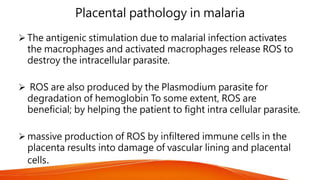
 The antigenic stimulation due to malarial infection activates
the macrophages and activated macrophages release ROS to
destroy the intracellular parasite.
 ROS are also produced by the Plasmodium parasite for
degradation of hemoglobin To some extent, ROS are
beneficial; by helping the patient to fight intra cellular parasite.
 massive production of ROS by infiltered immune cells in the
placenta results into damage of vascular lining and placental
cells.
Cerebral Malaria CM Pathog
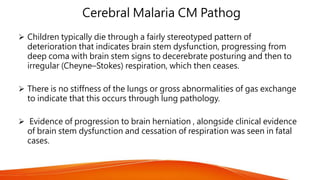
 Children typically die through a fairly stereotyped pattern of
deterioration that indicates brain stem dysfunction, progressing from
deep coma with brain stem signs to decerebrate posturing and then to
irregular (Cheyne–Stokes) respiration, which then ceases.
 There is no stiffness of the lungs or gross abnormalities of gas exchange
to indicate that this occurs through lung pathology.
 Evidence of progression to brain herniation , alongside clinical evidence
of brain stem dysfunction and cessation of respiration was seen in fatal
cases.
Cerebral Malaria CM
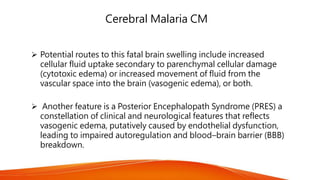
 Potential routes to this fatal brain swelling include increased
cellular fluid uptake secondary to parenchymal cellular damage
(cytotoxic edema) or increased movement of fluid from the
vascular space into the brain (vasogenic edema), or both.
 Another feature is a Posterior Encephalopath Syndrome (PRES) a
constellation of clinical and neurological features that reflects
vasogenic edema, putatively caused by endothelial dysfunction,
leading to impaired autoregulation and blood–brain barrier (BBB)
breakdown.
CYTOADHERENCE
• Vascular Sequestration.
 Parasites developing within the infected RBC transport P.
falciparum erythrocyte membrane protein 1 (PfEMP1) to the RBC
membrane functioning as a key ligand for cytoadherence.
 PfEMP1 is expressed on RBC protrusions, or ‘knobs’, -KAHRP ,that
confer points of attachment to the endothelium.
 PfEMP1 is strain specific, encoded by a highly variable var gene
family, which provides antigenic variation for immune evasion and
differential endothelial receptor binding.
 CD36 is an endothelial receptor constitutively expressed on most
vascular beds.
CYTOADHERENCE...
 The key endothelial receptor in the brain is intercellular adhesion
molecule-1 . endothelial protein C receptor as an important
receptor in the brain that binds to a specific PfEMP1domain.
 Cytoadhesion results in sequestration of parasitized RBCs in the
capillaries and postcapillary venules causing heterogeneous
blockage of the microcirculation and tissue hypoxia.
 In addition to flow obstruction by sequestered parasitized RBCs,
microcirculatory flow is thought to be further compromised by
increased rigidity of both infected and uninfected RBCs and
clumping of infected RBCs (platelet-mediated autoagglutination)
and uninfected RBCs adhering to infected RBCs (rosette
formation).
Case Management
 Any comatose patient with a history of fever and/or travel to malaria-
endemic regions must be considered to have cerebral malaria until
proven otherwise.
 In children, febrile convulsions should be distinguished from cerebral
malaria, wherein coma will persist beyond 1 h after anticonvulsive
treatment is administered.
 Absence of fever does not rule out malaria. Antimalarial treatment
should not be delayed in severely ill patients if diagnostics are
unavailable or delayed.
National Guidelines for Diagnosis and Treatment of Malaria. 2013
LABORATORY DIAGNOSIS
 WHO recommends that all suspected cases of malaria be
confirmed using.
Microscopy
Giemsa Stain
Quantitative Buffy Coat Analysis (QBC)
Acridine Orange (AO)
rapid diagnostic test
LFA- PfHRP2
National Guidelines for Diagnosis and Treatment of Malaria. 2013
MALARIA VACCINE
 On October 6, 2021 WHO for the first time
recommended use of a malaria vaccine for the
prevention of P. falciparum malaria for children living in
areas with moderate-to high malaria transmission.
 The RTS,S/AS01 vaccine is a recombinant chimeric
protein.
Pedro L. Alonso et al :An Important Step in a Century-Long Quest.
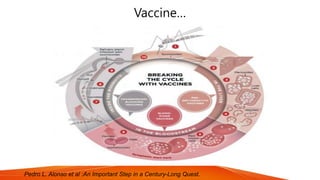
Vaccine…
Pedro L. Alonso et al :An Important Step in a Century-Long Quest.
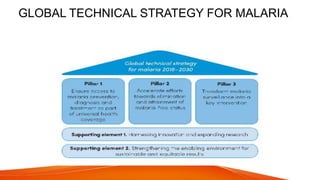
GLOBAL TECHNICAL STRATEGY FOR MALARIA
TREATMENT
The two key pillars:
 Prompt antimalarial treatment
 1ST Line intravenous artesunate
 Alternative -quinine .
supportive management.
REFERENCE
1. Morona D,Zinga M,Mirambo M.Sciences . Asymptomatic
malaria and associated factors among blood donors in
Mwanza , Tanzania. 2017;19(2):2–7.
2. Mazigo HD, Meza W, Ambrose EE, Kidenya BR, Kweka
EJ. Confirmed malaria cases among children under five
with fever and history of fever in rural western Tanzania.
2011;4–9.
3. Morona D, Zinga M, Mirambo MM, Mtawazi S, Silago V.
SHORT COMMUNICATION High prevalence of
Plasmodium falciparum malaria among Human
Immunodeficiency Virus seropositive population in the Lake
Victoria zone ,. 2018;20(1):20–3.
REFERENCE
4. Venugopal K, Hentzschel F, Valki G, Marti M.
Plasmodium asexual growth and sexual development in the
haematopoietic niche of the host. 2020;18(March):177–89.
5.The NEW ENGLAND JOURNAL of MEDICINE Pedro L.
Alonso, and Katherine L. O’Brien, A Malaria Vaccine for
Africa — An Important Step in a Century-Long Quest.
6.Welfare S, Malaria N, Programme C. National Guidelines
for Diagnosis and Treatment of Malaria. 2013
• 7. Malaguarnera L Musumeci SThe immune response
to Plasmodium falciparum malaria.Lancet Infect
Dis. 2002; 2: 472-478

MALARIA AND OTHER COCCIDIO.pptx

  • 1.
  • 2.
  • 3.
    Malaria a vectorborne Disease Malaria is a vector borne infectious disease caused by protozoan parasites. It is widespread in tropical and subtropical regions, including parts of the Americas, Asia, and Africa. https://www.cdc.gov/malaria/about/distribution.html
  • 4.
    Classification of malariaparasites  Kingdom:- Chromalveolata  Superphylum:- Alveolata  Phylum:-Apicomplexa  Class:- Aconoidasida  Order:- Haemosporidia  Family:-Plasmodiidae  Genus:- Plasmodium  Species: falciparum, ovale, malariae, P. falciparum, P. vivax, P. ovale, P. malariae
  • 5.
  • 7.
  • 8.
    EPIDEMIOLOGY  Malaria isan extremely important cause of mortality in different parts of world.  Plasmodium falciparum is widespread, contributing to an estimated 1 million pediatric deaths worldwide annually.  WHO estimated 241 million cases and 627 000 deaths globally in 2020.  It is responsible for millions of morbidity and thousands of deaths annually in developing countries.
  • 9.
    EPIDEMIOLOGY  The WHOAfrican Region carries a disproportionately high share of the global malaria burden.  In 2020,the region was home to 95% of malaria cases and 96% of malaria deaths.  Children under 5 accounted for an estimated 80% of all malaria deaths in the Region.  In Tanzania, malaria is the most important cause of morbidity and mortality, however of recent there is significant reduction in incidence.
  • 10.
    EPIDEMIOLOGY  The variableepidemiology makes it important to classify areas and countries with malaria as.  High risk,  Low risk, No risk  In high risk areas where malaria is a major problem, all children with febrile diseases can be assumed to have malaria.  In low risk areas, only children with no other diagnoses should be considered to have malaria.
  • 11.
    Stratification of malariaendemicity, seasonality and transmission intensity in Tanzania
  • 12.
    PATHOGENESIS  Female Anopholesmosquito, infect human during blood meal.injected sporozoites enters blood circulation to the hepatocytes.  In the liver develop parasitophorous vacuole and differentiate in first round of asexual replication and merozoites multiply( exoerythrocyte phase) and released to the blood circulation. 
  • 13.
    PATHOGENESIS Infected RBC produceprotein pfEMP1(Plasmodium falciparum erythrocyte Membrane Protein 1 P. falciparum differs from other human malarial species in that infected red blood cells (iRBC) do not remain in the circulation for the entire life cycle. Irbc bind to endothelia cell CD36,Infected RBC Trigger microglia to produce IL-1,IL-6,,TNF,ROS and RNS, Inflammatory cytokines→→pathological features of cerebral malaria.
  • 14.
    PATHOGENESIS...  After24–32 hours,when young parasites mature from the ring to the trophozoite stage, IRBC adhere to endothelial cells in the microcirculation of various organs.  Clinically Malaria is Categorized into Uncomplicated Complicated(Severe)
  • 15.
    Distinguishing features ofuncomplicated malaria in relation to age groups
  • 16.
    UNCOMPLICATED MALARIA CD8 TCells play a major role in triggering mechanism of Adaptive immunity, depending on IL12 and NK Cells. In uncomplicated malaria there is significant increase in IL18 Concentration, which diminish in recovery phase.
  • 17.
    Complicated Vs Uncomplicated MalaguarneraL et alThe immune response to Plasmodium falciparum malaria.
  • 18.
  • 19.
    CASE  A malepatient 24 years old diagnosed with P.falciparum Malaria infection, he experienced fever, chills and serious mental change, Involuntary movements, loss of vision.  Physical examination: Deep reflex hyper functional and no meningeal irritation can be found. The opening pressure at lumbar puncture was Normal CSF was clear, with 5-7 white cells/μl; protein slightly raised, as is the CSF lactate concentration. Magnetic resonance imaging of the brain showed slight brain swelling attributable to increased cerebral blood volume.
  • 20.
    Clinical and LaboratoryFeatures of Severe Malaria
  • 21.
    Complicated Malaria Malaguarnera Let alThe immune response to Plasmodium falciparum malaria.
  • 22.
    Complicated Malaria  Markedincrease and persistent production of TNFα, paralled by ↓in production of IL10 and TGFβ.  TGFβ is an important cytokine for maintaining the balance between protection and progression toward P falciparum malaria.  Persistent and late anti inflammatory cytokine response including TNFα and TGFβ contribute to severe and complicated Plasmodium Falciparum.
  • 23.
    Cerebral and MalariaPathogenesis  Binding of PfEMP1 to EPCR28 and ICAM1 is crucial for brain sequestration (and causal for cerebral malaria),  While the precise mechanisms of CM pathogenesis remain unclear, a hallmark of CM is the sequestration of iRBCs in capillaries and postcapillary venules.
  • 25.
    Intravascular sequestration ofPlasmodium falciparum.
  • 26.
    Placental pathology inmalaria  Placental pathology in malaria is caused by expression of unique Pf EMP1 protein on iRBC which helps the parasite to sequester into the placenta.  The interactions with CSA and IgM are required for sequestration in the placenta (and causal for placental malaria  Women, who have malaria during pregnancy, develop Pf EMP1-specific antibodies and these antibodies protect women from malaria in subsequent pregnancies
  • 27.
  • 28.
    Placental pathology inmalaria  The antigenic stimulation due to malarial infection activates the macrophages and activated macrophages release ROS to destroy the intracellular parasite.  ROS are also produced by the Plasmodium parasite for degradation of hemoglobin To some extent, ROS are beneficial; by helping the patient to fight intra cellular parasite.  massive production of ROS by infiltered immune cells in the placenta results into damage of vascular lining and placental cells.
  • 29.
    Cerebral Malaria CMPathog  Children typically die through a fairly stereotyped pattern of deterioration that indicates brain stem dysfunction, progressing from deep coma with brain stem signs to decerebrate posturing and then to irregular (Cheyne–Stokes) respiration, which then ceases.  There is no stiffness of the lungs or gross abnormalities of gas exchange to indicate that this occurs through lung pathology.  Evidence of progression to brain herniation , alongside clinical evidence of brain stem dysfunction and cessation of respiration was seen in fatal cases.
  • 30.
    Cerebral Malaria CM Potential routes to this fatal brain swelling include increased cellular fluid uptake secondary to parenchymal cellular damage (cytotoxic edema) or increased movement of fluid from the vascular space into the brain (vasogenic edema), or both.  Another feature is a Posterior Encephalopath Syndrome (PRES) a constellation of clinical and neurological features that reflects vasogenic edema, putatively caused by endothelial dysfunction, leading to impaired autoregulation and blood–brain barrier (BBB) breakdown.
  • 31.
    CYTOADHERENCE • Vascular Sequestration. Parasites developing within the infected RBC transport P. falciparum erythrocyte membrane protein 1 (PfEMP1) to the RBC membrane functioning as a key ligand for cytoadherence.  PfEMP1 is expressed on RBC protrusions, or ‘knobs’, -KAHRP ,that confer points of attachment to the endothelium.  PfEMP1 is strain specific, encoded by a highly variable var gene family, which provides antigenic variation for immune evasion and differential endothelial receptor binding.  CD36 is an endothelial receptor constitutively expressed on most vascular beds.
  • 32.
    CYTOADHERENCE...  The keyendothelial receptor in the brain is intercellular adhesion molecule-1 . endothelial protein C receptor as an important receptor in the brain that binds to a specific PfEMP1domain.  Cytoadhesion results in sequestration of parasitized RBCs in the capillaries and postcapillary venules causing heterogeneous blockage of the microcirculation and tissue hypoxia.  In addition to flow obstruction by sequestered parasitized RBCs, microcirculatory flow is thought to be further compromised by increased rigidity of both infected and uninfected RBCs and clumping of infected RBCs (platelet-mediated autoagglutination) and uninfected RBCs adhering to infected RBCs (rosette formation).
  • 33.
    Case Management  Anycomatose patient with a history of fever and/or travel to malaria- endemic regions must be considered to have cerebral malaria until proven otherwise.  In children, febrile convulsions should be distinguished from cerebral malaria, wherein coma will persist beyond 1 h after anticonvulsive treatment is administered.  Absence of fever does not rule out malaria. Antimalarial treatment should not be delayed in severely ill patients if diagnostics are unavailable or delayed. National Guidelines for Diagnosis and Treatment of Malaria. 2013
  • 34.
    LABORATORY DIAGNOSIS  WHOrecommends that all suspected cases of malaria be confirmed using. Microscopy Giemsa Stain Quantitative Buffy Coat Analysis (QBC) Acridine Orange (AO) rapid diagnostic test LFA- PfHRP2 National Guidelines for Diagnosis and Treatment of Malaria. 2013
  • 35.
    MALARIA VACCINE  OnOctober 6, 2021 WHO for the first time recommended use of a malaria vaccine for the prevention of P. falciparum malaria for children living in areas with moderate-to high malaria transmission.  The RTS,S/AS01 vaccine is a recombinant chimeric protein. Pedro L. Alonso et al :An Important Step in a Century-Long Quest.
  • 36.
    Vaccine… Pedro L. Alonsoet al :An Important Step in a Century-Long Quest.
  • 37.
  • 38.
    TREATMENT The two keypillars:  Prompt antimalarial treatment  1ST Line intravenous artesunate  Alternative -quinine . supportive management.
  • 39.
    REFERENCE 1. Morona D,ZingaM,Mirambo M.Sciences . Asymptomatic malaria and associated factors among blood donors in Mwanza , Tanzania. 2017;19(2):2–7. 2. Mazigo HD, Meza W, Ambrose EE, Kidenya BR, Kweka EJ. Confirmed malaria cases among children under five with fever and history of fever in rural western Tanzania. 2011;4–9. 3. Morona D, Zinga M, Mirambo MM, Mtawazi S, Silago V. SHORT COMMUNICATION High prevalence of Plasmodium falciparum malaria among Human Immunodeficiency Virus seropositive population in the Lake Victoria zone ,. 2018;20(1):20–3.
  • 40.
    REFERENCE 4. Venugopal K,Hentzschel F, Valki G, Marti M. Plasmodium asexual growth and sexual development in the haematopoietic niche of the host. 2020;18(March):177–89. 5.The NEW ENGLAND JOURNAL of MEDICINE Pedro L. Alonso, and Katherine L. O’Brien, A Malaria Vaccine for Africa — An Important Step in a Century-Long Quest. 6.Welfare S, Malaria N, Programme C. National Guidelines for Diagnosis and Treatment of Malaria. 2013 • 7. Malaguarnera L Musumeci SThe immune response to Plasmodium falciparum malaria.Lancet Infect Dis. 2002; 2: 472-478
Editor's Notes

  • #4 https://www.cdc.gov/malaria/about/distribution.html#