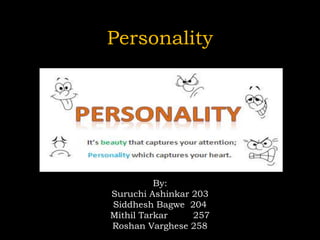
Personality
By:
Suruchi Ashinkar 203
Siddhesh Bagwe 204
Mithil Tarkar 257
Roshan Varghese 258
Contents
Introduction
Determinants of personality
Big 5 model
MBTI
Understanding personality types at workplace
Introduction
Personality refers to individual
differences in characteristic patterns
of thinking, feeling and behaving.
It is the way of a person reacting
to the situations.
Set of physical and mental
characteristics.
Determinants
Of
Personality
Physical
Cultural &
religious
HereditaryEnvironmental
Situational
Formula for
every step of life
Negative
approach
No inferior
Complex
Self Confidence
The right work
at right time
Success
Appreciation
Motivation
Extraversion
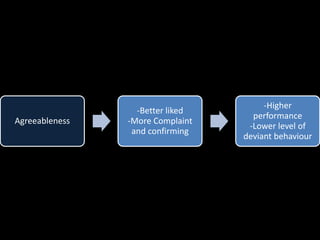
Agreeableness
ConscientiousnessEmotional Stability
Openness to
experience
Big 5 Personality Model
Emotional stability
-Less negative
thinking and fewer
negative emotions
-Less Hyper vigilant
-Higher job and life
satisfaction
-lower stress levels
Openness
-Increased Learning
-More Creative
-More flexible and
autonomous
-Training performance
-Enhanced leadership
-More Adaptable to
change
Extraversion
-better interpersonal
skill
-Greater Social
Dominance
-More Emotionally
expressive
-Higher performance
-Enhanced Leadership
-Higher Job and life
satisfaction
Agreeableness
-Better liked
-More Complaint
and confirming
-Higher
performance
-Lower level of
deviant behaviour
Conscientiousness
-Greater Effort and
persistence
-More drive and
discipline
-Better Organised and
Planning
-Higher Performance
-Enhanced Leadership
-Greater Longevity
Myers Briggs Type Indicator
Most widely used personally
assessment instrument
100 question test that ask
how people feel or react in a
particular situation
Used by organisations like
Apple, General Electrics, and
many more hospitals and
educational institutes
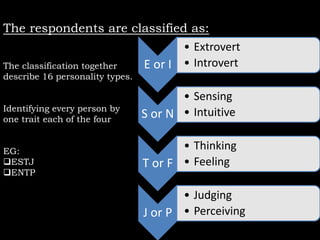
The respondents are classified as:
E or I
• Extrovert
• Introvert
S or N
• Sensing
• Intuitive
T or F
• Thinking
• Feeling
J or P
• Judging
• Perceiving
The classification together
describe 16 personality types.
Identifying every person by
one trait each of the four
EG:
ESTJ
ENTP
Understanding Personality Types at Workplace
Interpersonal understanding
Personality of you and your group
members
Mesh up
Not easy to read the personality
Assessment process
In the organisation
One step further
“Everyone can see everyone else as dearly as possible.”
Thank You

Personality (Organisation Behaviour)