The sum total of ways in which an individual reacts and interacts with others.
Personality is a pattern of stable states and characteristics of a person that influences
his or her behavior toward goal achievement
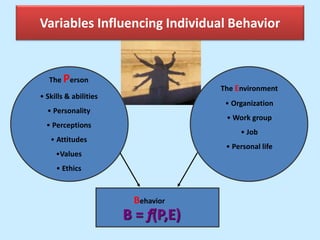
The Environment
• Organization
• Work group
• Job
• Personal life
Variables Influencing Individual Behavior
The Person
• Skills & abilities
• Personality
• Perceptions
• Attitudes
•Values
• Ethics
Behavior
B = f(P,E)
DEFINITION
Personality is relatively stable set of characteristics that
influences an individual’s behavior
It is a subjective phenomenon.
DEFINITION, Allport
Personality is the dynamic organization within the individual of
those psycho-physical systems that determine his characteristic
and behavior and thought.
Definitions: Mackinnon (1959)
• Personality refers to “factors” inside people that explain their behavior
• The sum total of typical ways of acting, thinking, and feeling that makes a
person unique.
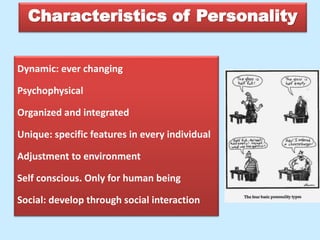
Dynamic: ever changing
Psychophysical
Organized and integrated
Unique: specific features in every individual
Adjustment to environment
Self conscious. Only for human being
Social: develop through social interaction
Characteristics of Personality
3 Facts to Consider When Defining “Personality”
 Individuals are unique
 Individuals behave differently in different situations
 Although individuals are unique and behave inconsistently across situations,
there is considerable commonality in human behavior
Personality: a person’s internally based characteristic way of acting and thinking
Character: Personal characteristics that have been judged or evaluated
Temperament: Hereditary aspects of personality, including sensitivity, moods,
irritability, and distractibility
Personality Trait: Stable qualities that a person shows in most situations
Personality Type: People who have several traits in common
Personality: Some Terms
A)Heredity and biological factors
- Physique
- Intelligence
- Sex differences
- Nervous system
- Chemical organisation
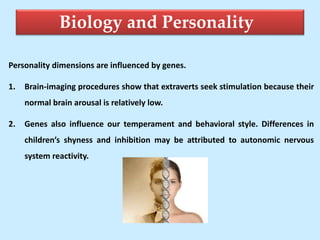
Biology and Personality
Personality dimensions are influenced by genes.
1. Brain-imaging procedures show that extraverts seek stimulation because their
normal brain arousal is relatively low.
2. Genes also influence our temperament and behavioral style. Differences in
children’s shyness and inhibition may be attributed to autonomic nervous
system reactivity.
B) Environmental factors
- Family
- Geography
- Life pattern
- Childhood experience
- Neighbourhood
- Friends
- School
- Media
- Cloths
- Culture
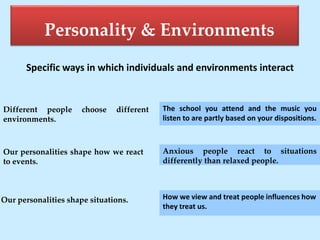
Personality & Environments
How we view and treat people influences how
they treat us.
Our personalities shape situations.
Anxious people react to situations
differently than relaxed people.
Our personalities shape how we react
to events.
The school you attend and the music you
listen to are partly based on your dispositions.
Different people choose different
environments.
Specific ways in which individuals and environments interact
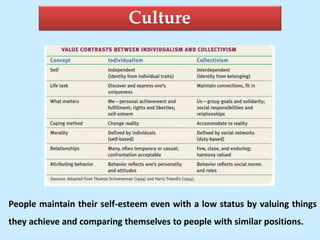
Culture
People maintain their self-esteem even with a low status by valuing things
they achieve and comparing themselves to people with similar positions.
C) Emotional reaction
- Aspiration
- Aptitudes and attitude
- Interest
- Motivation
- Intellectual level
Well balanced personality
 Good physical appearance
 Emotional stability
 High intellectual ability
 High degree of social adjustment
 High moral characters
 Good temperament
 Good directedness
 Tremendous commonsense, drive and pragmatic thinking
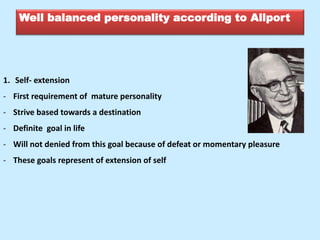
Well balanced personality according to Allport
1. Self- extension
- First requirement of mature personality
- Strive based towards a destination
- Definite goal in life
- Will not denied from this goal because of defeat or momentary pleasure
- These goals represent of extension of self
Well balanced personality according to Allport
2. Self objectification
A mature person look at himself objectivity.
- He has insight
- He accept his weaknesses
- He evaluates himself in terms of his potentialities
- Sense of realities
Well balanced personality according to Allport
3. Unifying philosophy of life
- A mature personality lives according to some accepted philosophy of life
developed to his own satisfaction
- His life will be value oriented
THEORIES
Trait Theory: understand individuals by breaking down behavior patterns
into observable traits.
Psychodynamic Theory: emphasizes the unconscious determinants of
behavior
Humanistic Theory: emphasizes individual growth and improvement
Integrative Approach: describes personality as a composite of an
individual’s psychological processes
PERSONALITY TRAITS
• A personality trait is a personality characteristic that endures over time and
across different situations
• Trait theories of personality focus on measuring, identifying and describing
individual differences in personality in terms of traits
• Focus is on what is different- not what is the same
• Can be used to predict behaviour based on traits
Assessing Traits
Personality inventories are questionnaires (often with true-false or agree-disagree
items) designed to gauge a wide range of feelings and behaviors assessing several
traits at once.
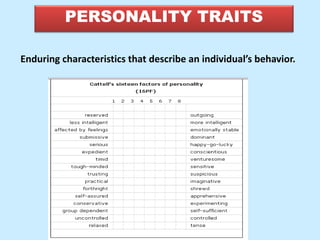
PERSONALITY TRAITS
Enduring characteristics that describe an individual’s behavior.
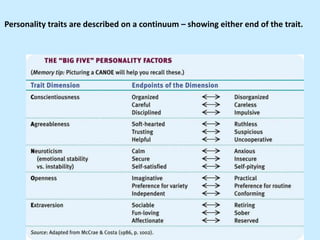
Personality traits are described on a continuum – showing either end of the trait.
Strengths and Limitations of trait theories
 Provide useful descriptions of personality and its structure
 Provided the foundation of valid and reliable personality devices
 Can lead people to accept and use oversimplified classifications and descriptions
 Underestimate socio-cultural influences on behaviour
Methods of Measuring Personality
Personality cannot be quantitatively measured but appraise personality to help us
to:
• know about the physical, mental, emotional and social behavior of the individual
• For the purpose of guidance and selection of personnel
• To appear of teacher competence
Methods of Measuring Personality
1- Subjective methods, ask the individual to evaluate himself, Data is also is
collected with the help of his friend also
- Autobiography: is the story about subject that has written by himself.
- Case history method
- Interview technique
- Questionnaire
- Inventories
2- Objective methods
3- Projective method
Subjective method- autobiography
Autobiography is faithful record of ones past and future
Subjects write about aims, ambitions, achievement, attitude and experience
Advantages:
 it is economical and useful to explore the personality
Limitations:
 The subject exaggerates his qualities
 It may be full of irrelevant and insignificant things.
 Since subjects writes from memory it may fail.
 Language handicap
Methods of Measuring Personality
Subjective method- Case history method
 Information collected about heredity & environment features.
 Physical, intellectual, academic, emotional & social history.
 Data about nature of delivery, health of child at birth, relationship with parent
and sibling, physical diseases, to know about cases of maladjustment
Advantages:
 Useful in clinical method
 More systematic and scientific
Limitations:
 Time consuming
 Difficult to collect data
Methods of Measuring Personality
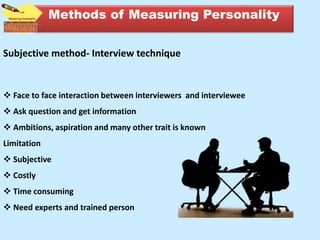
Subjective method- Interview technique
 Face to face interaction between interviewers and interviewee
 Ask question and get information
 Ambitions, aspiration and many other trait is known
Limitation
 Subjective
 Costly
 Time consuming
 Need experts and trained person
Methods of Measuring Personality
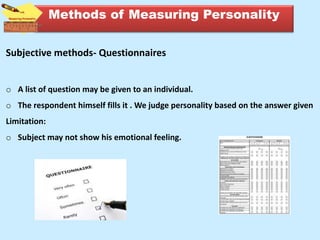
Subjective methods- Questionnaires
o A list of question may be given to an individual.
o The respondent himself fills it . We judge personality based on the answer given
Limitation:
o Subject may not show his emotional feeling.
Methods of Measuring Personality
Subjective methods- Inventories
• Specially designed to seek answers about the person and his personality traits.
• The items are addressed to the sense that the respondent is asking the question
to himself
examples:
- Personal data sheet (116 items) related to feeling, worries and symptoms of
mental disorders.
- MMPI
- EPI
Methods of Measuring Personality
Subjective methods- Inventories- MMPI
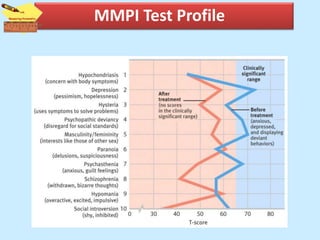
The Minnesota Multiphasic Personality Inventory (MMPI)
• is the most widely researched and clinically used of all personality tests.
• It was originally developed to identify emotional disorders.
• 550 items indicating specific personality traits
• Individual reads items and responses in yes, no or doubtful category will be given.
The MMPI was developed by empirically testing a pool of items and then selecting
those that discriminated between diagnostic groups.
Methods of Measuring Personality
MMPI Test Profile
Subjective methods- Inventories- (EPI)
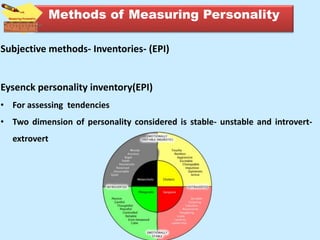
Eysenck personality inventory(EPI)
• For assessing tendencies
• Two dimension of personality considered is stable- unstable and introvert-
extrovert
Methods of Measuring Personality
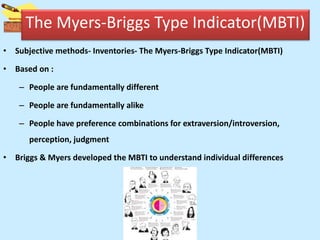
• Subjective methods- Inventories- The Myers-Briggs Type Indicator(MBTI)
• Based on :
– People are fundamentally different
– People are fundamentally alike
– People have preference combinations for extraversion/introversion,
perception, judgment
• Briggs & Myers developed the MBTI to understand individual differences
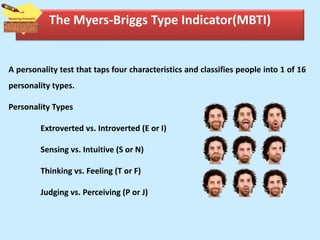
The Myers-Briggs Type Indicator(MBTI)
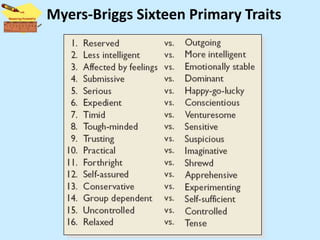
A personality test that taps four characteristics and classifies people into 1 of 16
personality types.
Personality Types
Extroverted vs. Introverted (E or I)
Sensing vs. Intuitive (S or N)
Thinking vs. Feeling (T or F)
Judging vs. Perceiving (P or J)
Myers-Briggs Sixteen Primary Traits
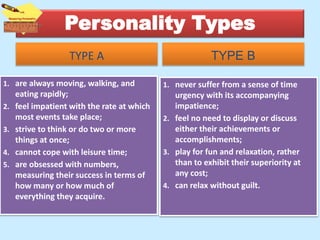
Personality Types
TYPE A
1. are always moving, walking, and
eating rapidly;
2. feel impatient with the rate at which
most events take place;
3. strive to think or do two or more
things at once;
4. cannot cope with leisure time;
5. are obsessed with numbers,
measuring their success in terms of
how many or how much of
everything they acquire.
TYPE B
1. never suffer from a sense of time
urgency with its accompanying
impatience;
2. feel no need to display or discuss
either their achievements or
accomplishments;
3. play for fun and relaxation, rather
than to exhibit their superiority at
any cost;
4. can relax without guilt.
Objective Methods
Do not depend upon subjects’ own statements but upon his overt behavior as
revealed to others
It is more scientific
Examples :
1- Rating scales
2- Judgment of one person by another
3- Rating can be done by teachers, parents, examiner in 5 points, 3 points 7 points, 9
or 11 point rating
Methods of Measuring Personality
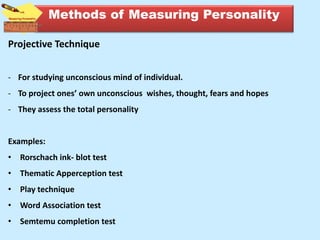
Projective Technique
- For studying unconscious mind of individual.
- To project ones’ own unconscious wishes, thought, fears and hopes
- They assess the total personality
Examples:
• Rorschach ink- blot test
• Thematic Apperception test
• Play technique
• Word Association test
• Semtemu completion test
Methods of Measuring Personality
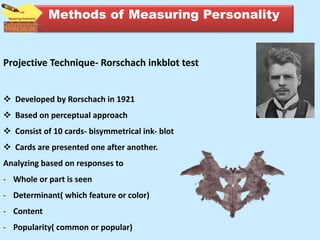
Projective Technique- Rorschach inkblot test
 Developed by Rorschach in 1921
 Based on perceptual approach
 Consist of 10 cards- bisymmetrical ink- blot
 Cards are presented one after another.
Analyzing based on responses to
- Whole or part is seen
- Determinant( which feature or color)
- Content
- Popularity( common or popular)
Methods of Measuring Personality
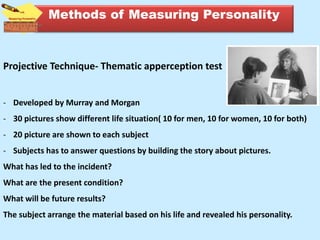
Projective Technique- Thematic apperception test
- Developed by Murray and Morgan
- 30 pictures show different life situation( 10 for men, 10 for women, 10 for both)
- 20 picture are shown to each subject
- Subjects has to answer questions by building the story about pictures.
What has led to the incident?
What are the present condition?
What will be future results?
The subject arrange the material based on his life and revealed his personality.
Methods of Measuring Personality
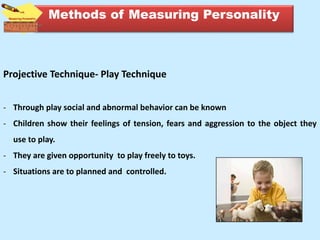
Projective Technique- Play Technique
- Through play social and abnormal behavior can be known
- Children show their feelings of tension, fears and aggression to the object they
use to play.
- They are given opportunity to play freely to toys.
- Situations are to planned and controlled.
Methods of Measuring Personality
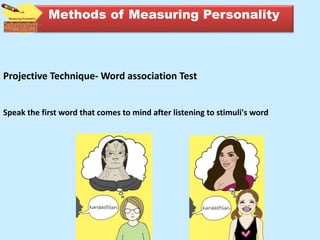
Projective Technique- Word association Test
Speak the first word that comes to mind after listening to stimuli's word
Methods of Measuring Personality
Projective Technique- Sentence completion test
- Beginning of some sentences are given that need to complete it by subject.
- Indicates their feeling, liking and disliking.
Methods of Measuring Personality
How is Personality Measured?
Projective Test - elicits an individual’s response to abstract stimuli
Behavioral Measures - personality assessments that involve observing an individual’s
behavior in a controlled situation
Self-Report Questionnaire - assessment involving an individual’s responses to
questions
Myers-Briggs Type Indicator (MBTI) - instrument measuring Jung’s theory of
individual differences.
Big Five Personality Traits
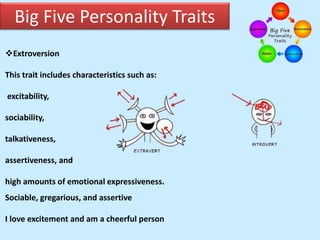
Extroversion
This trait includes characteristics such as:
excitability,
sociability,
talkativeness,
assertiveness, and
high amounts of emotional expressiveness.
Sociable, gregarious, and assertive
I love excitement and am a cheerful person
Big Five Personality Traits
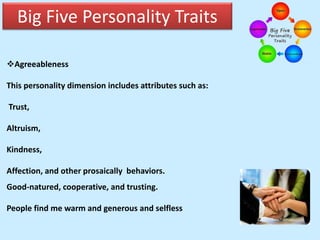
Agreeableness
This personality dimension includes attributes such as:
Trust,
Altruism,
Kindness,
Affection, and other prosaically behaviors.
Good-natured, cooperative, and trusting.
People find me warm and generous and selfless
Big Five Personality Traits
Conscientiousness
Common features of this dimension include high levels of thoughtfulness,
with good impulse control and goal-directed behaviors
Responsible,
dependable,
persistent, and organized.
People find me reliable and I keep my house clean
Big Five Personality Traits
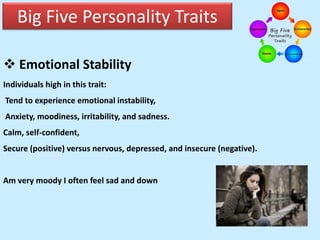
 Emotional Stability
Individuals high in this trait:
Tend to experience emotional instability,
Anxiety, moodiness, irritability, and sadness.
Calm, self-confident,
Secure (positive) versus nervous, depressed, and insecure (negative).
Am very moody I often feel sad and down
Big Five Personality Traits
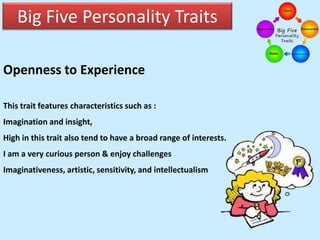
Openness to Experience
This trait features characteristics such as :
Imagination and insight,
High in this trait also tend to have a broad range of interests.
I am a very curious person & enjoy challenges
Imaginativeness, artistic, sensitivity, and intellectualism
Role of the teacher in the Personality development of students
 Respect for the individuality of each child
 Teacher should act as guide
 Firm in tearm of disciplines.
 Teacher should be source of inspiration
 Show love and patience
 Understand children: be a physician, mental hygienist, philosopher a
moralist and an artist to the child
Role of the teacher in the Personality development of students
 Teacher is a spiritual presepeor, communicator and provider of knowledge
 Teacher as a facilitator & manager of learning
 Teacher as a ideal person, a role model
 Teacher as a agent of social change and spearhead of change in society
 Character and personality of teacher
 Teachers love for the profession
 Teacher love for children

Personality

  • 1.
    The sum totalof ways in which an individual reacts and interacts with others. Personality is a pattern of stable states and characteristics of a person that influences his or her behavior toward goal achievement
  • 2.
    The Environment • Organization •Work group • Job • Personal life Variables Influencing Individual Behavior The Person • Skills & abilities • Personality • Perceptions • Attitudes •Values • Ethics Behavior B = f(P,E)
  • 3.
    DEFINITION Personality is relativelystable set of characteristics that influences an individual’s behavior It is a subjective phenomenon.
  • 4.
    DEFINITION, Allport Personality isthe dynamic organization within the individual of those psycho-physical systems that determine his characteristic and behavior and thought.
  • 5.
    Definitions: Mackinnon (1959) •Personality refers to “factors” inside people that explain their behavior • The sum total of typical ways of acting, thinking, and feeling that makes a person unique.
  • 6.
    Dynamic: ever changing Psychophysical Organizedand integrated Unique: specific features in every individual Adjustment to environment Self conscious. Only for human being Social: develop through social interaction Characteristics of Personality
  • 7.
    3 Facts toConsider When Defining “Personality”  Individuals are unique  Individuals behave differently in different situations  Although individuals are unique and behave inconsistently across situations, there is considerable commonality in human behavior
  • 8.
    Personality: a person’sinternally based characteristic way of acting and thinking Character: Personal characteristics that have been judged or evaluated Temperament: Hereditary aspects of personality, including sensitivity, moods, irritability, and distractibility Personality Trait: Stable qualities that a person shows in most situations Personality Type: People who have several traits in common Personality: Some Terms
  • 9.
    A)Heredity and biologicalfactors - Physique - Intelligence - Sex differences - Nervous system - Chemical organisation
  • 10.
    Biology and Personality Personalitydimensions are influenced by genes. 1. Brain-imaging procedures show that extraverts seek stimulation because their normal brain arousal is relatively low. 2. Genes also influence our temperament and behavioral style. Differences in children’s shyness and inhibition may be attributed to autonomic nervous system reactivity.
  • 11.
    B) Environmental factors -Family - Geography - Life pattern - Childhood experience - Neighbourhood - Friends - School - Media - Cloths - Culture
  • 12.
    Personality & Environments Howwe view and treat people influences how they treat us. Our personalities shape situations. Anxious people react to situations differently than relaxed people. Our personalities shape how we react to events. The school you attend and the music you listen to are partly based on your dispositions. Different people choose different environments. Specific ways in which individuals and environments interact
  • 13.
    Culture People maintain theirself-esteem even with a low status by valuing things they achieve and comparing themselves to people with similar positions.
  • 14.
    C) Emotional reaction -Aspiration - Aptitudes and attitude - Interest - Motivation - Intellectual level
  • 15.
    Well balanced personality Good physical appearance  Emotional stability  High intellectual ability  High degree of social adjustment  High moral characters  Good temperament  Good directedness  Tremendous commonsense, drive and pragmatic thinking
  • 16.
    Well balanced personalityaccording to Allport 1. Self- extension - First requirement of mature personality - Strive based towards a destination - Definite goal in life - Will not denied from this goal because of defeat or momentary pleasure - These goals represent of extension of self
  • 17.
    Well balanced personalityaccording to Allport 2. Self objectification A mature person look at himself objectivity. - He has insight - He accept his weaknesses - He evaluates himself in terms of his potentialities - Sense of realities
  • 18.
    Well balanced personalityaccording to Allport 3. Unifying philosophy of life - A mature personality lives according to some accepted philosophy of life developed to his own satisfaction - His life will be value oriented
  • 19.
    THEORIES Trait Theory: understandindividuals by breaking down behavior patterns into observable traits. Psychodynamic Theory: emphasizes the unconscious determinants of behavior Humanistic Theory: emphasizes individual growth and improvement Integrative Approach: describes personality as a composite of an individual’s psychological processes
  • 20.
    PERSONALITY TRAITS • Apersonality trait is a personality characteristic that endures over time and across different situations • Trait theories of personality focus on measuring, identifying and describing individual differences in personality in terms of traits • Focus is on what is different- not what is the same • Can be used to predict behaviour based on traits
  • 21.
    Assessing Traits Personality inventoriesare questionnaires (often with true-false or agree-disagree items) designed to gauge a wide range of feelings and behaviors assessing several traits at once.
  • 22.
    PERSONALITY TRAITS Enduring characteristicsthat describe an individual’s behavior.
  • 23.
    Personality traits aredescribed on a continuum – showing either end of the trait.
  • 24.
    Strengths and Limitationsof trait theories  Provide useful descriptions of personality and its structure  Provided the foundation of valid and reliable personality devices  Can lead people to accept and use oversimplified classifications and descriptions  Underestimate socio-cultural influences on behaviour
  • 25.
    Methods of MeasuringPersonality Personality cannot be quantitatively measured but appraise personality to help us to: • know about the physical, mental, emotional and social behavior of the individual • For the purpose of guidance and selection of personnel • To appear of teacher competence
  • 26.
    Methods of MeasuringPersonality 1- Subjective methods, ask the individual to evaluate himself, Data is also is collected with the help of his friend also - Autobiography: is the story about subject that has written by himself. - Case history method - Interview technique - Questionnaire - Inventories 2- Objective methods 3- Projective method
  • 27.
    Subjective method- autobiography Autobiographyis faithful record of ones past and future Subjects write about aims, ambitions, achievement, attitude and experience Advantages:  it is economical and useful to explore the personality Limitations:  The subject exaggerates his qualities  It may be full of irrelevant and insignificant things.  Since subjects writes from memory it may fail.  Language handicap Methods of Measuring Personality
  • 28.
    Subjective method- Casehistory method  Information collected about heredity & environment features.  Physical, intellectual, academic, emotional & social history.  Data about nature of delivery, health of child at birth, relationship with parent and sibling, physical diseases, to know about cases of maladjustment Advantages:  Useful in clinical method  More systematic and scientific Limitations:  Time consuming  Difficult to collect data Methods of Measuring Personality
  • 29.
    Subjective method- Interviewtechnique  Face to face interaction between interviewers and interviewee  Ask question and get information  Ambitions, aspiration and many other trait is known Limitation  Subjective  Costly  Time consuming  Need experts and trained person Methods of Measuring Personality
  • 30.
    Subjective methods- Questionnaires oA list of question may be given to an individual. o The respondent himself fills it . We judge personality based on the answer given Limitation: o Subject may not show his emotional feeling. Methods of Measuring Personality
  • 31.
    Subjective methods- Inventories •Specially designed to seek answers about the person and his personality traits. • The items are addressed to the sense that the respondent is asking the question to himself examples: - Personal data sheet (116 items) related to feeling, worries and symptoms of mental disorders. - MMPI - EPI Methods of Measuring Personality
  • 32.
    Subjective methods- Inventories-MMPI The Minnesota Multiphasic Personality Inventory (MMPI) • is the most widely researched and clinically used of all personality tests. • It was originally developed to identify emotional disorders. • 550 items indicating specific personality traits • Individual reads items and responses in yes, no or doubtful category will be given. The MMPI was developed by empirically testing a pool of items and then selecting those that discriminated between diagnostic groups. Methods of Measuring Personality
  • 33.
  • 34.
    Subjective methods- Inventories-(EPI) Eysenck personality inventory(EPI) • For assessing tendencies • Two dimension of personality considered is stable- unstable and introvert- extrovert Methods of Measuring Personality
  • 35.
    • Subjective methods-Inventories- The Myers-Briggs Type Indicator(MBTI) • Based on : – People are fundamentally different – People are fundamentally alike – People have preference combinations for extraversion/introversion, perception, judgment • Briggs & Myers developed the MBTI to understand individual differences The Myers-Briggs Type Indicator(MBTI)
  • 36.
    The Myers-Briggs TypeIndicator(MBTI) A personality test that taps four characteristics and classifies people into 1 of 16 personality types. Personality Types Extroverted vs. Introverted (E or I) Sensing vs. Intuitive (S or N) Thinking vs. Feeling (T or F) Judging vs. Perceiving (P or J)
  • 37.
  • 38.
    Personality Types TYPE A 1.are always moving, walking, and eating rapidly; 2. feel impatient with the rate at which most events take place; 3. strive to think or do two or more things at once; 4. cannot cope with leisure time; 5. are obsessed with numbers, measuring their success in terms of how many or how much of everything they acquire. TYPE B 1. never suffer from a sense of time urgency with its accompanying impatience; 2. feel no need to display or discuss either their achievements or accomplishments; 3. play for fun and relaxation, rather than to exhibit their superiority at any cost; 4. can relax without guilt.
  • 39.
    Objective Methods Do notdepend upon subjects’ own statements but upon his overt behavior as revealed to others It is more scientific Examples : 1- Rating scales 2- Judgment of one person by another 3- Rating can be done by teachers, parents, examiner in 5 points, 3 points 7 points, 9 or 11 point rating Methods of Measuring Personality
  • 40.
    Projective Technique - Forstudying unconscious mind of individual. - To project ones’ own unconscious wishes, thought, fears and hopes - They assess the total personality Examples: • Rorschach ink- blot test • Thematic Apperception test • Play technique • Word Association test • Semtemu completion test Methods of Measuring Personality
  • 41.
    Projective Technique- Rorschachinkblot test  Developed by Rorschach in 1921  Based on perceptual approach  Consist of 10 cards- bisymmetrical ink- blot  Cards are presented one after another. Analyzing based on responses to - Whole or part is seen - Determinant( which feature or color) - Content - Popularity( common or popular) Methods of Measuring Personality
  • 42.
    Projective Technique- Thematicapperception test - Developed by Murray and Morgan - 30 pictures show different life situation( 10 for men, 10 for women, 10 for both) - 20 picture are shown to each subject - Subjects has to answer questions by building the story about pictures. What has led to the incident? What are the present condition? What will be future results? The subject arrange the material based on his life and revealed his personality. Methods of Measuring Personality
  • 43.
    Projective Technique- PlayTechnique - Through play social and abnormal behavior can be known - Children show their feelings of tension, fears and aggression to the object they use to play. - They are given opportunity to play freely to toys. - Situations are to planned and controlled. Methods of Measuring Personality
  • 44.
    Projective Technique- Wordassociation Test Speak the first word that comes to mind after listening to stimuli's word Methods of Measuring Personality
  • 45.
    Projective Technique- Sentencecompletion test - Beginning of some sentences are given that need to complete it by subject. - Indicates their feeling, liking and disliking. Methods of Measuring Personality
  • 46.
    How is PersonalityMeasured? Projective Test - elicits an individual’s response to abstract stimuli Behavioral Measures - personality assessments that involve observing an individual’s behavior in a controlled situation Self-Report Questionnaire - assessment involving an individual’s responses to questions Myers-Briggs Type Indicator (MBTI) - instrument measuring Jung’s theory of individual differences.
  • 47.
    Big Five PersonalityTraits Extroversion This trait includes characteristics such as: excitability, sociability, talkativeness, assertiveness, and high amounts of emotional expressiveness. Sociable, gregarious, and assertive I love excitement and am a cheerful person
  • 48.
    Big Five PersonalityTraits Agreeableness This personality dimension includes attributes such as: Trust, Altruism, Kindness, Affection, and other prosaically behaviors. Good-natured, cooperative, and trusting. People find me warm and generous and selfless
  • 49.
    Big Five PersonalityTraits Conscientiousness Common features of this dimension include high levels of thoughtfulness, with good impulse control and goal-directed behaviors Responsible, dependable, persistent, and organized. People find me reliable and I keep my house clean
  • 50.
    Big Five PersonalityTraits  Emotional Stability Individuals high in this trait: Tend to experience emotional instability, Anxiety, moodiness, irritability, and sadness. Calm, self-confident, Secure (positive) versus nervous, depressed, and insecure (negative). Am very moody I often feel sad and down
  • 51.
    Big Five PersonalityTraits Openness to Experience This trait features characteristics such as : Imagination and insight, High in this trait also tend to have a broad range of interests. I am a very curious person & enjoy challenges Imaginativeness, artistic, sensitivity, and intellectualism
  • 52.
    Role of theteacher in the Personality development of students  Respect for the individuality of each child  Teacher should act as guide  Firm in tearm of disciplines.  Teacher should be source of inspiration  Show love and patience  Understand children: be a physician, mental hygienist, philosopher a moralist and an artist to the child
  • 53.
    Role of theteacher in the Personality development of students  Teacher is a spiritual presepeor, communicator and provider of knowledge  Teacher as a facilitator & manager of learning  Teacher as a ideal person, a role model  Teacher as a agent of social change and spearhead of change in society  Character and personality of teacher  Teachers love for the profession  Teacher love for children