PERSONALITY
BY :
RADHIKA GUPTA
MBA GEN (A)
170101010029
HARYANA SCHOOL OF BUSINESS
(GURU JAMBESHWAR UNIVERSITY OF
SCIENCE AND TECHNOLOGY)
CONTENTS
 Introduction
 Personality Determinants
 The Myers-Briggs Type Indicator(MBTI)
 Five Big Attribute of Personality
 Major Personality Attribute Influencing OB
 Type A vs. Type B Personality
 Hallmarks of an Effective Presentation
 Conclusion
WHAT IS PERSONALITY?
Personality refers to that role which a person
displays to the public. It combines both the
psychological and physical aspects with the
help of which one comes to have a special
adjustment with the circumstances.
“AN UGLY PERSONALITY
DESTROYS A PREETY FACE”
PERSONALITY
DETERMINANTS
HEREDITARY
FACTORS
ENVIRONMENTAL
FACTORS
PSYCHOLOGICAL
FACTORS
P
E
R
S
O
N
A
L
I
T
Y
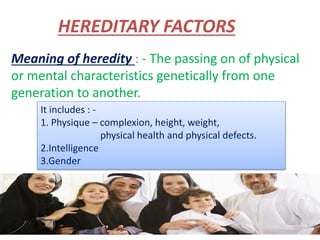
HEREDITARY FACTORS
Meaning of heredity : - The passing on of physical
or mental characteristics genetically from one
generation to another.
It includes : -
1. Physique – complexion, height, weight,
physical health and physical defects.
2.Intelligence
3.Gender
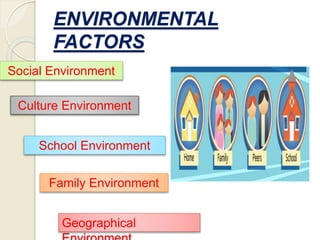
ENVIRONMENTAL
FACTORS
Social Environment
Culture Environment
Geographical
Family Environment
School Environment
PSYCHOLOGICAL
FACTORS
Attitude
Mental Development
Will Power
Where the willingness is great, the difficulties cannot be great.
The Myers-Briggs Type Indicator
(MBTI)
Personality Types
•Extroverted vs. Introverted (E or I)
•Sensing vs. Intuitive (S or N)
•Thinking vs. Feeling (T or F)
•Judging vs. Perceiving (P or J)
EXTRAVERSION/INTROVERSION
Extraversion (E)
 Outgoing
 Interacting
 Speaks , then thinks
Introversion (I)
Quiet
Reserved
Thinks , then speak
SENSING/INTUITING
Sensing
 Practical
 Specific
 Details
Intuiting
 General
 Abstract
 Visionary
THINKING/FEELING
Thinking
 Analytical
 Clarity
 Head
Feeling
• Subjective
• Heart
• Circumstances
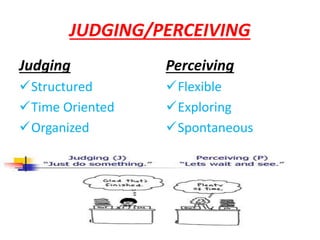
JUDGING/PERCEIVING
Judging
Structured
Time Oriented
Organized
Perceiving
Flexible
Exploring
Spontaneous
MEYERS-BRIGGS , CONTINUED
• A Meyers-Briggs score
- can be a valuable tool for self-awareness
and career guidance
BUT
- Should not be used as a selection tool
because it has not been related to job
performance !!!!
MAJOR PERSONALITY ATTRIBUTE
FIVE BIG ATTRIBUTE OF
PERSONALITY
Agreeableness
Extroversion
Conscientiousness
Emotional stability
Openness
AGREEABLENESS
It refers to a person’s ability to go
along with others
These People are :-
Cooperative
Good-natured
Trustworthy
These people are:-
Sociable
Gregarious
Assertive
EXTROVERSION
It refers to one’s comfort level with
relationship.
CONSCIENTIOUSNESS
• It refers to the number of goals on which an
individual focuses his attention.
These people are :-
Responsible
Systematic
Careful
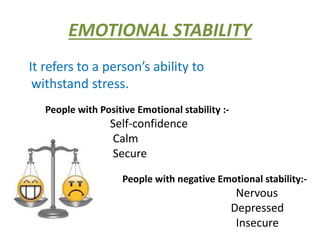
EMOTIONAL STABILITY
It refers to a person’s ability to
withstand stress.
People with Positive Emotional stability :-
Self-confidence
Calm
Secure
People with negative Emotional stability:-
Nervous
Depressed
Insecure
OPENNESS
• It refers to one’s quality of being open
and receptive of new ideas.
They have following attributes:-
 Curious
 Creative
 Imaginative
 Adventurous
OTHER MAJOR PERSONALITY
ATTRIBUTES INFLUENCING OB
Locus of control
Self-esteem
Self-monitoring
Risk taking
Machiavellianism
Narcissism
Proactive personality
LOCUS OF CONTROL
Locus of Control
The degree to which people believe they are
masters of their own fate.
Internals
Individuals who believe that they control what happens to
them.
Externals
Individuals who believe that what happens to them is
controlled by outside forces such as luck or chance.
SELF-ESTEEM
It refers to the extent to which
people hold positive or negative
views about themselves
People with High Self-Esteem
Performs challenging task
Satisfied with their jobs
Contribute significantly to the
effectiveness of the organisation
People with Low Self-Esteem
Having negative approach
Suffers from inferiority complex
Avoids challenging jobs
SELF-MONITORING
It refers to the ability of people to adjust
themselves to changing situations.
People with High-Self Monitoring
 Competent enough to face the changing environment
 Indulge in organizational politics
People with Low-Self Monitoring
 Consistent behaviour
 Not bother about others behaviour
RISK TAKING
It refers to that attribute of personality which is
associated with the degree to which a person is willing to
take a chance and make risky decision.
High Risk-taking Managers
Make quicker decisions
Use less information to make decisions
Operate in smaller and more entrepreneurial organizations
environments
Low Risk-taking Managers
Are slower to make decisions
Require more information before making decisions
Exist in larger organizations with stable environments
MACHIAVELLIANISM
It means getting hold of other people by clever
means and use them to get your objective
achieved.
The use of manipulation to achieve
power.
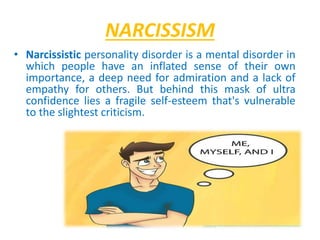
NARCISSISM
• Narcissistic personality disorder is a mental disorder in
which people have an inflated sense of their own
importance, a deep need for admiration and a lack of
empathy for others. But behind this mask of ultra
confidence lies a fragile self-esteem that's vulnerable
to the slightest criticism.
PROACTIVE PERSONALITY
 A person who identifies
opportunities, shows
initiative, takes action,
and perseveres until
meaningful change
occurs.
 Creates positive change
in the environment,
regardless or even in
spite of constraints or
obstacles.
TYPE A VS. TYPE B
PERSONALITY
TYPE A : A person who has
an intense desire to achieve,
is extremely competitive ,
and has a strong sense of
urgency.
TYPE B : A person who tends
to be easygoing and relaxed.
HALLMARKS OF AN
EFFECTIVE PERSONALITY
 Self confident without being arrogant
 Hard-working, never makes excuses
 Positive thinker
 Self motivated
 Be Patient…Good things come to those
who wait
 Always Believe in yourself
 Try to stay calm in tense situations
CONCLUSION
It is difficult to identify ones personality because individual behavior is
complex and construct multidimensional. Personality of a human being can
be determined by identifying stable characteristics of an individual.
Personality can be influenced by environmental factors and situation under
which an individual is working. Heredity has an influence on individual’s
physical appearance, facial attractiveness, sex, temperament and reflects.
These factors have deciding influence on individual behavior in the
organization. Individual behavior is shaped as per the environment he is
brought up. Cultural background, socio- economic conditions, parents
profession are some of the factors responsible for individual personality.
Every individual possesses various personality traits. Locus of control could
be internal or external. People who feel, they can decide their own fate are
internal and those who believe that luck, opportunity and other external
factors are responsible for their future are externals. Every individual behavior
display personality traits, Locus of control, risk taking, self-esteem and self-
monitoring aptitude. Individuals can possess A Type or B Type personality.
Indian managers believe more on competence and achievement orientation
traits as most important.
Personality
Personality

Personality

  • 1.
    PERSONALITY BY : RADHIKA GUPTA MBAGEN (A) 170101010029 HARYANA SCHOOL OF BUSINESS (GURU JAMBESHWAR UNIVERSITY OF SCIENCE AND TECHNOLOGY)
  • 2.
    CONTENTS  Introduction  PersonalityDeterminants  The Myers-Briggs Type Indicator(MBTI)  Five Big Attribute of Personality  Major Personality Attribute Influencing OB  Type A vs. Type B Personality  Hallmarks of an Effective Presentation  Conclusion
  • 5.
    WHAT IS PERSONALITY? Personalityrefers to that role which a person displays to the public. It combines both the psychological and physical aspects with the help of which one comes to have a special adjustment with the circumstances. “AN UGLY PERSONALITY DESTROYS A PREETY FACE”
  • 6.
  • 7.
    HEREDITARY FACTORS Meaning ofheredity : - The passing on of physical or mental characteristics genetically from one generation to another. It includes : - 1. Physique – complexion, height, weight, physical health and physical defects. 2.Intelligence 3.Gender
  • 8.
  • 9.
    PSYCHOLOGICAL FACTORS Attitude Mental Development Will Power Wherethe willingness is great, the difficulties cannot be great.
  • 10.
    The Myers-Briggs TypeIndicator (MBTI) Personality Types •Extroverted vs. Introverted (E or I) •Sensing vs. Intuitive (S or N) •Thinking vs. Feeling (T or F) •Judging vs. Perceiving (P or J)
  • 11.
    EXTRAVERSION/INTROVERSION Extraversion (E)  Outgoing Interacting  Speaks , then thinks Introversion (I) Quiet Reserved Thinks , then speak
  • 12.
    SENSING/INTUITING Sensing  Practical  Specific Details Intuiting  General  Abstract  Visionary
  • 13.
    THINKING/FEELING Thinking  Analytical  Clarity Head Feeling • Subjective • Heart • Circumstances
  • 14.
  • 15.
    MEYERS-BRIGGS , CONTINUED •A Meyers-Briggs score - can be a valuable tool for self-awareness and career guidance BUT - Should not be used as a selection tool because it has not been related to job performance !!!!
  • 16.
  • 17.
    FIVE BIG ATTRIBUTEOF PERSONALITY Agreeableness Extroversion Conscientiousness Emotional stability Openness
  • 18.
    AGREEABLENESS It refers toa person’s ability to go along with others These People are :- Cooperative Good-natured Trustworthy
  • 19.
    These people are:- Sociable Gregarious Assertive EXTROVERSION Itrefers to one’s comfort level with relationship.
  • 20.
    CONSCIENTIOUSNESS • It refersto the number of goals on which an individual focuses his attention. These people are :- Responsible Systematic Careful
  • 21.
    EMOTIONAL STABILITY It refersto a person’s ability to withstand stress. People with Positive Emotional stability :- Self-confidence Calm Secure People with negative Emotional stability:- Nervous Depressed Insecure
  • 22.
    OPENNESS • It refersto one’s quality of being open and receptive of new ideas. They have following attributes:-  Curious  Creative  Imaginative  Adventurous
  • 23.
    OTHER MAJOR PERSONALITY ATTRIBUTESINFLUENCING OB Locus of control Self-esteem Self-monitoring Risk taking Machiavellianism Narcissism Proactive personality
  • 24.
    LOCUS OF CONTROL Locusof Control The degree to which people believe they are masters of their own fate. Internals Individuals who believe that they control what happens to them. Externals Individuals who believe that what happens to them is controlled by outside forces such as luck or chance.
  • 25.
    SELF-ESTEEM It refers tothe extent to which people hold positive or negative views about themselves People with High Self-Esteem Performs challenging task Satisfied with their jobs Contribute significantly to the effectiveness of the organisation People with Low Self-Esteem Having negative approach Suffers from inferiority complex Avoids challenging jobs
  • 26.
    SELF-MONITORING It refers tothe ability of people to adjust themselves to changing situations. People with High-Self Monitoring  Competent enough to face the changing environment  Indulge in organizational politics People with Low-Self Monitoring  Consistent behaviour  Not bother about others behaviour
  • 27.
    RISK TAKING It refersto that attribute of personality which is associated with the degree to which a person is willing to take a chance and make risky decision. High Risk-taking Managers Make quicker decisions Use less information to make decisions Operate in smaller and more entrepreneurial organizations environments Low Risk-taking Managers Are slower to make decisions Require more information before making decisions Exist in larger organizations with stable environments
  • 28.
    MACHIAVELLIANISM It means gettinghold of other people by clever means and use them to get your objective achieved. The use of manipulation to achieve power.
  • 29.
    NARCISSISM • Narcissistic personalitydisorder is a mental disorder in which people have an inflated sense of their own importance, a deep need for admiration and a lack of empathy for others. But behind this mask of ultra confidence lies a fragile self-esteem that's vulnerable to the slightest criticism.
  • 30.
    PROACTIVE PERSONALITY  Aperson who identifies opportunities, shows initiative, takes action, and perseveres until meaningful change occurs.  Creates positive change in the environment, regardless or even in spite of constraints or obstacles.
  • 31.
    TYPE A VS.TYPE B PERSONALITY TYPE A : A person who has an intense desire to achieve, is extremely competitive , and has a strong sense of urgency. TYPE B : A person who tends to be easygoing and relaxed.
  • 32.
    HALLMARKS OF AN EFFECTIVEPERSONALITY  Self confident without being arrogant  Hard-working, never makes excuses  Positive thinker  Self motivated  Be Patient…Good things come to those who wait  Always Believe in yourself  Try to stay calm in tense situations
  • 33.
    CONCLUSION It is difficultto identify ones personality because individual behavior is complex and construct multidimensional. Personality of a human being can be determined by identifying stable characteristics of an individual. Personality can be influenced by environmental factors and situation under which an individual is working. Heredity has an influence on individual’s physical appearance, facial attractiveness, sex, temperament and reflects. These factors have deciding influence on individual behavior in the organization. Individual behavior is shaped as per the environment he is brought up. Cultural background, socio- economic conditions, parents profession are some of the factors responsible for individual personality. Every individual possesses various personality traits. Locus of control could be internal or external. People who feel, they can decide their own fate are internal and those who believe that luck, opportunity and other external factors are responsible for their future are externals. Every individual behavior display personality traits, Locus of control, risk taking, self-esteem and self- monitoring aptitude. Individuals can possess A Type or B Type personality. Indian managers believe more on competence and achievement orientation traits as most important.