PART IV: Leading 8
Learning Outcomes   After this class, I will be able to:
1. Define the focus and goals of  organizational behavior  (OB).
2. Identify and describe the three components of  attitudes .
3. Explain  cognitive dissonance .
4. Describe the Myers-Briggs personality type framework and its use in organizations.
5. Define perception and describe the factors that can shape or distort perception.
6. Explain how managers can  shape  employee behavior.
7. Contrast  formal  and  informal  groups.
8. Explain why people join  groups .
9. State how  roles  and  norms  influence employees’ behavior.
10. Describe how  group size  affects group behavior.
Organizational Behavior (OB) Defined The study of the  actions of people at work The focus of OB Individual behaviors Personality, perception, learning, and motivation Group behaviors Norms, roles, team-and conflict The goals of OB To  explain To  predict  behavior
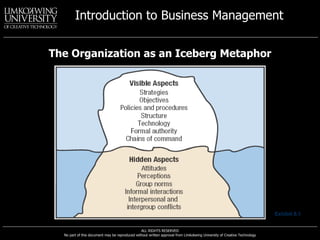
The Organization as an Iceberg Metaphor Exhibit 8.1
Behaviors of Interest to OB Employee productivity The efficiency and effectiveness of employees Absenteeism The election by employees to attend work Turnover The exit of an employee from an organization Organizational citizenship Employee behaviors that promote the welfare of the organization
Understanding Employees Attitudes Valuative statements concerning objects, people, or events Cognitive component The beliefs, opinions, knowledge, and information held by a person Affective component The emotional, or feeling, segment of an attitude Behavioral component An intention to behave in a certain way toward someone or something
Job-Related Attitudes Job satisfaction An employee’s general attitude toward his or her job. Job involvement The degree to which an employee identifies with his or her job, actively participates in it, and considers his or her job performance important for self-worth. Organizational commitment An employee’s orientation toward the organization in terms of his or her loyalty to, identification with, and involvement in the organization.
Cognitive Dissonance Theory Cognitive dissonance Any incompatibility between two or more attitudes or between behavior and attitudes Inconsistency is uncomfortable and individuals will seek a stable state with a minimum of dissonance. The desire to reduce dissonance is determined by: The importance of the elements creating the dissonance The degree of influence the individual believes he or she has over the elements The rewards that may be involved.
Fostering Positive Job Attitudes Managers can reduce dissonance by: Creating the perception that the source of the dissonance is externally imposed and uncontrollable. Increasing employee rewards for engaging in the behaviors related to the dissonance. Satisfied workers are not necessarily more productive workers. Assisting employees in successful performance of their jobs will increase their desired outcomes and lead to increased job satisfaction—focusing on productivity as a means rather than an ends.
Personality and Behavior Personality is the combination of the psychological traits that characterize that person. Myers-Briggs Type Indicator (MBTI) A method of identifying personality types uses four dimensions of personality to identify 16 different personality types. Big Five model Five-factor model of personality that includes extroversion, agreeableness, conscientiousness, emotional stability, and openness to experience.
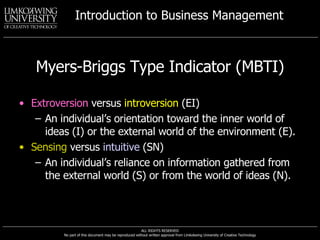
Myers-Briggs Type Indicator (MBTI) Extroversion  versus  introversion  (EI) An individual’s orientation toward the inner world of ideas (I) or the external world of the environment (E).  Sensing  versus  intuitive  (SN) An individual’s reliance on information gathered from the external world (S) or from the world of ideas (N).
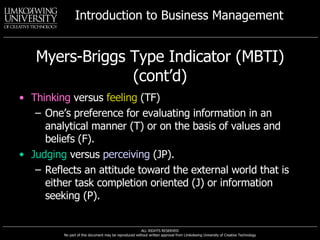
Myers-Briggs Type Indicator (MBTI) (cont’d) Thinking  versus  feeling  (TF) One’s preference for evaluating information in an analytical manner (T) or on the basis of values and beliefs (F). Judging  versus  perceiving  (JP). Reflects an attitude toward the external world that is either task completion oriented (J) or information seeking (P).
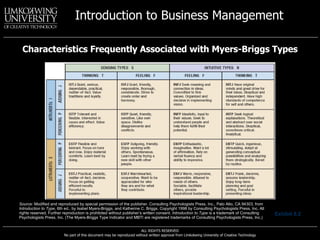
Characteristics Frequently Associated with Myers-Briggs Types Exhibit 8.2 Source:  Modified and reproduced by special permission of the publisher. Consulting Psychologists Press, Inc., Palo Alto, CA 94303, from  Introduction to Type , 6th ed., by Isabel Myers-Briggs, and Katherine C. Briggs. Copyright 1998 by Consulting Psychologists Press, Inc. All rights reserved. Further reproduction is prohibited without publisher’s written consent.  Introduction to Type  is a trademark of Consulting Psychologists Press, Inc. (The Myers-Briggs Type Indicator and MBTI are registered trademarks of Consulting Psychologists Press, Inc.)
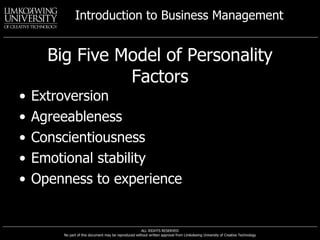
Big Five Model of Personality Factors Extroversion Agreeableness Conscientiousness Emotional stability Openness to experience
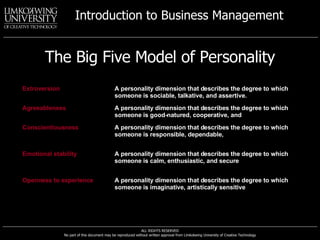
The Big Five Model of Personality Extroversion A personality dimension that describes the degree to which someone is sociable, talkative, and assertive. Agreeableness A personality dimension that describes the degree to which someone is good-natured, cooperative, and  trusting. Conscientiousness A personality dimension that describes the degree to which someone is responsible, dependable,  persistent, and achievement oriented. Emotional stability A personality dimension that describes the degree to which someone is calm, enthusiastic, and secure  (positive) or tense, nervous, depressed, and insecure (negative). Openness to experience A personality dimension that describes the degree to which someone is imaginative, artistically sensitive , and intellectual.
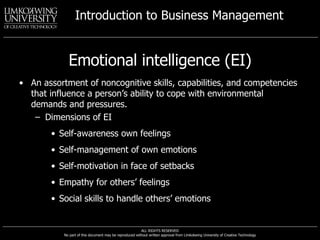
Emotional intelligence (EI) An assortment of noncognitive skills, capabilities, and competencies that influence a person’s ability to cope with environmental demands and pressures. Dimensions of EI Self-awareness own feelings Self-management of own emotions Self-motivation in face of setbacks Empathy for others’ feelings Social skills to handle others’ emotions
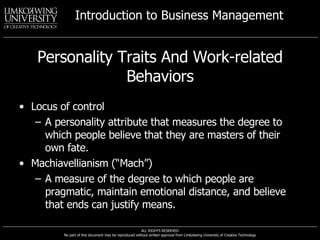
Personality Traits And Work-related Behaviors Locus of control A personality attribute that measures the degree to which people believe that they are masters of their own fate. Machiavellianism (“Mach”) A measure of the degree to which people are pragmatic, maintain emotional distance, and believe that ends can justify means.
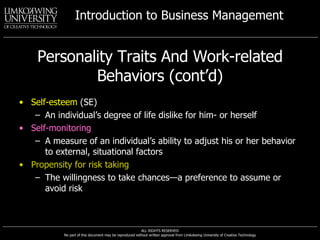
Personality Traits And Work-related Behaviors (cont’d) Self-esteem  (SE) An individual’s degree of life dislike for him- or herself Self-monitoring A measure of an individual’s ability to adjust his or her behavior to external, situational factors Propensity for risk taking The willingness to take chances—a preference to assume or avoid risk
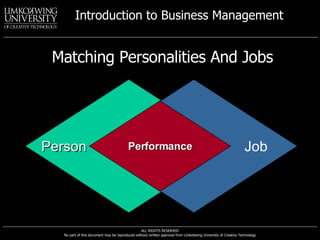
Matching Personalities And Jobs Person Job Performance
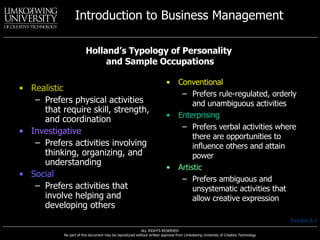
Holland’s Typology of Personality  and Sample Occupations Realistic Prefers physical activities that require skill, strength, and coordination Investigative Prefers activities involving thinking, organizing, and understanding Social Prefers activities that involve helping and developing others Conventional Prefers rule-regulated, orderly and unambiguous activities Enterprising Prefers verbal activities where there are opportunities to influence others and attain power Artistic Prefers ambiguous and unsystematic activities that allow creative expression Exhibit 8.3
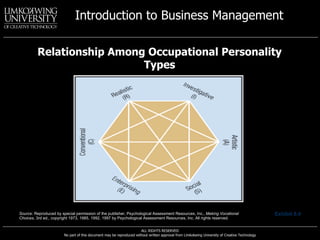
Relationship Among Occupational Personality Types Exhibit 8.4 Source:  Reproduced by special permission of the publisher, Psychological Assessment Resources, Inc.,  Making Vocational Choices , 3rd ed., copyright 1973, 1985, 1992, 1997 by Psychological Assessment Resources, Inc. All rights reserved.
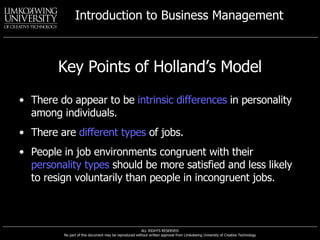
Key Points of Holland’s Model There do appear to be  intrinsic differences  in personality among individuals. There are  different types  of jobs. People in job environments congruent with their  personality types  should be more satisfied and less likely to resign voluntarily than people in incongruent jobs.
Personality Characteristics of Entrepreneurs Proactive personality High level of motivation Internal locus of control Need for autonomy Abundance of self-confidence Self-esteem High energy levels Persistence Moderate risk taker Problem solver
Perception Perception A process by which individuals organize and interpret their sensory impressions in order to give meaning to their environment.
Influences on Perception Personal characteristics Attitudes Personality Motives Interests Past experiences Expectations Target characteristics Relationship of a target to its background Closeness and/or similarity to other things The context in objects is seen Other situational factors.
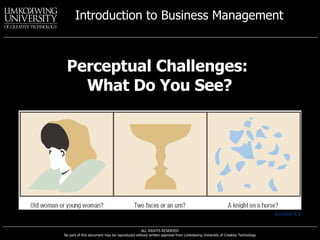
Perceptual Challenges:  What Do You See? Exhibit 8.5
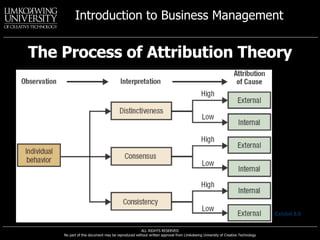
How Managers Judge Employees Attribution theory A theory based on the premise that we judge people differently depending on the meaning we attribute to a given behavior Internally caused behavior is believed to be under the control of the individual. Externally caused behavior results from outside causes; that is, the person is seen as having been forced into the behavior by the situation.
Interpreting Behavior Distinctiveness Whether an individual displays a behavior in many situations or whether it is particular to one situation. Consensus If the individual responds in the same way as everyone else faced with a similar situation responds. Consistency   The individual engages in the same behaviors regularly and consistently over time.
The Process of Attribution Theory Exhibit 8.6
Judgment Errors Fundamental attribution error The tendency to underestimate the influence of external factors and overestimate the influence of internal or personal factors when making judgments about the behavior of others. Self-serving bias The tendency for individuals to attribute their own successes to internal factors while putting the blame for failures on external factors.
Distortions in Shortcut Methods  in Judging Others Selectivity Assumed similarity Stereotyping Halo effect Self-fulfilling prophecy Exhibit 8.7
Learning Learning defined Any relatively permanent change in behavior that occurs as a result of experience. Operant conditioning (B. F. Skinner) A behavioral theory that argues that voluntary, or learned, behavior is a function of its consequences. Reinforcement increases the likelihood that behavior will be repeated; behavior that is not rewarded or is punished is less likely to be repeated. Rewards are most effective if they immediately follow the desired response.
Learning (cont’d) Social learning theory The theory that people can learn through observation and direct experience; by modeling the behavior of others. Modeling processes Attentional processes. Retention processes Motor reproduction processes Reinforcement processes
Shaping Behavior Shaping behavior Systematically reinforcing each successive step that moves an individual closer to a desired behavior Four ways in which to shape behavior: Positive reinforcement Negative reinforcement Punishment Extinction.
Foundations Of Group Behavior Group Two or more interacting and interdependent individuals who come together to achieve particular objectives Role A set of expected behavior patterns attributed to someone in a given position in a social unit Norms Acceptable standards (e.g., effort and performance, dress, and loyalty) shared and enforced by the members of a group
Foundations Of Group Behavior (cont’d) Status A prestige grading, position, or rank within a group May be informally conferred by characteristics such as education, age, skill, or experience. Anything can have status value if others in the group admire it.
Reasons Why People Join Groups Security Status Self-esteem Affiliation Power Goal achievement Exhibit 8.8
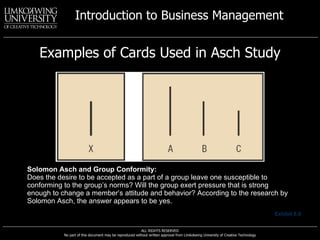
Examples of Cards Used in Asch Study Solomon Asch and Group Conformity: Does the desire to be accepted as a part of a group leave one susceptible to conforming to the group’s norms? Will the group exert pressure that is strong enough to change a member’s attitude and behavior? According to the research by Solomon Asch, the answer appears to be yes. Exhibit 8.9
Group Effects Social loafing The tendency of an individual in a group to decrease his or her effort because responsibility and individual achievement cannot be measured Group cohesiveness The degree to which members of a group are attracted to each other and share goals Size, work environment, length of time in existence, group-organization, and goal congruency affect the degree of group cohesiveness.
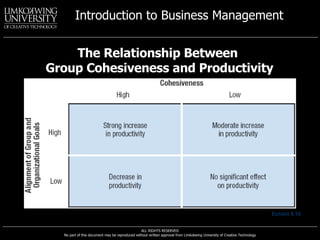
The Relationship Between  Group Cohesiveness and Productivity Exhibit 8.10

Day 8 - Understanding work teams

  • 1.
  • 2.
    Learning Outcomes After this class, I will be able to:
  • 3.
    1. Define thefocus and goals of organizational behavior (OB).
  • 4.
    2. Identify anddescribe the three components of attitudes .
  • 5.
    3. Explain cognitive dissonance .
  • 6.
    4. Describe theMyers-Briggs personality type framework and its use in organizations.
  • 7.
    5. Define perceptionand describe the factors that can shape or distort perception.
  • 8.
    6. Explain howmanagers can shape employee behavior.
  • 9.
    7. Contrast formal and informal groups.
  • 10.
    8. Explain whypeople join groups .
  • 11.
    9. State how roles and norms influence employees’ behavior.
  • 12.
    10. Describe how group size affects group behavior.
  • 13.
    Organizational Behavior (OB)Defined The study of the actions of people at work The focus of OB Individual behaviors Personality, perception, learning, and motivation Group behaviors Norms, roles, team-and conflict The goals of OB To explain To predict behavior
  • 14.
    The Organization asan Iceberg Metaphor Exhibit 8.1
  • 15.
    Behaviors of Interestto OB Employee productivity The efficiency and effectiveness of employees Absenteeism The election by employees to attend work Turnover The exit of an employee from an organization Organizational citizenship Employee behaviors that promote the welfare of the organization
  • 16.
    Understanding Employees AttitudesValuative statements concerning objects, people, or events Cognitive component The beliefs, opinions, knowledge, and information held by a person Affective component The emotional, or feeling, segment of an attitude Behavioral component An intention to behave in a certain way toward someone or something
  • 17.
    Job-Related Attitudes Jobsatisfaction An employee’s general attitude toward his or her job. Job involvement The degree to which an employee identifies with his or her job, actively participates in it, and considers his or her job performance important for self-worth. Organizational commitment An employee’s orientation toward the organization in terms of his or her loyalty to, identification with, and involvement in the organization.
  • 18.
    Cognitive Dissonance TheoryCognitive dissonance Any incompatibility between two or more attitudes or between behavior and attitudes Inconsistency is uncomfortable and individuals will seek a stable state with a minimum of dissonance. The desire to reduce dissonance is determined by: The importance of the elements creating the dissonance The degree of influence the individual believes he or she has over the elements The rewards that may be involved.
  • 19.
    Fostering Positive JobAttitudes Managers can reduce dissonance by: Creating the perception that the source of the dissonance is externally imposed and uncontrollable. Increasing employee rewards for engaging in the behaviors related to the dissonance. Satisfied workers are not necessarily more productive workers. Assisting employees in successful performance of their jobs will increase their desired outcomes and lead to increased job satisfaction—focusing on productivity as a means rather than an ends.
  • 20.
    Personality and BehaviorPersonality is the combination of the psychological traits that characterize that person. Myers-Briggs Type Indicator (MBTI) A method of identifying personality types uses four dimensions of personality to identify 16 different personality types. Big Five model Five-factor model of personality that includes extroversion, agreeableness, conscientiousness, emotional stability, and openness to experience.
  • 21.
    Myers-Briggs Type Indicator(MBTI) Extroversion versus introversion (EI) An individual’s orientation toward the inner world of ideas (I) or the external world of the environment (E). Sensing versus intuitive (SN) An individual’s reliance on information gathered from the external world (S) or from the world of ideas (N).
  • 22.
    Myers-Briggs Type Indicator(MBTI) (cont’d) Thinking versus feeling (TF) One’s preference for evaluating information in an analytical manner (T) or on the basis of values and beliefs (F). Judging versus perceiving (JP). Reflects an attitude toward the external world that is either task completion oriented (J) or information seeking (P).
  • 23.
    Characteristics Frequently Associatedwith Myers-Briggs Types Exhibit 8.2 Source: Modified and reproduced by special permission of the publisher. Consulting Psychologists Press, Inc., Palo Alto, CA 94303, from Introduction to Type , 6th ed., by Isabel Myers-Briggs, and Katherine C. Briggs. Copyright 1998 by Consulting Psychologists Press, Inc. All rights reserved. Further reproduction is prohibited without publisher’s written consent. Introduction to Type is a trademark of Consulting Psychologists Press, Inc. (The Myers-Briggs Type Indicator and MBTI are registered trademarks of Consulting Psychologists Press, Inc.)
  • 24.
    Big Five Modelof Personality Factors Extroversion Agreeableness Conscientiousness Emotional stability Openness to experience
  • 25.
    The Big FiveModel of Personality Extroversion A personality dimension that describes the degree to which someone is sociable, talkative, and assertive. Agreeableness A personality dimension that describes the degree to which someone is good-natured, cooperative, and trusting. Conscientiousness A personality dimension that describes the degree to which someone is responsible, dependable, persistent, and achievement oriented. Emotional stability A personality dimension that describes the degree to which someone is calm, enthusiastic, and secure (positive) or tense, nervous, depressed, and insecure (negative). Openness to experience A personality dimension that describes the degree to which someone is imaginative, artistically sensitive , and intellectual.
  • 26.
    Emotional intelligence (EI)An assortment of noncognitive skills, capabilities, and competencies that influence a person’s ability to cope with environmental demands and pressures. Dimensions of EI Self-awareness own feelings Self-management of own emotions Self-motivation in face of setbacks Empathy for others’ feelings Social skills to handle others’ emotions
  • 27.
    Personality Traits AndWork-related Behaviors Locus of control A personality attribute that measures the degree to which people believe that they are masters of their own fate. Machiavellianism (“Mach”) A measure of the degree to which people are pragmatic, maintain emotional distance, and believe that ends can justify means.
  • 28.
    Personality Traits AndWork-related Behaviors (cont’d) Self-esteem (SE) An individual’s degree of life dislike for him- or herself Self-monitoring A measure of an individual’s ability to adjust his or her behavior to external, situational factors Propensity for risk taking The willingness to take chances—a preference to assume or avoid risk
  • 29.
    Matching Personalities AndJobs Person Job Performance
  • 30.
    Holland’s Typology ofPersonality and Sample Occupations Realistic Prefers physical activities that require skill, strength, and coordination Investigative Prefers activities involving thinking, organizing, and understanding Social Prefers activities that involve helping and developing others Conventional Prefers rule-regulated, orderly and unambiguous activities Enterprising Prefers verbal activities where there are opportunities to influence others and attain power Artistic Prefers ambiguous and unsystematic activities that allow creative expression Exhibit 8.3
  • 31.
    Relationship Among OccupationalPersonality Types Exhibit 8.4 Source: Reproduced by special permission of the publisher, Psychological Assessment Resources, Inc., Making Vocational Choices , 3rd ed., copyright 1973, 1985, 1992, 1997 by Psychological Assessment Resources, Inc. All rights reserved.
  • 32.
    Key Points ofHolland’s Model There do appear to be intrinsic differences in personality among individuals. There are different types of jobs. People in job environments congruent with their personality types should be more satisfied and less likely to resign voluntarily than people in incongruent jobs.
  • 33.
    Personality Characteristics ofEntrepreneurs Proactive personality High level of motivation Internal locus of control Need for autonomy Abundance of self-confidence Self-esteem High energy levels Persistence Moderate risk taker Problem solver
  • 34.
    Perception Perception Aprocess by which individuals organize and interpret their sensory impressions in order to give meaning to their environment.
  • 35.
    Influences on PerceptionPersonal characteristics Attitudes Personality Motives Interests Past experiences Expectations Target characteristics Relationship of a target to its background Closeness and/or similarity to other things The context in objects is seen Other situational factors.
  • 36.
    Perceptual Challenges: What Do You See? Exhibit 8.5
  • 37.
    How Managers JudgeEmployees Attribution theory A theory based on the premise that we judge people differently depending on the meaning we attribute to a given behavior Internally caused behavior is believed to be under the control of the individual. Externally caused behavior results from outside causes; that is, the person is seen as having been forced into the behavior by the situation.
  • 38.
    Interpreting Behavior DistinctivenessWhether an individual displays a behavior in many situations or whether it is particular to one situation. Consensus If the individual responds in the same way as everyone else faced with a similar situation responds. Consistency The individual engages in the same behaviors regularly and consistently over time.
  • 39.
    The Process ofAttribution Theory Exhibit 8.6
  • 40.
    Judgment Errors Fundamentalattribution error The tendency to underestimate the influence of external factors and overestimate the influence of internal or personal factors when making judgments about the behavior of others. Self-serving bias The tendency for individuals to attribute their own successes to internal factors while putting the blame for failures on external factors.
  • 41.
    Distortions in ShortcutMethods in Judging Others Selectivity Assumed similarity Stereotyping Halo effect Self-fulfilling prophecy Exhibit 8.7
  • 42.
    Learning Learning definedAny relatively permanent change in behavior that occurs as a result of experience. Operant conditioning (B. F. Skinner) A behavioral theory that argues that voluntary, or learned, behavior is a function of its consequences. Reinforcement increases the likelihood that behavior will be repeated; behavior that is not rewarded or is punished is less likely to be repeated. Rewards are most effective if they immediately follow the desired response.
  • 43.
    Learning (cont’d) Sociallearning theory The theory that people can learn through observation and direct experience; by modeling the behavior of others. Modeling processes Attentional processes. Retention processes Motor reproduction processes Reinforcement processes
  • 44.
    Shaping Behavior Shapingbehavior Systematically reinforcing each successive step that moves an individual closer to a desired behavior Four ways in which to shape behavior: Positive reinforcement Negative reinforcement Punishment Extinction.
  • 45.
    Foundations Of GroupBehavior Group Two or more interacting and interdependent individuals who come together to achieve particular objectives Role A set of expected behavior patterns attributed to someone in a given position in a social unit Norms Acceptable standards (e.g., effort and performance, dress, and loyalty) shared and enforced by the members of a group
  • 46.
    Foundations Of GroupBehavior (cont’d) Status A prestige grading, position, or rank within a group May be informally conferred by characteristics such as education, age, skill, or experience. Anything can have status value if others in the group admire it.
  • 47.
    Reasons Why PeopleJoin Groups Security Status Self-esteem Affiliation Power Goal achievement Exhibit 8.8
  • 48.
    Examples of CardsUsed in Asch Study Solomon Asch and Group Conformity: Does the desire to be accepted as a part of a group leave one susceptible to conforming to the group’s norms? Will the group exert pressure that is strong enough to change a member’s attitude and behavior? According to the research by Solomon Asch, the answer appears to be yes. Exhibit 8.9
  • 49.
    Group Effects Socialloafing The tendency of an individual in a group to decrease his or her effort because responsibility and individual achievement cannot be measured Group cohesiveness The degree to which members of a group are attracted to each other and share goals Size, work environment, length of time in existence, group-organization, and goal congruency affect the degree of group cohesiveness.
  • 50.
    The Relationship Between Group Cohesiveness and Productivity Exhibit 8.10