Personality & Individual Differences
“Be yourself” is the worst
advice you can give some
people.
--T. Masson
First, a few administrative things…
Collect Student Information
Digital Photos
Student Information
Full name (and preferred name)
Year
Major/Minor
E-mail address
Hometown
Any special needs?
List work experience
What are your long term career goals?
Anything else you feel is important for me to know
Learning Objectives
Define the key biographical characteristics & how
they affect the OB dependent variables
Identify two types of ability & the importance of
ability-job fit
Explain the factors that determine an individual’s
personality
Describe personality traits & discuss the
personality-job fit theory
Define Emotional Intelligence (EQ) & Why it is
relevant to the workplace
Developmental Key Concepts 5
What makes us unique?
PERSONAL QUALITIES
Personality
Intelligence
Moral values
Mental health
GROUP IDENTITIES
Race
Culture
Gender
Factors that influence
Individual Behavior:
Biographical Characteristics
Abilities
Personality
Emotional Intelligence
Biographical Characteristics
These variables are more manageable when it comes to
finding and analyzing variables that have an impact on
turnover, satisfaction, etc.
Age- older workers are less likely to resign
Gender - women have higher rates of absence
Marital Status – Married employees have fewer absences,
less turnover, & more satisfied.
Tenure- negatively related to turnover, positively related
to satisfaction
Who Cares… what value do biographical characteristics
have for managers and organizations?
It can help in making choices
among job applicants.
Abilities
Intellectual Abilities
That required to do mental activities.
*Found to be strong predictors of future job
performance.
Physical Abilities
That required to do tasks demanding stamina,
dexterity, strength, and similar characteristics.
Ability-Job Fit
The Ability - Job Fit
Employee performance is enhanced when there
is a high ability - job fit.
We need to keep this in mind from an HR
perspective as well as an individual trying to
make a job decision.
What predictions can we make if the fit is poor?
If employees lack the required abilities?
If employees abilities far exceed the
requirements of the job?
Personality
What is Personality?
The sum total of ways in which an individual
reacts to and interacts with others
Measurable traits that a person exhibits.
An enduring combination of motives, emotions,
values, interests, attitudes and competencies.
Determinants of Personality
Heredity/ Physiological Determinants
physical differences, IQ, potential,
temperament
Environment
culture, norms of family, friends & social
groups, other influences
Situation
in class vs. at a party
on-the-field/court vs. off-the-field/court
Personality Traits
Myers-Briggs Type Indicator (next class)
Extraverted/Introverted
Sensing/Intuitive
Thinking/Feeling
Judging/Perceiving
Big 5 Model
Extraversion
Agreeableness
Conscientiousness
Emotional stability
Openness to Experience
66
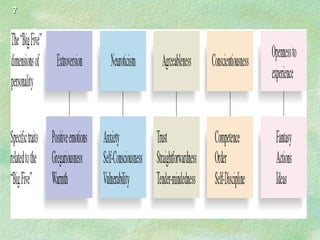
The Big Five Model of Personality
Extroversion: The tendency to experience positive
emotional states and feel good about oneself and the world
around.
Neuroticism(Emotional stability): The tendency to
experience negative emotional states and view oneself and
the world around negatively.
Agreeableness: The tendency to get along well with
others.
Conscientiousness: The extent to which a person is
careful, scrupulous, and persevering.
Openness to Experience: The extent to which a person is
original, has broad interests, and is willing to take risks.
77
Insert Figure 2.3 here
Chapter 2: Understanding Individual
Differences
16
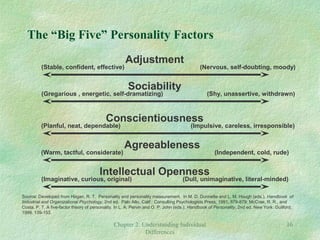
The “Big Five” Personality Factors
Agreeableness
Adjustment
(Stable, confident, effective) (Nervous, self-doubting, moody)
Sociability
(Gregarious , energetic, self-dramatizing) (Shy, unassertive, withdrawn)
Conscientiousness
(Planful, neat, dependable) (Impulsive, careless, irresponsible)
(Warm, tactful, considerate) (Independent, cold, rude)
Intellectual Openness
(Imaginative, curious, original) (Dull, unimaginative, literal-minded)
Source: Developed from Hogan, R. T. Personality and personality measurement. In M. D. Dunnette and L. M. Hough (eds.), Handbook of
Industrial and Organizational Psychology, 2nd ed. Palo Alto, Calif.: Consulting Psychologists Press, 1991, 878-879; McCrae, R. R., and
Costa, P. T. A five-factor theory of personality. In L. A. Pervin and O. P. John (eds.), Handbook of Personality, 2nd ed. New York: Guilford,
1999, 139-153.
99
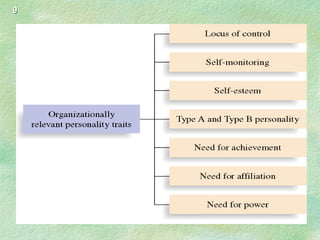
Insert Figure 2.7 here
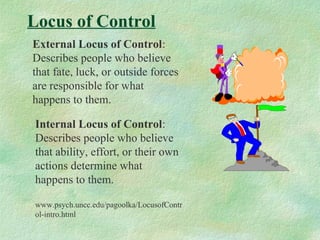
Locus of Control
Internal Locus of Control:
Describes people who believe
that ability, effort, or their own
actions determine what
happens to them.
www.psych.uncc.edu/pagoolka/LocusofContr
ol-intro.html
External Locus of Control:
Describes people who believe
that fate, luck, or outside forces
are responsible for what
happens to them.
1111
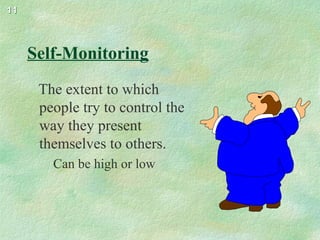
Self-Monitoring
The extent to which
people try to control the
way they present
themselves to others.
Can be high or low
1212
Self-Esteem
The extent to which
people have pride in
themselves and their
capabilities.
Can be high or low
Not situation specific
Type A’s & Type B’s
Type A Personality
Always moving, walking, and eating rapidly.
Feel impatient with the rate at which most events take place.
Strive to think or do two or more things at once.
Cannot cope with leisure time.
Are obsessed with numbers, measuring their success in terms of how
many or how much of everything they acquire.
Type B Personality
Never suffer from a sense of time urgency with its accompanying
impatience.
Feel no need to display or discuss either their achievements or
accomplishments unless such exposure is demanded by the situation.
Play for fun & relaxation, instead of exhibit their superiority at any cost.
Can relax without guilt.
stress.about.com/library/Type_A_quiz/bl_Type_A_quiz.htm
1414
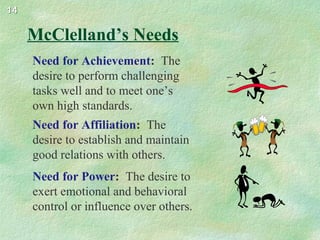
McClelland’s Needs
Need for Achievement: The
desire to perform challenging
tasks well and to meet one’s
own high standards.
Need for Affiliation: The
desire to establish and maintain
good relations with others.
Need for Power: The desire to
exert emotional and behavioral
control or influence over others.
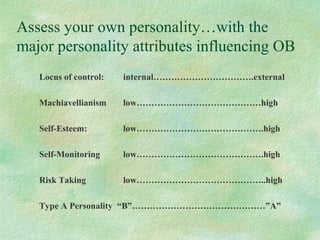
Assess your own personality…with the
major personality attributes influencing OB
Locus of control: internal…………………………….external
Machiavellianism low……………………………………high
Self-Esteem: low…………………………………….high
Self-Monitoring low…………………………………….high
Risk Taking low……………………………………..high
Type A Personality “B”………………………………………”A”
The Person-Job Fit
Today, managers are more interested in an
applicant’s flexibility to meet changing situations
(instead of ability to perform a specific job)
Holland’s personality-job fit theory captures the
notion of matching the job requirements with
personality characteristics
Holland’s
Personality-Job Fit Theory
Holland, a career development scholar, suggests
that career success and satisfaction depends on
the degree of fit between the person and his or her
work environment
Degree of congruence between personality traits
and work environment determines person’s
performance, satisfaction, length of time in career
Holland contends there are 6 types or themes that
represent characteristics of both the work
environment and the traits and interests of people
working in those environments.
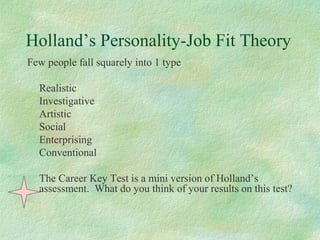
Few people fall squarely into 1 type
Realistic
Investigative
Artistic
Social
Enterprising
Conventional
The Career Key Test is a mini version of Holland’s
assessment. What do you think of your results on this test?
Holland’s Personality-Job Fit Theory
Person-Organization Fit
What is Personality-Organization Fit?
Examples
Why might managers today pay more attention to
the person-organization fit rather than the person-
job fit?
Emotional Intelligence
What is Emotional IQ?
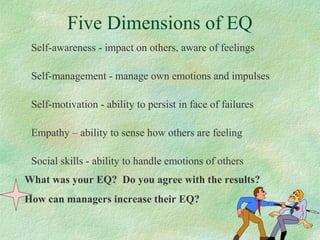
Five Dimensions of EQ
Self-awareness - impact on others, aware of feelings
Self-management - manage own emotions and impulses
Self-motivation - ability to persist in face of failures
Empathy – ability to sense how others are feeling
Social skills - ability to handle emotions of others
What was your EQ? Do you agree with the results?
How can managers increase their EQ?
Practicing Emotional Intelligence
1. Label their feelings, rather than labeling people or situations"
2. Distinguish between thoughts and feelings.
3. Take responsibility for their feelings.
4. Use their feelings to help them make decisions.
5. Show respect for other people's feelings.
6. Feel energized, not angry.
7. Validate other people's feelings.
8. Practice getting a positive value from their negative emotions.
9. Don't advise, command, control, criticize, judge
or lecture others.
10. Avoid people who invalidate them, or don't respect
their feelings.
Who Cares?
So why is it important that we understand
personality & individual differences?
What relevance does it have for managers?
What relevance does it have for organizations?
Why is it important that we understand
personality & individual differences?
To help you learn more about the dimensions of
your own personality.
To understand why individuals think, feel, and act
differently.
To help managers create a good fit between people
and jobs.
By selecting people with the right attributes
By redesigning jobs to fit individuals’ strengths
To help organizations create a good person-
organization fit
1515
Advice to Managers
Realize and accept that some workers are more likely than others to
be positive and enthusiastic because of their personalities. Similarly,
realize and accept that some workers are more likely than others to
complain and experience stress because of their personalities.
Provide an extra measure of direct supervision to workers who don’t
take the initiative to solve problems on their own and always seem to
blame someone or something else when things go wrong.
Provide additional encouragement and support to workers with low
self-esteem who tend to belittle themselves and question their
abilities.
Realize and accept that Type A individuals can be difficult to get
along with and sometimes have a hard time working in teams.
Let subordinates who seem overly concerned about other people
liking them know that sometimes it is necessary to give honest
feedback and be constructively critical (such as when supervising
others).

Personality & Individual Differences (Business Psychology)

  • 1.
    Personality & IndividualDifferences “Be yourself” is the worst advice you can give some people. --T. Masson
  • 2.
    First, a fewadministrative things… Collect Student Information Digital Photos
  • 3.
    Student Information Full name(and preferred name) Year Major/Minor E-mail address Hometown Any special needs? List work experience What are your long term career goals? Anything else you feel is important for me to know
  • 4.
    Learning Objectives Define thekey biographical characteristics & how they affect the OB dependent variables Identify two types of ability & the importance of ability-job fit Explain the factors that determine an individual’s personality Describe personality traits & discuss the personality-job fit theory Define Emotional Intelligence (EQ) & Why it is relevant to the workplace
  • 5.
    Developmental Key Concepts5 What makes us unique? PERSONAL QUALITIES Personality Intelligence Moral values Mental health GROUP IDENTITIES Race Culture Gender
  • 6.
    Factors that influence IndividualBehavior: Biographical Characteristics Abilities Personality Emotional Intelligence
  • 7.
    Biographical Characteristics These variablesare more manageable when it comes to finding and analyzing variables that have an impact on turnover, satisfaction, etc. Age- older workers are less likely to resign Gender - women have higher rates of absence Marital Status – Married employees have fewer absences, less turnover, & more satisfied. Tenure- negatively related to turnover, positively related to satisfaction
  • 8.
    Who Cares… whatvalue do biographical characteristics have for managers and organizations? It can help in making choices among job applicants.
  • 9.
    Abilities Intellectual Abilities That requiredto do mental activities. *Found to be strong predictors of future job performance. Physical Abilities That required to do tasks demanding stamina, dexterity, strength, and similar characteristics.
  • 10.
    Ability-Job Fit The Ability- Job Fit Employee performance is enhanced when there is a high ability - job fit. We need to keep this in mind from an HR perspective as well as an individual trying to make a job decision. What predictions can we make if the fit is poor? If employees lack the required abilities? If employees abilities far exceed the requirements of the job?
  • 11.
    Personality What is Personality? Thesum total of ways in which an individual reacts to and interacts with others Measurable traits that a person exhibits. An enduring combination of motives, emotions, values, interests, attitudes and competencies.
  • 12.
    Determinants of Personality Heredity/Physiological Determinants physical differences, IQ, potential, temperament Environment culture, norms of family, friends & social groups, other influences Situation in class vs. at a party on-the-field/court vs. off-the-field/court
  • 13.
    Personality Traits Myers-Briggs TypeIndicator (next class) Extraverted/Introverted Sensing/Intuitive Thinking/Feeling Judging/Perceiving Big 5 Model Extraversion Agreeableness Conscientiousness Emotional stability Openness to Experience
  • 14.
    66 The Big FiveModel of Personality Extroversion: The tendency to experience positive emotional states and feel good about oneself and the world around. Neuroticism(Emotional stability): The tendency to experience negative emotional states and view oneself and the world around negatively. Agreeableness: The tendency to get along well with others. Conscientiousness: The extent to which a person is careful, scrupulous, and persevering. Openness to Experience: The extent to which a person is original, has broad interests, and is willing to take risks.
  • 15.
  • 16.
    Chapter 2: UnderstandingIndividual Differences 16 The “Big Five” Personality Factors Agreeableness Adjustment (Stable, confident, effective) (Nervous, self-doubting, moody) Sociability (Gregarious , energetic, self-dramatizing) (Shy, unassertive, withdrawn) Conscientiousness (Planful, neat, dependable) (Impulsive, careless, irresponsible) (Warm, tactful, considerate) (Independent, cold, rude) Intellectual Openness (Imaginative, curious, original) (Dull, unimaginative, literal-minded) Source: Developed from Hogan, R. T. Personality and personality measurement. In M. D. Dunnette and L. M. Hough (eds.), Handbook of Industrial and Organizational Psychology, 2nd ed. Palo Alto, Calif.: Consulting Psychologists Press, 1991, 878-879; McCrae, R. R., and Costa, P. T. A five-factor theory of personality. In L. A. Pervin and O. P. John (eds.), Handbook of Personality, 2nd ed. New York: Guilford, 1999, 139-153.
  • 17.
  • 18.
    Locus of Control InternalLocus of Control: Describes people who believe that ability, effort, or their own actions determine what happens to them. www.psych.uncc.edu/pagoolka/LocusofContr ol-intro.html External Locus of Control: Describes people who believe that fate, luck, or outside forces are responsible for what happens to them.
  • 19.
    1111 Self-Monitoring The extent towhich people try to control the way they present themselves to others. Can be high or low
  • 20.
    1212 Self-Esteem The extent towhich people have pride in themselves and their capabilities. Can be high or low Not situation specific
  • 21.
    Type A’s &Type B’s Type A Personality Always moving, walking, and eating rapidly. Feel impatient with the rate at which most events take place. Strive to think or do two or more things at once. Cannot cope with leisure time. Are obsessed with numbers, measuring their success in terms of how many or how much of everything they acquire. Type B Personality Never suffer from a sense of time urgency with its accompanying impatience. Feel no need to display or discuss either their achievements or accomplishments unless such exposure is demanded by the situation. Play for fun & relaxation, instead of exhibit their superiority at any cost. Can relax without guilt. stress.about.com/library/Type_A_quiz/bl_Type_A_quiz.htm
  • 22.
    1414 McClelland’s Needs Need forAchievement: The desire to perform challenging tasks well and to meet one’s own high standards. Need for Affiliation: The desire to establish and maintain good relations with others. Need for Power: The desire to exert emotional and behavioral control or influence over others.
  • 23.
    Assess your ownpersonality…with the major personality attributes influencing OB Locus of control: internal…………………………….external Machiavellianism low……………………………………high Self-Esteem: low…………………………………….high Self-Monitoring low…………………………………….high Risk Taking low……………………………………..high Type A Personality “B”………………………………………”A”
  • 24.
    The Person-Job Fit Today,managers are more interested in an applicant’s flexibility to meet changing situations (instead of ability to perform a specific job) Holland’s personality-job fit theory captures the notion of matching the job requirements with personality characteristics
  • 25.
    Holland’s Personality-Job Fit Theory Holland,a career development scholar, suggests that career success and satisfaction depends on the degree of fit between the person and his or her work environment Degree of congruence between personality traits and work environment determines person’s performance, satisfaction, length of time in career Holland contends there are 6 types or themes that represent characteristics of both the work environment and the traits and interests of people working in those environments.
  • 26.
    Few people fallsquarely into 1 type Realistic Investigative Artistic Social Enterprising Conventional The Career Key Test is a mini version of Holland’s assessment. What do you think of your results on this test? Holland’s Personality-Job Fit Theory
  • 27.
    Person-Organization Fit What isPersonality-Organization Fit? Examples Why might managers today pay more attention to the person-organization fit rather than the person- job fit?
  • 28.
  • 29.
    Five Dimensions ofEQ Self-awareness - impact on others, aware of feelings Self-management - manage own emotions and impulses Self-motivation - ability to persist in face of failures Empathy – ability to sense how others are feeling Social skills - ability to handle emotions of others What was your EQ? Do you agree with the results? How can managers increase their EQ?
  • 30.
    Practicing Emotional Intelligence 1.Label their feelings, rather than labeling people or situations" 2. Distinguish between thoughts and feelings. 3. Take responsibility for their feelings. 4. Use their feelings to help them make decisions. 5. Show respect for other people's feelings. 6. Feel energized, not angry. 7. Validate other people's feelings. 8. Practice getting a positive value from their negative emotions. 9. Don't advise, command, control, criticize, judge or lecture others. 10. Avoid people who invalidate them, or don't respect their feelings.
  • 31.
    Who Cares? So whyis it important that we understand personality & individual differences? What relevance does it have for managers? What relevance does it have for organizations?
  • 32.
    Why is itimportant that we understand personality & individual differences? To help you learn more about the dimensions of your own personality. To understand why individuals think, feel, and act differently. To help managers create a good fit between people and jobs. By selecting people with the right attributes By redesigning jobs to fit individuals’ strengths To help organizations create a good person- organization fit
  • 33.
    1515 Advice to Managers Realizeand accept that some workers are more likely than others to be positive and enthusiastic because of their personalities. Similarly, realize and accept that some workers are more likely than others to complain and experience stress because of their personalities. Provide an extra measure of direct supervision to workers who don’t take the initiative to solve problems on their own and always seem to blame someone or something else when things go wrong. Provide additional encouragement and support to workers with low self-esteem who tend to belittle themselves and question their abilities. Realize and accept that Type A individuals can be difficult to get along with and sometimes have a hard time working in teams. Let subordinates who seem overly concerned about other people liking them know that sometimes it is necessary to give honest feedback and be constructively critical (such as when supervising others).

Editor's Notes