SUBJECT- ORGANIZATIONAL BEHAVIOUR
BBA-II
UNIT-II
 The overall profile or combination of characteristics that capture
the unique nature of a person as that person reacts and interacts
with others.
 Combines a set of physical and mental characteristics that
reflect how a person looks, thinks, acts, and feels.
Predictable relationships are expected between people’s
personalities and their behaviors.
 Personality refers to the set of traits & behaviors that
characterize an individual.
 It refers to the relatively stable pattern of behavior &
consistent internal state & explains an individual’s
behavioral tendencies.
 Personality has both internal (thoughts, values & genetic
characteristics that is inferred from observable behaviors)
& external (observable behaviors) elements.
 Personality of an individual is relatively stable in nature.
 Personality is both inherited as well as it can be shaped
by the environment.
 Law of Behavior: “People are different”
 To ensure high performing employees in an
organization.
 To manage workforce diversity.
 Summarizing person’s behaviors & attitudes in
relation to a wide range of events.
 Personality consists of characteristics or traits that
describe how people are likely to behave in a given
situation.
 Personality is useful in predicting & understanding
the general feelings, thoughts and behaviors of
individuals at the workplace.
 Contribution of various personality theories.
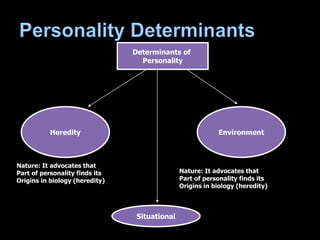
Determinants of
Personality
Heredity Environment
Situational
Nature: It advocates that
Part of personality finds its
Origins in biology (heredity)
Nature: It advocates that
Part of personality finds its
Origins in biology (heredity)
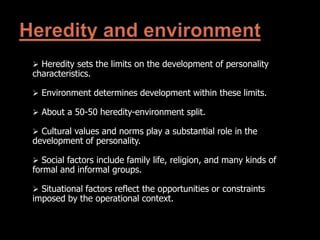
 Heredity sets the limits on the development of personality
characteristics.
 Environment determines development within these limits.
 About a 50-50 heredity-environment split.
 Cultural values and norms play a substantial role in the
development of personality.
 Social factors include family life, religion, and many kinds of
formal and informal groups.
 Situational factors reflect the opportunities or constraints
imposed by the operational context.
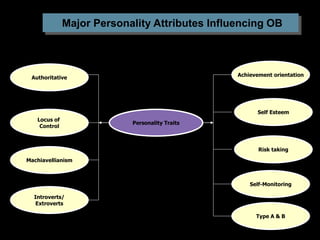
Major Personality Attributes Influencing OB
Personality Traits
Authoritative
Locus of
Control
Machiavellianism
Introverts/
Extroverts
Self Esteem
Risk taking
Self-Monitoring
Type A & B
Achievement orientation
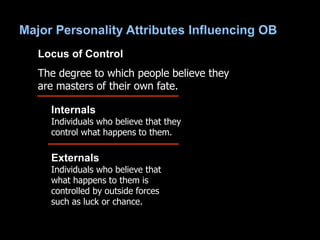
Locus of Control
The degree to which people believe they
are masters of their own fate.
Internals
Individuals who believe that they
control what happens to them.
Externals
Individuals who believe that
what happens to them is
controlled by outside forces
such as luck or chance.
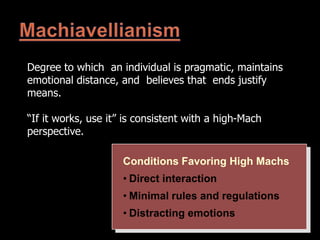
Degree to which an individual is pragmatic, maintains
emotional distance, and believes that ends justify
means.
“If it works, use it” is consistent with a high-Mach
perspective.
Conditions Favoring High Machs
• Direct interaction
• Minimal rules and regulations
• Distracting emotions
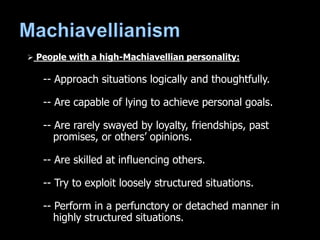
 People with a high-Machiavellian personality:
-- Approach situations logically and thoughtfully.
-- Are capable of lying to achieve personal goals.
-- Are rarely swayed by loyalty, friendships, past
promises, or others’ opinions.
-- Are skilled at influencing others.
-- Try to exploit loosely structured situations.
-- Perform in a perfunctory or detached manner in
highly structured situations.
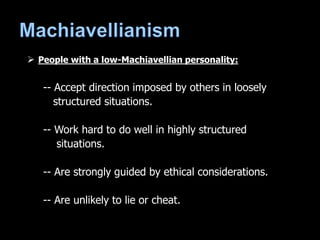
 People with a low-Machiavellian personality:
-- Accept direction imposed by others in loosely
structured situations.
-- Work hard to do well in highly structured
situations.
-- Are strongly guided by ethical considerations.
-- Are unlikely to lie or cheat.
Self-Esteem (SE)
Individuals’ degree of liking
or disliking themselves.
Self-Monitoring
A personality trait that measures
an individuals ability to adjust
his or her behavior to external,
situational factors.
 High Risk-taking Managers
 Make quicker decisions
 Use less information to make decisions
 Operate in smaller and more entrepreneurial
organizations
 Low Risk-taking Managers
 Are slower to make decisions
 Require more information before making decisions
 Exist in larger organizations with stable environments
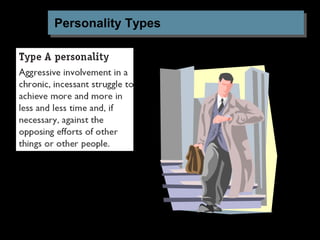
Personality Types
Type A’s
1. are always moving, walking, and eating rapidly;
2. feel impatient with the rate at which most events take place;
3. strive to think or do two or more things at once;
4. cannot cope with leisure time;
5. are obsessed with numbers, measuring their success in
terms of how many or how much of everything they acquire.
Type B’s
1. never suffer from a sense of time urgency with its
accompanying impatience;
2. feel no need to display or discuss either their achievements
or accomplishments;
3. play for fun and relaxation, rather than to exhibit their
superiority at any cost;
4. can relax without guilt.
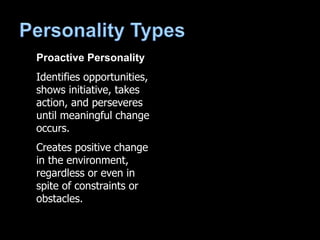
Proactive Personality
Identifies opportunities,
shows initiative, takes
action, and perseveres
until meaningful change
occurs.
Creates positive change
in the environment,
regardless or even in
spite of constraints or
obstacles.
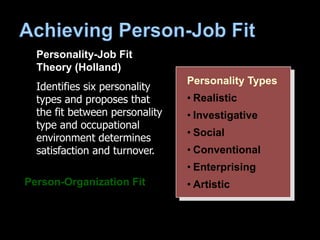
Personality Types
• Realistic
• Investigative
• Social
• Conventional
• Enterprising
• Artistic
Personality-Job Fit
Theory (Holland)
Identifies six personality
types and proposes that
the fit between personality
type and occupational
environment determines
satisfaction and turnover.
Person-Organization Fit
Book- Organization Behavior (Stephen Robbins)
www.slideshare.net/mariamnadir1/foundation-of-individual-
behaviour
business.fullerton.edu/management/slpurkiss/MGMT%20340/OB
02.doc
college.cengage.com/business/moorhead/organizational/6e/.../ch
04.html
www.slideshare.net/RahulJha6/foundations-of-individual-beh

U 2.1 ob bba-ii personality

  • 1.
  • 2.
     The overallprofile or combination of characteristics that capture the unique nature of a person as that person reacts and interacts with others.  Combines a set of physical and mental characteristics that reflect how a person looks, thinks, acts, and feels. Predictable relationships are expected between people’s personalities and their behaviors.
  • 3.
     Personality refersto the set of traits & behaviors that characterize an individual.  It refers to the relatively stable pattern of behavior & consistent internal state & explains an individual’s behavioral tendencies.  Personality has both internal (thoughts, values & genetic characteristics that is inferred from observable behaviors) & external (observable behaviors) elements.  Personality of an individual is relatively stable in nature.  Personality is both inherited as well as it can be shaped by the environment.
  • 4.
     Law ofBehavior: “People are different”  To ensure high performing employees in an organization.  To manage workforce diversity.  Summarizing person’s behaviors & attitudes in relation to a wide range of events.  Personality consists of characteristics or traits that describe how people are likely to behave in a given situation.
  • 5.
     Personality isuseful in predicting & understanding the general feelings, thoughts and behaviors of individuals at the workplace.  Contribution of various personality theories.
  • 6.
    Determinants of Personality Heredity Environment Situational Nature:It advocates that Part of personality finds its Origins in biology (heredity) Nature: It advocates that Part of personality finds its Origins in biology (heredity)
  • 7.
     Heredity setsthe limits on the development of personality characteristics.  Environment determines development within these limits.  About a 50-50 heredity-environment split.  Cultural values and norms play a substantial role in the development of personality.  Social factors include family life, religion, and many kinds of formal and informal groups.  Situational factors reflect the opportunities or constraints imposed by the operational context.
  • 8.
    Major Personality AttributesInfluencing OB Personality Traits Authoritative Locus of Control Machiavellianism Introverts/ Extroverts Self Esteem Risk taking Self-Monitoring Type A & B Achievement orientation
  • 9.
    Locus of Control Thedegree to which people believe they are masters of their own fate. Internals Individuals who believe that they control what happens to them. Externals Individuals who believe that what happens to them is controlled by outside forces such as luck or chance.
  • 10.
    Degree to whichan individual is pragmatic, maintains emotional distance, and believes that ends justify means. “If it works, use it” is consistent with a high-Mach perspective. Conditions Favoring High Machs • Direct interaction • Minimal rules and regulations • Distracting emotions
  • 11.
     People witha high-Machiavellian personality: -- Approach situations logically and thoughtfully. -- Are capable of lying to achieve personal goals. -- Are rarely swayed by loyalty, friendships, past promises, or others’ opinions. -- Are skilled at influencing others. -- Try to exploit loosely structured situations. -- Perform in a perfunctory or detached manner in highly structured situations.
  • 12.
     People witha low-Machiavellian personality: -- Accept direction imposed by others in loosely structured situations. -- Work hard to do well in highly structured situations. -- Are strongly guided by ethical considerations. -- Are unlikely to lie or cheat.
  • 13.
    Self-Esteem (SE) Individuals’ degreeof liking or disliking themselves. Self-Monitoring A personality trait that measures an individuals ability to adjust his or her behavior to external, situational factors.
  • 14.
     High Risk-takingManagers  Make quicker decisions  Use less information to make decisions  Operate in smaller and more entrepreneurial organizations  Low Risk-taking Managers  Are slower to make decisions  Require more information before making decisions  Exist in larger organizations with stable environments
  • 15.
  • 16.
    Type A’s 1. arealways moving, walking, and eating rapidly; 2. feel impatient with the rate at which most events take place; 3. strive to think or do two or more things at once; 4. cannot cope with leisure time; 5. are obsessed with numbers, measuring their success in terms of how many or how much of everything they acquire. Type B’s 1. never suffer from a sense of time urgency with its accompanying impatience; 2. feel no need to display or discuss either their achievements or accomplishments; 3. play for fun and relaxation, rather than to exhibit their superiority at any cost; 4. can relax without guilt.
  • 17.
    Proactive Personality Identifies opportunities, showsinitiative, takes action, and perseveres until meaningful change occurs. Creates positive change in the environment, regardless or even in spite of constraints or obstacles.
  • 18.
    Personality Types • Realistic •Investigative • Social • Conventional • Enterprising • Artistic Personality-Job Fit Theory (Holland) Identifies six personality types and proposes that the fit between personality type and occupational environment determines satisfaction and turnover. Person-Organization Fit
  • 19.
    Book- Organization Behavior(Stephen Robbins) www.slideshare.net/mariamnadir1/foundation-of-individual- behaviour business.fullerton.edu/management/slpurkiss/MGMT%20340/OB 02.doc college.cengage.com/business/moorhead/organizational/6e/.../ch 04.html www.slideshare.net/RahulJha6/foundations-of-individual-beh