Chapter 1:
The Study of the Person
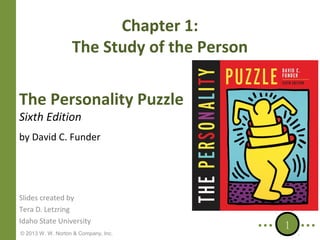
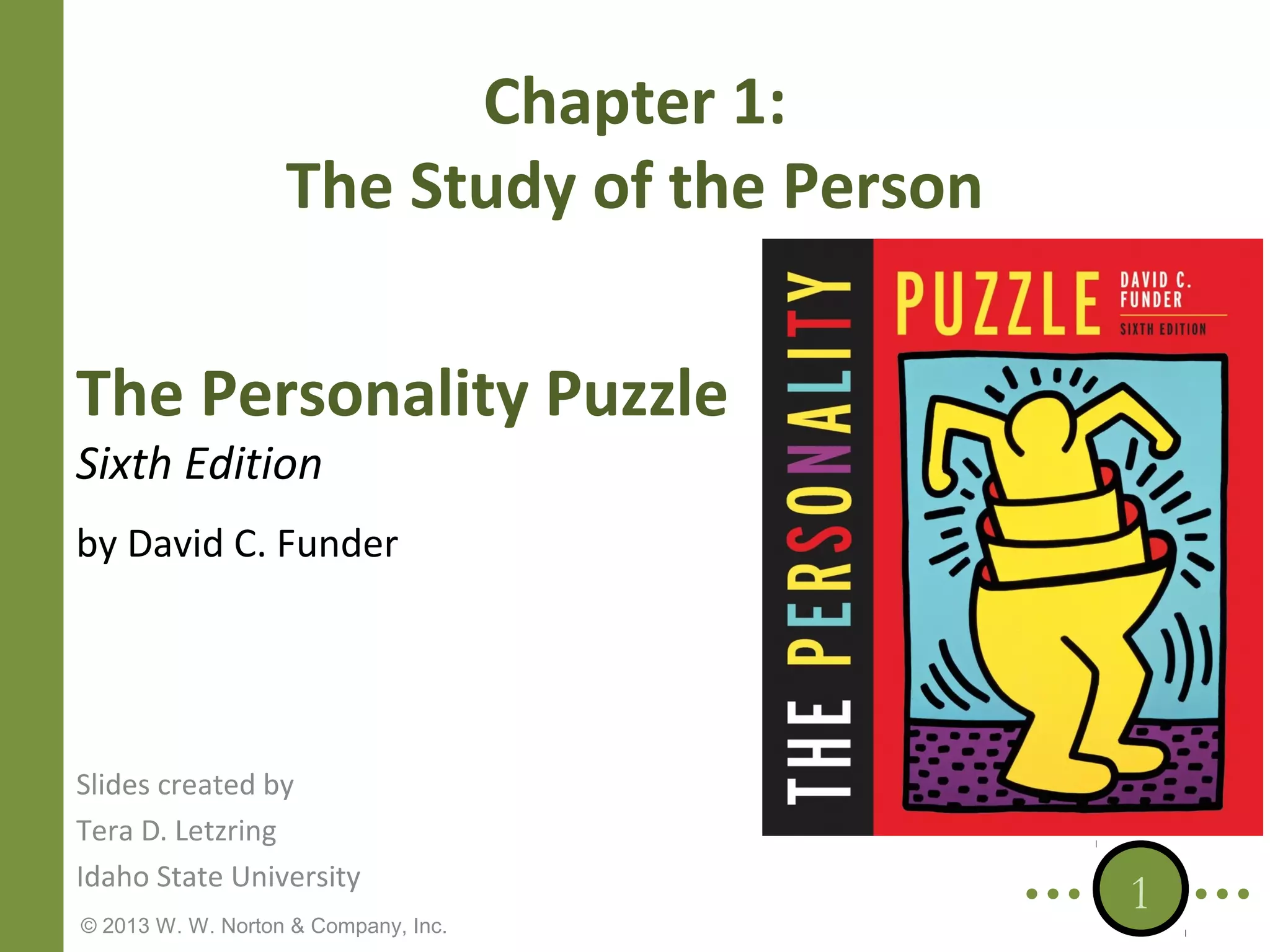
The Personality Puzzle
Sixth Edition

by David C. Funder

Slides created by
Tera D. Letzring
Idaho State University
© 2013 W. W. Norton & Company, Inc.

1
Objectives
• Discuss the things personality psychologists
study
• Define personality
• Discuss the goal of personality psychology and
how this leads to the basic approaches
• Discuss the advantages and disadvantages of
personality psychology

© 2013 W. W. Norton & Company, Inc.

2
The Things Personality Psychologists
Study
• Psychological triad: the combination of how
people think, feel, and behave
• Overlap with clinical psychology
– Normal vs. extreme patterns of personality
– Both attempt to understand the whole person

• The whole person
– How all other areas of psychology come together

© 2013 W. W. Norton & Company, Inc.

3
Definitions of Personality
• “An individual’s characteristic patterns of thought,
emotion, and behavior, together with the
psychological mechanisms—hidden or not—behind
those patterns” (p. 5)
• An individual’s unique and relatively consistent
patterns of thinking, feeling, and behaving

© 2013 W. W. Norton & Company, Inc.

4
The Goals of Personality Psychology
• Explain the whole person in his or her daily
environment
– Mission: Impossible

• Think of an important behavior that you
performed recently and all of the reasons for
that behavior.

© 2013 W. W. Norton & Company, Inc.

5
Basic Approaches to Personality
• Also called paradigms
• Definition: a theoretical view of personality
that focuses on some phenomena and ignores
others
• Trait approach: how people differ
psychologically

© 2013 W. W. Norton & Company, Inc.

6
Basic Approaches to Personality
• Biological approach: understand the mind in
terms of the body
• Psychoanalytic approach: primary concern is
with the unconscious mind and internal
mental conflict

© 2013 W. W. Norton & Company, Inc.

7
Basic Approaches
• Phenomenological approach: focus on
conscious experience of the world

– Humanistic psychology: how conscious awareness
produces uniquely human attributes
– Cross-cultural psychology: how the experience of
reality varies across cultures

© 2013 W. W. Norton & Company, Inc.

8
Basic Approaches
• Learning approach: how behavior changes as
a result of rewards, punishments, and life
experiences
• Cognitive approach

– Social learning: learning through observation and
self-evaluation
– Cognitive processes: focuses on perception,
memory, and thought

© 2013 W. W. Norton & Company, Inc.

9
Basic Approaches: Competitors or
Complements?
• Not mutually exclusive
• They address different questions
• One Big Theory
– It’s difficult to do everything well

© 2013 W. W. Norton & Company, Inc.

10
Advantages and Disadvantages of
Personality Psychology
• “Great strengths are usually great
weaknesses, and surprisingly often the
opposite is true as well.” (p. 10)
– Funder’s First Law
– Also seen in individuals
– What is something you really like about your best
friend? Does this same characteristic ever cause
problems?

© 2013 W. W. Norton & Company, Inc.

11
Advantages and Disadvantages of
Personality Psychology
• Goal is to account for the whole person and
real-life concerns
– Advantage: inclusive, interesting, and important
– Disadvantage: overinclusiveness or unfocused
research

• Basic approaches
– Advantage: good at addressing certain topics
– Disadvantage: poor at addressing other topics or
ignores them
12
© 2013 W. W. Norton & Company, Inc.
Pigeonholing Versus Appreciation of
Individual Differences
• Other areas of psychology treat all people as if
they were the same
• Personality psychologists emphasize individual
differences
– Negative: pigeonholing
– Positive: leads to sensitivity and respect for
individual differences

© 2013 W. W. Norton & Company, Inc.

13
Clicker Question #1
The goal of personality psychology is to
a) explain the whole person in his or her daily
environment.
b) explain how people think in ways that differ
from each other.
c) understand extreme patterns of personality.
d) develop One Big Theory to explain everything
about personality.
© 2013 W. W. Norton & Company, Inc.

14
Clicker Question #2
The basic approaches or paradigms of
personality psychology
a) can be combined to create One Big Theory.
b)are in competition with each other to offer
the best explanation of personality.
c)are useful because one approach cannot
sufficiently explain all of personality.
d) are not useful because they are too limited.
© 2013 W. W. Norton & Company, Inc.

15
Clicker Question #3
Which of the following is a strength of
personality psychology?
a) It uses pigeonholing.
b) It treats all people as if they were the same.
c)The basic approaches ignore areas they cannot
explain.
d) It is inclusive, interesting, and important.

© 2013 W. W. Norton & Company, Inc.

16

PSY 239 401 Chapter 1 SLIDES

  • 1.
    Chapter 1: The Studyof the Person The Personality Puzzle Sixth Edition by David C. Funder Slides created by Tera D. Letzring Idaho State University © 2013 W. W. Norton & Company, Inc. 1
  • 2.
    Objectives • Discuss thethings personality psychologists study • Define personality • Discuss the goal of personality psychology and how this leads to the basic approaches • Discuss the advantages and disadvantages of personality psychology © 2013 W. W. Norton & Company, Inc. 2
  • 3.
    The Things PersonalityPsychologists Study • Psychological triad: the combination of how people think, feel, and behave • Overlap with clinical psychology – Normal vs. extreme patterns of personality – Both attempt to understand the whole person • The whole person – How all other areas of psychology come together © 2013 W. W. Norton & Company, Inc. 3
  • 4.
    Definitions of Personality •“An individual’s characteristic patterns of thought, emotion, and behavior, together with the psychological mechanisms—hidden or not—behind those patterns” (p. 5) • An individual’s unique and relatively consistent patterns of thinking, feeling, and behaving © 2013 W. W. Norton & Company, Inc. 4
  • 5.
    The Goals ofPersonality Psychology • Explain the whole person in his or her daily environment – Mission: Impossible • Think of an important behavior that you performed recently and all of the reasons for that behavior. © 2013 W. W. Norton & Company, Inc. 5
  • 6.
    Basic Approaches toPersonality • Also called paradigms • Definition: a theoretical view of personality that focuses on some phenomena and ignores others • Trait approach: how people differ psychologically © 2013 W. W. Norton & Company, Inc. 6
  • 7.
    Basic Approaches toPersonality • Biological approach: understand the mind in terms of the body • Psychoanalytic approach: primary concern is with the unconscious mind and internal mental conflict © 2013 W. W. Norton & Company, Inc. 7
  • 8.
    Basic Approaches • Phenomenologicalapproach: focus on conscious experience of the world – Humanistic psychology: how conscious awareness produces uniquely human attributes – Cross-cultural psychology: how the experience of reality varies across cultures © 2013 W. W. Norton & Company, Inc. 8
  • 9.
    Basic Approaches • Learningapproach: how behavior changes as a result of rewards, punishments, and life experiences • Cognitive approach – Social learning: learning through observation and self-evaluation – Cognitive processes: focuses on perception, memory, and thought © 2013 W. W. Norton & Company, Inc. 9
  • 10.
    Basic Approaches: Competitorsor Complements? • Not mutually exclusive • They address different questions • One Big Theory – It’s difficult to do everything well © 2013 W. W. Norton & Company, Inc. 10
  • 11.
    Advantages and Disadvantagesof Personality Psychology • “Great strengths are usually great weaknesses, and surprisingly often the opposite is true as well.” (p. 10) – Funder’s First Law – Also seen in individuals – What is something you really like about your best friend? Does this same characteristic ever cause problems? © 2013 W. W. Norton & Company, Inc. 11
  • 12.
    Advantages and Disadvantagesof Personality Psychology • Goal is to account for the whole person and real-life concerns – Advantage: inclusive, interesting, and important – Disadvantage: overinclusiveness or unfocused research • Basic approaches – Advantage: good at addressing certain topics – Disadvantage: poor at addressing other topics or ignores them 12 © 2013 W. W. Norton & Company, Inc.
  • 13.
    Pigeonholing Versus Appreciationof Individual Differences • Other areas of psychology treat all people as if they were the same • Personality psychologists emphasize individual differences – Negative: pigeonholing – Positive: leads to sensitivity and respect for individual differences © 2013 W. W. Norton & Company, Inc. 13
  • 14.
    Clicker Question #1 Thegoal of personality psychology is to a) explain the whole person in his or her daily environment. b) explain how people think in ways that differ from each other. c) understand extreme patterns of personality. d) develop One Big Theory to explain everything about personality. © 2013 W. W. Norton & Company, Inc. 14
  • 15.
    Clicker Question #2 Thebasic approaches or paradigms of personality psychology a) can be combined to create One Big Theory. b)are in competition with each other to offer the best explanation of personality. c)are useful because one approach cannot sufficiently explain all of personality. d) are not useful because they are too limited. © 2013 W. W. Norton & Company, Inc. 15
  • 16.
    Clicker Question #3 Whichof the following is a strength of personality psychology? a) It uses pigeonholing. b) It treats all people as if they were the same. c)The basic approaches ignore areas they cannot explain. d) It is inclusive, interesting, and important. © 2013 W. W. Norton & Company, Inc. 16

Editor's Notes

  • #2 Activity 1-1: Ask the expert
  • #3 Each chapter will start with an objectives slide, which is a preview of the content that will be covered in each chapter.
  • #4 Psychological triad: especially interesting when the elements conflict with each other, which suggests the mind is complex and it can even be difficult to understand yourself Personality psychology studies normal patterns; clinical psychology studies extreme patterns. *Point out some normal traits that are problems in the extreme. Conscientiousness and obsessive-compulsive disorder is a good example. How all other areas of psychology come together (especially social, cognitive, developmental, clinical, biological)
  • #5 Explain the different parts of the definition, and discuss how “characteristic” does not mean always the same thing in all situations and with all people. The second definition is an alternative that can be used to emphasize that personality is what makes people unique and that personality is only RELATIVELY consistent.
  • #6 Mission: Impossible – It is impossible to account for everything at the same time. Reader: McAdams – What do we know when we know a person? Discuss how this is related to the goal of explaining the whole person.
  • #7 A way to limit what part of personality is examined so the task of personality psychology is not overwhelming and impossible
  • #8 Biological approach includes anatomy, physiology, genetics, evolution; example: depression as a function of abnormal levels of neurotransmitters Psychoanalytic approach example: Anxiety results from mental conflict.
  • #9 Uniquely human attributes: existential anxiety, creativity, free will, and happiness
  • #10 Classic behaviorists focus on overt behavior.
  • #11 They address different questions: Psychoanalysis is good for explaining why someone misplaced his keys, behavioral approach is not. One Big Theory (OBT) disagreement: Personality psychologists have not figured out how to solve this dilemma. Some would like to find One Big Theory, some believe their approach is the OBT, some would like to organize the existing theories into one framework, and some believe that the different approaches address different questions and should be left as is.
  • #14 Other areas of psychology treat all people as if they were the same: Individual differences are seen as error pigeonholing: putting people into specific categories Activity 1–2: Creativity in Education: Ken Robinson’s TED Talk
  • #15 Correct answer: a
  • #16 Correct answer: c
  • #17 Correct answer: d