Magnetoferritin: a Novel Magnetic Protein
Nanocarrier
Sumedha S. Bobade
PhD Scholar
Animal Biotechnology
Brief Introduction
• Introduction
• Sources of Nanoparticles
• Natural Nanparticles
• Protein Cage Nanocarrier
• Structure of Ferritin
• Apoferritine
• Magnetoferritin as Nanocarriers
• Synthesis of Magnetoferritin
• Applications
Introduction
 The term “nano” comes from the Greek word
“nanos” meaning dwarf.
 ‘Nano’ is used in scientific units to denote one-
billionth (10-9) of the base unit.
 Nanotechnology : manipulation of matter through
certain chemical and/or physical processes to create
materials with specific properties, which can be used
in particular applications.
• Bionanotechnology is concerned with molecular scale
properties and applications of biomolecular
nanostructures.
Sources of Nanoparticles
 A very wide range of biological resources like microorganisms (bacteria,
yeast, fungi, algae, and viruses) and plants can be used for nanoparticle
synthesis and production of low-cost, energy-efficient, and nontoxic
environmental friendly metallic nanoparticles.
 Nanoparticles made of natural compounds are materials that come from
nature with limited manipulation, such as natural polymers or proteins.
 Natural nanoparticles are more likely to be biocompatible, distributable in
the body, and biodegradable .
Natural Nanparticles
 Self-assembled protein nanoparticles, such as virus-like particles, ferritins,
or heat shock proteins, hold great promise as natural nano-carriers with
utility in biomedical and biomaterial sciences.
 Such protein-based nanoparticles are biocompatible and easy to make a
genetic or chemical modification.
 These charming from the biomedical point of view due to
 Their uniform structure,low toxicity,
 Ability to evade the immune system.
 Easily degraded after fulfilling their function.
Protein Cage Nanocarrier
 In the field of nanoscience Metal nanoparticles have attracted considerable interest because
of their optical, magnetic, electric and thermal properties. They include magnetosomes,
lipoproteins, viruses, exosomes and ferritins
 Many types of materials are used for the synthesis of Nanocarrier among these, special
attention is given to protein cage structures, such as ferritins , because they are self-
assembling, highly symmetrical proteins (Mosca et al., 2017).
 Recombinant ferritin provides a central cavity, which can be efficiently loaded with
transition metals, drugs, fluorescent molecules or contrast agents ( Zhen et al., 2013).
 The protein shell of ferritins can be easily modified either chemically or
genetically to introduce different functionalities .
(Lin et al., 2011).
Structure of Ferritin
 Ferritin was discovered in 1937 by Laufberger isolated it from horse spleen.
 The FRT superfamily can be divided into three subfamilies: the classical FRTs; the
bacterioferritins (BFRs); and the DNA-binding proteins from starved cells (DPSs).
 All protein cages share three common structural features an external surface, an inner surface or
core, and a protein-protein interface.
 The 24 subunits that self-assemble into a spherical spherical complex cage-like structure with
inner and outer dimensions of 8 and 12 nm, respectively.
 The ferritin quaternary structure has eight hydrophilic channels
 There are also six hydrophobic channels.
 Ferritins have been classified as
maxiferritins and miniferritins.
Uchida et al., 2010
Structure of Ferritin
 Ferritin is a large protein of 450 kDa consists of 24 subunits of heavy (FerH) and light (FerL) chains.
 Eukaryotes have two ferritin genes encoding the heavy (H; 21 kDa) and the light (L; 19 kDa) chains.
The H and L ferritins in mammalian cells, have complementary functions in iron uptake process.
 Consequently, the L chain ferritin has less iron than the H ferritin (Wang et al., 2017).
 The molar ratio of FerH and FerL in the ferritin is largely dependent on organs and species. For
example, horse spleen ferritin consists of 85% of FerL and 15% of FerH, whereas human spleen
ferritin contains more than 90% of FerL.
 Brain and heart ferritin mostly with FerH.
Theil, 2012
Apoferritine
 These templates have identical structures except that apoferritin lacks the ferritin iron oxide core.
 The apoferritin structure has six twofold ,four threefold and three fourfold symmetry axes.
 The outer surface -net positive while the inner surface has a negative net charge.
 The inner and outer surfaces are connected by channelsl, six are positively charged (4F-channel) and eight are
negatively charged (3F-channel called hydrophilic channels which provide a path for cations to come into the
cavity.
 Cations in the cavity can then bind to the inner surface. The binding sites become nuclei for crystallization, but
crystallization ends when the cavity is filled with crystals. The particles synthesized using a ferritin template
have size similar to the cavity, which is about 8 nm.
 Ferreting are easy to be expressed and purified at high levels and at low costs in Escherichia coli, and are
exceptionally stable over wide ranges of temperature and pH. In vitro, the protein shell called apoferritin
(ApoF) and the iron-filled protein called holoferritin (HoloF) have different affinities for
divalent metal atoms also depending of the pH.
Weichen Xu, 2005 Laghaei et al., 2013
Magnetoferritin Nanoparticles
 The emergence of nanotechnology, ferritin nanoparticle has been biomimetically
synthesized using H-chain ferritin as a template, which self-assembles to form a 24-
subunit cage-like nanostructure, with an internal iron oxide core. This engineered
ferritin, which has the same architecture as natural H-ferritin, is termed
magnetoferritin.
Schematic drawing of a ferritin
subunit. The main features are
the five helices,
Schematic drawing of a
ferritin molecule. Twenty-four
subunits (sausages) surround
the ferritin iron-core (black),
which may contain up to 4500
Fe(lll) as "ferrihydrite".
N indicates the N-terminus
and E the N-terminal end of
the E helix
Harrison,1986
Magnetoferritin as Nanocarrier
Ferritins are small enough to penetrate capillary spaces and large enough to avoid renal clearance. Ferritins are physiological materials, very soluble in aqueous solutions and in the blood, with low toxicity,
susceptible to chemical modifications and being modified by molecular biology techniques Materials such as Fe3O4, Co3O4, Mn3O4, Pt, CoPt, Pd, CdS, CdSe, ZnSe, CaCO3, SrCO3, Au, Ag and BaCO3
have been produced and characterized in different ferritin templates [Kasyutich et al., 2010].
The iron core of ferritin can be sulfurated to form FeS nanoparticles. The core can be removed by dialysis and incubated with other metal ions to form
nanoparticles of different compositions.
The formation of inorganic materials with complex form is a widespread biological
phenomenon (biomineralization)
Yamashita et al., 2010
Weichen Xu, 2005
Role of pH
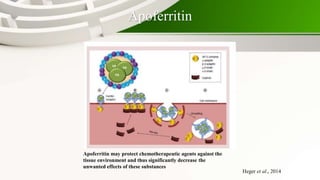
Apoferritine
Heger et al., 2014
Scheme of apoferritin reversible disassociation under the
influence of pH changes
Apoferritin may be simply exploited as a nanotransporter,
bearing various contrast agents.
Apoferritin
Apoferritin may protect chemotherapeutic agents against the
tissue environment and thus significantly decrease the
unwanted effects of these substances
Heger et al., 2014
Synthesis of Magnetoferritin
 The emergence of nanotechnology, ferritin nanoparticle has been biomimetically synthesized using H-chain
ferritin as a template,(Fan et al., 2012) which self-assembles to form a 24-subunit cage-like nanostructure, with
an internal iron oxide core. This engineered ferritin, which has the same architecture as natural H-ferritin, is
termed magnetoferritin.
Bacterial
Expression
and
Purification
Recombinant
human ferritin
H chain (HFt)
was expressed
and purified
from
E. coli
Samples
dialyzed
overnight
against
(PBS)
HFt
samples
eluted
HFt
samples
eluted
HFt
samples
eluted
Metal Containing
Nanocarrier
Preparation
Metal NP
prepared by
adding NP to
the HFt solution
Broad Applications
Application Core composition Source
MRI contrast Agent Iron oxide Transferrin human H-chain
ferritin
Phosphate removal from
water
Ferric phosphate Pyrococcus furiosus ferritn
Quantum label ZnSe Horse Spleen Apoferritin
Semi conductor template CdS/ZnSe Apoferritin
Aantibacterial Ag NPg Ag Pyrococcus furiosus ferritn
Gold NP Au Engneered human H-chain
ferritin
Drug Delivery Doxorubicin –Cu(II)
complex
Surfacemodified H-chain
ferritin
Information storage CoPt Horse spleen apoferritin
Magnetic nanoparticle Co3O4 Horse spleen apoferritin
Vaccine Development None Helicobacter pylori non-
heam-ferritin
Chemical catalyst Pt Apoferritin from sigma
Cu Horse Spleen apoferritin
Pd Recombinant L-chain
apoferritin from horse Live
He and Jon Marles-Wright,2015
Drug delivary
Applications
Schematic illustration of multifunctional H-ferritin nanoparticles. RGD4C and Cy5.5 are
introduced onto the surface via genetic and chemical means.
Strategies for targeting transferrin receptor 1 (TfR1) in tumor therapy and diagnosis. These strategies can be achieved by employing
(a) Anti-TfR1 monoclonal antibodies or conjugated-antibodies, (b) H-ferritin nanoparticles, and (c) conjugated Tf as carrier to deliver
chemotherapeutic drugs, imaging dyes, and radionuclides to treat or detect tumors.
Bioassay
Ferritin nanoparticles with unique physiochemical properties can be used in ultrasensitive biomarker detection
(Liu et al., 2017)
Application by Surface Protein Modification
Vaccine development
Applications
Cryo-EMimages of HFn nanocages (Left) and HFn-Dox NPs (Right).
Application in Cancer Therapy
Nano Actuation
 Nano actuation can be defined as actuation of a specific action using a nanoscale object
with or without the input of an external force acting on it. The ferritin nanoparticles
dissipate heat when exposed to AC magnetic field which triggered calcium ion influx
facilitated by TRPV1 (Transient receptor potential cation channel V member) activation.
 Calcium ion influx initiated transgene expression of insulin.
 This nano actuation application has significant
therapeutic benefits ( Stanley et al., 2015).
Application
 Laskar et al., 2012, examine the physiological impact of superparamagnetic iron oxide
nanoparticles (SPIONs) loading results in upregulation of lysosomal cathepsin, membranous
ferroportin and ferritin degradation, which is associated with secretion of both pro- and antiin
inflammatory cytokines. A reduced SPION uptake by oxysterol-laden cells may lead to a
compromised MRI with elevated cathepsins and ferritin.
 Shafie, et al., 2016 observed that hemoglobin, RBC, and serum iron were increased
significantly in rats received single dose of nanoparticles containing iron compare to rats
received single dose of ferrous sulfate which shows more bioavailability of iron in the form of
nanoparticles rather than the form of ferrous sulfate.
 Biomineralization of ferritin core has been extended to the artificial synthesis of homogeneous
metal complex nanoparticles (NPs) and semiconductor NPs. ( Yamashita et al., 2010).
Conclusion
 The Magnetoferritin can be genetically engineered and chemically addressed to
alter their functionalities for future therapeutic applications.
 The use of ferritin derivatives has potential to transform the diagnosis and treatment
of tumours in situ as nanocarrier.
 The features of ferritin in producing an environmentally friendly nanoparticles and
materials with decreasing use of toxic chemicals in synthetic protocol are exploring
ways to make use the unique properties of ferritins.
 Ferritin system presents a suitable platform for various large-scale biotechnological
processes and improved healthcare by fabrication of devices and drug delivery
systems for better monitoring.
References
• Fan K., B.Jiang, Z. Guan, J. He, D.Yang, N. Xie, G. Nie, C. Xie, and X. Yan, 2018.
Fenobody: A Ferritin-Displayed Nanobody with High Apparent Affinity and Half-
Life Extension. Anal. Chem., 90 (9):5671–5677.
• He D. and J. Marles-Wright, 2015. Ferritin family proteins and their use in
bionanotechnology. N Biotechnol. 32(6): 651–657.
• Kim J., W. Heu , S. Jeong , H. Kim , 2017. Genetically functionalized ferritin
nanoparticles with a high-affinity protein binder for immunoassay and imaging.
Analytica Chimica Acta 988:81-88.
• Lee J., K. Yang, A. Cho and S.Cho , 2018. Ferritin nanoparticles for improved
selfrenewal and differentiation of human neural stem cells. Biomaterials Research
22:5.
Magnetoferritin

Magnetoferritin

  • 1.
    Magnetoferritin: a NovelMagnetic Protein Nanocarrier Sumedha S. Bobade PhD Scholar Animal Biotechnology
  • 2.
    Brief Introduction • Introduction •Sources of Nanoparticles • Natural Nanparticles • Protein Cage Nanocarrier • Structure of Ferritin • Apoferritine • Magnetoferritin as Nanocarriers • Synthesis of Magnetoferritin • Applications
  • 3.
    Introduction  The term“nano” comes from the Greek word “nanos” meaning dwarf.  ‘Nano’ is used in scientific units to denote one- billionth (10-9) of the base unit.  Nanotechnology : manipulation of matter through certain chemical and/or physical processes to create materials with specific properties, which can be used in particular applications. • Bionanotechnology is concerned with molecular scale properties and applications of biomolecular nanostructures.
  • 4.
    Sources of Nanoparticles A very wide range of biological resources like microorganisms (bacteria, yeast, fungi, algae, and viruses) and plants can be used for nanoparticle synthesis and production of low-cost, energy-efficient, and nontoxic environmental friendly metallic nanoparticles.  Nanoparticles made of natural compounds are materials that come from nature with limited manipulation, such as natural polymers or proteins.  Natural nanoparticles are more likely to be biocompatible, distributable in the body, and biodegradable .
  • 5.
    Natural Nanparticles  Self-assembledprotein nanoparticles, such as virus-like particles, ferritins, or heat shock proteins, hold great promise as natural nano-carriers with utility in biomedical and biomaterial sciences.  Such protein-based nanoparticles are biocompatible and easy to make a genetic or chemical modification.  These charming from the biomedical point of view due to  Their uniform structure,low toxicity,  Ability to evade the immune system.  Easily degraded after fulfilling their function.
  • 6.
    Protein Cage Nanocarrier In the field of nanoscience Metal nanoparticles have attracted considerable interest because of their optical, magnetic, electric and thermal properties. They include magnetosomes, lipoproteins, viruses, exosomes and ferritins  Many types of materials are used for the synthesis of Nanocarrier among these, special attention is given to protein cage structures, such as ferritins , because they are self- assembling, highly symmetrical proteins (Mosca et al., 2017).  Recombinant ferritin provides a central cavity, which can be efficiently loaded with transition metals, drugs, fluorescent molecules or contrast agents ( Zhen et al., 2013).  The protein shell of ferritins can be easily modified either chemically or genetically to introduce different functionalities . (Lin et al., 2011).
  • 7.
    Structure of Ferritin Ferritin was discovered in 1937 by Laufberger isolated it from horse spleen.  The FRT superfamily can be divided into three subfamilies: the classical FRTs; the bacterioferritins (BFRs); and the DNA-binding proteins from starved cells (DPSs).  All protein cages share three common structural features an external surface, an inner surface or core, and a protein-protein interface.  The 24 subunits that self-assemble into a spherical spherical complex cage-like structure with inner and outer dimensions of 8 and 12 nm, respectively.  The ferritin quaternary structure has eight hydrophilic channels  There are also six hydrophobic channels.  Ferritins have been classified as maxiferritins and miniferritins. Uchida et al., 2010
  • 8.
    Structure of Ferritin Ferritin is a large protein of 450 kDa consists of 24 subunits of heavy (FerH) and light (FerL) chains.  Eukaryotes have two ferritin genes encoding the heavy (H; 21 kDa) and the light (L; 19 kDa) chains. The H and L ferritins in mammalian cells, have complementary functions in iron uptake process.  Consequently, the L chain ferritin has less iron than the H ferritin (Wang et al., 2017).  The molar ratio of FerH and FerL in the ferritin is largely dependent on organs and species. For example, horse spleen ferritin consists of 85% of FerL and 15% of FerH, whereas human spleen ferritin contains more than 90% of FerL.  Brain and heart ferritin mostly with FerH. Theil, 2012
  • 9.
    Apoferritine  These templateshave identical structures except that apoferritin lacks the ferritin iron oxide core.  The apoferritin structure has six twofold ,four threefold and three fourfold symmetry axes.  The outer surface -net positive while the inner surface has a negative net charge.  The inner and outer surfaces are connected by channelsl, six are positively charged (4F-channel) and eight are negatively charged (3F-channel called hydrophilic channels which provide a path for cations to come into the cavity.  Cations in the cavity can then bind to the inner surface. The binding sites become nuclei for crystallization, but crystallization ends when the cavity is filled with crystals. The particles synthesized using a ferritin template have size similar to the cavity, which is about 8 nm.  Ferreting are easy to be expressed and purified at high levels and at low costs in Escherichia coli, and are exceptionally stable over wide ranges of temperature and pH. In vitro, the protein shell called apoferritin (ApoF) and the iron-filled protein called holoferritin (HoloF) have different affinities for divalent metal atoms also depending of the pH. Weichen Xu, 2005 Laghaei et al., 2013
  • 10.
    Magnetoferritin Nanoparticles  Theemergence of nanotechnology, ferritin nanoparticle has been biomimetically synthesized using H-chain ferritin as a template, which self-assembles to form a 24- subunit cage-like nanostructure, with an internal iron oxide core. This engineered ferritin, which has the same architecture as natural H-ferritin, is termed magnetoferritin. Schematic drawing of a ferritin subunit. The main features are the five helices, Schematic drawing of a ferritin molecule. Twenty-four subunits (sausages) surround the ferritin iron-core (black), which may contain up to 4500 Fe(lll) as "ferrihydrite". N indicates the N-terminus and E the N-terminal end of the E helix Harrison,1986
  • 11.
    Magnetoferritin as Nanocarrier Ferritinsare small enough to penetrate capillary spaces and large enough to avoid renal clearance. Ferritins are physiological materials, very soluble in aqueous solutions and in the blood, with low toxicity, susceptible to chemical modifications and being modified by molecular biology techniques Materials such as Fe3O4, Co3O4, Mn3O4, Pt, CoPt, Pd, CdS, CdSe, ZnSe, CaCO3, SrCO3, Au, Ag and BaCO3 have been produced and characterized in different ferritin templates [Kasyutich et al., 2010]. The iron core of ferritin can be sulfurated to form FeS nanoparticles. The core can be removed by dialysis and incubated with other metal ions to form nanoparticles of different compositions. The formation of inorganic materials with complex form is a widespread biological phenomenon (biomineralization) Yamashita et al., 2010 Weichen Xu, 2005
  • 12.
  • 13.
    Apoferritine Heger et al.,2014 Scheme of apoferritin reversible disassociation under the influence of pH changes Apoferritin may be simply exploited as a nanotransporter, bearing various contrast agents.
  • 14.
    Apoferritin Apoferritin may protectchemotherapeutic agents against the tissue environment and thus significantly decrease the unwanted effects of these substances Heger et al., 2014
  • 15.
    Synthesis of Magnetoferritin The emergence of nanotechnology, ferritin nanoparticle has been biomimetically synthesized using H-chain ferritin as a template,(Fan et al., 2012) which self-assembles to form a 24-subunit cage-like nanostructure, with an internal iron oxide core. This engineered ferritin, which has the same architecture as natural H-ferritin, is termed magnetoferritin. Bacterial Expression and Purification Recombinant human ferritin H chain (HFt) was expressed and purified from E. coli Samples dialyzed overnight against (PBS) HFt samples eluted HFt samples eluted HFt samples eluted Metal Containing Nanocarrier Preparation Metal NP prepared by adding NP to the HFt solution
  • 16.
    Broad Applications Application Corecomposition Source MRI contrast Agent Iron oxide Transferrin human H-chain ferritin Phosphate removal from water Ferric phosphate Pyrococcus furiosus ferritn Quantum label ZnSe Horse Spleen Apoferritin Semi conductor template CdS/ZnSe Apoferritin Aantibacterial Ag NPg Ag Pyrococcus furiosus ferritn Gold NP Au Engneered human H-chain ferritin Drug Delivery Doxorubicin –Cu(II) complex Surfacemodified H-chain ferritin Information storage CoPt Horse spleen apoferritin Magnetic nanoparticle Co3O4 Horse spleen apoferritin Vaccine Development None Helicobacter pylori non- heam-ferritin Chemical catalyst Pt Apoferritin from sigma Cu Horse Spleen apoferritin Pd Recombinant L-chain apoferritin from horse Live He and Jon Marles-Wright,2015
  • 17.
  • 18.
    Applications Schematic illustration ofmultifunctional H-ferritin nanoparticles. RGD4C and Cy5.5 are introduced onto the surface via genetic and chemical means. Strategies for targeting transferrin receptor 1 (TfR1) in tumor therapy and diagnosis. These strategies can be achieved by employing (a) Anti-TfR1 monoclonal antibodies or conjugated-antibodies, (b) H-ferritin nanoparticles, and (c) conjugated Tf as carrier to deliver chemotherapeutic drugs, imaging dyes, and radionuclides to treat or detect tumors.
  • 19.
    Bioassay Ferritin nanoparticles withunique physiochemical properties can be used in ultrasensitive biomarker detection (Liu et al., 2017)
  • 20.
    Application by SurfaceProtein Modification
  • 21.
  • 22.
    Applications Cryo-EMimages of HFnnanocages (Left) and HFn-Dox NPs (Right).
  • 23.
  • 24.
    Nano Actuation  Nanoactuation can be defined as actuation of a specific action using a nanoscale object with or without the input of an external force acting on it. The ferritin nanoparticles dissipate heat when exposed to AC magnetic field which triggered calcium ion influx facilitated by TRPV1 (Transient receptor potential cation channel V member) activation.  Calcium ion influx initiated transgene expression of insulin.  This nano actuation application has significant therapeutic benefits ( Stanley et al., 2015).
  • 25.
    Application  Laskar etal., 2012, examine the physiological impact of superparamagnetic iron oxide nanoparticles (SPIONs) loading results in upregulation of lysosomal cathepsin, membranous ferroportin and ferritin degradation, which is associated with secretion of both pro- and antiin inflammatory cytokines. A reduced SPION uptake by oxysterol-laden cells may lead to a compromised MRI with elevated cathepsins and ferritin.  Shafie, et al., 2016 observed that hemoglobin, RBC, and serum iron were increased significantly in rats received single dose of nanoparticles containing iron compare to rats received single dose of ferrous sulfate which shows more bioavailability of iron in the form of nanoparticles rather than the form of ferrous sulfate.  Biomineralization of ferritin core has been extended to the artificial synthesis of homogeneous metal complex nanoparticles (NPs) and semiconductor NPs. ( Yamashita et al., 2010).
  • 26.
    Conclusion  The Magnetoferritincan be genetically engineered and chemically addressed to alter their functionalities for future therapeutic applications.  The use of ferritin derivatives has potential to transform the diagnosis and treatment of tumours in situ as nanocarrier.  The features of ferritin in producing an environmentally friendly nanoparticles and materials with decreasing use of toxic chemicals in synthetic protocol are exploring ways to make use the unique properties of ferritins.  Ferritin system presents a suitable platform for various large-scale biotechnological processes and improved healthcare by fabrication of devices and drug delivery systems for better monitoring.
  • 27.
    References • Fan K.,B.Jiang, Z. Guan, J. He, D.Yang, N. Xie, G. Nie, C. Xie, and X. Yan, 2018. Fenobody: A Ferritin-Displayed Nanobody with High Apparent Affinity and Half- Life Extension. Anal. Chem., 90 (9):5671–5677. • He D. and J. Marles-Wright, 2015. Ferritin family proteins and their use in bionanotechnology. N Biotechnol. 32(6): 651–657. • Kim J., W. Heu , S. Jeong , H. Kim , 2017. Genetically functionalized ferritin nanoparticles with a high-affinity protein binder for immunoassay and imaging. Analytica Chimica Acta 988:81-88. • Lee J., K. Yang, A. Cho and S.Cho , 2018. Ferritin nanoparticles for improved selfrenewal and differentiation of human neural stem cells. Biomaterials Research 22:5.

Editor's Notes

  • #11 Magnetic nanoparticles are considered one of the most promising inorganic nanoparticles because of their favorable applications in both biology and electronics.(Luo et al., 2015). Synthesis of single or mixed iron oxide nanoparticles (Magnetite) has captured the attention of researchers because of the increasing need for alternatives to address iron deficiency and get rid of the health problem anemia (Rieznichenko et al.,2013). The ferritin family proteins are ubiquitous in nature and have been the subject of much research focused on their applications in bionanotechnology. Almost 3000 published patents mention ferritin and nanotechnology, 100 of which specifically mention bionanotechnology. The primary role of ferritin is to protect cells from the damage caused by the Fenton reaction; where, in oxidising conditions, free Fe(II) produces harmful reactive oxygen species that can damage the cellular machinery [6]. Ferritins are also able to store a significant quantity of iron within a hollow core, and act as storage systems for iron within cells (Didi He and Jon Marles-Wright 2015).