Heterocyclic Chemistry
Fused ring systems
Mr. C. Naresh Babu
Assistant Professor
Email: nareshbabu.cvn@gmail.com
2
Quinoline – Molecular Formula – C9H7N
• In quinoline all ring atoms (9 carbons and 1
nitrogen) are SP2 hybridized.
• Two SP2 orbitals on each atom overlap with each
other to form the C-C and C-N σ bonds. The third SP2
orbital on each carbon atom overlaps with an S orbital
of hydrogen and forms C-H σ bonds.
Mr. C. Naresh Babu, Asst. Professor, RIPER, ATP
Quinoline is a Fused aromatic ring system also known as benzo(b)pyridine.
•The third SP2 orbital of nitrogen is occupied by the nitrogen lone pair of
electrons.
• Each ring atom possess one un hybridized p – orbital containing one
electron and those are perpendicular to the plane containing the σ bonds.
• Overlap of these p – orbitals produces delocalized π – molecular
orbital containing 10 electrons.
• Quinoline shows aromatic properties because the resulting
molecular orbital satisfies the Huckle’s rule (4n+2 rule).
• The nitrogen lone pair is not released into the aromatic system
because it is perpendicular to the  system.
•The nitrogen withdraws electrons by resonance, resulting in an
electron-deficient ring system.
Mr. C. Naresh Babu, Asst. Professor, RIPER, ATP 3
Preparations
1. Skraup Synthesis:
 Here a mixture of glycerol (propane- 1,2,3-triol), aniline
(phenylamine), sulfuric acid, nitrobenzene and ferrous [iron(II)]
sulfate are heated together.
 The reaction is exothermic and tends to become very violent.
 ferrous [iron(II)] sulfate is added to make the reaction less
violent.
 Nitrobenzene, or an alternative oxidant (iodine or chloroaniline
are often recommended), is required to convert the product, 1,2-
dihydroquinoline into quinoline.
Mr. C. Naresh Babu, Asst. Professor, RIPER, ATP 4
Mr. C. Naresh Babu, Asst. Professor, RIPER, ATP 5
Skraup Synthesis
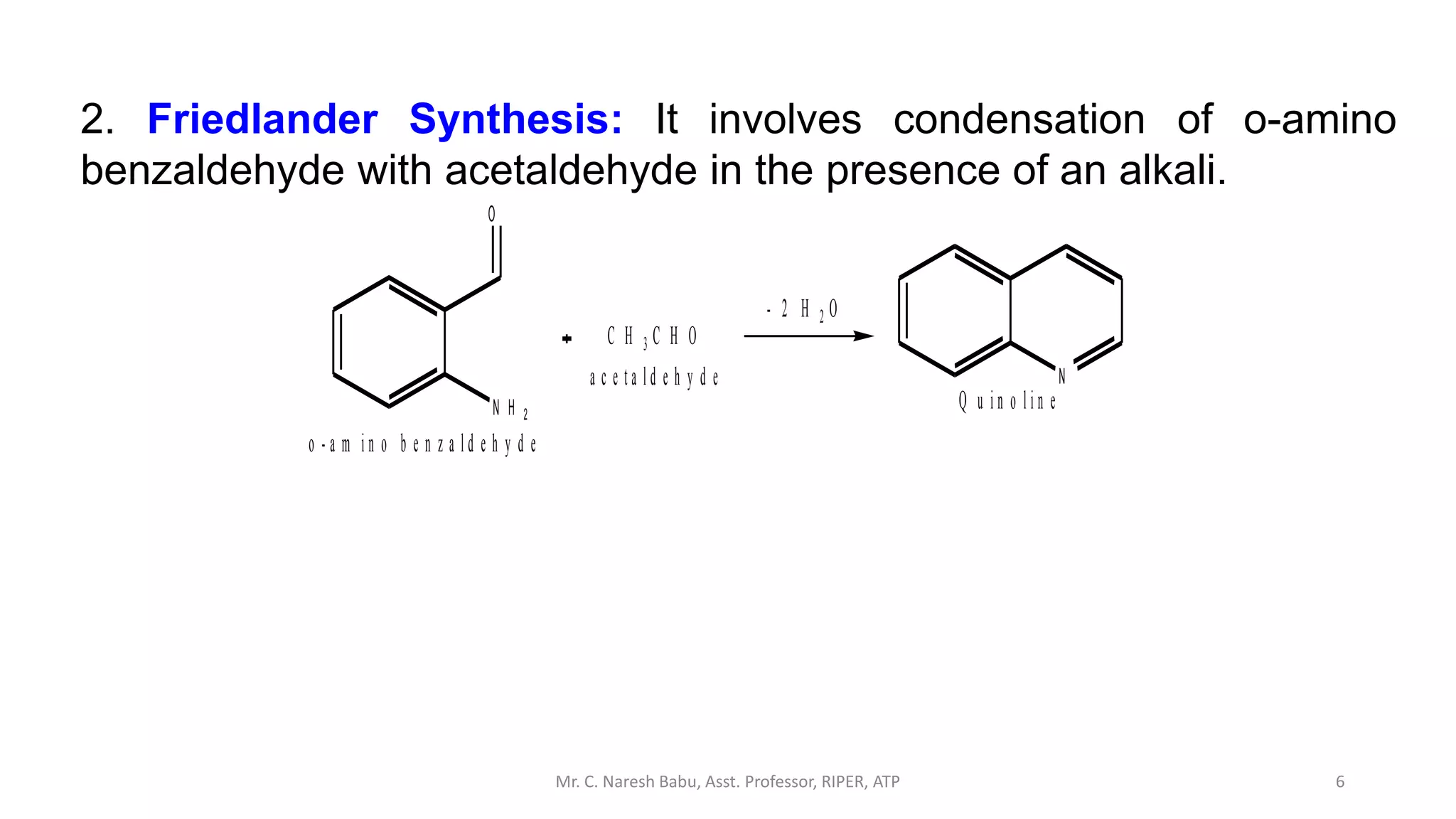
2. Friedlander Synthesis: It involves condensation of o-amino
benzaldehyde with acetaldehyde in the presence of an alkali.
Mr. C. Naresh Babu, Asst. Professor, RIPER, ATP 6
O
N H 2
o - a m i n o b e n z a l d e h y d e
C H 3 C H O
a c e t a l d e h y d e N
Q u i n o l i n e
- 2 H 2 O
Basic Character:
• Quinoline is slightly weaker base than pyridine. It reacts with acids
to yield salts which are sparingly soluble in water.
Mr. C. Naresh Babu, Asst. Professor, RIPER, ATP 7
N
Quinoline
HCl
N
H
Cl
Quinoline
Hydrogen chloride
Chemical reactions:
1. Electrophilic substitution reactions: Takes at C5 & C8 positions.
a) Nitration:
b) Sulphonation
Mr. C. Naresh Babu, Asst. Professor, RIPER, ATP 8
N
Q u i n o l i n e
H N O 3
N
H 2 S O 4
N
N O 2
N O 2
8 - n i t r o q u i n o l i n e
5 - n i t r o q u i n o l i n e
N
Q u i n o l i n e
N
H 2 S O 4
N
S O 3 H
S O 3 H
q u i n o l i n e - 8 - s u l f o n i c a c i d
q u i n o l i n e - 5 - s u l f o n i c a c i d
Mr. C. Naresh Babu, Asst. Professor, RIPER, ATP 9
2. Nucleophilic substitution reactions:
Reaction with sodamide: Substitution mostly happens at C-2 position, if any
substitution present at C-2 position then reaction occur at C-4 position.
3. Reaction with KOH:
4. Reaction with n-butyl lithium
N
Quinoline
N
NaNH2
Liq. NH3
NH2
quinolin-2-amine
N
Quinoline
N OH
KOH
quinolin-2-ol
N
Quinoline
N C
H2
C4H9Li
quinolin-2-ol
H2
C
C
H2
CH3- LiH
10
5. Reaction with per acetic acid:
6. Reaction with KMnO4:
7. Reduction:
N
Quinoline
N
CH3
O
O
HO
peracetic acid
O
Quinoline-N-oxide
N
Q u i n o l i n e
N
K M n O 4
H O O C
H O O C
p y r i d i n e - 2 , 3 - d i c a r b o x y l i c a c i d
Q u i n o l i n i c a c i d
N
Q u i n o l i n e
N
H
N
H
1 , 2 , 3 , 4 - t e t r a h y d r o q u i n o l i n e
d e c a h y d r o q u i n o l i n e
S n / H C l
H 2 / P t
1 4 0 0
C
11
8. Reaction with alkyl halides:
N
Q u i n o l i n e
N
C H 3 I
C H 3
I
N - m e t h y l q u i n o l i u m i o d i d e
12
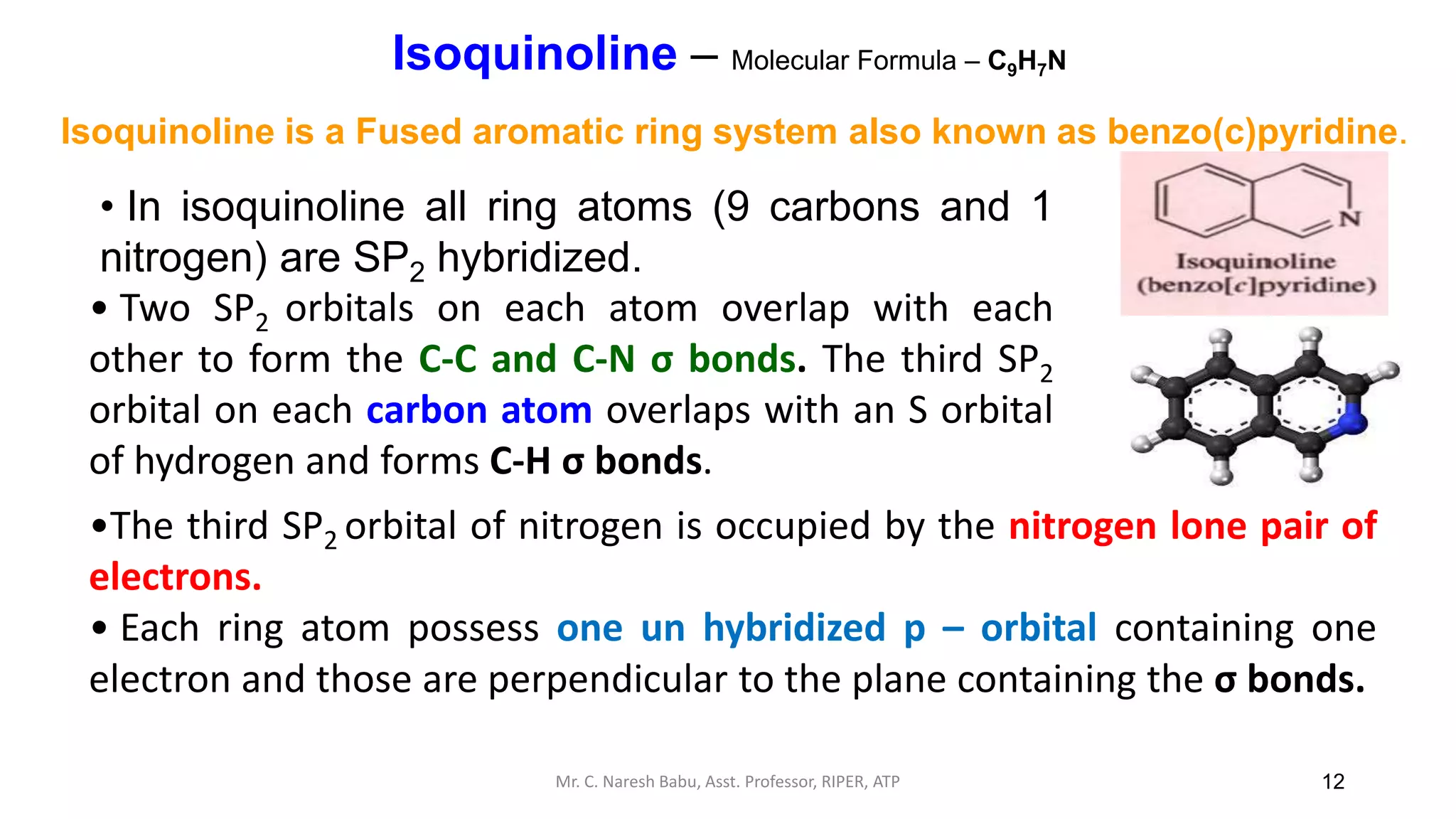
Isoquinoline – Molecular Formula – C9H7N
• In isoquinoline all ring atoms (9 carbons and 1
nitrogen) are SP2 hybridized.
• Two SP2 orbitals on each atom overlap with each
other to form the C-C and C-N σ bonds. The third SP2
orbital on each carbon atom overlaps with an S orbital
of hydrogen and forms C-H σ bonds.
Mr. C. Naresh Babu, Asst. Professor, RIPER, ATP
Isoquinoline is a Fused aromatic ring system also known as benzo(c)pyridine.
•The third SP2 orbital of nitrogen is occupied by the nitrogen lone pair of
electrons.
• Each ring atom possess one un hybridized p – orbital containing one
electron and those are perpendicular to the plane containing the σ bonds.
• Overlap of these p – orbitals produces delocalized π – molecular
orbital containing 10 electrons.
• Isoquinoline shows aromatic properties because the resulting
molecular orbital satisfies the Huckle’s rule (4n+2 rule).
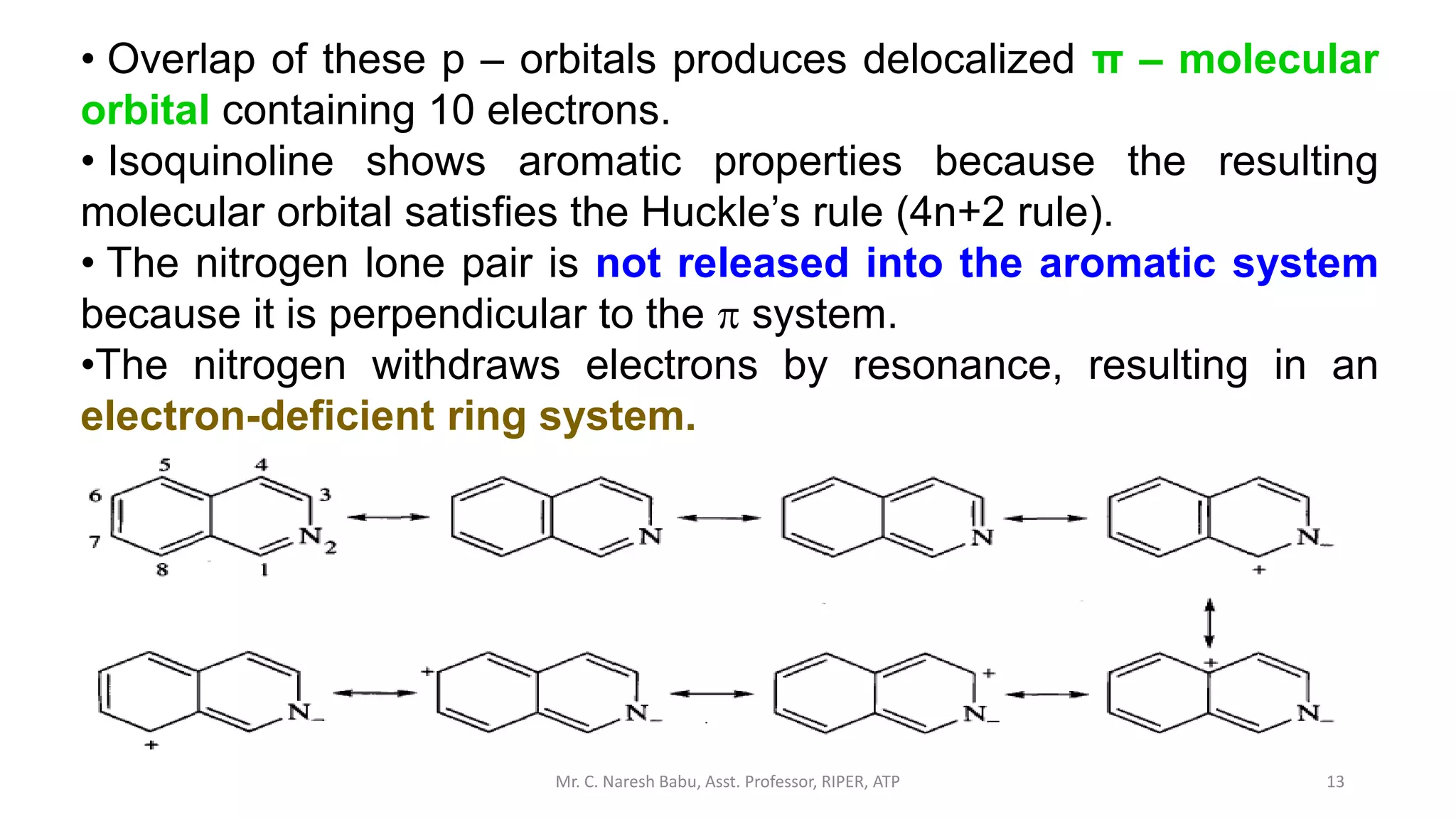
• The nitrogen lone pair is not released into the aromatic system
because it is perpendicular to the  system.
•The nitrogen withdraws electrons by resonance, resulting in an
electron-deficient ring system.
Mr. C. Naresh Babu, Asst. Professor, RIPER, ATP 13
Preparations
1. Bischler-Napieralski Synthesis:
 This method is very useful for the construction of 1-substituted
3,4- dihydroisoquinolines, which if necessary can be oxidized to
isoquinolines.
 β-phenylethylamine is reacted with an acyl chloride and a base to
give the corresponding amide (R1 = H) and then this is cyclized to
a 3,4-dihydroisoquinoline by treatment with either phosphorus
pentoxide or phosphorus oxychloride. Finally, aromatization is
accomplished by heating the 3,4-dihydroisoquinoline over
palladium on charcoal.
Mr. C. Naresh Babu, Asst. Professor, RIPER, ATP 14
Mr. C. Naresh Babu, Asst. Professor, RIPER, ATP 15
2. Pictet-Spengler Synthesis:
β-phenylethylamine react with an aldehyde, the reaction intermediate
is an imine which, provided the benzene ring contains electron
donating groups, often ring closes under very mild acidic conditions.
Indeed, cyclization can occur under physiological conditions, and in
Nature this is an important step in the biosynthesis of many
tetrahydroisoquinoline alkaloids. This tetrahydroisoquinoline can be
dehydrogenated by palladium to form 1-substituted isoquinoline.
Mr. C. Naresh Babu, Asst. Professor, RIPER, ATP 16
Mr. C. Naresh Babu, Asst. Professor, RIPER, ATP 17
N H 2
2-phenylethanam ine
R C H O
N
C
R
H
H +
N
3,4-dihydro-1-substituted
isoquinoline
N
P d
1-substituted isoquinoline
RR
Basic Character:
• Isoquinoline is slightly weaker base, It reacts with acids to yield
salts which are sparingly soluble in water.
Mr. C. Naresh Babu, Asst. Professor, RIPER, ATP 18
N
HCl
N
H
Cl
isoquinoline IsoquinolineHydrochloride
Chemical reactions:
1. Electrophilic substitution reactions: It takes place at the
position 5.
a) Nitration:
b) Sulphonation
Mr. C. Naresh Babu, Asst. Professor, RIPER, ATP 19
N
H N O 3
N
N O 2
i s o q u i n o l i n e
5 - n i t r o i s o q u i n o l i n e
N N
H2SO4
SO3H
isoquinoline isoquinoline-5-sulfonic acid
Mr. C. Naresh Babu, Asst. Professor, RIPER, ATP 20
c. Bromination:
2. Reduction:
N N
B r
i s o q u i n o l i n e
B r 2
5 - b r o m o i s o q u i n o l i n e
N
i s o q u i n o l i n e
N a - H g
S n c l 2
P t
H 2
H 2
H 2
N H N H
N H
1 , 2 - d i h y d r o i s o q u i n o l i n e 1 , 2 , 3 , 4 - t e t r a h y d r o i s o q u i n o l i n e
d e c a h y d r o i s o q u i n o l i n e
21
3. Oxidation / Reaction with KMnO4:
4. Reaction with alkyl halide:
5. Reaction with sodamide:
N
N
K M n O 4
( O )
C O O H
C O O H
p y r i d i n e - 3 , 4 - d i c a r b o x y l i c a c i di s o q u i n o l i n e
C O O H
C O O H
p h t h a l i c a c i d
N N
C H 3 I
C H 3
C l
i s o q u i n o l i n e I s o q u i n a l o n i u m m e t h y l i o d i d e
N N
N a N H 2
i s o q u i n o l i n e
N H 2
i s o q u i n o l i n - 1 - a m i n e
22
Indole – Molecular Formula – C8H7N
• In indole all ring atoms (8 carbons and 1
nitrogen) are SP2 hybridized.
• Two SP2 orbitals on each atom overlap with each
other to form the C-C and C-N σ bonds. The third SP2
orbital on each ring atom overlaps with an S orbital of
hydrogen and forms C-H and N-H σ bonds.
Mr. C. Naresh Babu, Asst. Professor, RIPER, ATP
Indole is a Fused aromatic ring system also known as benzo(b)pyrrole.
•The un hybridized p – orbital of nitrogen is occupied by the nitrogen
lone pair of electrons.
• Each carbon atom in ring possess one un hybridized p – orbital
containing one electron and those are perpendicular to the plane
containing the σ bonds.
• Overlap of these p – orbitals produces delocalized π – molecular
orbital containing 10 electrons. (8 electrons from 8 carbons and
lone pair of electrons from nitrogen)
• Indole shows aromatic properties because the resulting molecular
orbital satisfies the Huckle’s rule (4n+2 rule).
• The nitrogen lone pair is released into the aromatic system.
Mr. C. Naresh Babu, Asst. Professor, RIPER, ATP 23
Preparations
1. Lipp Synthesis:
 In this method o-amino chlorostyrene is heated with sodium
ethoxide at 160-1700C.
Mr. C. Naresh Babu, Asst. Professor, RIPER, ATP 24
N H 2
o - a m i n o c h l o r o s t y r e n e
H
C
C
H
C l
N a O C 2 H 5
N
H
I n d o l e
C 2 H 5 O H N a c l
Mr. C. Naresh Babu, Asst. Professor, RIPER, ATP 25
NH
NH2
Phenyl hydrazine
O
H3C O
OH
Pyruvic acid
N
H
-H2O
N
H3C COOH
ZnCl2
-NH3
N
H
COOH
Decarboxylation
N
H
1H-indole
-CO2
2. Fisher indole synthesis:
 Pyruvic acid is first treated wit phenyl hydrazine to form the corresponding phenyl
hydrazine.
 Then the hydrazine is heated with anhydrous zinc chloride or poly phosphoric acid
to give indole-2-carboxylic acid, which upon decarboxylation yields indole.
Mr. C. Naresh Babu, Asst. Professor, RIPER, ATP 26
3. Madelung synthesis:
 O-toluidine is react with formic acid to form N-formyl o-toluidine. This undergoes
dehydration on heating with sodium ethoxide or potassium t-butoxide to tield
indole.
C H 3
N H 2
o-toluidine
O
H O
H
form ic acid
- H 2O
C H 3
N
H
H
O
C2H 5O N a
C4H 9O -
K +
- H 2O
N
H
1H -indole
Mr. C. Naresh Babu, Asst. Professor, RIPER, ATP 27
4. From o-nitro phenyl acetaldehyde:
 This involves reduction of o-nitro phenyl acetaldehyde with iron powder and
sodium bisulphite to give o-amino phenyl acetaldehyde, which cyclizes
spontaneously to yield indole.
o-nitro phenyl acetaldehyde
Na+
O-
S
O
HO
Sodium bisulphite
O
NH2
o-amino phenylacetaldehyde
O
NO2
- H2O
N
H
1H-indole
Basic Character & Acidic character:
• Indole is a weak base and also a weak acid as like pyrrole.
• Indole is a weak base since the lone pair of electrons of nitrogen
atom contributes to the 4n+2 π electron cloud (aromatic sextet).
Thus, the availability of these lone pair of electrons is decreased.
• Indole also exhibit weak acidic properties, the weak acidic property
is because of its formation of potassium indole with KOH.
Mr. C. Naresh Babu, Asst. Professor, RIPER, ATP 28
N
H
1 H - i n d o l e
K O H
N
K
- H 2 O
P o t a s s i u m i n d o l e
Mr. C. Naresh Babu, Asst. Professor, RIPER, ATP 29
Chemical reactions:
Electrophilic Substitution reactions (C-3 versus C-2):
 Electrophiles attack indole at C-3, rather than at C-2.
 This is the opposite result to that observed for pyrroles, but can be explained if the
intermediates for each type of reaction are considered.
 For a reaction at C-3, the energy of activation of the intermediate is lowered because
it is possible to delocalize the positive charge through resonance involving the
nitrogen lone pair of electrons.
 This favourable situation is not possible in the corresponding intermediate for attack
at C-2. Any attempt to delocalize the positive charge would now disrupt the 6π
electrons system of the benzene ring.
a) Nitration:
b) Sulphonation
c) Halogenation
Mr. C. Naresh Babu, Asst. Professor, RIPER, ATP 30
N
H
1 H -in d o le
C 2 H 5 N O 2
E th y l n itra te
C 2 H 5 O N a
5 o
C
N
H
N O 2
3 -n itro -1 H -in d o le
N
H
1 H - i n d o l e
S O 3
P y r id i n e
1 1 0 o
C
N
H
S O 3 H
1 H - in d o l e - 3 - s u l f o n ic a c i d
N
H
1 H - in d o le
S O 2 C l2
B r - C H 3 O H
N
H
X
3 - h a lo 1 H - in d o le
d) Friedal-craft acylation
e) Formylation
f) Vilsmeyer reaction
Mr. C. Naresh Babu, Asst. Professor, RIPER, ATP 31
N
H
1H -indole
C H 3C O C l
A cetyl chloride
S nC l4
N
H
C O C H 3
3-acetyl indole
N
H
1 H - in d o le
H C N - H C l
N
H
C H O
3 - f o rm y l- 1 H -in d o le
N
H
1 H - i n d o l e
N
H
C H O
3 - f o r m y l - 1 H - i n d o l e
N O
N - f o r m y l d i m e t h y l a m i n e
P O C l 3
g) Reimer – tiemann reaction:
h) Alkylation
i) Mannich reaction:
Mr. C. Naresh Babu, Asst. Professor, RIPER, ATP 32
N
H
1 H - i n d o l e
C H C l 3
C h l o r o f o r m
N a O H
N
H
C H O
3 - f o r m y l i n d o l e
N
H
1 H - i n d o l e
D M F
N
H
C H 3
C H 3 I
3 - m e t h y l - 1 H - i n d o l e
N
H
1 H -in d o le
N
H
C H 2 -N (C H 3 )2
H C H O
H
N
C H 3H 3 C
D im e th y l a m in e
- H 2 O
3 -D im e th y l a m in o m e th y l-1 H -in d o le
j) Reduction: Mild reduction by Zn & HCl.
But catalyst Ni / Pt reduces both rings and forms octa hydro indole.
k) Diazo coupling:
Mr. C. Naresh Babu, Asst. Professor, RIPER, ATP 33
N
H
1 H - i n d o l e
N
H
i n d o l i n e o r
2 , 3 - d i h y d r o - 1 H - i n d o l e
Z n / H C l
N
H
1 H - i n d o l e
N
H
N i / P t
o c t a h y d r o - 1 H - i n d o l e
N
H
1 H -in d o le
N +
N
C l-
B en zen e d iazo n iu m ch lo rid e N
H
NN
1 -(1 H -in d o l-3 -y l)-2 -p h en y ld iazen e
34
Acridine – Molecular Formula – C13H9N
• In acridine all ring atoms (13 carbons and 1
nitrogen) are SP2 hybridized.
• Two SP2 orbitals on each atom overlap with each
other to form the C-C and C-N σ bonds. The third SP2
orbital on each carbon atom overlaps with an S orbital
of hydrogen and forms C-H σ bonds.
Mr. C. Naresh Babu, Asst. Professor, RIPER, ATP
Acridine is a Fused aromatic ring system also known as Dibenzo[b,e]pyridine
/ 2,3-Benzoquinoline
•The third SP2 orbital of nitrogen is occupied by the lone pair of electron
of nitrogen.
• Each ring atom in ring possess one un hybridized p – orbital containing
one electron and those are perpendicular to the plane containing the σ
bonds.
• Overlap of these p – orbitals produces delocalized π – molecular
orbital containing 14 electrons.
• Acridine shows aromatic properties because the resulting
molecular orbital satisfies the Huckle’s rule (4n+2 rule).
• The nitrogen lone pair is not released into the aromatic system.
• It is a planar molecule that is structurally related to anthracene with
one of the central CH group is replaced by nitrogen.
Mr. C. Naresh Babu, Asst. Professor, RIPER, ATP 35
Preparations
1. From diphenyl amine-2-carboxylic acid:
36
O
HO
Cl
o-chloro benzoic acid
H2N
Aniline
Base
N
H
COOH
Diphenylamine-2-carboxylic acid
H2SO4
POCl3
N
H
O
N
H
Cl
9-chloro-9,10-dihydroacridine
acridin-9(10H)-one
Na / Amyl
alcohol
H2 / Ni
N
H
9,10-dihydroacridine
Oxidation
N
Acridine
Mr. C. Naresh Babu, Asst. Professor, RIPER, ATP 37
2. From o-amino diphenyl methane:
Acridine is also prepared by passing o-amino diphenyl methane
through a red hot tube.
Basic character:
Acridine is a weak base but it forms soluble salts with mineral acids.
N H 2
o - a m i n o d i p h e n y l m e t h a n e
R e d h o t t u b e
N
A c r i d i n e
N
A c r i d i n e
H C l
N
H
C l
A c r i d i n e h y d r o c h l o r i d e
Chemical reactions:
1. Electrophilic substitution reactions:
Halogenation:
2. Reaction with nucleophilic reagents
 Acridine easily reacted with nucleophilic reagents.
 Nucleophilic attack takes place at 9-position, because the electron
density is decreased at this position when compare to 1,2,3 and 4th
positions.
Mr. C. Naresh Babu, Asst. Professor, RIPER, ATP 38
N
A cridine
B r2
C H 3C O O H
N
N
B r
B rB r
2,7-dibrom oacridine
2-brom oacridine
Mr. C. Naresh Babu, Asst. Professor, RIPER, ATP 39
 So, Acridine easily reacted with sodamide in liq. Ammonia, it gives 9-
amino acridine.
3. Reaction with oxidizing agents:
N
A cridine
N aN H 2
L iq. N H 3
N
N H 2
9-A m ino acridine
N
A cridine
K M nO 4
N
N
C O O H
C O O H
quinoline-2,3-dicarboxylic acid
C H 3
O
O
H O
Peracetic acid
O A cridine-N -oxide
Acridine is very stable ring
system towards oxidizing
agents. But in the presence
of per acids acridine easily
converted to N-oxide.
Mr. C. Naresh Babu, Asst. Professor, RIPER, ATP 40
4. Reaction with reducing agents:
5. Reaction with alkyl halides:
Acridine readily reacts with alkyl halides for example with methyl iodide it gives N-
methyl acridinium iodide.
N
A c r i d i n e
H 2 / N i
N
H
9 , 1 0 - d i h y d r o a c r i d i n e
N
Acridine
CH3I
N
H3C
I
10-methyl Acridinium iodide
41
Benzimidazole – Molecular Formula – C7H6N2
• In Benzimidazole all ring atoms (7 carbons and 2
nitrogens) are SP2 hybridized.
• Two SP2 orbitals on each atom overlap with each
other to form the C-C and C-N σ bonds.
•The third SP2 orbital on each carbon atom and one
nitrogen atom overlaps with an S orbital of hydrogen
and forms C-H and N-H σ bonds.
Mr. C. Naresh Babu, Asst. Professor, RIPER, ATP
Benzimidazole is a Fused aromatic ring system fusion of benzene and imidazole.
•The third SP2 orbital of second nitrogen is occupied by the lone pair of
electrons.
• Each carbon atom in ring possess one un hybridized p – orbital
containing one electron and those are perpendicular to the plane
containing the σ bonds.
Benzo(d)imidazole
• One of the nitrogen in benzimidazole having lone pair of electrons
are released into the aromatic system.
• Overlap of these p – orbitals, lone pair of electrons from one
nitrogen produces delocalized π – molecular orbital containing 10
electrons.
• Benzimidazole shows aromatic properties because the resulting
molecular orbital satisfies the Huckle’s rule (4n+2 rule).
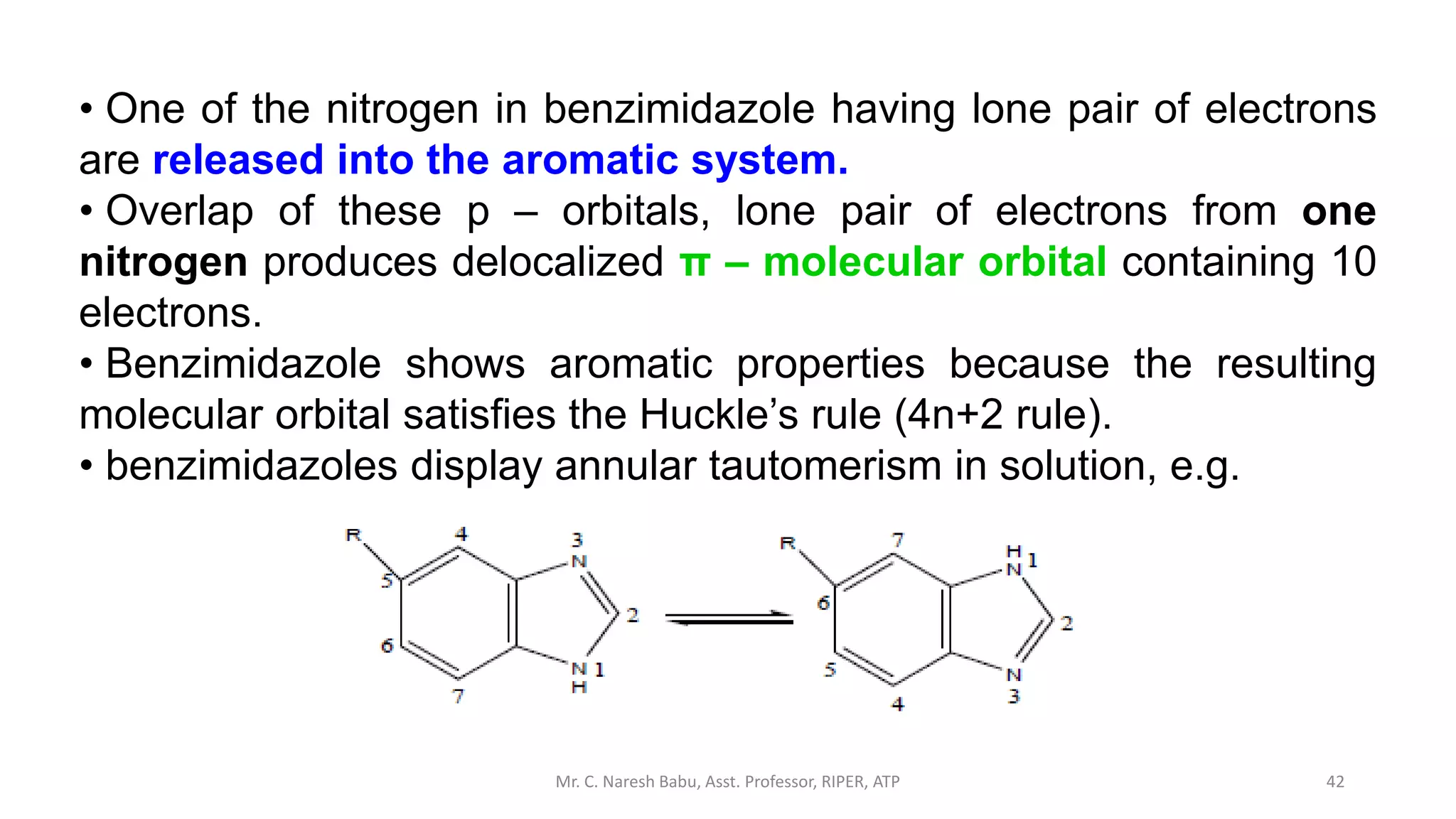
• benzimidazoles display annular tautomerism in solution, e.g.
Mr. C. Naresh Babu, Asst. Professor, RIPER, ATP 42
Preparations
1. From o-phenylenediamine / Phillips reaction:
It is the most important method of preparing benzimidazole by refluxing o-
phenylenediamine with a carboxylic acidnin 4N HCl.
43
NH2
NH2
o-phenylene diamine
OH
O
R
4N HCl, Reflux
N
N
H
2-Substituted Benzimidazole
R
- 2 H2O
Basic Character & Acidic character:
• Benzimidazole is a weak base and also a weak acid.
• Benzimidazole is a weak base because due to the presence of
lone pair of electrons on one of the nitrogen atom.
• Benzimidazole also exhibit weak acidic properties, the weak acidic
property is because of its formation of potassium phenothiazine
with KOH.
Mr. C. Naresh Babu, Asst. Professor, RIPER, ATP 44
N
N
H
Benzimidazole
H Cl
N
N
H
H
Cl
Benzim idazole hydrochloride
N
N
H
K O H
- H 2O
N
N
K1H -benzo[d]im idazole
N -potassium benzimidazole
Mr. C. Naresh Babu, Asst. Professor, RIPER, ATP 45
Chemical reactions:
Electrophilic Substitution reactions:
 Electrophiles attack in benzimidazole take place preferentially at the 5- or 6-
position. However, the electrophile may also enter the 4- or 7-position if the 5- or 6-
position is blocked.
Nitration:
Sulphonation:
N
N
H
B e n z i m i d a z o l e
H N O 3
N
N
H
O 2 N
5 - n i t r o - 1 H - b e n z o [ d ] i m i d a z o l e
N
N
H
B e n z i m i d a z o l e
H 2 S O 4
N
N
H
H O 3 S
1 H - b e n z o [ d ] i m i d a z o l e - 5 - s u l f o n i c a c i d
Mr. C. Naresh Babu, Asst. Professor, RIPER, ATP 46
By treatment with acid anhydrides: 1-benzimidazoylmagnesium bromide when treated
with benzoyl chloride in ether solution gives mostly N,N’- dibenzoylbenzimidazole and
the rupture of the imidazole ring has been postulated by hydrolysis.
Mr. C. Naresh Babu, Asst. Professor, RIPER, ATP 47
Halogenation: When 2,5 (or 2,6)-dimethylbenzimidazole in an aqueous acid solution is
treated with a saturated solution of bleaching powder at 0 to 5°C, 1-chloro-2,5(or 2,6)-
dimethylbenzimidazole is obtained.
Nucleophilic substitution reaction:
Reaction with sodamide:
N
N
H
B e n z i m i d a z o l e
N a N H 2
N
N
H
N H 2
1 H - b e n z o [ d ] i m i d a z o l - 2 - a m i n e
Reduction: Mild reduction by Zn & HCl.
But catalyst Ni / Pt reduces both rings and forms octa hydro indole.
Mr. C. Naresh Babu, Asst. Professor, RIPER, ATP 48
N
H
N
N
H
H
N
Z n / H C l
1 H - b e n z o [ d ] i m i d a z o l e 2 ,3 - d i h y d r o - 1 H - b e n z o [ d ] i m i d a z o l e
N
H
N
N
H
H
N
N i / P t
1 H - b e n z o [ d ] i m i d a z o l e o c t a h y d r o - 1 H - b e n z o [ d ] i m i d a z o l e
49
Phenothiazine – Molecular Formula – C12H9NS
• In phenothiazine all ring atoms (12 carbons and
1 nitrogen and 1 sulphur) are SP2 hybridized.
• Two SP2 orbitals on each atom overlap with each
other to form the C-C and C-N and C-S σ bonds.
•The third SP2 orbital on each carbon atom and
nitrogen atom overlaps with an S orbital of hydrogen
and forms C-H and N-H σ bonds.
Mr. C. Naresh Babu, Asst. Professor, RIPER, ATP
Phenothiazine is a Fused aromatic ring system also known as Dibenzothiazine
•The third SP2 orbital of sulphur is occupied by the lone pair of electrons.
• Each carbon atom in ring possess one un hybridized p – orbital
containing one electron and those are perpendicular to the plane
containing the σ bonds.
• Overlap of these p – orbitals, lone pair of electrons from Sulphur
and nitrogen produces delocalized π – molecular orbital containing
14 electrons.
• Phenothiazine shows aromatic properties because the resulting
molecular orbital satisfies the Huckle’s rule (4n+2 rule).
• The nitrogen and Sulphur lone pair are released into the aromatic
system.
Mr. C. Naresh Babu, Asst. Professor, RIPER, ATP 50
Preparations
1. From diphenyl amine:
It is prepared by fusing diphenyl amine with Sulphur.
2. From o-amino thiophenol:
It is prepared by heating o-amino thiophenol with catechol.
51
N
H
D i p h e n y l a m i n e
2 S
- H 2 S
S
N
H
P h e n o t h i a z i n e
N H 2
S H
o - a m i n o t h i o p h e n o l
H O
H O
C a t e c h o l
- 2 H 2 O
S
N
H
P h e n o t h i a z i n e
Basic Character & Acidic character:
Phenothiazine is a weak base and also a weak acid.
• Phenothiazine is a weak base since the lone pair of electrons of
nitrogen atom contributes to the 4n+2 π electron cloud. Thus, the
availability of these lone pair of electrons is decreased.
• Indole also exhibit weak acidic properties, the weak acidic property
is because of its formation of potassium phenothiazine with KOH.
Mr. C. Naresh Babu, Asst. Professor, RIPER, ATP 52
S
N
H
P h e n o t h i a z i n e
K O H
- H 2 O
S
N
K
P o t a s s i u m p h e n o t h i a z i n e
Mr. C. Naresh Babu, Asst. Professor, RIPER, ATP 53
1. Electrophilic substitution reactions:
Mostly the electrophilic substitution reactions happens at 2, 3, 7 and 8 th
positions.
S
H
N
Phenothiazine
Nitration
Sulphonation
Halogenation
S
H
N
S
H
N
S
H
N
NO2O2N HO3S SO3H
ClCl
Cl Cl
2,8-dinitro-10H-phenothiazine 10H-phenothiazine-2,8-disulfonic acid
2,3,7,8-tetrachloro-10H-phenothiazine
Mr. C. Naresh Babu, Asst. Professor, RIPER, ATP 54
2. Reaction of phenothiazine and n-butyl lithium followed by the addition
of solid carbon dioxide to the mixture and gives 1-carboxy phenothiazine.
3. Nucleophilic substitution reactions:
Mostly happens at 1 or 9th positions.
Reaction with sodamide:
S
H
N
P h e n o th ia z in e
N a N H 2
S
H
N
N H 2
1 0 H -p h e n o th ia z in -1 -a m in e

Heterocyclic chemistry - Fused ring systems

  • 1.
    Heterocyclic Chemistry Fused ringsystems Mr. C. Naresh Babu Assistant Professor Email: nareshbabu.cvn@gmail.com
  • 2.
    2 Quinoline – MolecularFormula – C9H7N • In quinoline all ring atoms (9 carbons and 1 nitrogen) are SP2 hybridized. • Two SP2 orbitals on each atom overlap with each other to form the C-C and C-N σ bonds. The third SP2 orbital on each carbon atom overlaps with an S orbital of hydrogen and forms C-H σ bonds. Mr. C. Naresh Babu, Asst. Professor, RIPER, ATP Quinoline is a Fused aromatic ring system also known as benzo(b)pyridine. •The third SP2 orbital of nitrogen is occupied by the nitrogen lone pair of electrons. • Each ring atom possess one un hybridized p – orbital containing one electron and those are perpendicular to the plane containing the σ bonds.
  • 3.
    • Overlap ofthese p – orbitals produces delocalized π – molecular orbital containing 10 electrons. • Quinoline shows aromatic properties because the resulting molecular orbital satisfies the Huckle’s rule (4n+2 rule). • The nitrogen lone pair is not released into the aromatic system because it is perpendicular to the  system. •The nitrogen withdraws electrons by resonance, resulting in an electron-deficient ring system. Mr. C. Naresh Babu, Asst. Professor, RIPER, ATP 3
  • 4.
    Preparations 1. Skraup Synthesis: Here a mixture of glycerol (propane- 1,2,3-triol), aniline (phenylamine), sulfuric acid, nitrobenzene and ferrous [iron(II)] sulfate are heated together.  The reaction is exothermic and tends to become very violent.  ferrous [iron(II)] sulfate is added to make the reaction less violent.  Nitrobenzene, or an alternative oxidant (iodine or chloroaniline are often recommended), is required to convert the product, 1,2- dihydroquinoline into quinoline. Mr. C. Naresh Babu, Asst. Professor, RIPER, ATP 4
  • 5.
    Mr. C. NareshBabu, Asst. Professor, RIPER, ATP 5 Skraup Synthesis
  • 6.
    2. Friedlander Synthesis:It involves condensation of o-amino benzaldehyde with acetaldehyde in the presence of an alkali. Mr. C. Naresh Babu, Asst. Professor, RIPER, ATP 6 O N H 2 o - a m i n o b e n z a l d e h y d e C H 3 C H O a c e t a l d e h y d e N Q u i n o l i n e - 2 H 2 O
  • 7.
    Basic Character: • Quinolineis slightly weaker base than pyridine. It reacts with acids to yield salts which are sparingly soluble in water. Mr. C. Naresh Babu, Asst. Professor, RIPER, ATP 7 N Quinoline HCl N H Cl Quinoline Hydrogen chloride
  • 8.
    Chemical reactions: 1. Electrophilicsubstitution reactions: Takes at C5 & C8 positions. a) Nitration: b) Sulphonation Mr. C. Naresh Babu, Asst. Professor, RIPER, ATP 8 N Q u i n o l i n e H N O 3 N H 2 S O 4 N N O 2 N O 2 8 - n i t r o q u i n o l i n e 5 - n i t r o q u i n o l i n e N Q u i n o l i n e N H 2 S O 4 N S O 3 H S O 3 H q u i n o l i n e - 8 - s u l f o n i c a c i d q u i n o l i n e - 5 - s u l f o n i c a c i d
  • 9.
    Mr. C. NareshBabu, Asst. Professor, RIPER, ATP 9 2. Nucleophilic substitution reactions: Reaction with sodamide: Substitution mostly happens at C-2 position, if any substitution present at C-2 position then reaction occur at C-4 position. 3. Reaction with KOH: 4. Reaction with n-butyl lithium N Quinoline N NaNH2 Liq. NH3 NH2 quinolin-2-amine N Quinoline N OH KOH quinolin-2-ol N Quinoline N C H2 C4H9Li quinolin-2-ol H2 C C H2 CH3- LiH
  • 10.
    10 5. Reaction withper acetic acid: 6. Reaction with KMnO4: 7. Reduction: N Quinoline N CH3 O O HO peracetic acid O Quinoline-N-oxide N Q u i n o l i n e N K M n O 4 H O O C H O O C p y r i d i n e - 2 , 3 - d i c a r b o x y l i c a c i d Q u i n o l i n i c a c i d N Q u i n o l i n e N H N H 1 , 2 , 3 , 4 - t e t r a h y d r o q u i n o l i n e d e c a h y d r o q u i n o l i n e S n / H C l H 2 / P t 1 4 0 0 C
  • 11.
    11 8. Reaction withalkyl halides: N Q u i n o l i n e N C H 3 I C H 3 I N - m e t h y l q u i n o l i u m i o d i d e
  • 12.
    12 Isoquinoline – MolecularFormula – C9H7N • In isoquinoline all ring atoms (9 carbons and 1 nitrogen) are SP2 hybridized. • Two SP2 orbitals on each atom overlap with each other to form the C-C and C-N σ bonds. The third SP2 orbital on each carbon atom overlaps with an S orbital of hydrogen and forms C-H σ bonds. Mr. C. Naresh Babu, Asst. Professor, RIPER, ATP Isoquinoline is a Fused aromatic ring system also known as benzo(c)pyridine. •The third SP2 orbital of nitrogen is occupied by the nitrogen lone pair of electrons. • Each ring atom possess one un hybridized p – orbital containing one electron and those are perpendicular to the plane containing the σ bonds.
  • 13.
    • Overlap ofthese p – orbitals produces delocalized π – molecular orbital containing 10 electrons. • Isoquinoline shows aromatic properties because the resulting molecular orbital satisfies the Huckle’s rule (4n+2 rule). • The nitrogen lone pair is not released into the aromatic system because it is perpendicular to the  system. •The nitrogen withdraws electrons by resonance, resulting in an electron-deficient ring system. Mr. C. Naresh Babu, Asst. Professor, RIPER, ATP 13
  • 14.
    Preparations 1. Bischler-Napieralski Synthesis: This method is very useful for the construction of 1-substituted 3,4- dihydroisoquinolines, which if necessary can be oxidized to isoquinolines.  β-phenylethylamine is reacted with an acyl chloride and a base to give the corresponding amide (R1 = H) and then this is cyclized to a 3,4-dihydroisoquinoline by treatment with either phosphorus pentoxide or phosphorus oxychloride. Finally, aromatization is accomplished by heating the 3,4-dihydroisoquinoline over palladium on charcoal. Mr. C. Naresh Babu, Asst. Professor, RIPER, ATP 14
  • 15.
    Mr. C. NareshBabu, Asst. Professor, RIPER, ATP 15
  • 16.
    2. Pictet-Spengler Synthesis: β-phenylethylaminereact with an aldehyde, the reaction intermediate is an imine which, provided the benzene ring contains electron donating groups, often ring closes under very mild acidic conditions. Indeed, cyclization can occur under physiological conditions, and in Nature this is an important step in the biosynthesis of many tetrahydroisoquinoline alkaloids. This tetrahydroisoquinoline can be dehydrogenated by palladium to form 1-substituted isoquinoline. Mr. C. Naresh Babu, Asst. Professor, RIPER, ATP 16
  • 17.
    Mr. C. NareshBabu, Asst. Professor, RIPER, ATP 17 N H 2 2-phenylethanam ine R C H O N C R H H + N 3,4-dihydro-1-substituted isoquinoline N P d 1-substituted isoquinoline RR
  • 18.
    Basic Character: • Isoquinolineis slightly weaker base, It reacts with acids to yield salts which are sparingly soluble in water. Mr. C. Naresh Babu, Asst. Professor, RIPER, ATP 18 N HCl N H Cl isoquinoline IsoquinolineHydrochloride
  • 19.
    Chemical reactions: 1. Electrophilicsubstitution reactions: It takes place at the position 5. a) Nitration: b) Sulphonation Mr. C. Naresh Babu, Asst. Professor, RIPER, ATP 19 N H N O 3 N N O 2 i s o q u i n o l i n e 5 - n i t r o i s o q u i n o l i n e N N H2SO4 SO3H isoquinoline isoquinoline-5-sulfonic acid
  • 20.
    Mr. C. NareshBabu, Asst. Professor, RIPER, ATP 20 c. Bromination: 2. Reduction: N N B r i s o q u i n o l i n e B r 2 5 - b r o m o i s o q u i n o l i n e N i s o q u i n o l i n e N a - H g S n c l 2 P t H 2 H 2 H 2 N H N H N H 1 , 2 - d i h y d r o i s o q u i n o l i n e 1 , 2 , 3 , 4 - t e t r a h y d r o i s o q u i n o l i n e d e c a h y d r o i s o q u i n o l i n e
  • 21.
    21 3. Oxidation /Reaction with KMnO4: 4. Reaction with alkyl halide: 5. Reaction with sodamide: N N K M n O 4 ( O ) C O O H C O O H p y r i d i n e - 3 , 4 - d i c a r b o x y l i c a c i di s o q u i n o l i n e C O O H C O O H p h t h a l i c a c i d N N C H 3 I C H 3 C l i s o q u i n o l i n e I s o q u i n a l o n i u m m e t h y l i o d i d e N N N a N H 2 i s o q u i n o l i n e N H 2 i s o q u i n o l i n - 1 - a m i n e
  • 22.
    22 Indole – MolecularFormula – C8H7N • In indole all ring atoms (8 carbons and 1 nitrogen) are SP2 hybridized. • Two SP2 orbitals on each atom overlap with each other to form the C-C and C-N σ bonds. The third SP2 orbital on each ring atom overlaps with an S orbital of hydrogen and forms C-H and N-H σ bonds. Mr. C. Naresh Babu, Asst. Professor, RIPER, ATP Indole is a Fused aromatic ring system also known as benzo(b)pyrrole. •The un hybridized p – orbital of nitrogen is occupied by the nitrogen lone pair of electrons. • Each carbon atom in ring possess one un hybridized p – orbital containing one electron and those are perpendicular to the plane containing the σ bonds.
  • 23.
    • Overlap ofthese p – orbitals produces delocalized π – molecular orbital containing 10 electrons. (8 electrons from 8 carbons and lone pair of electrons from nitrogen) • Indole shows aromatic properties because the resulting molecular orbital satisfies the Huckle’s rule (4n+2 rule). • The nitrogen lone pair is released into the aromatic system. Mr. C. Naresh Babu, Asst. Professor, RIPER, ATP 23
  • 24.
    Preparations 1. Lipp Synthesis: In this method o-amino chlorostyrene is heated with sodium ethoxide at 160-1700C. Mr. C. Naresh Babu, Asst. Professor, RIPER, ATP 24 N H 2 o - a m i n o c h l o r o s t y r e n e H C C H C l N a O C 2 H 5 N H I n d o l e C 2 H 5 O H N a c l
  • 25.
    Mr. C. NareshBabu, Asst. Professor, RIPER, ATP 25 NH NH2 Phenyl hydrazine O H3C O OH Pyruvic acid N H -H2O N H3C COOH ZnCl2 -NH3 N H COOH Decarboxylation N H 1H-indole -CO2 2. Fisher indole synthesis:  Pyruvic acid is first treated wit phenyl hydrazine to form the corresponding phenyl hydrazine.  Then the hydrazine is heated with anhydrous zinc chloride or poly phosphoric acid to give indole-2-carboxylic acid, which upon decarboxylation yields indole.
  • 26.
    Mr. C. NareshBabu, Asst. Professor, RIPER, ATP 26 3. Madelung synthesis:  O-toluidine is react with formic acid to form N-formyl o-toluidine. This undergoes dehydration on heating with sodium ethoxide or potassium t-butoxide to tield indole. C H 3 N H 2 o-toluidine O H O H form ic acid - H 2O C H 3 N H H O C2H 5O N a C4H 9O - K + - H 2O N H 1H -indole
  • 27.
    Mr. C. NareshBabu, Asst. Professor, RIPER, ATP 27 4. From o-nitro phenyl acetaldehyde:  This involves reduction of o-nitro phenyl acetaldehyde with iron powder and sodium bisulphite to give o-amino phenyl acetaldehyde, which cyclizes spontaneously to yield indole. o-nitro phenyl acetaldehyde Na+ O- S O HO Sodium bisulphite O NH2 o-amino phenylacetaldehyde O NO2 - H2O N H 1H-indole
  • 28.
    Basic Character &Acidic character: • Indole is a weak base and also a weak acid as like pyrrole. • Indole is a weak base since the lone pair of electrons of nitrogen atom contributes to the 4n+2 π electron cloud (aromatic sextet). Thus, the availability of these lone pair of electrons is decreased. • Indole also exhibit weak acidic properties, the weak acidic property is because of its formation of potassium indole with KOH. Mr. C. Naresh Babu, Asst. Professor, RIPER, ATP 28 N H 1 H - i n d o l e K O H N K - H 2 O P o t a s s i u m i n d o l e
  • 29.
    Mr. C. NareshBabu, Asst. Professor, RIPER, ATP 29 Chemical reactions: Electrophilic Substitution reactions (C-3 versus C-2):  Electrophiles attack indole at C-3, rather than at C-2.  This is the opposite result to that observed for pyrroles, but can be explained if the intermediates for each type of reaction are considered.  For a reaction at C-3, the energy of activation of the intermediate is lowered because it is possible to delocalize the positive charge through resonance involving the nitrogen lone pair of electrons.  This favourable situation is not possible in the corresponding intermediate for attack at C-2. Any attempt to delocalize the positive charge would now disrupt the 6π electrons system of the benzene ring.
  • 30.
    a) Nitration: b) Sulphonation c)Halogenation Mr. C. Naresh Babu, Asst. Professor, RIPER, ATP 30 N H 1 H -in d o le C 2 H 5 N O 2 E th y l n itra te C 2 H 5 O N a 5 o C N H N O 2 3 -n itro -1 H -in d o le N H 1 H - i n d o l e S O 3 P y r id i n e 1 1 0 o C N H S O 3 H 1 H - in d o l e - 3 - s u l f o n ic a c i d N H 1 H - in d o le S O 2 C l2 B r - C H 3 O H N H X 3 - h a lo 1 H - in d o le
  • 31.
    d) Friedal-craft acylation e)Formylation f) Vilsmeyer reaction Mr. C. Naresh Babu, Asst. Professor, RIPER, ATP 31 N H 1H -indole C H 3C O C l A cetyl chloride S nC l4 N H C O C H 3 3-acetyl indole N H 1 H - in d o le H C N - H C l N H C H O 3 - f o rm y l- 1 H -in d o le N H 1 H - i n d o l e N H C H O 3 - f o r m y l - 1 H - i n d o l e N O N - f o r m y l d i m e t h y l a m i n e P O C l 3
  • 32.
    g) Reimer –tiemann reaction: h) Alkylation i) Mannich reaction: Mr. C. Naresh Babu, Asst. Professor, RIPER, ATP 32 N H 1 H - i n d o l e C H C l 3 C h l o r o f o r m N a O H N H C H O 3 - f o r m y l i n d o l e N H 1 H - i n d o l e D M F N H C H 3 C H 3 I 3 - m e t h y l - 1 H - i n d o l e N H 1 H -in d o le N H C H 2 -N (C H 3 )2 H C H O H N C H 3H 3 C D im e th y l a m in e - H 2 O 3 -D im e th y l a m in o m e th y l-1 H -in d o le
  • 33.
    j) Reduction: Mildreduction by Zn & HCl. But catalyst Ni / Pt reduces both rings and forms octa hydro indole. k) Diazo coupling: Mr. C. Naresh Babu, Asst. Professor, RIPER, ATP 33 N H 1 H - i n d o l e N H i n d o l i n e o r 2 , 3 - d i h y d r o - 1 H - i n d o l e Z n / H C l N H 1 H - i n d o l e N H N i / P t o c t a h y d r o - 1 H - i n d o l e N H 1 H -in d o le N + N C l- B en zen e d iazo n iu m ch lo rid e N H NN 1 -(1 H -in d o l-3 -y l)-2 -p h en y ld iazen e
  • 34.
    34 Acridine – MolecularFormula – C13H9N • In acridine all ring atoms (13 carbons and 1 nitrogen) are SP2 hybridized. • Two SP2 orbitals on each atom overlap with each other to form the C-C and C-N σ bonds. The third SP2 orbital on each carbon atom overlaps with an S orbital of hydrogen and forms C-H σ bonds. Mr. C. Naresh Babu, Asst. Professor, RIPER, ATP Acridine is a Fused aromatic ring system also known as Dibenzo[b,e]pyridine / 2,3-Benzoquinoline •The third SP2 orbital of nitrogen is occupied by the lone pair of electron of nitrogen. • Each ring atom in ring possess one un hybridized p – orbital containing one electron and those are perpendicular to the plane containing the σ bonds.
  • 35.
    • Overlap ofthese p – orbitals produces delocalized π – molecular orbital containing 14 electrons. • Acridine shows aromatic properties because the resulting molecular orbital satisfies the Huckle’s rule (4n+2 rule). • The nitrogen lone pair is not released into the aromatic system. • It is a planar molecule that is structurally related to anthracene with one of the central CH group is replaced by nitrogen. Mr. C. Naresh Babu, Asst. Professor, RIPER, ATP 35
  • 36.
    Preparations 1. From diphenylamine-2-carboxylic acid: 36 O HO Cl o-chloro benzoic acid H2N Aniline Base N H COOH Diphenylamine-2-carboxylic acid H2SO4 POCl3 N H O N H Cl 9-chloro-9,10-dihydroacridine acridin-9(10H)-one Na / Amyl alcohol H2 / Ni N H 9,10-dihydroacridine Oxidation N Acridine
  • 37.
    Mr. C. NareshBabu, Asst. Professor, RIPER, ATP 37 2. From o-amino diphenyl methane: Acridine is also prepared by passing o-amino diphenyl methane through a red hot tube. Basic character: Acridine is a weak base but it forms soluble salts with mineral acids. N H 2 o - a m i n o d i p h e n y l m e t h a n e R e d h o t t u b e N A c r i d i n e N A c r i d i n e H C l N H C l A c r i d i n e h y d r o c h l o r i d e
  • 38.
    Chemical reactions: 1. Electrophilicsubstitution reactions: Halogenation: 2. Reaction with nucleophilic reagents  Acridine easily reacted with nucleophilic reagents.  Nucleophilic attack takes place at 9-position, because the electron density is decreased at this position when compare to 1,2,3 and 4th positions. Mr. C. Naresh Babu, Asst. Professor, RIPER, ATP 38 N A cridine B r2 C H 3C O O H N N B r B rB r 2,7-dibrom oacridine 2-brom oacridine
  • 39.
    Mr. C. NareshBabu, Asst. Professor, RIPER, ATP 39  So, Acridine easily reacted with sodamide in liq. Ammonia, it gives 9- amino acridine. 3. Reaction with oxidizing agents: N A cridine N aN H 2 L iq. N H 3 N N H 2 9-A m ino acridine N A cridine K M nO 4 N N C O O H C O O H quinoline-2,3-dicarboxylic acid C H 3 O O H O Peracetic acid O A cridine-N -oxide Acridine is very stable ring system towards oxidizing agents. But in the presence of per acids acridine easily converted to N-oxide.
  • 40.
    Mr. C. NareshBabu, Asst. Professor, RIPER, ATP 40 4. Reaction with reducing agents: 5. Reaction with alkyl halides: Acridine readily reacts with alkyl halides for example with methyl iodide it gives N- methyl acridinium iodide. N A c r i d i n e H 2 / N i N H 9 , 1 0 - d i h y d r o a c r i d i n e N Acridine CH3I N H3C I 10-methyl Acridinium iodide
  • 41.
    41 Benzimidazole – MolecularFormula – C7H6N2 • In Benzimidazole all ring atoms (7 carbons and 2 nitrogens) are SP2 hybridized. • Two SP2 orbitals on each atom overlap with each other to form the C-C and C-N σ bonds. •The third SP2 orbital on each carbon atom and one nitrogen atom overlaps with an S orbital of hydrogen and forms C-H and N-H σ bonds. Mr. C. Naresh Babu, Asst. Professor, RIPER, ATP Benzimidazole is a Fused aromatic ring system fusion of benzene and imidazole. •The third SP2 orbital of second nitrogen is occupied by the lone pair of electrons. • Each carbon atom in ring possess one un hybridized p – orbital containing one electron and those are perpendicular to the plane containing the σ bonds. Benzo(d)imidazole
  • 42.
    • One ofthe nitrogen in benzimidazole having lone pair of electrons are released into the aromatic system. • Overlap of these p – orbitals, lone pair of electrons from one nitrogen produces delocalized π – molecular orbital containing 10 electrons. • Benzimidazole shows aromatic properties because the resulting molecular orbital satisfies the Huckle’s rule (4n+2 rule). • benzimidazoles display annular tautomerism in solution, e.g. Mr. C. Naresh Babu, Asst. Professor, RIPER, ATP 42
  • 43.
    Preparations 1. From o-phenylenediamine/ Phillips reaction: It is the most important method of preparing benzimidazole by refluxing o- phenylenediamine with a carboxylic acidnin 4N HCl. 43 NH2 NH2 o-phenylene diamine OH O R 4N HCl, Reflux N N H 2-Substituted Benzimidazole R - 2 H2O
  • 44.
    Basic Character &Acidic character: • Benzimidazole is a weak base and also a weak acid. • Benzimidazole is a weak base because due to the presence of lone pair of electrons on one of the nitrogen atom. • Benzimidazole also exhibit weak acidic properties, the weak acidic property is because of its formation of potassium phenothiazine with KOH. Mr. C. Naresh Babu, Asst. Professor, RIPER, ATP 44 N N H Benzimidazole H Cl N N H H Cl Benzim idazole hydrochloride N N H K O H - H 2O N N K1H -benzo[d]im idazole N -potassium benzimidazole
  • 45.
    Mr. C. NareshBabu, Asst. Professor, RIPER, ATP 45 Chemical reactions: Electrophilic Substitution reactions:  Electrophiles attack in benzimidazole take place preferentially at the 5- or 6- position. However, the electrophile may also enter the 4- or 7-position if the 5- or 6- position is blocked. Nitration: Sulphonation: N N H B e n z i m i d a z o l e H N O 3 N N H O 2 N 5 - n i t r o - 1 H - b e n z o [ d ] i m i d a z o l e N N H B e n z i m i d a z o l e H 2 S O 4 N N H H O 3 S 1 H - b e n z o [ d ] i m i d a z o l e - 5 - s u l f o n i c a c i d
  • 46.
    Mr. C. NareshBabu, Asst. Professor, RIPER, ATP 46 By treatment with acid anhydrides: 1-benzimidazoylmagnesium bromide when treated with benzoyl chloride in ether solution gives mostly N,N’- dibenzoylbenzimidazole and the rupture of the imidazole ring has been postulated by hydrolysis.
  • 47.
    Mr. C. NareshBabu, Asst. Professor, RIPER, ATP 47 Halogenation: When 2,5 (or 2,6)-dimethylbenzimidazole in an aqueous acid solution is treated with a saturated solution of bleaching powder at 0 to 5°C, 1-chloro-2,5(or 2,6)- dimethylbenzimidazole is obtained. Nucleophilic substitution reaction: Reaction with sodamide: N N H B e n z i m i d a z o l e N a N H 2 N N H N H 2 1 H - b e n z o [ d ] i m i d a z o l - 2 - a m i n e
  • 48.
    Reduction: Mild reductionby Zn & HCl. But catalyst Ni / Pt reduces both rings and forms octa hydro indole. Mr. C. Naresh Babu, Asst. Professor, RIPER, ATP 48 N H N N H H N Z n / H C l 1 H - b e n z o [ d ] i m i d a z o l e 2 ,3 - d i h y d r o - 1 H - b e n z o [ d ] i m i d a z o l e N H N N H H N N i / P t 1 H - b e n z o [ d ] i m i d a z o l e o c t a h y d r o - 1 H - b e n z o [ d ] i m i d a z o l e
  • 49.
    49 Phenothiazine – MolecularFormula – C12H9NS • In phenothiazine all ring atoms (12 carbons and 1 nitrogen and 1 sulphur) are SP2 hybridized. • Two SP2 orbitals on each atom overlap with each other to form the C-C and C-N and C-S σ bonds. •The third SP2 orbital on each carbon atom and nitrogen atom overlaps with an S orbital of hydrogen and forms C-H and N-H σ bonds. Mr. C. Naresh Babu, Asst. Professor, RIPER, ATP Phenothiazine is a Fused aromatic ring system also known as Dibenzothiazine •The third SP2 orbital of sulphur is occupied by the lone pair of electrons. • Each carbon atom in ring possess one un hybridized p – orbital containing one electron and those are perpendicular to the plane containing the σ bonds.
  • 50.
    • Overlap ofthese p – orbitals, lone pair of electrons from Sulphur and nitrogen produces delocalized π – molecular orbital containing 14 electrons. • Phenothiazine shows aromatic properties because the resulting molecular orbital satisfies the Huckle’s rule (4n+2 rule). • The nitrogen and Sulphur lone pair are released into the aromatic system. Mr. C. Naresh Babu, Asst. Professor, RIPER, ATP 50
  • 51.
    Preparations 1. From diphenylamine: It is prepared by fusing diphenyl amine with Sulphur. 2. From o-amino thiophenol: It is prepared by heating o-amino thiophenol with catechol. 51 N H D i p h e n y l a m i n e 2 S - H 2 S S N H P h e n o t h i a z i n e N H 2 S H o - a m i n o t h i o p h e n o l H O H O C a t e c h o l - 2 H 2 O S N H P h e n o t h i a z i n e
  • 52.
    Basic Character &Acidic character: Phenothiazine is a weak base and also a weak acid. • Phenothiazine is a weak base since the lone pair of electrons of nitrogen atom contributes to the 4n+2 π electron cloud. Thus, the availability of these lone pair of electrons is decreased. • Indole also exhibit weak acidic properties, the weak acidic property is because of its formation of potassium phenothiazine with KOH. Mr. C. Naresh Babu, Asst. Professor, RIPER, ATP 52 S N H P h e n o t h i a z i n e K O H - H 2 O S N K P o t a s s i u m p h e n o t h i a z i n e
  • 53.
    Mr. C. NareshBabu, Asst. Professor, RIPER, ATP 53 1. Electrophilic substitution reactions: Mostly the electrophilic substitution reactions happens at 2, 3, 7 and 8 th positions. S H N Phenothiazine Nitration Sulphonation Halogenation S H N S H N S H N NO2O2N HO3S SO3H ClCl Cl Cl 2,8-dinitro-10H-phenothiazine 10H-phenothiazine-2,8-disulfonic acid 2,3,7,8-tetrachloro-10H-phenothiazine
  • 54.
    Mr. C. NareshBabu, Asst. Professor, RIPER, ATP 54 2. Reaction of phenothiazine and n-butyl lithium followed by the addition of solid carbon dioxide to the mixture and gives 1-carboxy phenothiazine. 3. Nucleophilic substitution reactions: Mostly happens at 1 or 9th positions. Reaction with sodamide: S H N P h e n o th ia z in e N a N H 2 S H N N H 2 1 0 H -p h e n o th ia z in -1 -a m in e