IRON STORAGE AND
TRANSPORT IN BIOLOGICAL
SYSTEMS
INTRODUCTION
 Iron is the most essential trace element.
 Total body content of iron in an adult body is 3 – 5 g.
 75% present in blood as a constituent of haemoglobin. Rest
is in liver,bone marrow and muscles.
 Heme is the most predominant iron Containing substance,
where it is a constituent of several protein/ enzymes.
 Hemoproteins:- hemoglobin, myoglobin, peroxidases,
cytochrome, catalyse, tryptophan etc..
 Non heme protein:- transferrin, ferritin, hemosiderin etc..
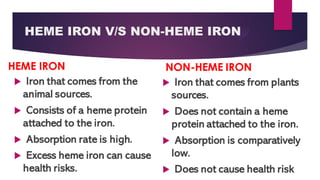
HEME IRON V/S NON-HEME IRON
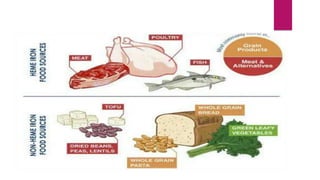
HEME IRON NON-HEME IRON
 Iron that comes from plants
sources.
 Does not contain a heme
protein attached to the iron.
 Absorption is comparatively
low.
 Does not cause health risk
 Iron that comes from the
animal sources.
 Consists of a heme protein
attached to the iron.
 Absorption rate is high.
 Excess heme iron can cause
health risks.
BIOLOGICAL FUNCTION OF IRON
 Haemoglobin and myoglobin are required for the transport
of Oxygen and Carbon dioxide.
 Cytochromes and some non-heme proteins are necessary for
electron transport Chain and oxidative phosphorylation.
 Peroxidase is required for phagocytosis and killing of
bacteria by neutrophils.
 Iron is associated with effective immunity competence of the
body.
SOURCES OF IRON
 Rich source : Organ meats (like liver).
 Good source : Leafy vegetable, Pulses, Cereals, Fish, Apple,
Dried fruits, Molasses.
 Poor source : Milk, Wheat, Polished rice.
IRON STORAGE
 Iron that is not required in a functional capacity is typically
stored in three major sites: the liver, bone marrow and spleen
 The storage of iron primarily occurs in two forms:
(i) Ferritin
(ii) Hemosiderin.
 Initially, iron is stored as a protein-iron complex-“ferritin”-in
cells.
 However, with time, the ferritin molecules aggregate to form
clusters which are subsequently engulfed by lysosomes and
consequently degraded.
 As a result of this process-“hemosiderin”- an amorphous
aggregate of denatured protein is formed.
FERRITIN
 Ferritin is water soluble intracellular protein which is
synthesized in a variety of tissues especially within the liver,
bone marrow, spleen and intestines.
 Ferritin can hold about 25% of iron by weight.
 The ferritin that has not been combined with iron is
commonly termed as “apoferritin.”
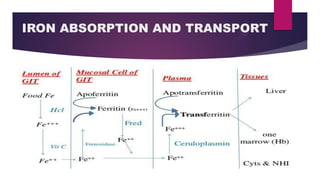
 Iron is mostly found in the foods in the ferric form Fe (III)
bound to proteins or organic acid.
 Reducing substance such as Vitamin C convert ferric ion Fe
(III) to ferrous ion Fe (II) form.
 This Fe (II) is toxic in nature so it should be converted to Fe
(III) or to a non toxic complex.
 The Fe (II) enter mucosal cells by absorption is again
converted to Fe (III) by the enzyme ferroxidase.
 Fe (III) combine with apoferritin to form ferritin which is the
temporary storage form of iron.
 While releasing iron as and when required by the body,
Fe(III) should be changed to the Fe(II) oxidation state.
 Once converted to the Fe(II) form, it leaves through the
three fold and four fold channels in the spherical structure
of ferritin to form apoferritin.
 This apoferritin repeat this cycle.
 When the quantity of iron in the plasma falls low, some of
the iron in the ferritin storage pool is removed easily and
transported in the form of transferrin in the plasma to the
areas of the body where it is needed.
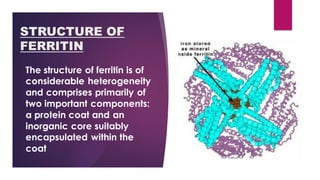
STRUCTURE OF
FERRITIN
The structure of ferritin is of
considerable heterogeneity
and comprises primarily of
two important components:
a protein coat and an
inorganic core suitably
encapsulated within the
coat
HEMOSIDERIN
 Hemosiderin is another iron-storage complex that is found
most commonly in macrophages and formed during
breakdown of haemoglobin molecules.
 Hemosiderin can hold about 35% of iron by weight
 In contrast to ferritin, its molecular nature remains poorly
defined.
 The iron that occurs within the deposits of hemosiderin is
poorly available to deliver iron when required.
IRON TRANSPORT IN PLASMA
 The iron liberated from the ferrintin of mucosal cells enters
the plasma in ferrous state Fe (II).
 There, it oxidised to ferric form by a copper containing
protein ceruloplamin which processes ferroxidase activity.
 Another cuproprotein ferroxidase II also helps to conversion
of Fe (II) to Fe (III).
 Ferric Ion then binds with a specific iron binding protein
namely transferrin.
TRANSFERRIN
 Transferrins are group of non heme iron-binding
glycoproteins that can effectively control the level of free iron
in biological fluids.
 Transferrin is mainly produced by the liver cells which is then
secreted into plasma.
 The main function of transferrin is to transport iron from
absorption centers to the sites of utilization, storage and
haemoglobin degradation.
 Each transferrin molecule can bind the two atom of ferric ion.
 The plasma transferrin (concentration 250 mg/dl) can bind
with 400 mg of iton/dl plasma.
 This is known as total ion binding capacity (TIBC).
STRUCTURE OF HUMAN SERUM
TRANSFERRIN
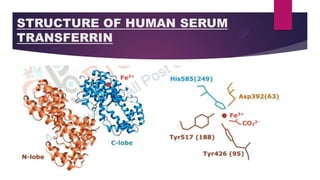
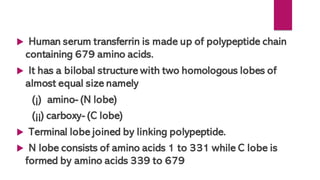
 Human serum transferrin is made up of polypeptide chain
containing 679 amino acids.
 It has a bilobal structure with two homologous lobes of
almost equal size namely
(¡) amino- (N lobe)
(¡¡) carboxy- (C lobe)
 Terminal lobe joined by linking polypeptide.
 N lobe consists of amino acids 1 to 331 while C lobe is
formed by amino acids 339 to 679
IRON ABSORPTION AND TRANSPORT
IRON METABOLISM OVERVIEW
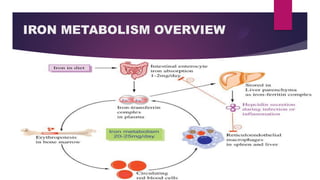
 Iron absorption from the intestines is extremely slow, at a
maximum rate of only a few milligrams per day.
 This means that even when tremendous quantities of iron
are present in the food, only small proportions can be
absorbed.
 When the body has become saturated with iron, the rate of
additional iron absorption from the intestinal tract becomes
greatly decreased.
 Thus, total body iron is regulated mainly by altering the
rate of absorption.
Iron storage and_transport

Iron storage and_transport

  • 1.
    IRON STORAGE AND TRANSPORTIN BIOLOGICAL SYSTEMS
  • 2.
    INTRODUCTION  Iron isthe most essential trace element.  Total body content of iron in an adult body is 3 – 5 g.  75% present in blood as a constituent of haemoglobin. Rest is in liver,bone marrow and muscles.  Heme is the most predominant iron Containing substance, where it is a constituent of several protein/ enzymes.
  • 3.
     Hemoproteins:- hemoglobin,myoglobin, peroxidases, cytochrome, catalyse, tryptophan etc..  Non heme protein:- transferrin, ferritin, hemosiderin etc..
  • 4.
    HEME IRON V/SNON-HEME IRON HEME IRON NON-HEME IRON  Iron that comes from plants sources.  Does not contain a heme protein attached to the iron.  Absorption is comparatively low.  Does not cause health risk  Iron that comes from the animal sources.  Consists of a heme protein attached to the iron.  Absorption rate is high.  Excess heme iron can cause health risks.
  • 5.
    BIOLOGICAL FUNCTION OFIRON  Haemoglobin and myoglobin are required for the transport of Oxygen and Carbon dioxide.  Cytochromes and some non-heme proteins are necessary for electron transport Chain and oxidative phosphorylation.  Peroxidase is required for phagocytosis and killing of bacteria by neutrophils.  Iron is associated with effective immunity competence of the body.
  • 6.
    SOURCES OF IRON Rich source : Organ meats (like liver).  Good source : Leafy vegetable, Pulses, Cereals, Fish, Apple, Dried fruits, Molasses.  Poor source : Milk, Wheat, Polished rice.
  • 8.
    IRON STORAGE  Ironthat is not required in a functional capacity is typically stored in three major sites: the liver, bone marrow and spleen  The storage of iron primarily occurs in two forms: (i) Ferritin (ii) Hemosiderin.
  • 9.
     Initially, ironis stored as a protein-iron complex-“ferritin”-in cells.  However, with time, the ferritin molecules aggregate to form clusters which are subsequently engulfed by lysosomes and consequently degraded.  As a result of this process-“hemosiderin”- an amorphous aggregate of denatured protein is formed.
  • 10.
    FERRITIN  Ferritin iswater soluble intracellular protein which is synthesized in a variety of tissues especially within the liver, bone marrow, spleen and intestines.  Ferritin can hold about 25% of iron by weight.  The ferritin that has not been combined with iron is commonly termed as “apoferritin.”  Iron is mostly found in the foods in the ferric form Fe (III) bound to proteins or organic acid.
  • 11.
     Reducing substancesuch as Vitamin C convert ferric ion Fe (III) to ferrous ion Fe (II) form.  This Fe (II) is toxic in nature so it should be converted to Fe (III) or to a non toxic complex.  The Fe (II) enter mucosal cells by absorption is again converted to Fe (III) by the enzyme ferroxidase.  Fe (III) combine with apoferritin to form ferritin which is the temporary storage form of iron.
  • 12.
     While releasingiron as and when required by the body, Fe(III) should be changed to the Fe(II) oxidation state.  Once converted to the Fe(II) form, it leaves through the three fold and four fold channels in the spherical structure of ferritin to form apoferritin.  This apoferritin repeat this cycle.  When the quantity of iron in the plasma falls low, some of the iron in the ferritin storage pool is removed easily and transported in the form of transferrin in the plasma to the areas of the body where it is needed.
  • 13.
    STRUCTURE OF FERRITIN The structureof ferritin is of considerable heterogeneity and comprises primarily of two important components: a protein coat and an inorganic core suitably encapsulated within the coat
  • 14.
    HEMOSIDERIN  Hemosiderin isanother iron-storage complex that is found most commonly in macrophages and formed during breakdown of haemoglobin molecules.  Hemosiderin can hold about 35% of iron by weight  In contrast to ferritin, its molecular nature remains poorly defined.  The iron that occurs within the deposits of hemosiderin is poorly available to deliver iron when required.
  • 15.
    IRON TRANSPORT INPLASMA  The iron liberated from the ferrintin of mucosal cells enters the plasma in ferrous state Fe (II).  There, it oxidised to ferric form by a copper containing protein ceruloplamin which processes ferroxidase activity.  Another cuproprotein ferroxidase II also helps to conversion of Fe (II) to Fe (III).  Ferric Ion then binds with a specific iron binding protein namely transferrin.
  • 16.
    TRANSFERRIN  Transferrins aregroup of non heme iron-binding glycoproteins that can effectively control the level of free iron in biological fluids.  Transferrin is mainly produced by the liver cells which is then secreted into plasma.  The main function of transferrin is to transport iron from absorption centers to the sites of utilization, storage and haemoglobin degradation.
  • 17.
     Each transferrinmolecule can bind the two atom of ferric ion.  The plasma transferrin (concentration 250 mg/dl) can bind with 400 mg of iton/dl plasma.  This is known as total ion binding capacity (TIBC).
  • 18.
    STRUCTURE OF HUMANSERUM TRANSFERRIN
  • 19.
     Human serumtransferrin is made up of polypeptide chain containing 679 amino acids.  It has a bilobal structure with two homologous lobes of almost equal size namely (¡) amino- (N lobe) (¡¡) carboxy- (C lobe)  Terminal lobe joined by linking polypeptide.  N lobe consists of amino acids 1 to 331 while C lobe is formed by amino acids 339 to 679
  • 20.
  • 21.
  • 22.
     Iron absorptionfrom the intestines is extremely slow, at a maximum rate of only a few milligrams per day.  This means that even when tremendous quantities of iron are present in the food, only small proportions can be absorbed.  When the body has become saturated with iron, the rate of additional iron absorption from the intestinal tract becomes greatly decreased.  Thus, total body iron is regulated mainly by altering the rate of absorption.