Coccidiosis in Poultry
Sumedha Bobade
Ph.D Scholar
Coccidiosis
• Introduction
• Etiology
• Pathogenesis
• Clinical signs
• Post Mortem Findings
• Diagnostic tool
• Control
Introduction
 Coccidiosis is caused in poultry by a parasite of the genus Eimeria.
 Protozoa -phylum -Apicomplexa,
 Family-Eimeriidae.
 In poultry, most species belong to the genus Eimeria and infect various sites in
the intestine.
 The life cycle of Eimeria - four to seven days to complete. It begins when active
“oocysts” are picked up by the bird and swallowed.
 An “oocyst” is a capsule. They “sporulate” or become infective if moisture,
temperature, and oxygen become conducive to growth.
 After a bird eats the oocysts, coccidia imbed in the intestinal lining and multiply
several times, damaging tissue.
 Coccidia are parasites, so they get their nutrients from the chicken host.
 The multiplications eventually stop, usually before causing death of the bird.
The bird sheds the parasite in its droppings.
 Coccidiosis is usually a disease of young birds, but outbreaks usually occur
when birds are between 3 and 8 weeks of age.
 Coccidiosis damages the gut and allows bacteria to enter and cause secondary
infections.
Etiology
Species-Specific Parasites
• There are seven different Eimeria that infect chickens, but only three
cause most of the trouble Eimeria tenella, Eimeria maxima, and
Eimeria acervulina.
• Immunity to one type does not provide immunity for other types.
Turkeys, ducks, geese, and other types of poultry are all infected by
different types of coccidia.
• Chicken coccidia species:
Eimeria acervulina
Eimeria maxima
Eimeria tenella
Eimeria necatrix
Eimeria mitis
Eimeria brunetti
Eimeria praecox
• Turkey coccidia species:
Eimeria adenoeides
Eimeria meleagrimitis
Eimeria gallopavonis
Eimeria dispersa
Transmission
• Ingestion of the infective form of oocytes (sporulated oocytes) is the only
natural method of spread.
• Oocytes can be spread mechanically by animals, insects,contaminated
equipments ,wild birds and dust.
• Movement of people and equipments between farms.
• The spread of coccidiosis is less during hot dry wheather (summer) and
greater in cooler wetter weather (Rainy and Winter season).
• Coccidia are almost universally present in poultry-raising operations, but
clinical disease occurs only after ingestion of relatively large numbers of
sporulated oocysts by susceptible birds.
• Both clinically infected and recovered birds shed oocysts in their
droppings, which contaminate feed, dust, water, litter, and soil.
• Fresh oocysts are not infective until they sporulate; under optimal
conditions (70°–90°F [21°–32°C] with adequate moisture and oxygen), this
requires 1–2 days. Coccidia are host-specific, and there is no cross-
immunity between species of coccidia.
Coccidical Multiplication and Pathogenesis
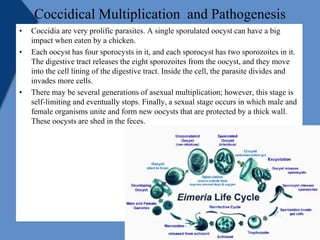
• Coccidia are very prolific parasites. A single sporulated oocyst can have a big
impact when eaten by a chicken.
• Each oocyst has four sporocysts in it, and each sporocyst has two sporozoites in it.
The digestive tract releases the eight sporozoites from the oocyst, and they move
into the cell lining of the digestive tract. Inside the cell, the parasite divides and
invades more cells.
• There may be several generations of asexual multiplication; however, this stage is
self-limiting and eventually stops. Finally, a sexual stage occurs in which male and
female organisms unite and form new oocysts that are protected by a thick wall.
These oocysts are shed in the feces.
Pathogenesis
• Coccidiosis is seen universally, most commonly in
young animals housed or confined in small areas
contaminated with oocytes.
• Coccidian are opportunistic pathogens; if pathogenic,
their virulence may be influenced by various stressors.
• Therefore, clinical coccidiosis is most prevalent under
conditions of poor nutrition, poor sanitation, or
overcrowding, or after the stresses of weaning,
shipping, sudden changes of feed, or severe weather.
Clinical Signs
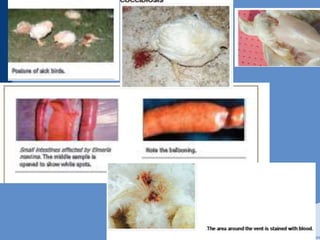
• Outward signs of coccidiosis in chickens include droopiness
and listlessness,
• Loss of appetite, Loss of yellow color in shanks,
• Pale combs and wattles, ruffled, unthrifty feathers, huddling or
acting chilled,
• Blood or mucus in the feces, diarrhea, dehydration, and even
death.
• Poor feed digestion, poor weight gain, and poor feed
efficiency. Some symptoms can be confused with other
diseases. For example, necrotic enteritis is a gut disease that
also causes bloody diarrhea.,Decreased egg production
• Mild infections of intestinal species, which would otherwise
be classed as subclinical, may cause depigmentation and
potentially lead to secondary infection, particularly
Clostridium spp infection.
Clotted blood in
opened cecum
Iqbal et al., 2017
(Saikia et al., 2017)
Chickens:
Turkey and Ducks
• Turkeys:
• E adenoeides and E gallopavonis infect the lower ileum, ceca, and rectum.
These species often cause mortality.
• The affected portion of the intestine may be dilated and have a thickened
wall. Thick, creamy material or caseous casts in the gut or excreta may
contain enormous numbers of oocysts.
• E meleagrimitis chiefly infects the upper and mid small intestine. The
lamina propria or deeper tissues may be parasitized, which may result in
necrotic enteritis .
• E dispersa infects the upper small intestine and causes a creamy, mucoid
enteritis that involves the entire intestine, including the ceca. Large
numbers of gametocytes and oocysts are associated with the lesions.
• Duck
• T. perniciosa is a known pathogen that balloons the entire small intestine
with mucohemorrhagic or caseous material. Eimeria spp also have been
described as pathogenic. Some species of coccidia of domestic ducks are
considered relatively nonpathogenic. In wild ducks, infrequent but dramatic
outbreaks of coccidiosis occur in ducklings 2–4 wk old; morbidity and
mortality may be high.
Post Mortem Lesion
• Signs during necropsy associated with the
conditions described are thin, fragile, often
translucent intestinal walls,
• ballooning of the gut,
• hyperaemia of the mesenteric blood vessels and
blood vessels on the serosal side of the intestine,
• flaccid gut edges after incision, lack of tonus
• watery or foamy contents,
• poorly digested feed particles at the end of the
gastro-intestinal tract (GIT)
• multi-coloured oily aspect of the gut contents in
contact with the mucosa
Diagnosis:
• The location in the host, appearance of lesions, and the size of
oocysts are used in determining the species present.
• Coccidial infections are readily confirmed by demonstration of
oocysts in feces or intestinal scrapings; however, the number of
oocysts present has little relationship to the extent of clinical
disease.
• Severity of lesions as well as knowledge of flock appearance,
morbidity, daily mortality, feed intake, growth rate, and rate of lay
are important for diagnosis. Necropsy of several fresh specimens is
advisable.
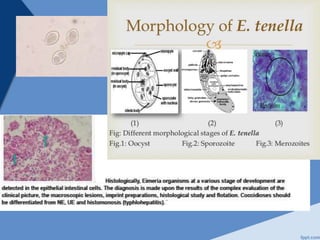
• Microscopic examination
• A diagnosis of clinical coccidiosis is warranted if oocysts,
merozoites, or schizonts are seen microscopically and if lesions are
severe. Subclinical coccidial infections may be unimportant, and
poor performance may be caused by other flock disorders.
• Differential Diagnosis
• ‘Necrotic Enteritis
• Histomeniasis
Diagnosis
• Intestinal scrapings should be examined for oocysts.
• The site and degree of lesions and size and shape of
oocysts and schizonts are all used to differentiate
between Eimeria species. It appears similar to bacterial
enteritis in chickens, especially necrotic enteritis.
• Species of coccidia found in chickens include Eimeria
acervulina, Eimeria brunetti,
• In recent years,polymerase chain reaction (PCR) has
been developed to provide accurate and rapid
identification of the seven known Eimeria species of
chickens(Eimeria maxima, Eimeria mitis, Eimeria
necatrix, Eimeria praecox, and Eimeria tenella).
Control:
• Bio security
• Vaccination:
• A species-specific immunity develops after natural infection,
the degree of which largely depends on the extent of infection
and the number of reinfections. Protective immunity is
primarily a T-cell response.
• Commercial vaccines consist of live, sporulated oocysts of the
various coccidial species administered at low doses. Modern
anticoccidial vaccines should be given to day-old chicks, either
at the hatchery or on the farm
• Anticoccidial Drugs:
• Many products are available for prevention or treatment of
coccidiosis in chickens and turkeys
Drugs
• Sulfa drugs: They work only against Eimeria
acervulina and Eimeria maxima, not against Eimeria tenella.
Sulfamonaides are used to treat coccidiosis.
• Amprolium: Amprolium is an anticoccidial drug. It is given in the
drinking water and interferes with metabolism of the vitamin
thiamin (vitamin B1) in coccidia. Amprolium treats both intestinal
and cecal coccidia.
• Quinolones: Quinolones are “coccidiostats” that arrest the coccidia
in an early stage of development. An example is decoquinate
(Deccox®). The drugs are used for prevention.
• Ionophores: Ionophores are anticoccidials commonly used in the
large-scale industry. They alter the function of the cell membrane
and rupture the parasite. However, some ionophores are now
completely ineffective against coccidia because of resistance the
coccidia have developed. They are used for prevention.
• Other drugs: There are many other anticoccidial drugs in various
chemical classes with various modes of action. Examples
are Cycarb® (nicarbizine) and Cycostat® (Robenidine
Hydrochloride).
Types of Vaccines
• Coccivac®: The “B” and “D” types are
different mixtures of Eimeria species; the “T”
type is for turkeys. Coccivac®
• Immucox®
• Advent®: It is marketed as having more
viable oocysts (truly sporulated oocysts that
can cause immunity) than other vaccines.
• Vaccines are recognized as the only
practical alternative to anticoccidial drugs
in large-scale production.

Coccidiois poultry

  • 1.
    Coccidiosis in Poultry Coccidiosisin Poultry Sumedha Bobade Ph.D Scholar
  • 2.
    Coccidiosis • Introduction • Etiology •Pathogenesis • Clinical signs • Post Mortem Findings • Diagnostic tool • Control
  • 3.
    Introduction  Coccidiosis iscaused in poultry by a parasite of the genus Eimeria.  Protozoa -phylum -Apicomplexa,  Family-Eimeriidae.  In poultry, most species belong to the genus Eimeria and infect various sites in the intestine.  The life cycle of Eimeria - four to seven days to complete. It begins when active “oocysts” are picked up by the bird and swallowed.  An “oocyst” is a capsule. They “sporulate” or become infective if moisture, temperature, and oxygen become conducive to growth.  After a bird eats the oocysts, coccidia imbed in the intestinal lining and multiply several times, damaging tissue.  Coccidia are parasites, so they get their nutrients from the chicken host.  The multiplications eventually stop, usually before causing death of the bird. The bird sheds the parasite in its droppings.  Coccidiosis is usually a disease of young birds, but outbreaks usually occur when birds are between 3 and 8 weeks of age.  Coccidiosis damages the gut and allows bacteria to enter and cause secondary infections.
  • 4.
    Etiology Species-Specific Parasites • Thereare seven different Eimeria that infect chickens, but only three cause most of the trouble Eimeria tenella, Eimeria maxima, and Eimeria acervulina. • Immunity to one type does not provide immunity for other types. Turkeys, ducks, geese, and other types of poultry are all infected by different types of coccidia. • Chicken coccidia species: Eimeria acervulina Eimeria maxima Eimeria tenella Eimeria necatrix Eimeria mitis Eimeria brunetti Eimeria praecox • Turkey coccidia species: Eimeria adenoeides Eimeria meleagrimitis Eimeria gallopavonis Eimeria dispersa
  • 5.
    Transmission • Ingestion ofthe infective form of oocytes (sporulated oocytes) is the only natural method of spread. • Oocytes can be spread mechanically by animals, insects,contaminated equipments ,wild birds and dust. • Movement of people and equipments between farms. • The spread of coccidiosis is less during hot dry wheather (summer) and greater in cooler wetter weather (Rainy and Winter season). • Coccidia are almost universally present in poultry-raising operations, but clinical disease occurs only after ingestion of relatively large numbers of sporulated oocysts by susceptible birds. • Both clinically infected and recovered birds shed oocysts in their droppings, which contaminate feed, dust, water, litter, and soil. • Fresh oocysts are not infective until they sporulate; under optimal conditions (70°–90°F [21°–32°C] with adequate moisture and oxygen), this requires 1–2 days. Coccidia are host-specific, and there is no cross- immunity between species of coccidia.
  • 6.
    Coccidical Multiplication andPathogenesis • Coccidia are very prolific parasites. A single sporulated oocyst can have a big impact when eaten by a chicken. • Each oocyst has four sporocysts in it, and each sporocyst has two sporozoites in it. The digestive tract releases the eight sporozoites from the oocyst, and they move into the cell lining of the digestive tract. Inside the cell, the parasite divides and invades more cells. • There may be several generations of asexual multiplication; however, this stage is self-limiting and eventually stops. Finally, a sexual stage occurs in which male and female organisms unite and form new oocysts that are protected by a thick wall. These oocysts are shed in the feces.
  • 7.
    Pathogenesis • Coccidiosis isseen universally, most commonly in young animals housed or confined in small areas contaminated with oocytes. • Coccidian are opportunistic pathogens; if pathogenic, their virulence may be influenced by various stressors. • Therefore, clinical coccidiosis is most prevalent under conditions of poor nutrition, poor sanitation, or overcrowding, or after the stresses of weaning, shipping, sudden changes of feed, or severe weather.
  • 8.
    Clinical Signs • Outwardsigns of coccidiosis in chickens include droopiness and listlessness, • Loss of appetite, Loss of yellow color in shanks, • Pale combs and wattles, ruffled, unthrifty feathers, huddling or acting chilled, • Blood or mucus in the feces, diarrhea, dehydration, and even death. • Poor feed digestion, poor weight gain, and poor feed efficiency. Some symptoms can be confused with other diseases. For example, necrotic enteritis is a gut disease that also causes bloody diarrhea.,Decreased egg production • Mild infections of intestinal species, which would otherwise be classed as subclinical, may cause depigmentation and potentially lead to secondary infection, particularly Clostridium spp infection.
  • 11.
    Clotted blood in openedcecum Iqbal et al., 2017
  • 14.
  • 15.
  • 16.
    Turkey and Ducks •Turkeys: • E adenoeides and E gallopavonis infect the lower ileum, ceca, and rectum. These species often cause mortality. • The affected portion of the intestine may be dilated and have a thickened wall. Thick, creamy material or caseous casts in the gut or excreta may contain enormous numbers of oocysts. • E meleagrimitis chiefly infects the upper and mid small intestine. The lamina propria or deeper tissues may be parasitized, which may result in necrotic enteritis . • E dispersa infects the upper small intestine and causes a creamy, mucoid enteritis that involves the entire intestine, including the ceca. Large numbers of gametocytes and oocysts are associated with the lesions. • Duck • T. perniciosa is a known pathogen that balloons the entire small intestine with mucohemorrhagic or caseous material. Eimeria spp also have been described as pathogenic. Some species of coccidia of domestic ducks are considered relatively nonpathogenic. In wild ducks, infrequent but dramatic outbreaks of coccidiosis occur in ducklings 2–4 wk old; morbidity and mortality may be high.
  • 17.
    Post Mortem Lesion •Signs during necropsy associated with the conditions described are thin, fragile, often translucent intestinal walls, • ballooning of the gut, • hyperaemia of the mesenteric blood vessels and blood vessels on the serosal side of the intestine, • flaccid gut edges after incision, lack of tonus • watery or foamy contents, • poorly digested feed particles at the end of the gastro-intestinal tract (GIT) • multi-coloured oily aspect of the gut contents in contact with the mucosa
  • 18.
    Diagnosis: • The locationin the host, appearance of lesions, and the size of oocysts are used in determining the species present. • Coccidial infections are readily confirmed by demonstration of oocysts in feces or intestinal scrapings; however, the number of oocysts present has little relationship to the extent of clinical disease. • Severity of lesions as well as knowledge of flock appearance, morbidity, daily mortality, feed intake, growth rate, and rate of lay are important for diagnosis. Necropsy of several fresh specimens is advisable. • Microscopic examination • A diagnosis of clinical coccidiosis is warranted if oocysts, merozoites, or schizonts are seen microscopically and if lesions are severe. Subclinical coccidial infections may be unimportant, and poor performance may be caused by other flock disorders. • Differential Diagnosis • ‘Necrotic Enteritis • Histomeniasis
  • 19.
    Diagnosis • Intestinal scrapingsshould be examined for oocysts. • The site and degree of lesions and size and shape of oocysts and schizonts are all used to differentiate between Eimeria species. It appears similar to bacterial enteritis in chickens, especially necrotic enteritis. • Species of coccidia found in chickens include Eimeria acervulina, Eimeria brunetti, • In recent years,polymerase chain reaction (PCR) has been developed to provide accurate and rapid identification of the seven known Eimeria species of chickens(Eimeria maxima, Eimeria mitis, Eimeria necatrix, Eimeria praecox, and Eimeria tenella).
  • 20.
    Control: • Bio security •Vaccination: • A species-specific immunity develops after natural infection, the degree of which largely depends on the extent of infection and the number of reinfections. Protective immunity is primarily a T-cell response. • Commercial vaccines consist of live, sporulated oocysts of the various coccidial species administered at low doses. Modern anticoccidial vaccines should be given to day-old chicks, either at the hatchery or on the farm • Anticoccidial Drugs: • Many products are available for prevention or treatment of coccidiosis in chickens and turkeys
  • 21.
    Drugs • Sulfa drugs:They work only against Eimeria acervulina and Eimeria maxima, not against Eimeria tenella. Sulfamonaides are used to treat coccidiosis. • Amprolium: Amprolium is an anticoccidial drug. It is given in the drinking water and interferes with metabolism of the vitamin thiamin (vitamin B1) in coccidia. Amprolium treats both intestinal and cecal coccidia. • Quinolones: Quinolones are “coccidiostats” that arrest the coccidia in an early stage of development. An example is decoquinate (Deccox®). The drugs are used for prevention. • Ionophores: Ionophores are anticoccidials commonly used in the large-scale industry. They alter the function of the cell membrane and rupture the parasite. However, some ionophores are now completely ineffective against coccidia because of resistance the coccidia have developed. They are used for prevention. • Other drugs: There are many other anticoccidial drugs in various chemical classes with various modes of action. Examples are Cycarb® (nicarbizine) and Cycostat® (Robenidine Hydrochloride).
  • 22.
    Types of Vaccines •Coccivac®: The “B” and “D” types are different mixtures of Eimeria species; the “T” type is for turkeys. Coccivac® • Immucox® • Advent®: It is marketed as having more viable oocysts (truly sporulated oocysts that can cause immunity) than other vaccines. • Vaccines are recognized as the only practical alternative to anticoccidial drugs in large-scale production.