Shri Shivaji Education Society Amravati’s
Shri Pundlik Maharaj Mahavidyalaya Nandura Rly,
Dist .Buldana
Department of Chemistry
Class- B.Sc-III Year
Semester-V
By
Mr. Nilkesh K. Dhurve
Assistant Professor
Unit-III (Organic Chemistry)
Contents
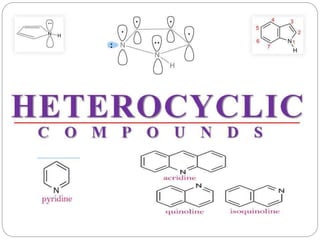
•Heterocyclic compounds
A. Nomenclature
B. Pyrrole
• Introduction
• Synthesis
• Physical Properties
• Molecular Orbital Structure
• Chemical Properties
C. Pyridine
• Introduction
• Synthesis
• Physical Properties
• Molecular Orbital Structure
• Chemical Properties
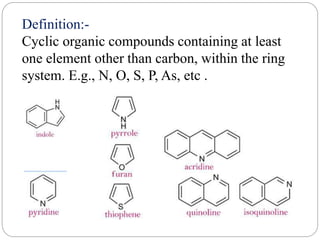
Definition:-
Cyclic organic compounds containing at least
one element other than carbon, within the ring
system. E.g., N, O, S, P, As, etc .
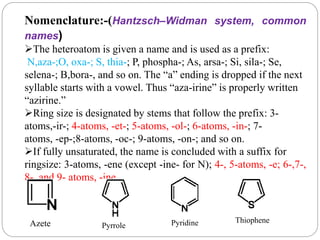
Nomenclature:-(Hantzsch–Widman system, common
names)
The heteroatom is given a name and is used as a prefix:
N,aza-;O, oxa-; S, thia-; P, phospha-; As, arsa-; Si, sila-; Se,
selena-; B,bora-, and so on. The “a” ending is dropped if the next
syllable starts with a vowel. Thus “aza-irine” is properly written
“azirine.”
Ring size is designated by stems that follow the prefix: 3-
atoms,-ir-; 4-atoms, -et-; 5-atoms, -ol-; 6-atoms, -in-; 7-
atoms, -ep-;8-atoms, -oc-; 9-atoms, -on-; and so on.
If fully unsaturated, the name is concluded with a suffix for
ringsize: 3-atoms, -ene (except -ine- for N); 4-, 5-atoms, -e; 6-,7-,
8-, and 9- atoms, -ine.
Azete Pyrrole Pyridine Thiophene
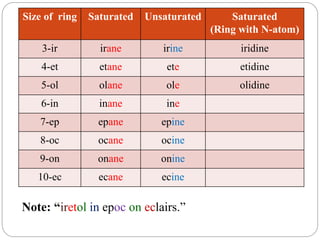
Size of ring Saturated Unsaturated Saturated
(Ring with N-atom)
3-ir irane irine iridine
4-et etane ete etidine
5-ol olane ole olidine
6-in inane ine
7-ep epane epine
8-oc ocane ocine
9-on onane onine
10-ec ecane ecine
Note: “iretol in epoc on eclairs.”
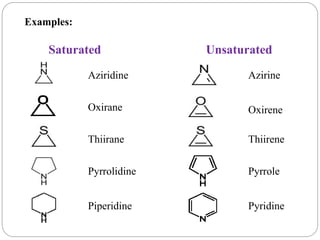
Examples:
Saturated Unsaturated
Aziridine
Oxirane
Thiirane
Azirine
Oxirene
Thiirene
Pyrrolidine Pyrrole
Piperidine Pyridine
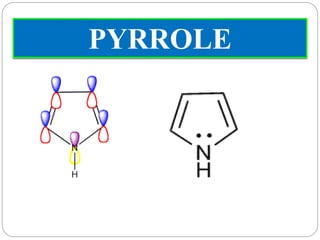
PYRROLE
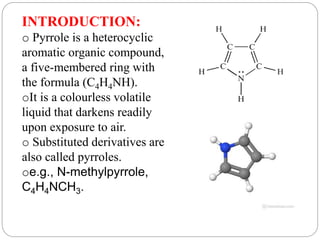
INTRODUCTION:
o Pyrrole is a heterocyclic
aromatic organic compound,
a five-membered ring with
the formula (C4H4NH).
oIt is a colourless volatile
liquid that darkens readily
upon exposure to air.
o Substituted derivatives are
also called pyrroles.
oe.g., N-methylpyrrole,
C4H4NCH3.
SYNTHESIS OF PYRROLE
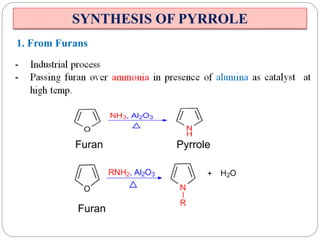
1. From Furans
Furan
Furan
Pyrrole
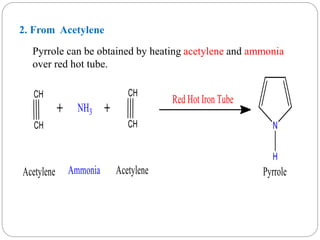
2. From Acetylene
Pyrrole can be obtained by heating acetylene and ammonia
over red hot tube.
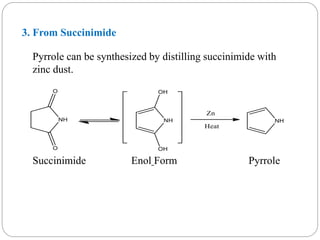
3. From Succinimide
Pyrrole can be synthesized by distilling succinimide with
zinc dust.
Succinimide Enol Form Pyrrole
Physical Properties of Pyrrole
•It is a colorless volatile liquid.
•It’s boiling point is 131°C and melting point is -23°C.
•It turns brown in the air and gradually resinifies.
•Only slightly soluble in water but it is totally miscible with
ether and ethanol.
•Pyrrole is weakly basic in nature.
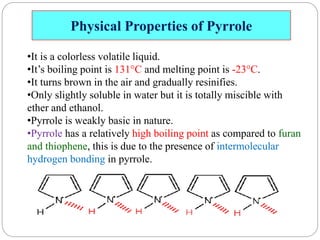
•Pyrrole has a relatively high boiling point as compared to furan
and thiophene, this is due to the presence of intermolecular
hydrogen bonding in pyrrole.
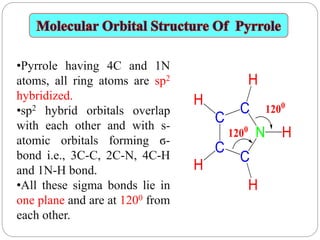
•Pyrrole having 4C and 1N
atoms, all ring atoms are sp2
hybridized.
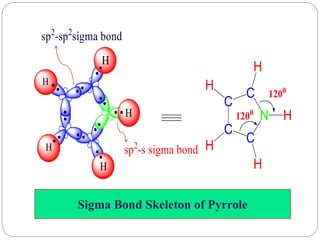
•sp2 hybrid orbitals overlap
with each other and with s-
atomic orbitals forming ϭ-
bond i.e., 3C-C, 2C-N, 4C-H
and 1N-H bond.
•All these sigma bonds lie in
one plane and are at 1200 from
each other.
Sigma Bond Skeleton of Pyrrole
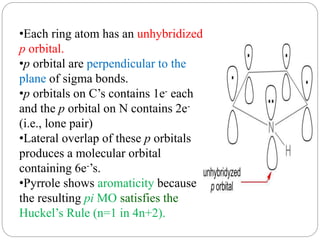
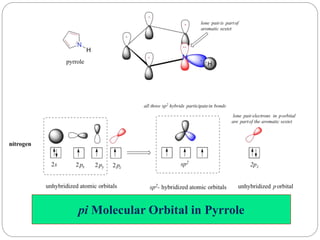
•Each ring atom has an unhybridized
p orbital.
•p orbital are perpendicular to the
plane of sigma bonds.
•p orbitals on C’s contains 1e- each
and the p orbital on N contains 2e-
(i.e., lone pair)
•Lateral overlap of these p orbitals
produces a molecular orbital
containing 6e-’s.
•Pyrrole shows aromaticity because
the resulting pi MO satisfies the
Huckel’s Rule (n=1 in 4n+2).
pi Molecular Orbital in Pyrrole
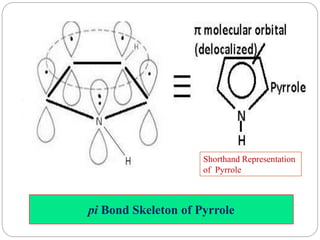
pi Bond Skeleton of Pyrrole
Shorthand Representation
of Pyrrole
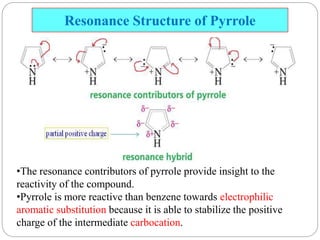
Resonance Structure of Pyrrole
•The resonance contributors of pyrrole provide insight to the
reactivity of the compound.
•Pyrrole is more reactive than benzene towards electrophilic
aromatic substitution because it is able to stabilize the positive
charge of the intermediate carbocation.
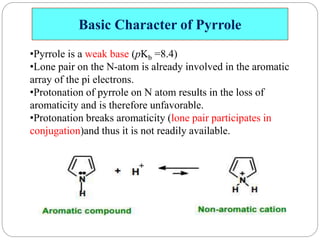
Basic Character of Pyrrole
•Pyrrole is a weak base (pKb =8.4)
•Lone pair on the N-atom is already involved in the aromatic
array of the pi electrons.
•Protonation of pyrrole on N atom results in the loss of
aromaticity and is therefore unfavorable.
•Protonation breaks aromaticity (lone pair participates in
conjugation)and thus it is not readily available.
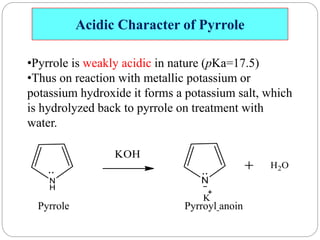
Acidic Character of Pyrrole
•Pyrrole is weakly acidic in nature (pKa=17.5)
•Thus on reaction with metallic potassium or
potassium hydroxide it forms a potassium salt, which
is hydrolyzed back to pyrrole on treatment with
water.
Pyrroyl anoin
Pyrrole
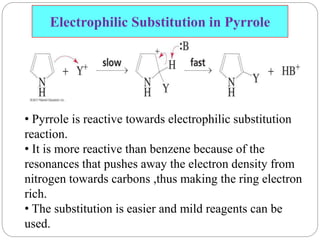
Electrophilic Substitution in Pyrrole
• Pyrrole is reactive towards electrophilic substitution
reaction.
• It is more reactive than benzene because of the
resonances that pushes away the electron density from
nitrogen towards carbons ,thus making the ring electron
rich.
• The substitution is easier and mild reagents can be
used.
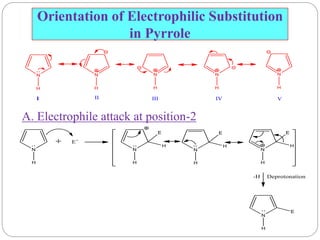
Orientation of Electrophilic Substitution
in Pyrrole
A. Electrophile attack at position-2
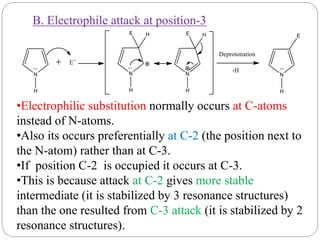
B. Electrophile attack at position-3
•Electrophilic substitution normally occurs at C-atoms
instead of N-atoms.
•Also its occurs preferentially at C-2 (the position next to
the N-atom) rather than at C-3.
•If position C-2 is occupied it occurs at C-3.
•This is because attack at C-2 gives more stable
intermediate (it is stabilized by 3 resonance structures)
than the one resulted from C-3 attack (it is stabilized by 2
resonance structures).
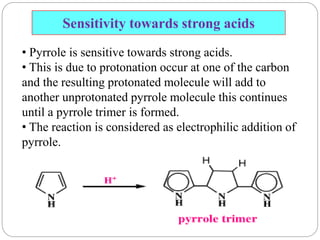
• Pyrrole is sensitive towards strong acids.
• This is due to protonation occur at one of the carbon
and the resulting protonated molecule will add to
another unprotonated pyrrole molecule this continues
until a pyrrole trimer is formed.
• The reaction is considered as electrophilic addition of
pyrrole.
Sensitivity towards strong acids
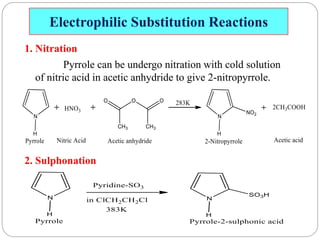
Electrophilic Substitution Reactions
1. Nitration
Pyrrole can be undergo nitration with cold solution
of nitric acid in acetic anhydride to give 2-nitropyrrole.
2. Sulphonation
3. Halogenation
a) Chlorination
i] Pyrrole is reacted with sulphuryl chloride in ether at
273K gives 2,3,4,5-tetrachloropyrrole.
ii] Pyrrole is reacted with chlorine gives 1,2,3,4,5-
pentachloropyrrole.
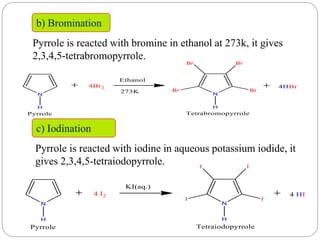
b) Bromination
Pyrrole is reacted with bromine in ethanol at 273k, it gives
2,3,4,5-tetrabromopyrrole.
c) Iodination
Pyrrole is reacted with iodine in aqueous potassium iodide, it
gives 2,3,4,5-tetraiodopyrrole.
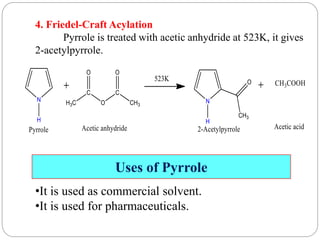
4. Friedel-Craft Acylation
Pyrrole is treated with acetic anhydride at 523K, it gives
2-acetylpyrrole.
Uses of Pyrrole
•It is used as commercial solvent.
•It is used for pharmaceuticals.
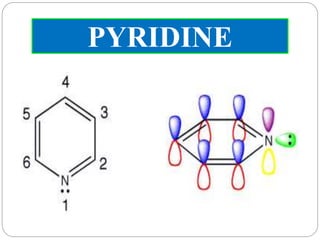
PYRIDINE
INTRODUCTION:
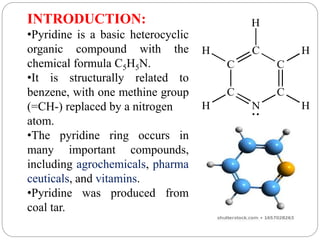
•Pyridine is a basic heterocyclic
organic compound with the
chemical formula C5H5N.
•It is structurally related to
benzene, with one methine group
(=CH-) replaced by a nitrogen
atom.
•The pyridine ring occurs in
many important compounds,
including agrochemicals, pharma
ceuticals, and vitamins.
•Pyridine was produced from
coal tar.
SYNTHESIS OF PYRIDINE
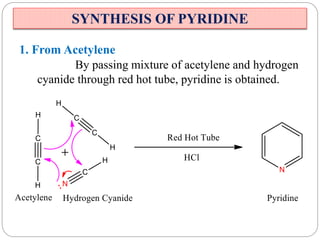
1. From Acetylene
By passing mixture of acetylene and hydrogen
cyanide through red hot tube, pyridine is obtained.
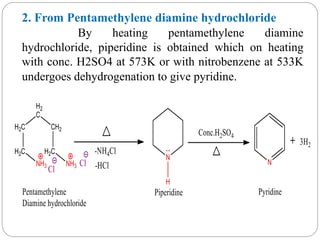
2. From Pentamethylene diamine hydrochloride
By heating pentamethylene diamine
hydrochloride, piperidine is obtained which on heating
with conc. H2SO4 at 573K or with nitrobenzene at 533K
undergoes dehydrogenation to give pyridine.
Physical Properties of Pyridine
•It is colorless, hygroscopic liquid with a distinctive,
unpleasant fish-like smell.
• It is a highly flammable, weakly alkaline, water-
miscible liquid and is miscible with most organic
solvents.
•It’s boiling point is 115.2°C(388.3K) and melting
point is –41.6°C(231.6K).
•Pyridine is diamagnetic (dipole moment is
2.2Debyes).
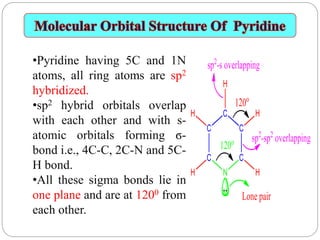
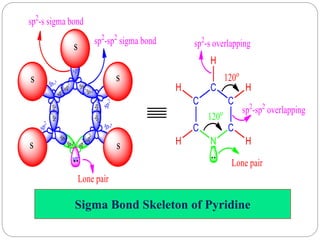
•Pyridine having 5C and 1N
atoms, all ring atoms are sp2
hybridized.
•sp2 hybrid orbitals overlap
with each other and with s-
atomic orbitals forming ϭ-
bond i.e., 4C-C, 2C-N and 5C-
H bond.
•All these sigma bonds lie in
one plane and are at 1200 from
each other.
Sigma Bond Skeleton of Pyridine
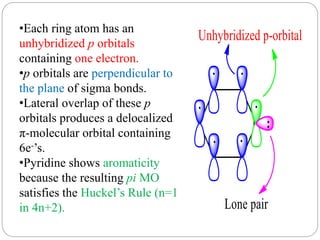
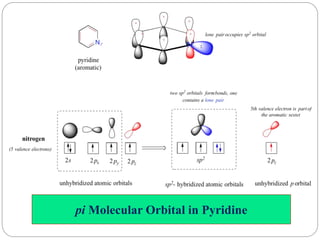
•Each ring atom has an
unhybridized p orbitals
containing one electron.
•p orbitals are perpendicular to
the plane of sigma bonds.
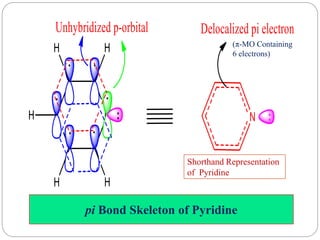
•Lateral overlap of these p
orbitals produces a delocalized
π-molecular orbital containing
6e-’s.
•Pyridine shows aromaticity
because the resulting pi MO
satisfies the Huckel’s Rule (n=1
in 4n+2).
pi Molecular Orbital in Pyridine
pi Bond Skeleton of Pyridine
Shorthand Representation
of Pyridine
(π-MO Containing
6 electrons)
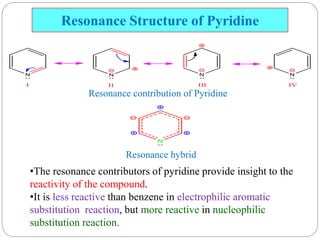
Resonance Structure of Pyridine
•The resonance contributors of pyridine provide insight to the
reactivity of the compound.
•It is less reactive than benzene in electrophilic aromatic
substitution reaction, but more reactive in nucleophilic
substitution reaction.
Resonance contribution of Pyridine
Resonance hybrid
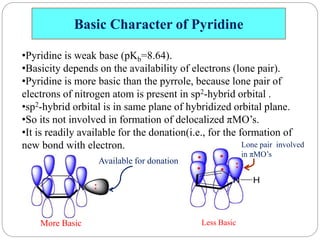
Basic Character of Pyridine
•Pyridine is weak base (pKb=8.64).
•Basicity depends on the availability of electrons (lone pair).
•Pyridine is more basic than the pyrrole, because lone pair of
electrons of nitrogen atom is present in sp2-hybrid orbital .
•sp2-hybrid orbital is in same plane of hybridized orbital plane.
•So its not involved in formation of delocalized πMO’s.
•It is readily available for the donation(i.e., for the formation of
new bond with electron.
More Basic Less Basic
Available for donation
Lone pair involved
in πMO’s
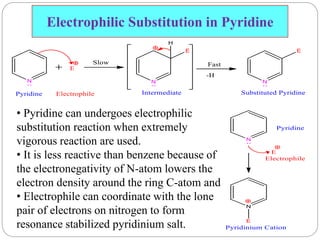
Electrophilic Substitution in Pyridine
• Pyridine can undergoes electrophilic
substitution reaction when extremely
vigorous reaction are used.
• It is less reactive than benzene because of
the electronegativity of N-atom lowers the
electron density around the ring C-atom and
• Electrophile can coordinate with the lone
pair of electrons on nitrogen to form
resonance stabilized pyridinium salt.
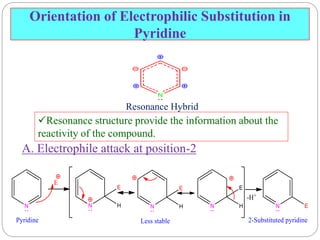
Orientation of Electrophilic Substitution in
Pyridine
Resonance Hybrid
A. Electrophile attack at position-2
Resonance structure provide the information about the
reactivity of the compound.
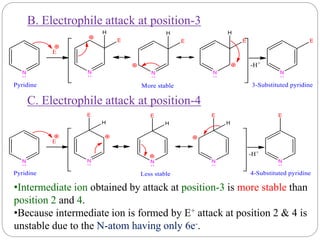
B. Electrophile attack at position-3
C. Electrophile attack at position-4
•Intermediate ion obtained by attack at position-3 is more stable than
position 2 and 4.
•Because intermediate ion is formed by E+ attack at position 2 & 4 is
unstable due to the N-atom having only 6e-.
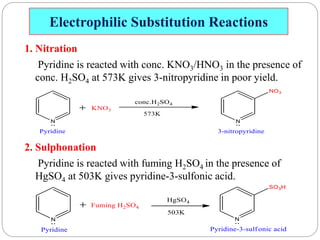
Electrophilic Substitution Reactions
1. Nitration
Pyridine is reacted with conc. KNO3/HNO3 in the presence of
conc. H2SO4 at 573K gives 3-nitropyridine in poor yield.
2. Sulphonation
Pyridine is reacted with fuming H2SO4 in the presence of
HgSO4 at 503K gives pyridine-3-sulfonic acid.
Nucleophilic Substitution in Pyridine
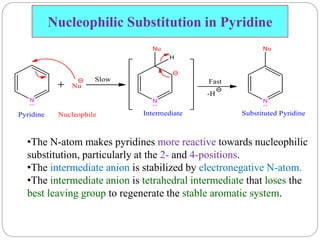
•The N-atom makes pyridines more reactive towards nucleophilic
substitution, particularly at the 2- and 4-positions.
•The intermediate anion is stabilized by electronegative N-atom.
•The intermediate anion is tetrahedral intermediate that loses the
best leaving group to regenerate the stable aromatic system.
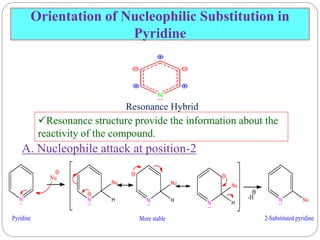
Orientation of Nucleophilic Substitution in
Pyridine
Resonance Hybrid
A. Nucleophile attack at position-2
Resonance structure provide the information about the
reactivity of the compound.
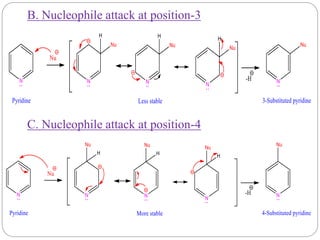
B. Nucleophile attack at position-3
C. Nucleophile attack at position-4
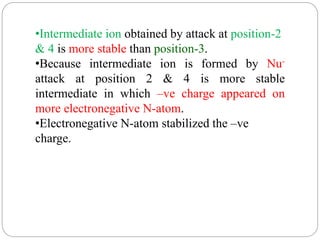
•Intermediate ion obtained by attack at position-2
& 4 is more stable than position-3.
•Because intermediate ion is formed by Nu-
attack at position 2 & 4 is more stable
intermediate in which –ve charge appeared on
more electronegative N-atom.
•Electronegative N-atom stabilized the –ve
charge.
Nucleophilic Substitution Reactions
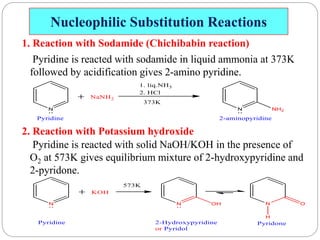
1. Reaction with Sodamide (Chichibabin reaction)
Pyridine is reacted with sodamide in liquid ammonia at 373K
followed by acidification gives 2-amino pyridine.
2. Reaction with Potassium hydroxide
Pyridine is reacted with solid NaOH/KOH in the presence of
O2 at 573K gives equilibrium mixture of 2-hydroxypyridine and
2-pyridone.
Uses of Pyridine
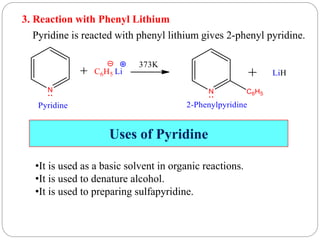
3. Reaction with Phenyl Lithium
Pyridine is reacted with phenyl lithium gives 2-phenyl pyridine.
•It is used as a basic solvent in organic reactions.
•It is used to denature alcohol.
•It is used to preparing sulfapyridine.
Than
k You

Unit-III-Heterocyclic Compounds.pptx

  • 1.
    Shri Shivaji EducationSociety Amravati’s Shri Pundlik Maharaj Mahavidyalaya Nandura Rly, Dist .Buldana Department of Chemistry Class- B.Sc-III Year Semester-V By Mr. Nilkesh K. Dhurve Assistant Professor Unit-III (Organic Chemistry)
  • 2.
    Contents •Heterocyclic compounds A. Nomenclature B.Pyrrole • Introduction • Synthesis • Physical Properties • Molecular Orbital Structure • Chemical Properties C. Pyridine • Introduction • Synthesis • Physical Properties • Molecular Orbital Structure • Chemical Properties
  • 4.
    Definition:- Cyclic organic compoundscontaining at least one element other than carbon, within the ring system. E.g., N, O, S, P, As, etc .
  • 5.
    Nomenclature:-(Hantzsch–Widman system, common names) Theheteroatom is given a name and is used as a prefix: N,aza-;O, oxa-; S, thia-; P, phospha-; As, arsa-; Si, sila-; Se, selena-; B,bora-, and so on. The “a” ending is dropped if the next syllable starts with a vowel. Thus “aza-irine” is properly written “azirine.” Ring size is designated by stems that follow the prefix: 3- atoms,-ir-; 4-atoms, -et-; 5-atoms, -ol-; 6-atoms, -in-; 7- atoms, -ep-;8-atoms, -oc-; 9-atoms, -on-; and so on. If fully unsaturated, the name is concluded with a suffix for ringsize: 3-atoms, -ene (except -ine- for N); 4-, 5-atoms, -e; 6-,7-, 8-, and 9- atoms, -ine. Azete Pyrrole Pyridine Thiophene
  • 6.
    Size of ringSaturated Unsaturated Saturated (Ring with N-atom) 3-ir irane irine iridine 4-et etane ete etidine 5-ol olane ole olidine 6-in inane ine 7-ep epane epine 8-oc ocane ocine 9-on onane onine 10-ec ecane ecine Note: “iretol in epoc on eclairs.”
  • 7.
  • 8.
  • 9.
    INTRODUCTION: o Pyrrole isa heterocyclic aromatic organic compound, a five-membered ring with the formula (C4H4NH). oIt is a colourless volatile liquid that darkens readily upon exposure to air. o Substituted derivatives are also called pyrroles. oe.g., N-methylpyrrole, C4H4NCH3.
  • 10.
    SYNTHESIS OF PYRROLE 1.From Furans Furan Furan Pyrrole
  • 11.
    2. From Acetylene Pyrrolecan be obtained by heating acetylene and ammonia over red hot tube.
  • 12.
    3. From Succinimide Pyrrolecan be synthesized by distilling succinimide with zinc dust. Succinimide Enol Form Pyrrole
  • 13.
    Physical Properties ofPyrrole •It is a colorless volatile liquid. •It’s boiling point is 131°C and melting point is -23°C. •It turns brown in the air and gradually resinifies. •Only slightly soluble in water but it is totally miscible with ether and ethanol. •Pyrrole is weakly basic in nature. •Pyrrole has a relatively high boiling point as compared to furan and thiophene, this is due to the presence of intermolecular hydrogen bonding in pyrrole.
  • 14.
    •Pyrrole having 4Cand 1N atoms, all ring atoms are sp2 hybridized. •sp2 hybrid orbitals overlap with each other and with s- atomic orbitals forming ϭ- bond i.e., 3C-C, 2C-N, 4C-H and 1N-H bond. •All these sigma bonds lie in one plane and are at 1200 from each other.
  • 15.
  • 16.
    •Each ring atomhas an unhybridized p orbital. •p orbital are perpendicular to the plane of sigma bonds. •p orbitals on C’s contains 1e- each and the p orbital on N contains 2e- (i.e., lone pair) •Lateral overlap of these p orbitals produces a molecular orbital containing 6e-’s. •Pyrrole shows aromaticity because the resulting pi MO satisfies the Huckel’s Rule (n=1 in 4n+2).
  • 17.
  • 18.
    pi Bond Skeletonof Pyrrole Shorthand Representation of Pyrrole
  • 19.
    Resonance Structure ofPyrrole •The resonance contributors of pyrrole provide insight to the reactivity of the compound. •Pyrrole is more reactive than benzene towards electrophilic aromatic substitution because it is able to stabilize the positive charge of the intermediate carbocation.
  • 20.
    Basic Character ofPyrrole •Pyrrole is a weak base (pKb =8.4) •Lone pair on the N-atom is already involved in the aromatic array of the pi electrons. •Protonation of pyrrole on N atom results in the loss of aromaticity and is therefore unfavorable. •Protonation breaks aromaticity (lone pair participates in conjugation)and thus it is not readily available.
  • 21.
    Acidic Character ofPyrrole •Pyrrole is weakly acidic in nature (pKa=17.5) •Thus on reaction with metallic potassium or potassium hydroxide it forms a potassium salt, which is hydrolyzed back to pyrrole on treatment with water. Pyrroyl anoin Pyrrole
  • 22.
    Electrophilic Substitution inPyrrole • Pyrrole is reactive towards electrophilic substitution reaction. • It is more reactive than benzene because of the resonances that pushes away the electron density from nitrogen towards carbons ,thus making the ring electron rich. • The substitution is easier and mild reagents can be used.
  • 23.
    Orientation of ElectrophilicSubstitution in Pyrrole A. Electrophile attack at position-2
  • 24.
    B. Electrophile attackat position-3 •Electrophilic substitution normally occurs at C-atoms instead of N-atoms. •Also its occurs preferentially at C-2 (the position next to the N-atom) rather than at C-3. •If position C-2 is occupied it occurs at C-3. •This is because attack at C-2 gives more stable intermediate (it is stabilized by 3 resonance structures) than the one resulted from C-3 attack (it is stabilized by 2 resonance structures).
  • 25.
    • Pyrrole issensitive towards strong acids. • This is due to protonation occur at one of the carbon and the resulting protonated molecule will add to another unprotonated pyrrole molecule this continues until a pyrrole trimer is formed. • The reaction is considered as electrophilic addition of pyrrole. Sensitivity towards strong acids
  • 26.
    Electrophilic Substitution Reactions 1.Nitration Pyrrole can be undergo nitration with cold solution of nitric acid in acetic anhydride to give 2-nitropyrrole. 2. Sulphonation
  • 27.
    3. Halogenation a) Chlorination i]Pyrrole is reacted with sulphuryl chloride in ether at 273K gives 2,3,4,5-tetrachloropyrrole. ii] Pyrrole is reacted with chlorine gives 1,2,3,4,5- pentachloropyrrole.
  • 28.
    b) Bromination Pyrrole isreacted with bromine in ethanol at 273k, it gives 2,3,4,5-tetrabromopyrrole. c) Iodination Pyrrole is reacted with iodine in aqueous potassium iodide, it gives 2,3,4,5-tetraiodopyrrole.
  • 29.
    4. Friedel-Craft Acylation Pyrroleis treated with acetic anhydride at 523K, it gives 2-acetylpyrrole. Uses of Pyrrole •It is used as commercial solvent. •It is used for pharmaceuticals.
  • 30.
  • 31.
    INTRODUCTION: •Pyridine is abasic heterocyclic organic compound with the chemical formula C5H5N. •It is structurally related to benzene, with one methine group (=CH-) replaced by a nitrogen atom. •The pyridine ring occurs in many important compounds, including agrochemicals, pharma ceuticals, and vitamins. •Pyridine was produced from coal tar.
  • 32.
    SYNTHESIS OF PYRIDINE 1.From Acetylene By passing mixture of acetylene and hydrogen cyanide through red hot tube, pyridine is obtained.
  • 33.
    2. From Pentamethylenediamine hydrochloride By heating pentamethylene diamine hydrochloride, piperidine is obtained which on heating with conc. H2SO4 at 573K or with nitrobenzene at 533K undergoes dehydrogenation to give pyridine.
  • 34.
    Physical Properties ofPyridine •It is colorless, hygroscopic liquid with a distinctive, unpleasant fish-like smell. • It is a highly flammable, weakly alkaline, water- miscible liquid and is miscible with most organic solvents. •It’s boiling point is 115.2°C(388.3K) and melting point is –41.6°C(231.6K). •Pyridine is diamagnetic (dipole moment is 2.2Debyes).
  • 35.
    •Pyridine having 5Cand 1N atoms, all ring atoms are sp2 hybridized. •sp2 hybrid orbitals overlap with each other and with s- atomic orbitals forming ϭ- bond i.e., 4C-C, 2C-N and 5C- H bond. •All these sigma bonds lie in one plane and are at 1200 from each other.
  • 36.
  • 37.
    •Each ring atomhas an unhybridized p orbitals containing one electron. •p orbitals are perpendicular to the plane of sigma bonds. •Lateral overlap of these p orbitals produces a delocalized π-molecular orbital containing 6e-’s. •Pyridine shows aromaticity because the resulting pi MO satisfies the Huckel’s Rule (n=1 in 4n+2).
  • 38.
  • 39.
    pi Bond Skeletonof Pyridine Shorthand Representation of Pyridine (π-MO Containing 6 electrons)
  • 40.
    Resonance Structure ofPyridine •The resonance contributors of pyridine provide insight to the reactivity of the compound. •It is less reactive than benzene in electrophilic aromatic substitution reaction, but more reactive in nucleophilic substitution reaction. Resonance contribution of Pyridine Resonance hybrid
  • 41.
    Basic Character ofPyridine •Pyridine is weak base (pKb=8.64). •Basicity depends on the availability of electrons (lone pair). •Pyridine is more basic than the pyrrole, because lone pair of electrons of nitrogen atom is present in sp2-hybrid orbital . •sp2-hybrid orbital is in same plane of hybridized orbital plane. •So its not involved in formation of delocalized πMO’s. •It is readily available for the donation(i.e., for the formation of new bond with electron. More Basic Less Basic Available for donation Lone pair involved in πMO’s
  • 42.
    Electrophilic Substitution inPyridine • Pyridine can undergoes electrophilic substitution reaction when extremely vigorous reaction are used. • It is less reactive than benzene because of the electronegativity of N-atom lowers the electron density around the ring C-atom and • Electrophile can coordinate with the lone pair of electrons on nitrogen to form resonance stabilized pyridinium salt.
  • 43.
    Orientation of ElectrophilicSubstitution in Pyridine Resonance Hybrid A. Electrophile attack at position-2 Resonance structure provide the information about the reactivity of the compound.
  • 44.
    B. Electrophile attackat position-3 C. Electrophile attack at position-4 •Intermediate ion obtained by attack at position-3 is more stable than position 2 and 4. •Because intermediate ion is formed by E+ attack at position 2 & 4 is unstable due to the N-atom having only 6e-.
  • 45.
    Electrophilic Substitution Reactions 1.Nitration Pyridine is reacted with conc. KNO3/HNO3 in the presence of conc. H2SO4 at 573K gives 3-nitropyridine in poor yield. 2. Sulphonation Pyridine is reacted with fuming H2SO4 in the presence of HgSO4 at 503K gives pyridine-3-sulfonic acid.
  • 46.
    Nucleophilic Substitution inPyridine •The N-atom makes pyridines more reactive towards nucleophilic substitution, particularly at the 2- and 4-positions. •The intermediate anion is stabilized by electronegative N-atom. •The intermediate anion is tetrahedral intermediate that loses the best leaving group to regenerate the stable aromatic system.
  • 47.
    Orientation of NucleophilicSubstitution in Pyridine Resonance Hybrid A. Nucleophile attack at position-2 Resonance structure provide the information about the reactivity of the compound.
  • 48.
    B. Nucleophile attackat position-3 C. Nucleophile attack at position-4
  • 49.
    •Intermediate ion obtainedby attack at position-2 & 4 is more stable than position-3. •Because intermediate ion is formed by Nu- attack at position 2 & 4 is more stable intermediate in which –ve charge appeared on more electronegative N-atom. •Electronegative N-atom stabilized the –ve charge.
  • 50.
    Nucleophilic Substitution Reactions 1.Reaction with Sodamide (Chichibabin reaction) Pyridine is reacted with sodamide in liquid ammonia at 373K followed by acidification gives 2-amino pyridine. 2. Reaction with Potassium hydroxide Pyridine is reacted with solid NaOH/KOH in the presence of O2 at 573K gives equilibrium mixture of 2-hydroxypyridine and 2-pyridone.
  • 51.
    Uses of Pyridine 3.Reaction with Phenyl Lithium Pyridine is reacted with phenyl lithium gives 2-phenyl pyridine. •It is used as a basic solvent in organic reactions. •It is used to denature alcohol. •It is used to preparing sulfapyridine.
  • 52.