The Relative
Age of Rocks


        Objectives:
•Explain the law of superposition
•Explain how geologists
determine the relative age of
rocks
•Evaluate the usefulness of index
fossils.
Geologic Time Scale
• The Geologic Time Scale is a record of the
  life forms and geologic events in Earth’s
  history.

• Why do we not talk in terms of calendars
  when we talk about the Earth’s geologic
  history?
Relative vs. Absolute age
• What is the difference between these
  two statements:
  – I am older than my sister.
  – I am 42 years old.


• Geologists use both of these ways to
  express the age of a rock and any fossil
  found in it.
• Relative age: The age of a rock compared
  to the ages of other rocks.

• Absolute age: The number of years since a
  rock was formed.

• Everyone and everything can be given a
  relative and absolute age.
The Position of Rock Layers
• Scientists have a hard time determining the
  absolute age of rocks. Why do you think that
  is so?
• Recall the “Law of superposition”.
• The law of superposition states that in
  horizontal sedimentary rock layers _______.
• How can the law of superposition help us
  determine the relative age of a sedimentary
  rock layer?
Law of superposition - activity
• Spread the cards on the table.
• Assuming that TC is the oldest layer,
  position the cards from oldest to youngest.
• Explain your reasoning in your journal.
Determining Relative Age
• There are other clues besides the position
  of rock layers.

• Clues from igneous rocks:
  – Lava that hardens on the surface is called an
    extrusion. An extrusion is always younger than
    the rocks below it.
  – Lava that cools and hardens below the surface
    is called an intrusion. An intrusion is always
    younger than the rock layers that surround it.
• Clues from faults: A fault is always younger
  than the rock it cuts through
• Cross-Cutting Principle: When something
  cuts across a body of rock, that
  “something” is younger than the rock it
  cuts across.
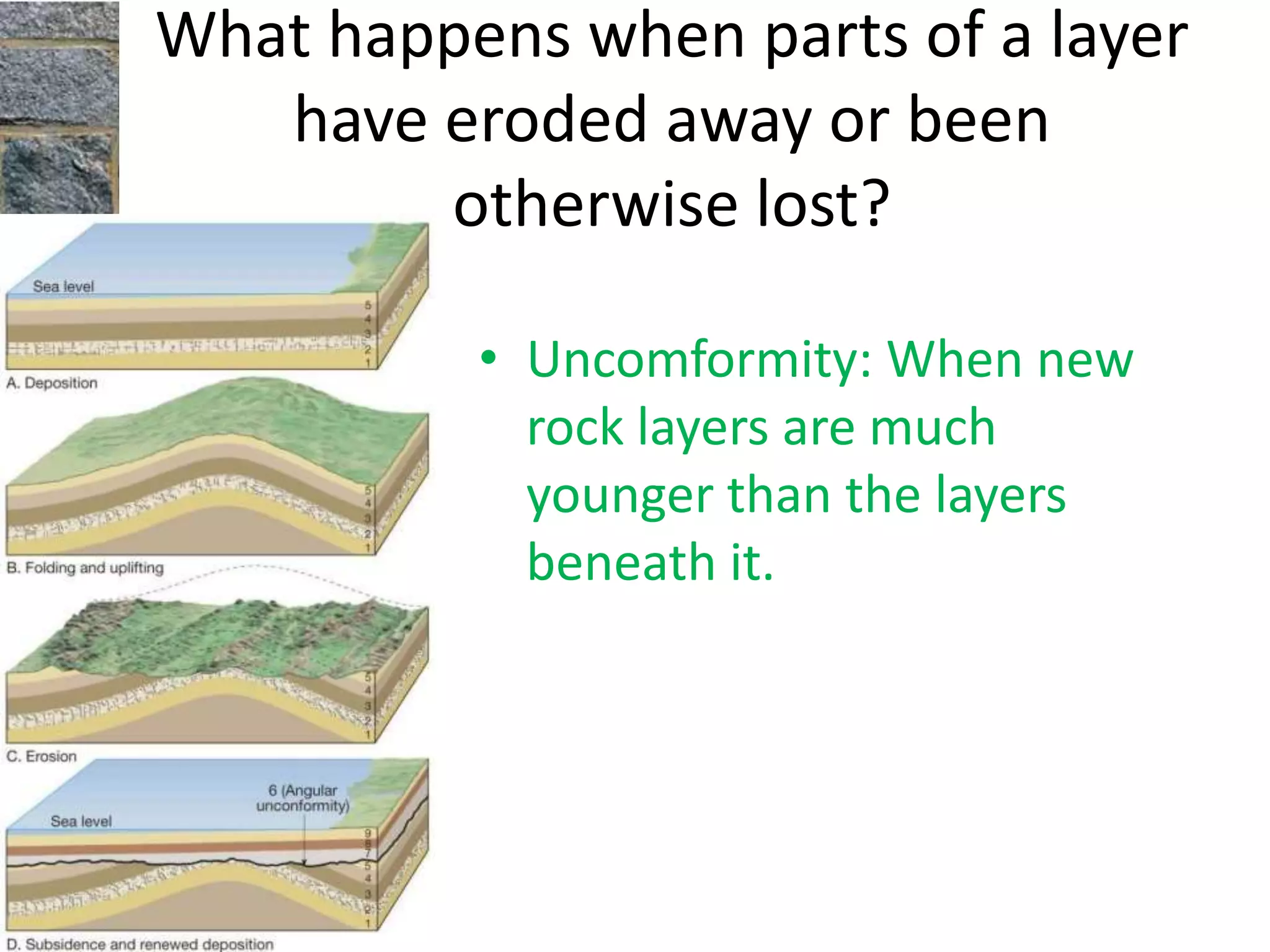
What happens when parts of a layer
   have eroded away or been
        otherwise lost?

          • Uncomformity: When new
            rock layers are much
            younger than the layers
            beneath it.
Using Fossils to Date Rocks


• To date rock layers, geologists first give a
  relative age to a layer of rock at one
  location. Then they can give the same age
  to matching layers of rock at other
  locations.
Example using Silly Bandz
                 Points of agreement:
•   Silly Bandz were popular between July-Oct
    2010.
•   Silly Bandz could be bought anywhere during
    that time.
•   By Dec 2010, it had become very difficult to
    get Silly Bandz.
•   Using most people’s standards, by December
    2010 it had become “silly” to wear Silly Bandz.
• Now let’s assume that I open my daughter’s
  dresser today and find a pile of Silly Bandz. When
  can I assume that she put them there?
• Let’s travel 3 years into the future. My daughter is
  finally cleaning out her dresser. She finds a couple
  of Silly Bandz sandwiched between a purple shirt
  (bottom) and a blue shirt (top).
   – What is the relative age of the purple shirt? How do
     you know?
• Finally, lets imagine that Hannah finds an undated
  letter from Annie with a packet of Silly Bandz. Can
  she accurately estimate its date? Why or why not.
• Back to geology, index fossils (Silly Bandz)
  help geologists match rock layers, and
  helping to determine the relative ages of
  the rocks in which they occur.
• To be useful as an index fossil, a fossil must
  be widely distributed and represent a type
  of organism that existed only briefly. Why?
Turn to page 278 in your textbook
• Complete the skills lab with a partner.
• Each student should write down their
  answers in complete sentences.

The relative age of rocks

  • 1.
    The Relative Age ofRocks Objectives: •Explain the law of superposition •Explain how geologists determine the relative age of rocks •Evaluate the usefulness of index fossils.
  • 2.
    Geologic Time Scale •The Geologic Time Scale is a record of the life forms and geologic events in Earth’s history. • Why do we not talk in terms of calendars when we talk about the Earth’s geologic history?
  • 3.
    Relative vs. Absoluteage • What is the difference between these two statements: – I am older than my sister. – I am 42 years old. • Geologists use both of these ways to express the age of a rock and any fossil found in it.
  • 4.
    • Relative age:The age of a rock compared to the ages of other rocks. • Absolute age: The number of years since a rock was formed. • Everyone and everything can be given a relative and absolute age.
  • 5.
    The Position ofRock Layers • Scientists have a hard time determining the absolute age of rocks. Why do you think that is so? • Recall the “Law of superposition”. • The law of superposition states that in horizontal sedimentary rock layers _______. • How can the law of superposition help us determine the relative age of a sedimentary rock layer?
  • 6.
    Law of superposition- activity • Spread the cards on the table. • Assuming that TC is the oldest layer, position the cards from oldest to youngest. • Explain your reasoning in your journal.
  • 7.
    Determining Relative Age •There are other clues besides the position of rock layers. • Clues from igneous rocks: – Lava that hardens on the surface is called an extrusion. An extrusion is always younger than the rocks below it. – Lava that cools and hardens below the surface is called an intrusion. An intrusion is always younger than the rock layers that surround it.
  • 8.
    • Clues fromfaults: A fault is always younger than the rock it cuts through • Cross-Cutting Principle: When something cuts across a body of rock, that “something” is younger than the rock it cuts across.
  • 9.
    What happens whenparts of a layer have eroded away or been otherwise lost? • Uncomformity: When new rock layers are much younger than the layers beneath it.
  • 10.
    Using Fossils toDate Rocks • To date rock layers, geologists first give a relative age to a layer of rock at one location. Then they can give the same age to matching layers of rock at other locations.
  • 11.
    Example using SillyBandz Points of agreement: • Silly Bandz were popular between July-Oct 2010. • Silly Bandz could be bought anywhere during that time. • By Dec 2010, it had become very difficult to get Silly Bandz. • Using most people’s standards, by December 2010 it had become “silly” to wear Silly Bandz.
  • 12.
    • Now let’sassume that I open my daughter’s dresser today and find a pile of Silly Bandz. When can I assume that she put them there? • Let’s travel 3 years into the future. My daughter is finally cleaning out her dresser. She finds a couple of Silly Bandz sandwiched between a purple shirt (bottom) and a blue shirt (top). – What is the relative age of the purple shirt? How do you know? • Finally, lets imagine that Hannah finds an undated letter from Annie with a packet of Silly Bandz. Can she accurately estimate its date? Why or why not.
  • 13.
    • Back togeology, index fossils (Silly Bandz) help geologists match rock layers, and helping to determine the relative ages of the rocks in which they occur. • To be useful as an index fossil, a fossil must be widely distributed and represent a type of organism that existed only briefly. Why?
  • 14.
    Turn to page278 in your textbook • Complete the skills lab with a partner. • Each student should write down their answers in complete sentences.