"THE BIG 4" MACROMOLECULES
Before you can understand the topics in this unit there are some key vocabulary terms you need to know. Macromolecule Polymer Monomer
MACROMOLECULE What is a
Oooooh, BIG ScaRy Science word!
MACRO Micro What do these words mean?
So What Is A Macromolecule? You should be able to define it on your own !
Next Word….. Polymer
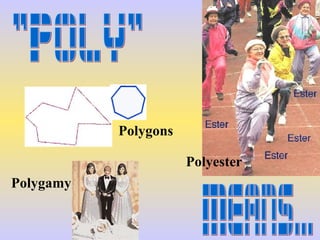
Polygons Polygamy Means... "Poly" Polyester
MANY POLY means
What does  “Mono”  mean? 1
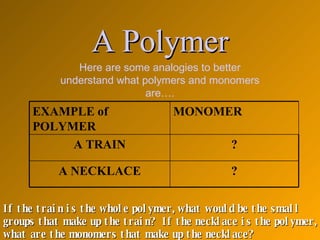
A Polymer Here are some analogies to better understand what polymers and monomers are…. If the train is the whole polymer, what would be the small groups that make up the train?  If the necklace is the polymer, what are the monomers that make up the necklace? ? A NECKLACE ? A TRAIN MONOMER EXAMPLE of POLYMER
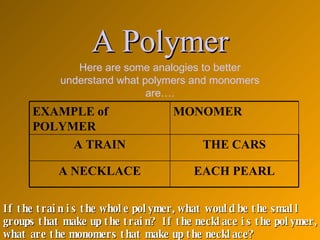
A Polymer Here are some analogies to better understand what polymers and monomers are…. If the train is the whole polymer, what would be the small groups that make up the train?  If the necklace is the polymer, what are the monomers that make up the necklace? EACH PEARL A NECKLACE THE CARS A TRAIN MONOMER EXAMPLE of POLYMER
Now you and your lab partner  need to think of at least 2 other analogies for a polymer and its monomers. (Write your analogies in your journal)
Now we are ready to  begin our study of...
The Big Four
1 2 3 4
NO WAY!!
The Big 4 There are 4 types of biochemical macromolecules • What does “Bio-Chemical” mean? Break it down: How do you define bio? How do you define chemical? (Write your answers in your journal) • Then what is a BIOchemical macromolecule?
Three out of the 4 types of biochemical macromolecules  can be found on food  nutrition labels…
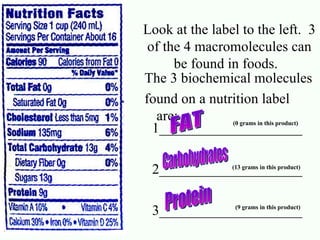
Look at the label to the left.  3 of the 4 macromolecules can be found in foods.  The 3 biochemical molecules found on a nutrition label are: 1____________________ 2____________________ 3____________________ (0 grams in this product) (13 grams in this product) (9 grams in this product) FAT Carbohydrates Protein
What is the fourth  type of biochemical  macromolecule?
The 4th type of biochemical macromolecules are the  NUCLEIC ACIDS The types of Nucleic Acids  we will study are: DNA (Deoxyribo Nucleic   Acid ) RNA (Ribo Nucleic Acid )
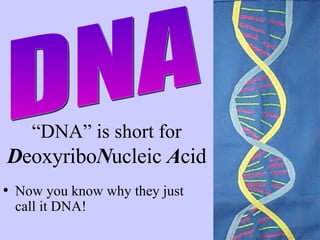
“ DNA” is short for  D eoxyribo N ucleic  A cid Now you know why they just call it DNA!  DNA
Answer the questions in your journal in  complete sentences .  JOURNAL PAUSE
When studying these biochemical molecules, we are interested in finding out….. what they do for living things. what they generally look like. what their monomers are. and how they may help the body gain energy to sustain life.
YOU CREATE IT: You are about to learn all about  the BIG 4.  Create an organized way to record the information in your journal.  You will learn about: Nucleic Acids What they look like Carbohydrates What they do/Where are  they Lipids What are they made up of- at the level of atoms Proteins How they help gain energy
LET’S BEGIN WITH CARBOHYDRATES They are the  main source  for the body  to gain energy .  They are our fuel! They  make up the cell wall in plants  which allow them to grow tall, without this carbohydrate, a plant would be a mushy mess!  This type of carbohydrate is called  Cellulose . THINK:  CARBS= ENERGY and CELL WALLS WHAT DO THEY DO?
CARBOHYDRATES WHERE ARE THEY FOUND? In plant foods- in the cell walls of plants --- in fruits, vegetables, peas, beans, SUGAR comes from a plant and so does FLOUR! (pasta, potatoes, bread, candy, cookies) --------------------------------------------------- In animal products- in MILK
CARBOHYDRATES TYPES THERE ARE 2 TYPES OF CARBOHYDRATES Simple Complex
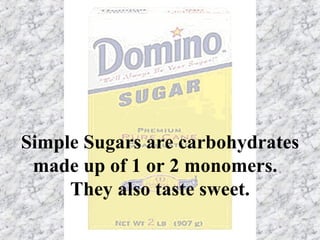
Simple Sugars are carbohydrates made up of 1 or 2 monomers.  They also taste sweet.
Simple Sugars COOKIES and CANDY CAKES FRUITS
Complex Carbohydrates… What are they? Complex Cabohydrates are polymers made up of many monomers. Most also taste starchy.
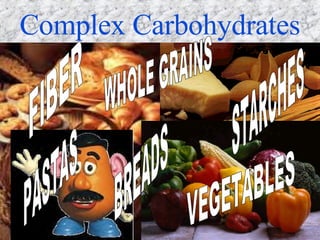
Complex Carbohydrates FIBER STARCHES VEGETABLES WHOLE GRAINS PASTAS BREADS
CARBOHYDRATES MADE UP OF... Carbohydrates are chains (polymers) made of monomers. The most common monomer of carbohydrates is… GLUCOSE
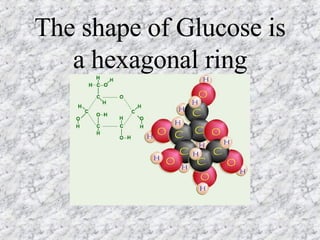
The shape of Glucose is a hexagonal ring
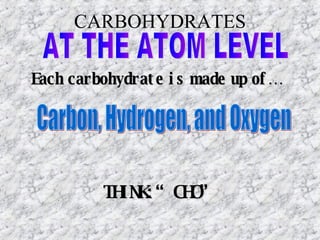
CARBOHYDRATES AT THE ATOM LEVEL Each carbohydrate is made up of… Carbon, Hydrogen, and Oxygen THINK: “CHO”
Answer the questions in your journal in  complete sentences .  JOURNAL PAUSE
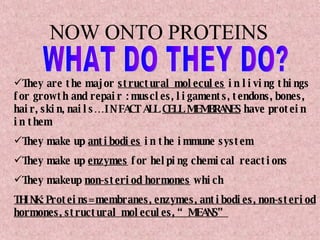
NOW ONTO PROTEINS They are the major  structural molecules  in living things for growth and repair : muscles, ligaments, tendons, bones, hair, skin, nails…IN FACT ALL  CELL MEMBRANES  have protein in them They make up  antibodies  in the immune system They make up  enzymes  for helping chemical reactions They makeup  non-steriod hormones  which THINK: Proteins= membranes, enzymes, antibodies, non-steriod hormones, structural molecules, “MEANS” WHAT DO THEY DO?
MORE ON PROTEINS… The following slides give you a little more in depth info on things that are made of proteins…
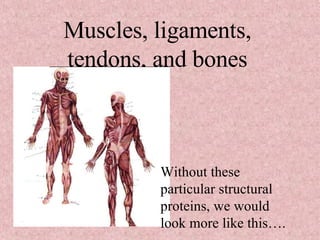
Muscles, ligaments, tendons, and bones Without these particular structural proteins, we would look more like this….
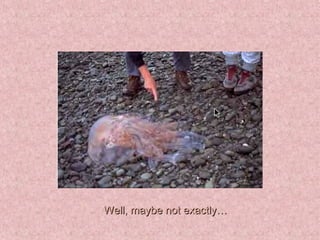
Well, maybe not exactly…
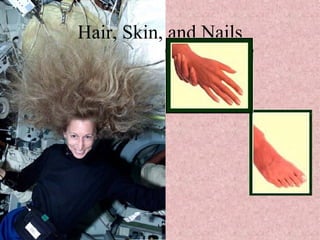
Hair, Skin, and Nails
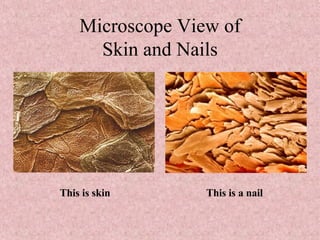
Microscope View of Skin and Nails This is skin This is a nail
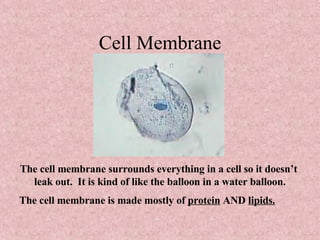
Cell Membrane The cell membrane surrounds everything in a cell so it doesn’t  leak out.  It is kind of like the balloon in a water balloon. The cell membrane is made mostly of  protein  AND  lipids.
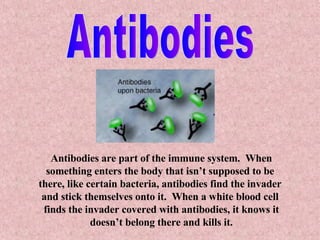
Antibodies are part of the immune system.  When something enters the body that isn’t supposed to be  there, like certain bacteria, antibodies find the invader  and stick themselves onto it.  When a white blood cell  finds the invader covered with antibodies, it knows it doesn’t belong there and kills it. Antibodies
Enzymes are proteins that speed up chemical reactions.  If you didn’t have enzymes in your stomach to speed up digestion, the food would rot in your stomach because it would take so long! Enzymes
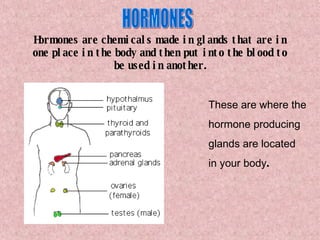
Hormones are chemicals made in glands that are in one place in the body and then put into the blood to be used in another. These are where the hormone producing  glands are located in your body . HORMONES
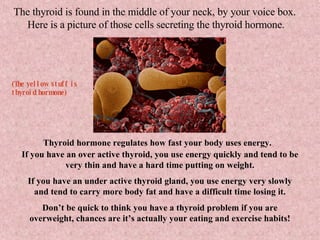
The thyroid is found in the middle of your neck, by your voice box.  Here is a picture of those cells secreting the thyroid hormone. Thyroid hormone regulates how fast your body uses energy.   If you have an over active thyroid, you use energy quickly and tend to be very thin and have a hard time putting on weight. If you have an under active thyroid gland, you use energy very slowly and tend to carry more body fat and have a difficult time losing it. Don’t be quick to think you have a thyroid problem if you are overweight, chances are it’s actually your eating and exercise habits! (The yellow stuff is thyroid hormone)
PROTEINS WHERE ARE THEY FOUND? In plant foods- in the cell membranes  In animal products- in the cell membranes- in the muscles or living things- cows, chicken, fish…
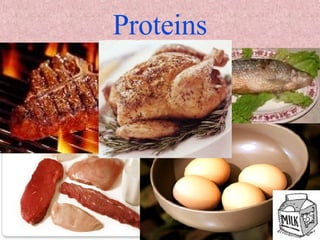
Proteins
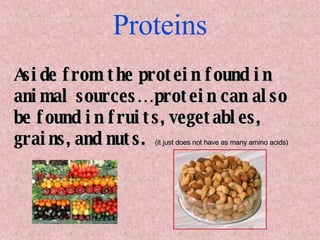
Proteins Aside from the protein found in animal sources…protein can also be found in fruits, vegetables, grains, and nuts.  (it just does not have as many amino acids)
PROTEINS MADE UP OF... Proteins are made of long chains (polymers) made of monomers. All proteins are made of the monomer… AMINO ACID
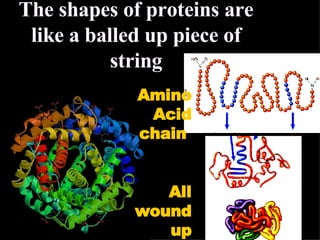
The shapes of proteins are like a balled up piece of string Amino Acid chain  All wound up
PROTEINS AT THE ATOM LEVEL Each protein is made up of… Carbon, Hydrogen, and Oxygen, Nitrogen and sometimes Sulfur THINK: “CHONS”
Answer the questions in your journal in  complete sentences .  JOURNAL PAUSE
LIPIDS ARE NEXT They are a great source of  STORED ENERGY  so we have it in the future. They  INSULATE  the body to maintain normal body temperature and they  CUSHION  the internal organs for protection. They produce hormones for the body called  STERIODS They  waterproof  surfaces of animals,plants, and fruits- these are waxes! THINK:  Waterproof, insulate, steriods, energy, cushion… “WISE C”  WHAT DO THEY DO?
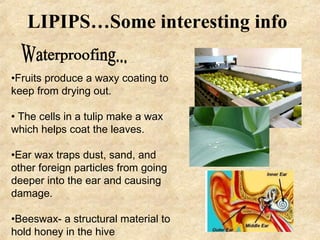
LIPIPS…Some interesting info Waterproofing... Fruits produce a waxy coating to keep from drying out. The cells in a tulip make a wax which helps coat the leaves. Ear wax traps dust, sand, and other foreign particles from going deeper into the ear and causing damage.  Beeswax- a structural material to hold honey in the hive
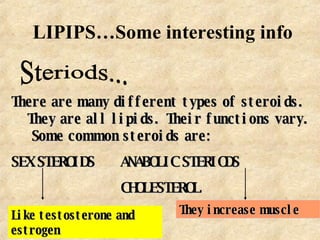
LIPIPS…Some interesting info Steriods... There are many different types of steroids.  They are all lipids.  Their functions vary.  Some common steroids are: SEX STEROIDS   ANABOLIC STERIODS CHOLESTEROL Like testosterone and estrogen They increase muscle
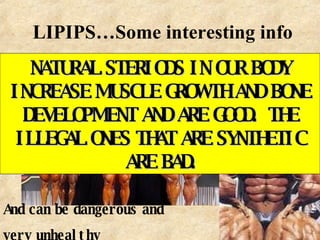
LIPIPS…Some interesting info Steriods... Some anabolic steroids are illegal And can be dangerous and  very unhealthy NATURAL STERIODS IN OUR BODY INCREASE MUSCLE GROWTH AND BONE DEVELOPMENT AND ARE GOOD.  THE ILLEGAL ONES THAT ARE SYNTHETIC ARE BAD.
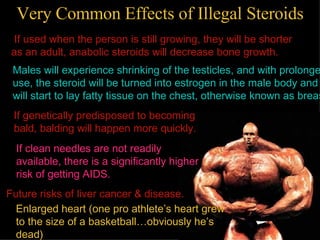
Very Common Effects of Illegal Steroids If used when the person is still growing, they will be shorter as an adult, anabolic steroids will decrease bone growth. Males will experience shrinking of the testicles, and with prolonged use, the steroid will be turned into estrogen in the male body and it  will start to lay fatty tissue on the chest, otherwise known as breasts . If genetically predisposed to becoming  bald, balding will happen more quickly. If clean needles are not readily available, there is a significantly higher  risk of getting AIDS. Future risks of liver cancer & disease. Enlarged heart (one pro athlete’s heart grew to the size of a basketball…obviously he’s dead)
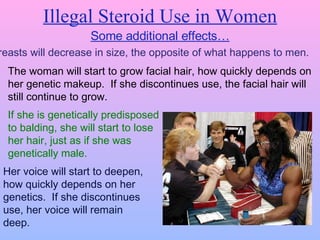
Illegal Steroid Use in Women Some additional effects… Breasts will decrease in size, the opposite of what happens to men. The woman will start to grow facial hair, how quickly depends on her genetic makeup.  If she discontinues use, the facial hair will still continue to grow. If she is genetically predisposed  to balding, she will start to lose  her hair, just as if she was  genetically male. Her voice will start to deepen, how quickly depends on her genetics.  If she discontinues use, her voice will remain deep.
LIPIDS WHERE ARE THEY FOUND? In plants- in the seeds --------------------------------------------------- In animals- in adipose tissue, connective tissue, in animals --------------------------------------------------- Lipids make up the cell membrane of all cells.  What’s that double layer called?
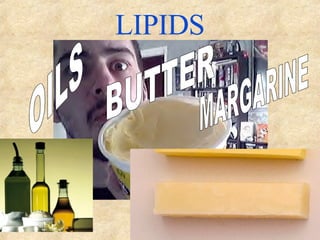
LIPIDS MARGARINE OILS BUTTER
LIPIDS MADE UP OF... Lipids are chains (polymers) made of monomers. The most common monomer of lipids is… TRIGLYCERIDES
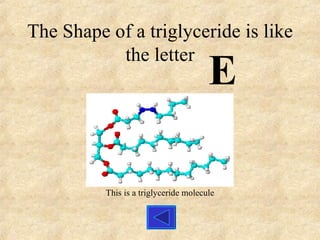
The Shape of a triglyceride is like the letter E This is a triglyceride molecule
LIPIDS AT THE ATOM LEVEL Each carbohydrate is made up of… Carbon, Hydrogen, and Oxygen THINK: “CHO”
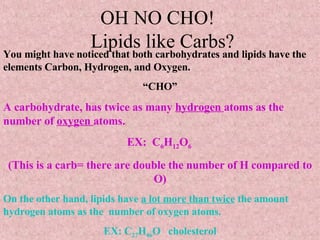
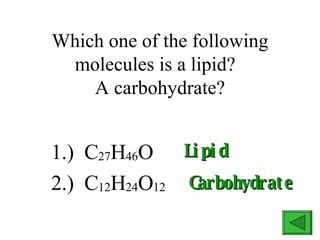
OH NO CHO!   Lipids like Carbs? You might have noticed that both carbohydrates and lipids have the elements Carbon, Hydrogen, and Oxygen.  “ CHO” A carbohydrate, has twice as many  hydrogen  atoms as the number of  oxygen  atoms. EX:  C 6 H 12 O 6  (This is a carb= there are double the number of H compared to O) On the other hand, lipids have  a lot more than twice  the amount hydrogen atoms as the  number of oxygen atoms. EX: C 27 H 46 O  cholesterol
Answer the questions in your journal in  complete sentences .  JOURNAL PAUSE
Quick Review Questions What Big 4 molecule stores energy for the future? What are 4 effects of illegal steroid use in men and 3 effects  in women? What are  4 things proteins do in your body? What are the functions of lipids? What is the main function of carbohydrates? Try to answer without looking back or using your notes :)
Mini Quiz Examples of the Big 4 Each of the following foods is high in one of the Big 4 organic molecules.  Decide which one for each of the following foods. Corn Oil Lean Ham Bread Fish
FINALLY- NUCLEIC ACIDS
NUCLEIC ACIDS TYPES THERE ARE 2 TYPES OF NUCLEIC ACIDS DNA RNA
Nucleic Acids DNA Is our genetic material. Chromosomes are made of DNA. Chromosomes contain the “recipes” to make proteins for your body. RNA Reads the DNA “protein recipes” and  makes  the proteins for your body. WHAT DO THEY DO
NUCLEIC ACIDS WHERE ARE THEY FOUND? In plants- inside the nucleus of the cells --------------------------------------------------- In animals- inside the nucleus of each cell ---------------------------------------------------
NUCLEIC ACIDS
NUCLEIC ACIDS MADE UP OF... Nucleic Acids are chains (polymers) made of monomers. Nucleic acids are made up of  Nucleotide Chains Which are nitrogen bases…something we will learn more about when we study DNA
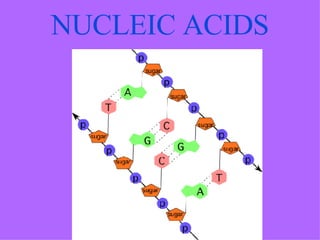
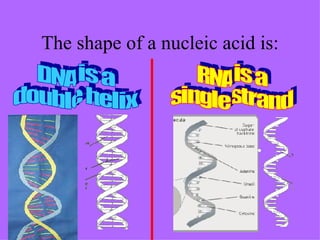
The shape of a nucleic acid is: DNA is a  double helix RNA is a  single strand
Nucleic Acids AT THE ATOM LEVEL Each nucleic acid is made up of… Phosphorus, Nitrogen,  Carbon, Hydrogen, and Oxygen THINK: “PONCH”
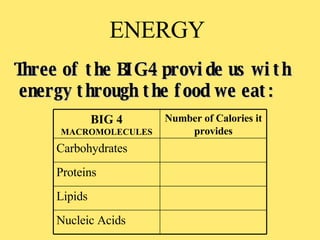
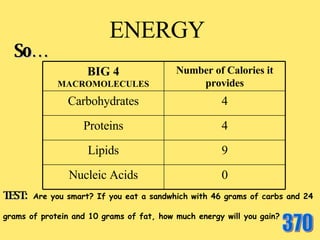
ENERGY  Three of the BIG 4 provide us with  energy through the food we eat: Number of Calories it provides BIG 4  MACROMOLECULES Nucleic Acids Lipids Proteins Carbohydrates
ENERGY  Energy that is gained by consuming food is called a  CALORIE
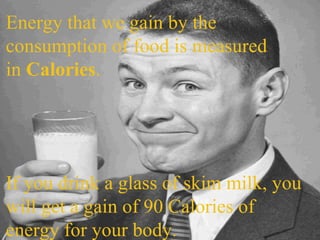
Energy that we gain by the consumption of food is measured in  Calories . If you drink a glass of skim milk, you will get a gain of 90 Calories of energy for your body.
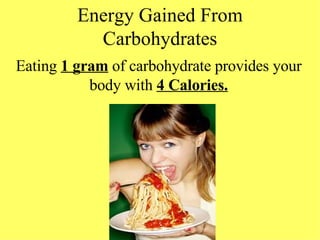
Energy Gained From Carbohydrates Eating  1 gram  of carbohydrate provides your body with  4 Calories.
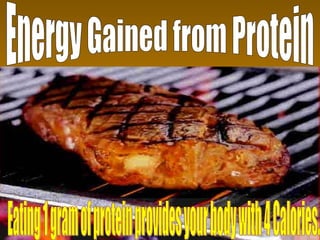
Energy Gained from Protein Eating 1 gram of protein provides your body with 4 Calories.
Energy Gained from Lipids Eating 1 gram of fat provides your body with  9 Calories.   Notice if you eat 1 gram of fat, you are gaining  more than twice  the amount of Calories than from a gram of carbohydrate or protein!
Nucleic acids The nucleic acids in food are not considered a substance that the body uses to gain energy.
So, you won’t find  nucleic acids listed on a  nutrition label!
ENERGY  So… TEST:  Are you smart? If you eat a sandwhich with 46 grams of carbs and 24 grams of protein and 10 grams of fat, how much energy will you gain?   370 Number of Calories it provides BIG 4  MACROMOLECULES 0 Nucleic Acids 9 Lipids 4 Proteins 4 Carbohydrates
What elements are found in all of the Big 4 molecules?  Which of the Big 4 has different elements and what are they? Since Carbohydrates and Lipids have the same elements in them, how can you tell the difference? Would C 26 H 32 O 5  be a carbohydrate or lipid? Which molecule is in the shape of a hexagon? Which molecule is in the shape of an E? A polymer of amino acids makes what molecule? REVIEW QUESTIONS
Which one of the following molecules is a lipid?  A carbohydrate? 1.)  C 27 H 46 O 2.)  C 12 H 24 O 12 Lipid Carbohydrate
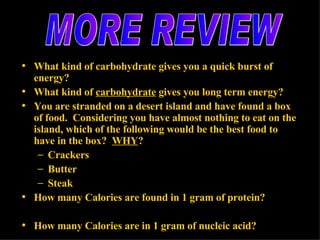
What kind of carbohydrate gives you a quick burst of energy?  What kind of  carbohydrate  gives you long term energy?  You are stranded on a desert island and have found a box of food.  Considering you have almost nothing to eat on the island, which of the following would be the best food to have in the box?  WHY ? Crackers Butter Steak  How many Calories are found in 1 gram of protein? How many Calories are in 1 gram of nucleic acid? MORE REVIEW
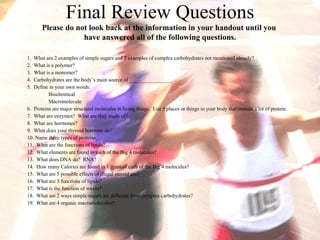
Final Review Questions Please do not look back at the information in your handout until you  have answered all of the following questions. 1.  What are 2 examples of simple sugars and 2 examples of complex carbohydrates not mentioned already? 2.  What is a polymer? 3.  What is a monomer? 4.  Carbohydrates are the body’s main source of ________________. 5.  Define in your own words: Biochemical Macromolecule 6.  Proteins are major structural molecules in living things.  List 5 places or things in your body that contain a lot of protein. 7.  What are enzymes?  What are they made of? 8.  What are hormones? 9.  What does your thyroid hormone do? 10. Name three types of proteins. 11.  What are the functions of lipids? 12.  What elements are found in each of the Big 4 molecules? 13.  What does DNA do?  RNA? 14.  How many Calories are found in 1 gram of each of the Big 4 molecules? 15.  What are 5 possible effects of illegal steroid use? 16.  What are 3 functions of lipids? 17.  What is the function of waxes? 18.  What are 2 ways simple sugars are different from complex carbohydrates? 19.  What are 4 organic macromolecules?

Big 4 Macromolecules

  • 1.
    "THE BIG 4"MACROMOLECULES
  • 2.
    Before you canunderstand the topics in this unit there are some key vocabulary terms you need to know. Macromolecule Polymer Monomer
  • 3.
  • 4.
    Oooooh, BIG ScaRyScience word!
  • 5.
    MACRO Micro Whatdo these words mean?
  • 6.
    So What IsA Macromolecule? You should be able to define it on your own !
  • 7.
  • 8.
    Polygons Polygamy Means..."Poly" Polyester
  • 9.
  • 10.
    What does “Mono” mean? 1
  • 11.
    A Polymer Hereare some analogies to better understand what polymers and monomers are…. If the train is the whole polymer, what would be the small groups that make up the train? If the necklace is the polymer, what are the monomers that make up the necklace? ? A NECKLACE ? A TRAIN MONOMER EXAMPLE of POLYMER
  • 12.
    A Polymer Hereare some analogies to better understand what polymers and monomers are…. If the train is the whole polymer, what would be the small groups that make up the train? If the necklace is the polymer, what are the monomers that make up the necklace? EACH PEARL A NECKLACE THE CARS A TRAIN MONOMER EXAMPLE of POLYMER
  • 13.
    Now you andyour lab partner need to think of at least 2 other analogies for a polymer and its monomers. (Write your analogies in your journal)
  • 14.
    Now we areready to begin our study of...
  • 15.
  • 16.
  • 17.
  • 18.
    The Big 4There are 4 types of biochemical macromolecules • What does “Bio-Chemical” mean? Break it down: How do you define bio? How do you define chemical? (Write your answers in your journal) • Then what is a BIOchemical macromolecule?
  • 19.
    Three out ofthe 4 types of biochemical macromolecules can be found on food nutrition labels…
  • 20.
    Look at thelabel to the left. 3 of the 4 macromolecules can be found in foods. The 3 biochemical molecules found on a nutrition label are: 1____________________ 2____________________ 3____________________ (0 grams in this product) (13 grams in this product) (9 grams in this product) FAT Carbohydrates Protein
  • 21.
    What is thefourth type of biochemical macromolecule?
  • 22.
    The 4th typeof biochemical macromolecules are the NUCLEIC ACIDS The types of Nucleic Acids we will study are: DNA (Deoxyribo Nucleic Acid ) RNA (Ribo Nucleic Acid )
  • 23.
    “ DNA” isshort for D eoxyribo N ucleic A cid Now you know why they just call it DNA! DNA
  • 24.
    Answer the questionsin your journal in complete sentences . JOURNAL PAUSE
  • 25.
    When studying thesebiochemical molecules, we are interested in finding out….. what they do for living things. what they generally look like. what their monomers are. and how they may help the body gain energy to sustain life.
  • 26.
    YOU CREATE IT:You are about to learn all about the BIG 4. Create an organized way to record the information in your journal. You will learn about: Nucleic Acids What they look like Carbohydrates What they do/Where are they Lipids What are they made up of- at the level of atoms Proteins How they help gain energy
  • 27.
    LET’S BEGIN WITHCARBOHYDRATES They are the main source for the body to gain energy . They are our fuel! They make up the cell wall in plants which allow them to grow tall, without this carbohydrate, a plant would be a mushy mess! This type of carbohydrate is called Cellulose . THINK: CARBS= ENERGY and CELL WALLS WHAT DO THEY DO?
  • 28.
    CARBOHYDRATES WHERE ARETHEY FOUND? In plant foods- in the cell walls of plants --- in fruits, vegetables, peas, beans, SUGAR comes from a plant and so does FLOUR! (pasta, potatoes, bread, candy, cookies) --------------------------------------------------- In animal products- in MILK
  • 29.
    CARBOHYDRATES TYPES THEREARE 2 TYPES OF CARBOHYDRATES Simple Complex
  • 30.
    Simple Sugars arecarbohydrates made up of 1 or 2 monomers. They also taste sweet.
  • 31.
    Simple Sugars COOKIESand CANDY CAKES FRUITS
  • 32.
    Complex Carbohydrates… Whatare they? Complex Cabohydrates are polymers made up of many monomers. Most also taste starchy.
  • 33.
    Complex Carbohydrates FIBERSTARCHES VEGETABLES WHOLE GRAINS PASTAS BREADS
  • 34.
    CARBOHYDRATES MADE UPOF... Carbohydrates are chains (polymers) made of monomers. The most common monomer of carbohydrates is… GLUCOSE
  • 35.
    The shape ofGlucose is a hexagonal ring
  • 36.
    CARBOHYDRATES AT THEATOM LEVEL Each carbohydrate is made up of… Carbon, Hydrogen, and Oxygen THINK: “CHO”
  • 37.
    Answer the questionsin your journal in complete sentences . JOURNAL PAUSE
  • 38.
    NOW ONTO PROTEINSThey are the major structural molecules in living things for growth and repair : muscles, ligaments, tendons, bones, hair, skin, nails…IN FACT ALL CELL MEMBRANES have protein in them They make up antibodies in the immune system They make up enzymes for helping chemical reactions They makeup non-steriod hormones which THINK: Proteins= membranes, enzymes, antibodies, non-steriod hormones, structural molecules, “MEANS” WHAT DO THEY DO?
  • 39.
    MORE ON PROTEINS…The following slides give you a little more in depth info on things that are made of proteins…
  • 40.
    Muscles, ligaments, tendons,and bones Without these particular structural proteins, we would look more like this….
  • 41.
    Well, maybe notexactly…
  • 42.
  • 43.
    Microscope View ofSkin and Nails This is skin This is a nail
  • 44.
    Cell Membrane Thecell membrane surrounds everything in a cell so it doesn’t leak out. It is kind of like the balloon in a water balloon. The cell membrane is made mostly of protein AND lipids.
  • 45.
    Antibodies are partof the immune system. When something enters the body that isn’t supposed to be there, like certain bacteria, antibodies find the invader and stick themselves onto it. When a white blood cell finds the invader covered with antibodies, it knows it doesn’t belong there and kills it. Antibodies
  • 46.
    Enzymes are proteinsthat speed up chemical reactions. If you didn’t have enzymes in your stomach to speed up digestion, the food would rot in your stomach because it would take so long! Enzymes
  • 47.
    Hormones are chemicalsmade in glands that are in one place in the body and then put into the blood to be used in another. These are where the hormone producing glands are located in your body . HORMONES
  • 48.
    The thyroid isfound in the middle of your neck, by your voice box. Here is a picture of those cells secreting the thyroid hormone. Thyroid hormone regulates how fast your body uses energy. If you have an over active thyroid, you use energy quickly and tend to be very thin and have a hard time putting on weight. If you have an under active thyroid gland, you use energy very slowly and tend to carry more body fat and have a difficult time losing it. Don’t be quick to think you have a thyroid problem if you are overweight, chances are it’s actually your eating and exercise habits! (The yellow stuff is thyroid hormone)
  • 49.
    PROTEINS WHERE ARETHEY FOUND? In plant foods- in the cell membranes In animal products- in the cell membranes- in the muscles or living things- cows, chicken, fish…
  • 50.
  • 51.
    Proteins Aside fromthe protein found in animal sources…protein can also be found in fruits, vegetables, grains, and nuts. (it just does not have as many amino acids)
  • 52.
    PROTEINS MADE UPOF... Proteins are made of long chains (polymers) made of monomers. All proteins are made of the monomer… AMINO ACID
  • 53.
    The shapes ofproteins are like a balled up piece of string Amino Acid chain All wound up
  • 54.
    PROTEINS AT THEATOM LEVEL Each protein is made up of… Carbon, Hydrogen, and Oxygen, Nitrogen and sometimes Sulfur THINK: “CHONS”
  • 55.
    Answer the questionsin your journal in complete sentences . JOURNAL PAUSE
  • 56.
    LIPIDS ARE NEXTThey are a great source of STORED ENERGY so we have it in the future. They INSULATE the body to maintain normal body temperature and they CUSHION the internal organs for protection. They produce hormones for the body called STERIODS They waterproof surfaces of animals,plants, and fruits- these are waxes! THINK: Waterproof, insulate, steriods, energy, cushion… “WISE C” WHAT DO THEY DO?
  • 57.
    LIPIPS…Some interesting infoWaterproofing... Fruits produce a waxy coating to keep from drying out. The cells in a tulip make a wax which helps coat the leaves. Ear wax traps dust, sand, and other foreign particles from going deeper into the ear and causing damage. Beeswax- a structural material to hold honey in the hive
  • 58.
    LIPIPS…Some interesting infoSteriods... There are many different types of steroids. They are all lipids. Their functions vary. Some common steroids are: SEX STEROIDS ANABOLIC STERIODS CHOLESTEROL Like testosterone and estrogen They increase muscle
  • 59.
    LIPIPS…Some interesting infoSteriods... Some anabolic steroids are illegal And can be dangerous and very unhealthy NATURAL STERIODS IN OUR BODY INCREASE MUSCLE GROWTH AND BONE DEVELOPMENT AND ARE GOOD. THE ILLEGAL ONES THAT ARE SYNTHETIC ARE BAD.
  • 60.
    Very Common Effectsof Illegal Steroids If used when the person is still growing, they will be shorter as an adult, anabolic steroids will decrease bone growth. Males will experience shrinking of the testicles, and with prolonged use, the steroid will be turned into estrogen in the male body and it will start to lay fatty tissue on the chest, otherwise known as breasts . If genetically predisposed to becoming bald, balding will happen more quickly. If clean needles are not readily available, there is a significantly higher risk of getting AIDS. Future risks of liver cancer & disease. Enlarged heart (one pro athlete’s heart grew to the size of a basketball…obviously he’s dead)
  • 61.
    Illegal Steroid Usein Women Some additional effects… Breasts will decrease in size, the opposite of what happens to men. The woman will start to grow facial hair, how quickly depends on her genetic makeup. If she discontinues use, the facial hair will still continue to grow. If she is genetically predisposed to balding, she will start to lose her hair, just as if she was genetically male. Her voice will start to deepen, how quickly depends on her genetics. If she discontinues use, her voice will remain deep.
  • 62.
    LIPIDS WHERE ARETHEY FOUND? In plants- in the seeds --------------------------------------------------- In animals- in adipose tissue, connective tissue, in animals --------------------------------------------------- Lipids make up the cell membrane of all cells. What’s that double layer called?
  • 63.
  • 64.
    LIPIDS MADE UPOF... Lipids are chains (polymers) made of monomers. The most common monomer of lipids is… TRIGLYCERIDES
  • 65.
    The Shape ofa triglyceride is like the letter E This is a triglyceride molecule
  • 66.
    LIPIDS AT THEATOM LEVEL Each carbohydrate is made up of… Carbon, Hydrogen, and Oxygen THINK: “CHO”
  • 67.
    OH NO CHO! Lipids like Carbs? You might have noticed that both carbohydrates and lipids have the elements Carbon, Hydrogen, and Oxygen. “ CHO” A carbohydrate, has twice as many hydrogen atoms as the number of oxygen atoms. EX: C 6 H 12 O 6 (This is a carb= there are double the number of H compared to O) On the other hand, lipids have a lot more than twice the amount hydrogen atoms as the number of oxygen atoms. EX: C 27 H 46 O cholesterol
  • 68.
    Answer the questionsin your journal in complete sentences . JOURNAL PAUSE
  • 69.
    Quick Review QuestionsWhat Big 4 molecule stores energy for the future? What are 4 effects of illegal steroid use in men and 3 effects in women? What are 4 things proteins do in your body? What are the functions of lipids? What is the main function of carbohydrates? Try to answer without looking back or using your notes :)
  • 70.
    Mini Quiz Examplesof the Big 4 Each of the following foods is high in one of the Big 4 organic molecules. Decide which one for each of the following foods. Corn Oil Lean Ham Bread Fish
  • 71.
  • 72.
    NUCLEIC ACIDS TYPESTHERE ARE 2 TYPES OF NUCLEIC ACIDS DNA RNA
  • 73.
    Nucleic Acids DNAIs our genetic material. Chromosomes are made of DNA. Chromosomes contain the “recipes” to make proteins for your body. RNA Reads the DNA “protein recipes” and makes the proteins for your body. WHAT DO THEY DO

  • 74.
    NUCLEIC ACIDS WHEREARE THEY FOUND? In plants- inside the nucleus of the cells --------------------------------------------------- In animals- inside the nucleus of each cell ---------------------------------------------------
  • 75.
  • 76.
    NUCLEIC ACIDS MADEUP OF... Nucleic Acids are chains (polymers) made of monomers. Nucleic acids are made up of Nucleotide Chains Which are nitrogen bases…something we will learn more about when we study DNA
  • 77.
    The shape ofa nucleic acid is: DNA is a double helix RNA is a single strand
  • 78.
    Nucleic Acids ATTHE ATOM LEVEL Each nucleic acid is made up of… Phosphorus, Nitrogen, Carbon, Hydrogen, and Oxygen THINK: “PONCH”
  • 79.
    ENERGY Threeof the BIG 4 provide us with energy through the food we eat: Number of Calories it provides BIG 4 MACROMOLECULES Nucleic Acids Lipids Proteins Carbohydrates
  • 80.
    ENERGY Energythat is gained by consuming food is called a CALORIE
  • 81.
    Energy that wegain by the consumption of food is measured in Calories . If you drink a glass of skim milk, you will get a gain of 90 Calories of energy for your body.
  • 82.
    Energy Gained FromCarbohydrates Eating 1 gram of carbohydrate provides your body with 4 Calories.
  • 83.
    Energy Gained fromProtein Eating 1 gram of protein provides your body with 4 Calories.
  • 84.
    Energy Gained fromLipids Eating 1 gram of fat provides your body with 9 Calories. Notice if you eat 1 gram of fat, you are gaining more than twice the amount of Calories than from a gram of carbohydrate or protein!
  • 85.
    Nucleic acids Thenucleic acids in food are not considered a substance that the body uses to gain energy.
  • 86.
    So, you won’tfind nucleic acids listed on a nutrition label!
  • 87.
    ENERGY So…TEST: Are you smart? If you eat a sandwhich with 46 grams of carbs and 24 grams of protein and 10 grams of fat, how much energy will you gain? 370 Number of Calories it provides BIG 4 MACROMOLECULES 0 Nucleic Acids 9 Lipids 4 Proteins 4 Carbohydrates
  • 88.
    What elements arefound in all of the Big 4 molecules? Which of the Big 4 has different elements and what are they? Since Carbohydrates and Lipids have the same elements in them, how can you tell the difference? Would C 26 H 32 O 5 be a carbohydrate or lipid? Which molecule is in the shape of a hexagon? Which molecule is in the shape of an E? A polymer of amino acids makes what molecule? REVIEW QUESTIONS
  • 89.
    Which one ofthe following molecules is a lipid? A carbohydrate? 1.) C 27 H 46 O 2.) C 12 H 24 O 12 Lipid Carbohydrate
  • 90.
    What kind ofcarbohydrate gives you a quick burst of energy? What kind of carbohydrate gives you long term energy? You are stranded on a desert island and have found a box of food. Considering you have almost nothing to eat on the island, which of the following would be the best food to have in the box? WHY ? Crackers Butter Steak How many Calories are found in 1 gram of protein? How many Calories are in 1 gram of nucleic acid? MORE REVIEW
  • 91.
    Final Review QuestionsPlease do not look back at the information in your handout until you have answered all of the following questions. 1. What are 2 examples of simple sugars and 2 examples of complex carbohydrates not mentioned already? 2. What is a polymer? 3. What is a monomer? 4. Carbohydrates are the body’s main source of ________________. 5. Define in your own words: Biochemical Macromolecule 6. Proteins are major structural molecules in living things. List 5 places or things in your body that contain a lot of protein. 7. What are enzymes? What are they made of? 8. What are hormones? 9. What does your thyroid hormone do? 10. Name three types of proteins. 11. What are the functions of lipids? 12. What elements are found in each of the Big 4 molecules? 13. What does DNA do? RNA? 14. How many Calories are found in 1 gram of each of the Big 4 molecules? 15. What are 5 possible effects of illegal steroid use? 16. What are 3 functions of lipids? 17. What is the function of waxes? 18. What are 2 ways simple sugars are different from complex carbohydrates? 19. What are 4 organic macromolecules?