Cephalosporins
VINAY GUPTA
DEPT OF PHARMACOLOGY
UP UNIVERSITY OF MEDICAL
SCIENCES,
SAIFAI, ETAWAH (UP) INDIA
Cephalosporins “C”
• Obtained from a fungus Cephalosporium,
cultured from the Sea, near Sardinian sewage
outfall in 1945.
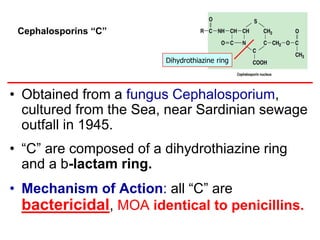
• “C” are composed of a dihydrothiazine ring
and a b-lactam ring.
• Mechanism of Action: all “C” are
bactericidal, MOA identical to penicillins.
Dihydrothiazine ring
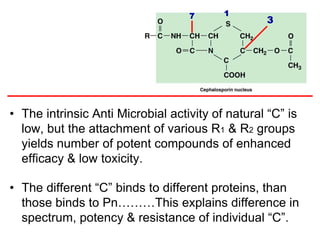
• The intrinsic Anti Microbial activity of natural “C” is
low, but the attachment of various R1 & R2 groups
yields number of potent compounds of enhanced
efficacy & low toxicity.
• The different “C” binds to different proteins, than
those binds to Pn………This explains difference in
spectrum, potency & resistance of individual “C”.
• Mechanism of Resistance: the acquired
resistance to cephalosporins have the Same basis as
penicillins.
1) Inactivation of the antibiotic by beta
lactamase (most common mechanism of
resistance)
2) Modification of target PBPs.
3) Impaired penetration of drug to target
PBPs (only in Gm –ve species bcoz of impermeable outer cell wall
with Porins, which is absent in Gm +ve species)
4) The presence of an efflux pump. (contains
cytoplasmic & periplasmic protein components that transport some
beta-lactam ab from periplasm to outer membrane)
• Classification: The “C” are classified
as first, second, third & forth
generation. This classification is
dependents on the antimicrobial
activity.
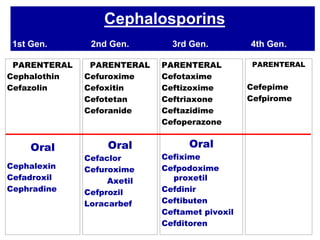
PARENTERAL
Cephalothin
Cefazolin
Oral
Cephalexin
Cefadroxil
Cephradine
Cephalosporins
1st Gen. 2nd Gen. 3rd Gen. 4th Gen.
PARENTERAL
Cefuroxime
Cefoxitin
Cefotetan
Ceforanide
Oral
Cefaclor
Cefuroxime
Axetil
Cefprozil
Loracarbef
PARENTERAL
Cefotaxime
Ceftizoxime
Ceftriaxone
Ceftazidime
Cefoperazone
Oral
Cefixime
Cefpodoxime
proxetil
Cefdinir
Ceftibuten
Ceftamet pivoxil
Cefditoren
PARENTERAL
Cefepime
Cefpirome
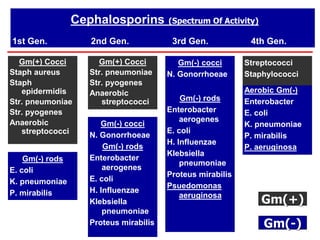
Gm(+) Cocci
Staph aureus
Staph
epidermidis
Str. pneumoniae
Str. pyogenes
Anaerobic
streptococci
Cephalosporins (Spectrum Of Activity)
1st Gen. 2nd Gen. 3rd Gen. 4th Gen.
Gm(-) rods
E. coli
K. pneumoniae
P. mirabilis
Gm(-) cocci
N. Gonorrhoeae
Gm(-) rods
Enterobacter
aerogenes
E. coli
H. Influenzae
Klebsiella
pneumoniae
Proteus mirabilis
Aerobic Gm(-)
Enterobacter
E. coli
K. pneumoniae
P. mirabilis
P. aeruginosa
Streptococci
Staphylococci
Gm(+) Cocci
Str. pneumoniae
Str. pyogenes
Anaerobic
streptococci
Gm(-) cocci
N. Gonorrhoeae
Gm(-) rods
Enterobacter
aerogenes
E. coli
H. Influenzae
Klebsiella
pneumoniae
Proteus mirabilis
Psuedomonas
aeruginosa
Gm(+)
Gm(-)
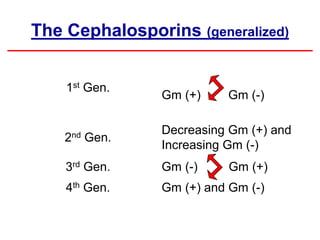
The Cephalosporins (generalized)
1st Gen.
Gm (+) Gm (-)
2nd Gen.
Decreasing Gm (+) and
Increasing Gm (-)
3rd Gen. Gm (-) Gm (+)
4th Gen. Gm (+) and Gm (-)
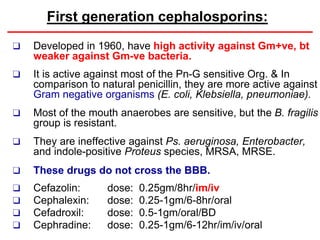
First generation cephalosporins:
❑ Developed in 1960, have high activity against Gm+ve, bt
weaker against Gm-ve bacteria.
❑ It is active against most of the Pn-G sensitive Org. & In
comparison to natural penicillin, they are more active against
Gram negative organisms (E. coli, Klebsiella, pneumoniae).
❑ Most of the mouth anaerobes are sensitive, but the B. fragilis
group is resistant.
❑ They are ineffective against Ps. aeruginosa, Enterobacter,
and indole-positive Proteus species, MRSA, MRSE.
❑ These drugs do not cross the BBB.
❑ Cefazolin: dose: 0.25gm/8hr/im/iv
❑ Cephalexin: dose: 0.25-1gm/6-8hr/oral
❑ Cefadroxil: dose: 0.5-1gm/oral/BD
❑ Cephradine: dose: 0.25-1gm/6-12hr/im/iv/oral
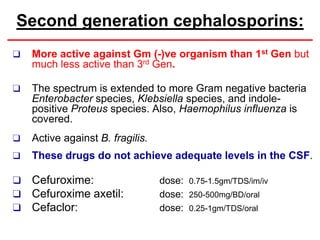
Second generation cephalosporins:
❑ More active against Gm (-)ve organism than 1st Gen but
much less active than 3rd Gen.
❑ The spectrum is extended to more Gram negative bacteria
Enterobacter species, Klebsiella species, and indole-
positive Proteus species. Also, Haemophilus influenza is
covered.
❑ Active against B. fragilis.
❑ These drugs do not achieve adequate levels in the CSF.
❑ Cefuroxime: dose: 0.75-1.5gm/TDS/im/iv
❑ Cefuroxime axetil: dose: 250-500mg/BD/oral
❑ Cefaclor: dose: 0.25-1gm/TDS/oral
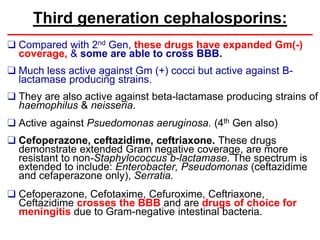
Third generation cephalosporins:
❑ Compared with 2nd Gen, these drugs have expanded Gm(-)
coverage, & some are able to cross BBB.
❑ Much less active against Gm (+) cocci but active against B-
lactamase producing strains.
❑ They are also active against beta-lactamase producing strains of
haemophilus & neisseria.
❑ Active against Psuedomonas aeruginosa. (4th Gen also)
❑ Cefoperazone, ceftazidime, ceftriaxone. These drugs
demonstrate extended Gram negative coverage, are more
resistant to non-Staphylococcus b-lactamase. The spectrum is
extended to include: Enterobacter, Pseudomonas (ceftazidime
and cefaperazone only), Serratia.
❑ Cefoperazone, Cefotaxime, Cefuroxime, Ceftriaxone,
Ceftazidime crosses the BBB and are drugs of choice for
meningitis due to Gram-negative intestinal bacteria.
Fourth generation
❑ Broadest activity among all generations.
❑ Have an extended activity spectrum compared with 3rd Gen &
also resist hydrolysis by B-lactamases.
❑ Pseudomonas aeruginosa & Staph. aureus is also inhibited.
❑ The drugs of this group are particularly useful for the empirical
treatment of serious & resistant hospital acquired infections.
❑ all drugs are parenteral.
❑ Crosses BBB & are highly effective in treating meningitis.
❑ Cefepime: severe Pneumonia: 1-2gm/iv/12 hr/10 days
: severe UTI: 0.5-1gm/iv/12 hr/ 7-10 days
: skin & skin str. Infection: 2gm/12 hr/ 10 days
❑ Cefpirome: 1-2gm/iv/BD
• None of the “C” has reliable activity against-
❑ Pn resistant S.
pneumoniae,
❑ MRSA,
❑ MRSE (epidermidis).
❑ L. monocytogenes
❑ Legionella pneumophila
❑ Clostridium difficile
❑ Xanthomonas maltophilia
❑ enterococci
Pharmacokinetics
• 1) Administration: Some “C” may be given orally
but most are given parenterally (IM or IV), because
of their poor oral absorption.
• 2) Distribution: All “C” are distribute very well in to
body fluids. However, adequate therapeutic levels in
CSF (except in case of inflammation) are achieved
only with 3rd & 4th Gen “C”.
• Some such as cefoperazone, cefotaxime,
cefuroxime, ceftriaxone, ceftazidime (3rd Gen),
Cefepime, & Cefpirome (4th Gen) crosses the BBB
and are drugs of choice for meningitis due to Gram-
negative intestinal bacteria.
• All “C” crosses the Placenta.
• “C” are found in high concentration in synovial &
pericardial fluids.
• 3rd Gen “C” has better penetration into the
aqueous humor of the Eye after systemic
administration but penetration into the vitreous
humor is comparatively poor.
• 3) Fate: Elimination occurs through tubular
secretion and/OR glomerular filtration. Hence
dose must be adjusted in case of severe renal
failure to control accumulation and toxicity.
• Most of the “C” are excreted unchanged in urine.
• Cefoperazone & Ceftriaxone (3rd Gn) are
excreted through bile in to the feces & hence
frequently given to the patient with renal
insufficiency.
• Among all “C” Ceftriaxone have longest t1/2
about 8 hrs while rest varies b/w 0.7 to 3.3 hrs.
Therapeutic Disadvantages of Selected
Cephalosporins
Cefaclor: (2nd Gen / oral) the drug is associated with
Serum Sickness.
Cefamandole (2nd Gen / P)
Cefotetan (2nd Gen / P)
Cefoperazone (3rd Gen / P)
They contains methylthiotetrazole
(MTT) Side chain causes bleeding,
hypo-Prothrombinemia &
Disulfiram Like Effects—an
intolerance to ingested Ethanol.
Adverse Effects
“C” are generally well tolerated, but are more toxic
than Pn.
1) Allergic manifestations: Pts with anaphylactic
response with Pn should not receive “C”.
-Hypersensitivity reactions caused by “C” are similar to Pn,
but overall incidence is lower.
-Rashes are the most common manifestation but asthma &
urticaria may also occurs.
-No skin test can reliably predict about detection of allergic
reactions by “C”.
2) Diarrhoea: is more common with oral preparation than
parenteral due to alteration of gut ecology. eg. Cephradine,
Cefoperazone, Cefixime etc.
• 3) Disulfiram like Effect: Certain “C” which contains
methylthiotetrazole (MTT) when taken with alcohol or given
with alcohol containing medication produces a Disulfiram
like effect.
• Cefamandole, cefotetan & Cefoperazone are the “C” shows
Disulfiram like effect.
• 4) Bleeding: Bleeding, Platelet dysfunction is also
associated with agents that contains the MTT group
(because of anti vit. K effects).
• Administration of Vit. K along with these drugs can corrects
the problem.
5) Nephrotoxicity:
-Acute tubular necrosis my be by adm. Of Cephaloridine in
doses grater than 4g/day.
-High dose of Cephalothin have reported to produce acute
tubular necrosis, while usual dose of 8-12 gm/day have
caused nephrotoxicity in patients with pre-existing renal
disease.
Drug interaction
• Cephalosporins demonstrate synergistic activity
when combined with an aminoglycoside to treat
Septicemias.
• Ceftazidime + Gentamicin is the most effective
therapy for Psuedomonas meningitis.
• Aminoglycosides are combined with “C” for
prophylaxis & treatment of neutropenic patients.
• Probenecid reduces the tubular secretion resulting in
prolongation of half life of “C” (Same as with Pn).
THERAPEUTIC USES OF “C”
▪ RTI
▪ UTI
▪ Skin & Soft tissue
infections
▪ Dental Procedures
▪ Meningitis
▪ Gynae & Obs Prosedures.
▪ Diseases
▪ Bone & Joint Infections
▪ Infection of Biliary tract
▪ Endocarditis.
▪ Wound infections
▪ Occular Infections
▪ ENT Infections
▪ Surgical Procedures
▪ Typhoid
▪ Hospital acquired
infections
▪ Mixed aerobic &
anaerobic infections in
cancer patients
▪ Venereal Diseases (STD)
“C” are indicated for treating several diseases like-

Cephalosporins

  • 1.
    Cephalosporins VINAY GUPTA DEPT OFPHARMACOLOGY UP UNIVERSITY OF MEDICAL SCIENCES, SAIFAI, ETAWAH (UP) INDIA
  • 2.
    Cephalosporins “C” • Obtainedfrom a fungus Cephalosporium, cultured from the Sea, near Sardinian sewage outfall in 1945. • “C” are composed of a dihydrothiazine ring and a b-lactam ring. • Mechanism of Action: all “C” are bactericidal, MOA identical to penicillins. Dihydrothiazine ring
  • 3.
    • The intrinsicAnti Microbial activity of natural “C” is low, but the attachment of various R1 & R2 groups yields number of potent compounds of enhanced efficacy & low toxicity. • The different “C” binds to different proteins, than those binds to Pn………This explains difference in spectrum, potency & resistance of individual “C”.
  • 4.
    • Mechanism ofResistance: the acquired resistance to cephalosporins have the Same basis as penicillins. 1) Inactivation of the antibiotic by beta lactamase (most common mechanism of resistance) 2) Modification of target PBPs. 3) Impaired penetration of drug to target PBPs (only in Gm –ve species bcoz of impermeable outer cell wall with Porins, which is absent in Gm +ve species) 4) The presence of an efflux pump. (contains cytoplasmic & periplasmic protein components that transport some beta-lactam ab from periplasm to outer membrane)
  • 5.
    • Classification: The“C” are classified as first, second, third & forth generation. This classification is dependents on the antimicrobial activity.
  • 6.
    PARENTERAL Cephalothin Cefazolin Oral Cephalexin Cefadroxil Cephradine Cephalosporins 1st Gen. 2ndGen. 3rd Gen. 4th Gen. PARENTERAL Cefuroxime Cefoxitin Cefotetan Ceforanide Oral Cefaclor Cefuroxime Axetil Cefprozil Loracarbef PARENTERAL Cefotaxime Ceftizoxime Ceftriaxone Ceftazidime Cefoperazone Oral Cefixime Cefpodoxime proxetil Cefdinir Ceftibuten Ceftamet pivoxil Cefditoren PARENTERAL Cefepime Cefpirome
  • 7.
    Gm(+) Cocci Staph aureus Staph epidermidis Str.pneumoniae Str. pyogenes Anaerobic streptococci Cephalosporins (Spectrum Of Activity) 1st Gen. 2nd Gen. 3rd Gen. 4th Gen. Gm(-) rods E. coli K. pneumoniae P. mirabilis Gm(-) cocci N. Gonorrhoeae Gm(-) rods Enterobacter aerogenes E. coli H. Influenzae Klebsiella pneumoniae Proteus mirabilis Aerobic Gm(-) Enterobacter E. coli K. pneumoniae P. mirabilis P. aeruginosa Streptococci Staphylococci Gm(+) Cocci Str. pneumoniae Str. pyogenes Anaerobic streptococci Gm(-) cocci N. Gonorrhoeae Gm(-) rods Enterobacter aerogenes E. coli H. Influenzae Klebsiella pneumoniae Proteus mirabilis Psuedomonas aeruginosa Gm(+) Gm(-)
  • 8.
    The Cephalosporins (generalized) 1stGen. Gm (+) Gm (-) 2nd Gen. Decreasing Gm (+) and Increasing Gm (-) 3rd Gen. Gm (-) Gm (+) 4th Gen. Gm (+) and Gm (-)
  • 9.
    First generation cephalosporins: ❑Developed in 1960, have high activity against Gm+ve, bt weaker against Gm-ve bacteria. ❑ It is active against most of the Pn-G sensitive Org. & In comparison to natural penicillin, they are more active against Gram negative organisms (E. coli, Klebsiella, pneumoniae). ❑ Most of the mouth anaerobes are sensitive, but the B. fragilis group is resistant. ❑ They are ineffective against Ps. aeruginosa, Enterobacter, and indole-positive Proteus species, MRSA, MRSE. ❑ These drugs do not cross the BBB. ❑ Cefazolin: dose: 0.25gm/8hr/im/iv ❑ Cephalexin: dose: 0.25-1gm/6-8hr/oral ❑ Cefadroxil: dose: 0.5-1gm/oral/BD ❑ Cephradine: dose: 0.25-1gm/6-12hr/im/iv/oral
  • 10.
    Second generation cephalosporins: ❑More active against Gm (-)ve organism than 1st Gen but much less active than 3rd Gen. ❑ The spectrum is extended to more Gram negative bacteria Enterobacter species, Klebsiella species, and indole- positive Proteus species. Also, Haemophilus influenza is covered. ❑ Active against B. fragilis. ❑ These drugs do not achieve adequate levels in the CSF. ❑ Cefuroxime: dose: 0.75-1.5gm/TDS/im/iv ❑ Cefuroxime axetil: dose: 250-500mg/BD/oral ❑ Cefaclor: dose: 0.25-1gm/TDS/oral
  • 11.
    Third generation cephalosporins: ❑Compared with 2nd Gen, these drugs have expanded Gm(-) coverage, & some are able to cross BBB. ❑ Much less active against Gm (+) cocci but active against B- lactamase producing strains. ❑ They are also active against beta-lactamase producing strains of haemophilus & neisseria. ❑ Active against Psuedomonas aeruginosa. (4th Gen also) ❑ Cefoperazone, ceftazidime, ceftriaxone. These drugs demonstrate extended Gram negative coverage, are more resistant to non-Staphylococcus b-lactamase. The spectrum is extended to include: Enterobacter, Pseudomonas (ceftazidime and cefaperazone only), Serratia. ❑ Cefoperazone, Cefotaxime, Cefuroxime, Ceftriaxone, Ceftazidime crosses the BBB and are drugs of choice for meningitis due to Gram-negative intestinal bacteria.
  • 12.
    Fourth generation ❑ Broadestactivity among all generations. ❑ Have an extended activity spectrum compared with 3rd Gen & also resist hydrolysis by B-lactamases. ❑ Pseudomonas aeruginosa & Staph. aureus is also inhibited. ❑ The drugs of this group are particularly useful for the empirical treatment of serious & resistant hospital acquired infections. ❑ all drugs are parenteral. ❑ Crosses BBB & are highly effective in treating meningitis. ❑ Cefepime: severe Pneumonia: 1-2gm/iv/12 hr/10 days : severe UTI: 0.5-1gm/iv/12 hr/ 7-10 days : skin & skin str. Infection: 2gm/12 hr/ 10 days ❑ Cefpirome: 1-2gm/iv/BD
  • 13.
    • None ofthe “C” has reliable activity against- ❑ Pn resistant S. pneumoniae, ❑ MRSA, ❑ MRSE (epidermidis). ❑ L. monocytogenes ❑ Legionella pneumophila ❑ Clostridium difficile ❑ Xanthomonas maltophilia ❑ enterococci
  • 14.
    Pharmacokinetics • 1) Administration:Some “C” may be given orally but most are given parenterally (IM or IV), because of their poor oral absorption. • 2) Distribution: All “C” are distribute very well in to body fluids. However, adequate therapeutic levels in CSF (except in case of inflammation) are achieved only with 3rd & 4th Gen “C”. • Some such as cefoperazone, cefotaxime, cefuroxime, ceftriaxone, ceftazidime (3rd Gen), Cefepime, & Cefpirome (4th Gen) crosses the BBB and are drugs of choice for meningitis due to Gram- negative intestinal bacteria.
  • 15.
    • All “C”crosses the Placenta. • “C” are found in high concentration in synovial & pericardial fluids. • 3rd Gen “C” has better penetration into the aqueous humor of the Eye after systemic administration but penetration into the vitreous humor is comparatively poor.
  • 16.
    • 3) Fate:Elimination occurs through tubular secretion and/OR glomerular filtration. Hence dose must be adjusted in case of severe renal failure to control accumulation and toxicity. • Most of the “C” are excreted unchanged in urine. • Cefoperazone & Ceftriaxone (3rd Gn) are excreted through bile in to the feces & hence frequently given to the patient with renal insufficiency. • Among all “C” Ceftriaxone have longest t1/2 about 8 hrs while rest varies b/w 0.7 to 3.3 hrs.
  • 17.
    Therapeutic Disadvantages ofSelected Cephalosporins Cefaclor: (2nd Gen / oral) the drug is associated with Serum Sickness. Cefamandole (2nd Gen / P) Cefotetan (2nd Gen / P) Cefoperazone (3rd Gen / P) They contains methylthiotetrazole (MTT) Side chain causes bleeding, hypo-Prothrombinemia & Disulfiram Like Effects—an intolerance to ingested Ethanol.
  • 18.
    Adverse Effects “C” aregenerally well tolerated, but are more toxic than Pn. 1) Allergic manifestations: Pts with anaphylactic response with Pn should not receive “C”. -Hypersensitivity reactions caused by “C” are similar to Pn, but overall incidence is lower. -Rashes are the most common manifestation but asthma & urticaria may also occurs. -No skin test can reliably predict about detection of allergic reactions by “C”. 2) Diarrhoea: is more common with oral preparation than parenteral due to alteration of gut ecology. eg. Cephradine, Cefoperazone, Cefixime etc.
  • 19.
    • 3) Disulfiramlike Effect: Certain “C” which contains methylthiotetrazole (MTT) when taken with alcohol or given with alcohol containing medication produces a Disulfiram like effect. • Cefamandole, cefotetan & Cefoperazone are the “C” shows Disulfiram like effect. • 4) Bleeding: Bleeding, Platelet dysfunction is also associated with agents that contains the MTT group (because of anti vit. K effects). • Administration of Vit. K along with these drugs can corrects the problem.
  • 20.
    5) Nephrotoxicity: -Acute tubularnecrosis my be by adm. Of Cephaloridine in doses grater than 4g/day. -High dose of Cephalothin have reported to produce acute tubular necrosis, while usual dose of 8-12 gm/day have caused nephrotoxicity in patients with pre-existing renal disease.
  • 21.
    Drug interaction • Cephalosporinsdemonstrate synergistic activity when combined with an aminoglycoside to treat Septicemias. • Ceftazidime + Gentamicin is the most effective therapy for Psuedomonas meningitis. • Aminoglycosides are combined with “C” for prophylaxis & treatment of neutropenic patients. • Probenecid reduces the tubular secretion resulting in prolongation of half life of “C” (Same as with Pn).
  • 22.
    THERAPEUTIC USES OF“C” ▪ RTI ▪ UTI ▪ Skin & Soft tissue infections ▪ Dental Procedures ▪ Meningitis ▪ Gynae & Obs Prosedures. ▪ Diseases ▪ Bone & Joint Infections ▪ Infection of Biliary tract ▪ Endocarditis. ▪ Wound infections ▪ Occular Infections ▪ ENT Infections ▪ Surgical Procedures ▪ Typhoid ▪ Hospital acquired infections ▪ Mixed aerobic & anaerobic infections in cancer patients ▪ Venereal Diseases (STD) “C” are indicated for treating several diseases like-