Lecture 6a: Macroevolution Macroevolution
Macroevolution Not really different than microevolution, but over a much larger scale Changes to species, not changes to populations
Species- what are they anyway? Biolgical Species Concept : members of the same species interbreed and have a shared gene pool, but are reproductively isolated from every other species Speciation : the evolution of new species
Species Two animals of the same species can reproduce and have fertile offspring One species can consist of one or many populations Appearance does not necessarily allow you to tell two species apart
Reproductive Barriers As speciation occurs, reproductive barriers arise that prevent breeding from occurring between the different species Barriers fall into two categories:  prezygotic  and  postzygotic
Prezygotic Barriers Habitat Isolation: The different species inhabit different habitats Temporal Isolation: Breeding season is at different times of the year Behavioral Isolation: Pheromones, courtship rituals, songs or calls, etc are different Mechanical Isolation: Genitalia are incompatible Gamete Isolation: The gametes can not fuse to form a zygote
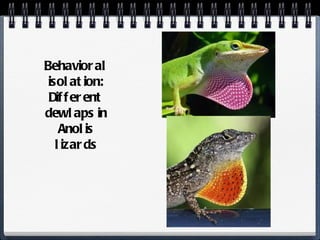
Behavioral isolation: Different dewlaps in Anolis lizards
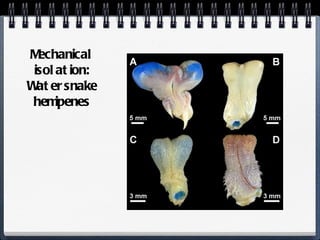
Mechanical isolation: Watersnake hemipenes
Postzygotic Barriers Zygote mortality: A zygote is formed, but it does not survive Hybrid sterility: The zygote develops into an adult, but it is sterile F2 Fitness: The hybrids can reproduce, but the F2 generation can not
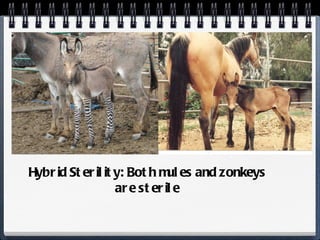
Hybrid Sterility: Both mules and zonkeys are sterile
Types of Speciation Allopatric Speciation Occurs when populations become geographically isolated, and move further and further apart genetically from the original species Ex. Ensatina salamanders, iguanas
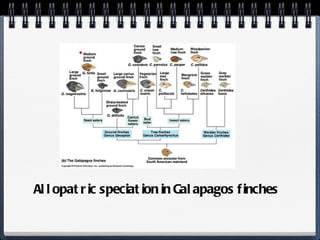
Allopatric speciation in Galapagos finches
Types of Speciation Sympatric speciation Population develops into two or more groups without geographic isolation Polyploidy: increase in number of chromosomes to 3n or higher due to hybridization, sometimes followed by doubling of chromosomes- results in 3rd species
Types of Speciation Adaptive Radiation New species evolve from one ancestral species to fill different niches in the habitat Ex. Galapagos finches, Hawaiian honeycreepers
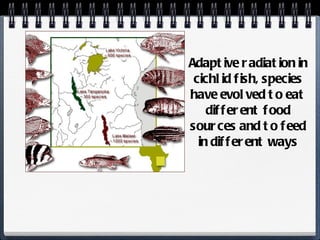
Adaptive radiation in cichlid fish, species have evolved to eat different food sources and to feed in different ways
Fossils To study extinct species, especially ones from millions of years ago, we look to  fossils: The remains or traces of past life Can take several forms- amber, footprints, petrification, actual remains
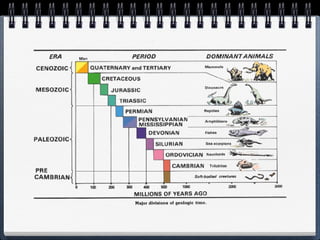
Geologic Time See timeline Cambrian explosion: all major groups of animals appeared Number of species on Earth has continued to increase over time, even to the present day
 
Speciation  We do not know how quickly species arise- there are two models: Gradualistic Model- slow steady change over a long period of time Punctuated Equilibrium: somewhat ‘sudden’ appearance of new species in fossil record The transitional fossils are unlikely due to geographic isolation and small numbers
Mass Extinctions Relatively sudden disappearances of large numbers of species  Have been several, of course dinos the best known example Two main causes: Continental drift and meteorite impacts
Continental Drift The continents on Earth are moving Plate tectonics: The crust of Earth is floating on the molten mantle, the crust is in several pieces As the continents move, the climate changes
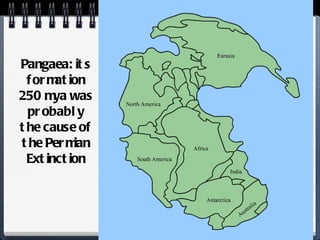
Pangaea: its formation 250 mya was probably the cause of the Permian Extinction
Meteorites Probably the cause of the dinosaur’s extinction Caused massive cloud of dust that blocked the sun, lowering temperatures worldwide Soot and iridium are found in Cretaceous clay, and a crater has been identified as well
Systematics DKPCOFGS As the category gets higher and higher, it gets more and more inclusive Ideally, organisms are classified according to their evolutionary relationships, so taxonomy is in constant flux as we learn more and more
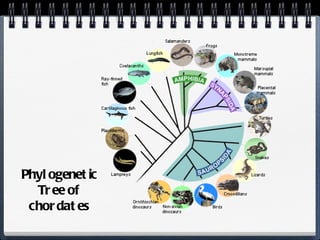
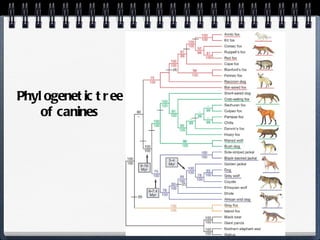
Phylogenetic Trees Trees that show relatedness of different organisms Indicate common ancestor, and lines of descent Determined using comparative anatomy, embryology, molecular evidence
Phylogenetic Tree of chordates
Phylogenetic tree of canines
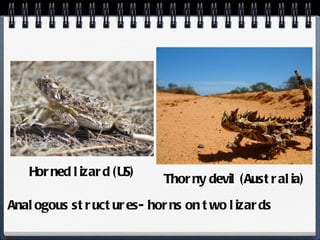
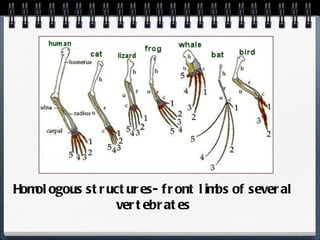
Anatomy Remember, it matters where the characteristic in question arose from, not what it does now Ex. Thorny devils vs. horny toads have  Analagous structures Ex. Vertebrate forelimbs are  Homologous structures
Thorny devil (Australia) Horned lizard (US) Analogous structures- horns on two lizards
Homologous structures- front limbs of several vertebrates
Using DNA to determine relationships Remember: evolution occurs when mutations in DNA occur-- it can not occur without those random changes Therefore, the more closely related animals are, the fewer differences there will be in their DNA This allows new information about DNA to be included in our understanding of how life on Earth evolved
 

Macroevolution

  • 1.
  • 2.
    Macroevolution Not reallydifferent than microevolution, but over a much larger scale Changes to species, not changes to populations
  • 3.
    Species- what arethey anyway? Biolgical Species Concept : members of the same species interbreed and have a shared gene pool, but are reproductively isolated from every other species Speciation : the evolution of new species
  • 4.
    Species Two animalsof the same species can reproduce and have fertile offspring One species can consist of one or many populations Appearance does not necessarily allow you to tell two species apart
  • 5.
    Reproductive Barriers Asspeciation occurs, reproductive barriers arise that prevent breeding from occurring between the different species Barriers fall into two categories: prezygotic and postzygotic
  • 6.
    Prezygotic Barriers HabitatIsolation: The different species inhabit different habitats Temporal Isolation: Breeding season is at different times of the year Behavioral Isolation: Pheromones, courtship rituals, songs or calls, etc are different Mechanical Isolation: Genitalia are incompatible Gamete Isolation: The gametes can not fuse to form a zygote
  • 7.
    Behavioral isolation: Differentdewlaps in Anolis lizards
  • 8.
  • 9.
    Postzygotic Barriers Zygotemortality: A zygote is formed, but it does not survive Hybrid sterility: The zygote develops into an adult, but it is sterile F2 Fitness: The hybrids can reproduce, but the F2 generation can not
  • 10.
    Hybrid Sterility: Bothmules and zonkeys are sterile
  • 11.
    Types of SpeciationAllopatric Speciation Occurs when populations become geographically isolated, and move further and further apart genetically from the original species Ex. Ensatina salamanders, iguanas
  • 12.
    Allopatric speciation inGalapagos finches
  • 13.
    Types of SpeciationSympatric speciation Population develops into two or more groups without geographic isolation Polyploidy: increase in number of chromosomes to 3n or higher due to hybridization, sometimes followed by doubling of chromosomes- results in 3rd species
  • 14.
    Types of SpeciationAdaptive Radiation New species evolve from one ancestral species to fill different niches in the habitat Ex. Galapagos finches, Hawaiian honeycreepers
  • 15.
    Adaptive radiation incichlid fish, species have evolved to eat different food sources and to feed in different ways
  • 16.
    Fossils To studyextinct species, especially ones from millions of years ago, we look to fossils: The remains or traces of past life Can take several forms- amber, footprints, petrification, actual remains
  • 17.
    Geologic Time Seetimeline Cambrian explosion: all major groups of animals appeared Number of species on Earth has continued to increase over time, even to the present day
  • 18.
  • 19.
    Speciation Wedo not know how quickly species arise- there are two models: Gradualistic Model- slow steady change over a long period of time Punctuated Equilibrium: somewhat ‘sudden’ appearance of new species in fossil record The transitional fossils are unlikely due to geographic isolation and small numbers
  • 20.
    Mass Extinctions Relativelysudden disappearances of large numbers of species Have been several, of course dinos the best known example Two main causes: Continental drift and meteorite impacts
  • 21.
    Continental Drift Thecontinents on Earth are moving Plate tectonics: The crust of Earth is floating on the molten mantle, the crust is in several pieces As the continents move, the climate changes
  • 22.
    Pangaea: its formation250 mya was probably the cause of the Permian Extinction
  • 23.
    Meteorites Probably thecause of the dinosaur’s extinction Caused massive cloud of dust that blocked the sun, lowering temperatures worldwide Soot and iridium are found in Cretaceous clay, and a crater has been identified as well
  • 24.
    Systematics DKPCOFGS Asthe category gets higher and higher, it gets more and more inclusive Ideally, organisms are classified according to their evolutionary relationships, so taxonomy is in constant flux as we learn more and more
  • 25.
    Phylogenetic Trees Treesthat show relatedness of different organisms Indicate common ancestor, and lines of descent Determined using comparative anatomy, embryology, molecular evidence
  • 26.
  • 27.
  • 28.
    Anatomy Remember, itmatters where the characteristic in question arose from, not what it does now Ex. Thorny devils vs. horny toads have Analagous structures Ex. Vertebrate forelimbs are Homologous structures
  • 29.
    Thorny devil (Australia)Horned lizard (US) Analogous structures- horns on two lizards
  • 30.
    Homologous structures- frontlimbs of several vertebrates
  • 31.
    Using DNA todetermine relationships Remember: evolution occurs when mutations in DNA occur-- it can not occur without those random changes Therefore, the more closely related animals are, the fewer differences there will be in their DNA This allows new information about DNA to be included in our understanding of how life on Earth evolved
  • 32.