Speciation
Chapter 13
Evolution
• Microevolution—Relatively short term
changes in ALLELE FREQUENCIES within a
population or species
• Macroevolution—Large scale evolutionary
changes
– Over long periods
– Small scale microevolution leads to
macroevolution
Biological Species Concept
• Species—Group of populations whose
members have the potential to interbreed in
nature and produce viable, fertile offspring,
but do not produce viable offspring with
members of other groups.
• What maintains species?
– Gene flow
– Reproductive isolation (biological)
Other Species Definitions
• Morphological Species Concept
– Characterizes by body shape and other structures
• Ecological Species Concept
– Characterizes in terms of ecological niche
• Phylogenetic Species Concept
– Smallest group of organisms that share a common
ancestor
Reproductive Isolation
• Prezygotic Barriers—block fertilization from
happening
– Prevent different species from attempting to mate
– Prevent an attempted mating from being successful
– Hindering fertilization
• Postzygotic Barriers—occur after zygote is
formed
– Developmental errors
– Birth defects cause death
– Infertile offspring
Prezygotic Reproductive Isolating
Barriers
• Behavioral isolation—Absence of cross-attraction between individuals of
separate species inhibiting any courtship initiation or individual behavior
during copulation does not allow normal fertilization to occur.
• Ecological isolation—Variations in the ecology of species give rise to
barriers:
– Habitat isolation—Even when living in the same common locality, species
occupy diverse habitats due to different biological or genetic tendencies
thereby limiting gene flow during breeding seasons.
– Temporal isolation—Species living in the same area have different breeding
seasons preventing gene flow.
– Pollinator isolation—Flowering plants have varying interactions with
pollinators thereby reducing gene flow.
• Mechanical isolation—Reproductive structures are incompatible between
species inhibiting copulation or pollination.
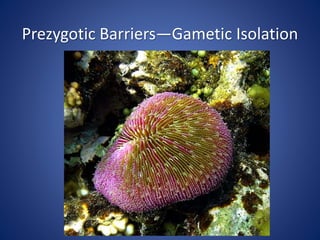
• Gametic isolation–Gametes that are transferred during copulation or
pollination are ineffectual for fertilization due to problems with storage or
transfer of gametes or because of conspecific pollen or sperm partiality.
Prezygotic Barriers—Habitat Isolation
Prezygotic Barriers—Temporal
Isolation
Prezygotic Barriers—Behavioral
Isolation
• http://www.fiddlercrab.info/video/u_heteropleura02.html
• http://www.fiddlercrab.info/video/u_ornata01.html
Prezygotic Barriers—Mechanical
Isolation
Prezygotic Barriers—Gametic Isolation
Postzygotic Reproductive Isolating
Barriers
• Ecological unviability—Although normal development
occurs, hybrids cannot find a suitable ecological niche
thereby lowering viability.
• Hybrid unviability—Hybrid species have developmental
issues causing complete or incomplete lethality.
• Behavioral sterility—Although normal gametogenesis
occurs, hybrids are less fertile and typically exhibit
phenotypes or courtship behaviors that make them less
desirable mates.
• Hybrid sterility—Hybrids can have developmental problems
of the reproductive organs or gametes, or can suffer from
physiological or neurological issues that prevent effective
courtship.
Postzygotic Barriers—Reduced Fertility
Speciation
• Development of a new species through a
variety of factors
• Rate of speciation depends on generation
time, environmental conditions, etc.
• Can be caused by a change in just 1 gene or a
set of genes causing some sort of isolation
Types of Speciation
• Allopatric Speciation—gene flow is interrupted when a
population is divided into geographically isolated
subpopulations
• Parapatric Speciation—occurs when part of a population
enters a new habitat bordering the range of the parent
species
– Some gene flow may occur between populations in border zone
• Sympatric Speciation—occurs in populations that live in
the same geographic area
– Less common than allopatric speciation
– Happens when gene flow is diminished by:
• Polyploidy
• Habitat differentiation
• Sexual selection
Types of Speciation
Allopatric
Speciation
Parapatric
Speciation
Ephedra californica
Ephedra trifurca
Sympatric Speciation
Apple maggot flies (Rhagoletis pomonella) on domestic apple (left) and on much smaller
native hawthorn fruits (right). Flies that emerge from a given host generally return to
mate and lay eggs on the same type of fruit.
How Does Speciation Occur?
• Gradualism—one species gradually
transforming into another through a series of
intermediate forms
– Evolutions occurs in small, incremental changes
over MANY generations
– Should be able to see in fossil record but we do
not – intermediate forms NOT present in fossils
• Fossil record incomplete or;
• Missing links too rare in fossils or;
• See next slide 
Gradualism
How Does Speciation Occur?
• Punctuated Equilibrium—relatively brief
bursts of rapid evolution interrupting long
periods of little change
– Fits with allopatric speciation
– Can occur during adaptive radiation—population
inhabiting a patchy environment gives rise to
multiple specialized forms in short time period
• Common in island groups
Punctuated Equilibrium
Adaptive
Radiation A. loysiana
GULF
OF
MEXICO
Florida
ATLANTIC OCEAN
CUBA
JAMAICAHISPANIOLA
PUERTO
RICO
Upper trunk/canopy
A. evermanni
Midtrunk
Lower trunk/ground
A. cristatellus
Grass/bush
A. pulchellus
Adaptive
Radiation
Extinction
• A species goes extinct when ALL of its
members die.
• Many factors can cause—climate,
reproductive barriers, disease.
• No matter what it is, it is a FAILURE of that
species to adapt to the new conditions
• More prevalent in small, less genetically
diverse populations
Types of Extinction
• Background Extinction—gradual loss of species
over time.
– Loss of habitat, small climate change, etc.
• Mass Extinction—many number of species
disappeared over a relatively short period of
time.
– Open up new habitats for adaptive radiation
– Two theories:
• Impact Theory—meteor, comet crashes into earth making it
inhabitable for the life there
• Movement of Earth’s Crust—causes dramatic environmental
changes
Taxonomy
• How we name and classify organisms
• Binomial Nomenclature
– First name—Genus
– Second name—Species
– Homo sapiens
• Organisms are classified based on a hierarchy
of more specific categories
Phylogeny
• Phylogeny—Depiction of species relationships
based on descent from shared ancestors
• Phylogenetic Trees—pictures of these
relationships
– Anatomical features of fossils and living creatures
– Behaviors
– Physiological adaptations
– Molecular sequences
Cladistics
• Phylogenetic system based on ancestral and
derived characteristics
– Ancestral Characteristics—inherited attributes and
RESEMBLE those of ancestor
– Derived Characteristics—features that are different
from ancestors group
– Monophyletic—Group of organisms with 1 common
ancestor and ALL the descendants
– Paraphyletic—Group of organisms with 1 common
ancestor and some, but not all descendants
– Polyphyletic—Group of organisms that EXCLUDES the
most recent common ancestor
Copyright © The McGraw-Hill Companies, Inc. Permission required for reproduction or display.
Clades
Taxa at branch
tips
Birds
Nonavian
dinosaurs
Crocodiles
Lizards
and snakes
Amphibians
Mammals
Turtles
Time
Node
(common
ancestor)
Last
common
ancestorRoot
of tree
Cladogram
Cladogram
Cladogram
Constructing Cladograms
• Light bones
• 3-toed foot
• Wishbone
• Breastbone
• Loss of 4th
and 5th digits
• Down like
feathers
• Longer arms
and hands
• Complex
feathers
• Arms as long or
longer than legs
• Feathers
support flight
1
2
3
4
5
Coelophysis
Allosaurus Modern birdsProtarchaeopteryx
SinosauropteryxArchaeopteryx
Last
common
ancestor of
theropods
Coelophysis
Allosaurus
Sinosauropteryx
Protarchaeopteryx
Archaeopteryx
Modern birds
Copyright © The McGraw-Hill Companies, Inc. Permission required for reproduction or display.
1
2
3
4
5
Constructing Cladograms
Cladistics
Phylogenetics and Cladistics Cheat
Sheet
Term Definition
Ancestral characters a trait inherited from the ancestor of a clade
Clade a group consisting of an ancestor and all its descendants—a single "branch" on the "tree of life”
Cladistics the science that tries to reconstruct phylogenetic trees and thus discover clades
Cladogram tree-shaped diagrams; the result of cladistic analyses
Derived characters a trait that has evolved—not from the common ancestor of the clade
Monophyletic group a taxon (group of organisms) which forms a clade
Outgroup a monophyletic group of organisms that serve as a reference group when determining the evolutionary
relationship among three or more monophyletic groups of organisms
Paraphyletic group a group that consists of all the descendants of the last common ancestor of the group's members minus a
small number of monophyletic groups of descendants
Phylogenetic tree a branching diagram or "tree" showing the inferred evolutionary relationships among various biological
species or other entities—their phylogeny—based upon similarities and differences in their physical or genetic
characteristics
Polyphyletic group a group characterized by one or more homoplasies: character states which have converged or reverted so as
to appear to be the same but which have not been inherited from common ancestors
Systemactics the study of the diversification of living forms, both past and present, and the relationships among living
things through time
The World Around Us

Speciation

  • 1.
  • 2.
    Evolution • Microevolution—Relatively shortterm changes in ALLELE FREQUENCIES within a population or species • Macroevolution—Large scale evolutionary changes – Over long periods – Small scale microevolution leads to macroevolution
  • 3.
    Biological Species Concept •Species—Group of populations whose members have the potential to interbreed in nature and produce viable, fertile offspring, but do not produce viable offspring with members of other groups. • What maintains species? – Gene flow – Reproductive isolation (biological)
  • 4.
    Other Species Definitions •Morphological Species Concept – Characterizes by body shape and other structures • Ecological Species Concept – Characterizes in terms of ecological niche • Phylogenetic Species Concept – Smallest group of organisms that share a common ancestor
  • 5.
    Reproductive Isolation • PrezygoticBarriers—block fertilization from happening – Prevent different species from attempting to mate – Prevent an attempted mating from being successful – Hindering fertilization • Postzygotic Barriers—occur after zygote is formed – Developmental errors – Birth defects cause death – Infertile offspring
  • 6.
    Prezygotic Reproductive Isolating Barriers •Behavioral isolation—Absence of cross-attraction between individuals of separate species inhibiting any courtship initiation or individual behavior during copulation does not allow normal fertilization to occur. • Ecological isolation—Variations in the ecology of species give rise to barriers: – Habitat isolation—Even when living in the same common locality, species occupy diverse habitats due to different biological or genetic tendencies thereby limiting gene flow during breeding seasons. – Temporal isolation—Species living in the same area have different breeding seasons preventing gene flow. – Pollinator isolation—Flowering plants have varying interactions with pollinators thereby reducing gene flow. • Mechanical isolation—Reproductive structures are incompatible between species inhibiting copulation or pollination. • Gametic isolation–Gametes that are transferred during copulation or pollination are ineffectual for fertilization due to problems with storage or transfer of gametes or because of conspecific pollen or sperm partiality.
  • 7.
  • 8.
  • 9.
  • 10.
  • 11.
  • 12.
    Postzygotic Reproductive Isolating Barriers •Ecological unviability—Although normal development occurs, hybrids cannot find a suitable ecological niche thereby lowering viability. • Hybrid unviability—Hybrid species have developmental issues causing complete or incomplete lethality. • Behavioral sterility—Although normal gametogenesis occurs, hybrids are less fertile and typically exhibit phenotypes or courtship behaviors that make them less desirable mates. • Hybrid sterility—Hybrids can have developmental problems of the reproductive organs or gametes, or can suffer from physiological or neurological issues that prevent effective courtship.
  • 13.
  • 14.
    Speciation • Development ofa new species through a variety of factors • Rate of speciation depends on generation time, environmental conditions, etc. • Can be caused by a change in just 1 gene or a set of genes causing some sort of isolation
  • 15.
    Types of Speciation •Allopatric Speciation—gene flow is interrupted when a population is divided into geographically isolated subpopulations • Parapatric Speciation—occurs when part of a population enters a new habitat bordering the range of the parent species – Some gene flow may occur between populations in border zone • Sympatric Speciation—occurs in populations that live in the same geographic area – Less common than allopatric speciation – Happens when gene flow is diminished by: • Polyploidy • Habitat differentiation • Sexual selection
  • 16.
  • 17.
  • 18.
  • 19.
    Sympatric Speciation Apple maggotflies (Rhagoletis pomonella) on domestic apple (left) and on much smaller native hawthorn fruits (right). Flies that emerge from a given host generally return to mate and lay eggs on the same type of fruit.
  • 20.
    How Does SpeciationOccur? • Gradualism—one species gradually transforming into another through a series of intermediate forms – Evolutions occurs in small, incremental changes over MANY generations – Should be able to see in fossil record but we do not – intermediate forms NOT present in fossils • Fossil record incomplete or; • Missing links too rare in fossils or; • See next slide 
  • 21.
  • 22.
    How Does SpeciationOccur? • Punctuated Equilibrium—relatively brief bursts of rapid evolution interrupting long periods of little change – Fits with allopatric speciation – Can occur during adaptive radiation—population inhabiting a patchy environment gives rise to multiple specialized forms in short time period • Common in island groups
  • 23.
  • 24.
    Adaptive Radiation A. loysiana GULF OF MEXICO Florida ATLANTICOCEAN CUBA JAMAICAHISPANIOLA PUERTO RICO Upper trunk/canopy A. evermanni Midtrunk Lower trunk/ground A. cristatellus Grass/bush A. pulchellus
  • 25.
  • 26.
    Extinction • A speciesgoes extinct when ALL of its members die. • Many factors can cause—climate, reproductive barriers, disease. • No matter what it is, it is a FAILURE of that species to adapt to the new conditions • More prevalent in small, less genetically diverse populations
  • 27.
    Types of Extinction •Background Extinction—gradual loss of species over time. – Loss of habitat, small climate change, etc. • Mass Extinction—many number of species disappeared over a relatively short period of time. – Open up new habitats for adaptive radiation – Two theories: • Impact Theory—meteor, comet crashes into earth making it inhabitable for the life there • Movement of Earth’s Crust—causes dramatic environmental changes
  • 28.
    Taxonomy • How wename and classify organisms • Binomial Nomenclature – First name—Genus – Second name—Species – Homo sapiens • Organisms are classified based on a hierarchy of more specific categories
  • 30.
    Phylogeny • Phylogeny—Depiction ofspecies relationships based on descent from shared ancestors • Phylogenetic Trees—pictures of these relationships – Anatomical features of fossils and living creatures – Behaviors – Physiological adaptations – Molecular sequences
  • 31.
    Cladistics • Phylogenetic systembased on ancestral and derived characteristics – Ancestral Characteristics—inherited attributes and RESEMBLE those of ancestor – Derived Characteristics—features that are different from ancestors group – Monophyletic—Group of organisms with 1 common ancestor and ALL the descendants – Paraphyletic—Group of organisms with 1 common ancestor and some, but not all descendants – Polyphyletic—Group of organisms that EXCLUDES the most recent common ancestor
  • 32.
    Copyright © TheMcGraw-Hill Companies, Inc. Permission required for reproduction or display. Clades Taxa at branch tips Birds Nonavian dinosaurs Crocodiles Lizards and snakes Amphibians Mammals Turtles Time Node (common ancestor) Last common ancestorRoot of tree Cladogram
  • 33.
  • 34.
  • 35.
    Constructing Cladograms • Lightbones • 3-toed foot • Wishbone • Breastbone • Loss of 4th and 5th digits • Down like feathers • Longer arms and hands • Complex feathers • Arms as long or longer than legs • Feathers support flight 1 2 3 4 5 Coelophysis Allosaurus Modern birdsProtarchaeopteryx SinosauropteryxArchaeopteryx Last common ancestor of theropods Coelophysis Allosaurus Sinosauropteryx Protarchaeopteryx Archaeopteryx Modern birds Copyright © The McGraw-Hill Companies, Inc. Permission required for reproduction or display. 1 2 3 4 5
  • 36.
  • 37.
  • 38.
    Phylogenetics and CladisticsCheat Sheet Term Definition Ancestral characters a trait inherited from the ancestor of a clade Clade a group consisting of an ancestor and all its descendants—a single "branch" on the "tree of life” Cladistics the science that tries to reconstruct phylogenetic trees and thus discover clades Cladogram tree-shaped diagrams; the result of cladistic analyses Derived characters a trait that has evolved—not from the common ancestor of the clade Monophyletic group a taxon (group of organisms) which forms a clade Outgroup a monophyletic group of organisms that serve as a reference group when determining the evolutionary relationship among three or more monophyletic groups of organisms Paraphyletic group a group that consists of all the descendants of the last common ancestor of the group's members minus a small number of monophyletic groups of descendants Phylogenetic tree a branching diagram or "tree" showing the inferred evolutionary relationships among various biological species or other entities—their phylogeny—based upon similarities and differences in their physical or genetic characteristics Polyphyletic group a group characterized by one or more homoplasies: character states which have converged or reverted so as to appear to be the same but which have not been inherited from common ancestors Systemactics the study of the diversification of living forms, both past and present, and the relationships among living things through time
  • 39.

Editor's Notes

  • #7 “Prezygotic Reproductive Isolating Barriers” https://en.wikipedia.org/wiki/Isolation_by_distance#Prezygotic_Reproductive_Isolating_Barriers ++
  • #8 Left: “Western Terrestrial Garter Snake Juvie” by James Bettaso. (Public Domain). https://commons.wikimedia.org/wiki/File:Western_terrestrial_garter_snake_juvie.jpg Right: “Aquatic Garter Snake” by SarahStierch. Licensed under a CC-BY-SA 3.0 Unported license. https://commons.wikimedia.org/wiki/File:Aquatic_Garter_Snake_-_Stierch_B.jpg
  • #9 Left: “Spilogale Putorius” by the National Park Service. (Public Domain). http://commons.wikimedia.org/wiki/File:Spilogale_putorius_(2).jpg Right: “Spilogale Gracilis” by Brian Kentosh. Released into the public domain by the copyright holder. http://commons.wikimedia.org/wiki/File:Spilogale_gracilis_amphiala.jpg
  • #10 “Fiddler Crab” by NOAA. (Public Domain). http://en.wikipedia.org/wiki/File:Fiddler_crab.jpg
  • #11 Image from Boundless
  • #12 “Mushroom coral” by Brocken Inaglory. Licensed under a CC-BY-SA 3.0 Unported license. https://en.wikipedia.org/wiki/File:Muchroom_coral.JPG
  • #13 “Postzygotic Reproductive Isolating Barriers” https://en.wikipedia.org/wiki/Isolation_by_distance#Postzygotic_Reproductive_Isolating_Barriers
  • #14 Top left: “AAV Stute” by Seviwurst. Licensed under a CC-BY-SA 2.0 Germany license. http://commons.wikimedia.org/wiki/File:AAV-Stute-2.jpg Top right: “Donkey 1 ARP” by Adrian Pingstone. Released into public domain by the copyright holder. http://commons.wikimedia.org/wiki/File:Donkey_1_arp_750px.jpg Bottom: “Maultier Grau” by Summi. Licensed under a CC-BY-SA 3.0 Unported license. http://commons.wikimedia.org/wiki/File:Maultier_grau.jpg
  • #17 “Speciation modes” by Ilmari Karonen. Licensed under a CC-BY-SA 3.0 Unported license. https://en.wikipedia.org/wiki/File:Speciation_modes.svg
  • #18 Image from Boundless
  • #19 Top: “Ephedra californica” by Stan Shebs. Licensed under a CC-BY-SA 3.0 Unported license. http://en.wikipedia.org/wiki/File:Ephedra_californica_1.jpg Map: “US Locator Blank” by Papayoung. Licensed under a CC-BY-SA 3.0 Unported license. https://commons.wikimedia.org/wiki/File:US_Locator_Blank.svg Bottom: “Ephedra trifurca” by Dcotetzee. Licensed under a CC-0 1.0 license. http://commons.wikimedia.org/wiki/File:Ephedra_trifurca.jpg
  • #20 Image and caption from Boundless
  • #22 Image from Boundless
  • #24 Image from Boundless
  • #25 REPLACE IMAGE
  • #26 Image from Boundless
  • #30 Images from Boundless
  • #33 REPLACE IMAGE
  • #34 “Morphology Molecular Genetics” by Wang Y, Zhao J, Yang J, Zhou Z, Chen G, Liu Y. Licensed under a CC-BY 4.0 International license. https://commons.wikimedia.org/wiki/File:Morphology-Molecular-Genetics-and-Bioacoustics-Support-Two-New-Sympatric-Xenophrys-Toads-(Amphibia-pone.0093075.g002.jpg
  • #35 “Artiodactylamorpha” by C. Buell and L. Betti-Nash. Licensed under a CC-BY 2.5 Generic license. https://commons.wikimedia.org/wiki/File:Artiodactylamorpha.png
  • #36 REPLACE IMAGE
  • #37 Image from Boundless
  • #38 “Monophyly, Paraphyly, Poplyphyly” by Petter Bockman. Licensed under a CC-BY-SA 3.0 Unported license.
  • #39 “Clade” http://en.wikipedia.org/wiki/Clade “Monophyly” http://en.wikipedia.org/wiki/Monophyly “Outgroup” http://en.wikipedia.org/wiki/Outgroup_(cladistics) “Paraphyly” http://en.wikipedia.org/wiki/Paraphyly “Phylogenetic tree” http://en.wikipedia.org/wiki/Phylogenetic_tree “Polyphyly” http://en.wikipedia.org/wiki/Polyphyly “Systematics” http://en.wikipedia.org/wiki/Systematics
  • #40 “Phylogenentic Tree of Life” by NASA. (Public Domain). https://commons.wikimedia.org/wiki/File:Phylogenetic_tree.svg