Lecture 1b Basic Chemistry Biological Molecules Introduction to Cells
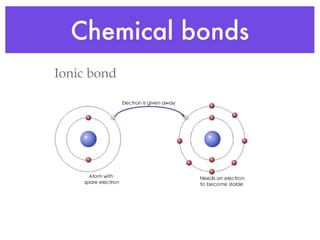
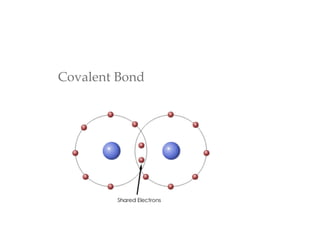
Basic Chemistry Atomic theory All matter is made of atoms Molecules are atoms bonded together Not all atoms can bind; depends on their nature Types of bonds Ionic - electrons ‘donated’, creating charge Covalent - electrons shared H bonds
Basic Chemistry Bonds can be strong or weak Chemicals form different shapes and the shape influences the activity of the chemical Chemical reactions are the basis for most life processes
Chemical bonds Ionic bond
Covalent Bond
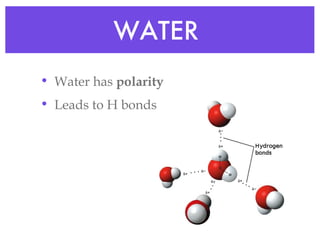
WATER  Water has  polarity Leads to H bonds
Water Water is a  solvent Dissolves ionic substances and other polar nonionic substances
Water Cohesion Water clings to itself Surface tension Adhesion Water clings to other stuff too How it gets in everywhere
Water High heat capacity T of water rises and falls slowly How organisms are able to live in a changing environment High heat of vaporization Has to be really hot to break H bonds and turn to steam
Water Ice is less dense  than liquid water Allows aquatic organisms to live underneath ice because it is on the surface
Carbon Because C forms 4 bonds, it is very versatile C chains are the basis of organic molecules (molecules containing C and H) Organic molecules are divided into 4 groups: Carbohydrates, Lipids, Proteins, Nucleic Acids Most are made up of polymers of different types of monomers
Carbohydrates Polymers of saccharides (sugars) Energy use Glucose Energy storage Starch in plants; glycogen in animals Structure Cellulose in plants; chitin
Lipids NOT soluble in water Fatty acid tails (usually 3) keep from dissolving Fats and oils; primary energy storage Fatty acid tails come in three varieties: Unsaturated, saturated, and trans
Lipids Not all lipids are bad! Phospholipids Have polar heads (water soluble); but non-polar tails (not soluble) This makes them arrange themselves in a bilayer These create the membranes of cells
Proteins Important to structure and function of cells Support Metabolism  Transport Defense Regulation Motion
Proteins Amino acids are the building blocks of proteins There are 20 amino acids- combine in different ways to form thousands of different proteins The ‘chain’ of amino acids determines its shape, and therefore its function
Proteins Function of protein is determined by its shape There are 4 levels of structure: Primary: the sequence of aa Secondary: alpha helix, pleated sheet- formed by H bonds between aa Tertiary: the globular shape Quaternary: more than one
Nucleic Acids DNA and RNA are the nucleic acids in cells Nucleotides are the monomers DNA stores genetic info RNA takes genetic info to site of protein synthesis
DNA Each nucleotide in DNA contains one of 4 different bases: adenine, guanine, cytosine, thymine G always bonds to C; A always bonds to T in double helix structure Very important to replication Every 3 bases stands for one amino acid So, if you know sequence of gene, you know sequence of protein
RNA RNA is single stranded The complementary pairs allow information to be passed to RNA from DNA; protein synthesis actually occurs from RNA
Nucleic Acids to Proteins Very small changes in a gene can potentially result in very large changes in protein Ex. Sickle cell: one aa difference
Cells! Why are cells small? Surface to volume ratio- gives adequate surface area for exchange of chemicals All cells have an outer  plasma membrane , which encloses the  cytoplasm
Cells Two main types of cells: prokaryotic and eukaryotic Prokaryotes do not have a membrane bound nucleus, eukaryotes do Bacteria are prokaryotes Extremely successful, widespread and necessary
Prokaryotic structure The membrane is surrounded by cell wall and sometimes capsule DNA of bacterium is in a region called the nucleoid Ribosomes produce proteins Appendages include flagella, fimbriae, and conjugation pilli
Bacteria Fun fact: bacteria can smell!

1b; chemistry, molecules

  • 1.
    Lecture 1b BasicChemistry Biological Molecules Introduction to Cells
  • 2.
    Basic Chemistry Atomictheory All matter is made of atoms Molecules are atoms bonded together Not all atoms can bind; depends on their nature Types of bonds Ionic - electrons ‘donated’, creating charge Covalent - electrons shared H bonds
  • 3.
    Basic Chemistry Bondscan be strong or weak Chemicals form different shapes and the shape influences the activity of the chemical Chemical reactions are the basis for most life processes
  • 4.
  • 5.
  • 6.
    WATER Waterhas polarity Leads to H bonds
  • 7.
    Water Water isa solvent Dissolves ionic substances and other polar nonionic substances
  • 8.
    Water Cohesion Waterclings to itself Surface tension Adhesion Water clings to other stuff too How it gets in everywhere
  • 9.
    Water High heatcapacity T of water rises and falls slowly How organisms are able to live in a changing environment High heat of vaporization Has to be really hot to break H bonds and turn to steam
  • 10.
    Water Ice isless dense than liquid water Allows aquatic organisms to live underneath ice because it is on the surface
  • 11.
    Carbon Because Cforms 4 bonds, it is very versatile C chains are the basis of organic molecules (molecules containing C and H) Organic molecules are divided into 4 groups: Carbohydrates, Lipids, Proteins, Nucleic Acids Most are made up of polymers of different types of monomers
  • 12.
    Carbohydrates Polymers ofsaccharides (sugars) Energy use Glucose Energy storage Starch in plants; glycogen in animals Structure Cellulose in plants; chitin
  • 13.
    Lipids NOT solublein water Fatty acid tails (usually 3) keep from dissolving Fats and oils; primary energy storage Fatty acid tails come in three varieties: Unsaturated, saturated, and trans
  • 14.
    Lipids Not alllipids are bad! Phospholipids Have polar heads (water soluble); but non-polar tails (not soluble) This makes them arrange themselves in a bilayer These create the membranes of cells
  • 15.
    Proteins Important tostructure and function of cells Support Metabolism Transport Defense Regulation Motion
  • 16.
    Proteins Amino acidsare the building blocks of proteins There are 20 amino acids- combine in different ways to form thousands of different proteins The ‘chain’ of amino acids determines its shape, and therefore its function
  • 17.
    Proteins Function ofprotein is determined by its shape There are 4 levels of structure: Primary: the sequence of aa Secondary: alpha helix, pleated sheet- formed by H bonds between aa Tertiary: the globular shape Quaternary: more than one
  • 18.
    Nucleic Acids DNAand RNA are the nucleic acids in cells Nucleotides are the monomers DNA stores genetic info RNA takes genetic info to site of protein synthesis
  • 19.
    DNA Each nucleotidein DNA contains one of 4 different bases: adenine, guanine, cytosine, thymine G always bonds to C; A always bonds to T in double helix structure Very important to replication Every 3 bases stands for one amino acid So, if you know sequence of gene, you know sequence of protein
  • 20.
    RNA RNA issingle stranded The complementary pairs allow information to be passed to RNA from DNA; protein synthesis actually occurs from RNA
  • 21.
    Nucleic Acids toProteins Very small changes in a gene can potentially result in very large changes in protein Ex. Sickle cell: one aa difference
  • 22.
    Cells! Why arecells small? Surface to volume ratio- gives adequate surface area for exchange of chemicals All cells have an outer plasma membrane , which encloses the cytoplasm
  • 23.
    Cells Two maintypes of cells: prokaryotic and eukaryotic Prokaryotes do not have a membrane bound nucleus, eukaryotes do Bacteria are prokaryotes Extremely successful, widespread and necessary
  • 24.
    Prokaryotic structure Themembrane is surrounded by cell wall and sometimes capsule DNA of bacterium is in a region called the nucleoid Ribosomes produce proteins Appendages include flagella, fimbriae, and conjugation pilli
  • 25.
    Bacteria Fun fact:bacteria can smell!