2c:
Photosynthesis
Photosynthesis
How plants turn sunlight into energy
Fuels all living organisms either
directly or indirectly
Chlorophyll (and a few other
pigments)are in the thylakoid
membranes: this absorbs solar energy
Also uses carbon dioxide and water
Oxidation and reduction
Reduction: gaining hydrogen atoms
Oxidation: losing hydrogen atoms
  Hydrogen has a +1 charge, it moves
  with electrons from solar energy,
  which have a -1 charge
  The electrons are what carry the energy
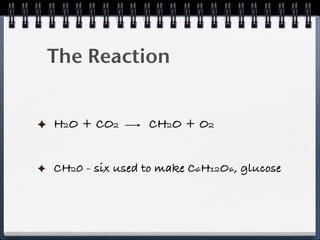
The Reaction


H2O + CO2       CH2O + O2


CH20 - six used to make C6H12O6, glucose
Photosynthesis
Two reactions occuring:
  Light reactions
     ATP produced and NADPH
     produced using solar energy
  Calvin cycle
     ATP and NADPH change carbon
     dioxide into carbohydrate
Light reactions

Chlorophyll absorbs violet, blue and red
light (why leaves look green)
Carotenoids absorb violet, blue and green
light (why leaves look red or yellow in
fall)
LR:Photosystems I and II
Photosystem II splits water
   Solar energy makes electrons so excited
   they escape from reaction center, which then
   takes electrons from water to replace them
Photosystem I produces NADPH from electrons
excited by solar energy
   PS I takes electrons from the above system
   to replace the ones it has lost
Electron Transport Chains

These are a series of molecules that pass
electrons (and H+) from one to the next
Basically a way for the energy stored in
these ions to be passed around from one
area to another, so it can be used for
things
DRAW THE CARTOON!!!!
H+ and potential energy
As water is split, two H+ remain in thylakoid
space, and energy from the electron transport
chain is used to move even more H+ into this
space
Creates POTENTIAL engery as the H+ want to
be evenly distributed
So they flow back into stroma at ATP synthase
complex - a membrane protein complex that uses
this energy to make ATP
Products of light rxns


Oxygen
ATP
NADPH
Calvin Cycle
Occur in stroma
First, attach CO2 to RuBP: fixation
Then, CO2 is reduced using NADPH and
ATP from the light reactions
  This makes G3P, the precursor to glucose
  but also many other biological molecules
Finally , RuBP is reformed to be used again
DRAW THE CARTOON!!!

2c; photosynthesis

  • 1.
  • 2.
    Photosynthesis How plants turnsunlight into energy Fuels all living organisms either directly or indirectly Chlorophyll (and a few other pigments)are in the thylakoid membranes: this absorbs solar energy Also uses carbon dioxide and water
  • 3.
    Oxidation and reduction Reduction:gaining hydrogen atoms Oxidation: losing hydrogen atoms Hydrogen has a +1 charge, it moves with electrons from solar energy, which have a -1 charge The electrons are what carry the energy
  • 4.
    The Reaction H2O +CO2 CH2O + O2 CH20 - six used to make C6H12O6, glucose
  • 5.
    Photosynthesis Two reactions occuring: Light reactions ATP produced and NADPH produced using solar energy Calvin cycle ATP and NADPH change carbon dioxide into carbohydrate
  • 6.
    Light reactions Chlorophyll absorbsviolet, blue and red light (why leaves look green) Carotenoids absorb violet, blue and green light (why leaves look red or yellow in fall)
  • 7.
    LR:Photosystems I andII Photosystem II splits water Solar energy makes electrons so excited they escape from reaction center, which then takes electrons from water to replace them Photosystem I produces NADPH from electrons excited by solar energy PS I takes electrons from the above system to replace the ones it has lost
  • 8.
    Electron Transport Chains Theseare a series of molecules that pass electrons (and H+) from one to the next Basically a way for the energy stored in these ions to be passed around from one area to another, so it can be used for things
  • 9.
  • 10.
    H+ and potentialenergy As water is split, two H+ remain in thylakoid space, and energy from the electron transport chain is used to move even more H+ into this space Creates POTENTIAL engery as the H+ want to be evenly distributed So they flow back into stroma at ATP synthase complex - a membrane protein complex that uses this energy to make ATP
  • 11.
    Products of lightrxns Oxygen ATP NADPH
  • 12.
    Calvin Cycle Occur instroma First, attach CO2 to RuBP: fixation Then, CO2 is reduced using NADPH and ATP from the light reactions This makes G3P, the precursor to glucose but also many other biological molecules Finally , RuBP is reformed to be used again
  • 13.

Editor's Notes