Mass Extinction - Definition
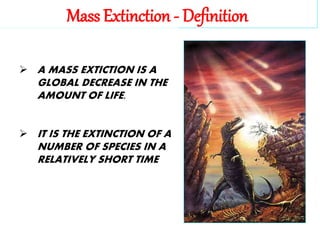
 A MASS EXTICTION IS A
GLOBAL DECREASE IN THE
AMOUNT OF LIFE.
 IT IS THE EXTINCTION OF A
NUMBER OF SPECIES IN A
RELATIVELY SHORT TIME
The 5 Major Mass Extinctions
Extinction
Ordovician-Silurian
End of Ordovician Mass Extinction – 443 Ma
70% of marine species became extinct
Main groups affected are Trilobites, Graptolites,
Echinoids, Brachiopods
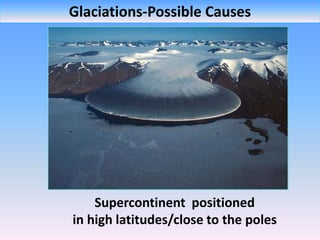
Glaciations-Possible Causes
Supercontinent positioned
in high latitudes/close to the poles
Glaciations-Effects on Ecosystems
Loss of habitat as ice masses grow
Could eventually lead to ‘Snowball Earth’ scenario
Global cooling.
A small minority of scientist have suggested
that the initial extinction could have been
caused by a gamma ray blast originating from
a hyper nova within 6000 Lys from earth.
A Gamma ray blast are a flashes of gamma rays
associated with extremely energetic high speed
particles and radiation moving in space.
 A mere ten seconds of blast could have
destroyed earth’s ozone layer.
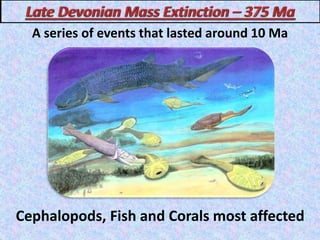
A series of events that lasted around 10 Ma
Cephalopods, Fish and Corals most affected
TERRESTRIAL PLANT
New root
system Decreased CO2
Boosted soil formation
Releasing nutrients into seas &
ocean
Algae boom
Anoxia
Chiller climate
Glaciation
TERRESTRIAL PLANT
New root
system Decreased CO2
Boosted soil formation
Releasing nutrients into seas &
ocean
Eutrophication
Anoxia
PERMIAN-TRIASSIC
EXTINCTION
The largest mass extinction event removing 95% of
marine species and 50% of marine families
Trilobites, Cephalopods, Bryozoans,
Corals, Crinoids badly affected
Major faunal and floral overturn on land
Marks the boundary between dominance
by the Palaeozoic and Modern Fauna
Methane Hydrates in Ocean Floor Sediments
Global warming may result
in deep ocean temperatures
rising and the release of
large volumes of methane
from ocean sediments
The rapid release of large
amounts of methane into
the atmosphere will result
in highly accelerated
global warming
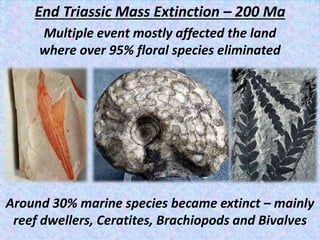
End Triassic Mass Extinction – 200 Ma
Multiple event mostly affected the land
where over 95% floral species eliminated
Around 30% marine species became extinct – mainly
reef dwellers, Ceratites, Brachiopods and Bivalves
Pangea broke up and eventually splitting
America from Europe and Africa and forming
the Atlantic ocean.
The Central American Magmatic Province
had begun to erupt huge amount of basalt lava
Billions of tonnes of
carbon dioxide and
sulphur dioxide released
into the atmosphere
during eruptions
Both are powerful
greenhouse gases and
will contribute to very
rapid global warming
When it rains the sulphur dioxide will come
back down to Earth dissolved in rainwater and
the acid rain will kill vegetation on a large scale
CO2 will cause global warming.
Rise in sea level
Global anoxia.
CRETACEOUS–PALEOGENE
EXTINCTION
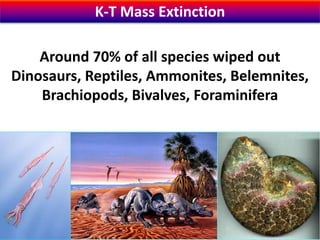
K-T Mass Extinction
Around 70% of all species wiped out
Dinosaurs, Reptiles, Ammonites, Belemnites,
Brachiopods, Bivalves, Foraminifera
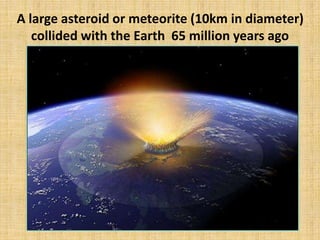
A large asteroid or meteorite (10km in diameter)
collided with the Earth 65 million years ago
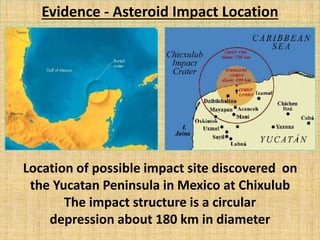
Evidence - Asteroid Impact Location
Location of possible impact site discovered on
the Yucatan Peninsula in Mexico at Chixulub
The impact structure is a circular
depression about 180 km in diameter
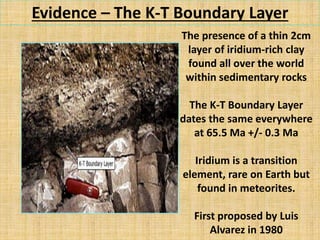
Evidence – The K-T Boundary Layer
The presence of a thin 2cm
layer of iridium-rich clay
found all over the world
within sedimentary rocks
The K-T Boundary Layer
dates the same everywhere
at 65.5 Ma +/- 0.3 Ma
Iridium is a transition
element, rare on Earth but
found in meteorites.
First proposed by Luis
Alvarez in 1980
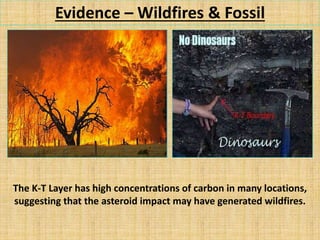
Evidence – Wildfires & Fossil
The K-T Layer has high concentrations of carbon in many locations,
suggesting that the asteroid impact may have generated wildfires.
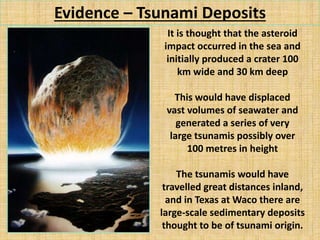
Evidence – Tsunami Deposits
It is thought that the asteroid
impact occurred in the sea and
initially produced a crater 100
km wide and 30 km deep
This would have displaced
vast volumes of seawater and
generated a series of very
large tsunamis possibly over
100 metres in height
The tsunamis would have
travelled great distances inland,
and in Texas at Waco there are
large-scale sedimentary deposits
thought to be of tsunami origin.
Evidence – Tsunami Deposits
The tsunami deposits in Waco, Texas are thought to be
from the waves generated by the K-T asteroid impact.
The sediments are estimated to have been deposited at
least 300km inland by the tsunamis!
Flood Basalt Eruptions 66 Ma – The Deccan Traps
Lasted over a period of 2 My .
Over 2000 metres thick and cover 500,000 km²
May have originally covered 1,500,000 km²
Released dust and sulphuric aerosols and blocking sunlight
thus reduced photosynthesis.
Also emitted CO2 .
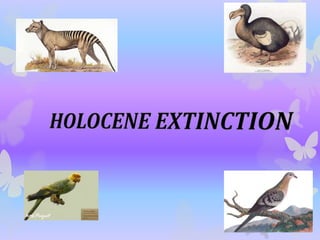
Holocene Extinction
The Earth is currently losing about 30,000 species
of plants, animals and insects a year.
That is about 3 species every hour! Lost forever.
It will take millions of years to repair what we
destroy in just a few decades.
CAUSES
Rising CO2 levels
Habitat destruction
Invasive species
Pollution
Over harvesting
How You Can Help
 Turn lights and appliances off when not using
them.
 Use energy efficient light bulbs.
 Make space for wildlife. Build a birdhouse , plant a
tree, compost your wastes and don’t use harmful
chemicals in your home or garden.
 Recycle, Reduce and Reuse.
That’s All Folks!
THANK
YOU..!!!

Mass extinction

  • 2.
    Mass Extinction -Definition  A MASS EXTICTION IS A GLOBAL DECREASE IN THE AMOUNT OF LIFE.  IT IS THE EXTINCTION OF A NUMBER OF SPECIES IN A RELATIVELY SHORT TIME
  • 3.
    The 5 MajorMass Extinctions
  • 4.
  • 5.
    End of OrdovicianMass Extinction – 443 Ma 70% of marine species became extinct Main groups affected are Trilobites, Graptolites, Echinoids, Brachiopods
  • 6.
  • 7.
    Glaciations-Effects on Ecosystems Lossof habitat as ice masses grow Could eventually lead to ‘Snowball Earth’ scenario Global cooling.
  • 8.
    A small minorityof scientist have suggested that the initial extinction could have been caused by a gamma ray blast originating from a hyper nova within 6000 Lys from earth. A Gamma ray blast are a flashes of gamma rays associated with extremely energetic high speed particles and radiation moving in space.  A mere ten seconds of blast could have destroyed earth’s ozone layer.
  • 10.
    A series ofevents that lasted around 10 Ma Cephalopods, Fish and Corals most affected
  • 11.
    TERRESTRIAL PLANT New root systemDecreased CO2 Boosted soil formation Releasing nutrients into seas & ocean Algae boom Anoxia Chiller climate Glaciation TERRESTRIAL PLANT New root system Decreased CO2 Boosted soil formation Releasing nutrients into seas & ocean Eutrophication Anoxia
  • 12.
  • 13.
    The largest massextinction event removing 95% of marine species and 50% of marine families Trilobites, Cephalopods, Bryozoans, Corals, Crinoids badly affected Major faunal and floral overturn on land Marks the boundary between dominance by the Palaeozoic and Modern Fauna
  • 16.
    Methane Hydrates inOcean Floor Sediments Global warming may result in deep ocean temperatures rising and the release of large volumes of methane from ocean sediments The rapid release of large amounts of methane into the atmosphere will result in highly accelerated global warming
  • 18.
    End Triassic MassExtinction – 200 Ma Multiple event mostly affected the land where over 95% floral species eliminated Around 30% marine species became extinct – mainly reef dwellers, Ceratites, Brachiopods and Bivalves
  • 19.
    Pangea broke upand eventually splitting America from Europe and Africa and forming the Atlantic ocean. The Central American Magmatic Province had begun to erupt huge amount of basalt lava
  • 20.
    Billions of tonnesof carbon dioxide and sulphur dioxide released into the atmosphere during eruptions Both are powerful greenhouse gases and will contribute to very rapid global warming
  • 21.
    When it rainsthe sulphur dioxide will come back down to Earth dissolved in rainwater and the acid rain will kill vegetation on a large scale CO2 will cause global warming. Rise in sea level Global anoxia.
  • 23.
  • 24.
    K-T Mass Extinction Around70% of all species wiped out Dinosaurs, Reptiles, Ammonites, Belemnites, Brachiopods, Bivalves, Foraminifera
  • 25.
    A large asteroidor meteorite (10km in diameter) collided with the Earth 65 million years ago
  • 26.
    Evidence - AsteroidImpact Location Location of possible impact site discovered on the Yucatan Peninsula in Mexico at Chixulub The impact structure is a circular depression about 180 km in diameter
  • 27.
    Evidence – TheK-T Boundary Layer The presence of a thin 2cm layer of iridium-rich clay found all over the world within sedimentary rocks The K-T Boundary Layer dates the same everywhere at 65.5 Ma +/- 0.3 Ma Iridium is a transition element, rare on Earth but found in meteorites. First proposed by Luis Alvarez in 1980
  • 28.
    Evidence – Wildfires& Fossil The K-T Layer has high concentrations of carbon in many locations, suggesting that the asteroid impact may have generated wildfires.
  • 29.
    Evidence – TsunamiDeposits It is thought that the asteroid impact occurred in the sea and initially produced a crater 100 km wide and 30 km deep This would have displaced vast volumes of seawater and generated a series of very large tsunamis possibly over 100 metres in height The tsunamis would have travelled great distances inland, and in Texas at Waco there are large-scale sedimentary deposits thought to be of tsunami origin.
  • 30.
    Evidence – TsunamiDeposits The tsunami deposits in Waco, Texas are thought to be from the waves generated by the K-T asteroid impact. The sediments are estimated to have been deposited at least 300km inland by the tsunamis!
  • 31.
    Flood Basalt Eruptions66 Ma – The Deccan Traps Lasted over a period of 2 My . Over 2000 metres thick and cover 500,000 km² May have originally covered 1,500,000 km² Released dust and sulphuric aerosols and blocking sunlight thus reduced photosynthesis. Also emitted CO2 .
  • 33.
    Holocene Extinction The Earthis currently losing about 30,000 species of plants, animals and insects a year. That is about 3 species every hour! Lost forever. It will take millions of years to repair what we destroy in just a few decades.
  • 34.
    CAUSES Rising CO2 levels Habitatdestruction Invasive species Pollution Over harvesting
  • 35.
    How You CanHelp  Turn lights and appliances off when not using them.  Use energy efficient light bulbs.  Make space for wildlife. Build a birdhouse , plant a tree, compost your wastes and don’t use harmful chemicals in your home or garden.  Recycle, Reduce and Reuse.
  • 36.