The Origin of Species
AP Biology
AP Biology
Crosby High School
Crosby High School
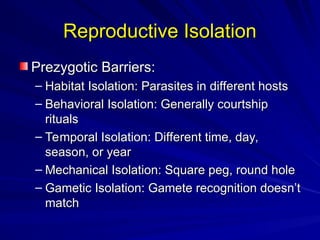
Reproductive Isolation
Prezygotic Barriers:
– Habitat Isolation: Parasites in different hosts
Habitat Isolation: Parasites in different hosts
– Behavioral Isolation: Generally courtship
Behavioral Isolation: Generally courtship
rituals
rituals
– Temporal Isolation: Different time, day,
Temporal Isolation: Different time, day,
season, or year
season, or year
– Mechanical Isolation: Square peg, round hole
Mechanical Isolation: Square peg, round hole
– Gametic Isolation: Gamete recognition doesn’t
Gametic Isolation: Gamete recognition doesn’t
match
match
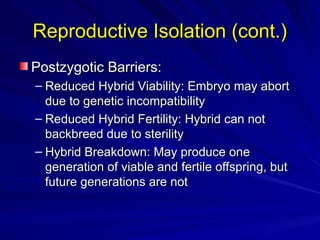
Reproductive Isolation (cont.)
Postzygotic Barriers:
– Reduced Hybrid Viability: Embryo may abort
Reduced Hybrid Viability: Embryo may abort
due to genetic incompatibility
– Reduced Hybrid Fertility: Hybrid can not
Reduced Hybrid Fertility: Hybrid can not
backbreed due to sterility
– Hybrid Breakdown: May produce one
Hybrid Breakdown: May produce one
generation of viable and fertile offspring, but
future generations are not
Classifying a Species
Biological Species: emphasizes
reproductive isolation
Ecological Species: Species defined by
ecological niche
ecological niche
Pluralistic Species: Reproductive or niche
Morphological Species: Unique set of
structural features
structural features
Geneological Species: Unique genetic
history
history
Allopatric Speciation
Conditions
Conditions
– Separated by a geographical feature
Separated by a geographical feature
– Changes must prevent interbreeding
Changes must prevent interbreeding
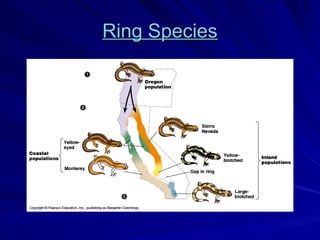
Ring Species
Ring Species
– California Salamanders more distant to the
California Salamanders more distant to the
south
south
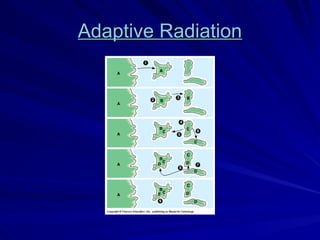
Adaptive Radiation
Adaptive Radiation
– Diversely adapted species from common
Diversely adapted species from common
ancestor
ancestor
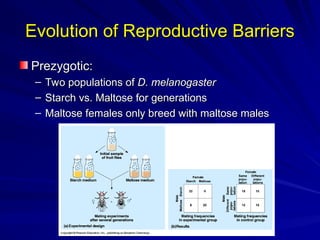
Evolution of Reproductive Barriers
Prezygotic:
Prezygotic:
– Two populations of
Two populations of D. melanogaster
D. melanogaster
– Starch vs. Maltose for generations
Starch vs. Maltose for generations
– Maltose females only breed with maltose males
Maltose females only breed with maltose males
Sympatric Speciation
Polyploid Speciation in Plants
– 2n
2n 
 4n
4n
– 4n can self pollinate or mate with other 4n
4n can self pollinate or mate with other 4n
– Oats, cotton, potatoes, tabacco, wheat
Oats, cotton, potatoes, tabacco, wheat
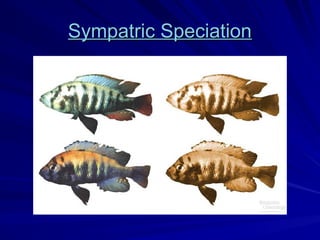
Sympatric Speciation in Animals
– Pundamilia pundamilia
Pundamilia pundamilia vs.
vs. Pundamilia
Pundamilia
nyererei
nyererei
– Normal light vs. monochromatic orange
Normal light vs. monochromatic orange
Evolutionary Time
Evolutionary Time
“
“Although each species must have passed
Although each species must have passed
through numerous transitional stages, it is
probable that the periods during which
each underwent modification, though
many and long as measured by years,
have been short in comparison with the
periods during which each remained in an
unchanged condition.”
-Charles Darwin
-Charles Darwin
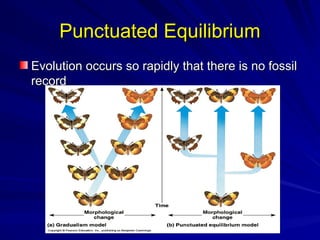
Punctuated Equilibrium
Evolution occurs so rapidly that there is no fossil
record
record
Eye Development
Eye Development
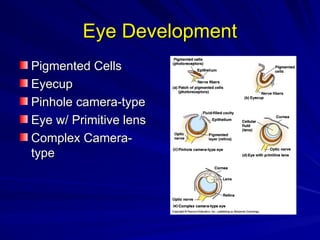
Pigmented Cells
Pigmented Cells
Eyecup
Eyecup
Pinhole camera-type
Pinhole camera-type
Eye w/ Primitive lens
Complex Camera-
Complex Camera-
type
type
Exaptations
Exaptations
Develop for one purpose, but later end up
serving another
serving another
Birds
Birds
– Honeycombed bones
Honeycombed bones
Original: light for agility
Present: light for flight
– Feathers
Feathers
Original: Display for mating
Present: flight
Present: flight
Evo - Devo
Evo - Devo
Allometric Growth: Growth rates create
proportioning for each species
– Heterochrony: Evolutionary change in rate or
Heterochrony: Evolutionary change in rate or
timing of developmental events
– Paedomorphosis: Rate of reproductive
Paedomorphosis: Rate of reproductive
development accelerates compared to
somatic
somatic
– Homeotic genes: Determine placement and
Homeotic genes: Determine placement and
spatial organization of body parts
Hox genes
Hox genes
Evolutionary Trends
Evolutionary Trends
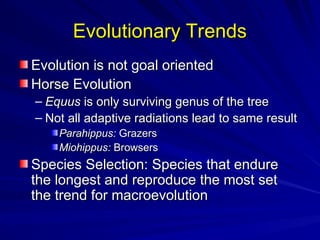
Evolution is not goal oriented
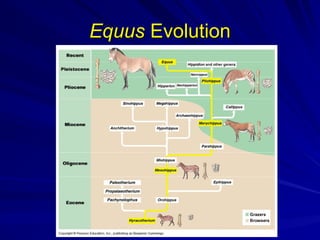
Horse Evolution
Horse Evolution
– Equus
Equus is only surviving genus of the tree
is only surviving genus of the tree
– Not all adaptive radiations lead to same result
Not all adaptive radiations lead to same result
Parahippus:
Parahippus: Grazers
Grazers
Miohippus:
Miohippus: Browsers
Browsers
Species Selection: Species that endure
the longest and reproduce the most set
the trend for macroevolution
Equus
Equus Evolution
Evolution
Sympatric Speciation
Ring Species
Ring Species
Adaptive Radiation
Adaptive Radiation

The_Origin_of_Species.ppt,.................

  • 1.
    The Origin ofSpecies The Origin of Species AP Biology AP Biology Crosby High School Crosby High School
  • 2.
    Reproductive Isolation Reproductive Isolation PrezygoticBarriers: Prezygotic Barriers: – Habitat Isolation: Parasites in different hosts Habitat Isolation: Parasites in different hosts – Behavioral Isolation: Generally courtship Behavioral Isolation: Generally courtship rituals rituals – Temporal Isolation: Different time, day, Temporal Isolation: Different time, day, season, or year season, or year – Mechanical Isolation: Square peg, round hole Mechanical Isolation: Square peg, round hole – Gametic Isolation: Gamete recognition doesn’t Gametic Isolation: Gamete recognition doesn’t match match
  • 3.
    Reproductive Isolation (cont.) ReproductiveIsolation (cont.) Postzygotic Barriers: Postzygotic Barriers: – Reduced Hybrid Viability: Embryo may abort Reduced Hybrid Viability: Embryo may abort due to genetic incompatibility due to genetic incompatibility – Reduced Hybrid Fertility: Hybrid can not Reduced Hybrid Fertility: Hybrid can not backbreed due to sterility backbreed due to sterility – Hybrid Breakdown: May produce one Hybrid Breakdown: May produce one generation of viable and fertile offspring, but generation of viable and fertile offspring, but future generations are not future generations are not
  • 4.
    Classifying a Species Classifyinga Species Biological Species: emphasizes Biological Species: emphasizes reproductive isolation reproductive isolation Ecological Species: Species defined by Ecological Species: Species defined by ecological niche ecological niche Pluralistic Species: Reproductive or niche Pluralistic Species: Reproductive or niche Morphological Species: Unique set of Morphological Species: Unique set of structural features structural features Geneological Species: Unique genetic Geneological Species: Unique genetic history history
  • 5.
    Allopatric Speciation Allopatric Speciation Conditions Conditions –Separated by a geographical feature Separated by a geographical feature – Changes must prevent interbreeding Changes must prevent interbreeding Ring Species Ring Species – California Salamanders more distant to the California Salamanders more distant to the south south Adaptive Radiation Adaptive Radiation – Diversely adapted species from common Diversely adapted species from common ancestor ancestor
  • 6.
    Evolution of ReproductiveBarriers Evolution of Reproductive Barriers Prezygotic: Prezygotic: – Two populations of Two populations of D. melanogaster D. melanogaster – Starch vs. Maltose for generations Starch vs. Maltose for generations – Maltose females only breed with maltose males Maltose females only breed with maltose males
  • 7.
    Sympatric Speciation Sympatric Speciation PolyploidSpeciation in Plants Polyploid Speciation in Plants – 2n 2n   4n 4n – 4n can self pollinate or mate with other 4n 4n can self pollinate or mate with other 4n – Oats, cotton, potatoes, tabacco, wheat Oats, cotton, potatoes, tabacco, wheat Sympatric Speciation in Animals Sympatric Speciation in Animals – Pundamilia pundamilia Pundamilia pundamilia vs. vs. Pundamilia Pundamilia nyererei nyererei – Normal light vs. monochromatic orange Normal light vs. monochromatic orange
  • 8.
    Evolutionary Time Evolutionary Time “ “Althougheach species must have passed Although each species must have passed through numerous transitional stages, it is through numerous transitional stages, it is probable that the periods during which probable that the periods during which each underwent modification, though each underwent modification, though many and long as measured by years, many and long as measured by years, have been short in comparison with the have been short in comparison with the periods during which each remained in an periods during which each remained in an unchanged condition.” unchanged condition.” -Charles Darwin -Charles Darwin
  • 9.
    Punctuated Equilibrium Punctuated Equilibrium Evolutionoccurs so rapidly that there is no fossil Evolution occurs so rapidly that there is no fossil record record
  • 10.
    Eye Development Eye Development PigmentedCells Pigmented Cells Eyecup Eyecup Pinhole camera-type Pinhole camera-type Eye w/ Primitive lens Eye w/ Primitive lens Complex Camera- Complex Camera- type type
  • 11.
    Exaptations Exaptations Develop for onepurpose, but later end up Develop for one purpose, but later end up serving another serving another Birds Birds – Honeycombed bones Honeycombed bones Original: light for agility Original: light for agility Present: light for flight Present: light for flight – Feathers Feathers Original: Display for mating Original: Display for mating Present: flight Present: flight
  • 12.
    Evo - Devo Evo- Devo Allometric Growth: Growth rates create Allometric Growth: Growth rates create proportioning for each species proportioning for each species – Heterochrony: Evolutionary change in rate or Heterochrony: Evolutionary change in rate or timing of developmental events timing of developmental events – Paedomorphosis: Rate of reproductive Paedomorphosis: Rate of reproductive development accelerates compared to development accelerates compared to somatic somatic – Homeotic genes: Determine placement and Homeotic genes: Determine placement and spatial organization of body parts spatial organization of body parts Hox genes Hox genes
  • 13.
    Evolutionary Trends Evolutionary Trends Evolutionis not goal oriented Evolution is not goal oriented Horse Evolution Horse Evolution – Equus Equus is only surviving genus of the tree is only surviving genus of the tree – Not all adaptive radiations lead to same result Not all adaptive radiations lead to same result Parahippus: Parahippus: Grazers Grazers Miohippus: Miohippus: Browsers Browsers Species Selection: Species that endure Species Selection: Species that endure the longest and reproduce the most set the longest and reproduce the most set the trend for macroevolution the trend for macroevolution
  • 14.
  • 15.
  • 16.
  • 17.