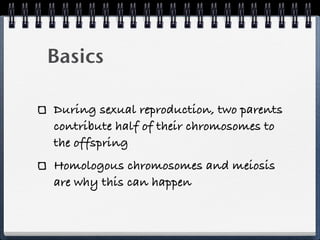
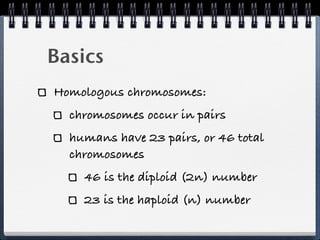
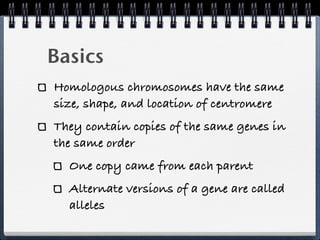
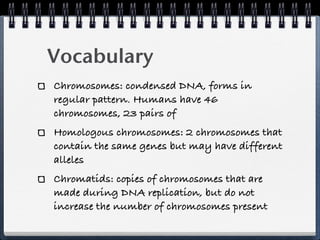
During sexual reproduction, two parents each contribute half of their chromosomes to offspring. Homologous chromosomes, which contain the same genes in the same order but may have different alleles, allow this to happen. Meiosis is a two-step cell division process that reduces the number of chromosomes in a cell from diploid to haploid. This includes a first meiotic division that separates homologous chromosome pairs, and a second division that separates sister chromatids, resulting in four haploid daughter cells each with a unique combination of chromosomes.


![5G Explained! A High Level Overview [Introduction]](https://cdn.slidesharecdn.com/ss_thumbnails/5gexplainedahighleveloverview-260119165306-cc137a3e-thumbnail.jpg?width=640&height=640&fit=bounds)


