Prepared by:-
Dr. Anukriti Nigam
Fergusson College (Auto.) Pune.
PRINCIPLES OF ANIMAL DISTRIBUTION
Jordan and Kellog proposed three laws that
govern distribution and postulated that every
species should be found everywhere unless:
It was unable to reach the place where it is
absent due to barriers.
It was unable to stay and adapt there because
of unfavourable conditions.
It became modifies into another species due to
directional selection.
Other principles of distribution are as follows:-
1. Species are distributed in areas where they are most adapted.
2. Different barriers act differently for different species depending on
their modes of locomotion and dispersal.
3. Poikilotherms generally spread slowly as compared to homeotherms.
4. Food, temp., water etc. restrict animals to an area even without
barriers.
5. Parasites disperse with their hosts and predators along with prey.
6. Majority of birds do not face any physical barriers due to their ability
to fly over them.
7. Low temperature prevents tropical animals to migrate northwards and
polar and temperate animals to migrate southwards.
8. For aquatic animals land is the barrier while for terrestrial animals
sea, rivers and lakes are physical barriers.
9. Oceans act as barriers for freshwater fishes and amphibians due to
osmotic problems.
Types of animal distribution: Animal distribution is of
following types:-
1. Distribution in space: This is the distribution of
animals in earth surface including land and water. This
is again sub divided into two types:-
A. Geographical or Horizontal Distribution:
B. Bathymetric or vertical Distribution:
a) Limnobiotic Distribution:
b) Holobiotic Distribution:
c) Geobiotic Distribution:
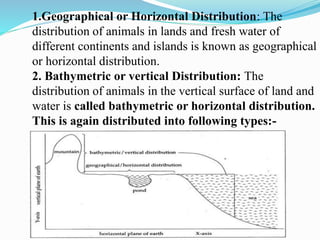
1.Geographical or Horizontal Distribution: The
distribution of animals in lands and fresh water of
different continents and islands is known as geographical
or horizontal distribution.
2. Bathymetric or vertical Distribution: The
distribution of animals in the vertical surface of land and
water is called bathymetric or horizontal distribution.
This is again distributed into following types:-
2. Bathymetric or vertical Distribution:
Divided into……
a) Limnobiotic Distribution: It is
distribution of animals in fresh water.
b) Holobiotic Distribution:
Distribution of animals in sea.
c) Geobiotic Distribution: Distribution
of animal on land
Type # 2. Distribution in Time:
The distribution of animals in the past of Earth’s
history is called the distribution in time.
 This can be studied by fossil evidences only. The
description of this type of distribution can be made on
the Geological time scale.
 Patterns of Distribution: There are generally four
types of pattern recognised for animal distribution:
(a) Arctic distribution
(b) Tropical distribution
(c) Continuous distribution, and
(d) Discontinuous distribution.
a) Arctic Distribution: In this time phase
number of species is found in arctic or
Antarctic with no existence of species in
intermediate water. This type of distribution
is also called bipolar distribution and
phenomenon is called bipolarity.
(i) Coelenterats: Botrynema, Grammaria, Lampta,
Myriothela
(ii) Molluscs: Limacina helicina, Clione
(iii) Arthropoda: Peripatus
(iv) Ascidian: Didetnnus albidum
(v) Fishes: Oncorhynchus (salmon), Latnma cornubica
(vi) Birds: Aptenodytes (Penguin)
b) Tropical Distribution:
The distribution of animals in between the
landmass of tropic of cancer and
tropic of Capricorn is called tropical
distribution.
C) Continuous Distribution:
This is also called cosmopolitan
distribution when an animal species is
found over a wide area.
Examples:
(i) Mollusca: The green mussel (Mytilus)
(ii) Arthropoda: Brine shrimp (Artemia
salina), cockroach (Periplaneta)
(iii) Birds: Hawks, cuckoo
(iv) Mammals: Rats, bats, etc.
Discontinuous Distribution:
When different species of same genus or
different animals of same species are
distributed in different part of earth is
called discontinuous distribution.
Other classification:-
Generally distribution can be classified into
three categories, namely, Continuous,
Discontinuous and Bipolar distribution.
1.Continuous
2. Discontinuous
3. Bipolar distribution. Some species
because they are adapted to the cold arctic
climate cannot migrate to the warmer areas
and hence restricted to the Polar Regions.
Origin of Discontinuous Distribution:
 There are several theories on the mode of origin of
discontinuous distribution of animals. Among these,
theories of P. J. Darlington (1957) and P. B. Weitz
(1966) are accepted by the scientists. P. J. Darlington
proposed that discontinuity in the distribution of
animals may be due to;
(i) Reaching the oceanic islands across the water,
(ii) By the submergence of the landmass in between
the ranges, and
(iii) By the extinction of the forms in the intermediate
areas.
The Passage of Animal Distribution:
 According to Weitz the animals can be distributed in
the following means:
1.Sweeps take Bridges
2. Filter Bridge
3. Corridor Bridge:-
 Panama Corridor.
 Arctic Corridor
 Antarctica Corridor..
4. Winds and storms
5. Through birds
6 . Human agency.
Theories of Distribution
Brown’s theory of centrifugal speciation.
Age and area theory of Willis.
 Climate and evolution theory of
Matthew
Continental drift theory
Barriers to Animal Distribution
 The following points highlight the top two barriers to animal
distribution.
 The barriers are:
 1. Extrinsic Barriers
 2. Intrinsic Barriers.
 Animal Distribution: Barrier # 1. Extrinsic Barriers:
Those barriers working from outside of an individual’s
body of the population are extrinsic barriers.
 Extrinsic barriers are generally of three types:
 (a) Physiographic
 (b) Biotic and
 (c) Climatic barriers.
(a) Physiographic Barriers:
 It can further be described under following heads:
(i) Topographical Barriers.
(ii) Large bodies of Water.
(iii) Large bodies of Land Masses.
(iv) Impurity and Lack of Salinity of Sea Water.
(v) Vegetative Barriers.
(vi) Desert.
(vii) Pressure and
(viii) Ice mass.
(b) Biotic Barrier
The biotic barriers include food, enemies
and competition from other living
organisms.
(i) Food
(ii) Enemies
(iii) Competition
(c) Climatic Barriers:
The abiotic factors, which can act as
barrier to animal distribution are
considered under this group.
These are:
(i) Temperature,
(ii) Rainfall,
(iii) Solar radiation and
(iv) Photoperiodism.
Animal Distribution: Barrier 2. Intrinsic Barriers:
The barriers which result from the nature
and behaviour of an animal is called
intrinsic barrier. They are described below.
(a) Philopatry
(b) Homing Instinct
(c) Parental Care
(d) Habitat Selection
THANK YOU

Animal distribution

  • 1.
    Prepared by:- Dr. AnukritiNigam Fergusson College (Auto.) Pune.
  • 2.
    PRINCIPLES OF ANIMALDISTRIBUTION Jordan and Kellog proposed three laws that govern distribution and postulated that every species should be found everywhere unless: It was unable to reach the place where it is absent due to barriers. It was unable to stay and adapt there because of unfavourable conditions. It became modifies into another species due to directional selection.
  • 3.
    Other principles ofdistribution are as follows:- 1. Species are distributed in areas where they are most adapted. 2. Different barriers act differently for different species depending on their modes of locomotion and dispersal. 3. Poikilotherms generally spread slowly as compared to homeotherms. 4. Food, temp., water etc. restrict animals to an area even without barriers. 5. Parasites disperse with their hosts and predators along with prey. 6. Majority of birds do not face any physical barriers due to their ability to fly over them. 7. Low temperature prevents tropical animals to migrate northwards and polar and temperate animals to migrate southwards. 8. For aquatic animals land is the barrier while for terrestrial animals sea, rivers and lakes are physical barriers. 9. Oceans act as barriers for freshwater fishes and amphibians due to osmotic problems.
  • 4.
    Types of animaldistribution: Animal distribution is of following types:- 1. Distribution in space: This is the distribution of animals in earth surface including land and water. This is again sub divided into two types:- A. Geographical or Horizontal Distribution: B. Bathymetric or vertical Distribution: a) Limnobiotic Distribution: b) Holobiotic Distribution: c) Geobiotic Distribution:
  • 5.
    1.Geographical or HorizontalDistribution: The distribution of animals in lands and fresh water of different continents and islands is known as geographical or horizontal distribution. 2. Bathymetric or vertical Distribution: The distribution of animals in the vertical surface of land and water is called bathymetric or horizontal distribution. This is again distributed into following types:-
  • 6.
    2. Bathymetric orvertical Distribution: Divided into…… a) Limnobiotic Distribution: It is distribution of animals in fresh water. b) Holobiotic Distribution: Distribution of animals in sea. c) Geobiotic Distribution: Distribution of animal on land
  • 7.
    Type # 2.Distribution in Time: The distribution of animals in the past of Earth’s history is called the distribution in time.  This can be studied by fossil evidences only. The description of this type of distribution can be made on the Geological time scale.  Patterns of Distribution: There are generally four types of pattern recognised for animal distribution: (a) Arctic distribution (b) Tropical distribution (c) Continuous distribution, and (d) Discontinuous distribution.
  • 8.
    a) Arctic Distribution:In this time phase number of species is found in arctic or Antarctic with no existence of species in intermediate water. This type of distribution is also called bipolar distribution and phenomenon is called bipolarity. (i) Coelenterats: Botrynema, Grammaria, Lampta, Myriothela (ii) Molluscs: Limacina helicina, Clione (iii) Arthropoda: Peripatus (iv) Ascidian: Didetnnus albidum (v) Fishes: Oncorhynchus (salmon), Latnma cornubica (vi) Birds: Aptenodytes (Penguin)
  • 9.
    b) Tropical Distribution: Thedistribution of animals in between the landmass of tropic of cancer and tropic of Capricorn is called tropical distribution.
  • 10.
    C) Continuous Distribution: Thisis also called cosmopolitan distribution when an animal species is found over a wide area. Examples: (i) Mollusca: The green mussel (Mytilus) (ii) Arthropoda: Brine shrimp (Artemia salina), cockroach (Periplaneta) (iii) Birds: Hawks, cuckoo (iv) Mammals: Rats, bats, etc.
  • 11.
    Discontinuous Distribution: When differentspecies of same genus or different animals of same species are distributed in different part of earth is called discontinuous distribution.
  • 12.
    Other classification:- Generally distributioncan be classified into three categories, namely, Continuous, Discontinuous and Bipolar distribution. 1.Continuous 2. Discontinuous 3. Bipolar distribution. Some species because they are adapted to the cold arctic climate cannot migrate to the warmer areas and hence restricted to the Polar Regions.
  • 13.
    Origin of DiscontinuousDistribution:  There are several theories on the mode of origin of discontinuous distribution of animals. Among these, theories of P. J. Darlington (1957) and P. B. Weitz (1966) are accepted by the scientists. P. J. Darlington proposed that discontinuity in the distribution of animals may be due to; (i) Reaching the oceanic islands across the water, (ii) By the submergence of the landmass in between the ranges, and (iii) By the extinction of the forms in the intermediate areas.
  • 14.
    The Passage ofAnimal Distribution:  According to Weitz the animals can be distributed in the following means: 1.Sweeps take Bridges 2. Filter Bridge 3. Corridor Bridge:-  Panama Corridor.  Arctic Corridor  Antarctica Corridor.. 4. Winds and storms 5. Through birds 6 . Human agency.
  • 15.
    Theories of Distribution Brown’stheory of centrifugal speciation. Age and area theory of Willis.  Climate and evolution theory of Matthew Continental drift theory
  • 16.
    Barriers to AnimalDistribution  The following points highlight the top two barriers to animal distribution.  The barriers are:  1. Extrinsic Barriers  2. Intrinsic Barriers.  Animal Distribution: Barrier # 1. Extrinsic Barriers: Those barriers working from outside of an individual’s body of the population are extrinsic barriers.  Extrinsic barriers are generally of three types:  (a) Physiographic  (b) Biotic and  (c) Climatic barriers.
  • 17.
    (a) Physiographic Barriers: It can further be described under following heads: (i) Topographical Barriers. (ii) Large bodies of Water. (iii) Large bodies of Land Masses. (iv) Impurity and Lack of Salinity of Sea Water. (v) Vegetative Barriers. (vi) Desert. (vii) Pressure and (viii) Ice mass.
  • 18.
    (b) Biotic Barrier Thebiotic barriers include food, enemies and competition from other living organisms. (i) Food (ii) Enemies (iii) Competition
  • 19.
    (c) Climatic Barriers: Theabiotic factors, which can act as barrier to animal distribution are considered under this group. These are: (i) Temperature, (ii) Rainfall, (iii) Solar radiation and (iv) Photoperiodism.
  • 20.
    Animal Distribution: Barrier2. Intrinsic Barriers: The barriers which result from the nature and behaviour of an animal is called intrinsic barrier. They are described below. (a) Philopatry (b) Homing Instinct (c) Parental Care (d) Habitat Selection
  • 21.