Lecture 4: Phylogeny and the Tree of Life 
Campbell & Reece: 
Chapter 26
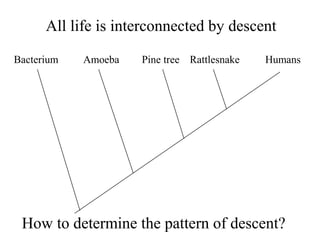
All life is interconnected by descent 
Bacterium Amoeba Pine tree Rattlesnake Humans 
How to determine the pattern of descent?
Systematics - field of biology dealing with 
diversity and evolutionary history of life 
Includes Taxonomy: DINC 
Description 
Identification 
Nomenclature 
Classification 
Goal: 
– Determine Evolutionary History (Phylogeny) of Life
Description 
= assign features 
Character = a feature (e.g., “petal color”) 
Character states = two or more forms of a 
character (e.g., “red,” “white”).
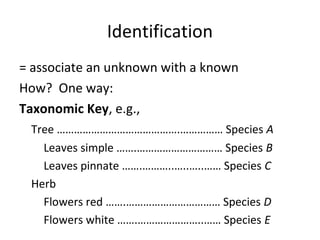
Identification 
= associate an unknown with a known 
How? One way: 
Taxonomic Key, e.g., 
Tree …………………………………….…………… Species A 
Leaves simple …….………………………… Species B 
Leaves pinnate …….………..…..…..…… Species C 
Herb 
Flowers red …….…………………………… Species D 
Flowers white …….…………………..…… Species E
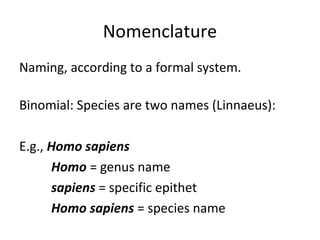
Nomenclature 
Naming, according to a formal system. 
Binomial: Species are two names (Linnaeus): 
E.g., Homo sapiens 
Homo = genus name 
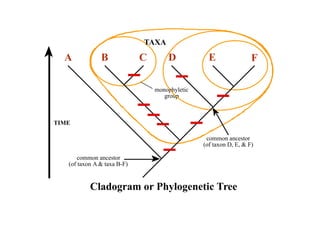
sapiens = specific epithet 
Homo sapiens = species name
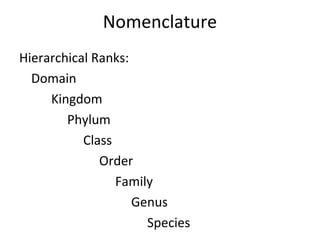
Nomenclature 
Hierarchical Ranks: 
Domain 
Kingdom 
Phylum 
Class 
Order 
Family 
Genus 
Species
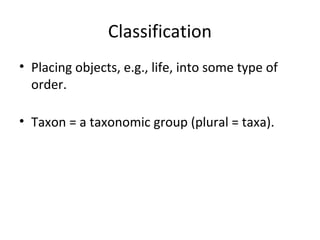
Classification 
• Placing objects, e.g., life, into some type of 
order. 
• Taxon = a taxonomic group (plural = taxa).
How to classify life 
• Phenetic classification 
– Based on overall similarity 
– Those organisms most similar are classified more 
“closely” together.
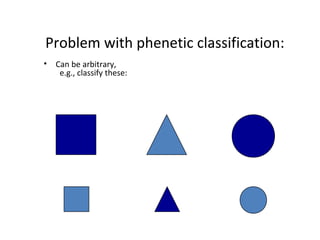
Problem with phenetic classification: 
• Can be arbitrary, 
e.g., classify these:
Phylogenetic classification 
• Based on known (inferred) evolutionary 
history. 
• Advantage: 
– Classification reflects pattern of evolution 
– Classification not ambiguous
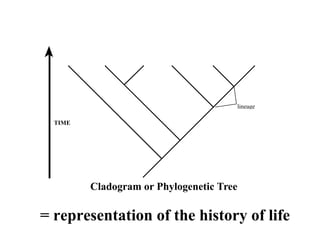
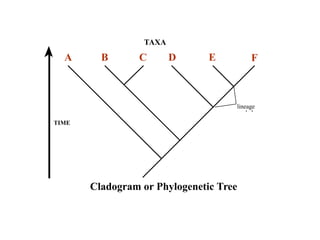
TIME 
lineage 
or clade 
Cladogram or Phylogenetic Tree 
= representation of the history of life
TAXA 
A B C D E F 
TIME 
lineage 
or clade 
Cladogram or Phylogenetic Tree
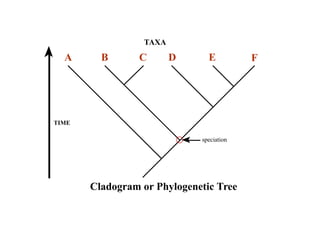
TAXA 
A B C D E F 
TIME 
speciation 
Cladogram or Phylogenetic Tree
Ingroup – group studied 
Outgroup – group not part of 
ingroup, used to “root” tree
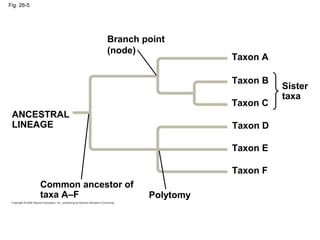
Fig. 26-5 
Sister 
taxa 
ANCESTRAL 
LINEAGE 
Taxon A 
Branch point 
(node) 
Polytomy 
Common ancestor of 
taxa A–F 
Taxon B 
Taxon C 
Taxon D 
Taxon E 
Taxon F
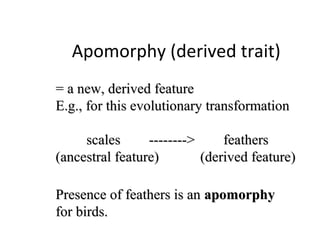
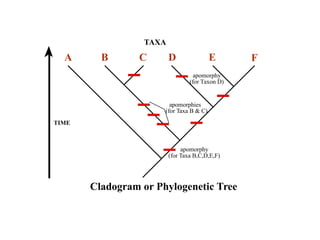
Apomorphy (derived trait) 
= a new, derived feature 
E.g., for this evolutionary transformation 
scales -------- feathers 
(ancestral feature) (derived feature) 
Presence of feathers is an apomorphy 
for birds.
Taxa are grouped by 
apomorphies 
Apomorphies are the result of evolution. 
Taxa sharing apomorphies 
underwent same evolutionary history 
should be grouped together.
Principle of Parsimony 
That cladogram (tree) having the fewest number 
of “steps” (evolutionary changes) is the one 
accepted. 
Okham’s razor: the simplest explanation, with 
fewest number of “ad hoc” hypotheses, is 
accepted.
Other methods of phylogeny 
reconstruction: 
• Maximum Likelihood or Bayesian analysis 
– Uses probabilities 
– Advantage: can use evolutionary models.
TAXA 
A B C D E F 
apomorphy 
(for Taxon D) 
apomorphies 
(for Taxa B  C) 
apomorphy 
(for Taxa B,C,D,E,F) 
TIME 
Cladogram or Phylogenetic Tree
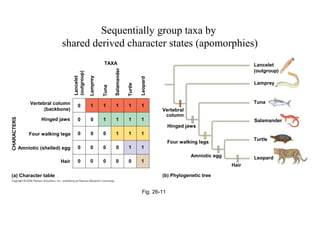
Sequentially group taxa by 
shared derived character states (apomorphies) 
Vertebral 
column 
1 1 
1 
1 
1 
1 1 
1 1 
1 1 1 
1 1 
Fig. 26-11 
TAXA 
(outgroup) 
Lamprey 
Lancelet 
Salamander 
Leopard 
Turtle 
Tuna 
Vertebral column 
(backbone) 
Hinged jaws 
Four walking legs 
Amniotic (shelled) egg 
CHARACTERS 
Hair 
(a) Character table 
Hair 
Hinged jaws 
Four walking legs 
Amniotic egg 
(b) Phylogenetic tree 
Lancelet 
(outgroup) 
Lamprey 
Tuna 
Salamander 
Turtle 
Leopard 
0 
0 0 
0 
0 
0 
0 0 
0 
0 
0 0 
0 0 0 1
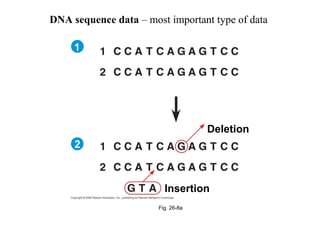
DNA sequence data – most important type of data 
Fig. 26-8a 
Deletion 
Insertion 
1 
2
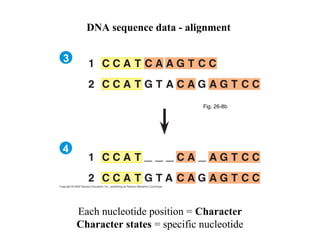
Fig. 26-8b 
3 
4 
DNA sequence data - alignment 
Each nucleotide position = Character 
Character states = specific nucleotide
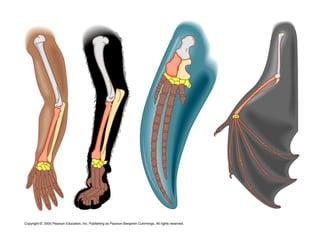
Homology 
• Similarity resulting from common ancestry. 
– E.g., the forelimb bones of a bird, bat, and cat.
Homoplasy (analogy) 
• Similarity not due to common ancestry 
• Reversal – loss of new (apomorphic) feature, 
resembles ancestral (old) feature. 
• Convergence (parallelism) – gain of new, 
similar features independently.
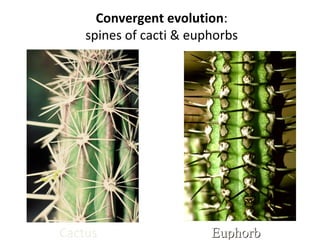
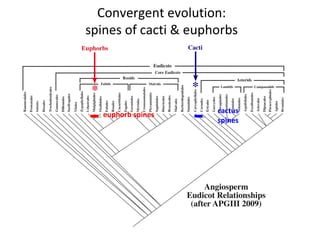
Convergent evolution: 
spines of cacti  euphorbs 
Cactus Euphorb
Convergent evolution: 
spines of cacti  euphorbs 
euphorb spines cactus 
spines
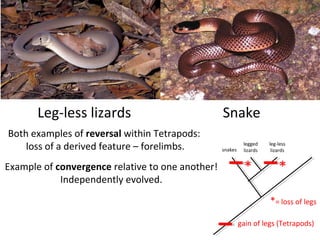
Leg-less lizards Snake 
Both examples of reversal within Tetrapods: 
loss of a derived feature – forelimbs. 
Example of convergence relative to one another! 
Independently evolved. 
snakes 
legged 
leg-less 
lizards 
lizards 
* * 
*= loss of legs 
gain of legs (Tetrapods)
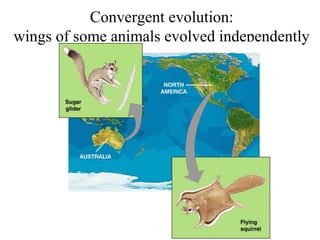
Convergent evolution: 
wings of some animals evolved independently
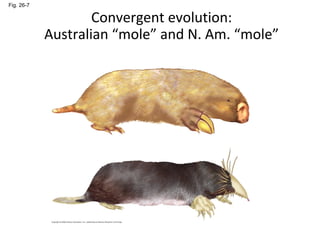
Fig. 26-7 
Convergent evolution: 
Australian “mole” and N. Am. “mole”
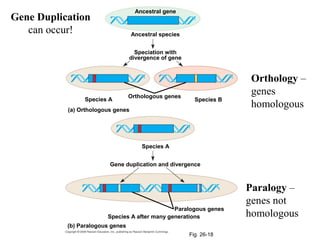
Orthologous genes 
Species A Species B 
Species A 
Gene duplication and divergence 
Fig. 26-18 
Speciation with 
divergence of gene 
(a) Orthologous genes 
(b) Paralogous genes 
Ancestral gene 
Ancestral species 
Paralogous genes 
Species A after many generations 
Orthology – 
genes 
homologous 
Paralogy – 
genes not 
homologous 
Gene Duplication 
can occur!
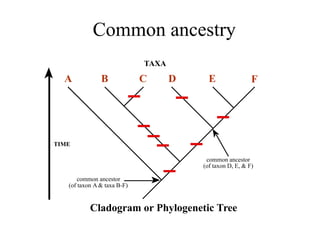
Common ancestry 
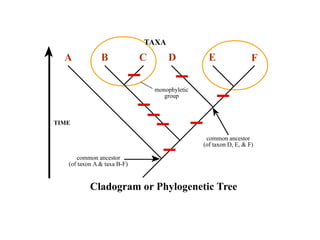
TAXA 
A B C D E F 
TIME 
common ancestor 
(of taxon A  taxa B-F) 
common ancestor 
(of taxon D, E,  F) 
Cladogram or Phylogenetic Tree
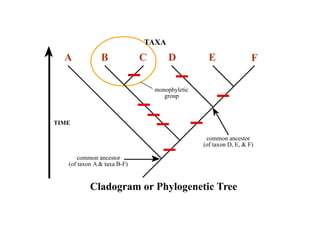
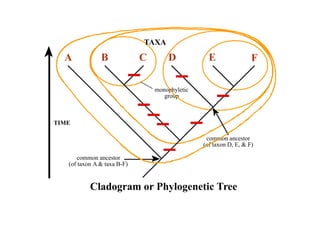
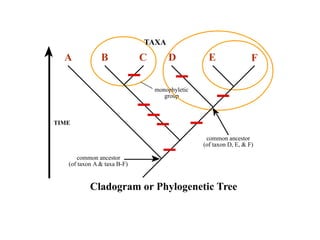
Monophyletic Group 
• a group consisting of: 
– a common ancestor + 
– all descendents of that common ancestor
TAXA 
A B C D E F 
monophyletic 
group 
TIME 
common ancestor 
(of taxon A  taxa B-F) 
common ancestor 
(of taxon D, E,  F) 
Cladogram or Phylogenetic Tree
TAXA 
A B C D E F 
monophyletic 
group 
TIME 
common ancestor 
(of taxon A  taxa B-F) 
common ancestor 
(of taxon D, E,  F) 
Cladogram or Phylogenetic Tree
TAXA 
A B C D E F 
monophyletic 
group 
TIME 
common ancestor 
(of taxon A  taxa B-F) 
common ancestor 
(of taxon D, E,  F) 
Cladogram or Phylogenetic Tree
TAXA 
A B C D E F 
monophyletic 
group 
TIME 
common ancestor 
(of taxon A  taxa B-F) 
common ancestor 
(of taxon D, E,  F) 
Cladogram or Phylogenetic Tree
TAXA 
A B C D E F 
monophyletic 
group 
TIME 
common ancestor 
(of taxon A  taxa B-F) 
common ancestor 
(of taxon D, E,  F) 
Cladogram or Phylogenetic Tree
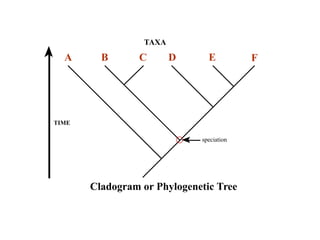
TAXA 
A B C D E F 
TIME 
speciation 
Cladogram or Phylogenetic Tree
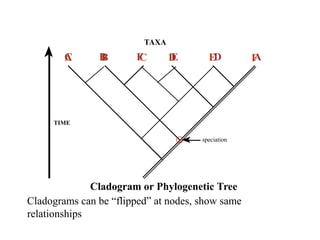
TAXA 
C B F E D A 
A B C D E F 
TIME 
speciation 
Cladogram or Phylogenetic Tree 
Cladograms can be “flipped” at nodes, show same 
relationships
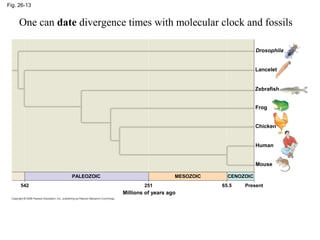
Fig. 26-13 
One can date divergence times with molecular clock and fossils 
Drosophila 
Lancelet 
Zebrafish 
Frog 
Chicken 
Human 
Mouse 
CENOZOIC 
65.5 Present 
MESOZOIC 
251 
Millions of years ago 
PALEOZOIC 
542
Relationship 
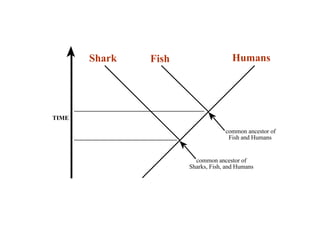
• = recency of common ancestry 
i.e., taxa sharing a common ancestor 
more recent in time are more closely related 
than those sharing common ancestors more 
distant in time.
Example: 
• Are fish more closely related to sharks or to 
humans?
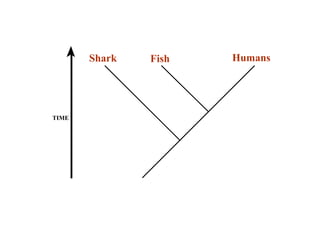
Shark Fish Humans 
TIME
Shark Fish Humans 
TIME 
common ancestor of 
Fish and Humans 
common ancestor of 
Sharks, Fish, and Humans
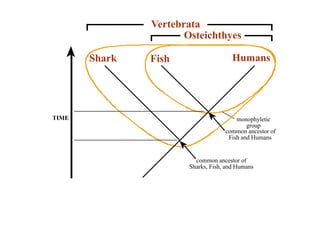
monophyletic 
group 
Vertebrata 
Osteichthyes 
Shark Fish Humans 
TIME 
common ancestor of 
Fish and Humans 
common ancestor of 
Sharks, Fish, and Humans
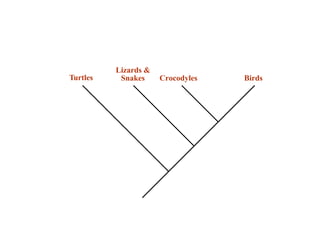
Example: 
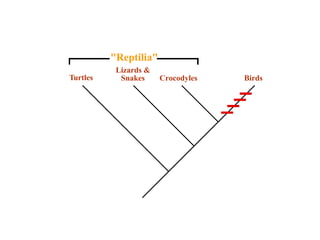
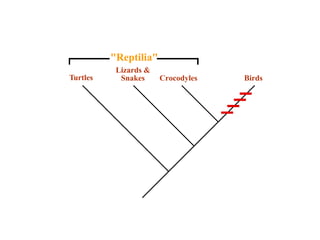
• Are crocodyles more closely related to lizards 
or to birds?
Lizards  
Snakes Turtles Crocodyles Birds
Reptilia 
Lizards  
Snakes Turtles Crocodyles Birds
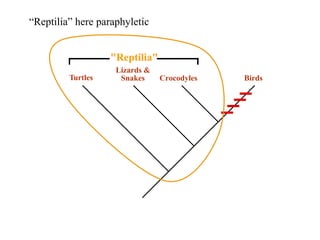
Paraphyletic group 
• Consist of common ancestor but not all 
descendents 
• Paraphyletic groups are unnatural, distort 
evolutionary history, and should not be 
recognized.
Reptilia 
Lizards  
Snakes Turtles Crocodyles Birds
“Reptilia” here paraphyletic 
Reptilia 
Lizards  
Snakes Turtles Crocodyles Birds
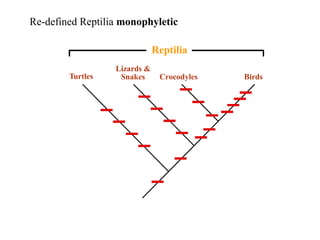
Re-defined Reptilia monophyletic 
Lizards  
Reptilia 
Turtles Snakes Crocodyles Birds
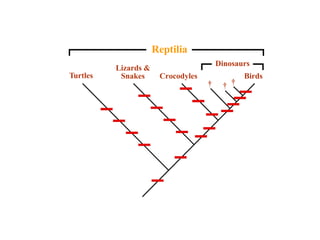
Dinosaurs 
Lizards  
Snakes Turtles Crocodyles Birds 
† † † 
Reptilia
Importance of a name: 
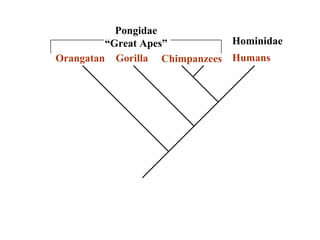
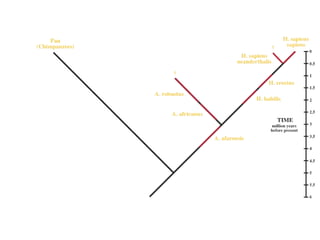
Did humans evolve from apes?
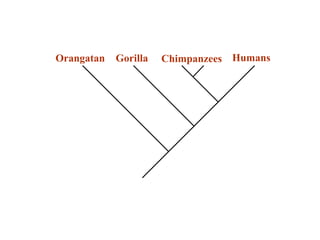
Orangatan Gorilla Chimpanzees Humans
Hominidae 
Pongidae 
“Great Apes” 
Orangatan Gorilla Chimpanzees Humans
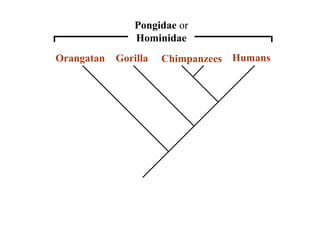
Pongidae or 
Hominidae 
Pongidae 
“Hominidae 
Great Apes” 
Orangatan Gorilla Chimpanzees Humans
Pongidae or 
Hominidae 
Hominidae 
Orangatan Gorilla Chimpanzees Humans
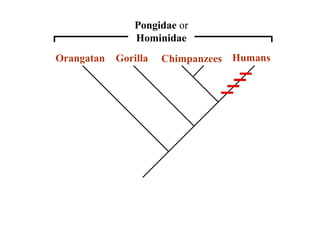
Pongidae or 
Hominidae 
Hominidae 
Orangatan Gorilla Chimpanzees Humans
We are human, but 
we are also apes. 
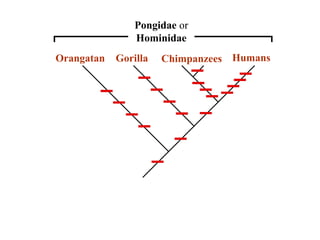
• We share unique human features. 
• We also share features with other apes 
(and with other animals, plants, fungi, 
bacteria, etc.). 
• Humans didn’t evolve from apes, humans 
are apes.
Importance of systematics  evolution: 
1) Foundation of biology - study of biodiversity 
2) Basis for classification of life 
3) Gives insight into biological processes: 
speciation processes 
adaptation to environment 
4) Can be aesthetically/intellectually pleasing!
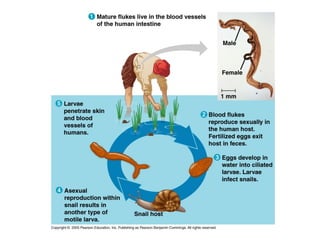
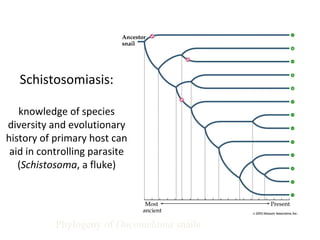
E.g., schistosomiasis
Schistosomiasis: 
knowledge of species 
diversity and evolutionary 
history of primary host can 
aid in controlling parasite 
(Schistosoma, a fluke) 
Phylogeny of Oncomelania snails
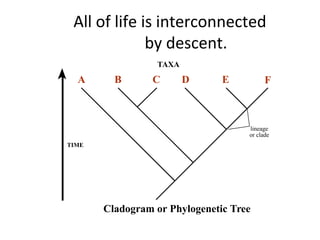
All of life is interconnected 
by descent. 
TAXA 
A B C D E F 
TIME 
lineage 
or clade 
Cladogram or Phylogenetic Tree
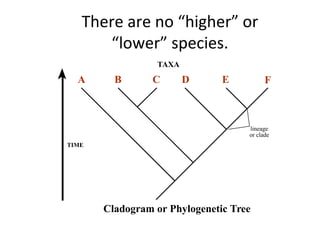
There are no “higher” or 
“lower” species. 
TAXA 
A B C D E F 
TIME 
lineage 
or clade 
Cladogram or Phylogenetic Tree

4 phylogeny-ch26

  • 1.
    Lecture 4: Phylogenyand the Tree of Life Campbell & Reece: Chapter 26
  • 2.
    All life isinterconnected by descent Bacterium Amoeba Pine tree Rattlesnake Humans How to determine the pattern of descent?
  • 3.
    Systematics - fieldof biology dealing with diversity and evolutionary history of life Includes Taxonomy: DINC Description Identification Nomenclature Classification Goal: – Determine Evolutionary History (Phylogeny) of Life
  • 4.
    Description = assignfeatures Character = a feature (e.g., “petal color”) Character states = two or more forms of a character (e.g., “red,” “white”).
  • 5.
    Identification = associatean unknown with a known How? One way: Taxonomic Key, e.g., Tree …………………………………….…………… Species A Leaves simple …….………………………… Species B Leaves pinnate …….………..…..…..…… Species C Herb Flowers red …….…………………………… Species D Flowers white …….…………………..…… Species E
  • 6.
    Nomenclature Naming, accordingto a formal system. Binomial: Species are two names (Linnaeus): E.g., Homo sapiens Homo = genus name sapiens = specific epithet Homo sapiens = species name
  • 7.
    Nomenclature Hierarchical Ranks: Domain Kingdom Phylum Class Order Family Genus Species
  • 8.
    Classification • Placingobjects, e.g., life, into some type of order. • Taxon = a taxonomic group (plural = taxa).
  • 9.
    How to classifylife • Phenetic classification – Based on overall similarity – Those organisms most similar are classified more “closely” together.
  • 10.
    Problem with pheneticclassification: • Can be arbitrary, e.g., classify these:
  • 11.
    Phylogenetic classification •Based on known (inferred) evolutionary history. • Advantage: – Classification reflects pattern of evolution – Classification not ambiguous
  • 12.
    TIME lineage orclade Cladogram or Phylogenetic Tree = representation of the history of life
  • 13.
    TAXA A BC D E F TIME lineage or clade Cladogram or Phylogenetic Tree
  • 14.
    TAXA A BC D E F TIME speciation Cladogram or Phylogenetic Tree
  • 15.
    Ingroup – groupstudied Outgroup – group not part of ingroup, used to “root” tree
  • 16.
    Fig. 26-5 Sister taxa ANCESTRAL LINEAGE Taxon A Branch point (node) Polytomy Common ancestor of taxa A–F Taxon B Taxon C Taxon D Taxon E Taxon F
  • 17.
    Apomorphy (derived trait) = a new, derived feature E.g., for this evolutionary transformation scales -------- feathers (ancestral feature) (derived feature) Presence of feathers is an apomorphy for birds.
  • 18.
    Taxa are groupedby apomorphies Apomorphies are the result of evolution. Taxa sharing apomorphies underwent same evolutionary history should be grouped together.
  • 19.
    Principle of Parsimony That cladogram (tree) having the fewest number of “steps” (evolutionary changes) is the one accepted. Okham’s razor: the simplest explanation, with fewest number of “ad hoc” hypotheses, is accepted.
  • 20.
    Other methods ofphylogeny reconstruction: • Maximum Likelihood or Bayesian analysis – Uses probabilities – Advantage: can use evolutionary models.
  • 21.
    TAXA A BC D E F apomorphy (for Taxon D) apomorphies (for Taxa B C) apomorphy (for Taxa B,C,D,E,F) TIME Cladogram or Phylogenetic Tree
  • 22.
    Sequentially group taxaby shared derived character states (apomorphies) Vertebral column 1 1 1 1 1 1 1 1 1 1 1 1 1 1 Fig. 26-11 TAXA (outgroup) Lamprey Lancelet Salamander Leopard Turtle Tuna Vertebral column (backbone) Hinged jaws Four walking legs Amniotic (shelled) egg CHARACTERS Hair (a) Character table Hair Hinged jaws Four walking legs Amniotic egg (b) Phylogenetic tree Lancelet (outgroup) Lamprey Tuna Salamander Turtle Leopard 0 0 0 0 0 0 0 0 0 0 0 0 0 0 0 1
  • 23.
    DNA sequence data– most important type of data Fig. 26-8a Deletion Insertion 1 2
  • 24.
    Fig. 26-8b 3 4 DNA sequence data - alignment Each nucleotide position = Character Character states = specific nucleotide
  • 25.
    Homology • Similarityresulting from common ancestry. – E.g., the forelimb bones of a bird, bat, and cat.
  • 27.
    Homoplasy (analogy) •Similarity not due to common ancestry • Reversal – loss of new (apomorphic) feature, resembles ancestral (old) feature. • Convergence (parallelism) – gain of new, similar features independently.
  • 28.
    Convergent evolution: spinesof cacti euphorbs Cactus Euphorb
  • 29.
    Convergent evolution: spinesof cacti euphorbs euphorb spines cactus spines
  • 30.
    Leg-less lizards Snake Both examples of reversal within Tetrapods: loss of a derived feature – forelimbs. Example of convergence relative to one another! Independently evolved. snakes legged leg-less lizards lizards * * *= loss of legs gain of legs (Tetrapods)
  • 31.
    Convergent evolution: wingsof some animals evolved independently
  • 32.
    Fig. 26-7 Convergentevolution: Australian “mole” and N. Am. “mole”
  • 33.
    Orthologous genes SpeciesA Species B Species A Gene duplication and divergence Fig. 26-18 Speciation with divergence of gene (a) Orthologous genes (b) Paralogous genes Ancestral gene Ancestral species Paralogous genes Species A after many generations Orthology – genes homologous Paralogy – genes not homologous Gene Duplication can occur!
  • 34.
    Common ancestry TAXA A B C D E F TIME common ancestor (of taxon A taxa B-F) common ancestor (of taxon D, E, F) Cladogram or Phylogenetic Tree
  • 35.
    Monophyletic Group •a group consisting of: – a common ancestor + – all descendents of that common ancestor
  • 36.
    TAXA A BC D E F monophyletic group TIME common ancestor (of taxon A taxa B-F) common ancestor (of taxon D, E, F) Cladogram or Phylogenetic Tree
  • 37.
    TAXA A BC D E F monophyletic group TIME common ancestor (of taxon A taxa B-F) common ancestor (of taxon D, E, F) Cladogram or Phylogenetic Tree
  • 38.
    TAXA A BC D E F monophyletic group TIME common ancestor (of taxon A taxa B-F) common ancestor (of taxon D, E, F) Cladogram or Phylogenetic Tree
  • 39.
    TAXA A BC D E F monophyletic group TIME common ancestor (of taxon A taxa B-F) common ancestor (of taxon D, E, F) Cladogram or Phylogenetic Tree
  • 40.
    TAXA A BC D E F monophyletic group TIME common ancestor (of taxon A taxa B-F) common ancestor (of taxon D, E, F) Cladogram or Phylogenetic Tree
  • 41.
    TAXA A BC D E F TIME speciation Cladogram or Phylogenetic Tree
  • 42.
    TAXA C BF E D A A B C D E F TIME speciation Cladogram or Phylogenetic Tree Cladograms can be “flipped” at nodes, show same relationships
  • 43.
    Fig. 26-13 Onecan date divergence times with molecular clock and fossils Drosophila Lancelet Zebrafish Frog Chicken Human Mouse CENOZOIC 65.5 Present MESOZOIC 251 Millions of years ago PALEOZOIC 542
  • 44.
    Relationship • =recency of common ancestry i.e., taxa sharing a common ancestor more recent in time are more closely related than those sharing common ancestors more distant in time.
  • 45.
    Example: • Arefish more closely related to sharks or to humans?
  • 46.
  • 47.
    Shark Fish Humans TIME common ancestor of Fish and Humans common ancestor of Sharks, Fish, and Humans
  • 48.
    monophyletic group Vertebrata Osteichthyes Shark Fish Humans TIME common ancestor of Fish and Humans common ancestor of Sharks, Fish, and Humans
  • 49.
    Example: • Arecrocodyles more closely related to lizards or to birds?
  • 50.
    Lizards SnakesTurtles Crocodyles Birds
  • 51.
    Reptilia Lizards Snakes Turtles Crocodyles Birds
  • 52.
    Paraphyletic group •Consist of common ancestor but not all descendents • Paraphyletic groups are unnatural, distort evolutionary history, and should not be recognized.
  • 53.
    Reptilia Lizards Snakes Turtles Crocodyles Birds
  • 54.
    “Reptilia” here paraphyletic Reptilia Lizards Snakes Turtles Crocodyles Birds
  • 55.
    Re-defined Reptilia monophyletic Lizards Reptilia Turtles Snakes Crocodyles Birds
  • 56.
    Dinosaurs Lizards Snakes Turtles Crocodyles Birds † † † Reptilia
  • 57.
    Importance of aname: Did humans evolve from apes?
  • 58.
  • 59.
    Hominidae Pongidae “GreatApes” Orangatan Gorilla Chimpanzees Humans
  • 60.
    Pongidae or Hominidae Pongidae “Hominidae Great Apes” Orangatan Gorilla Chimpanzees Humans
  • 61.
    Pongidae or Hominidae Hominidae Orangatan Gorilla Chimpanzees Humans
  • 62.
    Pongidae or Hominidae Hominidae Orangatan Gorilla Chimpanzees Humans
  • 64.
    We are human,but we are also apes. • We share unique human features. • We also share features with other apes (and with other animals, plants, fungi, bacteria, etc.). • Humans didn’t evolve from apes, humans are apes.
  • 65.
    Importance of systematics evolution: 1) Foundation of biology - study of biodiversity 2) Basis for classification of life 3) Gives insight into biological processes: speciation processes adaptation to environment 4) Can be aesthetically/intellectually pleasing!
  • 66.
  • 68.
    Schistosomiasis: knowledge ofspecies diversity and evolutionary history of primary host can aid in controlling parasite (Schistosoma, a fluke) Phylogeny of Oncomelania snails
  • 69.
    All of lifeis interconnected by descent. TAXA A B C D E F TIME lineage or clade Cladogram or Phylogenetic Tree
  • 70.
    There are no“higher” or “lower” species. TAXA A B C D E F TIME lineage or clade Cladogram or Phylogenetic Tree