Lecture 9b:
Circulatory System
Circulatory System
Used to transport nutrients and O2 to
cells, and to remove CO2 and waste
Some animals do not need circ. system
because the cells are exposed to watery
environment and are close to each other;
things can pass via diffusion
TMBG video
Open system
Found in Arthropods and some other
invertebrates
Heart-like pump moves hemolymph
through arteries to the body, and it then
drains back to the heart
  The heart is essentially open to the body
  when it is relaxed, closed to the body
  when it contracts
Closed system
What all vertebrates have
Blood is always contained inside the system and
does not drain into the body unless there is an
injury
   Heart: anatomy on board
   Arteries: Carry blood away from heart
   Veins: Carry blood to the heart
   Capillaries: Exchange materials with tissue fluid
3 kinds of vertebrate systems

Fish: One circuit loop
Amphibians and most reptiles: two
circuit loops, but only one ventricle
Crocodilians, birds, mammals: two
circuit loops, 2 atria and 2 ventricles
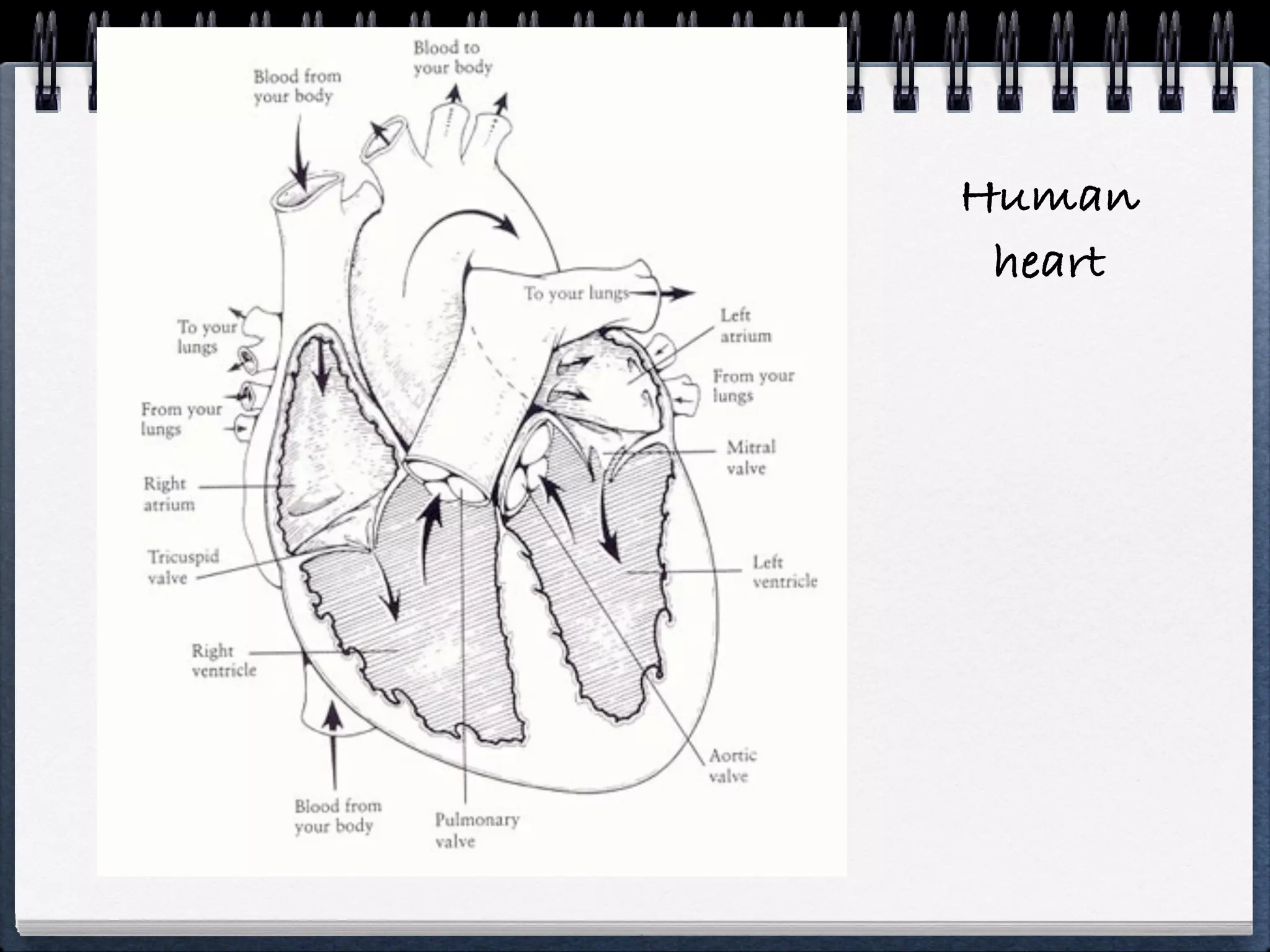
Human
 heart
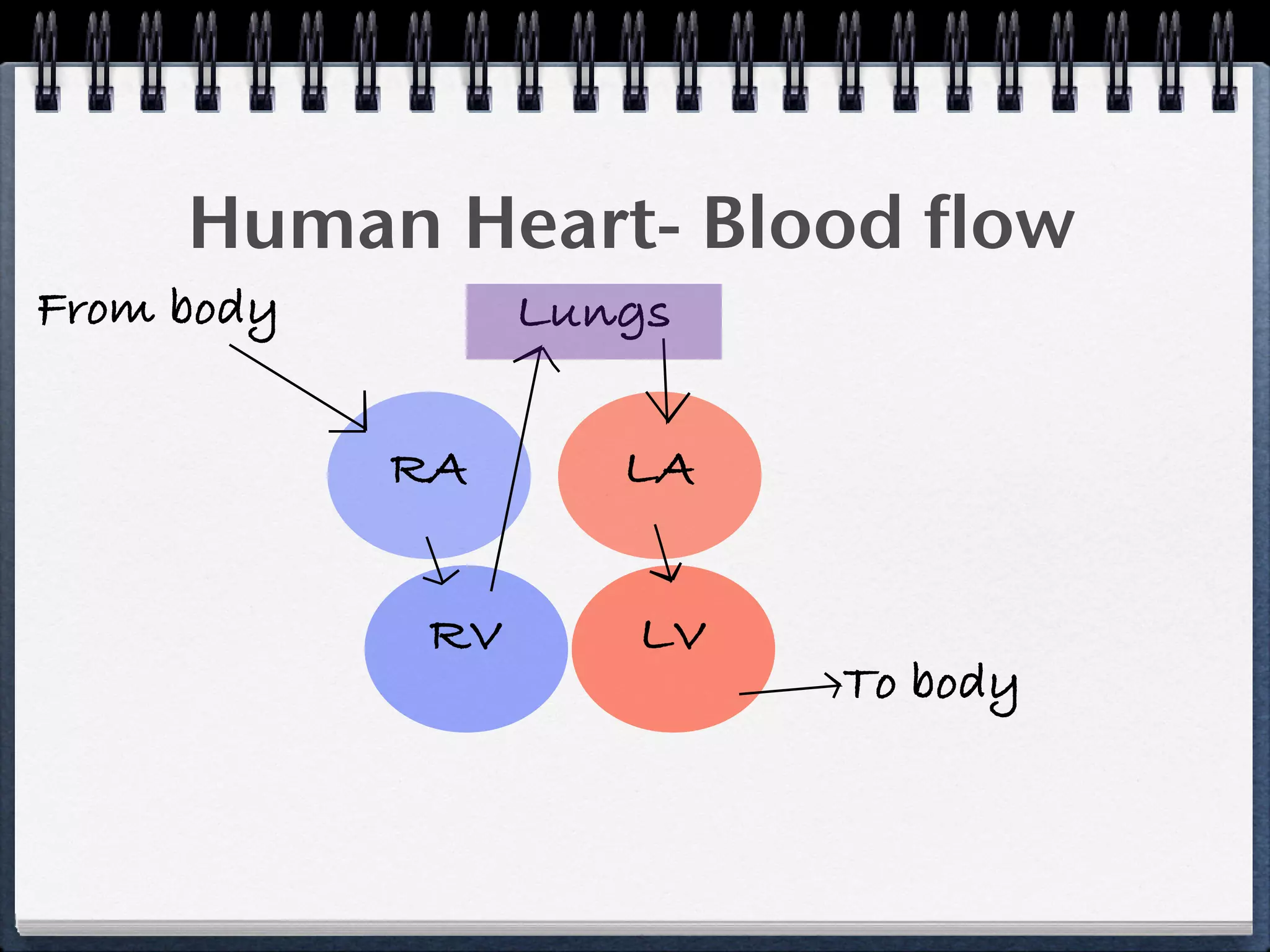
Human Heart- Blood flow
From body         Lungs


            RA       LA


             RV      LV
                          To body
Heart
Each chamber of the heart is separated
from the other
  Between each side is the septum
  Between each atria and ventricle are
  valves - keep the blood from flowing
  backwards
Heartbeat
Without the pumping action, the heart is
useless
Each beat consists of a series of events
called the cardiac cycle
  Atria contract, ventricles contract, rest
  Contraction is called systole
  Relaxation is called diastole
Heartbeat
The beat is controlled by a pacemaker, the SA
node (sinoatrial)
   Automatically sends out an impulse that
   causes atria to contract, and signals the AV
   node (atrioventricular)
   The AV node then sends out a signal for the
   ventricles to contract
   The beat is intrinsic to the heart, but it can be
   influenced by outside factors, hormones, etc.
Blood vessels
Arteries- transport blood away from the
heart
  Heart creates pressure to send blood
  into the arteries- this is what blood
  pressure is
  Have layer of smooth muscle inside to
  help provide elasticity
Blood vessels
Arteries branch into arterioles, smaller arteries
   Diameter can be regulated by nervous
   system, to change blood pressure
Arterioles branch into capillaries, microscopic
tubes - only one RBC can pass through them
at a time
   Occur in beds, all cells are less than 1mm
   from a capillary
Blood Vessels
Venules collect blood from the capillaries- these are
small veins
Venules come together in veins, which return blood
to the heart
   Veins have much less blood pressure, they are
   thin
   Skeletal muscles help move blood through the
   veins
       Veins have valves that prevent back flow
Two Circuits
Pulmonary circuit- O2 poor blood is sent
from the heart to the lungs, where it is
oxygenated and returned to the heart
Systemic circuit- O2 rich blood is sent
from the heart to all of the body, where
O2 is removed for cellular respiration,
and then returned to the heart
Lymphatic System
This system has several functions
One main function is to collect excess
tissue fluid and return it to the blood
  Does this by connecting to the
  subclavian veins in the shoulders
  Fat is also collected from the digestive
  system and delivered here
Lymphatic System
Lymphatic vessels are extensive and occur
throughout the body
Similar to veins in that:
   they are thin
   skeletal muscles cause fluid to move
   they have valves to prevent backflow
System is a one-way flow- capillaries to larger
vessels to the lymphatic ducts, which go into the
subclavian veins
Cardiovascular Disorders
Hypertension - leading cause of premature
death in US
  High blood pressure
  BP = systolic/ diastolic
     systolic- pressure during contraction
     diastolic- pressure during relaxation
     Normal = 120/80
Hypertension

Accumulation of fatty deposits called
plaque in the blood vessels interferes
with the flow of blood = atherosclerosis
Prevention includes low fat diet, no
smoking or excessive drinking, plenty
of exercise
Hypertension
Effects of plaque:
    Thrombus- clot that forms where the plaque causes an
    irregular shape
    Embolus- a clot that breaks free and moves with the blood
    flow
        Stroke- caused when a cranial arteriole bursts or is
        blocked by an embolus, leading to lack of O2 to part
        of the brain
        Heart attack- when an embolus (or emboli) blocks
        coronary arteriole, preventing blood flow to the heart
        itself
Blood
Functions of blood:
  1. Transports things to the capillaries
  to exchange with tissue fluid
  2. Defend the body against pathogens
  3. Helps regulate body temperature
  4. Forms clots to prevent catastrophic
  blood loss from an injury
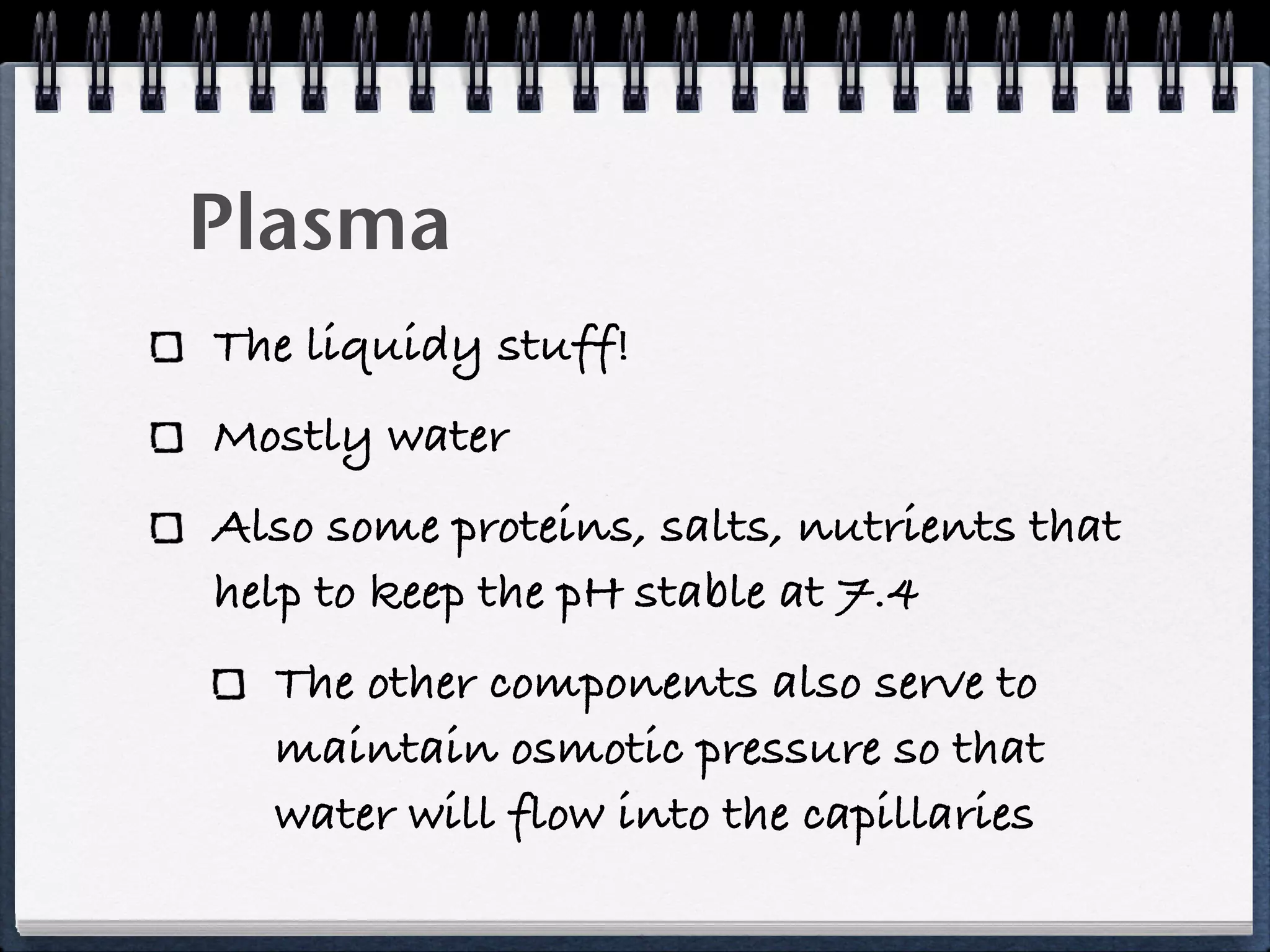
Plasma
The liquidy stuff!
Mostly water
Also some proteins, salts, nutrients that
help to keep the pH stable at 7.4
  The other components also serve to
  maintain osmotic pressure so that
  water will flow into the capillaries
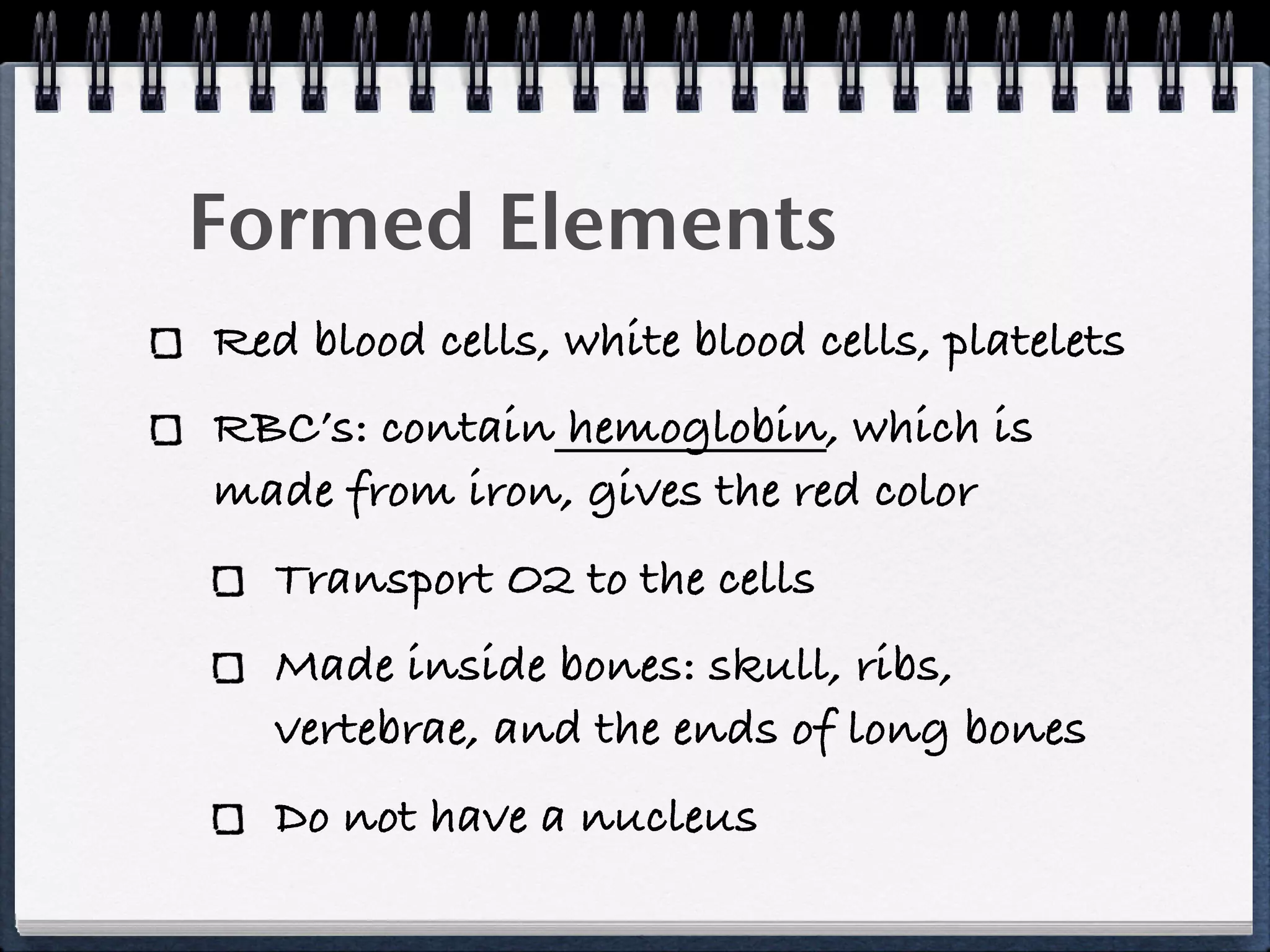
Formed Elements
Red blood cells, white blood cells, platelets
RBC’s: contain hemoglobin, which is
made from iron, gives the red color
   Transport O2 to the cells
   Made inside bones: skull, ribs,
   vertebrae, and the ends of long bones
   Do not have a nucleus
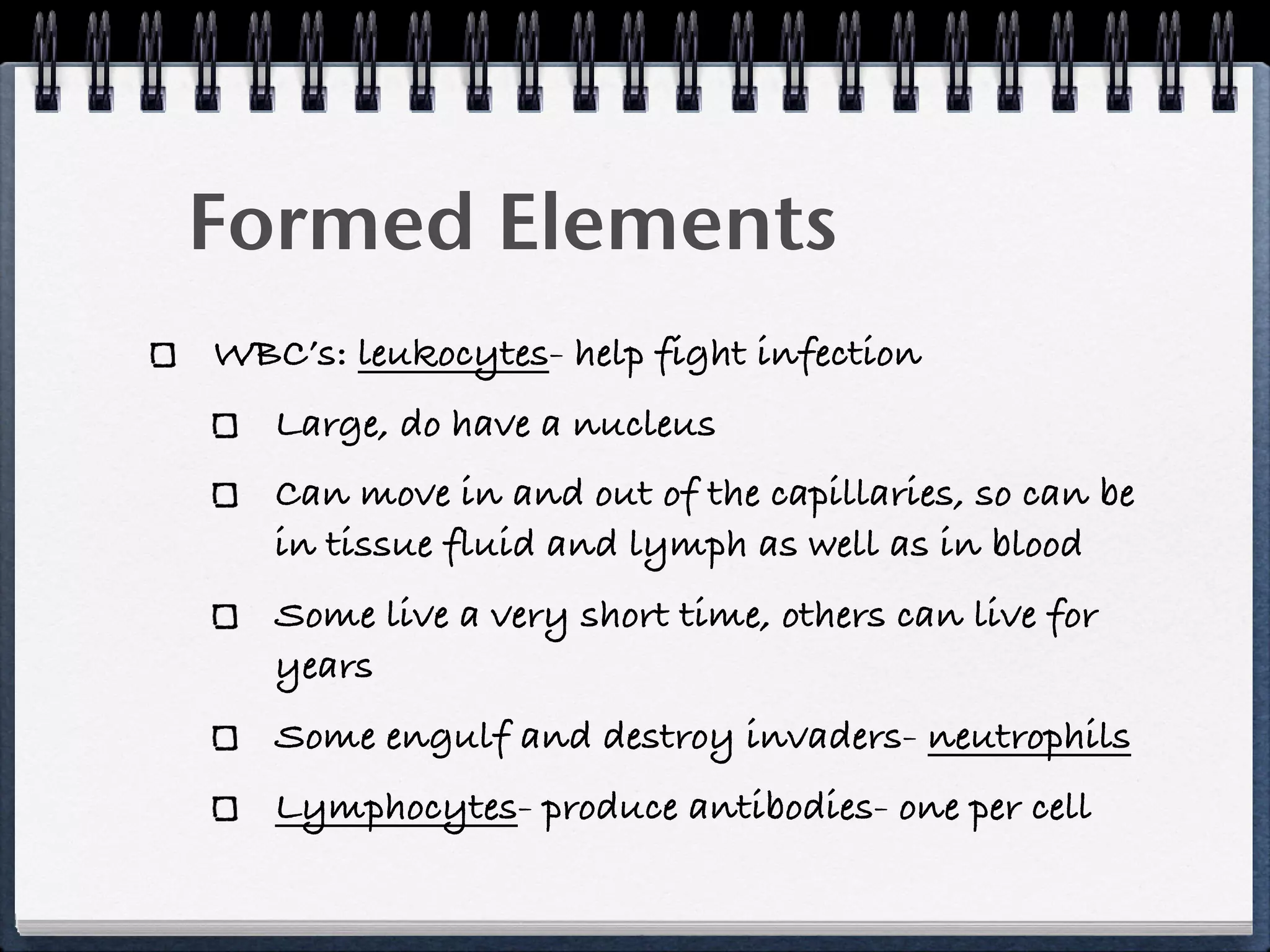
Formed Elements
WBC’s: leukocytes- help fight infection
   Large, do have a nucleus
   Can move in and out of the capillaries, so can be
   in tissue fluid and lymph as well as in blood
   Some live a very short time, others can live for
   years
   Some engulf and destroy invaders- neutrophils
   Lymphocytes- produce antibodies- one per cell
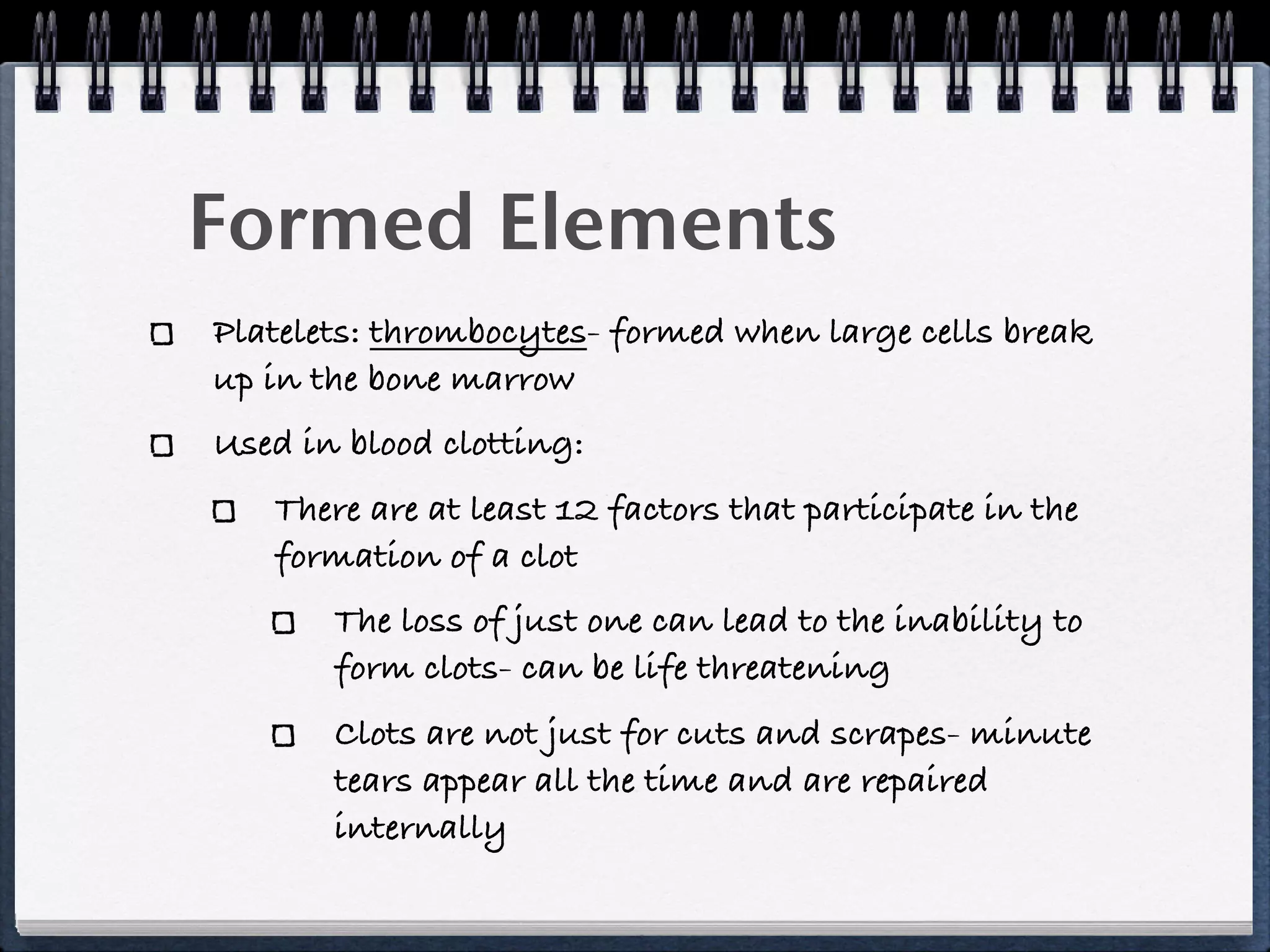
Formed Elements
Platelets: thrombocytes- formed when large cells break
up in the bone marrow
Used in blood clotting:
   There are at least 12 factors that participate in the
   formation of a clot
       The loss of just one can lead to the inability to
       form clots- can be life threatening
       Clots are not just for cuts and scrapes- minute
       tears appear all the time and are repaired
       internally
Capillary exchange
Exchange occurs because of two pressures at work in
the capillary: blood pressure and osmotic pressure
Blood pressure causes water to exit capillaries at the
arteriole end
Osmotic pressure causes water to enter at venule end
In between, pressures are about equal
   Passive diffusion causes wastes to enter and
   nutrients to exit

9b; circulatory system

  • 1.
  • 2.
    Circulatory System Used totransport nutrients and O2 to cells, and to remove CO2 and waste Some animals do not need circ. system because the cells are exposed to watery environment and are close to each other; things can pass via diffusion TMBG video
  • 3.
    Open system Found inArthropods and some other invertebrates Heart-like pump moves hemolymph through arteries to the body, and it then drains back to the heart The heart is essentially open to the body when it is relaxed, closed to the body when it contracts
  • 4.
    Closed system What allvertebrates have Blood is always contained inside the system and does not drain into the body unless there is an injury Heart: anatomy on board Arteries: Carry blood away from heart Veins: Carry blood to the heart Capillaries: Exchange materials with tissue fluid
  • 5.
    3 kinds ofvertebrate systems Fish: One circuit loop Amphibians and most reptiles: two circuit loops, but only one ventricle Crocodilians, birds, mammals: two circuit loops, 2 atria and 2 ventricles
  • 6.
  • 7.
    Human Heart- Bloodflow From body Lungs RA LA RV LV To body
  • 8.
    Heart Each chamber ofthe heart is separated from the other Between each side is the septum Between each atria and ventricle are valves - keep the blood from flowing backwards
  • 9.
    Heartbeat Without the pumpingaction, the heart is useless Each beat consists of a series of events called the cardiac cycle Atria contract, ventricles contract, rest Contraction is called systole Relaxation is called diastole
  • 10.
    Heartbeat The beat iscontrolled by a pacemaker, the SA node (sinoatrial) Automatically sends out an impulse that causes atria to contract, and signals the AV node (atrioventricular) The AV node then sends out a signal for the ventricles to contract The beat is intrinsic to the heart, but it can be influenced by outside factors, hormones, etc.
  • 11.
    Blood vessels Arteries- transportblood away from the heart Heart creates pressure to send blood into the arteries- this is what blood pressure is Have layer of smooth muscle inside to help provide elasticity
  • 12.
    Blood vessels Arteries branchinto arterioles, smaller arteries Diameter can be regulated by nervous system, to change blood pressure Arterioles branch into capillaries, microscopic tubes - only one RBC can pass through them at a time Occur in beds, all cells are less than 1mm from a capillary
  • 13.
    Blood Vessels Venules collectblood from the capillaries- these are small veins Venules come together in veins, which return blood to the heart Veins have much less blood pressure, they are thin Skeletal muscles help move blood through the veins Veins have valves that prevent back flow
  • 14.
    Two Circuits Pulmonary circuit-O2 poor blood is sent from the heart to the lungs, where it is oxygenated and returned to the heart Systemic circuit- O2 rich blood is sent from the heart to all of the body, where O2 is removed for cellular respiration, and then returned to the heart
  • 15.
    Lymphatic System This systemhas several functions One main function is to collect excess tissue fluid and return it to the blood Does this by connecting to the subclavian veins in the shoulders Fat is also collected from the digestive system and delivered here
  • 16.
    Lymphatic System Lymphatic vesselsare extensive and occur throughout the body Similar to veins in that: they are thin skeletal muscles cause fluid to move they have valves to prevent backflow System is a one-way flow- capillaries to larger vessels to the lymphatic ducts, which go into the subclavian veins
  • 17.
    Cardiovascular Disorders Hypertension -leading cause of premature death in US High blood pressure BP = systolic/ diastolic systolic- pressure during contraction diastolic- pressure during relaxation Normal = 120/80
  • 18.
    Hypertension Accumulation of fattydeposits called plaque in the blood vessels interferes with the flow of blood = atherosclerosis Prevention includes low fat diet, no smoking or excessive drinking, plenty of exercise
  • 19.
    Hypertension Effects of plaque: Thrombus- clot that forms where the plaque causes an irregular shape Embolus- a clot that breaks free and moves with the blood flow Stroke- caused when a cranial arteriole bursts or is blocked by an embolus, leading to lack of O2 to part of the brain Heart attack- when an embolus (or emboli) blocks coronary arteriole, preventing blood flow to the heart itself
  • 20.
    Blood Functions of blood: 1. Transports things to the capillaries to exchange with tissue fluid 2. Defend the body against pathogens 3. Helps regulate body temperature 4. Forms clots to prevent catastrophic blood loss from an injury
  • 21.
    Plasma The liquidy stuff! Mostlywater Also some proteins, salts, nutrients that help to keep the pH stable at 7.4 The other components also serve to maintain osmotic pressure so that water will flow into the capillaries
  • 22.
    Formed Elements Red bloodcells, white blood cells, platelets RBC’s: contain hemoglobin, which is made from iron, gives the red color Transport O2 to the cells Made inside bones: skull, ribs, vertebrae, and the ends of long bones Do not have a nucleus
  • 23.
    Formed Elements WBC’s: leukocytes-help fight infection Large, do have a nucleus Can move in and out of the capillaries, so can be in tissue fluid and lymph as well as in blood Some live a very short time, others can live for years Some engulf and destroy invaders- neutrophils Lymphocytes- produce antibodies- one per cell
  • 24.
    Formed Elements Platelets: thrombocytes-formed when large cells break up in the bone marrow Used in blood clotting: There are at least 12 factors that participate in the formation of a clot The loss of just one can lead to the inability to form clots- can be life threatening Clots are not just for cuts and scrapes- minute tears appear all the time and are repaired internally
  • 25.
    Capillary exchange Exchange occursbecause of two pressures at work in the capillary: blood pressure and osmotic pressure Blood pressure causes water to exit capillaries at the arteriole end Osmotic pressure causes water to enter at venule end In between, pressures are about equal Passive diffusion causes wastes to enter and nutrients to exit