Announcements:
1. Labs meet this week
2. Lab manuals have been ordered
3. Some slides from each lecture will be on
the web
4. Study questions will be posted after
each lecture
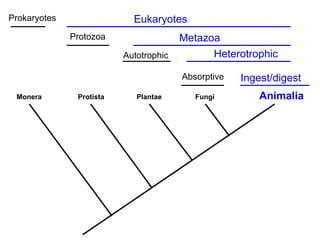
Monera Animalia
Fungi
Plantae
Protista
Prokaryotes Eukaryotes
Metazoa
Protozoa
Heterotrophic
Autotrophic
Absorptive Ingest/digest
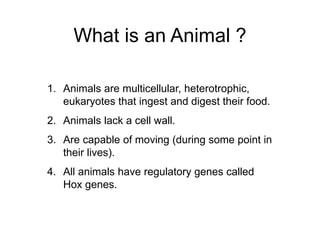
What is an Animal ?
1. Animals are multicellular, heterotrophic,
eukaryotes that ingest and digest their food.
2. Animals lack a cell wall.
3. Are capable of moving (during some point in
their lives).
4. All animals have regulatory genes called
Hox genes.
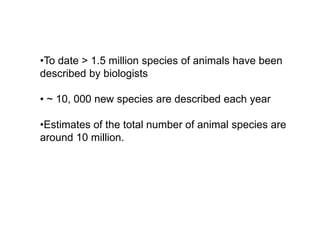
•To date > 1.5 million species of animals have been
described by biologists
• ~ 10, 000 new species are described each year
•Estimates of the total number of animal species are
around 10 million.
What is a Species?
Species Concepts:
1. Typological species concept: species are
distinct, unchanging entities defined by unique,
morphological features. This concept has been
abandoned by biologists.
It ignores evolution: species are not “unchanging
entities”
Some Problems with the Typological Species
Concept
1. Artificial selection:
artificial selection for oil
content in corn
High oil
Low oil
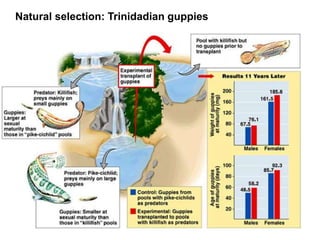
Natural selection: Trinidadian guppies
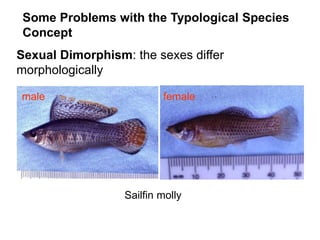
Sexual Dimorphism: the sexes differ
morphologically
Some Problems with the Typological Species
Concept
Sailfin molly
female
male
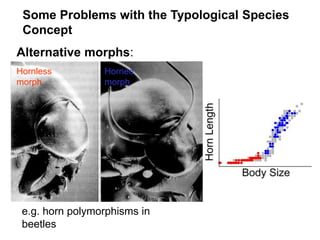
Alternative morphs:
e.g. horn polymorphisms in
beetles
Some Problems with the Typological Species
Concept
Hornless
morph
Horned
morph
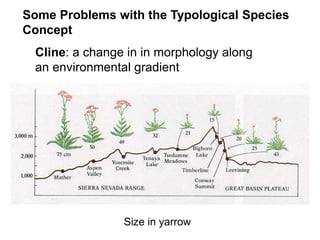
Cline: a change in in morphology along
an environmental gradient
Some Problems with the Typological Species
Concept
Size in yarrow
Some Problems with the Typological Species
Concept
Latitude
Drosophila
subobscura
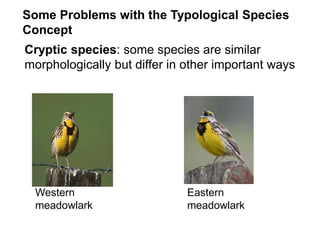
Cryptic species: some species are similar
morphologically but differ in other important ways
Some Problems with the Typological Species
Concept
Western
meadowlark
Eastern
meadowlark
What is a species?
Species Concepts:
2. Biological species concept: a species is a
population or group of populations that can
potentially interbreed and produce viable,fertile
offspring, but that is reproductively isolated from
other populations.
There is tremendous
morphological
variation within Homo
sapiens. But all
humans can
potentially interbreed.
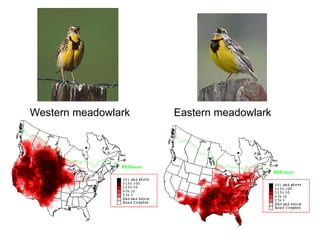
In contrast, some
species are very
similar
morphologically but
can not interbreed…
Western meadowlark Eastern meadowlark
Mechanisms of reproductive isolation:
1. Prezygotic barriers: prevent mating or
fertilization
•Behavioral
Western meadowlark Eastern meadowlark
Mechanisms of reproductive isolation:
1. Prezygotic barriers: prevent mating or
fertilization
•Behavioral
•Temporal
Western spotted skunk:
summer breeder
Eastern spotted skunk:
winter breeder
Mechanisms of reproductive isolation:
1. Prezygotic barriers: prevent mating or
fertilization
•Behavioral
•Temporal
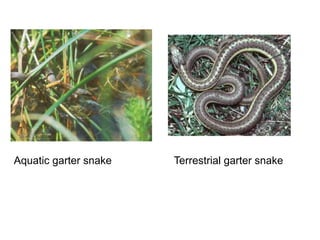
•Habitat isolation
Aquatic garter snake Terrestrial garter snake
Mechanisms of reproductive isolation:
1. Prezygotic barriers: prevent mating or
fertilization
2. Postzygotic barriers: prevent hybrid from
developing into a viable, fertile adult
Some problems with the biological species
concept:
1. It is hard to apply especially to fossil data.
2. Species exist in time and space: the biological species
concept has no time component.
3. What do we do with asexual organisms?
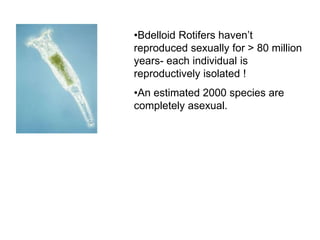
•Bdelloid Rotifers haven’t
reproduced sexually for > 80 million
years- each individual is
reproductively isolated !
•An estimated 2000 species are
completely asexual.
Species Concepts:
1. Typological species concept
2. Biological species concept
3. Evolutionary species concept
• Incorporates time
4. Ecological species concept
• Incoporates niche
5. Phylogenetic species concept
• Incorporates unique, evolved traits
These have all
been proposed
to solve some
of the problems
of the other
concepts
•To date > 1.5 million species of animals have been
described by biologists
• ~ 10, 000 new species are described each year
•Estimates of the total number of animal species are
around 10 million.
•How do biologists organize all of this diversity?
Classification and Phylogeny of Animals
•Taxonomy: the branch of biology that deals with
the systematic classification and naming of species
(or groups of species) (long pre-Darwinian history).
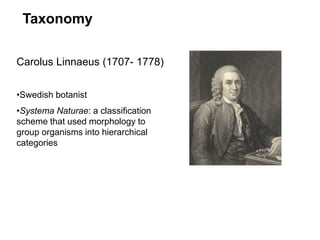
Carolus Linnaeus (1707- 1778)
•Swedish botanist
•Systema Naturae: a classification
scheme that used morphology to
group organisms into hierarchical
categories
Taxonomy
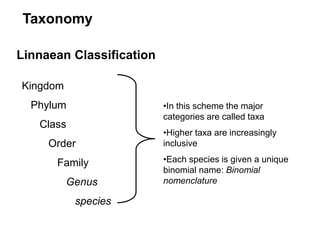
Linnaean Classification
Kingdom
Phylum
Class
Order
Family
Genus
species
•In this scheme the major
categories are called taxa
•Higher taxa are increasingly
inclusive
•Each species is given a unique
binomial name: Binomial
nomenclature
Taxonomy
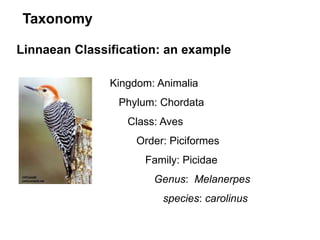
Linnaean Classification: an example
Kingdom: Animalia
Phylum: Chordata
Class: Aves
Order: Piciformes
Family: Picidae
Genus: Melanerpes
species: carolinus
Taxonomy
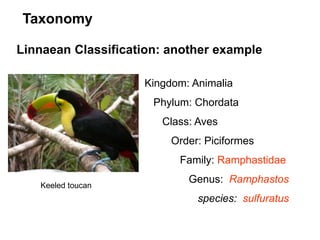
Linnaean Classification: another example
Kingdom: Animalia
Phylum: Chordata
Class: Aves
Order: Piciformes
Family: Picidae
Genus: Melanerpes
species: erythrocephalus
Taxonomy
Linnaean Classification: another example
Kingdom: Animalia
Phylum: Chordata
Class: Aves
Order: Piciformes
Family: Ramphastidae
Genus: Ramphastos
species: sulfuratus
Taxonomy
Keeled toucan
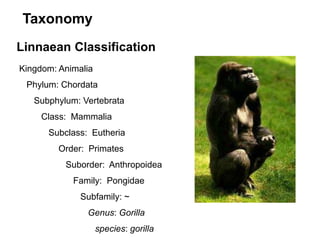
Linnaean Classification
Kingdom: Animalia
Phylum: Chordata
Subphylum: Vertebrata
Class: Mammalia
Subclass: Eutheria
Order: Primates
Suborder: Anthropoidea
Family: Pongidae
Subfamily: ~
Genus: Gorilla
species: gorilla
Taxonomy
Classification and Phylogeny of Animals
•Taxonomy: the branch of biology that deals with
the systematic classification and naming of species
(or groups of species) (long pre-Darwinian history).
•Systematics: the branch of biology that seeks to
understand the evolutionary relationships between
groups of organisms (post-Darwinian).
-One of the major goals of systematics is the
construction of phylogenies
Systematics
Phylogeny: an evolutionary tree that depicts the
relationships between living and extinct species (or
higher taxonomic groups)
A C
B D
Most recent common
ancestor of C and D
Most recent common
ancestor of A and B
Most recent common
ancestor of A, B, C
and D
What kind of information is used to construct
phylogenies?
•Characters: organismal features that vary among
species (morphological or molecular characteristics)
Systematics
Morphological characters used to construct
phylogenies-
•Levels of organization:
1. Cellular level: an aggregation of cells
that are functionally differentiated, but that
are not organized into tissues
2. Tissue level: cells are organized into
tissues that have a specific function
3. Organ level: tissues are aggregated into
organs that have specialized functions
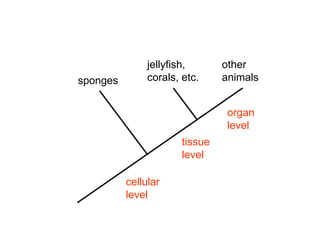
sponges
jellyfish,
corals, etc.
other
animals
cellular
level
tissue
level
organ
level
Morphological characters used to construct
phylogenies
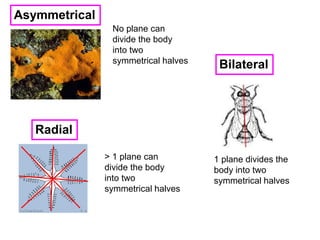
•Type of symmetry: the arrangement of body
structures relative to some axis of the body
1. Asymmetrical:
2. Radial symmetry:
3. Bilateral symmetry:
Asymmetrical
Bilateral
Radial
No plane can
divide the body
into two
symmetrical halves
> 1 plane can
divide the body
into two
symmetrical halves
1 plane divides the
body into two
symmetrical halves
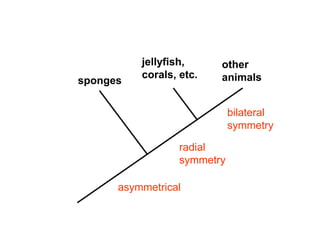
sponges
jellyfish,
corals, etc.
other
animals
asymmetrical
radial
symmetry
bilateral
symmetry
Characters used to construct phylogenies
•The presence of different body structures
•Developmental patterns
•Molecular data: DNA / RNA sequence data
What kind of information is used to establish
these relationships?
•Characters: organismal features that vary among
species (morphological or molecular characteristics)
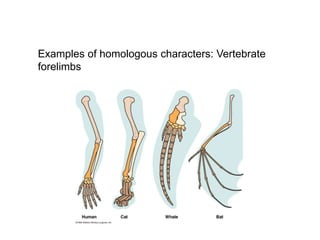
•Homologous characters: characters that are
similar to one another due to shared ancestry (not
necessarily shared function)
Examples of homologous characters: Vertebrate
forelimbs
•Analogous characters: characters that are similar
to one another in function, but not ancestry.
•Analogous characters are not useful in determining
the evolutionary relationships between organisms.
Examples of analogous characters: bat wings and
insect wings
Bat wing Fly wing
Classification and Phylogeny of Animals
•Taxonomy: the branch of biology that deals with
the systematic classification and naming of species
(or groups of species) (long pre-Darwinian history).
•Systematics: the branch of biology that seeks to
understand the evolutionary relationships between
groups of organisms (post-Darwinian).

classifiaction_and_phylogeny_1-11-05.ppt

  • 1.
    Announcements: 1. Labs meetthis week 2. Lab manuals have been ordered 3. Some slides from each lecture will be on the web 4. Study questions will be posted after each lecture
  • 2.
  • 3.
    What is anAnimal ? 1. Animals are multicellular, heterotrophic, eukaryotes that ingest and digest their food. 2. Animals lack a cell wall. 3. Are capable of moving (during some point in their lives). 4. All animals have regulatory genes called Hox genes.
  • 4.
    •To date >1.5 million species of animals have been described by biologists • ~ 10, 000 new species are described each year •Estimates of the total number of animal species are around 10 million.
  • 5.
    What is aSpecies? Species Concepts: 1. Typological species concept: species are distinct, unchanging entities defined by unique, morphological features. This concept has been abandoned by biologists.
  • 6.
    It ignores evolution:species are not “unchanging entities” Some Problems with the Typological Species Concept 1. Artificial selection: artificial selection for oil content in corn High oil Low oil
  • 7.
  • 8.
    Sexual Dimorphism: thesexes differ morphologically Some Problems with the Typological Species Concept Sailfin molly female male
  • 9.
    Alternative morphs: e.g. hornpolymorphisms in beetles Some Problems with the Typological Species Concept Hornless morph Horned morph
  • 10.
    Cline: a changein in morphology along an environmental gradient Some Problems with the Typological Species Concept Size in yarrow
  • 11.
    Some Problems withthe Typological Species Concept Latitude Drosophila subobscura
  • 12.
    Cryptic species: somespecies are similar morphologically but differ in other important ways Some Problems with the Typological Species Concept Western meadowlark Eastern meadowlark
  • 13.
    What is aspecies? Species Concepts: 2. Biological species concept: a species is a population or group of populations that can potentially interbreed and produce viable,fertile offspring, but that is reproductively isolated from other populations.
  • 14.
    There is tremendous morphological variationwithin Homo sapiens. But all humans can potentially interbreed. In contrast, some species are very similar morphologically but can not interbreed…
  • 15.
  • 16.
    Mechanisms of reproductiveisolation: 1. Prezygotic barriers: prevent mating or fertilization •Behavioral
  • 17.
  • 18.
    Mechanisms of reproductiveisolation: 1. Prezygotic barriers: prevent mating or fertilization •Behavioral •Temporal
  • 19.
    Western spotted skunk: summerbreeder Eastern spotted skunk: winter breeder
  • 20.
    Mechanisms of reproductiveisolation: 1. Prezygotic barriers: prevent mating or fertilization •Behavioral •Temporal •Habitat isolation
  • 21.
    Aquatic garter snakeTerrestrial garter snake
  • 22.
    Mechanisms of reproductiveisolation: 1. Prezygotic barriers: prevent mating or fertilization 2. Postzygotic barriers: prevent hybrid from developing into a viable, fertile adult
  • 23.
    Some problems withthe biological species concept: 1. It is hard to apply especially to fossil data. 2. Species exist in time and space: the biological species concept has no time component. 3. What do we do with asexual organisms?
  • 24.
    •Bdelloid Rotifers haven’t reproducedsexually for > 80 million years- each individual is reproductively isolated ! •An estimated 2000 species are completely asexual.
  • 25.
    Species Concepts: 1. Typologicalspecies concept 2. Biological species concept 3. Evolutionary species concept • Incorporates time 4. Ecological species concept • Incoporates niche 5. Phylogenetic species concept • Incorporates unique, evolved traits These have all been proposed to solve some of the problems of the other concepts
  • 26.
    •To date >1.5 million species of animals have been described by biologists • ~ 10, 000 new species are described each year •Estimates of the total number of animal species are around 10 million. •How do biologists organize all of this diversity?
  • 27.
    Classification and Phylogenyof Animals •Taxonomy: the branch of biology that deals with the systematic classification and naming of species (or groups of species) (long pre-Darwinian history).
  • 28.
    Carolus Linnaeus (1707-1778) •Swedish botanist •Systema Naturae: a classification scheme that used morphology to group organisms into hierarchical categories Taxonomy
  • 29.
    Linnaean Classification Kingdom Phylum Class Order Family Genus species •In thisscheme the major categories are called taxa •Higher taxa are increasingly inclusive •Each species is given a unique binomial name: Binomial nomenclature Taxonomy
  • 30.
    Linnaean Classification: anexample Kingdom: Animalia Phylum: Chordata Class: Aves Order: Piciformes Family: Picidae Genus: Melanerpes species: carolinus Taxonomy
  • 31.
    Linnaean Classification: anotherexample Kingdom: Animalia Phylum: Chordata Class: Aves Order: Piciformes Family: Picidae Genus: Melanerpes species: erythrocephalus Taxonomy
  • 32.
    Linnaean Classification: anotherexample Kingdom: Animalia Phylum: Chordata Class: Aves Order: Piciformes Family: Ramphastidae Genus: Ramphastos species: sulfuratus Taxonomy Keeled toucan
  • 33.
    Linnaean Classification Kingdom: Animalia Phylum:Chordata Subphylum: Vertebrata Class: Mammalia Subclass: Eutheria Order: Primates Suborder: Anthropoidea Family: Pongidae Subfamily: ~ Genus: Gorilla species: gorilla Taxonomy
  • 34.
    Classification and Phylogenyof Animals •Taxonomy: the branch of biology that deals with the systematic classification and naming of species (or groups of species) (long pre-Darwinian history). •Systematics: the branch of biology that seeks to understand the evolutionary relationships between groups of organisms (post-Darwinian). -One of the major goals of systematics is the construction of phylogenies
  • 35.
    Systematics Phylogeny: an evolutionarytree that depicts the relationships between living and extinct species (or higher taxonomic groups) A C B D Most recent common ancestor of C and D Most recent common ancestor of A and B Most recent common ancestor of A, B, C and D
  • 36.
    What kind ofinformation is used to construct phylogenies? •Characters: organismal features that vary among species (morphological or molecular characteristics) Systematics
  • 37.
    Morphological characters usedto construct phylogenies- •Levels of organization: 1. Cellular level: an aggregation of cells that are functionally differentiated, but that are not organized into tissues 2. Tissue level: cells are organized into tissues that have a specific function 3. Organ level: tissues are aggregated into organs that have specialized functions
  • 38.
  • 39.
    Morphological characters usedto construct phylogenies •Type of symmetry: the arrangement of body structures relative to some axis of the body 1. Asymmetrical: 2. Radial symmetry: 3. Bilateral symmetry:
  • 40.
    Asymmetrical Bilateral Radial No plane can dividethe body into two symmetrical halves > 1 plane can divide the body into two symmetrical halves 1 plane divides the body into two symmetrical halves
  • 41.
  • 42.
    Characters used toconstruct phylogenies •The presence of different body structures •Developmental patterns •Molecular data: DNA / RNA sequence data
  • 43.
    What kind ofinformation is used to establish these relationships? •Characters: organismal features that vary among species (morphological or molecular characteristics) •Homologous characters: characters that are similar to one another due to shared ancestry (not necessarily shared function)
  • 44.
    Examples of homologouscharacters: Vertebrate forelimbs
  • 45.
    •Analogous characters: charactersthat are similar to one another in function, but not ancestry. •Analogous characters are not useful in determining the evolutionary relationships between organisms.
  • 46.
    Examples of analogouscharacters: bat wings and insect wings Bat wing Fly wing
  • 47.
    Classification and Phylogenyof Animals •Taxonomy: the branch of biology that deals with the systematic classification and naming of species (or groups of species) (long pre-Darwinian history). •Systematics: the branch of biology that seeks to understand the evolutionary relationships between groups of organisms (post-Darwinian).